Avoiding the Distributed Monolith Trap in .NET Microservices
When engineering teams transition from a monolithic application to a microservice architecture, they are usually chasing a very specific set of promises: faster feature delivery, independent scalability, localized fault isolation, and the freedom to experiment with modern technology stacks. However, many .NET organizations hit a wall where development velocity grinds to a halt. Instead of a nimble, loosely coupled ecosystem, they find themselves maintaining a distributed monolith—an architecture that combines the operational complexity of distributed systems with the tight coupling of a traditional monolith.
This challenge is rarely malicious or intentional. It usually creeps in through subtle architectural choices, such as sharing a database across multiple services, relying heavily on synchronous HTTP calls, or letting API governance become an administrative bottleneck. In this post, we will explore the symptoms of the distributed monolith trap, uncover the hidden performance problems lurking in your network layers, identify architectural bottlenecks using modern observability tools, and walk through practical strategies to regain independent scaling in your .NET microservices. If your team has felt the friction of slowing delivery speeds, you are not alone, and understanding these patterns is the first step toward reclaiming your agility.
Microservice Architecture: Hidden Complexity

Distributed Monoliths
Symptoms
You may think that splitting your application into microservices will automatically solve your performance issues. However, you can easily end up with a distributed monolith. This occurs when services depend on each other to such a degree that you lose the true benefits of separation. You might notice these common symptoms:
- Services rely on synchronous calls for every standard business operation.
- Teams struggle to deploy individual changes without risking downtime or breaking downstream services.
- Shared databases force you to tightly coordinate schema changes across multiple distinct development teams.
- Components remain tightly coupled, even though they physically run in separate processes or containers.
Speed Impact
A distributed monolith can slow your system down in ways you do not initially expect. You will see network latency increase because every single service-to-service call adds delay. Unlike a monolithic application where calls happen instantly within memory, a microservice architecture shifts your performance bottlenecks from the database or CPU to the network layer. Synchronous calls across microservices accumulate latency, while a monolith handles these calls in-process. Consequently, you lose the ability to scale services independently and isolate faults effectively, causing performance challenges to compound as your dependency tree grows.
When you try to distribute a monolithic application without proper boundary design, you often face severe performance challenges. Components stay heavily dependent on each other, and you do not gain the benefits of independent scaling or fault isolation that well-structured microservices provide.
Coordination Overhead
API Governance
Microservice architecture requires strong API governance. You must review and approve every change to avoid accumulating technical debt and duplicated efforts. If governance is too strict, you slow down development to a crawl. If it is too lax, you risk building up structural technical debt almost overnight.
When governance is either too lax or too strict, it can lead to technical debt, duplicated efforts, and massive slowdowns in the development process.
Essentially, you’re building a whole load of technical debt very quickly. And in the end, do you have to spend more money and more time ripping that all out and starting again.
You need to design your governance models to actively benefit developers. Automation helps improve API quality, security, and consistency without adding administrative drag.
When governance is designed to benefit developers and reinforced with automation, it serves as a catalyst for improved API quality, security, and consistency.
APIs play a critical role in your broader business strategy. You must treat them as first-class citizens.
In the latest state of API integration report, 84 percent of businesses said that APIs were critical or very critical to their core business strategy.
Team Collaboration
Microservices demand constant coordination between teams. You spend hours preparing for meetings, switching contexts between domains, and clarifying cross-team roles. These activities can easily consume a large portion of your workweek.
| Coordination Cost Factors | Description |
|---|---|
| Decision Latency | Delays due to multiple stakeholders and cumbersome approval chains |
| Context Switching | Fragmented attention across various cross-functional coordination points |
| Information Decay | Loss or distortion of critical knowledge through organizational layers |
| Role Ambiguity | Unclear accountability leading to gaps and duplicated development efforts |
| Coordination Activity | Time Spent |
|---|---|
| Meeting Preparation | Over 8 hours per week |
| Coordination Activities | 35-80% of knowledge workers' time |
You must recognize that coordination overhead can quietly sabotage delivery speed. Clear ownership boundaries and streamlined communication channels are mandatory to avoid gaps and duplicated efforts.
.NET Ecosystem Challenges
Platform Engineering
Microservice architecture in the .NET ecosystem brings unique engineering challenges. You frequently face code duplication and redundancies, which increase maintenance efforts and risk data inconsistencies. Developers often deal with an excessive amount of boilerplate code just to get infrastructure up and running. Organizing source code becomes exceptionally difficult when you share domain models across services improperly. Copy-and-paste anti-patterns delay bug fixes and significantly complicate long-term maintenance.
- Code duplication leads to higher continuous maintenance costs.
- Shared models across services make schema updates hazardous.
- Developers may copy and paste service logic, which slows down critical bug fixes.
Domain Boundaries
You must define razor-sharp domain boundaries when building microservices in .NET. If you fail to do this, you drastically increase developer cognitive load. Too many simultaneous architectural demands overwhelm your team. Upholding standards and compliance becomes difficult, which can cause reliability issues and weaken your overall security posture.
- Cognitive load rises sharply as developers juggle multiple interconnected services.
- Standards and enterprise compliance become harder to enforce consistently.
- Reliability and security suffer when domain boundaries are poorly defined.
While microservice architecture offers compelling benefits, you must proactively address its hidden complexity. Watch out for distributed monolith symptoms, manage your coordination overhead, and tackle .NET-specific platform challenges head-on.
Ticking Time Bomb: Performance Problems
You may assume microservices will inherently boost system speed, but without rigorous design, they can become a ticking time bomb for your infrastructure. Many engineering teams discover common performance problems only after deploying to production. These issues hide beneath the surface, waiting to drag down your application under peak load. You need to understand how network latency, cascading failure points, and database contention turn your architecture into a source of chronic production frustration.
Network Latency
In-Process vs Network Calls
When you break apart a monolith into microservices, you shift from in-process function calls to network calls. This architectural shift introduces unavoidable latency. In a monolithic application, a function call resolves almost instantaneously. In microservices, every service-to-service call must traverse the network, adding milliseconds of delay.
| Architecture Type | Average Latency |
|---|---|
| In-process function call (monolith) | 0.001 ms (1 microsecond) |
| HTTP call within same datacenter (microservices) | 1-5 ms (1,000-5,000 microseconds) |
Network calls are orders of magnitude slower than in-process function calls. This difference compounds rapidly as your system scales. Each new service introduced into a request chain adds more latency, turning simple operations into slow, frustrating experiences for end-users.
Resource Usage
Network calls do more than just add latency; they consume valuable system resources. Every call consumes CPU cycles, memory buffers, and network bandwidth. As you add more microservices, you generate exponential network traffic. This extra load leads to higher cloud infrastructure costs and sluggish response times.
You can improve performance by aggressively reducing unnecessary inter-service calls. Some advanced teams use intelligent traffic management to lower latency and boost resilience:
- The MCG approach improved response times by 15% under increased network latency due to reduced inter-service communication delays.
- Under peak load conditions, the MCG-enhanced setup showed superior resilience with fewer error rates compared to standard service mesh configurations.
- Performance evaluations demonstrated that smart traffic placement strategies mitigated sidecar proxy overhead, lowering response times and stabilizing throughput.
You must continuously monitor how network traffic affects your system performance. Small, accumulated delays easily snowball into major bottlenecks.
Failure Points
Propagation Risks
Microservices fundamentally change your system's failure profile. Because every service depends on others, a single failure can ripple across your entire infrastructure.
| Architecture Type | Failure Propagation Risk | Fault Isolation | System Resilience |
|---|---|---|---|
| Monolithic | High | No | Low |
| Microservices | Low | Yes | High |
In a monolithic system, one fatal bug can bring down the entire application process. Microservices offer much better fault isolation; if a non-critical service fails, others can continue running. Resilience patterns like circuit breakers help prevent failures from spreading globally.
- In a monolith, a single bug can cause a complete outage, creating a single point of failure.
- Microservices allow true fault tolerance, ensuring non-critical component failures do not sink the platform.
- Patterns like circuit breakers enhance resilience by isolating failing downstream dependencies.
Observability Challenges
You need comprehensive observability to detect and fix performance problems across a sprawling microservice mesh. Tracking down the root cause of latency or intermittent errors becomes exponentially harder as services multiply. You must aggregate logs, infrastructure metrics, and distributed traces from every running instance. Without robust observability tooling, you will waste countless hours searching for the source of production slowdowns.
Common performance bottlenecks often hide within complex, asynchronous call chains. You should leverage distributed tracing to follow requests across boundaries, allowing you to catch bottlenecks before they impact your users.
Watch out for these classic anti-patterns:
- God Service (Too Much Responsibility): A service handling multiple disparate business domains, violating core architectural principles.
- Tight Coupling Between Services: Direct hardcoded dependencies that break downstream systems whenever a schema changes.
Database Contention
Shared Data Stores
Many teams make the critical mistake of sharing a database across multiple microservices. This practice creates severe coupling by schema. Changing your database structure becomes hazardous because it risks breaking external services, destroying your velocity and independent scalability.
The main problem with shared databases is that they create coupling by schema. The cost of change goes up dramatically as it becomes difficult to know when you can make changes safely without breaking another service. This has knock-on effects for system scalability. You cannot scale services individually when they rely on a shared data store. Since a service's scalability is limited by its slowest component, a shared database quickly becomes a massive bottleneck.
You should eliminate shared data stores entirely. Assign every microservice its own dedicated database to decouple your data layers and restore performance.
Scalability Issues
Database contention acts as a ticking time bomb for enterprise applications. When multiple microservices compete for the same database engine, you create a heavy performance bottleneck. The slowest query or service limits the capacity of the entire system, leading to connection pool exhaustion, rising latency, and catastrophic outages during traffic spikes.
Identifying Bottlenecks in Microservices Architecture
Monitoring Tools
Metrics
You must track the right operational metrics to spot performance degradation early. Metrics provide an instant snapshot of your system health, helping you catch trends before they impact production. Focus heavily on business-relevant indicators alongside technical metrics: track p99 response times, error rates, and request throughput.
Visibility
Visibility is non-negotiable for distributed systems. You cannot fix what you cannot see. Implement monitoring tools that ingest telemetry from every service instance:
- Prometheus, Datadog, and Grafana for real-time infrastructure and application monitoring.
- Elasticsearch, Logstash, Kibana (ELK), or Graylog for centralized log aggregation.
- Application Performance Monitoring (APM) tools like New Relic or Dynatrace for code-level call profiling.
- Kubernetes or container orchestrators for underlying cluster observability.
- API gateways like Kong or Zuul for edge traffic analytics.
Distributed Tracing
Request Flows
Distributed tracing allows you to follow an HTTP request as it traverses your microservice architecture. Tracing tools like OpenTelemetry, Jaeger, and Zipkin connect these calls together, displaying the end-to-end execution path and highlighting exact latency hotspots.
- Distributed tracing provides deep visibility across service boundaries.
- It exposes hidden bottlenecks and drastically accelerates debugging workflows.
- Engineering teams use traces to uncover latency sources and improve reliability.
Latency Sources
Latency accumulates as requests hop across services. Standard logs and infrastructure metrics alone cannot show this level of transactional granularity. Tracing preserves request context across network hops so you can pinpoint the exact method or database query causing slowdowns.
Recognizing Hidden Slowdowns
Symptoms
Hidden slowdowns can damage user experience even in the absence of total outages. Watch for rising response times, elevated error rates, and increased memory footprints. Use correlation IDs to trace requests through your systems and set up proactive alerting based on strict service-level objectives (SLOs).
Real-World Cases
Real-world engineering case studies highlight the importance of proactive bottleneck detection. For instance, a high-load Spring Boot microservice suffered severe performance degradation. Through deep APM and profiling tools, the engineering team discovered an unoptimized query loop. By introducing a specific clause to batch database operations, they reduced queries per second from 300 to 30, instantly stabilizing CPU usage and clearing garbage collection overhead.
Tip: Always combine metrics, logs, and traces into a unified observability pipeline. This combination gives you an immediate, holistic view of your system health.
Solutions for Microservices Performance Problems
Asynchronous Communication
Messaging Benefits
You can solve many scaling hurdles in a microservice architecture by embracing asynchronous communication. By decoupling requests via message queues, services process work at their own pace, absorbing traffic spikes safely without dropping requests.
| Performance Improvement | Description |
|---|---|
| Scalability | Asynchronous messaging allows for massive scaling using queues to buffer traffic spikes. |
| Reliability | Asynchronous brokers support message retries and dead-letter queues, ensuring zero message loss during downtime. |
| Testability | Testing becomes simpler since consuming services only need a mock queue for payload verification. |
Implementation
Implement asynchronous communication using robust message brokers like RabbitMQ, Azure Service Bus, or Apache Kafka. Use publish-subscribe patterns to broadcast domain events cleanly across independent services.
Bulkheads & Circuit Breakers
Isolation Strategies
Protect your microservices from cascading failures using bulkheads and circuit breakers. Bulkheads partition resource pools so that a failure in one service cannot exhaust threads or connections across the entire system.
Bulkheads are designed to isolate failure domains by creating separate resource pools or quotas for different services, preventing localized failures from taking down the entire application.
Failure Mitigation
Circuit breakers monitor error rates and fast-fail requests to unhealthy dependencies, preventing cascading outages across your network.
The bulkhead pattern in microservice architecture is used to prevent faults in one part of a system from crashing the entire platform, effectively isolating failures at their origin.
Caching & Scaling
Data Store Selection
Caching is an essential tool for high-performance microservices. Offload repeated database reads and expensive API computations to fast in-memory caches like Redis or Memcached.
| Benefit | Description |
|---|---|
| Fine-grained control | Cache domain fragments based on volatility and update frequencies. |
| Reduced cache invalidation | Minimizes purging overhead by refreshing only impacted data segments. |
| Improved cache hit ratios | Enables smaller, highly optimized cache entries for higher in-memory hit rates. |
| Dynamic/static hybrid handling | Supports caching static records while fetching real-time statistics dynamically. |
Independent Scaling
Caching and segregated data stores empower you to scale individual services independently, eliminating resource contention bottlenecks.
- Enhanced system scalability
- Increased development agility and faster time to market
- Robust fault isolation and system resilience
- Cost-effective cloud resource utilization
- Better DevOps integration and continuous deployment pipelines
Reducing Dependencies
Decoupling
True microservices require radical decoupling. When services operate independently without blocking synchronous calls, you eliminate artificial bottlenecks.
Decoupling means each microservice handles its internal workload without waiting synchronously on external processes. This independence avoids bottlenecks and keeps your platform running smoothly.
Key architectural benefits of reducing dependencies include:
- Independent scaling of services based on real-time workloads.
- Minimized risk of cascading failures across team boundaries.
- Autonomy for development teams to ship code on their own schedules.
- Faster root-cause isolation during incident response.
Simplification
Simplifying your dependency graph lowers cognitive load, making your architecture vastly easier to test, monitor, and secure.
| Approach | What It Means | Why It Matters |
|---|---|---|
| Individual SLOs | Track reliability for each microservice separately | Can miss system-wide user experience degradation |
| Composite SLOs | Combine reliability objectives across interdependent services | Reflect true end-to-end system health |
Evaluating Microservice Architecture Fit
Choosing the right architectural model dictates your engineering velocity and operational costs. The Microsoft Development Podcast frequently explores this tension, highlighting a growing trend where organizations consolidate overly fragmented microservices back into manageable modular monoliths.
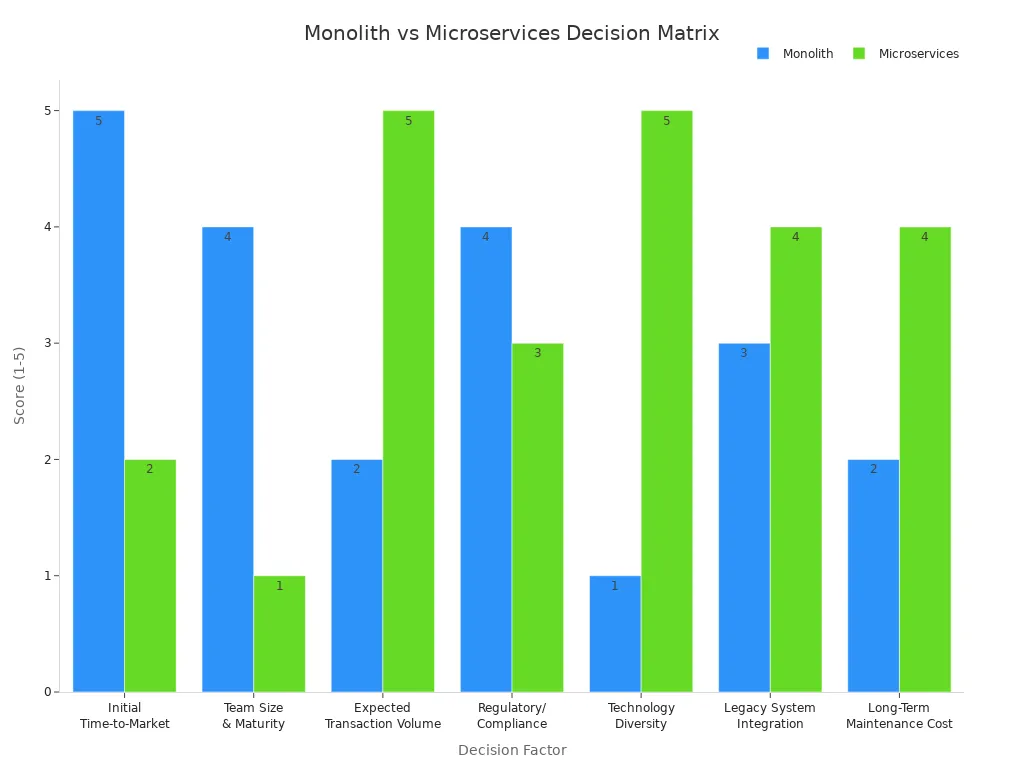
Decision Matrix
Use a structured decision matrix to evaluate whether microservices genuinely fit your organizational maturity:
| Decision Factor | Monolith Score (1-5) | Microservices Score (1-5) | Strategic Rationale |
|---|---|---|---|
| Initial Time-to-Market (Speed) | 5 | 2 | Monoliths require minimal upfront infrastructure configuration. |
| Team Size & Maturity (DevOps) | 4 | 1 | Microservices demand advanced CI/CD, automation, and observability. |
| Expected Transaction Volume (Scale) | 2 | 5 | Microservices allow precise, independent scaling of resource-heavy bottlenecks. |
| Regulatory/Compliance Complexity | 4 | 3 | Single artifacts simplify initial security auditing and compliance checks. |
| Technology Diversity/Experimentation | 1 | 5 | Microservices allow teams to adopt specialized tech stacks per service domain. |
| Legacy System Integration | 3 | 4 | Microservices excel at wrapping and modernizing legacy components. |
| Long-Term Maintenance Cost (TCO) | 2 | 4 | Microservices lower feature cost over time at the expense of higher operational overhead. |
Key Assessment Questions
- Does your engineering team possess robust DevOps, platform engineering, and SRE skills?
- Are you experiencing extreme scale requirements that justify distributed overhead?
- Do you need polyglot persistence and technology diversity?
- Is your organizational culture ready to handle intense cross-team coordination costs?
Signs to Reconsider
Watch for these red flags indicating your microservice architecture needs restructuring:
- Delivery speed grinds to a halt due to constant cross-team dependencies.
- Cloud operational expenses outpace business revenue growth.
- Outages cascade easily across multiple domains.
Monolith vs Microservices
| Architecture Type | Team Size Recommendation | Key Characteristics |
|---|---|---|
| Monolithic | < 8-10 developers | Simple deployments, low operational overhead |
| Microservices | > 10-15 developers | Independent team autonomy, complex distributed coordination |
You face hidden complexity and performance hazards when implementing microservice architecture. Bottlenecks invariably appear in unexpected network and data layers. The Microsoft Development Podcast underscores how rapid delivery requires rigorous architectural discipline. To keep your .NET systems healthy, remember to:
- Manage inter-service requests and timeout policies carefully.
- Implement elastic load balancing and automated scaling.
- De-couple data stores so every service owns its database.
- Aggressively cache repetitive API and database queries.
You should also enforce architectural governance, utilize robust API gateways, and conduct regular architectural reviews. Continuous evaluation ensures your technology stack scales effectively alongside your business.
FAQ
What is a distributed monolith?
A distributed monolith is an anti-pattern where an application is physically split into multiple microservices, but remains logically coupled through synchronous HTTP calls, shared databases, and tight deployment dependencies, forfeiting the core benefits of microservices.
How do you spot performance bottlenecks in microservices?
Monitor p99 response times, error rates, and request throughput. Leverage distributed tracing tools to track requests across service boundaries and identify slow network hops or database queries.
Why does network latency matter in microservice architecture?
Network latency adds milliseconds of delay to every inter-service call. Unlike instant in-process memory calls in a monolith, distributed network hops accumulate rapidly, degrading overall application responsiveness.
How can you reduce coordination overhead between teams?
Define clear domain ownership boundaries, automate API governance checks, reduce unnecessary status meetings, and embrace asynchronous communication patterns to empower teams to work autonomously.
What tools help with observability in .NET microservices?
Popular observability tools include Prometheus, Grafana, OpenTelemetry, Jaeger, Zipkin, and centralized logging platforms like the ELK stack, which collectively capture metrics, logs, and distributed traces.
When should you consider consolidating microservices?
Consider consolidation if feature delivery velocity drops, cloud infrastructure costs spiral out of control, or cascading outages regularly impact your ability to maintain uptime.
What is the best way to handle shared data in microservices?
Give every microservice its own private database. Avoid sharing databases across services to eliminate schema coupling and restore independent database scalability.
How does asynchronous communication improve microservice performance?
Asynchronous communication using message brokers allows services to process events at their own pace, buffering traffic spikes and removing blocking synchronous bottlenecks.
🎧 Listen to this episode
Want a practical, deep-dive explanation of Why Microservice Architecture Slows Software Delivery? This episode breaks down these critical architectural topics in clear language and shows why they matter for Microsoft 365, Azure, Power Platform, enterprise security, AI, and modern software engineering.
Listen to this episode if you want to:
- Understand the core concepts behind why microservices can slow down software delivery
- See how architecture fits into the broader Microsoft technology ecosystem
- Learn where it can create practical, measurable value for your enterprise organization
You may also enjoy these related M365 FM episodes:
- The Monorepo Myth: Why Your Architecture Is Fragmented
- Microsoft Graph Automation Architecture: Beyond Scripts
- Graph-Powered AI Agents: An Enterprise Architecture Guide
- .NET Extensibility and Clean Architecture with Miguel Castro [MVP]
- Enterprise AI Agent Fabric: Architecture Beyond Chatbots
Discover more practical Microsoft engineering conversations on M365 FM.

Microsoft MVP | Host of M365.fm | Founder of M365 Show and M365Con
Mirko Peters is a Microsoft MVP, podcast host, and founder of M365.fm, M365 Show, and M365Con. His work connects Microsoft practitioners through podcast interviews, livestreams, and community events.
At M365.fm, Mirko hosts conversations with Microsoft MVPs, product experts, architects, and community contributors. Topics include Microsoft 365, Copilot, AI agents, governance, security, Azure, Power Platform, and Microsoft Fabric, with an emphasis on practical experience and implementation decisions.
M365.fm is the podcast and learning platform. M365 Show brings experts together for livestreams, while M365Con provides an online conference setting for community learning.
Official website: Mirko Peters (https://www.mirkopeters.com/). Recognition: Mirko Peters — Microsoft MVP profile (https://mvp.microsoft.com/de-DE/mvp/profile/9b0ca797-db5a-493a-a845-8b9158046cf5). Connect on LinkedIn (https://www.linkedin.com/in/m365showpodcast/).