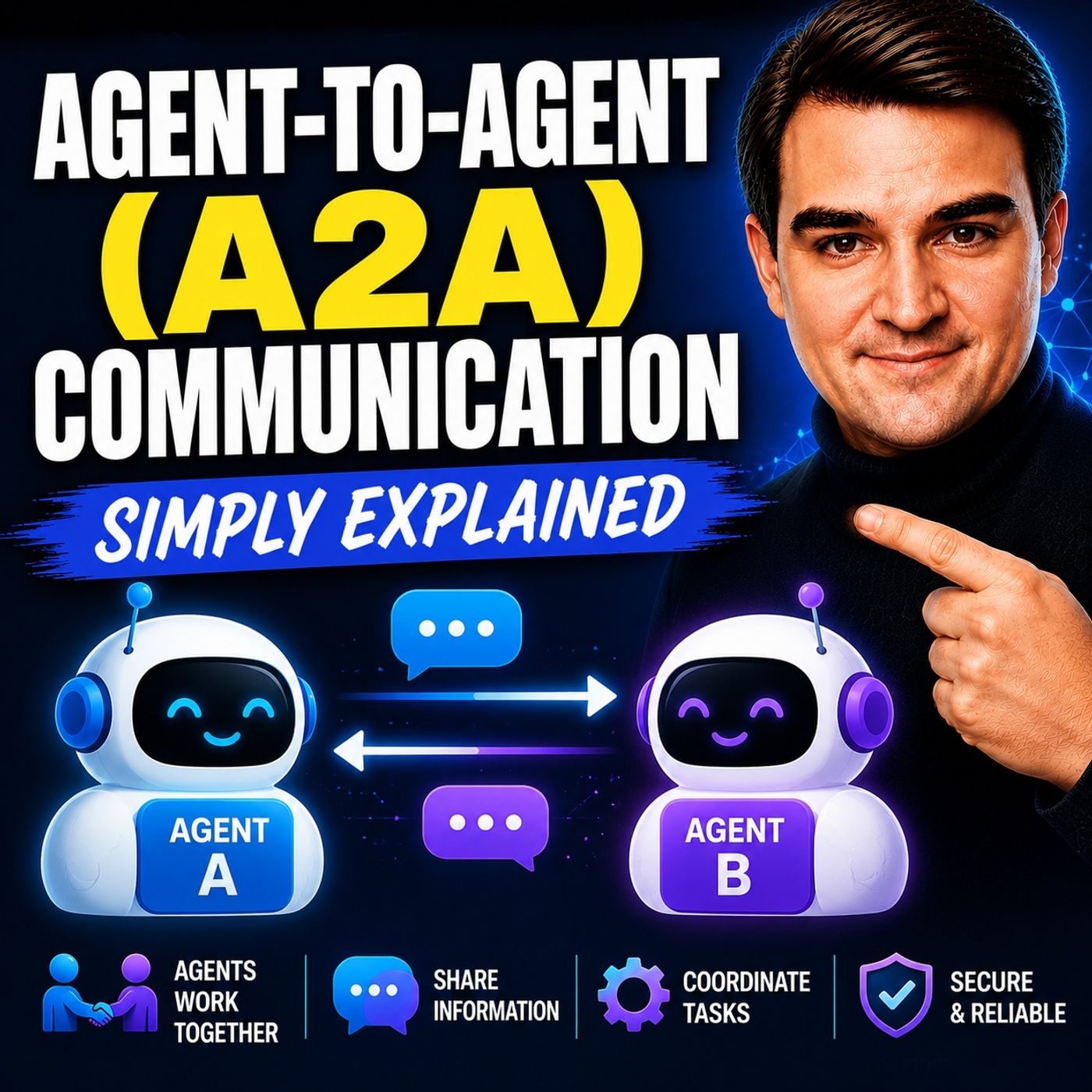
Breaking Down Agent-to-Agent (A2A) Communication: Why AI Collaboration Matters
Welcome back to the podcast companion blog! In today's post, we are diving deep into a topic that is fundamentally transforming how artificial intelligence operates within modern enterprise environments. For years, AI tools have functioned largely as isolated assistants—helpful, yes, but trapped within their own silos, waiting for a human prompt to kick off a task. But as artificial intelligence matures, a massive architectural shift is underway. We are moving away from solitary bots and stepping into a collaborative ecosystem powered by direct information exchange.
This paradigm shift is known as Agent-to-Agent (A2A) communication. By enabling AI systems to talk directly to one another, share context, and delegate subtasks in real time, organizations can unlock unprecedented levels of operational efficiency and reliability. If you want to dive even deeper into this architectural evolution, be sure to check out our dedicated podcast episode, Agent-to-Agent (A2A) Communication - Simply Explained. Now, let us break down why this matters, the underlying technologies driving it, and how you can successfully implement it.
Key Takeaways
- Agent-to-agent communication allows AI agents to share information directly, enhancing collaboration and breaking down legacy silos.
- Real-time data sharing boosts operational efficiency, slashes process completion times, and enables proactive problem-solving.
- Structured protocols improve reliability and interoperability among different AI systems, regardless of their underlying platform.
- The A2A protocol standardizes communication, ensuring seamless compatibility and secure data exchange across enterprise environments.
- Implementing A2A can lead to significant cost reductions—such as up to 60% savings in customer care—and drastically improved customer service.
- Robust security measures like mutual TLS and JSON Web Tokens are essential for protecting sensitive data during agent communications.
- Adopting phased implementation plans helps organizations integrate agent-to-agent capabilities effectively without overwhelming existing infrastructure.
- Addressing interoperability, governance, and privacy challenges is crucial for building a trustworthy, scalable multi-agent ecosystem.
Why Agent-to-Agent Matters
Efficiency Gains
Agent-to-agent communication significantly enhances operational efficiency. By allowing AI agents to communicate directly without human intervention in the loop for every single handoff, you can streamline processes and eliminate operational bottlenecks. For instance, inter-agent communication optimizes workflows, enabling proactive problem-solving before minor hitdowns cascade into major system failures. This leads to quicker responses, optimized resource management, and drastically reduced latency in distributed systems.
Here are some measurable improvements organizations have reported since adopting multi-agent frameworks:
| Improvement Type | Description |
|---|---|
| Operational Efficiency | Inter-agent communication optimizes processes, allowing for proactive problem-solving in complex business operations. |
| Scalability | AI agents can handle exponentially increasing workloads, supporting sustainable business growth without manual administrative limitations. |
| Real-time Insights | AI agents provide accurate predictions and collaborative insights, enabling quick decision-making and immediate operational adjustments. |
| Accessibility for Small Businesses | Automating routine handoffs allows smaller teams to use their limited human resources more efficiently, facilitating rapid growth. |
Collaboration Benefits
Agent collaboration becomes infinitely more powerful when agents possess the ability to talk natively to one another. Multi-agent systems allow distinct specialized agents to share information, negotiate parameters, and coordinate complex activities seamlessly. Major enterprises have reported up to 60% cost reductions in customer service operations simply by deploying collaborative agent mechanisms that handle tier-one through tier-three triage automatically.
Standardized communication protocols streamline these integrations, making the addition of a new AI chatbot or backend service to an existing enterprise platform remarkably straightforward. Instead of building custom API wrappers for every single point-to-point connection, the A2A framework establishes a universal language for agent discovery and state sharing.
Technologies Behind Agent-to-Agent Communication

A2A Protocol Overview
The agent2agent protocol (A2A) plays a critical role in enabling frictionless communication between diverse AI agents. This protocol provides a standardized method for agents to interact across heterogeneous platforms. By leveraging established, battle-tested web standards like HTTP and JSON-RPC, A2A ensures deep compatibility with existing enterprise IT architectures.
Key features of the A2A protocol include:
- Standardized Communication: A2A allows agents to communicate and collaborate effectively, regardless of their underlying vendor platforms or model architectures.
- Interoperability: The protocol supports secure interactions and structured messaging schemas, which are essential for effective dialogue between diverse agent platforms.
- Real-World Adoption: Major technology leaders and enterprise organizations are increasingly embracing standardized agent protocols to future-proof their AI investments.
Secure Data Exchange
Security cannot be an afterthought when building autonomous distributed systems. Because agent-to-agent communication involves machine-to-machine data exchanges that bypass traditional human oversight points, securing the transport layer is paramount. Modern A2A implementations rely heavily on HTTPS and JSON-RPC to keep data secure and reliable.
-
HTTPS: This foundational protocol encrypts all messages exchanged between agents, protecting payloads against interception and tampering. By strictly implementing Transport Layer Security (TLS 1.3), organizations mitigate critical vulnerabilities such as:
- Prompt Injection: Attackers attempting to smuggle malicious instructions into inter-agent payloads.
- Data Leakage: Unintentional exposure of proprietary corporate data during transmission.
- Data Poisoning: Malicious inputs corrupting the shared memory or state of receiving agents.
- Man-in-the-Middle (MITM): Unauthorized actors intercepting and altering live communications.
-
JSON-RPC: A lightweight, stateless remote procedure call protocol that facilitates structured communication between agents. It allows a client agent to securely trigger tasks on a remote agent. Key security enforcement practices include:
- Mandatory TLS 1.3 encryption across all communication endpoints.
- Robust authentication and authorization handled via modern frameworks like OAuth 2.0 and scoped API keys.
- Rrigorous request validation to ensure only cryptographically verified agents can participate in the network.
Best Practices for Agent-to-Agent Integration
Implementation Strategies
Successfully rolling out agent-to-agent communication requires a disciplined architectural strategy. To build a resilient framework for your AI agents, consider adopting the following best practices:
- Standardized A2A Interfaces: Adopt universal interfaces to ensure smooth interoperability across your entire technology stack, preventing vendor lock-in.
- Multi-Phase Implementation Plans: Begin with isolated proof-of-concept use cases. Gradually expand your deployment topology to include multi-step, cross-departmental agent orchestration once core stability is proven.
- Reliable Infrastructure: Establish a robust underlying platform capable of managing agent lifecycles, state persistence, and security governance at scale.
- Architectural Governance: Clearly define scaling mechanisms, agent discovery registries, and permission boundaries before introducing new agents into the ecosystem.
Security Measures
To maintain absolute trust in your autonomous multi-agent environments, your security posture must be multi-layered:
- Mutual TLS (mTLS): Enforce mTLS so that both communicating agents cryptographically verify their certificates before a single packet of data is exchanged.
- JWT Tokens: Implement JSON Web Tokens for stateless, time-bound authentication coupled with frequent key rotation policies.
- OAuth Client Credentials: Combine client credential grants with mTLS to create a bulletproof machine identity verification pipeline.
- Role and Permission Limits: Apply the principle of least privilege by strictly scoping what data sources and backend tools an individual agent can access.
- Continuous Monitoring: Maintain deep telemetry and audit logs to track agent behaviors, detect anomalous communication patterns, and prevent unauthorized actions in real time.
Real-World Applications of A2A Communication

Industry Use Cases
Agent-to-agent communication is already reshaping operations across multiple industries by driving unprecedented levels of agility and cross-system collaboration. In the financial sector, specialized AI agents cooperate to optimize complex workflows:
- Trading: AI agents analyze market signals and execute high-speed, compliant transactions collaboratively.
- Compliance: Automated compliance agents cross-reference transactions against global regulatory frameworks in real time.
- Risk Management: Continuous portfolio monitoring agents alert risk-assessment bots to mitigate exposure instantly.
- Customer Service: Frontline support agents coordinate directly with backend database agents to resolve client inquiries without manual ticket escalation.
In manufacturing and supply chain management, A2A communication eliminates traditional operational blind spots:
| Aspect | Description |
|---|---|
| Logistics Execution | Agents autonomously orchestrate transport bookings, vendor communications, and specialized warehouse tasks. |
| Real-time Demand Detection | Supply chain agents detect emerging inventory constraints and capacity gaps instantly, triggering automated rebalancing. |
| Disruption Management | When transit delays occur, logistics agents instantly reroute shipments and update downstream customer portals without human intervention. |
Modular Systems
Modular multi-agent architectures offer dramatic advantages over monolithic AI systems. By dividing complex business logic among specialized agents, organizations achieve superior system resilience, fine-grained scalability, and effortless adaptability as business requirements evolve over time.
Challenges in Agent-to-Agent Communication
Interoperability Issues
Despite its massive potential, implementing A2A communication comes with notable hurdles. Interoperability remains complex due to disparate network perimeters, differing corporate governance models, and conflicting compliance policies. To overcome these challenges, modern architectures rely on standardized agent identity cards and universal message schemas, ensuring that agents can dynamically discover and parse each other's capabilities without custom bridge code.
Privacy and Security Challenges
Handling sensitive enterprise and consumer data via autonomous agents introduces strict compliance demands. Regulations such as GDPR mandate explicit user consent, strict data minimization, and robust protection of personally identifiable information. Designing communication protocols that respect these legal boundaries while maintaining high-speed agent collaboration requires careful governance, rigorous sandboxing, and continuous auditing.
Agent-to-agent communication is undeniably the next frontier for enterprise artificial intelligence. By enabling bots to share context, negotiate tasks, and operate as a cohesive digital workforce, organizations can unlock unprecedented levels of efficiency, cost reduction, and innovation. As this technology matures, standardized protocols like A2A will become as foundational to the intelligent web as HTTP was to the early internet.
To get a comprehensive, practitioner-led breakdown of this exact topic, make sure to listen to our full companion episode: Agent-to-Agent (A2A) Communication - Simply Explained.
FAQ
What is agent-to-agent communication?
Agent-to-agent communication refers to the direct, automated exchange of information, context, and tasks between AI agents, enabling them to collaborate seamlessly without constant human intervention.
How does the A2A protocol work?
The A2A protocol provides a universal, standardized framework for AI agents to interact. It uses established web standards like HTTP and JSON-RPC to guarantee cross-platform compatibility and secure data transmission.
What are the benefits of using A2A communication?
Key benefits include dramatic improvements in operational efficiency, reduced integration and customer service costs, enhanced real-time data sharing, and the ability to execute complex multi-step workflows autonomously.
How can I implement A2A communication in my organization?
Start by establishing a solid architectural foundation, adopting standardized interfaces, and deploying phased proof-of-concept projects before scaling out multi-agent workflows across departments.
What security measures should I consider for A2A communication?
Essential security measures include mutual TLS (mTLS) for cryptographic device authentication, JSON Web Tokens (JWT) for stateless authorization, strict role-based permission boundaries, and continuous system monitoring.
Can A2A communication be used in any industry?
Yes. While adoption is currently prominent in finance, manufacturing, and customer support, any sector leveraging artificial intelligence can benefit from connecting specialized agents into a collaborative ecosystem.
What challenges might I face with A2A communication?
Common hurdles include handling cross-network interoperability, enforcing data privacy regulations (such as GDPR), managing identity governance, and preventing prompt injection vulnerabilities.
How does A2A communication support modular systems?
It allows specialized micro-agents to operate independently while coordinating tasks dynamically, making the overall architecture highly scalable, fault-tolerant, and adaptable to change.
🎧 Listen to this episode
Want a practical explanation of Agent-to-Agent (A2A) Communication? This episode breaks down the topic in clear language and shows why it matters for Microsoft 365, Azure, Power Platform, security, AI, and modern work.
Listen to this episode if you want to:
- Understand the key concepts behind Agent-to-Agent (A2A) Communication
- See how it fits into the wider Microsoft technology ecosystem
- Learn where it can create practical value for your organization
You may also enjoy these related M365 FM episodes:
- Microsoft AI Agent Harness - Simply Explained
- Microsoft Agent Builder — Simply Explained
- Microsoft Entra Agent ID: Secure Identity for AI Agents
- Multi-Agent AI with Microsoft Copilot and SharePoint – Reshmee Auckloo [MVP]
- Microsoft AI Agent Runtimes: Beyond Enterprise Chatbots
Discover more practical Microsoft conversations on M365 FM.
Last reviewed: July 2026.
Who Should Listen
This episode is for Microsoft 365 administrators, architects, IT leaders, and practitioners who need a practical understanding of Agent-to-Agent Communication before planning, implementing, or supporting it.

Microsoft MVP | Host of M365.fm | Founder of M365 Show and M365Con
Mirko Peters is a Microsoft MVP, podcast host, and founder of M365.fm, M365 Show, and M365Con. His work connects Microsoft practitioners through podcast interviews, livestreams, and community events.
At M365.fm, Mirko hosts conversations with Microsoft MVPs, product experts, architects, and community contributors. Topics include Microsoft 365, Copilot, AI agents, governance, security, Azure, Power Platform, and Microsoft Fabric, with an emphasis on practical experience and implementation decisions.
M365.fm is the podcast and learning platform. M365 Show brings experts together for livestreams, while M365Con provides an online conference setting for community learning.
Official website: Mirko Peters (https://www.mirkopeters.com/). Recognition: Mirko Peters — Microsoft MVP profile (https://mvp.microsoft.com/de-DE/mvp/profile/9b0ca797-db5a-493a-a845-8b9158046cf5). Connect on LinkedIn (https://www.linkedin.com/in/m365showpodcast/).