


 Apple Podcasts
 Spotify
 Youtube Music
 Spreaker
 Podchaser
 Amazon Music
 Agent-to-Agent (A2A) Communication - Simply Explained
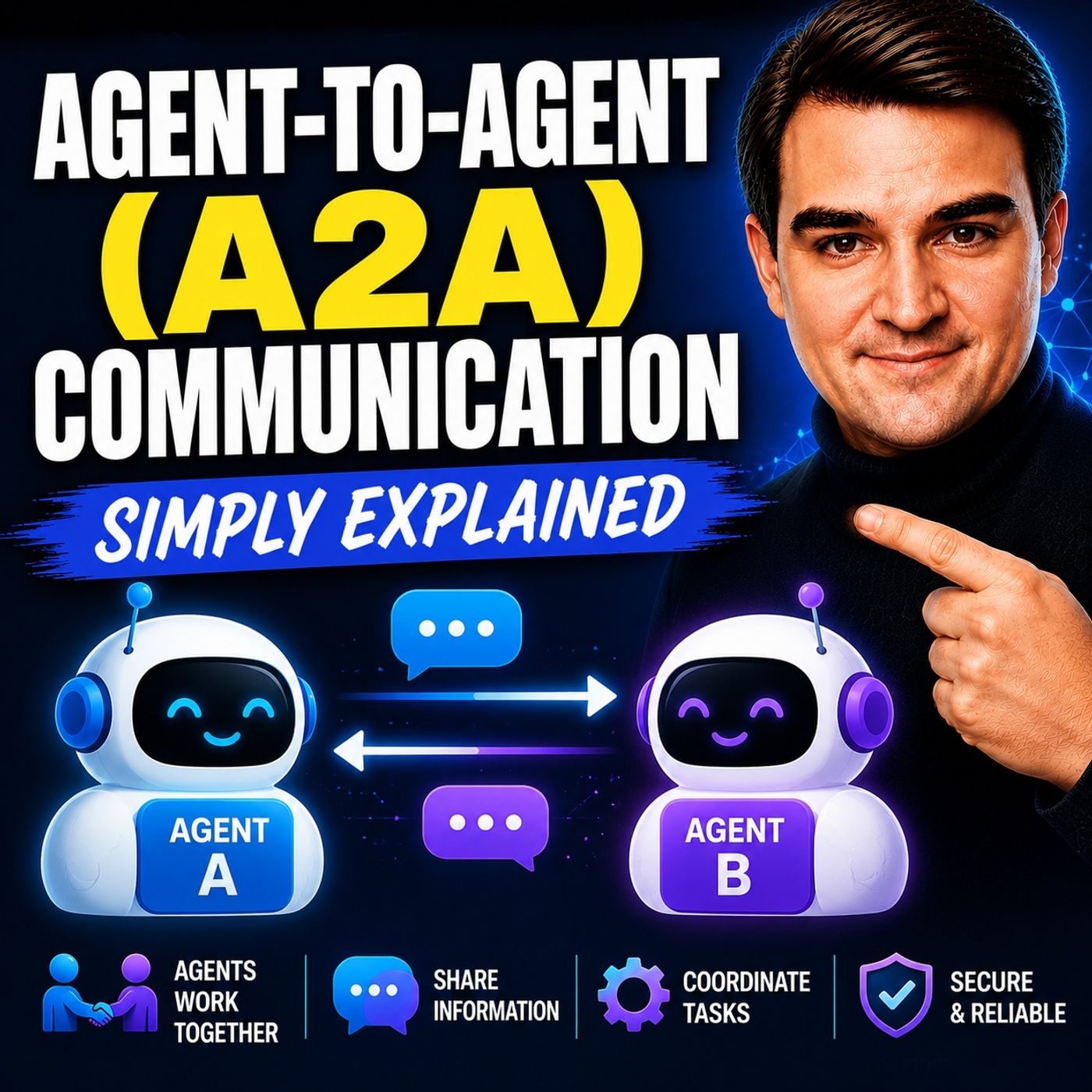
Agent-to-Agent (A2A) Communication is an open protocol that enables AI agents to discover, communicate, and collaborate with one another—regardless of the framework, programming language, or platform they were built on. Instead of creating custom integrations between every agent, A2A defines a common standard for exchanging messages, delegating tasks, sharing capabilities, and coordinating complex workflows across distributed AI systems.
In this episode of Microsoft Knowledge Nuggets, Mirko Peters explains Agent-to-Agent (A2A) Communication in simple terms and shows why it's becoming a key building block for enterprise AI. You'll learn how agents discover each other through Agent Cards, exchange structured requests and responses, manage long-running tasks, and collaborate securely across organizational and technology boundaries. The episode also explains how A2A differs from Model Context Protocol (MCP): MCP connects AI models to tools and data, while A2A enables independent AI agents to work together.
The episode explores practical scenarios including AI assistants coordinating business processes, specialized agents handing work to expert agents, multi-agent customer support, software development workflows, research assistants, and enterprise automation. You'll also discover how A2A supports streaming responses, secure authentication, cross-platform interoperability, and integrations with Microsoft Agent Framework, Microsoft Copilot Studio, and other agent platforms.
Whether you're an AI developer, solution architect, Microsoft professional, or preparing for the next generation of AI-powered applications, this episode provides a practical introduction to Agent-to-Agent Communication. By the end, you'll understand how A2A enables scalable multi-agent systems, simplifies collaboration between intelligent services, and lays the foundation for interoperable AI ecosystems across the enterprise.
Quick answer: Agent-to-Agent Communication is covered in this M365 FM episode with a practical focus on what it is, how it works, and the decisions that matter for architecture, adoption, security, governance, or day-to-day operations.
Agent-to-agent communication refers to the direct exchange of information between AI agents. This method revolutionizes how these systems interact, making them more efficient and reliable. In a world where AI agents often work in isolation, agent communication enables them to collaborate seamlessly.
Key aspects to understand include:
- Real-time data sharing: This enhances operational efficiency and speeds up processes.
- Structured protocols: These improve reliability and interoperability among agents.
- Automatic discovery: Agents can identify each other's capabilities without manual input.
The table below highlights how agent-to-agent communication compares with traditional communication models:
| Feature | Agent-to-Agent Communication | Traditional Communication |
|---|---|---|
| Speed | High due to real-time data sharing | Often slower due to siloed operations |
| Reliability | Enhanced through structured protocols | Lacks reliability due to disconnected systems |
| Interoperability | Improved with structured protocols | Limited interoperability |
| Security | Focused on from the beginning | Often an afterthought |
This innovative approach not only streamlines processes but also sets the stage for a more connected and intelligent future.
Key Takeaways
- Agent-to-agent communication allows AI agents to share information directly, enhancing collaboration.
- Real-time data sharing boosts operational efficiency and speeds up processes.
- Structured protocols improve reliability and interoperability among different AI systems.
- The A2A protocol standardizes communication, ensuring compatibility across various platforms.
- Implementing A2A can lead to significant cost reductions and improved customer service.
- Security measures like mutual TLS and JWT tokens are essential for protecting data in agent communications.
- Adopting phased implementation plans helps organizations integrate agent-to-agent communication effectively.
- Addressing interoperability and privacy challenges is crucial for successful agent-to-agent communication.
Why Agent-to-Agent Matters
Efficiency Gains
Agent-to-agent communication significantly enhances operational efficiency. By allowing AI agents to communicate directly, you can streamline processes and reduce delays. For instance, inter-agent communication optimizes workflows, enabling proactive problem-solving. This leads to quicker responses and better resource management.
Here are some measurable improvements organizations have reported:
| Improvement Type | Description |
|---|---|
| Operational Efficiency | Inter-agent communication optimizes processes, allowing for proactive problem-solving in operations. |
| Scalability | AI agents can handle increasing workloads, supporting sustainable business growth without limitations. |
| Real-time Insights | AI agents provide accurate predictions and insights, enabling quick decision-making and operational adjustments. |
| Accessibility for Small Businesses | Automating tasks allows small businesses to use their resources more efficiently, facilitating growth. |
Efficient communication also reduces resource consumption in distributed systems. You can minimize latency and resource usage, allowing agents to work on independent subtasks. This parallel execution significantly cuts down overall completion time.
Collaboration Benefits
Agent collaboration becomes more effective with agent-to-agent communication. Multi-agent systems allow agents to share information and coordinate activities seamlessly. This leads to substantial operational improvements. For example, organizations have reported up to 60% cost reductions in customer care due to effective collaboration mechanisms. Major financial institutions have saved $1.5 billion by implementing these systems.
The agent2agent protocol addresses integration challenges in heterogeneous AI systems. It supports agent communications in large-scale multi-agent systems, emphasizing interoperability and authentication. Standardized communication protocols streamline integrations, allowing for real-time data exchange. For instance, adding a new AI chatbot to a platform becomes much simpler with these protocols.
Technologies Behind Agent-to-Agent Communication

A2A Protocol Overview
The agent2agent protocol (A2A) plays a crucial role in enabling seamless communication between AI agents. This protocol provides a standardized method for agents to interact across various platforms. By using established web standards like HTTP and JSON-RPC, A2A ensures compatibility with existing systems.
Here are some key features of the A2A protocol:
- Standardized Communication: A2A allows agents to communicate and collaborate effectively, regardless of their underlying platforms.
- Interoperability: The protocol supports secure interactions and structured messaging, which are essential for effective communication between diverse agent platforms.
- Real-World Applications: Organizations like Salesforce and SAP have implemented A2A in their systems, showcasing its practical benefits.
The adoption of the A2A protocol is growing rapidly. Over 150 organizations, including major players like Google, Microsoft, and AWS, have embraced it. In contrast, the MCP protocol has seen a significant increase in usage, with 78% of enterprise AI teams adopting it. However, A2A remains a leading choice for enterprise environments.
Secure Data Exchange
Security is paramount in agent-to-agent communication. The use of HTTPS and JSON-RPC ensures that data exchanged between agents remains secure and reliable.
-
HTTPS: This protocol encrypts messages exchanged between agents, protecting against interception and tampering. By implementing TLS (Transport Layer Security), HTTPS mitigates risks such as:
- Prompt Injection: Attackers inserting harmful instructions into messages.
- Data Leakage: Unintentional sharing of sensitive information.
- Data Poisoning: Malicious inputs corrupting data.
- Man-in-the-Middle (MITM): Attackers intercepting and modifying communications.
-
JSON-RPC: This lightweight protocol facilitates structured communication between agents. It allows a client agent to send tasks to a remote agent securely. The data exchange occurs over HTTPS, ensuring secure transport. Key aspects of JSON-RPC include:
- All connections utilize HTTPS with current TLS configurations, specifically TLS 1.3.
- Authentication and authorization are managed through established methods like OAuth 2.0 and API keys.
- Each request undergoes review to ensure that only authorized agents can communicate, maintaining data integrity.
By leveraging these technologies, organizations can enhance the security and efficiency of their agent-to-agent communication systems.
Best Practices for Agent-to-Agent Integration
Implementation Strategies
To implement agent-to-agent communication effectively, you should consider several strategies. These strategies will help you create a robust framework for your AI agents. Here are some recommended approaches:
- Standardized A2A Interfaces: Implementing standardized interfaces allows for interoperability across various platforms. This ensures that your agents can communicate seamlessly, regardless of their underlying technologies.
- Multi-Phase Implementation Plans: Start with isolated use cases as proof of concept. Gradually expand your implementation to include more complex scenarios. This phased approach helps you identify potential issues early.
- Reliable Infrastructure: Establish a solid infrastructure for managing the agent lifecycle and security governance. This infrastructure will support the ongoing needs of your agents as they evolve.
- Architectural Requirements: Define governance mechanisms for scalability. Consider how your architecture will adapt as you add more agents or integrate with new systems.
By following these strategies, you can enhance the effectiveness of your agent orchestration and ensure smooth communication between your AI agents.
Security Measures
Security is crucial in agent-to-agent communication. You must implement strong security measures to protect your data and maintain trust among agents. Here are some best practices to consider:
- Mutual TLS (mTLS): Use mTLS for secure authentication. This ensures that both parties present verified certificates, establishing a trusted connection.
- JWT Tokens: Implement JSON Web Tokens (JWT) for stateless authentication. Use short lifetimes and frequent key rotation to enhance security.
- OAuth Client Credentials: Combine OAuth client credentials with mTLS for added security in agent communications. This combination provides a robust authentication mechanism.
- Role and Permission Limits: Set clear limits on agent roles and permissions. This restricts access to necessary resources, reducing the risk of unauthorized actions.
- Continuous Monitoring: Regularly validate and monitor agent behaviors and communications. This helps detect anomalies and potential security threats.
- Layered Defenses: Build layered defenses using authentication, sandboxing, and human oversight. This multi-faceted approach enhances the overall security of your agent communication channels.
By prioritizing security and standardization, you can create a reliable environment for agent collaboration. This will not only protect your data but also foster trust among your AI agents.
Real-World Applications of A2A Communication

Industry Use Cases
Agent-to-agent communication has transformed various industries by enhancing efficiency and collaboration. In the financial sector, AI agents streamline processes and improve service delivery. Here are some prominent applications:
- Trading: AI agents facilitate faster and more accurate trading processes.
- Compliance: They assist organizations in meeting regulatory requirements and reporting obligations.
- Risk Management: Continuous monitoring of transactions helps identify potential risks.
- Customer Service: AI assistants provide personalized financial guidance to clients.
In decentralized finance (DeFi), agents analyze user intent for transactions and automate treasury management. They also gather and classify transaction data for compliance reporting and procure market intelligence.
In manufacturing, agent-to-agent communication enhances supply chain management. The following table illustrates how AI agents improve logistics and operational efficiency:
| Aspect | Description |
|---|---|
| Logistics Execution | Agents orchestrate booking, communication, and specialized tasks, improving logistics efficiency and agility. |
| Real-time Demand Detection | Agents detect shipment demand and capacity gaps in real time, allowing for proactive management of logistics. |
| Disruption Management | In case of disruptions, agents automatically rebook, reroute, or reprioritize shipments, enhancing resilience. |
AI agents mimic human reasoning and decision-making at scale. They shift operations from reactive to proactive, anticipating issues before they arise. This leads to fewer disruptions and better service levels.
Modular Systems
Modular multi-agent systems offer significant advantages over traditional monolithic architectures. These systems allow for specialization of agents for specific tasks, leading to improved performance. Here are some key benefits:
- Scalability: You can grow your capabilities without significant redesign.
- Resilience: If one agent fails, others continue to operate, ensuring system reliability.
- Adaptability: Modular systems support evolving business needs, aligning with operational complexity.
In dynamic environments, modular layers enhance agent organization and communication. Holonic architecture allows agents to operate independently while being part of a larger structure. This flexibility is crucial for adapting to changes.
Decentralized orchestration enables real-time task reassignment and dynamic reconfiguration. Service-oriented agents support lifecycle management and interoperability, enhancing collaboration in dynamic networks. By maintaining flexible interdependencies, agents can adapt to new tasks and environments effectively.
Challenges in Agent-to-Agent Communication
Interoperability Issues
Interoperability remains a significant challenge in agent-to-agent communication. As you implement these systems, you may encounter several obstacles that hinder seamless interactions. Here are some key issues to consider:
- Network Scope: A2A communication primarily focuses on private networks. This focus complicates interactions across different network types.
- Governance: Companies often face complexities in adhering to varying risk and compliance policies. You must decide between centralized and decentralized governance models in multi-agent environments.
- Data Privacy and Protection: Managing user identities becomes difficult due to disparate systems and data sources. Ensuring secure user verification and access control during agent interactions is crucial.
To address these interoperability challenges, the A2A protocol emphasizes the need for a standardized language. This approach prevents the necessity for custom code in agent interactions. Additionally, agents can advertise their identity and capabilities through an "Agent Card," facilitating easier discovery and interaction. Structured communication allows agents to exchange various types of data, enhancing collaboration and task state tracking.
Privacy and Security Challenges
Privacy and security concerns are paramount in agent-to-agent communication. As you navigate these systems, you must be aware of the potential risks associated with data handling. Here are some critical privacy issues to consider:
- Sensitive Data Protection: AI agents often handle sensitive information, especially in sectors like healthcare. Protecting patient data is essential to maintain trust and comply with regulations.
- Ethical Implications: Transparency in algorithms used by AI agents raises ethical questions. You should consider who is responsible for decisions made by these systems.
- Regulatory Compliance: Frameworks like GDPR impose strict data handling requirements. You must integrate these requirements into your communication systems to avoid penalties.
The table below outlines some key aspects of GDPR that impact the design of agent-to-agent communication systems:
| Aspect | Description |
|---|---|
| Data Handling Requirements | GDPR mandates strict data handling and privacy requirements that must be integrated into designs. |
| User Consent | Explicit user consent is required for data processing, influencing communication protocols. |
| Protection of Sensitive Info | Communication systems must safeguard sensitive information to comply with GDPR. |
By addressing these privacy and security challenges, you can create a more robust and trustworthy environment for agent-to-agent communication. This proactive approach not only protects sensitive data but also fosters confidence among users and stakeholders.
Agent-to-agent communication is a game-changer for modern technology. It enhances collaboration and efficiency among AI agents, allowing them to tackle complex workflows. Here are some key takeaways:
- A2A enables agents to work together for real-time solutions.
- It automates processes, unlocking operational success.
- Innovation accelerates through real-time collaboration, improving customer experiences.
As you explore this technology, consider how it can influence your field. The A2A protocol may become a foundational standard for AI agents, similar to HTTP for the web. This evolution will enhance operational efficiency and reduce integration costs, paving the way for autonomous systems that function seamlessly.
FAQ
What is agent-to-agent communication?
Agent-to-agent communication allows AI agents to exchange information directly. This method enhances collaboration and efficiency, enabling agents to work together seamlessly across different platforms.
How does the A2A protocol work?
The A2A protocol standardizes communication between AI agents. It uses established web technologies like HTTP and JSON-RPC to ensure compatibility and secure data exchange.
What are the benefits of using A2A communication?
A2A communication improves operational efficiency, reduces integration costs, and enhances collaboration among AI agents. It allows for real-time data sharing and task delegation, streamlining workflows.
How can I implement A2A communication in my organization?
Start by adopting standardized A2A interfaces and creating a phased implementation plan. Ensure you have a reliable infrastructure and define governance mechanisms for scalability.
What security measures should I consider for A2A communication?
Implement mutual TLS for authentication, use JWT tokens for stateless authentication, and set clear role limits for agents. Continuous monitoring and layered defenses enhance overall security.
Can A2A communication be used in any industry?
Yes, A2A communication applies to various industries, including finance, healthcare, and manufacturing. It enhances efficiency and collaboration, making it suitable for any sector utilizing AI agents.
What challenges might I face with A2A communication?
You may encounter interoperability issues, data privacy concerns, and compliance with regulations. Addressing these challenges requires careful planning and adherence to standardized protocols.
How does A2A communication support modular systems?
A2A communication enables modular systems by allowing specialized agents to work independently. This flexibility enhances scalability and resilience, making it easier to adapt to changing business needs.
🎧 Listen to this episode
Want a practical explanation of Agent-to-Agent (A2A) Communication? This episode breaks down the topic in clear language and shows why it matters for Microsoft 365, Azure, Power Platform, security, AI, and modern work.
Listen to this episode if you want to:
- Understand the key concepts behind Agent-to-Agent (A2A) Communication
- See how it fits into the wider Microsoft technology ecosystem
- Learn where it can create practical value for your organization
You may also enjoy these related M365 FM episodes:
- Microsoft AI Agent Harness - Simply Explained
- Microsoft Agent Builder — Simply Explained
- Microsoft Entra Agent ID: Secure Identity for AI Agents
- Multi-Agent AI with Microsoft Copilot and SharePoint – Reshmee Auckloo [MVP]
- Microsoft AI Agent Runtimes: Beyond Enterprise Chatbots
Discover more practical Microsoft conversations on M365 FM.
Last reviewed: July 2026.
Who Should Listen
This episode is for Microsoft 365 administrators, architects, IT leaders, and practitioners who need a practical understanding of Agent-to-Agent Communication before planning, implementing, or supporting it.
🚀 Want to be part of m365.fm?
Then stop just listening… and start showing up.
👉 Connect with me on LinkedIn and let’s make something happen:
- 🎙️ Be a podcast guest and share your story
- 🎧 Host your own episode (yes, seriously)
- 💡 Pitch topics the community actually wants to hear
- 🌍 Build your personal brand in the Microsoft 365 space
This isn’t just a podcast — it’s a platform for people who take action.
🔥 Most people wait. The best ones don’t.
👉 Connect with me on LinkedIn and send me a message:
"I want in"
Let’s build something awesome 👊
1
00:00:00,000 --> 00:00:01,480
Welcome to another knowledge nugget.
2
00:00:01,480 --> 00:00:03,200
Imagine you run a company and hire a team
3
00:00:03,200 --> 00:00:05,920
of brilliant specialists, a world-class travel planner,
4
00:00:05,920 --> 00:00:09,280
an employee on boarding expert, and an IT support person.
5
00:00:09,280 --> 00:00:10,720
But none of them talk to each other.
6
00:00:10,720 --> 00:00:12,640
Every time a task needs two of them,
7
00:00:12,640 --> 00:00:13,960
you have to walk between desks
8
00:00:13,960 --> 00:00:15,680
and carry the information yourself.
9
00:00:15,680 --> 00:00:17,880
That's exactly how most AI agents work right now.
10
00:00:17,880 --> 00:00:19,280
They operate in isolation,
11
00:00:19,280 --> 00:00:21,320
even when the problem clearly needs teamwork.
12
00:00:21,320 --> 00:00:23,960
So today we're talking about how agents can communicate,
13
00:00:23,960 --> 00:00:26,200
hand off work, and act like real teams.
14
00:00:26,200 --> 00:00:27,120
I'm Mirko Peters.
15
00:00:27,120 --> 00:00:28,560
This isn't some future concept.
16
00:00:28,560 --> 00:00:30,920
Multi-agent orchestration is already happening,
17
00:00:30,920 --> 00:00:33,560
and it's powered by a protocol called A2A.
18
00:00:33,560 --> 00:00:34,720
We'll start with the problem,
19
00:00:34,720 --> 00:00:36,480
break down that protocol piece by piece,
20
00:00:36,480 --> 00:00:39,000
and see how Microsoft uses it inside co-pilot studio
21
00:00:39,000 --> 00:00:41,720
and Azure AI, grab your coffee, and let's dive in.
22
00:00:41,720 --> 00:00:43,160
So what's the actual problem?
23
00:00:43,160 --> 00:00:46,440
AI agents today are exactly like those isolated specialists.
24
00:00:46,440 --> 00:00:48,880
Each one has its own knowledge, tools, and goals.
25
00:00:48,880 --> 00:00:50,400
A weather agent knows the forecast.
26
00:00:50,400 --> 00:00:52,360
A hotel agent knows room availability,
27
00:00:52,360 --> 00:00:53,560
but they don't share anything.
28
00:00:53,560 --> 00:00:56,200
Now, picture a user asking for a trip to Seattle next week
29
00:00:56,200 --> 00:00:57,760
with a hotel near the office.
30
00:00:57,760 --> 00:00:59,760
A single agent would need to be a weather expert,
31
00:00:59,760 --> 00:01:02,280
travel expert, and local business expert, all at once.
32
00:01:02,280 --> 00:01:04,040
That means giant bloated prompts
33
00:01:04,040 --> 00:01:06,800
that cram every possible capability into one system,
34
00:01:06,800 --> 00:01:08,560
and those prompts break constantly.
35
00:01:08,560 --> 00:01:10,320
The old solution was custom code.
36
00:01:10,320 --> 00:01:12,360
You'd write a bridge between the weather agent
37
00:01:12,360 --> 00:01:15,000
and the hotel agent, then another between the hotel agent
38
00:01:15,000 --> 00:01:17,680
and the flight agent, and another for the calendar agent.
39
00:01:17,680 --> 00:01:19,840
It works at first, but every time you add a new agent,
40
00:01:19,840 --> 00:01:21,560
you build another integration.
41
00:01:21,560 --> 00:01:23,160
Pretty soon you've got a spaghetti nightmare
42
00:01:23,160 --> 00:01:25,600
of point-to-point connections, where one change breaks everything.
43
00:01:25,600 --> 00:01:27,920
The productivity gains your AI was supposed to deliver
44
00:01:27,920 --> 00:01:29,760
get eaten alive by maintenance work.
45
00:01:29,760 --> 00:01:31,480
Let's look at the real business pain.
46
00:01:31,480 --> 00:01:34,120
Your organization already has processes with handoffs.
47
00:01:34,120 --> 00:01:36,320
A ticket gets created, someone triages it,
48
00:01:36,320 --> 00:01:39,120
someone resolves it, someone logs it, and each step is a handoff.
49
00:01:39,120 --> 00:01:41,800
In the old world, you automate each step with a separate agent
50
00:01:41,800 --> 00:01:44,000
and then spend weeks wiring them together.
51
00:01:44,000 --> 00:01:45,240
But what if there was a protocol
52
00:01:45,240 --> 00:01:47,760
that let agents discover each other and cooperate
53
00:01:47,760 --> 00:01:49,320
without any custom bridges?
54
00:01:49,320 --> 00:01:50,680
That's exactly what A2A does.
55
00:01:50,680 --> 00:01:53,000
In plain English, A2A is a standard way for agents
56
00:01:53,000 --> 00:01:55,000
to talk to each other, pass work around,
57
00:01:55,000 --> 00:01:56,920
and get things done as a team.
58
00:01:56,920 --> 00:01:57,920
What is A2A?
59
00:01:57,920 --> 00:01:59,080
The simple definition.
60
00:01:59,080 --> 00:02:01,040
A2A stands for agent to agent.
61
00:02:01,040 --> 00:02:03,640
It's an open protocol that lets AI agents talk directly
62
00:02:03,640 --> 00:02:05,560
to each other, no matter who built them.
63
00:02:05,560 --> 00:02:07,520
You can think of it like HTTP for agents.
64
00:02:07,520 --> 00:02:10,720
HTTP is the language web browsers and servers used to communicate.
65
00:02:10,720 --> 00:02:12,800
And A2A does the same thing for agents.
66
00:02:12,800 --> 00:02:15,960
An agent built by your IT team on Microsoft Copilot Studio
67
00:02:15,960 --> 00:02:17,880
can talk to an agent built by a different company
68
00:02:17,880 --> 00:02:21,080
on Google Cloud as long as both speak A2A.
69
00:02:21,080 --> 00:02:22,720
This isn't a small project either.
70
00:02:22,720 --> 00:02:25,840
A2A is sponsored by eight major companies, including Google,
71
00:02:25,840 --> 00:02:29,520
Microsoft, Cisco, Salesforce, SAP, and others,
72
00:02:29,520 --> 00:02:31,520
and it's hosted by the Linux Foundation.
73
00:02:31,520 --> 00:02:34,720
Version 1.0 is stable and ready for real use,
74
00:02:34,720 --> 00:02:37,440
which means no single vendor controls the protocol.
75
00:02:37,440 --> 00:02:39,440
It's not a Google thing or a Microsoft thing.
76
00:02:39,440 --> 00:02:40,560
It's an industry thing.
77
00:02:40,560 --> 00:02:42,120
The design is intentionally simple.
78
00:02:42,120 --> 00:02:44,080
A2A builds on existing web standards
79
00:02:44,080 --> 00:02:46,200
like HTTP and JSON RPC.
80
00:02:46,200 --> 00:02:48,080
Things every developer already knows.
81
00:02:48,080 --> 00:02:49,960
Nothing exotic or proprietary there.
82
00:02:49,960 --> 00:02:52,120
That makes it easy for enterprises to adopt
83
00:02:52,120 --> 00:02:54,720
without ripping out their existing infrastructure.
84
00:02:54,720 --> 00:02:57,680
Now, you might have heard of another protocol called MCP,
85
00:02:57,680 --> 00:02:59,040
or ModelContext Protocol.
86
00:02:59,040 --> 00:03:00,000
Here's the difference.
87
00:03:00,000 --> 00:03:02,840
MCP is agent to tool, meaning it connects an agent
88
00:03:02,840 --> 00:03:04,800
to external data sources and APIs.
89
00:03:04,800 --> 00:03:08,400
A2A is agent to agent connecting agents directly to each other.
90
00:03:08,400 --> 00:03:09,280
They're not competitors.
91
00:03:09,280 --> 00:03:10,120
They're complementary.
92
00:03:10,120 --> 00:03:12,400
Think of MCP as the vertical connection
93
00:03:12,400 --> 00:03:14,400
from an agent down to its tools.
94
00:03:14,400 --> 00:03:19,000
And A2A as the horizontal connection between agents side by side.
95
00:03:19,000 --> 00:03:20,200
One more design choice.
96
00:03:20,200 --> 00:03:22,320
A2A treats agents as opaque.
97
00:03:22,320 --> 00:03:24,000
So when one agent talks to another,
98
00:03:24,000 --> 00:03:26,400
it doesn't see the other agents internal reasoning
99
00:03:26,400 --> 00:03:27,600
tools or private data.
100
00:03:27,600 --> 00:03:30,320
It only sees the task it sent and the result it gets back.
101
00:03:30,320 --> 00:03:32,600
That preserves privacy and intellectual property.
102
00:03:32,600 --> 00:03:34,080
A weather agent doesn't need to know
103
00:03:34,080 --> 00:03:35,840
how the hotel agent books rooms.
104
00:03:35,840 --> 00:03:37,360
It just needs to hand off the forecast.
105
00:03:37,360 --> 00:03:39,800
Now let's look at the first piece of the puzzle,
106
00:03:39,800 --> 00:03:41,560
the agent card.
107
00:03:41,560 --> 00:03:43,320
The agent card, the resume.
108
00:03:43,320 --> 00:03:47,080
Every A2A compatible agent publishes something called an agent card.
109
00:03:47,080 --> 00:03:49,040
That card is a machine readable document
110
00:03:49,040 --> 00:03:51,480
that lives at a standard URL on the agent's domain,
111
00:03:51,480 --> 00:03:56,440
specifically at PAS well known, agent card, Jason.
112
00:03:56,440 --> 00:03:57,560
If you know where an agent lives,
113
00:03:57,560 --> 00:04:00,480
you can fetch its card and learn everything you need to work with it.
114
00:04:00,480 --> 00:04:03,120
Think of the agent card as a resume or a business card.
115
00:04:03,120 --> 00:04:06,040
It tells other agents who you are and what you can do.
116
00:04:06,040 --> 00:04:08,320
The card contains the agent's name,
117
00:04:08,320 --> 00:04:11,040
a plain text description of its capabilities,
118
00:04:11,040 --> 00:04:13,400
and skill tags that help with discovery.
119
00:04:13,400 --> 00:04:16,400
It also lists the endpoint URL where it accepts requests,
120
00:04:16,400 --> 00:04:20,480
its authentication requirements, and the input and output formats it expects.
121
00:04:20,480 --> 00:04:21,640
Here's a concrete example.
122
00:04:21,640 --> 00:04:23,240
Say you have a weather specialist agent.
123
00:04:23,240 --> 00:04:25,840
Its agent card says, "I can provide current weather
124
00:04:25,840 --> 00:04:27,880
and a five-day forecast for any city.
125
00:04:27,880 --> 00:04:31,200
It lists its API endpoint, says it accepts a city name,
126
00:04:31,200 --> 00:04:34,080
and returns temperature and conditions in Jason format."
127
00:04:34,080 --> 00:04:34,920
That's the whole thing.
128
00:04:34,920 --> 00:04:37,320
It's just a clear declaration of what it can do
129
00:04:37,320 --> 00:04:39,800
with no secrets or internal logic exposed.
130
00:04:39,800 --> 00:04:41,240
Discovery works like this.
131
00:04:41,240 --> 00:04:44,160
An orchestrator agent has a list of known agent URLs
132
00:04:44,160 --> 00:04:45,840
or you can configure it with them
133
00:04:45,840 --> 00:04:48,400
when a task comes in, the orchestrator fetches the agent card,
134
00:04:48,400 --> 00:04:52,280
reads the descriptions, and decides which agent is the best match.
135
00:04:52,280 --> 00:04:54,800
The weather card says weather, so weather tasks go there.
136
00:04:54,800 --> 00:04:58,040
The hotel card says hotels, so hotel tasks go there.
137
00:04:58,040 --> 00:05:00,040
Notice there's no central registry required.
138
00:05:00,040 --> 00:05:02,680
Agents don't need to register with a global directory.
139
00:05:02,680 --> 00:05:05,120
They just publish their card at a known location,
140
00:05:05,120 --> 00:05:07,720
and any other agent that knows the URL can find them.
141
00:05:07,720 --> 00:05:08,960
That's a deliberate design choice
142
00:05:08,960 --> 00:05:11,400
that keeps the system decentralized and flexible.
143
00:05:11,400 --> 00:05:12,960
You can add a new specialist to your network
144
00:05:12,960 --> 00:05:14,640
by giving the orchestrator its URL
145
00:05:14,640 --> 00:05:16,400
and discovery happens automatically.
146
00:05:16,400 --> 00:05:18,360
So the orchestrator knows who's available,
147
00:05:18,360 --> 00:05:20,360
but how do they actually hand off work?
148
00:05:20,360 --> 00:05:22,360
How A to A communication works?
149
00:05:22,360 --> 00:05:24,720
So the orchestrator knows which agents are available
150
00:05:24,720 --> 00:05:27,200
through the agent card, but how do these agents
151
00:05:27,200 --> 00:05:29,040
actually hand off work to each other?
152
00:05:29,040 --> 00:05:30,240
The answer is simple.
153
00:05:30,240 --> 00:05:34,280
All communication happens over HTTP using Jason RPC messages.
154
00:05:34,280 --> 00:05:36,880
The same protocol that powers most web services today,
155
00:05:36,880 --> 00:05:38,360
nothing custom or complicated,
156
00:05:38,360 --> 00:05:41,000
just standard web traffic flowing between two agents.
157
00:05:41,000 --> 00:05:43,280
Here's the thing, not all tasks are the same.
158
00:05:43,280 --> 00:05:45,640
A to A supports three different interaction patterns
159
00:05:45,640 --> 00:05:46,920
depending on what you need.
160
00:05:46,920 --> 00:05:48,640
Instant response handles quick lookups
161
00:05:48,640 --> 00:05:50,880
where the remote agent can answer immediately.
162
00:05:50,880 --> 00:05:53,800
You send a request, it replies right away, and you are done.
163
00:05:53,800 --> 00:05:56,600
Asking a weather agent for today's forecast works exactly
164
00:05:56,600 --> 00:05:59,080
like this, a synchronous reply in and out.
165
00:05:59,080 --> 00:06:00,600
Streaming handles the longer tasks,
166
00:06:00,600 --> 00:06:04,000
maybe the specialist agent needs to search multiple databases
167
00:06:04,000 --> 00:06:05,800
or run a complex analysis.
168
00:06:05,800 --> 00:06:07,840
Instead of making you wait for a single response,
169
00:06:07,840 --> 00:06:09,600
the agent sends status updates as it works
170
00:06:09,600 --> 00:06:12,400
using server send events, you get progress reports along the way,
171
00:06:12,400 --> 00:06:14,320
and then the final result lands at the end.
172
00:06:14,320 --> 00:06:16,400
Tracking a package delivery works the same way.
173
00:06:16,400 --> 00:06:18,200
You see each step as it happens.
174
00:06:18,200 --> 00:06:20,560
Async notification handles the long running tasks
175
00:06:20,560 --> 00:06:23,800
where the remote agent might take minutes, hours, or even days.
176
00:06:23,800 --> 00:06:25,680
Employee onboarding is a good example.
177
00:06:25,680 --> 00:06:27,640
One specialist provisions IT accounts
178
00:06:27,640 --> 00:06:30,600
while another handles benefits enrollment over multiple days.
179
00:06:30,600 --> 00:06:33,560
The client agent submits a request, gets back at task ID
180
00:06:33,560 --> 00:06:35,000
and moves on with its work.
181
00:06:35,000 --> 00:06:37,760
Later, the remote agent sends the result through a web hook.
182
00:06:37,760 --> 00:06:39,560
The client can also check progress anytime
183
00:06:39,560 --> 00:06:41,200
by pulling that task ID.
184
00:06:41,200 --> 00:06:42,920
Every interaction follows the same structure
185
00:06:42,920 --> 00:06:44,160
all organized as a task.
186
00:06:44,160 --> 00:06:46,320
When the client sends a request, the remote agent
187
00:06:46,320 --> 00:06:48,680
creates a task and returns a task ID.
188
00:06:48,680 --> 00:06:51,680
That ID becomes the tracking handle for everything that follows.
189
00:06:51,680 --> 00:06:54,920
Messages inside that task have a role, telling you who sent it,
190
00:06:54,920 --> 00:06:58,240
and parts, which can be plain text, binary data
191
00:06:58,240 --> 00:07:01,720
like images or documents, JSON payloads, or URLs
192
00:07:01,720 --> 00:07:04,920
pointing to files stored elsewhere.
193
00:07:04,920 --> 00:07:07,240
Authentication follows standard web conventions,
194
00:07:07,240 --> 00:07:09,920
OAuth API keys, baritokens.
195
00:07:09,920 --> 00:07:12,080
The usual suspects, nothing new to learn here.
196
00:07:12,080 --> 00:07:14,360
The agent card tells the client which authentication method
197
00:07:14,360 --> 00:07:16,520
to use, and the client handles it the same way
198
00:07:16,520 --> 00:07:18,160
it would for any other API call.
199
00:07:18,160 --> 00:07:19,560
Here is how this looks in practice.
200
00:07:19,560 --> 00:07:22,080
Say the orchestrator needs weather data for a trip.
201
00:07:22,080 --> 00:07:23,680
It sends a task to the weather specialist.
202
00:07:23,680 --> 00:07:25,720
The weather specialist acknowledges the request,
203
00:07:25,720 --> 00:07:28,600
starts processing, and streams back progress updates.
204
00:07:28,600 --> 00:07:31,200
Fetching data, passing results.
205
00:07:31,200 --> 00:07:32,360
Done.
206
00:07:32,360 --> 00:07:34,120
Then it sends the final forecast.
207
00:07:34,120 --> 00:07:36,880
The orchestrator never sees the weather agent's internal tools,
208
00:07:36,880 --> 00:07:39,280
its API keys, or its reasoning process.
209
00:07:39,280 --> 00:07:40,640
It only sees the output.
210
00:07:40,640 --> 00:07:42,280
That is the key design principle.
211
00:07:42,280 --> 00:07:45,560
Clean boundaries between agents and no internal state leaking out.
212
00:07:45,560 --> 00:07:47,000
But A2A alone is not enough.
213
00:07:47,000 --> 00:07:49,720
You need a smart boss to coordinate all these specialists.
214
00:07:49,720 --> 00:07:52,600
That brings us to the orchestrator specialist pattern.
215
00:07:52,600 --> 00:07:56,000
The orchestrator specialist pattern, here is where everything connects.
216
00:07:56,000 --> 00:07:58,720
The orchestrator specialist pattern is the most common architecture
217
00:07:58,720 --> 00:08:00,520
in production multi-agent systems today.
218
00:08:00,520 --> 00:08:04,080
Think of it like a company with departments, IT, HR, finance,
219
00:08:04,080 --> 00:08:05,560
each handling its own area.
220
00:08:05,560 --> 00:08:07,880
You have a central decision maker that roots work
221
00:08:07,880 --> 00:08:11,760
to specialized teams, and each team focuses on what it does best.
222
00:08:11,760 --> 00:08:13,600
The orchestrator holds the big picture.
223
00:08:13,600 --> 00:08:16,680
It receives the user's request, figures out what needs to happen,
224
00:08:16,680 --> 00:08:19,120
and decides which specialist can handle each piece.
225
00:08:19,120 --> 00:08:22,000
If a user asks, plan a trip to Seattle next week,
226
00:08:22,000 --> 00:08:25,000
the orchestrator does not book flights or check hotels itself.
227
00:08:25,000 --> 00:08:27,720
It knows there is a flight specialist, a hotel specialist,
228
00:08:27,720 --> 00:08:29,120
and a weather specialist.
229
00:08:29,120 --> 00:08:32,080
It breaks the request into those pieces and delegates each one.
230
00:08:32,080 --> 00:08:33,960
Each specialist has a narrow focus.
231
00:08:33,960 --> 00:08:36,600
One agent handles flight booking, another handles hotel search,
232
00:08:36,600 --> 00:08:38,360
and a third handles incident triage.
233
00:08:38,360 --> 00:08:40,520
They do not need to know about each other's domains.
234
00:08:40,520 --> 00:08:43,280
The flight specialist knows airlines roots and pricing.
235
00:08:43,280 --> 00:08:45,600
It does not need to know anything about hotel room types
236
00:08:45,600 --> 00:08:47,240
or cancellation policies.
237
00:08:47,240 --> 00:08:50,480
That narrow focus keeps each agent simple, easy to maintain,
238
00:08:50,480 --> 00:08:51,560
and easy to test.
239
00:08:51,560 --> 00:08:52,720
Here is the important part.
240
00:08:52,720 --> 00:08:54,880
The orchestrator does not execute the tasks.
241
00:08:54,880 --> 00:08:56,720
It routes work and merges results.
242
00:08:56,720 --> 00:08:57,880
That is its only job.
243
00:08:57,880 --> 00:09:00,320
The orchestrator's role is to be a smartest patcher,
244
00:09:00,320 --> 00:09:02,480
not a super agent that tries to do everything.
245
00:09:02,480 --> 00:09:05,080
When you let the orchestrator start doing specialist work,
246
00:09:05,080 --> 00:09:06,880
you lose the whole benefit of the pattern.
247
00:09:06,880 --> 00:09:08,520
It becomes a monolithic mess again.
248
00:09:08,520 --> 00:09:09,720
Watch out for a common mistake.
249
00:09:09,720 --> 00:09:12,480
Some teams create overlapping specialist domains.
250
00:09:12,480 --> 00:09:14,960
Two agents both claim they can handle customer support
251
00:09:14,960 --> 00:09:18,120
or data lookup, which creates rooting confusion.
252
00:09:18,120 --> 00:09:20,040
The orchestrator does not know which one to pick
253
00:09:20,040 --> 00:09:22,080
and users get inconsistent results.
254
00:09:22,080 --> 00:09:23,400
The fix is straightforward.
255
00:09:23,400 --> 00:09:25,720
Each specialist owns a clearly bounded domain
256
00:09:25,720 --> 00:09:26,680
with no overlap.
257
00:09:26,680 --> 00:09:28,720
If two agents can do the same thing, merge them
258
00:09:28,720 --> 00:09:30,400
or split the domain more cleanly.
259
00:09:30,400 --> 00:09:33,400
Microsoft's co-pilot studio uses this pattern natively.
260
00:09:33,400 --> 00:09:35,360
Your main co-pilot acts as the orchestrator
261
00:09:35,360 --> 00:09:38,000
while child agents and connected agents act as specialists.
262
00:09:38,000 --> 00:09:40,760
When a user asks something that spans multiple domains,
263
00:09:40,760 --> 00:09:43,400
the main co-pilot delegates to the right specialists
264
00:09:43,400 --> 00:09:44,280
through A2A.
265
00:09:44,280 --> 00:09:45,560
It is built into the platform,
266
00:09:45,560 --> 00:09:47,680
so you do not have to code the orchestration logic
267
00:09:47,680 --> 00:09:48,600
from scratch.
268
00:09:48,600 --> 00:09:50,520
The big benefit here is modularity.
269
00:09:50,520 --> 00:09:52,640
Need to swap out your hotel booking provider,
270
00:09:52,640 --> 00:09:54,400
replace the hotel specialist without touching
271
00:09:54,400 --> 00:09:56,280
the orchestrator or any other agent.
272
00:09:56,280 --> 00:09:58,640
Adding a new capability, build a new specialist,
273
00:09:58,640 --> 00:10:00,960
register it with the orchestrator and you are done.
274
00:10:00,960 --> 00:10:04,680
Each agent stays small, manageable and independently deployable.
275
00:10:04,680 --> 00:10:07,080
That is the whole point of moving from monolithic agents
276
00:10:07,080 --> 00:10:08,320
to a multi-agent system.
277
00:10:08,320 --> 00:10:10,600
So we have the protocol, the agent cards and the pattern.
278
00:10:10,600 --> 00:10:13,440
Let us see it in action with real scenarios.
279
00:10:13,440 --> 00:10:15,240
Real examples of A2A in action.
280
00:10:15,240 --> 00:10:17,840
So what does A2A actually look like in the real world?
281
00:10:17,840 --> 00:10:19,480
Let's start with a simple example.
282
00:10:19,480 --> 00:10:23,280
You tell your AI assistant, plan a trip to Seattle next week.
283
00:10:23,280 --> 00:10:24,600
In the old way of doing things,
284
00:10:24,600 --> 00:10:26,880
that single assistant would have to know everything.
285
00:10:26,880 --> 00:10:30,480
Weather, flights, hotels, restaurants, all at once.
286
00:10:30,480 --> 00:10:31,960
That is a lot to ask from one prompt.
287
00:10:31,960 --> 00:10:34,160
With A2A, the orchestrator breaks it down.
288
00:10:34,160 --> 00:10:35,800
It sends a task to a weather specialist
289
00:10:35,800 --> 00:10:38,160
asking for the forecast for those specific days.
290
00:10:38,160 --> 00:10:40,360
At the same time, it asks a flight specialist
291
00:10:40,360 --> 00:10:43,560
to find flights arriving Tuesday morning, returning Thursday evening
292
00:10:43,560 --> 00:10:45,520
and a hotel specialist to search for places
293
00:10:45,520 --> 00:10:47,840
near downtown Seattle for three nights.
294
00:10:47,840 --> 00:10:49,800
Each specialist works independently
295
00:10:49,800 --> 00:10:51,880
and they don't need to talk to the other agents
296
00:10:51,880 --> 00:10:55,280
because they each have their own data sources, tools and expertise.
297
00:10:55,280 --> 00:10:56,960
The orchestrator collects all the results
298
00:10:56,960 --> 00:10:59,320
and merges them into one response.
299
00:10:59,320 --> 00:11:01,320
The user sees a single answer.
300
00:11:01,320 --> 00:11:02,240
Here is the forecast.
301
00:11:02,240 --> 00:11:03,360
These are your flight options
302
00:11:03,360 --> 00:11:05,360
and here are three hotels near the office.
303
00:11:05,360 --> 00:11:08,000
Behind the scenes, three separate agents work together
304
00:11:08,000 --> 00:11:10,400
without any custom integration code.
305
00:11:10,400 --> 00:11:12,880
Now a business scenario, say a ticket comes in,
306
00:11:12,880 --> 00:11:15,080
my laptop won't connect to the VPN.
307
00:11:15,080 --> 00:11:17,600
The orchestrator figures, this is a network issue.
308
00:11:17,600 --> 00:11:19,880
It hands the ticket to a runbook specialist
309
00:11:19,880 --> 00:11:21,800
that knows the standard steps.
310
00:11:21,800 --> 00:11:25,200
Check VPN client status, verify network credentials,
311
00:11:25,200 --> 00:11:26,640
restart the service.
312
00:11:26,640 --> 00:11:28,240
That specialist returns the steps.
313
00:11:28,240 --> 00:11:30,120
Then the orchestrator passes the result
314
00:11:30,120 --> 00:11:31,520
to a ticket writer specialist
315
00:11:31,520 --> 00:11:33,280
that logs the resolution in the system.
316
00:11:33,280 --> 00:11:36,000
All this happens in seconds without a human touching it
317
00:11:36,000 --> 00:11:37,880
and the IT team only gets involved
318
00:11:37,880 --> 00:11:40,160
if the automated steps don't fix the problem.
319
00:11:40,160 --> 00:11:42,120
Employee onboarding is another example
320
00:11:42,120 --> 00:11:44,240
but this one takes days, not seconds,
321
00:11:44,240 --> 00:11:46,080
a new hire joins the company.
322
00:11:46,080 --> 00:11:48,280
The orchestrator triggers an IT specialist
323
00:11:48,280 --> 00:11:50,200
to create accounts and a sign hardware
324
00:11:50,200 --> 00:11:51,680
which might take a few hours.
325
00:11:51,680 --> 00:11:53,960
At the same time, it triggers an HR benefit specialist
326
00:11:53,960 --> 00:11:55,200
for enrollment forms
327
00:11:55,200 --> 00:11:58,240
and later a facility specialist for desk and badge access.
328
00:11:58,240 --> 00:12:01,400
Each specialist runs its own long running task independently
329
00:12:01,400 --> 00:12:03,000
and the orchestrator tracks progress
330
00:12:03,000 --> 00:12:05,280
using those task IDs we talked about earlier.
331
00:12:05,280 --> 00:12:07,880
So if the IT specialist finishes the orchestrator knows
332
00:12:07,880 --> 00:12:10,640
and if the facility specialist is delayed, it can follow up.
333
00:12:10,640 --> 00:12:12,800
The user sees one smooth onboarding flow
334
00:12:12,800 --> 00:12:15,120
but behind the scenes, it is a coordinated team
335
00:12:15,120 --> 00:12:16,240
working over multiple days
336
00:12:16,240 --> 00:12:18,920
and this isn't just theory, Coca-Cola beverages.
337
00:12:18,920 --> 00:12:21,280
Africa is already using co-pilot studio agents
338
00:12:21,280 --> 00:12:24,200
with Dynamics 365 to automate planning cycles.
339
00:12:24,200 --> 00:12:26,200
Their planners use to spend up to an hour and a half
340
00:12:26,200 --> 00:12:28,080
every day on repetitive tasks.
341
00:12:28,080 --> 00:12:30,880
With multi-agent orchestration, those cycles run on their own.
342
00:12:30,880 --> 00:12:33,040
The orchestrator delegates to specialists
343
00:12:33,040 --> 00:12:36,000
that handle different parts of the supply chain planning process.
344
00:12:36,000 --> 00:12:38,760
The result is over an hour saved per person per day
345
00:12:38,760 --> 00:12:40,720
just by letting agents talk to each other
346
00:12:40,720 --> 00:12:43,560
instead of making humans carry information between systems.
347
00:12:43,560 --> 00:12:45,920
So the pattern is the same in all these examples.
348
00:12:45,920 --> 00:12:47,760
Each agent is a self-contained expert
349
00:12:47,760 --> 00:12:50,240
that knows its own domain and has its own tools
350
00:12:50,240 --> 00:12:52,800
and it doesn't need to know anything about the other agents.
351
00:12:52,800 --> 00:12:54,880
A2A provides a simple communication layer
352
00:12:54,880 --> 00:12:57,080
so they can cooperate without custom code.
353
00:12:57,080 --> 00:13:00,000
You get a standard protocol and a smart orchestrator
354
00:13:00,000 --> 00:13:02,480
with no bridges, no point-to-point integrations
355
00:13:02,480 --> 00:13:03,960
and no maintenance headaches.
356
00:13:03,960 --> 00:13:05,320
Microsoft has been all in on this.
357
00:13:05,320 --> 00:13:08,440
Let's see where co-pilot studio and Azure AI fit in.
358
00:13:08,440 --> 00:13:12,120
Microsoft's ecosystem, co-pilot studio and Azure AI.
359
00:13:12,120 --> 00:13:13,920
So where does Microsoft sit in all this?
360
00:13:13,920 --> 00:13:15,000
Right at the center.
361
00:13:15,000 --> 00:13:17,680
Co-pilot studio now supports A2A natively
362
00:13:17,680 --> 00:13:20,720
and it has been generally available since April, 2026.
363
00:13:20,720 --> 00:13:22,240
That is not a preview or a beta.
364
00:13:22,240 --> 00:13:25,280
It is production ready and any eligible customer can use it today.
365
00:13:25,280 --> 00:13:27,760
Here is the thing, you can connect external agents
366
00:13:27,760 --> 00:13:29,520
to your co-pilot studio orchestrator.
367
00:13:29,520 --> 00:13:32,320
When I say external, I mean truly external.
368
00:13:32,320 --> 00:13:35,960
Agents built on Google Cloud, AWS or any other platform
369
00:13:35,960 --> 00:13:37,680
that supports the A2A protocol.
370
00:13:37,680 --> 00:13:39,680
The orchestrator doesn't care where the agent lives
371
00:13:39,680 --> 00:13:41,480
or what framework it was built with.
372
00:13:41,480 --> 00:13:43,680
As long as it speaks A2A, it can join the team.
373
00:13:43,680 --> 00:13:44,960
The setup is simple.
374
00:13:44,960 --> 00:13:48,400
In co-pilot studio, you create something called a connected agent.
375
00:13:48,400 --> 00:13:50,560
You paste in the agent's endpoint URL,
376
00:13:50,560 --> 00:13:52,920
co-pilot studio automatically fetches the agent card
377
00:13:52,920 --> 00:13:55,640
from that URL, which is the perhaps well-known agent card
378
00:13:55,640 --> 00:13:57,160
Jason file we talked about.
379
00:13:57,160 --> 00:13:59,320
It reads the agent's capabilities,
380
00:13:59,320 --> 00:14:02,160
authentication requirements and input and output formats.
381
00:14:02,160 --> 00:14:04,600
Then it builds a custom connector behind the scenes
382
00:14:04,600 --> 00:14:07,320
and your orchestrator can start delegating tasks immediately.
383
00:14:07,320 --> 00:14:10,000
You don't need manual integration work or custom code,
384
00:14:10,000 --> 00:14:11,960
just paste the URL and you are done.
385
00:14:11,960 --> 00:14:14,280
On the Azure side, Azure AI Foundry agent service
386
00:14:14,280 --> 00:14:15,640
also supports A2A.
387
00:14:15,640 --> 00:14:18,040
It has a dedicated A2A API endpoint
388
00:14:18,040 --> 00:14:20,360
that lets open source orchestrators like AutoGen,
389
00:14:20,360 --> 00:14:23,080
Langchain and Semantic kernel invoke Foundry agents.
390
00:14:23,080 --> 00:14:25,520
So if you have built agents using those frameworks,
391
00:14:25,520 --> 00:14:27,680
you can plug them into the Microsoft ecosystem
392
00:14:27,680 --> 00:14:28,920
without rewriting anything.
393
00:14:28,920 --> 00:14:29,920
It is a two way street.
394
00:14:29,920 --> 00:14:32,560
Microsoft follows the same orchestrator specialist pattern
395
00:14:32,560 --> 00:14:33,760
we have been describing.
396
00:14:33,760 --> 00:14:36,680
The main agent in co-pilot studio acts as the orchestrator
397
00:14:36,680 --> 00:14:39,360
while child agents and connected agents are the specialists.
398
00:14:39,360 --> 00:14:40,960
Each one handles its own domain
399
00:14:40,960 --> 00:14:42,920
and the orchestrator roots and merges.
400
00:14:42,920 --> 00:14:45,840
It is the same architecture just running on Microsoft's platform.
401
00:14:45,840 --> 00:14:47,840
But here's the thing, there are some limitations
402
00:14:47,840 --> 00:14:48,920
you need to know about.
403
00:14:48,920 --> 00:14:51,760
First, every extra orchestration hop adds latency.
404
00:14:51,760 --> 00:14:54,080
If your main agent calls a connected agent
405
00:14:54,080 --> 00:14:56,080
and that connected agent calls another specialist,
406
00:14:56,080 --> 00:14:57,840
each hop adds network time.
407
00:14:57,840 --> 00:14:59,120
For real time conversations,
408
00:14:59,120 --> 00:15:01,720
too many hops can make the experience feel sluggish.
409
00:15:01,720 --> 00:15:04,480
Second, over-delegation creates routing chaos.
410
00:15:04,480 --> 00:15:07,120
If you have too many specialists with overlapping domains,
411
00:15:07,120 --> 00:15:09,640
the orchestrator starts making bad rooting decisions.
412
00:15:09,640 --> 00:15:11,560
So keep your specialist count manageable
413
00:15:11,560 --> 00:15:13,840
and your domains clearly separated.
414
00:15:13,840 --> 00:15:17,120
Third, there is a specific limitation with fabric data agents.
415
00:15:17,120 --> 00:15:19,120
They don't work when the main agent is deployed
416
00:15:19,120 --> 00:15:21,160
to Microsoft 365 co-pilot.
417
00:15:21,160 --> 00:15:24,080
If your deployment targets M365 plan accordingly,
418
00:15:24,080 --> 00:15:26,320
these constraints are real, but they are manageable.
419
00:15:26,320 --> 00:15:28,920
The platform is mature enough for production use
420
00:15:28,920 --> 00:15:31,920
and Microsoft is actively working on closing these gaps.
421
00:15:31,920 --> 00:15:34,440
Now let's connect the dots and see the big picture.
422
00:15:34,440 --> 00:15:37,000
Connection section, how it all fits together.
423
00:15:37,000 --> 00:15:39,320
Let's step back and see how these pieces connect.
424
00:15:39,320 --> 00:15:42,640
A2A is the phone system agents use to call each other.
425
00:15:42,640 --> 00:15:44,280
The agent cards, that's your phone book.
426
00:15:44,280 --> 00:15:46,680
They show you who to call and what each agent handles.
427
00:15:46,680 --> 00:15:48,040
The orchestrator is the receptionist
428
00:15:48,040 --> 00:15:49,960
that routes each call to the right department.
429
00:15:49,960 --> 00:15:51,320
None of these pieces work alone.
430
00:15:51,320 --> 00:15:52,320
You need all three.
431
00:15:52,320 --> 00:15:54,240
Without a phone book, you don't know who to call.
432
00:15:54,240 --> 00:15:57,400
Without a receptionist, nobody directs traffic.
433
00:15:57,400 --> 00:16:00,600
And without a phone system, a receptionist can't connect anyone.
434
00:16:00,600 --> 00:16:03,280
They only work as a team, but that's where modularity comes in.
435
00:16:03,280 --> 00:16:04,720
When your specialists are modular,
436
00:16:04,720 --> 00:16:06,040
you can add new capabilities
437
00:16:06,040 --> 00:16:07,640
without breaking what's already working.
438
00:16:07,640 --> 00:16:09,560
Say you want to add a car rental specialist
439
00:16:09,560 --> 00:16:11,120
to your travel assistant, you build it,
440
00:16:11,120 --> 00:16:12,240
you publish its agent card,
441
00:16:12,240 --> 00:16:14,080
you give the orchestrator its URL.
442
00:16:14,080 --> 00:16:14,680
Done.
443
00:16:14,680 --> 00:16:17,720
The flight specialist and hotel specialists stay exactly the same.
444
00:16:17,720 --> 00:16:19,360
The orchestrator doesn't change either.
445
00:16:19,360 --> 00:16:22,280
You just plug in a new piece and the system adapts.
446
00:16:22,280 --> 00:16:25,280
Because the protocol is open, you never get stuck with one vendor.
447
00:16:25,280 --> 00:16:27,560
Your orchestrator can run on co-pilot studio.
448
00:16:27,560 --> 00:16:29,440
Your weather agent can live on Google Cloud.
449
00:16:29,440 --> 00:16:31,560
Your hotel agent can be on AWS.
450
00:16:31,560 --> 00:16:33,560
Your internal systems can stay on Azure.
451
00:16:33,560 --> 00:16:35,200
They all speak the same language.
452
00:16:35,200 --> 00:16:37,040
That's the beauty of an open standard.
453
00:16:37,040 --> 00:16:38,200
It prevents vendor lock-in
454
00:16:38,200 --> 00:16:40,320
and lets you pick the best tool for each job.
455
00:16:40,320 --> 00:16:43,440
A2A isn't about building one super smart agent that knows everything.
456
00:16:43,440 --> 00:16:45,680
It's about building a flexible workforce of specialists
457
00:16:45,680 --> 00:16:47,440
you can rearrange as your needs change.
458
00:16:47,440 --> 00:16:49,600
You don't replace your agents, you rearrange them,
459
00:16:49,600 --> 00:16:52,080
you add new ones, you swap old ones out.
460
00:16:52,080 --> 00:16:54,720
The system grows with you instead of becoming a bottleneck.
461
00:16:54,720 --> 00:16:57,000
So what can you do with this knowledge today?
462
00:16:57,000 --> 00:16:58,160
Actionable takeaways.
463
00:16:58,160 --> 00:16:59,040
Starts more.
464
00:16:59,040 --> 00:17:01,440
Pick one repetitive process in your organization
465
00:17:01,440 --> 00:17:03,320
that involves multiple systems.
466
00:17:03,320 --> 00:17:05,600
Ticket resolution, employee onboarding
467
00:17:05,600 --> 00:17:07,320
or expense reporting, for example,
468
00:17:07,320 --> 00:17:09,520
something with clear handoffs between steps.
469
00:17:09,520 --> 00:17:12,480
Then build a prototype with one orchestrator and two specialists.
470
00:17:12,480 --> 00:17:13,960
You don't need a grand architecture.
471
00:17:13,960 --> 00:17:16,320
You just need a working example you can learn from.
472
00:17:16,320 --> 00:17:18,320
Use the tools that already support this.
473
00:17:18,320 --> 00:17:20,520
Copilot Studio has built an A2A support.
474
00:17:20,520 --> 00:17:22,120
Azure AI Foundry has it too.
475
00:17:22,120 --> 00:17:23,840
You don't need to build the protocol from scratch
476
00:17:23,840 --> 00:17:25,760
or write custom integration code.
477
00:17:25,760 --> 00:17:29,280
Paste a URL, configure your agents and start delegating.
478
00:17:29,280 --> 00:17:30,640
Watch for common pitfalls.
479
00:17:30,640 --> 00:17:32,760
Keep your specialist domains from overlapping.
480
00:17:32,760 --> 00:17:34,320
If two agents can do the same thing,
481
00:17:34,320 --> 00:17:36,280
merge them or split the domain more cleanly.
482
00:17:36,280 --> 00:17:38,920
Let the orchestrator handle routing, not execution.
483
00:17:38,920 --> 00:17:40,880
And watch for latency from orchestration hops.
484
00:17:40,880 --> 00:17:42,520
If your response time start creeping up,
485
00:17:42,520 --> 00:17:44,600
you might have too many layers of delegation.
486
00:17:44,600 --> 00:17:46,040
The best first step is simple.
487
00:17:46,040 --> 00:17:48,440
Map out the handoffs in your existing workflow.
488
00:17:48,440 --> 00:17:50,440
Where does information get passed between people
489
00:17:50,440 --> 00:17:51,320
or between systems?
490
00:17:51,320 --> 00:17:53,320
Those are the spots where agents can take over.
491
00:17:53,320 --> 00:17:55,360
Every handoff is an opportunity.
492
00:17:55,360 --> 00:17:58,000
So that's the A2A system in a nutshell.
493
00:17:58,000 --> 00:18:00,040
Three simple pieces working together.
494
00:18:00,040 --> 00:18:02,960
Agent stop being isolated and start acting like a real team.
495
00:18:02,960 --> 00:18:05,960
Pick one workflow with clear handoffs and build from there.
496
00:18:05,960 --> 00:18:07,760
Subscribe for more plain English breakdowns
497
00:18:07,760 --> 00:18:10,480
and drop a comment if anything clicked.

Founder of m365.fm, m365.show and m365con.net
Mirko Peters is a Microsoft 365 expert, content creator, and founder of m365.fm, a platform dedicated to sharing practical insights on modern workplace technologies. His work focuses on Microsoft 365 governance, security, collaboration, and real-world implementation strategies.
Through his podcast and written content, Mirko provides hands-on guidance for IT professionals, architects, and business leaders navigating the complexities of Microsoft 365. He is known for translating complex topics into clear, actionable advice, often highlighting common mistakes and overlooked risks in real-world environments.
With a strong emphasis on community contribution and knowledge sharing, Mirko is actively building a platform that connects experts, shares experiences, and helps organizations get the most out of their Microsoft 365 investments.




