
Core Architecture and Ecosystem: Enabling Business Value in the Digital Era
In today’s digital era, core architecture and business ecosystems are the bedrock for modernization and innovation. With platforms like Microsoft Teams and SharePoint becoming everyday essentials, having a resilient, unified architectural framework isn’t optional—it’s what separates leaders from laggards.
Why? Because a modern digital ecosystem isn’t a single product or team. It’s a network: people, technology, processes, and partners moving as one, driving value and staying ahead. Unified architecture means seamless experiences, dependable governance, and protection against disruptions.
This guide gives IT leaders, architects, and governance experts the tools to rethink digital transformation. We’ll explore why ecosystem thinking and a strong architectural core matter so much in enabling secure collaboration, compliance, and business agility—setting the foundation for lasting success in a world that’s always changing.
Microsoft Teams Core Architecture and Ecosystem — Definition
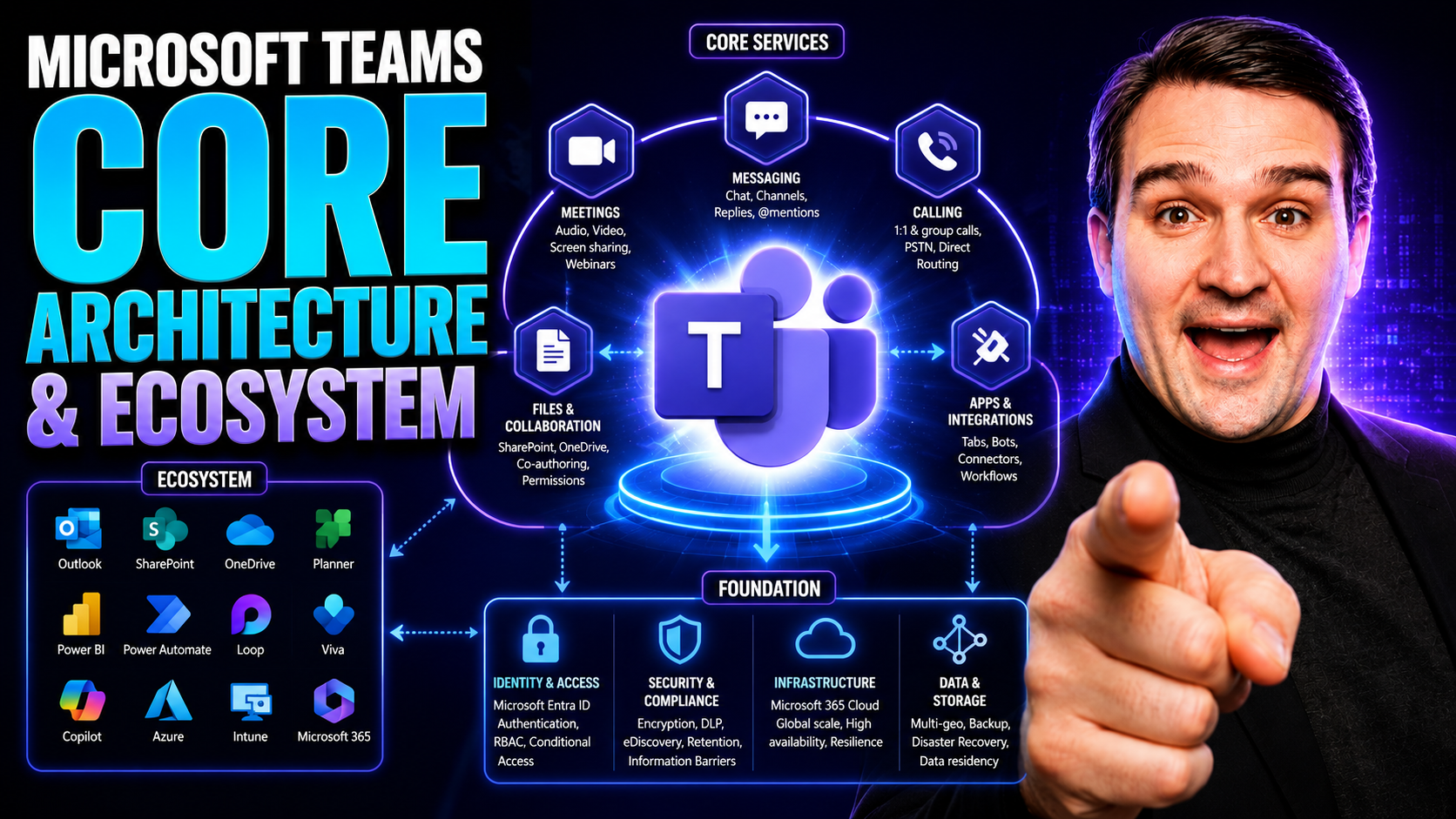
Microsoft Teams core architecture and ecosystem refers to the structural design, components, services, and integrations that enable Teams to deliver real-time collaboration, communication, and productivity features across devices and platforms. It encompasses client applications, cloud services, identity and security layers, media processing, data storage, extensibility points (apps and bots), and the integrations with Microsoft 365 and third-party services that together provide a unified collaboration experience.
Short Explanation
The architecture is built on a cloud-first, microservice-oriented model hosted primarily in Microsoft Azure. Key layers include:
- Client layer: Native and web clients for Windows, macOS, iOS, Android, and browsers that provide UI, local caching, and real-time rendering.
- Identity and access: Azure Active Directory for authentication, single sign-on, conditional access, and tenant-aware multi-organization support.
- Collaboration and data services: Graph-based APIs and Microsoft 365 services (Exchange, SharePoint, OneDrive) for chat, channels, files, calendars, and mail integration; data persisted across resilient, geo-distributed stores.
- Media and real-time services: Dedicated media nodes and services for audio/video conferencing, PSTN connectivity (via Direct Routing or Calling Plans), media relay, signaling, and quality management.
- Backend microservices: Scalable services handling messaging, presence, notifications, compliance (eDiscovery, retention), and search, designed for multi-tenant performance and reliability.
- Extensibility and ecosystem: Teams Platform allowing apps, bots, tabs, messaging extensions, and connectors built with Microsoft Graph and Bot Framework; app distribution via organizational app catalogs and the Teams App Store.
- Security, compliance, and governance: Encryption in transit and at rest, data loss prevention, information protection, auditing, and governance controls integrated with Microsoft 365 compliance tools.
Together, these components form an ecosystem that enables organizations to extend Teams with custom workflows, line-of-business apps, and third-party integrations while maintaining centralized management, security, and a consistent user experience across devices.
Introduction to Ecosystem-Oriented Architecture: Defining Unified Digital Ecosystems
Ecosystem-oriented architecture is exactly what it sounds like—a way to design your technology and business processes so everything and everyone works together, not in silos. Instead of building isolated apps or teams, you set up a shared foundation, letting platforms like Microsoft Teams and SharePoint plug into a bigger, more flexible system.
So what’s a unified digital ecosystem? Think of it as the “glue” binding together multiple tools, partners, and business units. It moves data, not roadblocks. It prioritizes interoperability (everyone gets along), data governance (nothing gets lost, nothing leaks), and collaboration, even across company lines. The experience is secure, efficient, and feels naturally integrated, whether you’re hopping in a Teams meeting or digging into a SharePoint dashboard.
Why does this matter? Digital transformation isn’t a buzzword—it’s dealing with the reality that every company now relies on constantly connected tools and constantly shifting requirements. By designing from an ecosystem perspective, organizations build resilience and innovation right into the blueprint. You get consistent user experiences, streamlined data flows, and ironclad compliance, all while encouraging agile growth.
Platforms such as Microsoft Teams showcase these principles in practice. Teams draws on a unified architecture that supports cross-platform chats, file sharing, and meetings, letting people and departments connect securely and productively. For more architect-level detail, see how AI-driven services like Copilot layer onto Teams and SharePoint in this deep dive on Microsoft Copilot’s architecture—it’s all about harmonizing tools, data access, and compliance boundaries to unlock enterprise-grade productivity.
IIBE: The Foundation Beneath Ecosystem Architecture and Innovation
The Integrated Innovation and Business Ecosystem (IIBE) model lays the groundwork for any successful digital ecosystem. Think of IIBE as the invisible but essential structure that supports your organization’s ability to innovate and adapt. It creates the rules, standards, and connections that make ecosystem-oriented architecture practical and scalable.
Within platforms like Microsoft Teams, the IIBE model is what lets organizations combine robust collaboration, compliance, and data security into one seamless system. It’s the reason teams can innovate confidently, knowing the underlying framework will protect sensitive data and support new business models. For more on turning digital chaos into confident collaboration with strong rules and guardrails, check out the strategies in Microsoft Teams Governance.
Ecosystem Architects and Core Consolidators in Modern Business
Figuring out who shapes today’s digital ecosystems isn’t just an academic question—it’s strategic. Two roles dominate the conversation: ecosystem architects and core consolidators. Each has distinct influence on how business value gets created, managed, and scaled.
Ecosystem architects are the visionaries. They design, orchestrate, and evolve the network of players, technologies, and rules that let an ecosystem thrive. Consolidators, meanwhile, focus on cementing their position at the “core”—controlling the flow of value, standardizing processes, and defending key capabilities against rivals. Both have a hand in digital strategy, but their approaches and long-term impacts diverge.
Understanding these roles is vital for decision-makers setting governance priorities or mapping out digital investments. Down in the weeds, you'll see how ecosystem architects enable agility, integration, and innovation, while core consolidators build stability and economies of scale. In the sections that follow, we’ll dig into their exact functions, use-case examples, and what their rivalry means for your organization’s position in the digital future.
Ecosystem Architects’ Core Functions in Value Networks
- Value Orchestration: Ecosystem architects coordinate the flow of value between partners, platforms, and users. This means setting up pathways for collaboration, exchange, and innovation that benefit everyone in the network.
- Partner Integration: They enable frictionless onboarding and integration of new partners—think standardized APIs, shared protocols, and modular services—so ecosystem growth doesn’t grind to a halt.
- Digital Governance: Architects define roles, policies, and compliance rules (security, data privacy, access control) to ensure collaboration stays secure and compliant. Solid governance is what prevents teams from spinning into chaos, as explained in how Teams governance drives collaboration.
- Technology Standardization: By setting shared technology standards and best practices across the network, architects make sure that everyone plays by rules that encourage stability and interoperability—supporting sustainable growth.
Strategic Roles of Ecosystem Architects Across Sectors
- Healthcare and Life Sciences: Ecosystem architects in healthcare address strict compliance (e.g., HIPAA), complex data sharing protocols, and evolving patient privacy standards. Their strategies help platforms like Microsoft Teams deliver secure, governed collaboration for care teams and research partners.
- Industrial Energy: Here, architects facilitate cross-organization data flows between suppliers, regulators, and grid operators. They focus on semantic interoperability and robust governance frameworks to handle both operational data and regulatory requirements efficiently.
- Electric Vehicles (EV): In the EV space, architects coordinate between device makers, charging networks, utilities, and customers. Ensuring interoperability and the rapid onboarding of new partners is crucial as the sector evolves fast and standards mature in real time.
- Banking and Financial Systems: For banking, ecosystem architects must balance open innovation with strict risk containment and compliance. They use standardized models and secure APIs so financial platforms can interact without propagating systemic risk or violating privacy.
Across industries, ecosystem architects drive growth by embracing modular design, compliance, and stakeholder engagement—always adjusting strategies to fit unique sector challenges.
Pros and Cons for Microsoft Teams Ecosystem Architects and Core Consolidators in Modern Business
Microsoft Teams Ecosystem Architects
Pros
- Centralized collaboration: Design a unified communication platform that consolidates chat, meetings, calling, and file sharing, improving user productivity.
- Integration-first approach: Enable seamless integration with Microsoft 365, Azure services, and third-party apps to create cohesive workflows across the enterprise.
- Scalability and reliability: Leverage Microsoft cloud infrastructure for scalable, resilient deployment and global availability.
- Security and compliance controls: Implement role-based access, data loss prevention, eDiscovery, and compliance policies to meet regulatory requirements.
- Extensibility through apps and bots: Customize experiences with Teams apps, Power Platform automation, and Teams-based workflows to address specific business needs.
- Improved user adoption: Provide a single-pane user experience that reduces context switching and simplifies end-user training and support.
- Analytics and governance: Use telemetry and governance frameworks to monitor usage, optimize costs, and enforce policies across the Teams ecosystem.
Cons
- Complex governance: Managing app sprawl, permissions, and lifecycle across many teams and tenants can be administratively heavy and error-prone.
- Integration complexity: Bridging legacy systems, custom line-of-business apps, and non-Microsoft platforms can require substantial engineering and middleware.
- Customization vs. upgrade friction: Heavy customizations can complicate updates and affect compatibility when Microsoft evolves the Teams platform.
- Vendor lock-in risk: Deep dependence on Microsoft 365 and Azure services can limit flexibility and increase long-term costs or negotiation risk.
- User experience inconsistencies: Variations in client versions, device types, and third-party integrations can lead to fragmented experiences for end users.
- Data residency and sovereignty challenges: Meeting specific regional data residency requirements can add architectural and operational complexity.
- Cost management: Scaling features like PSTN calling, storage, and third-party integrations can raise licensing and operational expenses if not tightly managed.
Core Consolidators in Modern Business
- Reduced complexity: Consolidating core systems (identity, data, communications, and services) simplifies maintenance and lowers integration overhead.
- Cost efficiency: Fewer disparate platforms reduce licensing, infrastructure, and support costs while simplifying vendor management.
- Improved data consistency: Centralized data and canonical models improve data quality, reduce duplication, and enable better analytics and decision-making.
- Stronger security posture: Unified authentication, access controls, and monitoring reduce attack surface and simplify compliance.
- Faster innovation: A stable core architecture enables faster delivery of new features and easier integration of new services into the ecosystem.
- Operational resilience: Consolidated core services can be standardized for redundancy, observability, and disaster recovery practices.
- Better developer experience: Clear core APIs and shared services accelerate application development and reduce reinvention.
Cons
- Single point of failure: Over-centralization can create critical dependencies; failures in core services have wider impact across the business.
- Change management risk: Migrating to consolidated cores requires significant planning, coordination, and potential disruption to business units.
- Organizational resistance: Teams accustomed to autonomy may resist consolidation, slowing adoption and creating shadow IT.
- Upfront costs and effort: Designing and implementing a consolidated core architecture demands upfront investment in time, skills, and project resources.
- Potential loss of specialized capabilities: Standardizing on a core can marginalize niche tools that serve specialized workflows, reducing flexibility.
- Governance overhead: Defining and enforcing standards, SLAs, and onboarding processes across diverse stakeholders adds governance work.
- Scalability trade-offs: A one-size-fits-all core may under-serve extreme scale or niche performance needs without additional architecture layering.
Business Ecosystem Design and Strategic Modeling Methods
Designing a business ecosystem isn't just about connecting partners and platforms—it's about building a system that can deliver measurable value and survive disruption. That’s where ecosystem design principles and advanced modeling strategies come into play.
Effective business ecosystems use design thinking to identify needs, align goals, and structure collaboration from the ground up. Modeling techniques allow leaders to simulate how the ecosystem will perform under different scenarios—testing assumptions and anticipating downstream effects before making big bets.
This section introduces proven ways to use quantification and simulation as tools for measuring ecosystem value, optimizing stakeholder incentives, and evolving the ecosystem iteratively. In the next segments, you’ll see how these models help fine-tune digital ecosystem strategy, with actionable takeaways for Teams, SharePoint, and beyond.
Quantification and Simulation for Measuring Ecosystem Value
- Performance Metrics: Use KPIs and scorecards to track collaboration, security, and adoption within Microsoft Teams and SharePoint. These numbers reveal whether your ecosystem is hitting targets or needs adjustments.
- Ecosystem Simulation Models: Deploy digital twins or scenario-based tools to experiment with changes (like adding a new partner or governance rule), anticipating how it’ll ripple across the network—before committing.
- Quantitative Value Analysis: Apply financial modeling and value-stream mapping to see where returns are created, and where friction or risk might sap value. AI-powered tools like M365 Copilot can automate parts of these analyses, as described in how M365 Copilot orchestrates workflows.
Technology Requirements for Scalable Digital Innovation
Building a scalable digital ecosystem calls for more than new apps or a quick lift to the cloud. You need a solid technical backbone—think tight integrations, robust security, and frameworks ready-made for future growth.
Enterprise collaboration platforms like Microsoft Teams thrive because they sit on top of architectures designed for interoperability and governed by strong compliance rules. As digital ecosystems grow, your foundation must support seamless API integrations, real-time data flow, and strict privacy controls—without buckling under scale.
In the next section, you’ll see how a unified site architecture can tie together multiple business units or customer-facing services, all while keeping governance tight and user experiences distinct. If you’re curious about how data flows and security are handled in AI-powered platforms, check out resources like how Microsoft Copilot manages data flow and architecture, privacy controls for organizational data, and best practices for hardening Microsoft Teams security. These highlight the technical and policy foundations needed for truly resilient, governable digital ecosystems.
Unified Site Architecture in Practice: Three Properties, One Solid Basis
A unified site architecture means running several distinct digital properties—like public-facing sites, employee portals, and operational dashboards—on one strategic platform. You get economies of scale and easier governance while allowing each property to keep its unique branding, purpose, and user base.
This structure is layered for interoperability and data security, ensuring seamless communication between services. For instance, you might deploy dashboards tailored to different roles in Microsoft Teams versus SharePoint. For a practical look at optimizing dashboards across Teams and SharePoint environments, see this detailed comparison.
Ecosystem Resilience in Changing Markets: Designing for Adaptability
Resilient digital ecosystems aren’t just a flashy buzzword; they’re a must-have if you want your business to stay standing through market shakeups, regulatory curveballs, or the arrival of the next big tech. At the heart of this resilience is modular design. Think of it like building with Legos: you swap out a part without toppling your whole structure. This flexibility keeps your core architecture steady, even when everything around it is changing.
But it takes more than modular blocks. Dynamic reconfiguration lets your ecosystem bend, not break, when new partners show up or old ones step out. Having “plug-and-play” integrations—where technology and business processes can be shuffled or scaled on demand—means you can bring on new collaborators (or say goodbye) without lengthy downtime or an IT fire drill.
Of course, with great connectivity comes wild risk. That’s why risk containment is central. You need smart guardrails: isolation layers to keep bad actors in one corner, trust boundaries so a breach doesn’t trigger dominoes, and constant monitoring for trouble. These design choices can keep an ecosystem functional even during big disruptions, whether it’s a regulatory shift or cyberattack.
Planning for resilience isn’t just about plugging holes—it’s a serious investment in future-proofing your value network. With tools like strong data governance and real-time access controls, you can balance innovation with stability, ensuring your digital ecosystem delivers for the long haul—no matter what tomorrow throws at you.
Microsoft Teams Core Architecture & Ecosystem Checklist
Use this checklist to validate design, deployment, security, and operational readiness for Microsoft Teams core architecture & ecosystem.
Approach and advantage in core architecture & ecosystem
What is core architecture & ecosystem?
Core architecture & ecosystem refers to the foundational structural design and the network of components, services, and participants that enable a technology platform or enterprise to operate. It covers principles of enterprise architecture, the software and hardware components, integration patterns, data flows, and the external and internal actors that supply and consume services in the ecosystem.
Why is enterprise architecture important to a core architecture & ecosystem?
Enterprise architecture provides a holistic blueprint that aligns business strategy with technology decisions. It offers insight into how systems interconnect, reduces redundant activity, helps manage risk, and enables the organization to operate more efficiently by standardizing interfaces and guiding future investments.
How does software choice affect the ecosystem?
Software choices determine compatibility, extensibility, and the ability of the ecosystem to emerge and scale. Selecting modular, standards-based software can offer integration advantages, lower supply chain risk, and make it easier to offer new capabilities or third-party extensions without disrupting core operations.
What common approaches are used to design a resilient core architecture?
Common approaches include modularization, microservices, event-driven design, and layered architecture. These approaches support decoupling components, enable independent scaling, and offer resilience by isolating failures so that critical services continue to operate during incidents.
How do ecosystems enable partners to offer complementary services?
Ecosystems provide APIs, developer tools, and governance models that allow partners to integrate and build upon the platform. By offering clear integration points and commercial models, the core architecture encourages partners to supply complementary services, creating mutual value and expanding the overall offering.
What insights can monitoring and observability provide within the ecosystem?
Monitoring and observability deliver insight into runtime behavior, performance bottlenecks, and user activity. These insights help teams optimize resource allocation, detect anomalies early, improve customer experience, and guide architectural changes to better operate at scale.
How does the core architecture support scalability as demand emerges?
Scalability is supported by design choices such as stateless services, elastic infrastructure, load balancing, and horizontal scaling strategies. As demand emerges, these mechanisms allow the system to adjust capacity automatically and maintain performance without significant redesign.
What security activities should be part of maintaining the ecosystem?
Key security activities include threat modeling, identity and access management, continuous vulnerability scanning, patch management, and incident response planning. Embedding security into the design and operation of the core architecture minimizes risk and protects both platform and partner assets.
How can organizations measure the advantage provided by their core architecture & ecosystem?
Organizations can measure advantage through metrics such as time-to-market for new features, integration time for partners, system uptime, operational cost per transaction, and customer satisfaction. These measures provide insight into the competitive and operational benefits offered by the architecture.
What role do APIs play in a core architecture & ecosystem?
APIs are the primary interface that allows internal components and external partners to interact with platform services. Well-designed APIs enable consistent integration, reduce development activity on custom connectors, and allow the ecosystem to scale by making it easier for others to offer new capabilities.
How do governance and standards influence the ecosystem’s growth?
Governance and standards define rules for interoperability, security, and compliance. By establishing clear policies and reusable patterns, governance reduces friction for partners, ensures quality, and fosters a predictable environment where new solutions can emerge and be adopted more quickly.
What operational practices help the ecosystem continue to operate effectively?
Operational best practices include automation of deployments, continuous delivery pipelines, capacity planning, runbooks for common incidents, and collaborative change management. These practices keep services reliable, reduce manual errors, and ensure coordinated updates across the ecosystem.
How can organizations ensure the ecosystem remains flexible for future needs?
To remain flexible, organizations should adopt modular designs, favor open standards, maintain clean APIs, and invest in documentation and developer tooling. This approach allows new participants to integrate, enables iterative evolution, and protects against vendor lock-in as the ecosystem evolves.
What are common pitfalls when building a core architecture & ecosystem?
Common pitfalls include overcentralization, tight coupling between components, unclear governance, neglecting developer experience, and ignoring operational costs. These issues can hinder partners from adopting the platform, slow down innovation, and increase the effort required to operate and scale.
How does data strategy fit into the core architecture & ecosystem?
A data strategy defines how data is collected, stored, governed, and shared across the ecosystem. It supplies the rules for data quality, privacy, and access, enabling reliable analytics and insight generation while ensuring compliance and trust among ecosystem participants.
What is the role of automation in operating the ecosystem?
Automation reduces manual activity, speeds up delivery, and improves consistency. Automated testing, deployment, scaling, and incident remediation allow the ecosystem to operate more reliably and with lower operational overhead, enabling teams to focus on innovation rather than repetitive tasks.
How can an organization evaluate whether to build or buy components for their core architecture?
Evaluation should consider strategic importance, total cost of ownership, time-to-value, and the ability to offer unique differentiation. If a component is core to competitive advantage, building may be appropriate; for commodity capabilities, buying or sourcing from partners often accelerates delivery and reduces supply risk.
How do collaboration and community influence ecosystem success?
Active collaboration and a vibrant community drive adoption, shared innovation, and feedback loops that improve the platform. Encouraging contributions, offering clear documentation, and recognizing partners’ efforts helps the ecosystem evolve and creates network effects that benefit all participants.
You Should Also Listen To
Strong Microsoft ecosystem architecture is not a product diagram; it connects technology choices to adoption, governance, information architecture, and business outcomes. These episodes explore those relationships:
- Microsoft 365 Copilot Adoption with Chris Hinch [Microsoft] — See how architecture becomes valuable only when users adopt repeatable scenarios that solve real work problems.
- Fix Microsoft Teams Governance Sprawl with Enforced Decisions — Understand how enforceable platform decisions prevent ecosystem growth from turning into uncontrolled sprawl.
- AI-Powered SharePoint Intranets: Beyond Static Design — Explore how AI, SharePoint, and personalization are reshaping the information layer of Microsoft 365.
- Make SharePoint Search Show the Right Files First — Learn why navigation, metadata, search, and information architecture determine whether people and Copilot can find trusted knowledge.

Microsoft MVP | Host of M365.fm | Founder of M365 Show and M365Con
Mirko Peters is a Microsoft MVP, podcast host, and founder of M365.fm, M365 Show, and M365Con. His work connects Microsoft practitioners through podcast interviews, livestreams, and community events.
At M365.fm, Mirko hosts conversations with Microsoft MVPs, product experts, architects, and community contributors. Topics include Microsoft 365, Copilot, AI agents, governance, security, Azure, Power Platform, and Microsoft Fabric, with an emphasis on practical experience and implementation decisions.
M365.fm is the podcast and learning platform. M365 Show brings experts together for livestreams, while M365Con provides an online conference setting for community learning.
Official website: Mirko Peters (https://www.mirkopeters.com/). Recognition: Mirko Peters — Microsoft MVP profile (https://mvp.microsoft.com/de-DE/mvp/profile/9b0ca797-db5a-493a-a845-8b9158046cf5). Connect on LinkedIn (https://www.linkedin.com/in/m365showpodcast/).





![Microsoft 365 Copilot Adoption with Chris Hinch [Microsoft]](https://d3wo5wojvuv7l.cloudfront.net/t_rss_itunes_square_1400/images.spreaker.com/original/914780fa7b3bc99df95a0551a3994e82.jpg "Microsoft 365 Copilot Adoption with Chris Hinch [Microsoft]")