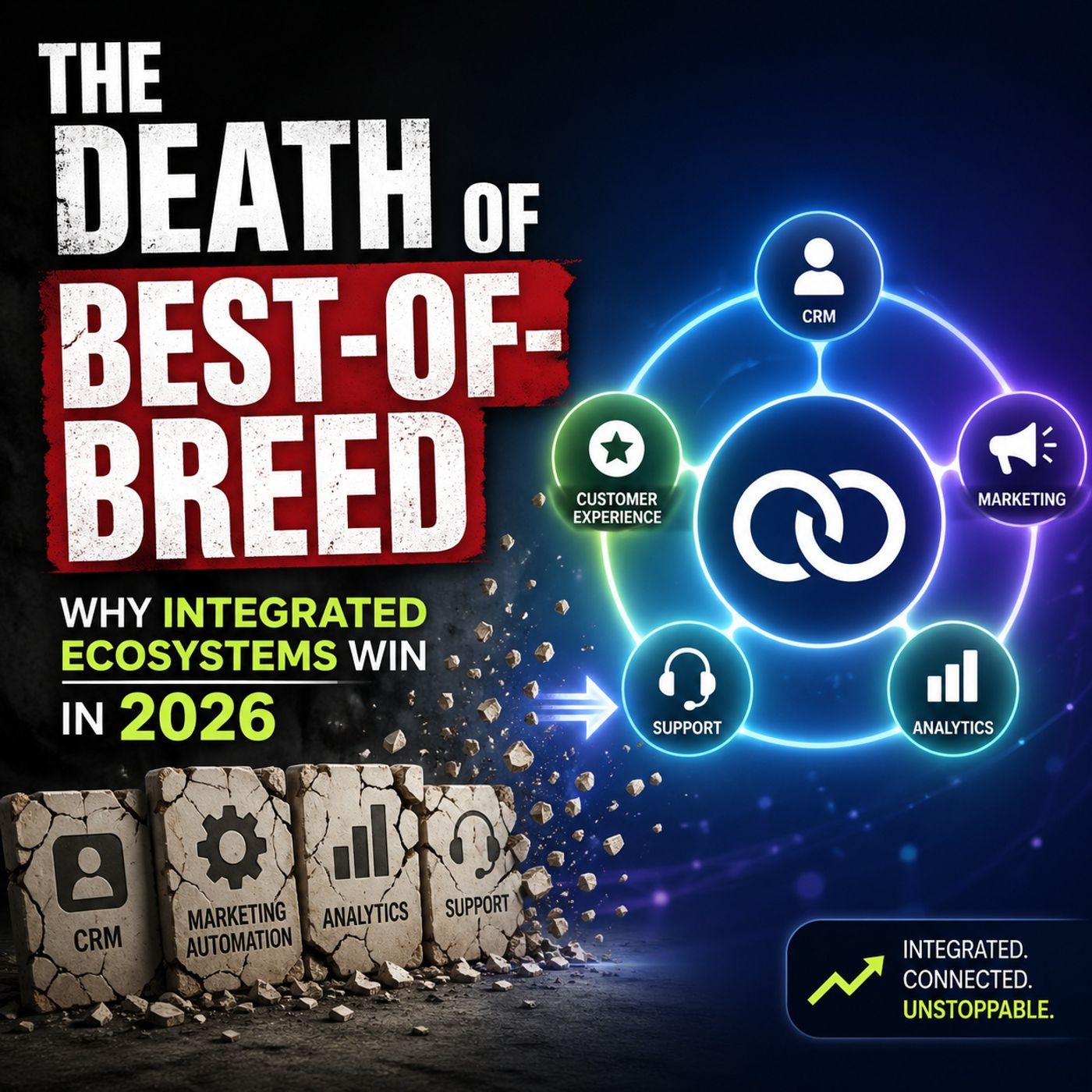
Integrated Technology Ecosystems vs Best-of-Breed Tools: Which is Right for You?
When planning your organizational tech stack, one of the most critical architecture decisions you will face is choosing between a unified, integrated technology ecosystem and a collection of standalone, best-of-breed tools. This choice impacts everything from your day-to-day data flow and IT budgets to how efficiently your teams can collaborate. In this deep dive, we will explore the fundamental differences between these two approaches, examine how they influence data fragmentation, IT costs, and overall organizational efficiency, and look at how modern frameworks leverage unified data for advanced artificial intelligence success.
Introduction to Integrated Technology Ecosystems vs. Best-of-Breed Tools
For years, organizations have been pulled in two different directions when purchasing software. On one side are best-of-breed tools, praised for offering specialized, best-in-class features tailored to a single department or narrow function. On the other side are integrated technology ecosystems—comprehensive suites provided by major vendors like Microsoft—that promise a connected experience across your entire organization. As businesses scale, the hidden costs of stitching together dozens of disparate applications often become apparent. Fragmented systems breed data silos, complicate governance, and make it difficult to harness the full power of modern technologies like AI. To make an informed choice, you must weigh the specialized depth of standalone software against the seamless connectivity of a unified ecosystem.
Understanding Unified Ecosystems
A unified ecosystem is designed around the concept of shared data architecture and seamless interoperability. Instead of forcing separate applications to communicate via brittle, custom-built scripts, a unified ecosystem relies on a central nervous system—such as Microsoft Graph—to connect user activities, documents, conversations, and business data across services. This architecture ensures that information flows naturally, giving employees a single, coherent environment to manage their work. By keeping data within a unified perimeter, organizations can streamline security, simplify user access management, and ensure that every application draws from the same trusted source of truth.
Exploring Best-of-Breed Tools
Best-of-breed tools appeal to organizations looking for hyper-specialized solutions. If your marketing team needs the absolute most advanced email automation platform, or your engineering team requires a niche issue-tracking system, a best-of-breed approach lets you procure the top-rated tool on the market for that specific task. However, this granular perfection comes with trade-offs. Each standalone tool operates within its own database, meaning it inherently lacks context regarding what is happening in the rest of your organization. Bridging these gaps requires APIs, connectors, and continuous maintenance, shifting the burden onto IT departments to keep the patchwork quilt of software from unraveling.
Impact on Data Fragmentation and Silos
Data fragmentation is one of the greatest silent killers of productivity in the modern enterprise. When your organization relies exclusively on disconnected best-of-breed tools, your data lives in separate systems. This creates organizational barriers that slow down work and make it nearly impossible to find a clear answer to simple business questions. Disconnected data forces IT teams into reactive firefighting measures like building temporary integrations, writing custom scripts, or manually synchronizing data. These fixes are expensive, time-consuming, and fragile, creating long-term technical debt and diverting IT resources away from strategic innovation initiatives.
By shifting toward an integrated technology ecosystem, you actively break down these barriers. When external data is brought into a unified environment, you eliminate the friction of manual data entry and drastically reduce the risk of conflicting information across departments. Teams can locate the information they need instantly, helping the entire organization move faster and make sharper, data-driven decisions.
IT Costs and Resource Management
At first glance, purchasing a handful of specialized best-of-breed tools might seem cost-effective or flexible. However, the total cost of ownership (TCO) tells a different story. Licensing multiple standalone applications often leads to software bloat, redundant features, and wasted spend. Furthermore, the operational overhead required to maintain custom integrations between these tools consumes valuable IT resources. Every time a vendor updates their API, your custom integration risks breaking, triggering emergency maintenance cycles.
In contrast, an integrated technology ecosystem consolidates your vendor relationships, streamlines license management, and reduces the administrative burden on your technical staff. Automated audit trails, centralized data governance, and native cross-platform functionality mean your IT team spends less time fixing broken connections and more time enabling business growth.
Organizational Efficiency and Operational Speed
Operational efficiency is deeply tied to how smoothly information travels through your workforce. When systems are integrated, workflows happen in real time. Employees no longer need to switch between half a dozen applications, copy and paste data manually, or wait for batch updates to sync overnight. Streamlined processes reduce human error, enhance cross-departmental collaboration, and accelerate decision-making cycles.
Organizations that automate data integration report substantial cost savings and massive gains in daily productivity. With real-time access to operational data, leadership teams can respond to market shifts instantly rather than waiting weeks for fragmented reports to be manually compiled.
AI Performance and Unified Data Architecture
The rise of enterprise artificial intelligence has fundamentally shifted the debate from mere convenience to operational necessity. AI models and assistants—such as Microsoft 365 Copilot—require complete, consistent, and well-contextualized data to function effectively. If your data is scattered across isolated best-of-breed platforms, your AI tools will struggle to deliver accurate, reliable results.
When you feed unified data into an AI architecture, you provide the context it needs to generate intelligent insights. Fragmented data limits AI intelligence, creates multiple versions of truth, and introduces compliance risks. Integrated ecosystems solve this by pre-indexing enterprise data and establishing clear semantic relationships, ensuring that your AI investments yield high-fidelity, actionable outputs rather than educated guesses.
Security, Governance, and Compliance
Security cannot be an afterthought when designing your tech stack. Managing security policies across dozens of independent best-of-breed tools creates vulnerabilities, as each application has its own unique permission model, encryption standards, and user management interface. If an employee leaves the company, revoking access across every disparate system manually is a recipe for oversight.
Integrated ecosystems centralize security and governance. By leveraging enterprise-grade identity management, centralized access control lists, and automated compliance policies, you ensure that sensitive data remains protected. In a unified architecture like Microsoft 365, external data ingested through connectors remains securely within your tenant, ensuring strict data privacy without sacrificing accessibility.
Scalability and Long-Term Growth
Your tech stack must be able to grow alongside your business. Best-of-breed architectures often hit a scalability ceiling as the number of integrations grows exponentially with each added tool—a phenomenon often referred to as "integration spaghetti." Maintaining these connections becomes exponentially more expensive and complex as data volume increases.
Integrated technology ecosystems are designed for elastic scalability. By utilizing cloud-native platforms, modular components, and pre-built connectors, organizations can easily ingest new data sources, scale up user populations, and expand operations without requiring major structural overhauls of their IT infrastructure.
Making the Right Choice for Your Organization
Choosing between an integrated technology ecosystem and best-of-breed tools is not always an all-or-nothing proposition. While unified ecosystems provide unmatched advantages in data coherence, AI readiness, security, and long-term cost management, some organizations may still selectively adopt specialized tools for hyper-specific niche requirements. However, the core foundation of your digital workplace should always prioritize integration over isolation.
To explore this topic further and understand how unified architectures are shaping the future of work, listen to the related episode Integrated Technology Ecosystems vs Best-of-Breed Tools. By thoughtfully planning your integration strategy and anchoring your operations in a secure, unified ecosystem, you can future-proof your organization, maximize your technology ROI, and unlock the true potential of your workforce.
🎧 Listen to this episode
Want a practical explanation of Integrated Technology Ecosystems vs Best-of-Breed Tools? This episode breaks down the topic in clear language and shows why it matters for Microsoft 365, Azure, Power Platform, security, AI, and modern work.
Listen to this episode if you want to:
- Understand the key concepts behind Integrated Technology Ecosystems vs Best-of-Breed Tools
- See how it fits into the wider Microsoft technology ecosystem
- Learn where it can create practical value for your organization
You may also enjoy these related M365 FM episodes:
- Power Platform Governance Best Practices with Craig White [MVP]
- How to Fix Azure at Scale Without Buying More Tools
- Automate Power Platform Data Entry with AI Tools
- Clean Code vs Dirty Code: Refactoring Best Practices
Discover more practical Microsoft conversations on M365 FM.

Microsoft MVP | Host of M365.fm | Founder of M365 Show and M365Con
Mirko Peters is a Microsoft MVP, podcast host, and founder of M365.fm, M365 Show, and M365Con. His work connects Microsoft practitioners through podcast interviews, livestreams, and community events.
At M365.fm, Mirko hosts conversations with Microsoft MVPs, product experts, architects, and community contributors. Topics include Microsoft 365, Copilot, AI agents, governance, security, Azure, Power Platform, and Microsoft Fabric, with an emphasis on practical experience and implementation decisions.
M365.fm is the podcast and learning platform. M365 Show brings experts together for livestreams, while M365Con provides an online conference setting for community learning.
Official website: Mirko Peters (https://www.mirkopeters.com/). Recognition: Mirko Peters — Microsoft MVP profile (https://mvp.microsoft.com/de-DE/mvp/profile/9b0ca797-db5a-493a-a845-8b9158046cf5). Connect on LinkedIn (https://www.linkedin.com/in/m365showpodcast/).