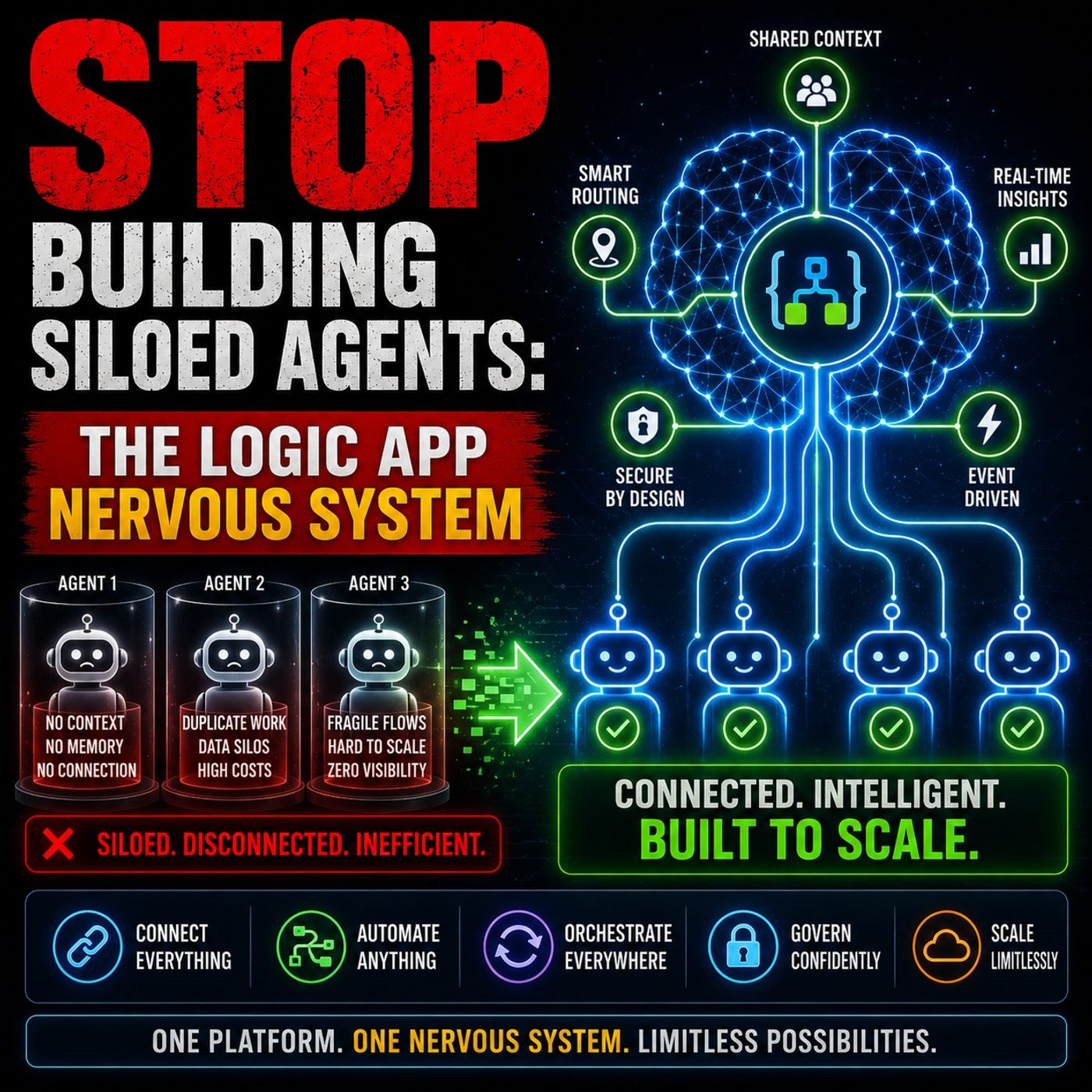
Stop Building Siloed Agents: Moving Toward a Unified Enterprise AI Architecture
Welcome back to the podcast! As we dive deeper into the world of enterprise AI and automation, I want to address a critical architectural anti-pattern that I am seeing across organizations everywhere: the tendency to spin up isolated, independent chatbots and AI agents without a cohesive master plan. When you deploy these tools haphazardly, you end up with a mess of integration sprawl, skyrocketing operational debt, and disjointed user experiences. In this deep-dive companion piece to our latest podcast episode, we are going to explore how you can transition from fragmented local optimizations to a unified, scalable enterprise-wide strategy using Azure Logic Apps.
If you want to hear a detailed, practical discussion on how to execute this shift successfully in your own environment, make sure to check out the related podcast episode: Azure Logic Apps for Multi-Agent AI Orchestration.
Stop Building Siloed Agents
The Chatbot Mirage
You might feel a sudden rush of excitement when your team builds a brand-new chatbot or autonomous AI agent. The initial demo works like magic. The agent answers questions cleanly, summarizes text, and solves localized problems instantly. This early success often tricks stakeholders into believing that multiplying these independent agents will automatically multiply business value. However, you quickly realize that these isolated tools only solve micro-problems. They do not help your entire organization collaborate or function better as a single unit.
Local vs Enterprise Optimization
When your technology strategy fixates entirely on local wins, you completely miss the macro picture. Individual departments rush to create their own specialized agents to handle departmental tasks. Unfortunately, these localized agents rarely share information, context, or triggers with one another. You wind up with a fragmented array of digital point solutions that fail to aggregate into a robust enterprise system. If you genuinely want to stop building siloed agents, you have to step back and evaluate how every single agent maps back to your broader corporate objectives.
Operational Debt
Every single standalone agent you deploy adds an invisible tax to your ongoing workload. Your engineering and IT support teams must manually maintain, update, patch, and support each one independently. Over time, this compounding dynamic creates massive operational debt. You spend more and more working hours putting out integration fires and less time driving actual business innovation. If you do not break the cycle and stop building siloed agents, your enterprise will face ballooning infrastructure costs alongside a frustrating surge in manual intervention.
Architectural Weaknesses
Demo Success vs Scale Failure
A smart chatbot can shine brightly inside a controlled pilot environment, but the landscape changes dramatically when you try to scale. One agent working in a vacuum is manageable; dozens of uncoordinated agents interacting with live databases and users will quickly create chaos. Without an intentional architectural roadmap designed to stop building siloed agents, your enterprise will inevitably encounter broken data pipelines, orphaned records, and deeply frustrated end users. You need a rock-solid structural foundation to handle genuine enterprise scale.
The Point-to-Point Trap
Many technical teams fall into the trap of wiring their agents directly to external APIs, scattered databases, or disparate SaaS tools. While this direct-connection method feels fast and straightforward during early development stages, it quickly buckles under its own weight as your agent ecosystem expands.
Integration Sprawl
- The modern enterprise now relies on an average of 110 separate SaaS applications, a staggering leap from just 8 platforms back in 2015.
- Enterprise knowledge workers spend roughly 36% of their standard workday switching back and forth between disparate apps and searching for critical information trapped inside siloed systems.
When you fail to stop building siloed agents, you inadvertently spin a tangled web of brittle, point-to-point data connections. This results in severe integration sprawl. Your core tech stack becomes exceptionally difficult to govern, and your employees waste precious hours chasing down context across disconnected networks.
Credential Proliferation
Every direct, hardcoded connection requires its own dedicated set of API keys, tokens, and database credentials. As you introduce more agents into your ecosystem, you amplify the burden of managing and rotating these secrets. This careless credential proliferation escalates your security posture risks and creates massive compliance vulnerabilities. If your goal is to stop building siloed agents, you must adopt a centralized identity, access, and orchestration framework.
Tip: Focus heavily on establishing a unified enterprise architecture. This core design choice will help you stop building siloed agents and dramatically reduce operational complexity across your entire organization.
Why Agents Fail at Scale
Reasoning vs Orchestration
It is easy to assume that deploying advanced foundational models with high reasoning capabilities will solve every business problem natively. In practice, however, raw reasoning power does not guarantee production success. Autonomous agents require strict orchestration layers to coordinate actions, share context, and execute multi-step workflows reliably. When you unleash smart agents into a production environment without proper orchestration, you face severe hurdles:
- Governance and ecosystem-wide observability become nearly impossible to maintain.
- Direct integration with legacy enterprise systems slows progress to a crawl.
- Engineering teams are forced into constant manual supervision to mitigate erratic agent behavior.
- Without standardized orchestration platforms, your AI initiatives remain permanently trapped in perpetual pilot mode.
Transitioning from aging legacy mainframes to cloud-native microservices—or merging massive enterprise databases—frequently amplifies underlying data hygiene problems. Deploying AI agents on top of messy data does not clean up those structural flaws; it almost always makes them significantly worse.
You must treat AI agents as production-grade software systems from day one. This mindset shift guarantees proper reliability, security compliance, and lifecycle management.
Stateless vs Stateful Workflows
Stateless workflows treat each individual interaction or prompt as a completely independent transaction. You typically rely on stateless designs for simple, transient tasks like generating a quick translation or running an isolated API lookup. Conversely, stateful workflows give agents the persistent memory needed to retain conversational context, evaluate historical data, and manage complex, multi-turn reasoning loops. This technical distinction fundamentally dictates how well agents perform in high-stakes enterprise scenarios.
| Aspect | Stateless Workflows | Stateful Workflows |
|---|---|---|
| Scalability | Achieves up to 99.9% linear scaling efficiency. | Bounded scalability due to active session state tracking. |
| Cost | Highly cost-efficient; ideal for high-volume, low-complexity scenarios. | 2 to 3 times more expensive due to persistent session and memory overhead. |
| Performance | Extremely fast per request execution (50ms to 150ms). | Slower per request execution (150ms to 500ms) due to context hydration. |
| User Experience | Subpar for multi-turn conversations and long-running business processes. | Superior for conversational continuity and advanced multi-step task execution. |
| Use Cases | Text translation, basic API routing, simple data classification. | Enterprise customer service, sales automation, healthcare triage, approvals. |
Process Persistence
You absolutely require robust process persistence for business workflows that stretch far beyond a single synchronous interaction. Stateless agents cannot remember what happened three steps ago. Stateful workflows, however, continuously preserve conversational context and operational state, allowing your agents to pause, wait for external triggers, and seamlessly resume execution after interruptions. This capability is indispensable for complex enterprise processes like employee onboarding, vendor approvals, and financial auditing.
Workflow Recovery
Effective workflow recovery ensures that your systems never lose operational progress when an unexpected runtime error occurs. Stateful workflow engines can capture checkpoints and restore system state instantly. This grants your organization extreme reliability and continuity, even when downstream APIs crash or network partitions disrupt your agent cluster.
Governance and Observability
You cannot effectively govern what you cannot observe. Without comprehensive ecosystem observability and granular decision tracing, you will never be able to answer fundamental audit questions like, "Why did the agent take that specific automated action?" Security auditing, forensic analysis, and organizational trust all break down completely without it. You must pair deep system observability with strict governance guardrails to guarantee production reliability and full traceability.
Untraceable Actions
When agents operate in black-box environments devoid of monitoring, critical operational risks remain completely invisible until an actual security incident occurs. You need to capture decision histories, contextual input parameters, cross-system workflow interactions, and comprehensive system logs over time. This foundational practice supports absolute accountability and satisfies rigorous enterprise compliance standards.
Fragmented Error Handling
Fragmented error handling makes proactive oversight exceptionally difficult. Your engineering teams must review, document, and act upon operational signals continuously. Proper observability surfaces critical indicators such as agent decision traces and tool utilization metrics. Governance ensures that these telemetry signals translate directly into workflow improvements, preventing minor software glitches from cascading into major enterprise disasters.
Observability is not just a best practice; it is a mandatory governance requirement for modern agent-driven systems. Regulatory frameworks like the EU AI Act explicitly mandate full technical traceability, comprehensive technical documentation, human-in-the-loop oversight, and exhaustive activity logging. You must embed these capabilities directly into your agent architecture if you want to scale successfully.
Logic Apps as the Nervous System

Imagine your enterprise organization as a complex living organism. Every individual AI agent functions much like a specialized muscle or an organ, carrying out a specific localized task. However, without a centralized nervous system, these vital parts cannot communicate, synchronize, or respond to stimuli in a unified way. Azure Logic Apps serve precisely as this central nervous system for your enterprise AI ecosystem. They coordinate operational actions, transmit secure telemetry signals, and ensure that every agent and connected business system fires at the exact right moment.
Orchestration Layer
You need much more than isolated smart agents to achieve true, measurable business transformation. Azure Logic Apps provide a powerful orchestration layer that bridges the gap between autonomous AI agents, human workers, and legacy enterprise databases. This orchestration layer acts as your central command center, guiding every agent through intricate, multi-step business logic. With this foundation, you can design resilient workflows that:
- Trigger autonomous agents automatically based on real-time enterprise business events.
- Route complex approval tasks dynamically to the appropriate human expert or downstream system.
- Blend human judgment seamlessly with automated agent execution steps.
- Monitor every single transaction meticulously for compliance, performance, and security.
By leveraging Logic Apps, you can connect your AI agents smoothly to core enterprise platforms like SAP, Salesforce, and Microsoft Dynamics. You can also deploy advanced conditional branching and parallel execution paths to process high-volume workloads efficiently. This centralized orchestration layer helps you dodge common architectural traps like unnecessary infrastructure complexity or uncontrolled latency. Furthermore, you can optimize operating costs by matching the right AI model tiers to specific workflow tasks while maintaining total visibility through built-in monitoring.
Tip: Carefully identify the exact operational bottlenecks in your workflows where human judgment is mandatory. Design your Logic App orchestration paths to include intentional human-in-the-loop checkpoints to ensure superior operational outcomes.
Effective orchestration strategies include:
- Agent Execution Loops: Allow workflows to iteratively think, act, and evaluate results in closed cycles until a defined business goal is successfully reached.
- Enterprise System Integration: Utilize native connectors to link autonomous agents directly with foundational business platforms and data lakes.
- Hybrid Execution Support: Harmoniously blend automated machine execution with authenticated human oversight.
Event-Driven Architecture
You want your enterprise agent ecosystem to remain highly responsive, resilient, and dynamically scalable. Adopting an event-driven architecture makes this goal a reality. In this modern design paradigm, your agents and workflows react instantly to discrete business events rather than idling while waiting for scheduled polling jobs. For instance, the creation of a new customer record, an incoming support ticket, or an encrypted file upload can trigger an entire enterprise workflow instantaneously.
An event-driven architecture cleanly decouples agent management from raw execution. Distributed message queues absorb sudden traffic spikes, keeping your core infrastructure rock-solid even during peak business hours. Intelligent event listeners activate agents only when fresh data actually arrives, which drastically slashes idle compute costs and accelerates throughput speed. Services like Azure Event Grid allow your agents to ingest events from virtually any source, making your overall operational architecture infinitely more adaptable.
- Your autonomous agents can react instantly to shifting business conditions.
- Information is processed immediately upon creation, eliminating unnecessary operational lag.
- Loose coupling between underlying microservices and agent loops vastly improves horizontal scalability.
Ultimately, you gain a dynamic architecture that grows seamlessly alongside your business needs and adapts gracefully to new technological demands. Event-driven design turns your Logic Apps into a true nervous system that keeps every corner of your enterprise synchronized.
Connectors as Neural Pathways
Connectors function much like biological nerve fibers within your enterprise nervous system. They bridge Logic Apps to hundreds of external SaaS platforms, legacy databases, and cloud services, ensuring that data flows smoothly and securely between your AI agents and core business applications. You can leverage these connectors to ingest external data, automate repetitive tasks, and eliminate tedious manual entry across departments.
Microsoft 365 Integration
You can easily integrate Logic Apps with core Microsoft 365 productivity tools like Microsoft Teams, Outlook, SharePoint, and OneDrive. This deep ecosystem integration empowers your AI agents to:
- Access corporate emails, shared calendars, and document repositories securely.
- Automate complex meeting schedules, administrative follow-ups, and broadcast notifications.
- Update living business documents and distribute critical project summaries across cross-functional teams.
By utilizing these native connectors, you dramatically minimize costly context switching for your employees. Your AI agents can pull relevant customer records, recent project updates, or logistics statuses directly into their active reasoning workspace. You streamline repetitive administrative burdens—such as sorting incoming communications or dispatching operational alerts—without ever forcing users to step outside of their familiar Microsoft 365 environment.
Custom APIs
Inevitably, your enterprise will need to integrate with proprietary systems or bespoke software that lacks a prebuilt connector. Logic Apps allow you to build custom APIs that act as tailored neural pathways for your architecture. Through custom connectors, you can:
- Integrate smoothly with third-party customer relationship tools, transportation management systems, or niche project management apps.
- Automate critical actions like generating support tickets, updating shipment statuses, or logging secure compliance audits.
- Apply smart validation rules to intelligently route operational tasks or react to specialized business events.
“Connectors have had a transformative impact on our enterprise operations because our teams can now securely access all the critical information they need without ever leaving their primary inbox. Furthermore, smart routing rules allow us to identify potentially harmful inbound emails and quarantine them dynamically based on telemetry alerts in our fraud detection software. This lets us verify and prevent spoofing or financial fraud attempts before our sales teams even lay eyes on them.” — Brandon Bay, EVP, Logistics Group International
Prebuilt and low-code connectors empower you to supercharge organizational productivity with minimal friction. You can automate complex workflows, eliminate human error, and boost cross-departmental efficiency effortlessly.
Key benefits of utilizing enterprise connectors:
- Centralize external data ingestion from dozens of disparate systems into a single operational view.
- Automate repetitive administrative tasks to free up human workers for high-value cognitive work.
- Simplify integration hurdles through robust prebuilt and low-code connectivity options.
By acting as the central nervous system, Logic Apps utilize these connectors to ensure every autonomous agent and enterprise system communicates with absolute clarity. You secure a unified, event-driven architectural foundation that powers long-term growth, organizational agility, and continuous innovation.
Building Agent Ecosystems

Agent Loop Action
You can build vastly smarter, self-improving agents by implementing the Agent Loop pattern. This sophisticated architectural approach allows your agents to dynamically learn and adapt over time. The standard Agent Loop operates across three distinct operational phases:
- Reasoning (Think): The agent analyzes its primary objective alongside the current real-time environment state to determine the most logical next step.
- Action (Act): The agent leverages the native connectors built into Logic Apps to execute its chosen operational step across connected enterprise systems.
- Reflection (Learn): The agent evaluates the concrete output of its action, updates its internal context, and refines its strategic approach for subsequent iterations.
The Agent Loop continuously cycles through these phases. This iterative capability ensures your agents do not simply follow rigid, hardcoded rules—they progressively optimize their performance over time. You end up with intelligent agents that continuously improve at their assigned operational duties.
Multi-Agent Collaboration
Modern enterprise challenges require multi-agent collaboration rather than isolated single-agent solutions. Dividing complex operational tasks among an ecosystem of specialized agents allows you to conquer massive business problems efficiently. For instance, within a smart healthcare architecture, one specialized agent can continuously monitor patient telemetry while a completely separate agent handles appointment scheduling and billing handoffs. This collaborative division of labor guarantees operational accuracy and absolute process continuity.
To ensure robust multi-agent collaboration, you should focus intently on several architectural pillars:
- Agent Orchestration: Control how specialized agents are initialized, executed, handed off, and safely terminated.
- Common Communication Protocols: Establish a standardized messaging schema so disparate agents can exchange structured data seamlessly.
- Reasoning and Planning Engines: Break down sweeping high-level business goals into manageable sub-tasks and distribute them to the appropriate specialist agents.
- Knowledge and Memory Management: Enable secure data sharing between agents so they never duplicate computational effort or work with stale data.
- Security and Trust Frameworks: Enforce strict role-based constraints to ensure only authorized agents can access sensitive enterprise resources.
- Human-Agent Teaming Interfaces: Provide intuitive dashboards that allow human supervisors to monitor, audit, and intervene in agent activities when necessary.
You can configure your platform so that every individual agent possesses tightly scoped tools and granular permission boundaries. This design makes it remarkably easy to onboard new agents or modify existing roles as your business landscape evolves. Your broader technical and business teams can participate in managing these workflows without requiring deep engineering overhauls.
Cross-Tenant Coordination
As your organization scales or navigates corporate mergers, you may find yourself needing AI agents to coordinate smoothly across distinct Microsoft 365 tenants. Cross-tenant coordination requires a disciplined approach to maintain ironclad security postures and uncompromised enterprise scalability.
| Aspect | Description |
|---|---|
| Cross-Tenant Operational Standardization | Utilize API-driven data normalization to keep security investigations and operational tasks uniform across all isolated tenants, creating a unified model tailored to each client's specific compliance constraints. |
| Acceleration of Detection and Response | Rapidly aggregate operational evidence and validate incoming threat signals across environments, allowing your security teams to act decisively and minimize attacker dwell time. |
| Closed-Loop Learning and Continuous Improvement | Implement automated feedback loops to refine threat detection and risk-scoring models across individual tenants, keeping your systems accurate without leaking sensitive proprietary data between boundaries. |
Identity and Security
You must protect your corporate data assets fiercely when your agents operate across complex tenant boundaries. Enforce strict multi-factor authentication and rigorous access control policies to ensure only verified, authorized agents can reach protected enterprise resources.
Managed Identities
Leveraging Azure Managed Identities eliminates the operational risk and maintenance overhead of hardcoded password sprawl. Your engineering teams no longer need to manually store, manage, or rotate static secrets. Logic Apps can utilize managed identities to authenticate securely against resources in any approved target tenant.
Workload Federation
Workload federation enables your agents to authenticate seamlessly across administrative domains without exposing static credentials. By relying on federated cloud credentials and secure token exchange protocols, you establish verifiable trust between separate tenants. This fully supports zero-trust security architectures, making your broader agent ecosystem significantly safer and vastly easier to govern.
Tip: Always construct your multi-agent ecosystems around these foundational security practices to guarantee uncompromised compliance, horizontal scalability, and continuous operational improvement.
Stateful Workflows and Memory
Stateful workflows provide your AI agents with the vital capacity to remember prior actions, track ongoing processes, and maintain continuous operational context across extended sessions. By adopting this approach, you secure an adaptive system that preserves continuity through complex, long-running business processes requiring persistent memory and careful multi-agent coordination.
Checkpointing and Persistence
Checkpointing allows your enterprise workflows to safely pause, wait for external triggers, and resume execution later without losing a single byte of operational progress. You configure strategic transactional boundaries where the workflow engine serializes and saves its current state. If a sudden runtime error or network partition occurs, your workflow can instantly restart from the most recent verified checkpoint rather than rolling back to square one.
- Checkpoints store transient intermediate results in fast memory for rapid access or persist them inside secure databases for long-term durability.
- You successfully preserve previously completed steps even if downstream microservices fail, drastically improving overall operational resilience.
- You guarantee that autonomous agents can seamlessly pick up pending tasks after interruptions, ensuring absolute process reliability.
When you implement robust checkpointing, you drastically mitigate the risk of data loss. Your AI agents can confidently manage complex business tasks that stretch across hours, days, or even weeks. This architectural maturity transforms brittle workflows into resilient, dependable enterprise pipelines.
Approval Handling
Automated agent workflows frequently reach critical decision gates that demand explicit human validation and authorization. You must design your approval mechanisms to be clean, highly secure, and exceptionally easy for human reviewers to manage. Core best practices include:
- Request only the bare minimum data needed for the decision, then gather any missing contextual information conversationally in the background.
- Keep approval requests strictly in-thread, pairing them with robust fallback paths and clearly designated business owners.
- Cleanly separate pure knowledge automation steps from impactful system modification actions.
- Tag automated workflow completions with clear metadata to ensure transparent auditing and reporting.
- Review system governance dashboards weekly and aggressively optimize the single slowest workflow step.
- Enforce strict least-privilege role assignments and keep sensitive operational flows strictly private.
- Publish concise, straightforward rules so business requesters always know what to expect from the process.
You build deep organizational trust and transparency by adhering strictly to these operational practices. Your approval pipelines remain organized, predictable, and free from administrative bottlenecks. At the same time, you protect sensitive enterprise data by locking down access privileges and isolating private execution flows.
Recovery and Coordination
Structured recovery and coordination protocols ensure your enterprise workflows continue smoothly even when individual agents crash or tasks face unexpected roadblocks. You rely on active system monitoring to detect runtime anomalies and intelligent orchestrators to manage automated remediation:
- Detection: System telemetry continuously monitors agent health, immediately flagging stalled tasks or thrown runtime exceptions.
- Isolation: The central orchestrator marks the faulty task execution as failed and retrieves the last verified workflow checkpoint.
- State Preservation: Intermediate results and contextual parameters from prior successful steps are safely protected in persistent storage.
- Recovery Action: The orchestrator automatically restarts the failed agent or spins up a fresh instance, injecting the preserved operational context.
- Resume Workflow: The newly restored agent resumes execution seamlessly from the checkpoint, while downstream dependent agents synchronize automatically.
You preserve operational continuity and eliminate the painful loss of work-in-progress data. Your enterprise architecture gracefully adapts to runtime failures by recovering rapidly and coordinating tasks cleanly across specialized agents. This discipline keeps your workflows efficient, reliable, and production-ready.
Stateful workflows and persistent memory fundamentally transform your enterprise agent ecosystem. You gain hyper-personalized user responses, master complex multi-step processes, and coordinate vast clusters of specialized agents effortlessly. Your technical architecture continuously learns from past experiences, maintains persistent operational identity, and delivers consistent results across long-running business operations.
Best Practices for Agent Integration
Custom Connectors
Your enterprise will frequently need to link AI agents to niche software or proprietary legacy databases that lack out-of-the-box connectors. Custom connectors provide the technical flexibility required to build these bridges yourself. They empower you to solve unique integration hurdles and guarantee that your agents communicate fluently with any system your business relies upon.
Here are the primary reasons custom connectors are indispensable:
- Tailored Integration Solutions: You can custom-engineer connectors designed precisely to match your unique data schemas and operational needs, guaranteeing seamless interoperability with your existing tech stack.
- Enhanced Functionality and Flexibility: Custom connectors allow you to design advanced data mapping rules and execute specialized API calls that standard out-of-the-box solutions simply cannot handle.
- Distinct Competitive Advantage: Building targeted custom integrations drastically reduces manual data entry and accelerates core business processes, driving superior productivity and enhanced customer satisfaction.
Tip: Begin by cataloging the exact internal systems that lack standard integration options. Systematically design, build, and rigorously test custom connectors for those high-priority targets to align with your broader enterprise goals.
Logic-in-API Contracts
You must establish absolute clarity regarding how your autonomous agents exchange data and execute delegated tasks. Logic-in-API contracts define these exact operational boundaries. They explicitly specify what structured input data goes into each workflow step (StepInput) and what precise output format is expected in return (StepOutput). This disciplined practice makes your enterprise workflows completely predictable and remarkably easy to govern.
Logic-in-API contracts function as formal, binding agreements between different microservices and agent loops within your architecture. Every participating agent knows precisely what data structures to expect and return. This structural rigor drastically reduces runtime confusion and operational errors. Standardizing your data flows with these contracts makes your broader agent ecosystem significantly more resilient while simplifying future updates and agent additions.
Note: Standardizing your operational data exchange using explicit logic-in-API contracts helps you eradicate silent integration failures and keeps your workflows entirely consistent, even as your enterprise architecture scales upward.
Security and Compliance
Safeguarding sensitive enterprise data is your absolute highest priority when integrating autonomous AI agents. You must enforce strict security and compliance standards to keep corporate assets secure against emerging threats.
- Encryption Standards: Mandate robust TLS 1.3 encryption for all data in transit across your network boundaries and AES-256 encryption for data stored at rest. This protects your operational payloads from unauthorized interception.
- Identity and Access Management: Implement modern authentication protocols like OAuth2 or OpenID Connect. Enforce strict Role-Based Access Control (RBAC) to limit who or what can view or modify sensitive enterprise data.
- Monitoring and Response: Connect your agent workflow telemetry directly to a centralized Security Information and Event Management (SIEM) platform. This gives your security operations team instant visibility to spot and neutralize threats rapidly.
- Regulatory Compliance: Verify that all agent integrations adhere strictly to relevant legal frameworks such as GDPR, HIPAA, and SOC 2. Embed compliance checks into your design phase rather than treating them as an afterthought.
Continuously audit your security configurations and update your access policies as the enterprise threat landscape evolves. Keeping your agent integrations locked down protects your core business and preserves hard-earned customer trust.
Error Handling Intelligence
You require robust, intelligent error handling to keep your agent integrations reliable, secure, and production-ready. True intelligent error handling goes far beyond simply catching thrown exceptions. It actively helps your teams detect anomalies early, remediate failures swiftly, and learn systematically from every operational hiccup. You build genuine organizational trust in your automated systems when your platform can transparently explain what went wrong and how it was successfully resolved.
Start by deploying a unified observability platform. Enterprise tools like Datadog, Dynatrace, or New Relic allow your engineers to monitor every agent, workflow, and connector from a single centralized pane of glass. You can ingest logs, performance traces, and automated alerts from every layer of your architecture, making it exponentially easier to diagnose issues before they impact end users.
Specialized monitoring tools are equally vital for tracking the behavioral nuances of your AI agents. Platforms like LangSmith enable you to trace, debug, and systematically evaluate multi-turn agent interactions. You can inspect every individual reasoning step an agent takes, giving you deep visibility into why it made specific operational decisions. This granular telemetry helps you optimize agent instructions and remediate logic errors much faster.
Structured logging is another mandatory engineering practice. You must log every consequential workflow action in a uniform, machine-readable format. Assign unique trace IDs to every incoming request so your engineers can follow an operational transaction from start to finish, even as it bounces across dozens of microservices. Clear, structured logs make tracking down the root cause of an unexpected failure remarkably straightforward.
Configure proactive health checks and real-time alerts for your mission-critical enterprise workflows. Automated health checks test whether your agents and connectors are responding normally. If an anomaly occurs, automated alerts notify your on-call engineers immediately, enabling rapid remediation and uninterrupted business operations.
Tip: Review your error logs, trace histories, and active alerts on a regular cadence. Look for emerging patterns, recurring bottlenecks, and systemic failure modes. Use these operational insights to refactor your workflows and prevent recurring incidents.
You must also plan proactively for the inevitable lifecycle changes of your underlying AI models and connected enterprise APIs. Foundation models and third-party APIs evolve constantly; a new upstream version can easily break an older integration or alter expected data payloads. To protect your systems, utilize strict version pinning to lock your agents and custom APIs to verified, known-good releases. Always monitor vendor release notes and test structural modifications thoroughly inside a staging environment before pushing updates to production. Gradual staged rollouts and classic adapter patterns help you absorb upstream changes without destabilizing your core workflows.
By fully embracing these engineering practices, you establish an agent ecosystem capable of handling runtime errors with intelligence and grace. You secure high operational resilience, lightning-fast recovery times, and a continuous feedback loop that makes your system stronger with every failure. This discipline keeps your enterprise integrations rock-solid as your business scales.
Getting Started with Logic Apps
Quick Wins
You can start leveraging Azure Logic Apps remarkably quickly, even if you have never built an enterprise workflow from scratch before. Logic Apps provides an intuitive, highly accessible pathway to automate repetitive business tasks and unify your fragmented software stack. You do not need to write sprawling lines of boilerplate code to achieve meaningful results. Here is a practical, step-by-step guide to help you take your very first automation steps:
- Log into the Azure Portal using your corporate Azure credentials.
- Search for "Logic App" in the top portal navigation search bar and select the service.
- Choose the hosting plan that matches your project scale. If you are just starting out or running lightweight automations, the Consumption Plan is ideal.
- Configure your Logic App instance by selecting your designated Resource Group, assigning a unique name, choosing your geographic Region, and initiating deployment.
- Build your inaugural workflow by selecting an initial trigger. For instance, you can configure a trigger that fires daily at a set hour or initiates instantly whenever a new file is uploaded to a SharePoint repository.
Tip: Always start with a small, low-risk workflow, such as automating a daily operational summary email. This simple exercise helps you understand how triggers and actions interlock smoothly.
You will see tangible results almost immediately. Logic Apps allows you to connect instantly with countless services across the Microsoft ecosystem and beyond. As you grow comfortable, you can weave additional actions into your workflows. Every small step builds your technical fluency and demonstrates the raw, transformative power of enterprise automation.
Resources and Roadmap
As you expand your Logic Apps expertise, you will naturally want to scale your automation footprint and tackle increasingly sophisticated multi-agent workflows. Microsoft provides a wealth of official documentation and tooling to support your architectural journey. The reference table below highlights key tools and features you should leverage:
| Resource | Description |
|---|---|
| Azure Logic Apps | Orchestrate complex enterprise workflows and multi-agent business processes at true Azure scale, enabling intelligent, goal-driven operational execution. |
| Power Automate Migration to Logic Apps (Standard) | Offers extreme horizontal scalability for massive enterprise workflows featuring high transactional throughput, low latency, and advanced performance optimization capabilities. |
| Azure Logic Apps Connectors | Provides hundreds of out-of-the-box enterprise connectors alongside robust custom connector authoring tools, facilitating seamless automation across teams and platforms. |
| Visual Workflow Designer | Features an intuitive web-based visual workflow designer and rich organizational templates that accelerate workflow creation, testing, and enterprise governance. |
You can leverage the visual designer to draft and iterate on complex workflows without writing manual code. Ready-made templates help your teams get started faster while embedding architectural best practices from the start. Out-of-the-box connectors let you automate repetitive tasks across your favorite business applications effortlessly. When your needs outgrow standard solutions, custom connectors allow you to bridge any proprietary enterprise gap.
Note: As your automation initiative transitions from simple scripts to enterprise-grade production systems, carefully review available Microsoft resources and map out a structured roadmap. This deliberate planning guarantees you build a secure, highly scalable automation platform for your entire organization.
By intentionally moving away from siloed, uncoordinated agents and stepping up toward orchestrated ecosystems, you unlock vastly superior enterprise AI outcomes. Fragmented systems inflate operational costs and cause autonomous agents to suffer from acute amnesia regarding prior user interactions. Centralizing your operational control plane drastically improves team collaboration and sharpens executive decision-making. A unified governance framework boosts efficiency while cutting out duplicated engineering effort. Azure Logic Apps serve as the essential nervous system for your enterprise, connecting disparate agents, data sources, and workflows into a cohesive whole. Take the next step today: begin integrating your autonomous agents and explore the power of event-driven architecture. For further guidance, review Microsoft’s official technical documentation and try building a simple workflow to experience these powerful benefits firsthand.
FAQ
What are agents in Logic Apps, and why do they matter?
Agents function as specialized digital workers embedded within your automated workflows. You utilize agents to execute discrete tasks, connect disparate enterprise systems, and process unstructured data. Agents help you construct scalable, resilient architectures and dramatically boost operational efficiency. You can coordinate multiple agents for real-time communication and adaptive workflow execution.
How do Logic Apps support real-time event-driven design?
Logic Apps leverage an event-driven design paradigm to trigger workflows instantaneously upon the arrival of new data or system signals. You can configure event-driven agents that react immediately to changes across your SaaS platforms and databases. This architectural approach delivers real-time operational updates and enables you to automate complex processes without frustrating latency delays.
Can I build multi-agent systems for complex workflows?
Yes, you can easily design and deploy sophisticated multi-agent systems using Azure Logic Apps. You assign each specialized agent a distinct operational role within your overarching architecture. These agents share contextual memory and collaborate seamlessly to complete multi-step business goals. This robust setup scales effortlessly and supports fully autonomous enterprise operations.
How do I ensure data interoperability and seamless integration?
You connect your AI agents to hundreds of external platforms using native Logic Apps connectors and custom APIs. This ensures complete data interoperability and seamless system integration. You can shuttle data cleanly between platforms, maintain continuous conversational context, and keep your enterprise workflows running smoothly.
What is the best way to test your AI solution in Logic Apps?
You should test your enterprise AI solutions by executing controlled sample workflows. Validate how your agents handle contextual memory, state persistence, and real-time event triggers. Review system logs thoroughly for runtime errors and iterate on your agent instructions to optimize performance. Rigorous testing is the key to building reliable, scalable enterprise architectures.
How do I create a standard edition logic app for AI agents?
You begin directly inside the Azure Portal. Choose to provision a new Standard Edition Logic App instance. Add your designated AI agents and configure your step-by-step workflows visually. Utilize out-of-the-box connectors for event-driven agents and real-time triggers. This robust method fully supports multi-agent systems and ensures uncompromised scalability.
What makes no-code AI agent development possible in Logic Apps?
Logic Apps provide a comprehensive, web-based visual workflow designer. You simply drag and drop actions and connectors to visually construct complex workflows for your AI agents without writing manual source code. This accessible no-code approach lets your teams focus entirely on system architecture, contextual memory, and event-driven design.
How do I manage context and memory in adaptive workflows?
You implement stateful workflows to securely store and pass contextual memory. Your agents remember past actions, evaluate historical data, and share operational information across steps. This vital capability lets you coordinate multi-agent systems and maintain reliable real-time operations. Adaptive workflows adjust gracefully to environmental changes, keeping your entire enterprise architecture flexible.
Tip: Always review your workflows to ensure proper context sharing and verify your real-time trigger configurations. This diligent practice guarantees your agents collaborate effectively and your core architecture remains rock-solid.
🎧 Listen to this episode
Want a practical, straightforward explanation of Azure Logic Apps for Multi-Agent AI Orchestration? This podcast episode breaks down this complex topic into clear, conversational language and demonstrates why it matters profoundly for Microsoft 365, Azure, Power Platform, enterprise security, artificial intelligence, and modern knowledge work.
Listen to this episode if you want to:
- Understand the core technical concepts behind Azure Logic Apps for Multi-Agent AI Orchestration.
- See how this orchestration model fits neatly into the broader Microsoft technology ecosystem.
- Learn where this architecture can create tangible, practical value for your organization today.
You may also enjoy these related M365 FM episodes:
- Azure Logic Apps - Simply Explained
- Multi-Agent AI with Microsoft Copilot and SharePoint – Reshmee Auckloo [MVP]
- Multi-Agent AI with Copilot Studio and David Lorenzo Lopez [MVP]
- Stop Microsoft Copilot Prompt Injection with Azure Logic Apps
- Scale Azure Logic Apps Beyond Custom Connectors
Discover more practical Microsoft technical conversations on M365 FM.
Last reviewed: July 2026.
Who Should Listen
This episode is crafted specifically for Microsoft administrators, cloud architects, software developers, cybersecurity professionals, and forward-thinking business leaders who require a practical technical foundation before making critical implementation, operations, or governance decisions.
🎧 You Should Also Listen To
- AI Agents — A strongly related next step for expanding your mastery of this topic.
- Power Platform — A strongly related next step for expanding your mastery of this topic.
- Microsoft Graph Data Connect — A strongly related next step for expanding your mastery of this topic.

Microsoft MVP | Host of M365.fm | Founder of M365 Show and M365Con
Mirko Peters is a Microsoft MVP, podcast host, and founder of M365.fm, M365 Show, and M365Con. His work connects Microsoft practitioners through podcast interviews, livestreams, and community events.
At M365.fm, Mirko hosts conversations with Microsoft MVPs, product experts, architects, and community contributors. Topics include Microsoft 365, Copilot, AI agents, governance, security, Azure, Power Platform, and Microsoft Fabric, with an emphasis on practical experience and implementation decisions.
M365.fm is the podcast and learning platform. M365 Show brings experts together for livestreams, while M365Con provides an online conference setting for community learning.
Official website: Mirko Peters (https://www.mirkopeters.com/). Recognition: Mirko Peters — Microsoft MVP profile (https://mvp.microsoft.com/de-DE/mvp/profile/9b0ca797-db5a-493a-a845-8b9158046cf5). Connect on LinkedIn (https://www.linkedin.com/in/m365showpodcast/).