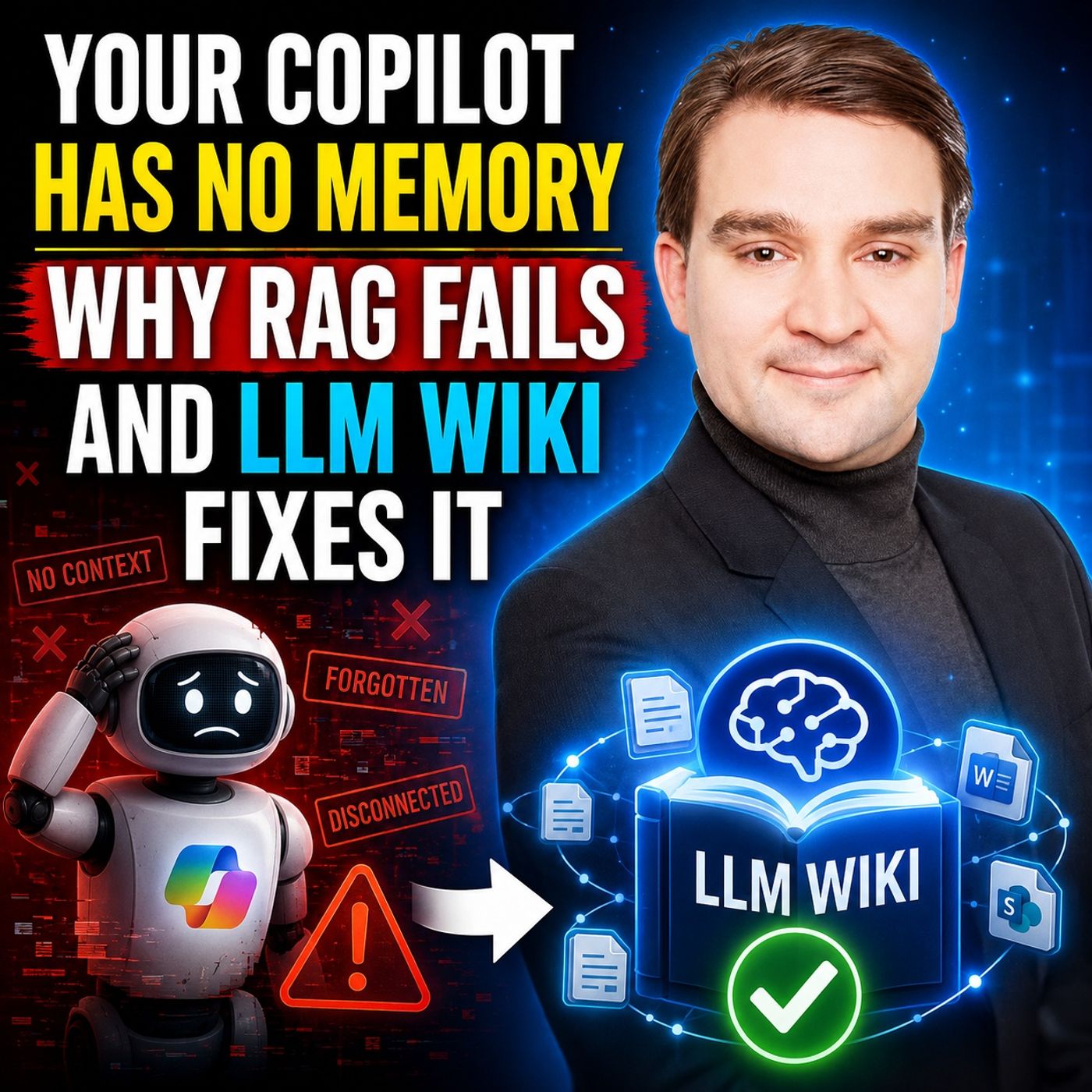
The Stateless RAG Trap: Why Query-Time AI Architecture Falls Short
Welcome back to the blog! If you have been following along with our podcast discussions on enterprise artificial intelligence, you know we spend a lot of time looking past the initial hype of modern productivity tools. In a standard demonstration, tools like Microsoft Copilot can feel remarkably intelligent. They can find a project document, summarize a policy, extract information from SharePoint, and connect pieces of enterprise content into a convincing answer. But there is a fundamental architectural limitation hiding behind that impressive user experience: retrieval is not memory. Copilot can search your organization, but that does not mean it has built a persistent understanding of your organization. In this post, we are going to dive deep into the mechanics of Retrieval-Augmented Generation to understand how chunking and stateless query loops prevent AI from retaining accumulated context across enterprise interactions. Be sure to check out the related podcast episode, Your Copilot Has No Memory — Why RAG Fails and LLM Wiki Fixes It, for a deeper audio breakdown of these concepts.
Copilot doesn't remember — it retrieves
The experience of using Copilot creates an important illusion. When it successfully connects information from Microsoft 365, it can appear as though the system has learned something about your organization. Ask a similar question later, however, and the system may produce a different result because it performs another retrieval operation rather than simply recalling the understanding it established previously. That distinction becomes critical when organizations move beyond basic summarization and start expecting AI to support real decisions.
If essentially identical questions can produce inconsistent answers depending on which information was retrieved, users quickly become reluctant to rely on AI for business-critical work. The result can become an adoption problem rather than merely a technical problem. Users want predictability, and when an assistant gives one answer on Monday and a contradictory answer on Thursday for the exact same prompt, trust begins to erode rapidly.
What Retrieval-Augmented Generation actually does
RAG stands for Retrieval-Augmented Generation. At a simplified level, enterprise documents are divided into chunks, those chunks are represented through embeddings, a user's question is transformed into a comparable representation, and the system searches for semantically relevant chunks. The highest-ranking pieces of information are then supplied to the language model as context for generating its response.
This architecture is extremely useful. It allows a large language model to answer questions using information that was never part of its original training data and provides a practical way to ground AI responses in enterprise content. But it also creates an important architectural constraint: the model receives fragments selected for the current query rather than maintaining a complete persistent representation of the organization's knowledge.
The chunking problem
Enterprise knowledge rarely exists as isolated paragraphs. A project plan might contain dependencies distributed across dozens of pages. A policy might reference another policy. A technical architecture could depend on decisions documented months earlier in meeting notes, Teams conversations, SharePoint pages, and design documents.
Traditional RAG breaks those sources into smaller units and determines which fragments appear relevant to the current question. The model therefore sees selected pieces rather than necessarily understanding the complete document and all of its relationships. For straightforward information retrieval, that can work extremely well. For questions requiring relationships, historical context, dependencies, accumulated decisions, or reasoning across many sources, the limitations become much more visible.
The stateless RAG trap
A conventional retrieval workflow has no inherent concept of something being already figured out. A question is received, information is retrieved, an answer is generated, and the process effectively starts again for the next retrieval operation. This is the exact point where RAG's statelessness becomes a major hurdle.
Knowledge discovered during one interaction does not automatically become durable organizational knowledge available to every future interaction. For enterprise AI, this is a massive distinction. Organizations do not simply need better search. They increasingly need systems capable of maintaining a structured understanding of projects, processes, policies, technologies, people, decisions, dependencies, and the relationships connecting them.
Searching for knowledge vs. compiling knowledge
This leads to the central architectural idea we explore in our latest audio series: instead of repeatedly reconstructing organizational knowledge at query time, what if AI compiled that knowledge beforehand? An LLM Wiki represents that shift in thinking.
Rather than treating every enterprise document as another collection of fragments waiting for retrieval, artificial intelligence can synthesize information into structured knowledge artifacts that represent what the organization currently understands. The important change is not simply another user interface. It is moving intelligence from query-time reconstruction toward persistent knowledge synthesis.
Why an LLM Wiki changes the model
Imagine thousands of documents describing the same product, customer, project, policy, or architecture. Traditional RAG waits for a question and then tries to locate the fragments most likely to answer it. An LLM Wiki approach instead attempts to continuously transform those fragmented sources into coherent knowledge pages.
Relationships, decisions, definitions, dependencies, historical context, and supporting sources can become part of a maintained knowledge representation. Copilot or another AI agent can then retrieve from a layer containing synthesized organizational understanding instead of repeatedly attempting to reconstruct that understanding from raw documents.
From document repository to knowledge layer
This changes the role of systems such as SharePoint. SharePoint can continue serving as the authoritative repository for documents, pages, policies, presentations, meeting artifacts, and collaboration content. But raw enterprise content does not automatically constitute usable organizational knowledge.
An AI-generated knowledge layer can sit above those source systems and transform scattered information into something closer to an organizational map: projects connected to decisions, policies connected to processes, systems connected to owners, and concepts connected to their supporting evidence. The goal is not to eliminate source documents. It is to make the relationships hidden inside them explicit.
Why better prompts don't solve the architecture
Prompt engineering can improve how an LLM interprets retrieved context, but it cannot guarantee that the correct context was retrieved in the first place. If the retrieval layer returns incomplete fragments, misses an important dependency, or surfaces an outdated document, even an excellent model is reasoning over an incomplete information set.
This is why improving the model alone cannot solve every enterprise AI problem. The quality and structure of the knowledge supplied to the model remain fundamental. No amount of prompt wizardry can fix an underlying architecture that relies on fleeting search results instead of structured, persistent memory.
The governance problem gets bigger
There is also a significant warning attached to this architecture. If an organization's SharePoint environment contains obsolete policies, duplicate documentation, abandoned processes, contradictory instructions, or documents without clear ownership, an LLM Wiki can synthesize that bad information just as efficiently as it synthesizes good information.
The danger is that synthesized knowledge can look considerably cleaner and more authoritative than the underlying content deserves. AI therefore makes traditional information governance more important rather than less important. Content ownership, lifecycle management, versioning, retention, archival processes, authoritative sources, metadata, and clearly defined systems of record become foundational components of AI architecture.
AI readiness starts with content quality
Organizations frequently approach Copilot readiness as a licensing, security, deployment, or training project. Those elements matter, but the underlying knowledge environment matters just as much. If nobody knows which document represents the current process, the AI cannot magically resolve the organizational ambiguity.
If three departments maintain contradictory versions of a policy, AI has inherited three versions of the truth. If obsolete documentation remains searchable indefinitely, it remains potential grounding material. Enterprise AI therefore exposes knowledge-management debt that organizations could previously ignore.
Why trust determines Copilot adoption
The technical consequences quickly become business consequences. Users may tolerate occasional inconsistencies when AI is used for drafting an email or summarizing a meeting. They become much less tolerant when AI is expected to explain policy, support customer decisions, interpret project status, provide compliance information, or guide operational processes.
Once users experience inconsistent answers to important questions, they frequently return to trusted human experts and established manual processes. This is a major reason why Copilot adoption can flatten even after an apparently successful rollout. Trust therefore becomes an architectural requirement, not merely an adoption metric.
Conclusion
In summary, while Retrieval-Augmented Generation has given enterprise AI a powerful way to tap into external documents, its stateless query loops and chunking limitations mean it often falls short of true organizational memory. Without persistent knowledge compilation, systems like Copilot will continue to struggle with consistency, deep contextual relationships, and enterprise trust. Transitioning from raw document repositories to a structured, compiled knowledge layer—such as the emerging LLM Wiki approach—is the key to bridging the gap between flashy demos and reliable business tools. To explore this topic further and hear our full analysis on fixing enterprise AI memory, make sure you listen to the complete episode over at Your Copilot Has No Memory — Why RAG Fails and LLM Wiki Fixes It.

Founder of M365 Show, M365con.net & m365.fm
Mirko Peters is a Microsoft 365 expert, content creator, and founder of m365.fm, a platform dedicated to sharing practical insights on modern workplace technologies. His work focuses on Microsoft 365 governance, security, collaboration, and real-world implementation strategies.
Through his podcast and written content, Mirko provides hands-on guidance for IT professionals, architects, and business leaders navigating the complexities of Microsoft 365. He is known for translating complex topics into clear, actionable advice, often highlighting common mistakes and overlooked risks in real-world environments.
With a strong emphasis on community contribution and knowledge sharing, Mirko is actively building a platform that connects experts, shares experiences, and helps organizations get the most out of their Microsoft 365 investments.