


 Apple Podcasts
 Spotify
 Youtube Music
 Spreaker
 Podchaser
 Amazon Music
 Dynamics 365 Master Planning - Simply Explained
Key Takeaways
- Dynamics 365 Master Planning connects customer demand, inventory, purchasing, production, and lead times into one unified supply plan instead of relying on disconnected spreadsheets.
- Master planning evaluates both quantity and timing together, ensuring components arrive exactly when production needs them rather than just verifying total stock counts.
- The system offers three primary planning modes—Master Planning for short-term net requirements, Forecast Planning for gross demand expectations, and Intercompany Master Planning across legal entities.
- Using a Bill of Materials (BOM) and production routes, Dynamics 365 works backward from customer delivery dates to generate planned purchase, production, and transfer orders automatically.
- Features like pegging, marking, and reservations provide varying levels of traceability and hard-locking between supply sources and demand transactions to prevent allocation errors.
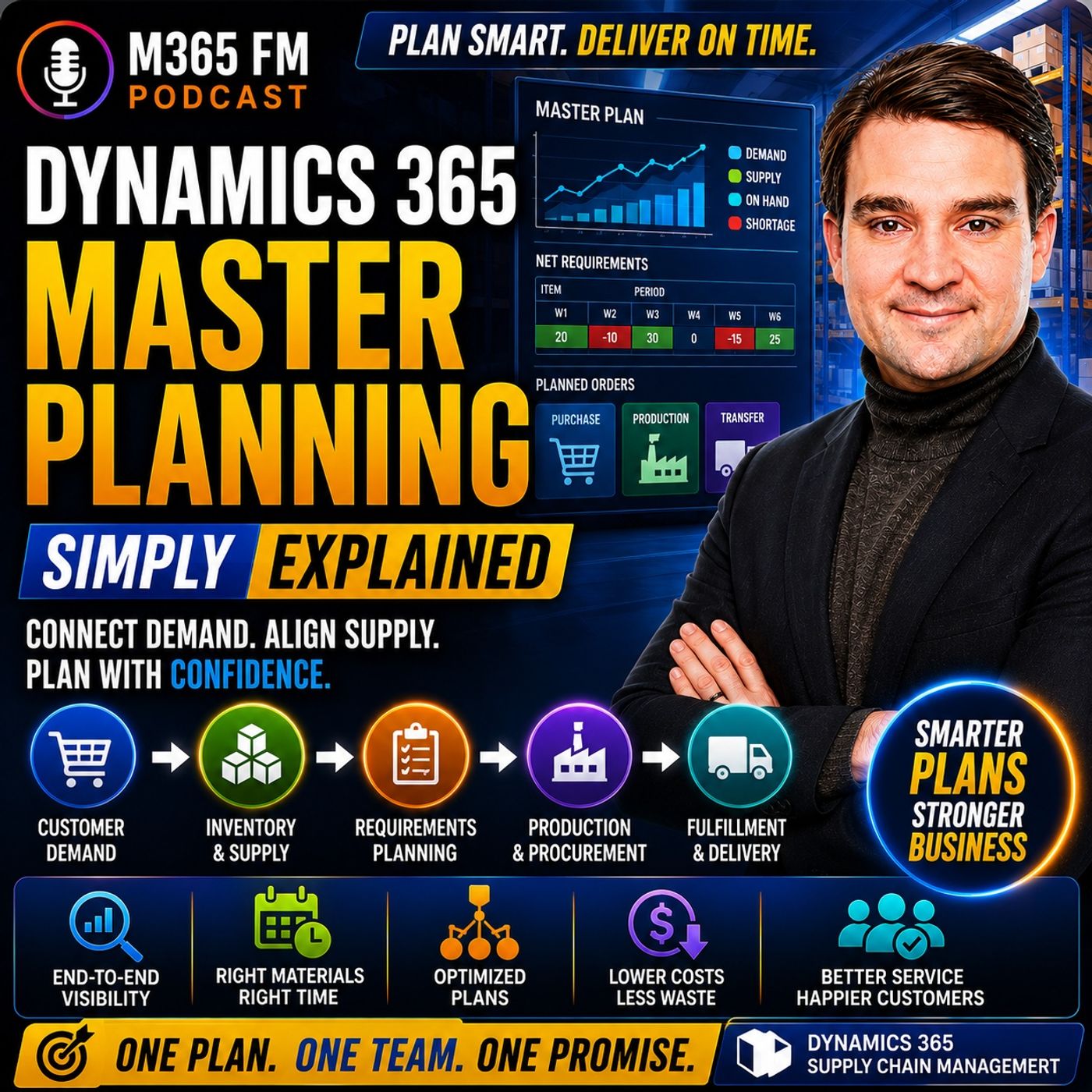
A customer wants 100 bicycles next month. You already have some finished bicycles in stock, wheels are arriving from a supplier, frames are stored somewhere else, and your production line is booked for the next two weeks. What should you buy, what should you build, what should you move—and when does each action need to happen? In this episode of M365 FM, Mirko Peters explains how Dynamics 365 Master Planning connects customer demand, inventory, purchasing, production, bills of materials, lead times, capacity, forecasts, and planned orders to create one connected supply plan.
WHAT IS DYNAMICS 365 MASTER PLANNING?
Dynamics 365 Master Planning is the part of Supply Chain Management that determines how future demand should be covered. Think of your business as an office building with a stockroom attached. Customer orders enter through one door. Inventory sits on shelves. Suppliers deliver materials. Production converts components into finished products. Master Planning looks across all of these activities instead of allowing each team to maintain its own disconnected plan. It combines current demand and available or expected supply, identifies shortages, and suggests actions for planners to review.
WHY A STOCK COUNT ISN'T ENOUGH
Imagine a customer orders 100 bicycles and your warehouse currently contains 30. You still need 70. But those 70 bicycles require frames, wheels, chains, seats, bolts, packaging, employees, machines, and enough production time. A simple inventory report tells you what exists now. It doesn't tell you whether the missing components can arrive before production needs them or whether the factory has enough time to complete the order. Master Planning connects quantity with time.
FROM SPREADSHEETS TO CONNECTED PLANNING
Without connected planning, sales might maintain customer orders in one system while warehouse employees check inventory somewhere else. Purchasing tracks supplier dates in spreadsheets and emails. Production maintains another schedule describing what the factory can build. Each individual list might be correct, but somebody still needs to connect everything to answer one question: Can we deliver what the customer ordered by the promised date? Dynamics 365 Master Planning brings these demand and supply signals together.
MASTER PLANNING VS A SPREADSHEET
Think of a spreadsheet as a photograph. It can provide a useful snapshot of inventory at a particular moment. Master Planning is closer to a forward-looking schedule. It considers quantities alongside dates, future demand, incoming supply, production requirements, and existing inventory. When one of those elements changes, the planning picture can change as well.
THE THREE PLANNING MODES
Dynamics 365 doesn't provide only one way to plan. The episode explains three different planning scenarios: Master Planning focuses on day-to-day and shorter-term requirements. Forecast Planning looks at expected future demand. Intercompany Master Planning connects demand and supply requirements between legal entities. Each starts with demand but answers a different planning question.
MASTER PLANNING AND NET REQUIREMENTS
Master Planning calculates net requirements. The basic concept is straightforward: Demand – Available or Expected Supply = Remaining Requirement Suppose a customer orders 100 units and the warehouse has 30 available. The remaining requirement is 70. If another 20 units are already scheduled to arrive from a supplier before the customer's required date, the uncovered requirement becomes smaller again. Dynamics 365 therefore doesn't simply suggest purchasing or producing the complete customer quantity. It considers supply that already exists or is expected to arrive.
WHY DATES CHANGE THE ANSWER
Having enough inventory eventually isn't the same as having enough inventory when it's required. Suppose 20 additional bicycles arrive from a supplier. If they arrive before the customer needs them, they can help satisfy the demand. If they arrive afterward, they don't solve this particular shortage. Master Planning therefore considers quantity and timing together. A total inventory number without dates can provide a misleading picture of whether customer demand can actually be fulfilled.
THE PLANNING HORIZON
The appropriate planning horizon depends on the business. A company purchasing simple products locally might only need to look several weeks ahead. A manufacturer using components with long supplier lead times may need to plan months ahead. The important principle is that planning needs to look far enough forward to identify shortages while there is still time to respond. Discovering a shortage after the required purchasing or production date has already passed provides very little value.
FORECAST PLANNING
Forecast Planning begins with expected demand rather than confirmed customer orders. A bicycle manufacturer might expect demand to increase during summer. A retailer might anticipate significantly higher sales during a promotion. Waiting until every customer order arrives could leave insufficient time to purchase materials or reserve production capacity. Forecast Planning gives organizations an earlier view of the workload they expect to face.
GROSS REQUIREMENTS
Forecast Planning calculates gross requirements based on expected demand. If the forecast predicts demand for 500 bicycles in July, planning begins with that expected requirement. The organization can then consider the materials, supplier capacity, warehouse space, and production resources potentially required to support that volume. Forecasts aren't guaranteed customer orders. They provide a planning signal allowing the business to prepare before confirmed demand arrives.
INTERCOMPANY MASTER PLANNING
Large organizations may operate several legal entities. One company might manufacture a product while another sells that product in another country. The selling company sees customer demand. The manufacturing company needs visibility into the supply requirements created by that demand. Intercompany Master Planning carries planning signals across company boundaries so each legal entity doesn't plan as though it operates completely independently.
FROM ONE ORDER TO A CHAIN OF SUPPLY
A finished product can create demand for many lower-level components. Suppose a customer orders 70 bicycles. Dynamics 365 can examine the structure of the finished bicycle and determine which components are required to produce those 70 units. That might create requirements for 70 frames, 140 wheels, 70 chains, 70 seats, and hundreds of smaller components. This is where the Bill of Materials becomes critical.
BILL OF MATERIALS EXPLAINED
A Bill of Materials, commonly called a BOM, is essentially the recipe for a manufactured product. For a bicycle, it identifies the frames, wheels, chains, seats, handlebars, brakes, bolts, and other components required for production. Master Planning can expand demand for the finished product into requirements for the components underneath it. Planners therefore don't need to manually calculate every component requirement whenever customer demand changes.
PRODUCTION ROUTES
Having every component available still doesn't automatically create a finished product. Production requires work. A route describes the steps required to manufacture the item. For a bicycle, those steps might include assembling the frame, installing wheels, checking brakes, and packing the finished product. Each operation can require resources such as employees, assembly lines, workbenches, machines, or specialized equipment.
PLANNING BACKWARD FROM THE CUSTOMER DATE
Suppose the customer needs the bicycles on Friday. Production might need to finish Thursday so the warehouse has time to prepare the shipment. Assembly might therefore need to begin Tuesday. Components might need to be available Monday. If a supplier requires ten days to deliver wheels, the purchase order must be placed considerably earlier. The customer delivery date therefore creates a chain of dependent dates stretching backward through production and purchasing.
LEAD TIMES
A lead time represents how long an activity takes. A supplier might require ten days to deliver components. A warehouse transfer could require two days. A production process might require three days. Master Planning uses these lead times when calculating when supply needs to become available. Incorrect lead times can therefore produce incorrect planning suggestions even when the planning calculation itself works perfectly.
PLANNED ORDERS
When existing supply can't cover demand, Dynamics 365 can create a planned order. A planned purchase order suggests buying something from a supplier. A planned production order suggests manufacturing something internally. A planned transfer order suggests moving inventory from another site or warehouse. These planned orders contain suggested quantities and dates based on the information available to the planning engine.
PLANNED ORDERS ARE SUGGESTIONS
A planned order isn't automatically a commitment. Dynamics 365 doesn't need to silently send a purchase order to the supplier or begin production simply because the planning calculation identified a shortage. The planner reviews the suggestion. Is the proposed supplier appropriate? Is the delivery date realistic? Does the quantity make sense? Can production actually handle the work? Master Planning provides the recommendation while the planner remains responsible for the decision.
Become a supporter of this podcast: https://www.spreaker.com/podcast/m365-fm-modern-work-security-and-productivity-with-microsoft-365--6704921/support.
🚀 Want to be part of m365.fm?
Then stop just listening… and start showing up.
👉 Connect with me on LinkedIn and let’s make something happen:
- 🎙️ Be a podcast guest and share your story
- 🎧 Host your own episode (yes, seriously)
- 💡 Pitch topics the community actually wants to hear
- 🌍 Build your personal brand in the Microsoft 365 space
This isn’t just a podcast — it’s a platform for people who take action.
🔥 Most people wait. The best ones don’t.
👉 Connect with me on LinkedIn and send me a message:
"I want in"
Let’s build something awesome 👊
Frequently Asked Questions
What is Dynamics 365 Master Planning?
Dynamics 365 Master Planning is a Supply Chain Management module that determines how future demand should be covered by connecting customer orders, inventory, purchasing, and production schedules into one unified plan.
How do net requirements work in Dynamics 365?
Net requirements are calculated by taking total demand and subtracting available or expected supply, ensuring the system only plans for the remaining shortage rather than duplicating existing inventory.
What is the difference between static and dynamic plans in Dynamics 365?
A static plan remains stable until the next scheduled master planning run, providing a consistent view for the day, whereas a dynamic plan instantly reflects real-time demand changes as they happen.
What is pegging in Dynamics 365 Master Planning?
Pegging is the system's automatic planning link that connects a specific demand transaction, such as a sales order, with its covering supply source, such as a purchase order or inventory.
00:00:00,000 --> 00:00:03,840
Imagine a customer wants 100 bicycles next month, the frames arrive late.
2
00:00:03,840 --> 00:00:07,040
The wheels sit in a different warehouse, and your assembly line already has work booked
3
00:00:07,040 --> 00:00:08,040
for the next two weeks.
4
00:00:08,040 --> 00:00:08,880
So what do you buy?
5
00:00:08,880 --> 00:00:09,880
What do you build?
6
00:00:09,880 --> 00:00:10,880
What do you move?
7
00:00:10,880 --> 00:00:11,880
And when do you need each piece?
8
00:00:11,880 --> 00:00:15,680
EOtem and Mirko Peters from M365 FM.
9
00:00:15,680 --> 00:00:20,680
This knowledge nugget is about Dynamics 365 Master Planning AU, the part of supply chain
10
00:00:20,680 --> 00:00:24,240
management that works through those questions behind the scenes.
11
00:00:24,240 --> 00:00:27,520
Think of your business like an office building with a stockroom attached.
12
00:00:27,520 --> 00:00:31,480
Mothers come through one door, inventory sits on shelves, suppliers bring goods to the loading
13
00:00:31,480 --> 00:00:34,480
dock, production turns parts into finished products.
14
00:00:34,480 --> 00:00:39,320
Master Planning looks across the whole building, instead of leaving each team with its own separate
15
00:00:39,320 --> 00:00:40,320
list.
16
00:00:40,320 --> 00:00:44,760
Today we, Goodtem and will follow one bicycle order from the customer request all the
17
00:00:44,760 --> 00:00:48,400
way to the supply actions Dynamics 365 suggests.
18
00:00:48,400 --> 00:00:51,560
Why businesses need a plan, not a spreadsheet?
19
00:00:51,560 --> 00:00:55,960
Before connected planning tools existed, companies worked from separate pieces of information.
20
00:00:55,960 --> 00:00:58,080
Sales had customer orders in one place.
21
00:00:58,080 --> 00:01:01,840
Warehouse teams checked stock in another system, purchasing tracked supply updates and emails
22
00:01:01,840 --> 00:01:03,080
or spreadsheets.
23
00:01:03,080 --> 00:01:06,600
And production kept its own notes about what the factory could build this week.
24
00:01:06,600 --> 00:01:08,080
Each list looked correct on its own.
25
00:01:08,080 --> 00:01:10,960
The trouble started when someone tried to answer one customer question.
26
00:01:10,960 --> 00:01:13,760
"Oh can we deliver 100 bicycles by the date we promised?"
27
00:01:13,760 --> 00:01:17,600
Aeolitaoctums imagine the warehouse holds 30 finished bicycles today.
28
00:01:17,600 --> 00:01:19,080
That sounds like a good start.
29
00:01:19,080 --> 00:01:21,600
But the order still needs another 70 bicycles.
30
00:01:21,600 --> 00:01:26,320
And those 70 bicycles need frames, wheels, chains, seats, bolts, packing materials, people
31
00:01:26,320 --> 00:01:29,080
to assemble them and time on the right machines.
32
00:01:29,080 --> 00:01:33,440
A simple stock count only tells you what sits on the shelf right now.
33
00:01:33,440 --> 00:01:36,600
It does know it's time to tell you whether 70 more frames can arrive before production needs
34
00:01:36,600 --> 00:01:37,600
them.
35
00:01:37,600 --> 00:01:40,840
It does know, tell you whether an open purchase order already covers the wheels.
36
00:01:40,840 --> 00:01:43,520
And it does know it's time to tell you whether the factory has enough time to put everything
37
00:01:43,520 --> 00:01:45,400
together before the delivery date.
38
00:01:45,400 --> 00:01:51,000
Here out in is the thing, "Oh, that out in as we're planning becomes more than counting."
39
00:01:51,000 --> 00:01:54,480
When a customer orders 100 bicycles, the system looks at the demand for 100.
40
00:01:54,480 --> 00:01:56,880
It subtracts the 30 bicycles already available.
41
00:01:56,880 --> 00:01:59,920
Then it traces what must happen for the remaining 70.
42
00:01:59,920 --> 00:02:02,080
It checks the parts below the finished bicycle.
43
00:02:02,080 --> 00:02:04,040
It checks the supply already on its way.
44
00:02:04,040 --> 00:02:06,640
And it checks the dates attached to every piece of work.
45
00:02:06,640 --> 00:02:08,600
One missing part can change the whole answer.
46
00:02:08,600 --> 00:02:10,800
You might have enough wheels and enough seats.
47
00:02:10,800 --> 00:02:14,480
But if the frames need two weeks from a supplier, buying them the day before assembly will
48
00:02:14,480 --> 00:02:16,120
now suit them into the help.
49
00:02:16,120 --> 00:02:20,560
The order can look possible on a spreadsheet until you place every part on a calendar.
50
00:02:20,560 --> 00:02:22,200
And that calendar changes all the time.
51
00:02:22,200 --> 00:02:24,680
A supplier might move their delivery date earlier.
52
00:02:24,680 --> 00:02:27,200
Another sales order might take stock you thought was free.
53
00:02:27,200 --> 00:02:28,800
A production job might finish late.
54
00:02:28,800 --> 00:02:33,400
When those details live in separate places, people spend all their time calling, emailing,
55
00:02:33,400 --> 00:02:36,440
checking and updating their own version of the plan.
56
00:02:36,440 --> 00:02:38,120
Dynamics 365.
57
00:02:38,120 --> 00:02:41,880
Master planning pulls the current demand and current supply into one planning view.
58
00:02:41,880 --> 00:02:46,560
It reads "Custom orders, stock on hand, incoming supply and production information together."
59
00:02:46,560 --> 00:02:49,680
Then it works out where supply covers demand and where a gap remains.
60
00:02:49,680 --> 00:02:53,720
Instead of asking each team to manually connect the dots, the system creates suggested actions
61
00:02:53,720 --> 00:02:55,800
based on the information it can see.
62
00:02:55,800 --> 00:02:58,880
Now that does not mean the system runs the business by itself.
63
00:02:58,880 --> 00:03:03,640
A planner still checks the suggestions, asks questions and decides what should happen.
64
00:03:03,640 --> 00:03:07,320
But the planner starts with a connected picture rather than a pile of separate lists.
65
00:03:07,320 --> 00:03:09,120
Think of a spreadsheet as a photograph.
66
00:03:09,120 --> 00:03:12,480
It captures stock at one moment and it can be useful.
67
00:03:12,480 --> 00:03:16,000
Master planning is closer to a forward looking schedule because it connects quantities with
68
00:03:16,000 --> 00:03:18,720
dates, incoming supply and future demand.
69
00:03:18,720 --> 00:03:22,280
The next step is to separate the different kinds of demand that the planning process can
70
00:03:22,280 --> 00:03:24,000
read.
71
00:03:24,000 --> 00:03:25,920
The three planning modes.
72
00:03:25,920 --> 00:03:29,880
So here is the thing about Dynamics 365.
73
00:03:29,880 --> 00:03:31,080
There is no item.
74
00:03:31,080 --> 00:03:32,080
Just one way to plan.
75
00:03:32,080 --> 00:03:35,840
The planning mode you use depends on the question your business needs answered.
76
00:03:35,840 --> 00:03:40,600
A company handling this week, TMS customer orders, needs a completely different view from
77
00:03:40,600 --> 00:03:42,960
one preparing materials for next season.
78
00:03:42,960 --> 00:03:44,880
The first mode is master planning.
79
00:03:44,880 --> 00:03:47,960
This is your day-to-day plan and it calculates net requirements.
80
00:03:47,960 --> 00:03:51,800
Own it out just means the system looks at what you need and subtracts the supply you already
81
00:03:51,800 --> 00:03:53,600
have or expect to receive.
82
00:03:53,600 --> 00:03:57,600
It reads real business activity or sales orders from customers, purchase orders already sent
83
00:03:57,600 --> 00:04:01,400
to suppliers, production orders already on the factory floor and inventory sitting on
84
00:04:01,400 --> 00:04:02,920
hand in the warehouse.
85
00:04:02,920 --> 00:04:05,480
Imagine a customer order for 100 units of a product.
86
00:04:05,480 --> 00:04:08,680
Your warehouse holds 30 units that planning can use for that order.
87
00:04:08,680 --> 00:04:12,280
The system does now attempt to suggest buying or building all 100 again because it sees
88
00:04:12,280 --> 00:04:16,200
those 30 as supply so it calculates a remaining need of 70 units.
89
00:04:16,200 --> 00:04:17,960
At remaining 70 is the net requirement.
90
00:04:17,960 --> 00:04:21,040
A real plan can include more than just stock on a shelf.
91
00:04:21,040 --> 00:04:24,120
Maybe another 20 units are due from a supplier before the customer out.
92
00:04:24,120 --> 00:04:27,280
TM has as requested date.
93
00:04:27,280 --> 00:04:31,400
In that case, the system takes those 20 into account too, leaving an even smaller gap to
94
00:04:31,400 --> 00:04:33,600
cover, but dates control the answer.
95
00:04:33,600 --> 00:04:37,160
If those 20 units arrive after the customer expects delivery, they don't know how to
96
00:04:37,160 --> 00:04:38,160
help much.
97
00:04:38,160 --> 00:04:41,760
You physically receive them, but they automatically wait for this specific need.
98
00:04:41,760 --> 00:04:44,400
Master planning looks at quantity and timing together.
99
00:04:44,400 --> 00:04:45,400
Own.
100
00:04:45,400 --> 00:04:47,880
A simple total stock number can give you the wrong answer.
101
00:04:47,880 --> 00:04:50,880
For many businesses, this is the plan they run most often.
102
00:04:50,880 --> 00:04:55,320
Microsoft calls Master Planning a short term process, usually covering one week to six months.
103
00:04:55,320 --> 00:04:59,280
The exact range depends on how long supply takes to arrive or how long production takes
104
00:04:59,280 --> 00:05:00,280
to finish.
105
00:05:00,280 --> 00:05:04,600
A company buying simple, local items may only plan a few weeks ahead, but a manufacturer
106
00:05:04,600 --> 00:05:09,000
with parts that take months needs to look further forward I.U. often as far as the longest
107
00:05:09,000 --> 00:05:10,880
total lead time for its products.
108
00:05:10,880 --> 00:05:15,240
Otherwise, the planning run discovers a shortage after its outtems too late to avoid it.
109
00:05:15,240 --> 00:05:17,360
The second mode is forecast planning.
110
00:05:17,360 --> 00:05:22,080
Instead of starting with confirmed sales orders, forecast planning starts with expected demand.
111
00:05:22,080 --> 00:05:26,360
Maybe the sales team expects higher bicycle sales during summer, or a retailer expects
112
00:05:26,360 --> 00:05:29,040
a big promotion to create demand later in the year.
113
00:05:29,040 --> 00:05:32,960
These are forecast based on what the team expects, not confirmed orders.
114
00:05:32,960 --> 00:05:35,920
They are out in a useful because waiting for every customer order can leave too little
115
00:05:35,920 --> 00:05:40,480
time to buy raw materials, book factory work, or prepare enough capacity.
116
00:05:40,480 --> 00:05:44,040
Long lead items need earlier decisions even when the final customer order has no
117
00:05:44,040 --> 00:05:45,320
certainty arrived yet.
118
00:05:45,320 --> 00:05:47,320
Forecast planning calculates gross requirements.
119
00:05:47,320 --> 00:05:50,560
Ogrosso means it begins with the expected demand volume.
120
00:05:50,560 --> 00:05:56,760
If a forecast expects 500 bicycles in July, planning first sees the full 500 unit requirement
121
00:05:56,760 --> 00:05:58,640
and works from that expected need.
122
00:05:58,640 --> 00:06:01,440
Think of it as looking ahead at the workload coming toward the business.
123
00:06:01,440 --> 00:06:04,920
You can then plan materials and capacity around that expected volume.
124
00:06:04,920 --> 00:06:08,800
You might need to talk to suppliers early, prepare warehouse space, or check whether production
125
00:06:08,800 --> 00:06:10,960
can handle the expected workload.
126
00:06:10,960 --> 00:06:15,160
Costs are now empty, promises are you, they can change and actual sales might not match.
127
00:06:15,160 --> 00:06:19,280
Still, they give you a longer view than a plan based only on orders already placed.
128
00:06:19,280 --> 00:06:22,000
Then their old team's intercompany master planning.
129
00:06:22,000 --> 00:06:25,080
This comes into play when one legal entity needs supply from another.
130
00:06:25,080 --> 00:06:29,080
For example, one company in your group might produce an item while another company sells
131
00:06:29,080 --> 00:06:31,040
it to customers in a different country.
132
00:06:31,040 --> 00:06:33,320
The selling company sees customer demand.
133
00:06:33,320 --> 00:06:37,280
The producing company needs to see the supply requirement that demand creates.
134
00:06:37,280 --> 00:06:40,800
Another company master planning connects those needs across the company boundary, including
135
00:06:40,800 --> 00:06:44,720
planned demand and supply that have an out to make it become firm orders.
136
00:06:44,720 --> 00:06:48,160
The company's donno, tempty plan as if they operate alone.
137
00:06:48,160 --> 00:06:52,440
The sales company can plan for supply from the manufacturing company, while the manufacturing
138
00:06:52,440 --> 00:06:56,400
company can see that it needs materials and capacity to support that demand.
139
00:06:56,400 --> 00:06:59,640
The link carries the planning signal from one legal entity to the other.
140
00:06:59,640 --> 00:07:01,320
Each mode starts with demand.
141
00:07:01,320 --> 00:07:05,280
But demand is only the first signal because one finished product can create a chain of
142
00:07:05,280 --> 00:07:07,280
needs for many lower level parts.
143
00:07:07,280 --> 00:07:11,640
Sitten, from one order to a chain of supply, let's ask them to stay with the bicycle because
144
00:07:11,640 --> 00:07:15,240
this is where master planning starts doing its real work, imagine a customer places an
145
00:07:15,240 --> 00:07:19,480
order for 70 bicycles and asks for delivery on a specific date.
146
00:07:19,480 --> 00:07:22,040
That date is no-mighty just a note for the sales team.
147
00:07:22,040 --> 00:07:26,920
Oh, it becomes the point that planning works back from asking what needs to happen before
148
00:07:26,920 --> 00:07:29,160
those bicycles can leave the warehouse.
149
00:07:29,160 --> 00:07:31,760
The finished bicycle is only the first layer.
150
00:07:31,760 --> 00:07:35,200
Dynamics 365 checks the bill of materials, often called a bomb.
151
00:07:35,200 --> 00:07:37,520
The bulk of the bomb is the recipe for one bicycle.
152
00:07:37,520 --> 00:07:42,720
It lists the frame, wheels, chain, seat, handlebars, brakes, bolts and every other part required
153
00:07:42,720 --> 00:07:43,720
to build it.
154
00:07:43,720 --> 00:07:48,240
If the order needs 70 bicycles, planning expands that order into the parts needed for all
155
00:07:48,240 --> 00:07:49,240
70.
156
00:07:49,240 --> 00:07:50,760
That can become a long list very quickly.
157
00:07:50,760 --> 00:07:55,280
You might need 70 frames, 140 wheels, 70 chains, 70 seats and hundreds of small bolts.
158
00:07:55,280 --> 00:07:58,320
A planner does now at Métis have to count every part by hand.
159
00:07:58,320 --> 00:08:02,440
The bill of materials gives Dynamics 365 the structure so the system can trace demand
160
00:08:02,440 --> 00:08:06,800
from the finished bicycle down to each component, but parts alone don't now admit it produced
161
00:08:06,800 --> 00:08:07,800
bicycles.
162
00:08:07,800 --> 00:08:08,960
Production also needs a route.
163
00:08:08,960 --> 00:08:13,440
A route describes the work steps needed to build the item out, assembling the frame, fitting
164
00:08:13,440 --> 00:08:17,240
the wheels, checking the brakes and packing the finished bicycle.
165
00:08:17,240 --> 00:08:18,720
Each step can need a resource.
166
00:08:18,720 --> 00:08:23,320
That resource might be an assembly line, a workbench, a paint booth, a machine or a group
167
00:08:23,320 --> 00:08:25,440
of people with the right skills.
168
00:08:25,440 --> 00:08:28,280
Planning uses this information to place work at the right time.
169
00:08:28,280 --> 00:08:31,480
Instead of treating production as something that happens instantly, this is where dates
170
00:08:31,480 --> 00:08:32,760
start moving backward.
171
00:08:32,760 --> 00:08:36,560
If the customer needs the bicycles on Friday, the finished production order might need to
172
00:08:36,560 --> 00:08:39,720
complete on Thursday so the warehouse can pack and ship them.
173
00:08:39,720 --> 00:08:41,480
Assembly may need to start on Tuesday.
174
00:08:41,480 --> 00:08:43,720
The frames and wheels may need to arrive by Monday.
175
00:08:43,720 --> 00:08:47,560
If a supplier needs 10 days to deliver wheels, then the purchase order needs to leave your
176
00:08:47,560 --> 00:08:48,840
business even earlier.
177
00:08:48,840 --> 00:08:51,280
The customer date creates a chain of dates.
178
00:08:51,280 --> 00:08:56,040
Dynamics 365 works backward through that chain, taking account of lead times.
179
00:08:56,040 --> 00:09:00,640
A lead time is simply the time something needs, whether that out, TM's, a supplier delivering
180
00:09:00,640 --> 00:09:04,480
a part, a warehouse moving goods or a factory finishing a job.
181
00:09:04,480 --> 00:09:09,080
A lead part can push everything else, suppose the system finds 70 frames in stock.
182
00:09:09,080 --> 00:09:13,960
It also sees an open purchase order for 140 wheels, with delivery scheduled before assembly
183
00:09:13,960 --> 00:09:14,960
begins.
184
00:09:14,960 --> 00:09:18,840
That supply covers the wheel requirement, while the frames already cover their part.
185
00:09:18,840 --> 00:09:19,840
Then it checks the chains.
186
00:09:19,840 --> 00:09:23,960
Maybe there are only 40 chains on hand, and no purchase order brings in the other 30.
187
00:09:23,960 --> 00:09:26,720
Planning sees a gap and creates a suggestion to cover it.
188
00:09:26,720 --> 00:09:31,200
The same check runs for the finished bicycles, the parts beneath them, and any work in between.
189
00:09:31,200 --> 00:09:32,760
Some supply already exists.
190
00:09:32,760 --> 00:09:36,160
Available inventory can fill a need, an open purchase order can fill it if the goods arrive
191
00:09:36,160 --> 00:09:37,160
in time.
192
00:09:37,160 --> 00:09:40,680
An open production order can fill it if the factory finishes on time.
193
00:09:40,680 --> 00:09:44,440
When none of those sources cover the demand, the plan creates a planned order.
194
00:09:44,440 --> 00:09:47,640
A planned purchase order suggests buying something from a supplier.
195
00:09:47,640 --> 00:09:50,920
A planned production order suggests building something inside your business.
196
00:09:50,920 --> 00:09:55,280
A planned transfer order suggests moving stock from one side or warehouse to another.
197
00:09:55,280 --> 00:09:57,640
These are suggestions, not commitments.
198
00:09:57,640 --> 00:10:02,560
Dynamics 365 does no temt, silently send an order to a supplier, or start work on the factory
199
00:10:02,560 --> 00:10:03,560
floor.
200
00:10:03,560 --> 00:10:07,400
It gives the planner a proposed quantity and date based on the data it can see.
201
00:10:07,400 --> 00:10:11,080
A person still checks whether the supplier is right, whether the date is possible, and
202
00:10:11,080 --> 00:10:13,400
whether the business should approve the action.
203
00:10:13,400 --> 00:10:15,800
Picture a small problem with our bicycle order.
204
00:10:15,800 --> 00:10:17,320
Everything looks ready except one wheel.
205
00:10:17,320 --> 00:10:21,760
The planned supply covers frames, chains, seats, and nearly every wheel, but one wheel
206
00:10:21,760 --> 00:10:24,200
arrives a day after assembly needs it.
207
00:10:24,200 --> 00:10:28,720
At that wheel, one bicycle can open it be completed even though the warehouse may look full of parts.
208
00:10:28,720 --> 00:10:31,160
Master planning traces the gap back to its source.
209
00:10:31,160 --> 00:10:35,160
The planner can see that the shortage does no temt that come from the customer order itself
210
00:10:35,160 --> 00:10:36,160
o.
211
00:10:36,160 --> 00:10:38,400
It comes from the supplier date on the wheel purchase order.
212
00:10:38,400 --> 00:10:40,800
That gives the planner something specific to act on.
213
00:10:40,800 --> 00:10:44,160
Ask for an earlier delivery, find another source, or change the production date.
214
00:10:44,160 --> 00:10:47,600
The plan can suggest supply, but the next question is just as useful.
215
00:10:47,600 --> 00:10:51,240
Why did Dynamics 365 connect this supply to that demand?
216
00:10:51,240 --> 00:10:54,520
Using net requirements, the planning conversation.
217
00:10:54,520 --> 00:10:57,680
So planners use the net requirements page to dig into that connection.
218
00:10:57,680 --> 00:11:01,680
This page pulls together the full planning conversation for one item in one place.
219
00:11:01,680 --> 00:11:05,760
It shows every demand that needs the item and every supply source that can cover it with
220
00:11:05,760 --> 00:11:07,480
dates right next to each line.
221
00:11:07,480 --> 00:11:09,200
Take the bicycle wheel as an example.
222
00:11:09,200 --> 00:11:12,920
At the top, you pick the site or warehouse where that wheel matters.
223
00:11:12,920 --> 00:11:17,880
Then below Dynamics 365 shows all the related transactions, AU sales, purchases, inventory,
224
00:11:17,880 --> 00:11:19,840
production are all in one list.
225
00:11:19,840 --> 00:11:22,760
Demand shows up as a negative number against your available stock.
226
00:11:22,760 --> 00:11:24,800
That demand can come from many places.
227
00:11:24,800 --> 00:11:27,920
A sales order needs wheels because a customer ordered bikes.
228
00:11:27,920 --> 00:11:30,400
A forecast creates expected future demand.
229
00:11:30,400 --> 00:11:33,200
A production order needs wheels for the factory plan.
230
00:11:33,200 --> 00:11:36,480
And a transfer order creates demand when another warehouse requests stock.
231
00:11:36,480 --> 00:11:38,280
Each line answers a simple question.
232
00:11:38,280 --> 00:11:39,280
Who needs this item?
233
00:11:39,280 --> 00:11:41,040
How many do they need and on what date?
234
00:11:41,040 --> 00:11:43,360
That sounds simple, but it prevents a common mistake.
235
00:11:43,360 --> 00:11:47,960
You'll often see a total quantity and assume it belongs to one customer or one job when
236
00:11:47,960 --> 00:11:51,640
the same item may support several orders across several dates.
237
00:11:51,640 --> 00:11:55,520
On the supply side, you have on-hand inventory, oh, what's already in stock.
238
00:11:55,520 --> 00:11:59,920
Then purchase orders from vendors, production orders, your business plans to build, transfers
239
00:11:59,920 --> 00:12:03,760
between warehouses and planned orders that the system suggests, but nobody has created
240
00:12:03,760 --> 00:12:04,760
yet.
241
00:12:04,760 --> 00:12:06,040
The page sorts everything by date.
242
00:12:06,040 --> 00:12:09,600
As you scroll down the list, you can watch the available quantity change.
243
00:12:09,600 --> 00:12:13,320
Stock might look good early in the month, then drop when a production order uses parts,
244
00:12:13,320 --> 00:12:16,440
then rise again when a supplier delivery arrives.
245
00:12:16,440 --> 00:12:17,960
Timing changes the result.
246
00:12:17,960 --> 00:12:21,960
Suppose a hundred wheels sit in one warehouse on Monday, but a production order needs 80 on
247
00:12:21,960 --> 00:12:25,400
Tuesday and another customer need appears for 30 on Wednesday.
248
00:12:25,400 --> 00:12:29,400
The total demand exceeds the stock, even though an inbound purchase order for 50 wheels
249
00:12:29,400 --> 00:12:30,800
arrives on Friday.
250
00:12:30,800 --> 00:12:33,200
Friday's delivery doesn't solve Wednesday's shortage.
251
00:12:33,200 --> 00:12:36,400
That date-by-date view explains why the system makes its suggestions.
252
00:12:36,400 --> 00:12:39,480
Dynamics 365 isn't just randomly asking for more wheels.
253
00:12:39,480 --> 00:12:43,800
It sees exactly when available supply drops below the demand it must cover.
254
00:12:43,800 --> 00:12:47,680
Now you might ask a more specific question, which supply line covers which demand line?
255
00:12:47,680 --> 00:12:49,200
That connection is called pegging.
256
00:12:49,200 --> 00:12:52,800
Pegging is Dynamics 365's own planning link between demand and supply.
257
00:12:52,800 --> 00:12:56,600
It connects a need like a production order for bicycles, with the source expected to cover
258
00:12:56,600 --> 00:12:59,680
it, like a purchase order for wheels or a planned purchase order.
259
00:12:59,680 --> 00:13:02,680
The system builds this link during the planning calculation.
260
00:13:02,680 --> 00:13:06,080
If the demand changes, planning can recalculate the connection.
261
00:13:06,080 --> 00:13:10,240
The customer moves their delivery date or an inbound purchase order slips.
262
00:13:10,240 --> 00:13:14,040
Pegging can then point to a different supply source or create a new planned order where
263
00:13:14,040 --> 00:13:15,280
the gap appears.
264
00:13:15,280 --> 00:13:17,000
It helps you trace the whole chain.
265
00:13:17,000 --> 00:13:20,200
Start with a sales order, see the production order it connects to, follow that down to
266
00:13:20,200 --> 00:13:23,320
the parts needed, and find the purchase order that covers them.
267
00:13:23,320 --> 00:13:24,800
Sometimes you need more control.
268
00:13:24,800 --> 00:13:25,800
That's where marking comes in.
269
00:13:25,800 --> 00:13:29,880
Marking is a manual connection between a supply transaction and a demand transaction.
270
00:13:29,880 --> 00:13:33,400
It tells the system that this supply should cover that demand, rather than letting
271
00:13:33,400 --> 00:13:35,360
planning freely match it elsewhere.
272
00:13:35,360 --> 00:13:38,400
Think of it as putting a label on two related records.
273
00:13:38,400 --> 00:13:43,120
You might mark a specific incoming purchase order of wheels against a particular production
274
00:13:43,120 --> 00:13:45,920
order because those wheels were bought for that work.
275
00:13:45,920 --> 00:13:48,960
Planning respects that relationship more firmly than its normal pegging link.
276
00:13:48,960 --> 00:13:52,480
Still, marked supply isn't the strongest connection available.
277
00:13:52,480 --> 00:13:53,720
Reservation is stronger.
278
00:13:53,720 --> 00:13:58,240
When you reserve inventory or incoming supply for a specific demand, you create a hard link.
279
00:13:58,240 --> 00:14:02,360
That quantity is set aside for the chosen sales order, production order, or other demand.
280
00:14:02,360 --> 00:14:06,840
When master planning treats the reservation as a priority over normal pegging and marking.
281
00:14:06,840 --> 00:14:11,720
Imagine 10 wheels in stock, but those wheels are reserved for an urgent repair order.
282
00:14:11,720 --> 00:14:15,800
A later customer order may need wheels too, but planning can't treat those 10 reserved
283
00:14:15,800 --> 00:14:17,560
wheels as freely available.
284
00:14:17,560 --> 00:14:20,960
It needs to find other supply or suggest more supply because the reservation already assigns
285
00:14:20,960 --> 00:14:21,960
them elsewhere.
286
00:14:21,960 --> 00:14:25,160
So pegging, marking, and reservation give you three levels of connection.
287
00:14:25,160 --> 00:14:27,240
Pegging is the system's automatic match.
288
00:14:27,240 --> 00:14:29,440
Marking is a manual, more fixed link.
289
00:14:29,440 --> 00:14:32,960
Even locks supply to a specific need AU, the strongest of the three.
290
00:14:32,960 --> 00:14:37,520
Once you can read those links, planned orders, stop looking like unexplained instructions.
291
00:14:37,520 --> 00:14:42,000
The next question is how often this planning view changes and how quickly Dynamics 365 can
292
00:14:42,000 --> 00:14:43,720
calculate it.
293
00:14:43,720 --> 00:14:45,920
Static, dynamic, and planning optimization.
294
00:14:45,920 --> 00:14:49,880
The net requirements page shows a planning result, but not every plan updates the same way.
295
00:14:49,880 --> 00:14:53,480
A static plan changes only when someone runs the master planning job.
296
00:14:53,480 --> 00:14:57,360
That gives planners a stable view they can review during the day without every new transaction
297
00:14:57,360 --> 00:14:59,240
changing the numbers underneath them.
298
00:14:59,240 --> 00:15:01,800
And a large sales order arrives at 11 in the morning.
299
00:15:01,800 --> 00:15:05,840
If the static plan ran overnight, that new order won't appear in its suggestions until
300
00:15:05,840 --> 00:15:07,160
the next planning run.
301
00:15:07,160 --> 00:15:11,480
The plan still shows the last calculated result which can be useful when a team needs one
302
00:15:11,480 --> 00:15:12,840
agreed view for the day.
303
00:15:12,840 --> 00:15:14,320
But that stability has a cost.
304
00:15:14,320 --> 00:15:17,640
New demand can sit outside the static plan for a while, especially if your business runs
305
00:15:17,640 --> 00:15:19,920
planning once each night or once each week.
306
00:15:19,920 --> 00:15:24,240
A planner may know a customer order exists, but the static plan hasn't yet recalculated
307
00:15:24,240 --> 00:15:25,240
the supply response.
308
00:15:25,240 --> 00:15:26,560
That's where a dynamic plan helps.
309
00:15:26,560 --> 00:15:29,200
A dynamic plan shows current demand as it happens.
310
00:15:29,200 --> 00:15:32,760
Planners can see the effect of new sales orders and other demand without waiting for the
311
00:15:32,760 --> 00:15:34,400
next full master planning job.
312
00:15:34,400 --> 00:15:35,760
It's a shorter term view.
313
00:15:35,760 --> 00:15:39,600
Dynamic plans, skip forecasts and focus on what's happening right now.
314
00:15:39,600 --> 00:15:43,480
Say a customer places an unexpected order for 200 bicycles this afternoon.
315
00:15:43,480 --> 00:15:47,520
Before anyone promises a delivery date, the planner can open the dynamic plan and check
316
00:15:47,520 --> 00:15:48,520
the effect.
317
00:15:48,520 --> 00:15:50,280
Does the new order create a shortage?
318
00:15:50,280 --> 00:15:52,520
Does it push an existing need to a later date?
319
00:15:52,520 --> 00:15:55,560
Does it trigger a new suggested purchase or production action?
320
00:15:55,560 --> 00:15:58,640
This gives the team a practical what if view?
321
00:15:58,640 --> 00:16:02,120
You aren't changing the static plan just to investigate one new order.
322
00:16:02,120 --> 00:16:05,520
You're checking the likely impact first, then deciding whether the order needs attention
323
00:16:05,520 --> 00:16:08,880
now or can wait for the next scheduled planning run.
324
00:16:08,880 --> 00:16:11,640
Static and dynamic plans answer related but different questions.
325
00:16:11,640 --> 00:16:16,520
The static plan asks, "What did our last official planning calculation tell us to do?"
326
00:16:16,520 --> 00:16:20,400
The dynamic plan asks, "What does current demand look like right now?"
327
00:16:20,400 --> 00:16:22,680
Behind both plans sits the planning engine.
328
00:16:22,680 --> 00:16:27,120
For Dynamics 365 cloud environments, planning optimization is the modern engine Microsoft
329
00:16:27,120 --> 00:16:29,160
uses to run master planning.
330
00:16:29,160 --> 00:16:33,080
It calculates the requirements outside the main business application, which reduces the
331
00:16:33,080 --> 00:16:35,480
load on the system people use for daily work.
332
00:16:35,480 --> 00:16:37,680
Older planning runs could take a long time.
333
00:16:37,680 --> 00:16:41,160
Reports from customers and partners describe planning work that once took hours completing
334
00:16:41,160 --> 00:16:43,400
in minutes with planning optimization.
335
00:16:43,400 --> 00:16:47,080
Faster runs mean teams can refresh the plan more often, rather than waiting until the end
336
00:16:47,080 --> 00:16:49,080
of the day to see whether demand changed.
337
00:16:49,080 --> 00:16:51,360
But a faster answer can still be a wrong answer.
338
00:16:51,360 --> 00:16:55,560
Planning optimization can calculate a huge amount of connected data quickly, yet it only
339
00:16:55,560 --> 00:16:57,880
works from the records your business gives it.
340
00:16:57,880 --> 00:17:01,360
If a supplier lead time is wrong, the suggested order date can be wrong too.
341
00:17:01,360 --> 00:17:05,520
If the system thinks 500 wheels sit in stock when they don't, it may skip a purchase suggestion
342
00:17:05,520 --> 00:17:06,760
that you actually need.
343
00:17:06,760 --> 00:17:10,840
And if the bill of materials leaves out a part, planning can't create demand for that missing
344
00:17:10,840 --> 00:17:11,840
part.
345
00:17:11,840 --> 00:17:15,680
The calculation may finish in minutes, but the factory still stops when that part isn't
346
00:17:15,680 --> 00:17:16,680
there.
347
00:17:16,680 --> 00:17:18,240
There's also a change in how planning runs.
348
00:17:18,240 --> 00:17:20,560
With planning optimization plans are regenerative.
349
00:17:20,560 --> 00:17:24,720
That means each run reviews all requirements again, rather than using the older net change
350
00:17:24,720 --> 00:17:28,360
approach that only updated items with new requirements since the last run.
351
00:17:28,360 --> 00:17:31,680
Think of it as recalculating the full planning picture each time.
352
00:17:31,680 --> 00:17:35,480
That takes away some uncertainty about whether an earlier change escaped the calculation,
353
00:17:35,480 --> 00:17:39,200
while the faster engine makes full recalculation more practical for many businesses.
354
00:17:39,200 --> 00:17:43,200
So speed helps, but clean data decides whether the plan deserves trust.
355
00:17:43,200 --> 00:17:47,000
Once the plan produces its suggestions, the next job is deciding which ones need action
356
00:17:47,000 --> 00:17:48,000
first.
357
00:17:48,000 --> 00:17:52,680
But what master planning does and what it does now do so here's the simplest definition.
358
00:17:52,680 --> 00:17:57,940
After planning takes all the data inside Dynamics 365 and suggests what to buy, build or move
359
00:17:57,940 --> 00:18:00,400
out, complete with dates and quantities.
360
00:18:00,400 --> 00:18:03,160
A planner reviews those planned orders before acting.
361
00:18:03,160 --> 00:18:06,800
They check the vendor, the delivery date, the quantity and whether the factory can handle
362
00:18:06,800 --> 00:18:07,800
the work.
363
00:18:07,800 --> 00:18:11,360
Once they confirm, firming that suggestion turns it into a real purchase order, a production
364
00:18:11,360 --> 00:18:13,000
order, or a transfer order.
365
00:18:13,000 --> 00:18:15,040
But master planning can't see the future.
366
00:18:15,040 --> 00:18:19,000
Forecasts are just estimates, and real customer orders can change overnight.
367
00:18:19,000 --> 00:18:21,800
And it definitely doesn't replace human planners.
368
00:18:21,800 --> 00:18:27,160
People still handle supplier risk, customer promises and exceptions, the system simply can't judge.
369
00:18:27,160 --> 00:18:30,880
Stock alone isn't enough either, that inventory might arrive too late, sit in the wrong warehouse
370
00:18:30,880 --> 00:18:33,000
or already be reserved for another order.
371
00:18:33,000 --> 00:18:35,640
To get good results, start with clean data.
372
00:18:35,640 --> 00:18:40,760
Clean item records, accurate lead times, correct bills of materials, up-auto out-date stock,
373
00:18:40,760 --> 00:18:42,080
and realistic demand.
374
00:18:42,080 --> 00:18:45,760
For our bicycle order, existing stock covers part of the need, planning suggests supply
375
00:18:45,760 --> 00:18:48,480
for the rest, and the planner confirms the action.
376
00:18:48,480 --> 00:18:51,240
That brings us back to the question every team needs answered.
377
00:18:51,240 --> 00:18:53,440
What needs to happen next?
378
00:18:53,440 --> 00:18:54,440
Conclusion.
379
00:18:54,440 --> 00:18:55,760
One connected plan.
380
00:18:55,760 --> 00:19:00,760
Master planning takes demand, stock levels, supplier delivery dates, production schedules,
381
00:19:00,760 --> 00:19:05,200
and capacity, and turns it all into actions your team can review.
382
00:19:05,200 --> 00:19:07,840
Plant orders start the human decision or they don't finish it.
383
00:19:07,840 --> 00:19:09,480
That's why planners stay essential.
384
00:19:09,480 --> 00:19:13,000
Subscribe on your favorite podcast platform, and share this knowledge nugget with someone
385
00:19:13,000 --> 00:19:15,480
learning Dynamics 365 Supply Chain Management.




