


 Apple Podcasts
 Spotify
 Youtube Music
 Spreaker
 Podchaser
 Amazon Music
 Dynamics 365 Virtual Entities - Simply Explained
Key Takeaways
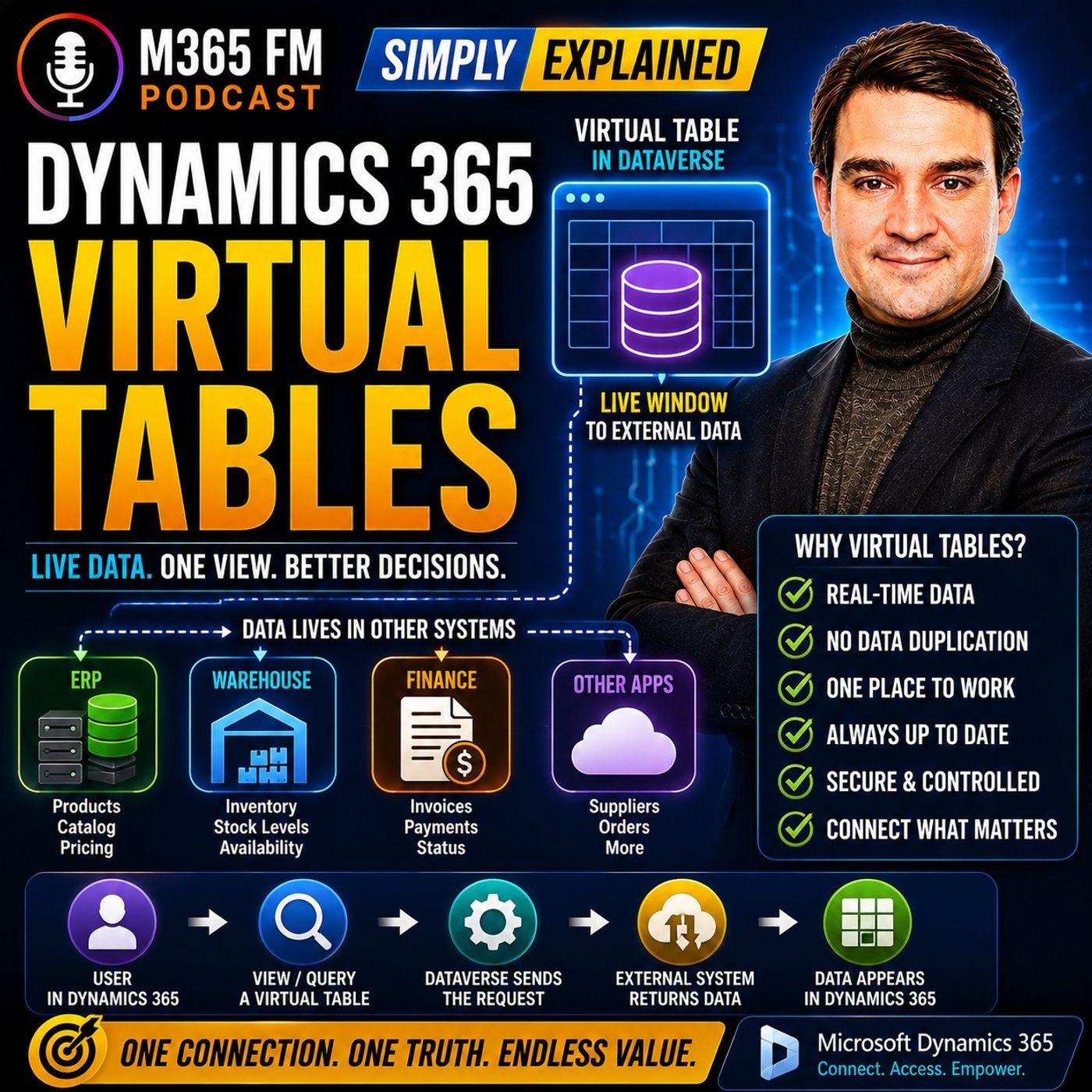
- Dynamics 365 Virtual Tables provide a live window into external business data without requiring Dynamics 365 to store duplicated records or manage complex synchronization jobs.
- Copying data between systems often creates outdated records and ownership conflicts, making live virtual access a cleaner alternative when external systems own the truth.
- Every virtual table relies on three core components: a Data Provider to translate requests, a Data Source to handle connection details, and a Virtual Table definition to map external fields to Dataverse.
- Virtual tables are best utilized for scenarios like live inventory, product catalogs, invoice statuses, and ERP integrations where users need real-time visibility while working inside Dynamics 365.
- While virtual tables look and feel like standard Dataverse tables on screen, developers must evaluate performance, query capabilities, and security limitations before implementation.
What happens when your sales team works in Dynamics 365, but inventory lives in a warehouse system, invoices live in finance, and product information lives in an ERP? You could copy all that information into Dataverse, but then you create duplicate records, synchronization jobs, delays, and another place where information can become outdated. In this episode of M365 FM, Mirko Peters explains how Dynamics 365 Virtual Tables, formerly known as Virtual Entities, provide live access to external business data without requiring Dynamics 365 to store another copy.
WHAT ARE DYNAMICS 365 VIRTUAL TABLES?
A Virtual Table is a table definition inside Microsoft Dataverse that points to records stored somewhere else. Dataverse understands what the information looks like—such as product name, available quantity, price, or invoice status—but the actual records remain in the external system. Think of it as a window into another business system. Dynamics 365 provides the familiar interface while the external application remains responsible for storing and managing the data.
VIRTUAL ENTITIES VS VIRTUAL TABLES
You may still encounter the term Virtual Entities in older documentation, implementations, and conversations. The current terminology is Virtual Tables. The underlying concept remains the same: Dynamics 365 and Dataverse can expose external information as though users were working with another Dataverse table, while the records themselves remain outside Dataverse.
WHY COPYING DATA CREATES PROBLEMS
Imagine your warehouse has ten units available when an overnight synchronization runs. The following morning, Dynamics 365 shows ten. At lunchtime, the warehouse ships all ten units. The warehouse system immediately knows inventory has reached zero, but Dynamics 365 could continue displaying ten until the next synchronization occurs. Your salesperson is now making decisions using outdated information. The problem isn't necessarily that synchronization failed. The problem is that the copied information became outdated between synchronization runs.
THE DUPLICATE RECORD PROBLEM
Copying information also creates another question: Which system owns the truth? The product exists in the ERP system, but another copy exists in Dataverse. Someone changes the description, price, status, or availability. Now somebody needs to determine which version should win. Virtual Tables avoid this problem by allowing the original business system to continue owning the record while Dynamics 365 users access that information when required.
THINK OF TWO FILING CABINETS
Imagine keeping identical documents in two filing cabinets. One cabinet belongs to sales and another belongs to the warehouse. Whenever somebody changes a document in one cabinet, they need to carry the updated copy to the other. Miss one update and the cabinets disagree. Traditional synchronization follows a similar pattern. Virtual Tables provide another approach: instead of maintaining the second copy, give the sales team a secure way to see information from the original cabinet.
ONE PLACE TO WORK DOESN'T REQUIRE ONE DATABASE
Organizations frequently say they want "one system." What employees often actually need is one place to work. A salesperson shouldn't need to open Dynamics 365, switch to the ERP to check inventory, open another application to check an invoice, and then return to the customer record. Virtual Tables can bring selected external information into the Dynamics 365 experience while allowing specialized systems to continue managing their respective business processes.
A LIVE WINDOW INTO EXTERNAL DATA
Suppose an account manager is discussing a large opportunity with a customer. The customer wants 500 units next month. While remaining inside Dynamics 365, the account manager opens related product availability information showing the item number, warehouse, available quantity, and expected replenishment date. That information can come directly from the external warehouse or ERP system rather than yesterday's imported inventory list. Dynamics 365 becomes the workspace while the warehouse system remains the inventory authority.
NORMAL DATAVERSE TABLE VS VIRTUAL TABLE
With a normal Dataverse table, the records are stored inside Dataverse. Accounts, contacts, opportunities, and cases are common examples. With a Virtual Table, Dataverse defines how the external information should appear and how to retrieve it, but the actual records remain somewhere else. The difference can be summarized as: Standard Table → Dataverse stores the record Virtual Table → Dataverse accesses the record from another system
THINK OF A LIBRARY CATALOG
A library catalog contains information describing a book. It tells you the title, author, and where to find it. But the catalog isn't the book. A Virtual Table works similarly. Dataverse understands the structure and knows how to request the record, but the external system contains the actual business data.
RUNTIME DATA ACCESS
Virtual Tables retrieve information when the application needs it. A user might open a view, search for particular records, apply a filter, or select an individual row. Dataverse then requests the relevant information from the external system. The objective isn't to fetch every external record and permanently store it. Instead, the application requests the information required for the current interaction.
THE THREE BUILDING BLOCKS
The episode explains three important components behind a Virtual Table: Data Provider → translates requests Data Source → identifies and connects to the external service Virtual Table → maps external information into a Dataverse table structure Together, these components allow Dynamics 365 to request external records and present them through a familiar user experience.
WHAT IS A DATA PROVIDER?
The Data Provider acts as a translator. Dynamics 365 and Dataverse send requests using their own concepts—tables, columns, filters, and record IDs. The external system might use another API or data format. The provider translates between those two sides. Users don't need to understand that conversation. They interact with the resulting records through the Dynamics 365 application.
WHAT IS A DATA SOURCE?
If the provider knows how to communicate, the Data Source identifies where to communicate. The Data Source contains connection information for the external service. This can include the service address, authentication information, and connection-related settings. Think of the Data Provider as knowing the language and the Data Source as containing the address and connection details required to reach the correct system.
ODATA V4
Dataverse includes support for an OData Version 4 provider. OData provides a standardized approach for exposing and requesting data over the web. An external service might expose products containing fields such as product number, description, unit price, and available quantity. The provider can request those records and return them in a structure Dataverse understands. This provides a common integration approach when the external application already supports OData V4.
CUSTOM DATA PROVIDERS
Not every external business application supports OData. Organizations can use custom Data Providers when another integration method is required. A developer might create a provider connecting Dataverse with a REST API, database, or proprietary company service. The custom provider still performs the same fundamental job: Receive the Dataverse request → communicate with the external system → translate the response → return records to Dataverse.
MAPPING EXTERNAL COLUMNS
The Virtual Table defines how external fields should appear inside Dataverse. The warehouse application might call a field Available Quantity, while Dynamics 365 users see Stock on Hand. The mapping tells Dataverse that these fields represent the same information. This allows organizations to provide user-friendly terminology inside Dynamics 365 without requiring the external system to rename its own fields.
UNIQUE RECORD IDS
Dataverse needs to distinguish one external record from another. Virtual Table records therefore require dependable unique identifiers that Dataverse can recognize. Without a reliable ID, Dataverse can't confidently determine which exact product, invoice, customer, or other external record the user selected. Record identity is therefore an important technical requirement when evaluating whether an external data source can work effectively through Virtual Tables.
FOLLOWING A VIRTUAL TABLE REQUEST
Imagine a salesperson opens a product list and filters for available items. Dataverse recognizes that the request targets a Virtual Table. The Data Provider receives the request. The Data Source provides the information required to contact the external service. The provider translates the filter into something the external service understands. The source system returns matching records. The provider converts those results into Dataverse rows. Dynamics 365 displays them in the familiar interface. The user sees a normal-looking product list while the data remains in the external system.
WHERE VIRTUAL TABLES FIT BEST
Virtual Tables work particularly well when another system clearly owns the information but Dynamics 365 users need that information during their normal work. Examples include live inventory, product information, purchase status, invoice status, finance information, supplier catalogs, and selected marketing information. The external application remains responsible for managing the lifecycle of the record. Dynamics 365 provides contextual access to that record alongside the customer's sales or service information.
Become a supporter of this podcast: https://www.spreaker.com/podcast/m365-fm-modern-work-security-and-productivity-with-microsoft-365--6704921/support.
🚀 Want to be part of m365.fm?
Then stop just listening… and start showing up.
👉 Connect with me on LinkedIn and let’s make something happen:
- 🎙️ Be a podcast guest and share your story
- 🎧 Host your own episode (yes, seriously)
- 💡 Pitch topics the community actually wants to hear
- 🌍 Build your personal brand in the Microsoft 365 space
This isn’t just a podcast — it’s a platform for people who take action.
🔥 Most people wait. The best ones don’t.
👉 Connect with me on LinkedIn and send me a message:
"I want in"
Let’s build something awesome 👊
Frequently Asked Questions
What are Dynamics 365 Virtual Entities?
Dynamics 365 Virtual Entities, now officially called Virtual Tables, are table definitions inside Microsoft Dataverse that point to records stored in external systems, providing live access without data duplication.
What is the difference between Virtual Entities and Virtual Tables?
There is no functional difference; Virtual Entities is the older terminology, while Virtual Tables is the current Microsoft standard for the exact same underlying concept.
What are the three main building blocks of a Virtual Table?
The three core components are the Data Provider (which translates requests), the Data Source (which connects to the external service), and the Virtual Table itself (which maps external fields into a Dataverse structure).
When should you use Virtual Tables instead of data synchronization?
You should use Virtual Tables when another system owns the primary data lifecycle (like an ERP or warehouse system) and users need real-time visibility and interaction without risking outdated records from overnight sync jobs.
00:00:00,000 --> 00:00:02,520
So what happens when a customer calls about an order,
2
00:00:02,520 --> 00:00:04,720
but the stock level lives in your warehouse system
3
00:00:04,720 --> 00:00:07,000
and the payment status, lives and finance?
4
00:00:07,000 --> 00:00:09,520
You can copy all that data into Dynamics 365,
5
00:00:09,520 --> 00:00:11,840
or you can ask your team to open three more systems.
6
00:00:11,840 --> 00:00:13,120
Neither option feels great.
7
00:00:13,120 --> 00:00:14,380
Here's the simple definition.
8
00:00:14,380 --> 00:00:17,060
Virtual entities, are you now often called virtual tables
9
00:00:17,060 --> 00:00:19,760
out, give Dynamics 365 a live window into data
10
00:00:19,760 --> 00:00:21,320
that already lives somewhere else?
11
00:00:21,320 --> 00:00:22,600
Welcome to another knowledge nugget.
12
00:00:22,600 --> 00:00:25,680
I'm Mirko Piedas from M365, FM, and today,
13
00:00:25,680 --> 00:00:27,500
we're breaking this down in plain English.
14
00:00:27,500 --> 00:00:28,480
We'll start with the problem,
15
00:00:28,480 --> 00:00:30,080
then look at the building blocks behind it
16
00:00:30,080 --> 00:00:32,360
when virtual tables fit and where they can cause trouble.
17
00:00:32,360 --> 00:00:36,280
Why copying data creates problems?
18
00:00:36,280 --> 00:00:40,160
Imagine a sales team working in Dynamics 365.
19
00:00:40,160 --> 00:00:42,160
They can see the customer, the opportunity,
20
00:00:42,160 --> 00:00:43,800
and every call they've logged.
21
00:00:43,800 --> 00:00:46,440
But the product catalog belongs in an ERP system.
22
00:00:46,440 --> 00:00:48,280
Stock levels sit in the warehouse system,
23
00:00:48,280 --> 00:00:49,800
invoices belong in finance.
24
00:00:49,800 --> 00:00:51,760
Each system owns part of the story.
25
00:00:51,760 --> 00:00:54,160
For years, the usual answer was copying records
26
00:00:54,160 --> 00:00:55,960
from one system into another.
27
00:00:55,960 --> 00:00:57,160
A job might run every night
28
00:00:57,160 --> 00:00:58,960
and bring product details, inventory numbers,
29
00:00:58,960 --> 00:01:01,240
or invoice status into Dynamics 365.
30
00:01:01,240 --> 00:01:04,240
That sounds simple until the data changes at lunchtime.
31
00:01:04,240 --> 00:01:07,400
A warehouse worker ships the last 10 units of a product.
32
00:01:07,400 --> 00:01:09,840
The ERP system knows the stock is now zero,
33
00:01:09,840 --> 00:01:12,520
but Dynamics 365 might still show 10 units
34
00:01:12,520 --> 00:01:14,280
until the next scheduled sink runs.
35
00:01:14,280 --> 00:01:16,480
Your salesperson sees stock that no longer exists,
36
00:01:16,480 --> 00:01:18,360
then there's the duplicate record problem.
37
00:01:18,360 --> 00:01:19,960
The product lives in the ERP system,
38
00:01:19,960 --> 00:01:22,000
but a copied version lives in DATAverse,
39
00:01:22,000 --> 00:01:25,160
the data foundation behind Dynamics 365 and Power Apps.
40
00:01:25,160 --> 00:01:27,800
When someone changes a description, price, or status,
41
00:01:27,800 --> 00:01:30,200
someone needs to decide which system should win.
42
00:01:30,200 --> 00:01:32,360
That question creates a lot of messy work.
43
00:01:32,360 --> 00:01:35,920
Think of it like keeping paper files in two filing cabinets.
44
00:01:35,920 --> 00:01:38,160
One in the sales office and one in the warehouse.
45
00:01:38,160 --> 00:01:40,280
Each time somebody changes a paper in one cabinet,
46
00:01:40,280 --> 00:01:42,640
they must carry an updated copy to the other cabinet.
47
00:01:42,640 --> 00:01:44,680
Miss one trip and the cabinets disagree.
48
00:01:44,680 --> 00:01:46,160
Sync jobs can fail too.
49
00:01:46,160 --> 00:01:48,200
A password changes, a connection breaks,
50
00:01:48,200 --> 00:01:50,200
a field changes in the source system.
51
00:01:50,200 --> 00:01:51,520
The job stops overnight
52
00:01:51,520 --> 00:01:53,480
and users may not notice until they start looking
53
00:01:53,480 --> 00:01:55,680
at wrong or missing records the next morning.
54
00:01:55,680 --> 00:01:58,160
Meanwhile, the people doing the work have their own problem.
55
00:01:58,160 --> 00:02:00,760
They open a customer in Dynamics 365,
56
00:02:00,760 --> 00:02:03,640
then switch to the ERP system to check stock.
57
00:02:03,640 --> 00:02:06,320
Next, they open a finance tool to check an invoice.
58
00:02:06,320 --> 00:02:08,080
Then they return to Dynamics 365
59
00:02:08,080 --> 00:02:09,560
and try to remember what they saw.
60
00:02:09,560 --> 00:02:11,560
That breaks the flow of the conversation.
61
00:02:11,560 --> 00:02:13,040
Now here's the thing, you don't always need
62
00:02:13,040 --> 00:02:14,440
a full copy of every record.
63
00:02:14,440 --> 00:02:16,440
Sometimes you only need to see the current answer
64
00:02:16,440 --> 00:02:17,720
while you work with the customer.
65
00:02:17,720 --> 00:02:19,720
For example, an account manager may need
66
00:02:19,720 --> 00:02:21,080
today's available quantity
67
00:02:21,080 --> 00:02:22,800
before promising a delivery date.
68
00:02:22,800 --> 00:02:24,800
The warehouse system should keep control of that number
69
00:02:24,800 --> 00:02:27,200
because it tracks goods moving in and out all day.
70
00:02:27,200 --> 00:02:30,560
Dynamics 365 doesn't need to become a second warehouse database.
71
00:02:30,560 --> 00:02:31,880
This is the choice that matters.
72
00:02:31,880 --> 00:02:34,920
Do you need Dynamics 365 to own a local copy of the data
73
00:02:34,920 --> 00:02:36,720
or do you need users to see the latest data
74
00:02:36,720 --> 00:02:38,360
from the system that already owns it?
75
00:02:38,360 --> 00:02:40,520
When copying ads more jobs, more duplicates
76
00:02:40,520 --> 00:02:42,640
and more chances for records to disagree,
77
00:02:42,640 --> 00:02:44,640
a live connection can be the cleaner path.
78
00:02:44,640 --> 00:02:46,680
The source system keeps the record.
79
00:02:46,680 --> 00:02:49,080
Dynamics 365 gives users a place to see it
80
00:02:49,080 --> 00:02:51,440
alongside their sales or service work.
81
00:02:51,440 --> 00:02:53,680
What a virtual entity actually is today.
82
00:02:53,680 --> 00:02:56,160
We, Udimer, talking about virtual tables.
83
00:02:56,160 --> 00:02:57,400
You might also hear them called
84
00:02:57,400 --> 00:03:00,480
virtual entities are the same concept, different name.
85
00:03:00,480 --> 00:03:03,840
A virtual table is a table definition inside dataverse
86
00:03:03,840 --> 00:03:05,920
that points to records stored somewhere else.
87
00:03:05,920 --> 00:03:07,680
Dataverse knows what the columns look like
88
00:03:07,680 --> 00:03:10,580
or product name available quantity, price, invoice,
89
00:03:10,580 --> 00:03:13,880
status, or but it does now to restore the actual data.
90
00:03:13,880 --> 00:03:16,400
Think of it as a blueprint, not the building itself.
91
00:03:16,400 --> 00:03:18,800
At first, that difference sounds small.
92
00:03:18,800 --> 00:03:20,520
Here are Timers the Thing.
93
00:03:20,520 --> 00:03:21,880
It changes everything.
94
00:03:21,880 --> 00:03:23,280
With a normal dataverse table,
95
00:03:23,280 --> 00:03:25,240
the data lives right inside dataverse.
96
00:03:25,240 --> 00:03:27,200
You create an account, contact, or case,
97
00:03:27,200 --> 00:03:28,520
and the record is stored there.
98
00:03:28,520 --> 00:03:30,520
With a virtual table, you only define the shape
99
00:03:30,520 --> 00:03:32,320
of what columns to show or and a path
100
00:03:32,320 --> 00:03:34,120
to where the real data actually lives.
101
00:03:34,120 --> 00:03:35,600
Think of a library catalog.
102
00:03:35,600 --> 00:03:38,360
The catalog card has the title, author, and shelf number.
103
00:03:38,360 --> 00:03:40,040
But the card is no, Timer, the book,
104
00:03:40,040 --> 00:03:42,200
or it just tells you where to find it.
105
00:03:42,200 --> 00:03:43,680
A virtual table works the same way.
106
00:03:43,680 --> 00:03:46,080
Dynamics 365 knows how to ask for the record
107
00:03:46,080 --> 00:03:48,640
and what feels to expose, but the outside system
108
00:03:48,640 --> 00:03:49,760
keeps the real data.
109
00:03:49,760 --> 00:03:51,560
The card is no, Tim, the book.
110
00:03:51,560 --> 00:03:53,240
So when do you see this in action?
111
00:03:53,240 --> 00:03:56,200
When you open a view of external products in a model-driven app,
112
00:03:56,200 --> 00:03:58,040
or when you look at live inventory records
113
00:03:58,040 --> 00:04:00,680
from a sales opportunity, dataverse sends a request
114
00:04:00,680 --> 00:04:02,760
to the other system, grabs the data,
115
00:04:02,760 --> 00:04:05,880
and shows it in the familiar Dynamics 365 screen.
116
00:04:05,880 --> 00:04:08,360
To the person using the app, it looks like any other table.
117
00:04:08,360 --> 00:04:10,520
They see columns in a grid, they open a form,
118
00:04:10,520 --> 00:04:12,440
and they select a record and read the fields.
119
00:04:12,440 --> 00:04:15,680
Nothing announces that the number came from a different application.
120
00:04:15,680 --> 00:04:17,240
The connection happens behind the scenes.
121
00:04:17,240 --> 00:04:19,400
But here, Tim's the important part.
122
00:04:19,400 --> 00:04:21,920
When someone views the data, it does know to me,
123
00:04:21,920 --> 00:04:23,680
silently move into dataverse.
124
00:04:23,680 --> 00:04:24,880
It stays where it belongs.
125
00:04:24,880 --> 00:04:27,200
Imagine Dynamics 365 as an office
126
00:04:27,200 --> 00:04:29,320
with a secure video screen on the wall.
127
00:04:29,320 --> 00:04:31,400
Across town, another office manages a stockroom
128
00:04:31,400 --> 00:04:33,240
and keeps the product records there.
129
00:04:33,240 --> 00:04:34,680
The video screen lets the sales team
130
00:04:34,680 --> 00:04:37,480
see what EU team says as on the stockroom shelves
131
00:04:37,480 --> 00:04:39,800
without carrying every box into the sales office.
132
00:04:39,800 --> 00:04:42,080
The stockroom remains where the work happens.
133
00:04:42,080 --> 00:04:43,280
Now, picture and account manager
134
00:04:43,280 --> 00:04:45,080
working on a large sales opportunity.
135
00:04:45,080 --> 00:04:47,120
The customer wants 500 units next month,
136
00:04:47,120 --> 00:04:49,240
and they need an answer while still on the call.
137
00:04:49,240 --> 00:04:51,360
The account manager opens a related virtual table
138
00:04:51,360 --> 00:04:53,120
called Product Availability.
139
00:04:53,120 --> 00:04:55,360
They see the item number, warehouse location available
140
00:04:55,360 --> 00:04:57,880
quantity, and expected replenishment date.
141
00:04:57,880 --> 00:04:59,680
Those details come straight from the warehouse
142
00:04:59,680 --> 00:05:02,800
or ERP system at that moment or not from last night.
143
00:05:02,800 --> 00:05:04,240
Tim's imported list.
144
00:05:04,240 --> 00:05:06,720
The account manager speaks from current data.
145
00:05:06,720 --> 00:05:08,840
Dynamics 365 brings sales and inventory
146
00:05:08,840 --> 00:05:10,240
together into one place.
147
00:05:10,240 --> 00:05:12,280
The warehouse system still decides the quantity.
148
00:05:12,280 --> 00:05:14,240
That separation matters because different systems
149
00:05:14,240 --> 00:05:15,520
handle different jobs.
150
00:05:15,520 --> 00:05:17,560
A warehouse system tracks stock movements.
151
00:05:17,560 --> 00:05:19,800
A finance app manages invoices and payments.
152
00:05:19,800 --> 00:05:22,400
The CRM app tracks conversations, opportunities,
153
00:05:22,400 --> 00:05:23,520
and service cases.
154
00:05:23,520 --> 00:05:25,960
Virtual tables let users see outside information
155
00:05:25,960 --> 00:05:28,560
without pretending every system needs to own every record.
156
00:05:28,560 --> 00:05:30,400
You might hear the term all run time.
157
00:05:30,400 --> 00:05:32,560
Ayo, that simply means the moment the app is running
158
00:05:32,560 --> 00:05:34,080
and someone asks for data.
159
00:05:34,080 --> 00:05:36,120
The virtual table does now empty to fetch everything
160
00:05:36,120 --> 00:05:37,760
once and keep it forever.
161
00:05:37,760 --> 00:05:40,640
It asks for the current record when a user opens a view,
162
00:05:40,640 --> 00:05:42,600
searches for something, or selects a row.
163
00:05:42,600 --> 00:05:44,840
So the virtual table is not a new database.
164
00:05:44,840 --> 00:05:46,480
It outtoms a dataverse table that
165
00:05:46,480 --> 00:05:49,280
presents outside records through Dynamics 365.
166
00:05:49,280 --> 00:05:51,640
Next, the totems follow that request from one click
167
00:05:51,640 --> 00:05:55,120
on the screen, out to the other system, and back again.
168
00:05:55,120 --> 00:05:59,040
Behind the scenes, provider, data source, and table.
169
00:05:59,040 --> 00:06:01,680
So what happens after someone selects a virtual table record
170
00:06:01,680 --> 00:06:04,360
in Dynamics 365, imagine the sales rep
171
00:06:04,360 --> 00:06:05,920
opens a list of products and types
172
00:06:05,920 --> 00:06:08,640
that filter out every item in a certain product group.
173
00:06:08,640 --> 00:06:11,880
Dynamics 365 can automatically just look inside dataverse
174
00:06:11,880 --> 00:06:14,160
for those rows because the rows live outside.
175
00:06:14,160 --> 00:06:15,760
Instead, dataverse sends the request
176
00:06:15,760 --> 00:06:16,800
through a data provider.
177
00:06:16,800 --> 00:06:19,200
A data provider is the translator in the setup.
178
00:06:19,200 --> 00:06:22,920
Dynamics 365 asks for data in its own format, our table name,
179
00:06:22,920 --> 00:06:25,480
columns, filters, record IDs.
180
00:06:25,480 --> 00:06:28,360
The outside system may speak a completely different language.
181
00:06:28,360 --> 00:06:30,440
The provider translates between the two sides.
182
00:06:30,440 --> 00:06:33,160
Think of it like a receptionist who speaks two languages.
183
00:06:33,160 --> 00:06:36,040
The sales rep asks for available products in English.
184
00:06:36,040 --> 00:06:37,640
The receptionist turns that question
185
00:06:37,640 --> 00:06:41,040
into the warehouse system out TMS language, sends it,
186
00:06:41,040 --> 00:06:43,400
receives the reply, and presents the answer
187
00:06:43,400 --> 00:06:45,800
in a form the sales rep can use.
188
00:06:45,800 --> 00:06:47,400
Users never see that translation.
189
00:06:47,400 --> 00:06:50,240
Behind the scenes, the provider handles the conversation.
190
00:06:50,240 --> 00:06:52,880
Dataverse includes a provider for ODATA version 4.
191
00:06:52,880 --> 00:06:56,120
ODATA is a standard way for systems to share data over the web.
192
00:06:56,120 --> 00:06:58,560
If an external service supports ODATA version 4,
193
00:06:58,560 --> 00:07:00,240
it can describe its tables and fields
194
00:07:00,240 --> 00:07:01,880
in a way dataverse understands.
195
00:07:01,880 --> 00:07:03,240
That gives you a common starting point
196
00:07:03,240 --> 00:07:05,600
instead of writing a separate connection from scratch.
197
00:07:05,600 --> 00:07:06,920
For example, an outside service
198
00:07:06,920 --> 00:07:08,800
might expose a collection called products
199
00:07:08,800 --> 00:07:10,280
with fields like product number,
200
00:07:10,280 --> 00:07:12,960
description, unit price, and available quantity.
201
00:07:12,960 --> 00:07:15,000
The ODATA provider can request those records
202
00:07:15,000 --> 00:07:16,640
and pass them back to dataverse.
203
00:07:16,640 --> 00:07:18,280
But the provider still needs to know
204
00:07:18,280 --> 00:07:20,000
where the service lives and how to reach it.
205
00:07:20,000 --> 00:07:22,440
That information sits in a data source record.
206
00:07:22,440 --> 00:07:25,480
A data source is the connection card for the outside system.
207
00:07:25,480 --> 00:07:27,520
It holds details like the service address,
208
00:07:27,520 --> 00:07:30,240
sign in credentials, and how long dataverse should wait
209
00:07:30,240 --> 00:07:32,360
before treating a request as timed out.
210
00:07:32,360 --> 00:07:34,800
Think of it as the address book entry for the service.
211
00:07:34,800 --> 00:07:36,680
The provider knows how to speak the language,
212
00:07:36,680 --> 00:07:38,680
the data source tells it which system to call
213
00:07:38,680 --> 00:07:40,240
and how to get through the front door.
214
00:07:40,240 --> 00:07:41,840
Then comes the virtual table itself.
215
00:07:41,840 --> 00:07:43,920
The virtual table gives dataverse a familiar shape
216
00:07:43,920 --> 00:07:45,280
for the outside data.
217
00:07:45,280 --> 00:07:48,200
You choose a table name, define the columns users need,
218
00:07:48,200 --> 00:07:50,280
and connect each column to the matching field
219
00:07:50,280 --> 00:07:51,480
from the external system.
220
00:07:51,480 --> 00:07:54,320
Maybe the warehouse system calls a field available quantity
221
00:07:54,320 --> 00:07:57,360
while your Dynamics 365 app calls it stock on hand.
222
00:07:57,360 --> 00:07:58,520
That automates fine.
223
00:07:58,520 --> 00:08:00,360
The mapping tells dataverse that both names
224
00:08:00,360 --> 00:08:02,560
point to the same piece of data.
225
00:08:02,560 --> 00:08:05,480
The user sees stock on hand in the Dynamics screen
226
00:08:05,480 --> 00:08:08,200
while the provider knows to request available quantity
227
00:08:08,200 --> 00:08:09,280
from the source.
228
00:08:09,280 --> 00:08:10,960
Each outside record also needs an ID
229
00:08:10,960 --> 00:08:12,440
that dataverse can recognize.
230
00:08:12,440 --> 00:08:15,040
For virtual tables, that ID needs to work as a gridau
231
00:08:15,040 --> 00:08:17,720
the long unique ID format dataverse uses.
232
00:08:17,720 --> 00:08:19,880
The provider uses that ID to connect the record
233
00:08:19,880 --> 00:08:22,160
on screen with the record in the source system.
234
00:08:22,160 --> 00:08:24,840
Without a dependable ID, dataverse can out empty
235
00:08:24,840 --> 00:08:26,720
know which exact record you selected.
236
00:08:26,720 --> 00:08:28,080
Now follow the full journey.
237
00:08:28,080 --> 00:08:29,960
A user opens a product view and filters
238
00:08:29,960 --> 00:08:31,640
for items that are in stock.
239
00:08:31,640 --> 00:08:34,600
Dataverse sees the request against the virtual table.
240
00:08:34,600 --> 00:08:36,240
The data provider reads the request,
241
00:08:36,240 --> 00:08:39,160
uses the data source details to contact the outside service,
242
00:08:39,160 --> 00:08:42,400
and translates the filter into a query that service understands.
243
00:08:42,400 --> 00:08:44,240
The source system finds the matching records
244
00:08:44,240 --> 00:08:45,320
and sends them back.
245
00:08:45,320 --> 00:08:48,440
The provider turns those results into dataverse table rows.
246
00:08:48,440 --> 00:08:51,480
Then Dynamics 365 displays the product names, prices,
247
00:08:51,480 --> 00:08:54,520
and quantities in the same sort of grid your users already know.
248
00:08:54,520 --> 00:08:56,320
The screen feels familiar because dataverse
249
00:08:56,320 --> 00:08:57,800
does the presentation work.
250
00:08:57,800 --> 00:08:59,600
The outside system does the data work.
251
00:08:59,600 --> 00:09:02,640
What if the source does now attempt support or data?
252
00:09:02,640 --> 00:09:05,000
That items where a custom data provider comes in.
253
00:09:05,000 --> 00:09:07,560
A developer can build a provider for another type of service
254
00:09:07,560 --> 00:09:10,120
or a REST API, a database connection,
255
00:09:10,120 --> 00:09:12,920
or a company system with its own data exchange format.
256
00:09:12,920 --> 00:09:15,400
The custom provider still plays translator.
257
00:09:15,400 --> 00:09:18,880
It receives a request from dataverse, contacts the outside system,
258
00:09:18,880 --> 00:09:20,920
turns the reply into dataverse records,
259
00:09:20,920 --> 00:09:22,240
and returns them to the app.
260
00:09:22,240 --> 00:09:24,320
That work takes code and careful testing
261
00:09:24,320 --> 00:09:27,000
because the provider decides how well filters, searches,
262
00:09:27,000 --> 00:09:28,440
and record lookups behave.
263
00:09:28,440 --> 00:09:30,760
A provider can also support more than reading.
264
00:09:30,760 --> 00:09:32,920
The built-in or data version for provider supports
265
00:09:32,920 --> 00:09:35,720
create, read, update, and delete actions.
266
00:09:35,720 --> 00:09:37,920
Custom providers can support those same actions
267
00:09:37,920 --> 00:09:40,960
when developers build them for the external system.
268
00:09:40,960 --> 00:09:43,240
For finance and operations virtual entities,
269
00:09:43,240 --> 00:09:45,960
dataverse can also send create, read, update,
270
00:09:45,960 --> 00:09:48,800
and delete requests straight to the finance and operations app.
271
00:09:48,800 --> 00:09:50,520
That does not mean every virtual table
272
00:09:50,520 --> 00:09:52,160
lets users edit records.
273
00:09:52,160 --> 00:09:53,880
Write actions depend on the provider
274
00:09:53,880 --> 00:09:55,880
and on what the outside system permits.
275
00:09:55,880 --> 00:09:58,480
The source system still receives the request and applies
276
00:09:58,480 --> 00:10:00,400
its own rules before it changes anything.
277
00:10:00,400 --> 00:10:03,320
So there are three building blocks behind every virtual table.
278
00:10:03,320 --> 00:10:04,880
The provider translates the request.
279
00:10:04,880 --> 00:10:06,760
The data source points to the outside service.
280
00:10:06,760 --> 00:10:10,040
The virtual table maps what users see in Dynamics 365
281
00:10:10,040 --> 00:10:12,400
to the fields and records that service returns.
282
00:10:12,400 --> 00:10:13,840
Once you see those rolled separately,
283
00:10:13,840 --> 00:10:15,600
you can also see why a virtual table
284
00:10:15,600 --> 00:10:18,280
fits some kinds of data much better than others.
285
00:10:18,280 --> 00:10:21,360
Where virtual entities fit best.
286
00:10:21,360 --> 00:10:23,840
So when does a virtual table really make sense?
287
00:10:23,840 --> 00:10:25,880
It makes sense when another business system already
288
00:10:25,880 --> 00:10:29,160
owns the data, but your people working in Dynamics 365
289
00:10:29,160 --> 00:10:31,920
need to see that data right when they're helping a customer.
290
00:10:31,920 --> 00:10:33,800
Picture a sales rep getting a quote ready.
291
00:10:33,800 --> 00:10:36,040
They need product details, current stock,
292
00:10:36,040 --> 00:10:37,640
maybe a promised delivery date,
293
00:10:37,640 --> 00:10:39,360
and the status of an earlier purchase.
294
00:10:39,360 --> 00:10:41,120
The ERP system owns all those records
295
00:10:41,120 --> 00:10:43,600
because it handles purchasing stock movement, pricing,
296
00:10:43,600 --> 00:10:44,360
and fulfillment.
297
00:10:44,360 --> 00:10:46,720
You could copy everything into data versus A.U.
298
00:10:46,720 --> 00:10:48,400
But if that copy data only exists,
299
00:10:48,400 --> 00:10:49,520
so the rep can look at it,
300
00:10:49,520 --> 00:10:51,480
you're creating extra work without changing
301
00:10:51,480 --> 00:10:53,240
who actually owns the record.
302
00:10:53,240 --> 00:10:55,520
A virtual table lets the rep work from one screen
303
00:10:55,520 --> 00:10:57,600
while the ERP keeps running the business process
304
00:10:57,600 --> 00:10:58,440
behind the scenes.
305
00:10:58,440 --> 00:10:59,560
Let's take a live product data.
306
00:10:59,560 --> 00:11:01,560
A product catalog might have thousands of items
307
00:11:01,560 --> 00:11:04,200
with descriptions, units, prices, supply details,
308
00:11:04,200 --> 00:11:05,240
and availability.
309
00:11:05,240 --> 00:11:08,240
Sales staff need enough of that information to help a customer,
310
00:11:08,240 --> 00:11:10,280
but they shouldn't have to become ERP users
311
00:11:10,280 --> 00:11:11,920
just to answer a product question.
312
00:11:11,920 --> 00:11:13,800
With a virtual table, that product data
313
00:11:13,800 --> 00:11:15,880
appears right next to accounts, opportunities,
314
00:11:15,880 --> 00:11:18,040
and quotes inside Dynamics 365.
315
00:11:18,040 --> 00:11:19,880
Inventory is another great example.
316
00:11:19,880 --> 00:11:22,560
Stock changes all day as goods arrive, orders ship,
317
00:11:22,560 --> 00:11:24,720
and warehouse teams move items around.
318
00:11:24,720 --> 00:11:27,520
When a customer asks, can you deliver this next week?
319
00:11:27,520 --> 00:11:29,080
The answer needs to come from the system,
320
00:11:29,080 --> 00:11:30,560
tracking the shelves and deliveries,
321
00:11:30,560 --> 00:11:33,480
how, not from a separate list someone copied earlier.
322
00:11:33,480 --> 00:11:35,160
Purchase status works in a similar way,
323
00:11:35,160 --> 00:11:37,040
a customer service agent might need to check
324
00:11:37,040 --> 00:11:39,080
if a replacement part has been ordered,
325
00:11:39,080 --> 00:11:40,560
whether it arrived from a supplier
326
00:11:40,560 --> 00:11:42,200
or if it's waiting for dispatch.
327
00:11:42,200 --> 00:11:44,800
That information lives in the purchasing or warehouse system,
328
00:11:44,800 --> 00:11:47,320
but the agent sees it right next to the service case.
329
00:11:47,320 --> 00:11:48,800
Finance records can work well too
330
00:11:48,800 --> 00:11:50,000
when the goal is visibility.
331
00:11:50,000 --> 00:11:52,120
A sales or service person might need to know
332
00:11:52,120 --> 00:11:55,120
if an invoice is paid, overdue, or under review
333
00:11:55,120 --> 00:11:56,400
before making a decision.
334
00:11:56,400 --> 00:11:58,760
Finance keeps responsibility for the invoice.
335
00:11:58,760 --> 00:12:02,080
Dynamics 365 just brings the status into the customer conversation.
336
00:12:02,080 --> 00:12:03,720
Here's the thing, oh you.
337
00:12:03,720 --> 00:12:05,560
People often ask for one system
338
00:12:05,560 --> 00:12:07,920
when what they really need is one place to work.
339
00:12:07,920 --> 00:12:09,280
Those are two different things.
340
00:12:09,280 --> 00:12:10,880
You can give someone a single work screen
341
00:12:10,880 --> 00:12:13,560
without cramming every business record into one database.
342
00:12:13,560 --> 00:12:16,200
Finance and operations uses this idea directly.
343
00:12:16,200 --> 00:12:19,040
Its OD entities can show up as virtual tables in Dataverse,
344
00:12:19,040 --> 00:12:21,080
so makers can build customer engagement apps
345
00:12:21,080 --> 00:12:23,000
and power platform experiences around finance
346
00:12:23,000 --> 00:12:26,280
and operations data without copying that data first.
347
00:12:26,280 --> 00:12:27,440
Depending on the setup,
348
00:12:27,440 --> 00:12:29,760
users can even create update or delete finance
349
00:12:29,760 --> 00:12:31,760
and operations records through Dataverse.
350
00:12:31,760 --> 00:12:34,920
The Finance and Operations app still applies its own business rules
351
00:12:34,920 --> 00:12:38,040
and that matters because a record does more than just hold fields.
352
00:12:38,040 --> 00:12:39,560
When someone changes a purchase order,
353
00:12:39,560 --> 00:12:42,040
adjusts stock or updates and invoice related record,
354
00:12:42,040 --> 00:12:44,400
the owning system might need to run checks and rules
355
00:12:44,400 --> 00:12:45,960
before accepting the change.
356
00:12:45,960 --> 00:12:48,400
Virtual tables keep that process in the right place.
357
00:12:48,400 --> 00:12:50,800
External marketing data can fit this pattern too.
358
00:12:50,800 --> 00:12:52,800
Maybe a marketing platform tracks email opens,
359
00:12:52,800 --> 00:12:55,040
event registrations or campaign activity
360
00:12:55,040 --> 00:12:57,800
while Dynamics 365 tracks the account manager out there
361
00:12:57,800 --> 00:12:59,760
as calls and opportunities.
362
00:12:59,760 --> 00:13:01,520
Showing a few selected marketing details
363
00:13:01,520 --> 00:13:03,840
beside a customer record gives the account manager better
364
00:13:03,840 --> 00:13:06,160
context without creating another permanent set
365
00:13:06,160 --> 00:13:08,520
of campaign records inside Dataverse.
366
00:13:08,520 --> 00:13:11,280
The same idea works with an outside product catalog.
367
00:13:11,280 --> 00:13:13,520
A company might sell products from a supplier,
368
00:13:13,520 --> 00:13:14,600
the outcomes catalog,
369
00:13:14,600 --> 00:13:17,040
where descriptions and availability change often.
370
00:13:17,040 --> 00:13:19,080
The supplier stays responsible for the catalog
371
00:13:19,080 --> 00:13:21,800
while your Dynamics 365 users browse current information
372
00:13:21,800 --> 00:13:22,560
during sales work,
373
00:13:22,560 --> 00:13:24,200
so ask yourself a simple question.
374
00:13:24,200 --> 00:13:27,680
Does Dynamics 365 need to run the life cycle of this record?
375
00:13:27,680 --> 00:13:30,880
Or do users just need to see and sometimes act on the record
376
00:13:30,880 --> 00:13:31,720
while they work?
377
00:13:31,720 --> 00:13:33,480
When the source system owns the record
378
00:13:33,480 --> 00:13:35,600
and a live view helps people do their jobs,
379
00:13:35,600 --> 00:13:37,280
a virtual table fits really well.
380
00:13:37,280 --> 00:13:38,760
But keep in mind, oh,
381
00:13:38,760 --> 00:13:40,800
a table that looks normal on screen
382
00:13:40,800 --> 00:13:43,000
doesn't automatically support every feature
383
00:13:43,000 --> 00:13:45,120
of a normal Dataverse table.
384
00:13:45,120 --> 00:13:47,120
Limits security and performance.
385
00:13:47,120 --> 00:13:49,880
A virtual table can look like a normal Dataverse table on screen,
386
00:13:49,880 --> 00:13:51,600
but don't assume it works like one.
387
00:13:51,600 --> 00:13:53,360
The data lives outside Dataverse
388
00:13:53,360 --> 00:13:55,880
and that changes what Dynamics 365 can do with it.
389
00:13:55,880 --> 00:13:58,200
Before you build a process around virtual Data,
390
00:13:58,200 --> 00:13:59,800
check whether the feature you need works
391
00:13:59,800 --> 00:14:01,640
with the provider and the outside system.
392
00:14:01,640 --> 00:14:03,800
Take writing Data back to the source system.
393
00:14:03,800 --> 00:14:05,640
Many older virtual entity setups
394
00:14:05,640 --> 00:14:07,280
only supported reading AU users
395
00:14:07,280 --> 00:14:09,200
could open a record and see current information,
396
00:14:09,200 --> 00:14:11,720
but they couldn't edit it from Dynamics 365.
397
00:14:11,720 --> 00:14:13,800
Today, the built-in OData V4 provider
398
00:14:13,800 --> 00:14:16,800
can support Create, Read, Update and Delete actions
399
00:14:16,800 --> 00:14:18,960
and custom providers can support them too.
400
00:14:18,960 --> 00:14:21,640
Still, that support doesn't appear automatically.
401
00:14:21,640 --> 00:14:23,240
The provider has to understand the action
402
00:14:23,240 --> 00:14:25,000
the outside system has to allow it
403
00:14:25,000 --> 00:14:27,520
and the user needs permission in that outside system.
404
00:14:27,520 --> 00:14:29,000
If any one of those pieces doesn't work
405
00:14:29,000 --> 00:14:31,760
and edit can fail, even when the Dynamics 365 form
406
00:14:31,760 --> 00:14:32,880
shows an edit button.
407
00:14:32,880 --> 00:14:35,560
Some Dataverse features also need stored records.
408
00:14:35,560 --> 00:14:37,680
Virtual tables don't support Dataverse auditing,
409
00:14:37,680 --> 00:14:39,760
so Dataverse won't keep its own audit history
410
00:14:39,760 --> 00:14:40,920
for changes to those records.
411
00:14:40,920 --> 00:14:42,960
If you need a clear record of who changed the value
412
00:14:42,960 --> 00:14:45,400
and when, the outside system must track that
413
00:14:45,400 --> 00:14:48,480
or you need to bring the data into a standard Dataverse table.
414
00:14:48,480 --> 00:14:51,200
Dataverse Search doesn't support Virtual tables either
415
00:14:51,200 --> 00:14:53,280
and neither do charts and dashboards.
416
00:14:53,280 --> 00:14:55,480
You also can't cache Virtual Table records
417
00:14:55,480 --> 00:14:57,040
for offline work older field engineer
418
00:14:57,040 --> 00:14:59,040
using a mobile device without a connection,
419
00:14:59,040 --> 00:15:01,280
can't rely on Virtual Data being available.
420
00:15:01,280 --> 00:15:02,880
Calculated columns and roll-up columns
421
00:15:02,880 --> 00:15:04,360
don't work on Virtual tables either.
422
00:15:04,360 --> 00:15:07,000
Any calculation needs to happen in the outside system
423
00:15:07,000 --> 00:15:09,400
or the Data provider needs to return the finished value.
424
00:15:09,400 --> 00:15:11,640
For example, if you need a total stock value
425
00:15:11,640 --> 00:15:13,160
based on quantity and price,
426
00:15:13,160 --> 00:15:15,280
calculated whether product data lives
427
00:15:15,280 --> 00:15:18,000
rather than expecting Dataverse to build the number later.
428
00:15:18,000 --> 00:15:20,080
Security needs the same careful thought.
429
00:15:20,080 --> 00:15:22,520
Virtual tables are organization-owned tables.
430
00:15:22,520 --> 00:15:25,080
Dataverse can turn access to the table on or off
431
00:15:25,080 --> 00:15:26,400
through security roles,
432
00:15:26,400 --> 00:15:28,680
but it doesn't apply the usual user-owned
433
00:15:28,680 --> 00:15:30,920
row security model or field-level security
434
00:15:30,920 --> 00:15:32,360
to the external rows.
435
00:15:32,360 --> 00:15:34,040
In plain English, Dataverse controls
436
00:15:34,040 --> 00:15:35,520
who gets through the front door.
437
00:15:35,520 --> 00:15:37,720
The outside system decides which records and fields
438
00:15:37,720 --> 00:15:39,360
they see once they're inside.
439
00:15:39,360 --> 00:15:41,360
For Finance and Operations Virtual tables,
440
00:15:41,360 --> 00:15:43,680
Dataverse passes the calling user's identity
441
00:15:43,680 --> 00:15:45,040
to Finance and Operations,
442
00:15:45,040 --> 00:15:47,200
which then checks that user's permissions
443
00:15:47,200 --> 00:15:49,920
and row-level rules before returning the data.
444
00:15:49,920 --> 00:15:51,560
That keeps the Finance or Operations app
445
00:15:51,560 --> 00:15:53,280
in control of its own records.
446
00:15:53,280 --> 00:15:55,760
Other Data providers may handle security differently.
447
00:15:55,760 --> 00:15:58,120
Before you expose customer, Finance or stock data
448
00:15:58,120 --> 00:16:00,520
through a Virtual Table, ask a direct question.
449
00:16:00,520 --> 00:16:02,040
When a user opens this record,
450
00:16:02,040 --> 00:16:03,920
which system checks their permission?
451
00:16:03,920 --> 00:16:05,680
You need a clear answer, not a guess.
452
00:16:05,680 --> 00:16:08,080
Performance also depends on the outside system.
453
00:16:08,080 --> 00:16:10,320
A normal Dataverse table reads from DataStore
454
00:16:10,320 --> 00:16:11,560
to close to the app.
455
00:16:11,560 --> 00:16:14,080
A Virtual Table sends a request to another service,
456
00:16:14,080 --> 00:16:15,920
waits for that service to process it,
457
00:16:15,920 --> 00:16:17,200
and waits for the reply.
458
00:16:17,200 --> 00:16:18,640
A fast source feels natural.
459
00:16:18,640 --> 00:16:21,440
A slow source turns a simple view into a long wait.
460
00:16:21,440 --> 00:16:23,960
That delay can grow when a view asks for many rows.
461
00:16:23,960 --> 00:16:26,560
Includes lots of columns or uses look-up columns
462
00:16:26,560 --> 00:16:27,840
that need extra reads.
463
00:16:27,840 --> 00:16:29,280
Keep Virtual Views focused.
464
00:16:29,280 --> 00:16:31,080
Return the fields people truly need,
465
00:16:31,080 --> 00:16:32,880
and avoid treating a Virtual Table
466
00:16:32,880 --> 00:16:35,720
as a place to browse thousands of records without a filter.
467
00:16:35,720 --> 00:16:37,600
For Finance and Operations connections,
468
00:16:37,600 --> 00:16:40,000
Microsoft recommends keeping Dataverse and Finance
469
00:16:40,000 --> 00:16:43,480
and Operations in the same Azure region to cut down on delay.
470
00:16:43,480 --> 00:16:46,080
The external data also needs a Guide primary key.
471
00:16:46,080 --> 00:16:49,280
A Guide is the long, unique record ID the Dataverse uses.
472
00:16:49,280 --> 00:16:50,560
Each external row needs one,
473
00:16:50,560 --> 00:16:52,560
so Dataverse can tell one product, invoice,
474
00:16:52,560 --> 00:16:54,640
or customer record apart from every other record.
475
00:16:54,640 --> 00:16:57,600
If the source system can't provide a dependable Guide,
476
00:16:57,600 --> 00:16:59,240
this Virtual Table model won't work
477
00:16:59,240 --> 00:17:01,080
without extra effort in the provider.
478
00:17:01,080 --> 00:17:04,160
One more choice becomes permanent when you create the table.
479
00:17:04,160 --> 00:17:06,160
You can't turn a Virtual Table into
480
00:17:06,160 --> 00:17:08,080
a standard Dataverse Table later,
481
00:17:08,080 --> 00:17:10,840
and you can't take a standard Table and switch it into a Virtual One.
482
00:17:10,840 --> 00:17:12,680
Choose the Table Type based on how people
483
00:17:12,680 --> 00:17:13,920
actually need to use the data,
484
00:17:13,920 --> 00:17:16,320
not just what looks easiest during setup.
485
00:17:16,320 --> 00:17:18,160
If you need offline use, audit history,
486
00:17:18,160 --> 00:17:20,000
Dataverse search, charts, dashboards,
487
00:17:20,000 --> 00:17:21,560
or Dataverse manage calculations,
488
00:17:21,560 --> 00:17:23,440
a local Dataverse Table with a plan sink
489
00:17:23,440 --> 00:17:24,960
may suit the job better.
490
00:17:24,960 --> 00:17:26,640
A Virtual Table gives you live access,
491
00:17:26,640 --> 00:17:28,240
but it also brings the outside systems
492
00:17:28,240 --> 00:17:30,400
limits straight into your app.
493
00:17:30,400 --> 00:17:33,880
Choosing the right approach, window, or local copy.
494
00:17:33,880 --> 00:17:35,760
So how do you choose between a Virtual Table
495
00:17:35,760 --> 00:17:37,320
and a standard Table with sink?
496
00:17:37,320 --> 00:17:38,360
Start with two questions.
497
00:17:38,360 --> 00:17:39,680
First, who owns the Data?
498
00:17:39,680 --> 00:17:42,400
Second, do your users always need the latest version
499
00:17:42,400 --> 00:17:43,680
when they open a record?
500
00:17:43,680 --> 00:17:45,480
If another system owns the Data and your team
501
00:17:45,480 --> 00:17:48,160
just needs a live view while working in Dynamics 365,
502
00:17:48,160 --> 00:17:49,160
use a Virtual Table.
503
00:17:49,160 --> 00:17:50,840
Think of it as a window, you see through it,
504
00:17:50,840 --> 00:17:52,040
but nothing gets copied.
505
00:17:52,040 --> 00:17:54,400
If you need offline access, detailed auditing,
506
00:17:54,400 --> 00:17:56,880
custom reporting, or any Dataverse only feature,
507
00:17:56,880 --> 00:17:58,600
choose a standard Table with sink.
508
00:17:58,600 --> 00:17:59,680
That's your local copy.
509
00:17:59,680 --> 00:18:01,960
The data is stored right inside Dataverse.
510
00:18:01,960 --> 00:18:05,480
Virtual Entities connect Dynamics 365 to Data that lives elsewhere
511
00:18:05,480 --> 00:18:06,880
without creating a second copy.
512
00:18:06,880 --> 00:18:07,720
That's the magic of it.
513
00:18:07,720 --> 00:18:09,840
Subscribe on your favorite podcast platform
514
00:18:09,840 --> 00:18:11,000
and share this knowledge nugget
515
00:18:11,000 --> 00:18:14,000
with someone connecting Dynamics 365 to another business system.




