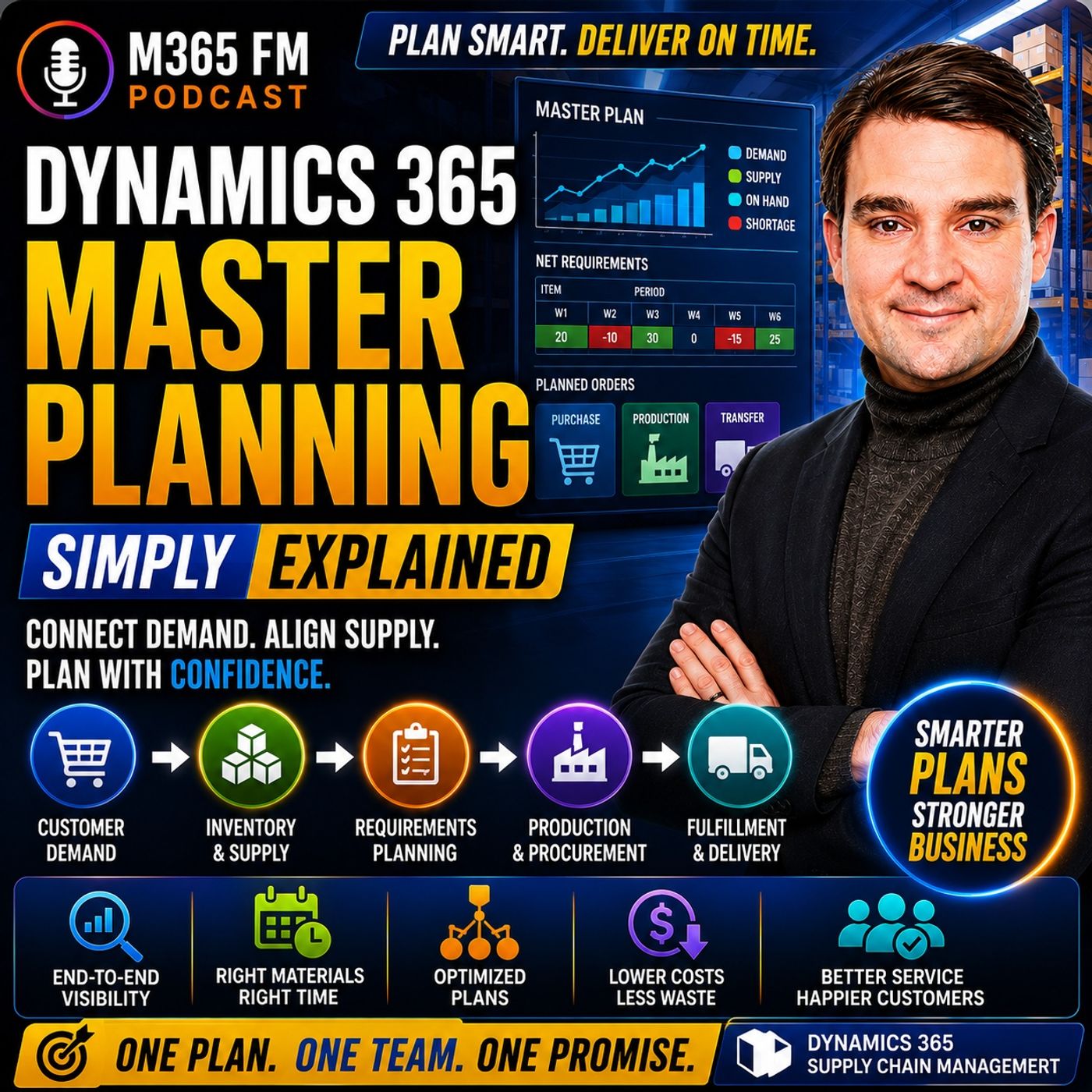
Why a Stock Count Isn't Enough: Moving Beyond Basic Inventory
Welcome back to our companion blog for the podcast! If you have ever run a retail shop, a warehouse, or a massive manufacturing operation, you likely know the feeling of panic that sets in when an unexpected, high-volume order lands on your desk. You rush to your inventory software, run a stock report, and breathe a sigh of relief because the numbers look high enough. But as many operations managers eventually find out the hard way, simply knowing how many items are sitting on your shelves is only a tiny fraction of the battle. Modern commerce is fast-paced, highly complex, and intimately tied to countless moving parts. When a customer demands a custom configuration or a large batch of products by a strict deadline, a basic inventory count will not keep you out of trouble.
In this post, we are going to dive deep into why static inventory counts fail, how siloed spreadsheets break down under pressure, and how modern systems bridge the gap between simple quantities, ticking clocks, and factory capacity. Whether you are scaling up your warehouse or trying to streamline a complex assembly line, understanding these concepts is vital for keeping your promises to customers without driving your team into absolute chaos.
Introduction: The Complexity of Modern Customer Orders
Imagine this scenario: A major client reaches out and demands one hundred bicycles delivered right to their distribution center by next month. At first glance, this sounds like a great problem to have. Revenue is coming in, and your sales team is celebrating. But then you start looking at the operational reality of that single order. You might have a few finished bicycles already sitting in your warehouse, but you certainly do not have a full hundred ready to ship. Furthermore, the wheels you need are currently sitting on a shipping container halfway across the ocean, your frame components are stored in a secondary warehouse across town, and your main factory floor production line is completely booked solid for the next two weeks.
This is where the rubber meets the road in supply chain management. What should you buy? What should you build internally? What should you transfer from another facility? And most importantly, when does each of those individual actions need to happen so that everything comes together seamlessly? Managing these intricate dependencies manually is practically impossible. To truly understand how to orchestrate a modern supply chain, we have to look past simple numbers and examine how systems like Dynamics 365 bring demand, inventory, purchasing, production, bills of materials, lead times, and manufacturing capacity together into one cohesive, actionable plan. To get a comprehensive audio breakdown of this exact topic, make sure you listen to our related episode, Dynamics 365 Master Planning - Simply Explained.
Why a Basic Stock Count Falls Short
Let us return to our bicycle order. A customer wants one hundred units, and your warehouse management system tells you that you currently have thirty finished bicycles sitting on the shelf. Basic math tells you that you are short by seventy units. At this point, a naive inventory system might flag that you need seventy more frames, but it leaves out the critical context required to actually make those frames a reality.
Those seventy missing bicycles require an astonishing array of inputs: frames, wheels, chains, seats, bolts, packaging materials, dedicated employees, available machinery, and, crucially, enough production time to put it all together. A simple inventory report only tells you what exists right this exact second. It cannot tell you whether your suppliers can ship the raw materials before your assembly team needs them, nor does it tell you if your factory has enough available operating hours to complete the job. A basic stock count ignores the dimension of time, and in supply chain management, time is just as important as quantity.
Moving from Siloed Spreadsheets to Connected Planning
How do most growing companies manage their inventory and production before they adopt enterprise-grade planning tools? They rely on spreadsheets, emails, and disconnected legacy software. In this traditional environment, the sales department maintains customer orders in one isolated database, while warehouse employees check physical inventory in a completely different system. Meanwhile, the purchasing team tracks supplier delivery dates inside a massive, unwieldy spreadsheet, and the production team maintains yet another independent schedule describing what the factory floor is supposed to build today.
If you examine each of these lists individually, they might all appear correct. The sales list matches the customer emails, and the purchasing sheet has dates supplied by vendors. However, someone still has to manually connect all of these isolated islands of data to answer the ultimate question: Can we actually deliver what the customer ordered by the promised date? Without an automated engine, answering that question takes days of meetings, frantic phone calls, and crossed fingers. This is why organizations eventually transition from static spreadsheets to dynamic, connected planning tools that continuously talk to one another.
Master Planning vs. A Spreadsheet
Think of a traditional spreadsheet as a photograph. It can provide a useful, highly specific snapshot of your inventory at one precise moment in time. But business does not freeze while you look at a photograph. Master Planning, on the other hand, is closer to a forward-looking, real-time movie. It considers quantities alongside calendar dates, future customer demand, incoming supplier shipments, production bottlenecks, and existing inventory balances. When just one of these elements changes—for example, a supplier delays a shipment of brakes by three days—the entire planning picture shifts, and the system can instantly recalculate your next best move.
The Three Planning Modes
Enterprise systems do not force you into a single way of thinking; they offer different planning modes to tackle distinct business questions. Traditional master planning usually focuses on day-to-day and short-term operational requirements, ensuring that immediate customer orders are covered. Forecast planning, conversely, looks far ahead at expected future demand before firm orders are even placed. Finally, intercompany master planning connects demand and supply requirements across multiple legal entities within the same corporate umbrella. Each of these modes starts with a form of demand but answers a very different strategic question for the business.
Connecting Quantity with Time and Capacity
Having enough inventory eventually is fundamentally different from having enough inventory when it is actually required by the customer or the assembly line. Imagine that twenty additional bicycles are scheduled to arrive from an external supplier. If those bicycles arrive three days before the customer deadline, they can be utilized to satisfy the order. But if those same bicycles arrive three days after the deadline, they do not solve your immediate shortage at all. They just sit in the warehouse as excess stock.
This reality is why modern systems calculate net requirements using a straightforward formula: Demand minus available or expected supply equals your remaining requirement. Suppose a customer orders one hundred units and your warehouse has thirty available. Your remaining requirement is seventy. However, if another twenty units are already scheduled to arrive from a reliable supplier before the customer's required shipping date, the uncovered requirement shrinks down to fifty. The system does not blindly suggest that you purchase or build the entire customer quantity from scratch; it intelligently subtracts what is already on its way.
Furthermore, planning must look far enough forward into the future. The appropriate planning horizon depends entirely on your specific industry. A local retail distributor purchasing fast-moving consumer goods might only need to look a few weeks ahead. Conversely, a heavy manufacturer utilizing specialized components with months-long supplier lead times must plan far into the future. Discovering a material shortage after the required purchasing or production date has already passed is a recipe for missed deadlines and unhappy clients.
Forecast Planning and Gross Requirements
When you look beyond confirmed orders, you enter the realm of forecast planning. This mode begins with expected demand rather than signed contracts. A bicycle manufacturer might look at historical data and expect demand to surge during the summer months. Waiting until every single individual customer order trickles in could leave the company with insufficient time to source raw materials or reserve crucial production capacity. Forecast planning gives organizations an early warning signal of the workload they are about to face.
By calculating gross requirements based on expected demand—such as predicting five hundred bicycles needed in July—the organization can evaluate whether its suppliers, warehouse space, and factory machinery can handle the load. Forecasts are not guaranteed sales, but they provide the vital visibility needed to prepare the supply chain before the rush actually hits.
How Master Planning Translates Demand into Actionable Steps
When a single customer order enters your ecosystem, it triggers a massive chain reaction throughout your entire supply chain. A single finished product demand can cascade down into dozens of requirements for lower-level components. If a customer orders seventy bicycles, the system looks at the structural recipe of that product and determines precisely what is needed to make it happen: seventy frames, one hundred and forty wheels, seventy chains, seventy seats, and hundreds of smaller nuts, bolts, and cables. This is where the Bill of Materials (BOM) becomes the absolute center of your manufacturing universe.
A Bill of Materials is essentially the culinary recipe for a manufactured item. Instead of forcing planners to manually calculate component requirements every time a customer order changes, the system expands the finished product demand into component-level tasks automatically. But having every raw component sitting on your shelves still does not magically turn them into a finished product. That requires active labor and machinery.
This is where production routes and lead times come into play. A route outlines the exact sequence of steps required to build an item—such as welding the frame, attaching the wheels, testing the brakes, and packaging the unit. Each step demands specific resources, like specialized machinery or trained technicians. Master Planning works backward from the customer's required delivery date. If the client needs the bicycles on Friday, assembly might need to finish on Thursday, components need to be staged by Monday, and purchase orders for raw wheels must go out weeks in advance due to supplier lead times.
When the system identifies that existing supply cannot cover this cascading demand, it generates what we call planned orders. These can be planned purchase orders to buy from vendors, planned production orders to build in-house, or planned transfer orders to move stock between facilities. Crucially, a planned order is always a suggestion, never an automated command. Planners review these recommendations to ensure the vendors, dates, and capacities make sense before greenlighting the work.
Conclusion: Taking Control of Your Supply Chain
Moving beyond basic inventory counts is no longer just a luxury for massive multinational corporations; it is an absolute operational necessity for any business dealing with complex customer demands, multi-tiered manufacturing, and strict delivery timelines. Relying on static spreadsheets and simple stock reports leaves your organization vulnerable to sudden bottlenecks, missed deadlines, and bloated carrying costs. By connecting quantities with calendar dates, production capacities, bills of materials, and supplier lead times, modern planning tools transform raw data into a clear, actionable roadmap for your entire team.
If you want to explore these concepts in greater detail and hear real-world examples of how enterprise resource planning transforms modern supply chains, be sure to check out our complete podcast episode, Dynamics 365 Master Planning - Simply Explained. Mastering your supply chain starts with understanding the tools at your disposal, and taking that next step will ensure your business is always ready for whatever your customers demand next.

Microsoft MVP | Host of M365.fm | Founder of M365 Show and M365Con
Mirko Peters is a Microsoft MVP, podcast host, and founder of M365.fm, M365 Show, and M365Con. His work connects Microsoft practitioners through podcast interviews, livestreams, and community events.
At M365.fm, Mirko hosts conversations with Microsoft MVPs, product experts, architects, and community contributors. Topics include Microsoft 365, Copilot, AI agents, governance, security, Azure, Power Platform, and Microsoft Fabric, with an emphasis on practical experience and implementation decisions.
M365.fm is the podcast and learning platform. M365 Show brings experts together for livestreams, while M365Con provides an online conference setting for community learning.
Official website: Mirko Peters (https://www.mirkopeters.com/). Recognition: Mirko Peters — Microsoft MVP profile (https://mvp.microsoft.com/de-DE/mvp/profile/9b0ca797-db5a-493a-a845-8b9158046cf5). Connect on LinkedIn (https://www.linkedin.com/in/m365showpodcast/).