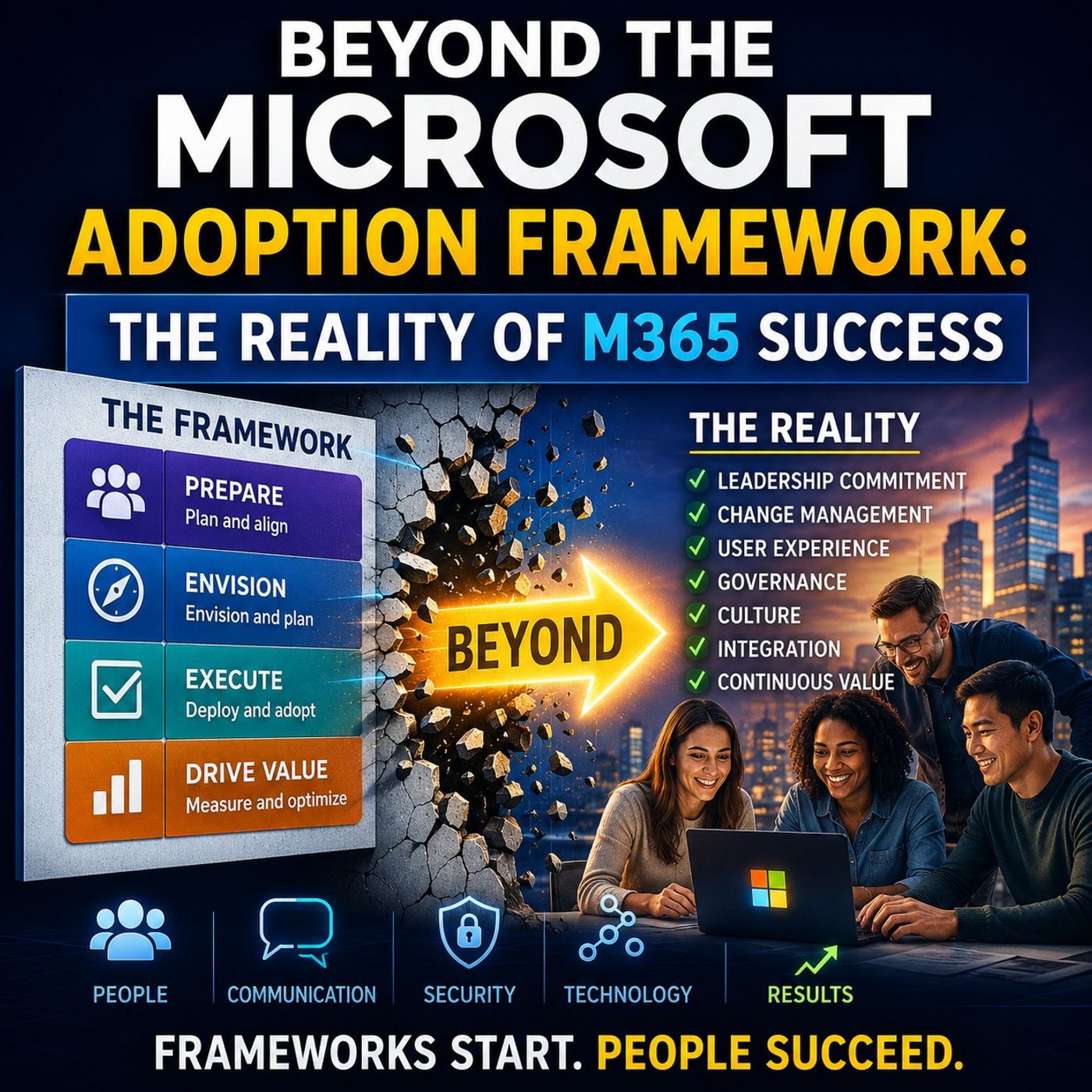
Why Your M365 Framework is a Map, Not a Transformation
When organizations embark on a digital overhaul, they often treat the process like an engineering problem that can be solved exclusively by following a manual. Define the strategy, prepare the environment, migrate the workloads, establish the baseline governance, train the users, measure the initial adoption, and continue optimizing. On paper, this progression looks clean, logical, and entirely comprehensive. Yet, thousands of companies follow every recommended step of the deployment guide, successfully turn on Microsoft Teams, OneDrive, SharePoint, and advanced tools like Microsoft 365 Copilot, only to discover a frustrating truth: absolutely nothing about how their people actually work has fundamentally changed. This core dilemma is unpacked deeply in our Beyond the Microsoft Adoption Framework- The Reality of M365 Success episode.
The persistent failure of modern cloud initiatives rarely stems from the software itself. Microsoft 365 is more than capable of supporting enterprise collaboration, security, and productivity. Instead, failure happens because deployment is constantly confused with true transformation, basic user activity is misread as genuine adoption, and a pre-packaged framework is expected to magically compensate for an operating model that was never modernized in the first place. Without a conscious shift in human behavior, you are simply lifting old, broken processes and dropping them into a shiny new cloud interface.
Why Your M365 Framework is a Map, Not the Transformation
Microsoft offers robust cloud adoption frameworks loaded with industry best practices, architectural blueprints, and phased guidance accumulated over decades of large-scale implementations. However, the value of any map depends entirely on how the traveler interprets it. A map can show you the roads, highlight common pitfalls, and point out scenic routes, but it cannot drive the vehicle for you, nor can it dictate your ultimate destination.
Imagine replacing a traditional, highly centralized downtown intersection controlled by a traffic policeman with a modern, free-flowing roundabout. The physical infrastructure of the roundabout is objectively superior. It promises greater autonomy, smoother traffic flow, and higher speed. But laying down asphalt and painting lane markers does not automatically teach drivers how to navigate a roundabout. People still need to understand how to yield, how to merge, and how to exit safely. If drivers treat the roundabout like a traditional four-way stop, traffic grinds to a halt regardless of how well the civil engineers designed the intersection.
Microsoft 365 functions in the exact same way. The ecosystem delivers teams spaces, identity services, collaborative document repositories, and cutting-edge artificial intelligence. But simply providing these technical capabilities does not automatically create the modern behavioral patterns required to leverage them. The framework establishes the digital roads and the security guardrails, but your organization still needs to sit down and write the traffic rules.
Why Technically Successful Deployments Still Fail
It is entirely possible for a Microsoft 365 project to hit every single traditional IT milestone and still crash and burn as a corporate transformation initiative. Mailboxes get migrated without a hitch, user identities sync seamlessly, Microsoft Teams is provisioned across every department, SharePoint sites are spun up by the dozens, and AI licenses are distributed to the workforce. On paper, the project is a massive success. Yet, employees are still emailing attachments back and forth, siloed in departmental bubbles, and struggling to find basic company documentation.
This disconnect happens because different stakeholders measure success through entirely different lenses. IT departments naturally focus on technical readiness and system stability. Once the environment is up and running and error logs are clear, IT considers the job well done. Employees, on the other hand, experience the rollout simply as a forced change in the tools they use to survive their daily workload. Meanwhile, executive leadership evaluates the project through the narrow viewfinder of budgets, timelines, and status reports.
None of these perspectives are inherently wrong, but none of them guarantee that adoption has actually occurred. There is a vast chasm between technical access and actual behavioral change. Assigning a Microsoft 365 Copilot license takes less than a minute. Changing how a knowledge worker prepares a complex report, analyzes raw data, documents critical decisions, or evaluates machine-generated output can take months of intentional coaching, process re-engineering, and cultural alignment. License activation proves a user can reach a tool; it proves nothing about whether they know how to use it to drive business value.
Activity vs. Adoption: Why More Clicks Don't Mean Better Collaboration
When organizations try to measure the success of their digital workplace, they almost always fall back on the metrics that are easiest to track: platform telemetry. Administrators pull shiny dashboards showing monthly active users, total Teams messages sent, hours spent in virtual meetings, SharePoint file edits, and Copilot prompt volumes. While these numbers provide a useful pulse check, treating them as definitive proof of transformation is a dangerous trap.
Consider the volume of communication inside an enterprise. A sudden spike in daily Teams messages might mean that your teams have successfully transitioned their chaotic email threads into transparent, collaborative workspaces. But that exact same spike could just as easily indicate that your organization has descended into digital noise—that communication has become completely fragmented across dozens of unmanaged channels, forcing employees to send more messages simply to hunt down basic information.
Similarly, an increase in SharePoint activity might represent healthy co-authoring and shared ownership, or it might mean that terrified employees are frantically copying, moving, and duplicating documents because nobody understands the underlying information architecture. In fact, organizational confusion actively generates digital activity. Dashboards can show climbing numbers while the actual quality of collaboration plummets. Usage data is merely evidence; it requires human context before it can ever be labeled as success.
When Technology Becomes the Strategy
One of the earliest and most damaging missteps organizations make is leading with technology rather than business outcomes. Perhaps your enterprise license agreement is up for renewal, or legacy servers are rapidly approaching end-of-support. Maybe a recent merger is creating intense pressure to consolidate tenant environments, or the executive board has panicked because competitors are suddenly talking about artificial intelligence.
Because the technology stack and the looming deadline are right in front of them, organizations start migrating workloads and turning on features before anyone has clearly defined what needs to change operationally. It is vital to distinguish between a migration trigger and an innovation trigger. Migrations are usually driven by fear, cost savings, aging hardware, or operational risk. Innovation is driven by the desire to unlock new capabilities, enter emerging markets, scale operations, or weave artificial intelligence into the fabric of daily work.
Conflating these two motivations is disastrous. If your primary goal is simply to escape unsupported infrastructure, you should prioritize speed, cost containment, and risk reduction. If your goal is to fundamentally redesign knowledge work around AI and advanced collaboration, you need a completely different program—one rooted in deep process analysis, targeted experimentation, ongoing training, and careful change management. When these motivations are blurred, organizations become dangerously efficient at implementing the wrong solution.
When Deadlines Create Movement Without Direction
Urgency is a master disguise artist; it loves to wear the clothes of strategy. A contract expires, a security compliance mandate changes, or a CEO makes a public commitment to digital transformation, and suddenly the entire company is sprinting. The project is loaded with aggressive deadlines, massive budgets, and exhaustive lists of technical deliverables, but it completely lacks a true destination.
This phenomenon leaves organizations trapped in a state of motion without direction. Everyone is working furiously, but nobody can answer what the future state is actually supposed to achieve. This lack of strategic clarity becomes painfully obvious when project costs inevitably creep upward. Leadership can easily defend a large financial investment when the expected business outcome is crystal clear. It becomes nearly impossible to defend ongoing cloud spending when nobody can explain whether the ultimate goal was cost reduction, streamlined communication, mitigated risk, faster decision-making, or simply finishing a migration before an old software version hit its end-of-life date.
True strategy must provide more than just forward momentum. It must establish concrete criteria by which the organization can eventually evaluate whether the entire transformation journey was actually worth the investment.
Conclusion: Building Your Own Rules for the Cloud Road
Migrating to Microsoft 365 is not a project with a neat beginning, middle, and end; it is the ongoing evolution of how your organization operates in a digital-first world. While deployment frameworks, architectural blueprints, and telemetry dashboards are essential tools for any IT team, they will never be a substitute for thoughtful leadership, clear operating models, and intentional culture building. Stop treating technology deployment as the finish line. Instead, focus on aligning your tools with real business objectives, teaching your people how to drive in the modern cloud environment, and establishing your own internal rules of the road. To dive deeper into these insights and hear more about bridging the gap between deployment and true transformation, listen to the full episode on Beyond the Microsoft Adoption Framework- The Reality of M365 Success.

Founder of M365 Show, M365con.net & m365.fm
Mirko Peters is a Microsoft 365 expert, content creator, and founder of m365.fm, a platform dedicated to sharing practical insights on modern workplace technologies. His work focuses on Microsoft 365 governance, security, collaboration, and real-world implementation strategies.
Through his podcast and written content, Mirko provides hands-on guidance for IT professionals, architects, and business leaders navigating the complexities of Microsoft 365. He is known for translating complex topics into clear, actionable advice, often highlighting common mistakes and overlooked risks in real-world environments.
With a strong emphasis on community contribution and knowledge sharing, Mirko is actively building a platform that connects experts, shares experiences, and helps organizations get the most out of their Microsoft 365 investments.