


 Apple Podcasts
 Spotify
 Youtube Music
 Spreaker
 Podchaser
 Amazon Music
 Dynamics 365 Customer Insights Data - Simply Explained
Key Takeaways
- Scattered customer data across sales, support, and marketing creates fragmented experiences where departments have useful information but lack the complete picture.
- Dynamics 365 Customer Insights - Data acts as a Customer Data Platform (CDP) to connect siloed customer records and build unified 360-degree customer profiles without replacing existing CRM systems.
- Data mapping and matching conditions allow organizations to intelligently link records that belong to the same person, even when names, email addresses, or phone number formats vary across systems.
- Measures, AI predictions, and enrichments turn raw customer data into actionable insights, helping teams track purchasing patterns, calculate churn risk, and spot opportunities before reaching out.
- Segments enable organizations to group customers based on dynamic rules rather than static spreadsheets, ensuring that marketing campaigns, sales calls, and service interactions are relevant and timely.
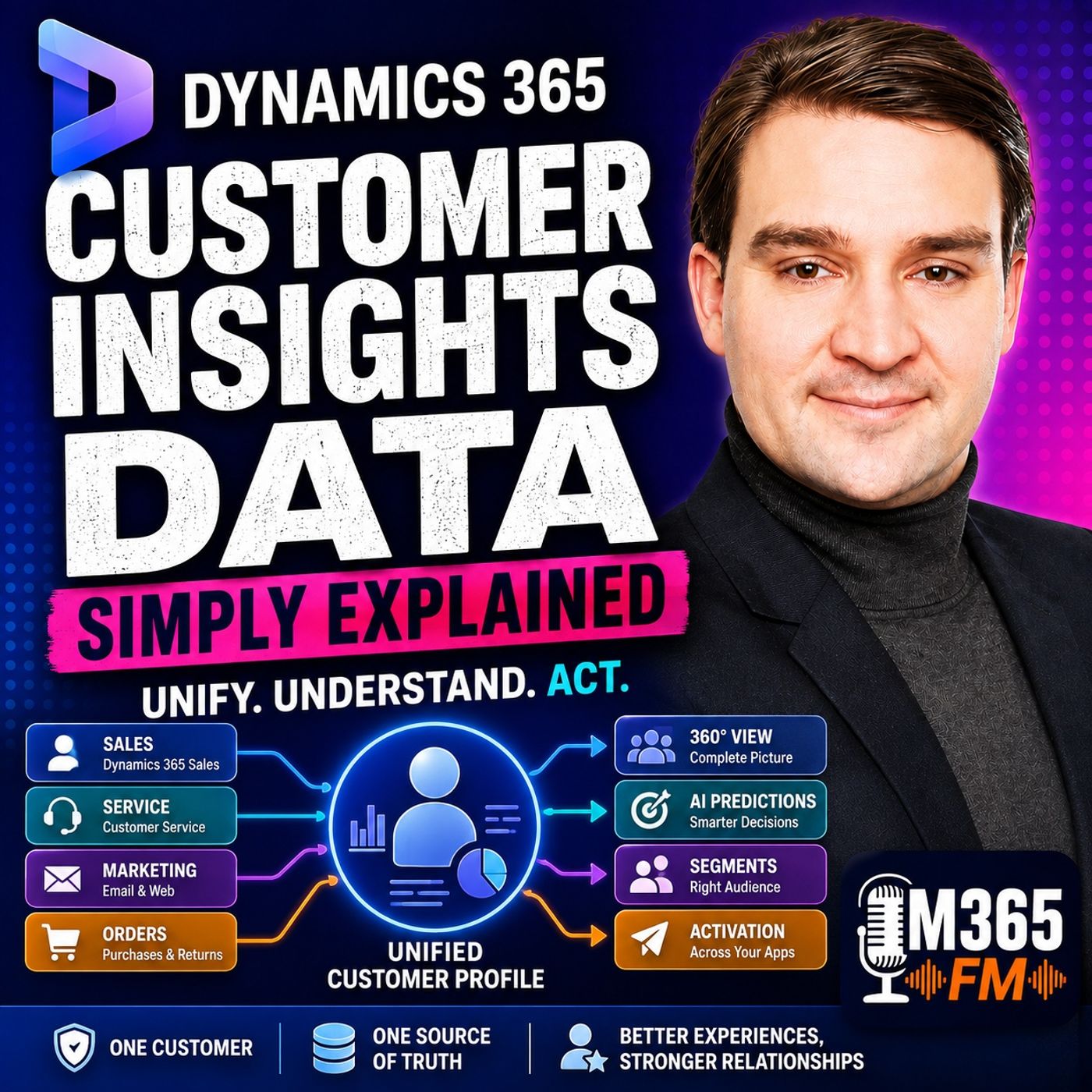
What happens when the same customer appears in three different systems—and every system tells a different story?Sales sees an open opportunity. Customer service sees recent complaints. Marketing sees email clicks and website activity. An order system knows the customer has already purchased twice. Each department has useful information, but nobody has the complete picture.In this episode of Microsoft Knowledge Nuggets on M365 FM, Mirko Peters explains Microsoft Dynamics 365 Customer Insights - Data in plain English and explores how organizations can bring fragmented customer information together, unify records, create 360-degree customer profiles, calculate measures, build segments, use AI-powered predictions, and activate customer insights across Microsoft business applications.Dynamics 365 Customer Insights - Data is Microsoft's Customer Data Platform (CDP). Its purpose is not to replace CRM, sales, service, or marketing applications. Instead, it connects information from those systems to create a more complete and usable understanding of each customer.
WHY SCATTERED CUSTOMER DATA CREATES BAD DECISIONS
Most organizations already have significant amounts of customer data. The problem is that the information is often distributed across multiple systems.Dynamics 365 Sales may contain contacts, accounts, opportunities, calls, meetings, quotes, and notes. Customer service systems contain cases, complaints, product issues, and support conversations. Marketing systems track email opens, clicks, forms, event registrations, and website engagement. Order platforms contain purchases and returns.Every system provides a useful perspective, but none necessarily provides the complete customer story.This can create situations where sales approaches a customer who currently has a serious support problem, marketing sends an upgrade promotion to someone who just purchased the product, or customer service fails to recognize that the caller is one of the company's most important customers.The problem is not necessarily missing information. The information exists—it simply is not connected.
WHAT IS DYNAMICS 365 CUSTOMER INSIGHTS DATA?
Dynamics 365 Customer Insights - Data is a Customer Data Platform, commonly abbreviated as CDP.A CDP brings customer information from different approved sources together, identifies records that appear to represent the same customer, and creates unified customer profiles that other business processes can use.Think of it as a central customer records room.Sales contributes customer and opportunity information. Service contributes cases and interactions. E-commerce or order systems contribute purchases and returns. Websites contribute digital interactions. Other business applications contribute additional customer information.Customer Insights - Data organizes these records and attempts to connect the information belonging to the same customer.
WHAT IS A 360-DEGREE CUSTOMER VIEW?
The term 360-degree customer view sounds complicated, but the underlying concept is straightforward.Instead of understanding a customer from only one perspective, organizations can combine multiple types of information into a broader profile.That profile might show who the customer is, what they purchased, which service cases they opened, which events they attended, and how they recently interacted with the organization online.It is not a magical perfect view of everything about a customer.It is a more complete business view created from the customer information an organization has legitimately connected.
CUSTOMER DATA TYPES
Customer information can come in many forms.Demographic or profile information can include names, addresses, job titles, organizations, and contact information.Transactional data can contain purchases, payments, returns, subscriptions, or reservations.Behavioral information can describe actions such as visiting a webpage, opening an email, registering for an event, submitting a form, or using an application.Operational information can provide additional context from service processes, inventory systems, or connected devices.Combining these different types of data allows organizations to understand more than what appears in a single CRM record.
CUSTOMER INSIGHTS DATA VS CUSTOMER INSIGHTS JOURNEYS
Microsoft uses the Customer Insights name for two closely related areas, but their responsibilities are different.Customer Insights - Data brings customer information together, creates unified profiles, calculates insights, and builds customer segments.Customer Insights - Journeys focuses on customer communications and journeys across channels such as email and text messaging.An easy way to remember the distinction is:Data understands the customer. Journeys communicates with the customer.Customer Insights - Data can prepare the audience and customer context. Customer Insights - Journeys can then use that information when the organization decides how and when to communicate.
CUSTOMER INSIGHTS DATA VS DYNAMICS 365 SALES
Dynamics 365 Sales and Customer Insights - Data also perform different jobs.Dynamics 365 Sales gives sales professionals the tools required to manage leads, opportunities, accounts, activities, and customer relationships.Customer Insights - Data takes a broader perspective.It can incorporate information from Dynamics 365 Sales while also connecting approved information from service platforms, websites, order systems, cloud data platforms, and other sources.It therefore extends the customer context available around CRM processes rather than simply replacing Dynamics 365 Sales.
BUILDING THE UNIFIED CUSTOMER PROFILE
Creating a unified customer profile begins by bringing appropriate data sources into a Customer Insights environment.An environment acts as a controlled workspace where customer information can be imported, prepared, unified, and managed.Organizations then connect the sources containing relevant customer information.These sources may contain customer tables, order tables, service records, website interactions, or other structured business information.The challenge is that different systems rarely describe customers in exactly the same way.
DATAVERSE, FABRIC, AZURE AND OTHER DATA SOURCES
Organizations using Dynamics 365 and Power Platform may already have significant amounts of customer information stored in Microsoft Dataverse.Customer Insights - Data can also work with data from platforms discussed in the episode including Azure Data Lake, Microsoft Fabric OneLake, and Azure Synapse Analytics.Power Query connectors provide another method for bringing information from databases, business applications, and other connected sources into the customer data environment.The purpose is to connect relevant customer information regardless of whether every source uses the same structure.
DATA MAPPING
Different systems often use different names and formats for the same information.One database might use a field called "Email Address." Another might simply use "Email." Phone numbers might appear with or without country codes. Names can contain different formatting, titles, or spelling.Mapping tells Customer Insights what those incoming fields actually represent.Organizations identify fields representing information such as names, email addresses, phone numbers, customer IDs, addresses, and other attributes useful for identifying customers.Relationships between business records also need to be understood.An order means little in a unified profile unless the system can determine which customer placed it.
CUSTOMER MATCHING
Matching is one of the most important parts of customer data unification.Suppose Alex Morgan appears in Dynamics 365 Sales using a work email address, in a support platform using a personal email address, and in a webinar registration using a name and telephone number.Those records may represent the same person.However, matching customer information is not as simple as automatically joining identical names.Two different people can have the same name. Family members may share email addresses. Customers change jobs and email addresses. Phone number formats vary.Customer Insights - Data therefore allows organizations to define matching conditions based on appropriate combinations of identifying information.The objective is to connect records when there is sufficient evidence that they represent the same customer.
DUPLICATE REMOVAL
Before creating the wider customer profile, organizations also need to deal with duplicate records.A customer might appear twice because someone submitted a web form more than once, an import created another contact, or another business process accidentally created duplicate information.Duplicate removal helps prevent a single customer from being represented multiple times before broader unification takes place.Clean source data therefore remains important even when sophisticated customer data technology is available.
THE GOLDEN CUSTOMER RECORD
After matching and deduplication, Customer Insights - Data can create a unified customer profile.This is sometimes described as a golden record.The term does not mean that the platform creates a magically perfect version of the customer.Instead, it represents the best combined customer profile that can be created from the approved information and matching rules provided by the organization.A unified profile might combine contact information from one source, account relationships from another, purchase history from a commerce system, and service history from another application.
Become a supporter of this podcast: https://www.spreaker.com/podcast/m365-fm-modern-work-security-and-productivity-with-microsoft-365--6704921/support.
🚀 Want to be part of m365.fm?
Then stop just listening… and start showing up.
👉 Connect with me on LinkedIn and let’s make something happen:
- 🎙️ Be a podcast guest and share your story
- 🎧 Host your own episode (yes, seriously)
- 💡 Pitch topics the community actually wants to hear
- 🌍 Build your personal brand in the Microsoft 365 space
This isn’t just a podcast — it’s a platform for people who take action.
🔥 Most people wait. The best ones don’t.
👉 Connect with me on LinkedIn and send me a message:
"I want in"
Let’s build something awesome 👊
Frequently Asked Questions
What is Dynamics 365 Customer Insights - Data?
It is Microsoft's Customer Data Platform (CDP) designed to bring fragmented customer information from multiple systems together, unify records, and create a single 360-degree customer profile for business applications.
What is the difference between Customer Insights - Data and Customer Insights - Journeys?
Customer Insights - Data focuses on organizing, unifying, and understanding customer information, whereas Customer Insights - Journeys uses those unified profiles to manage communications and multi-channel campaigns.
Does Dynamics 365 Customer Insights replace Dynamics 365 Sales?
No, it does not replace sales applications. Instead, it extends CRM processes by incorporating broader data from service platforms, websites, order systems, and other sources to provide complete customer context.
How are unified customer profiles created in Customer Insights?
Organizations connect various data sources, map incoming fields to standard attributes, define matching rules to connect related records, remove duplicates, and generate a cohesive golden customer record.
00:00:00,000 --> 00:00:04,600
What if one customer shows up in three systems and each one tells a completely different story?
2
00:00:04,600 --> 00:00:09,640
Sales, season, open deal, support, season, complaint, marketing, see someone who clicked an email last week,
3
00:00:09,640 --> 00:00:14,860
"Oh, but that same person has already bought from you twice. Nobody looking at a single screen can see the whole picture."
4
00:00:14,860 --> 00:00:20,580
I'm Mirko Peters from M365FM, and this knowledge nugget puts that picture back together in plain English.
5
00:00:20,580 --> 00:00:27,140
You'll see why scattered customer data causes real headaches, and why companies need one shared view before they can treat customers like people,
6
00:00:27,140 --> 00:00:29,420
instead of rows, in separate lists.
7
00:00:29,420 --> 00:00:32,400
Why scattered customer data creates bad decisions?
8
00:00:32,400 --> 00:00:35,160
Imagine you run a company that sells equipment to other businesses.
9
00:00:35,160 --> 00:00:43,040
Your sales team uses Dynamics 365 sales. They see contacts, accounts, calls, meetings, open opportunities, quotes, and notes from past conversations.
10
00:00:43,040 --> 00:00:47,080
That helps the salesperson prepare for a call, but it only shows work inside the sales system.
11
00:00:47,080 --> 00:00:53,920
Your support team handles work somewhere else. They see service cases, broken products, questions, complaints, and the conversations needed to solve a problem.
12
00:00:53,920 --> 00:01:01,020
An agent knows a customer contacted support three times this month, yet that history never shows up on the sales record. Marketing has its own set of information.
13
00:01:01,020 --> 00:01:05,520
They know who opened an email, clicked a link, filled in a form, visited a page, or signed up for an event.
14
00:01:05,520 --> 00:01:11,760
A marketer sees strong interest in a new product, while the support agent sees a customer frustrated with the product they already own.
15
00:01:11,760 --> 00:01:17,900
Here's the simple analogy. Think of it like an office building with separate rooms. Each room has its own window AU.
16
00:01:17,900 --> 00:01:22,040
Sales sees one view, support sees another, and marketing sees a third.
17
00:01:22,040 --> 00:01:26,580
Nobody has the whole picture until you open the doors between them. That's what a shared customer file does.
18
00:01:26,580 --> 00:01:32,920
Oh, it opens the doors. Nobody is doing anything wrong. The information simply lives in separate places, built for separate jobs.
19
00:01:32,920 --> 00:01:43,020
Sales needs to manage deals, service needs to solve cases, marketing needs to understand engagement, order sit in a different system, and website activity lives in an analytics tool.
20
00:01:43,020 --> 00:01:47,820
That split creates a strange situation. Here's an example. Take a customer named Alex Morgan.
21
00:01:47,820 --> 00:01:52,440
In the sales system, Alex has an account record with an old work email and an active opportunity.
22
00:01:52,440 --> 00:01:56,760
Over in the support system, Alex shows up under a personal email with two recent cases.
23
00:01:56,760 --> 00:02:02,960
And on the website, Alex signed up for a webinar using only a first name, last name, and phone number.
24
00:02:02,960 --> 00:02:08,500
Those records all belong to the same person, but without a way to connect them, the company sees three different Alex Morgan's.
25
00:02:08,500 --> 00:02:15,360
Sales prepares a friendly pitch, marketing sends a promotion for an upgrade, and support asks Alex to repeat the same details from the last call.
26
00:02:15,360 --> 00:02:24,380
From Alex's side, it feels disorganized. You've seen this yourself or you contact a company about an issue, explain it clearly, then receive a cheerful email asking whether you'd like to buy more.
27
00:02:24,380 --> 00:02:28,720
The company has the information, but its teams just don't share the same view of it.
28
00:02:28,720 --> 00:02:35,220
Bad data links create smaller problems too. A duplicate record leads to duplicate emails and old email address leaves the right person out of a message,
29
00:02:35,220 --> 00:02:39,700
and a missing connection between an order and a service case hides the reason a customer stopped buying.
30
00:02:39,700 --> 00:02:46,540
Then people start exporting lists into spreadsheets, marketing creates one list, sales creates another, service keeps its own report.
31
00:02:46,540 --> 00:02:52,140
Before long, teams debate whose list is correct while the customer waits for someone to understand the full situation.
32
00:02:52,140 --> 00:02:56,880
This affects decisions every single day. A sales manager chases customers who recently raised serious issues,
33
00:02:56,880 --> 00:03:00,580
a marketer sends a discount to someone who already purchased that full price.
34
00:03:00,580 --> 00:03:04,340
And a service leader doesn't know a caller is one of the company's largest customers.
35
00:03:04,340 --> 00:03:09,820
But the answer isn't to force every team into one app AU. Each team still needs tools built for its job.
36
00:03:09,820 --> 00:03:13,820
What they need is one shared customer file that can connect the separate records.
37
00:03:13,820 --> 00:03:18,180
That way, every team starts with the same person, not a different version of that person,
38
00:03:18,180 --> 00:03:20,820
or what customer inside's data actually is.
39
00:03:20,820 --> 00:03:25,900
So what joins those different customer records together, without forcing every department to use the same app,
40
00:03:25,900 --> 00:03:31,300
the answer is Dynamics 365 customer inside's data, Microsoft's customer data platform often called a CDP.
41
00:03:31,300 --> 00:03:36,620
With the simplest definition, a CDP pulls customer data from every system you use into one place,
42
00:03:36,620 --> 00:03:42,380
connects records that belong to the same person, and builds a lasting profile your business tools can work with.
43
00:03:42,380 --> 00:03:45,780
Picture it like a big filing room. Every department sends folders into that room,
44
00:03:45,780 --> 00:03:50,180
sales, sense, contact details, and deal history. Support sense case records,
45
00:03:50,180 --> 00:03:55,060
your website sends signups and page visits, and your order system sends purchases and returns.
46
00:03:55,060 --> 00:04:00,260
On their own, those folders might use different labels, different formats, even different customer numbers.
47
00:04:00,260 --> 00:04:05,740
Customer insights, data sorts through them all, and puts together one customer file from the records that belong together.
48
00:04:05,740 --> 00:04:10,500
That file gives you what people call a 360 degree view. You hear that phrase a lot, so here's what it means.
49
00:04:10,500 --> 00:04:15,420
A 360 degree view just means you can look at one customer and see more than one type of interaction.
50
00:04:15,420 --> 00:04:20,020
Who they are, what they bought, when they called support, and how they engaged with you online.
51
00:04:20,020 --> 00:04:21,620
It's a fuller picture, not magic.
52
00:04:21,620 --> 00:04:24,980
Customer data normally falls into a few common types.
53
00:04:24,980 --> 00:04:28,700
Demographic data describes the person, name, address, job title, company.
54
00:04:28,700 --> 00:04:34,180
Transactional data records an exchange, a purchase, return, payment, reservation, or subscription.
55
00:04:34,180 --> 00:04:39,020
Behavioral data captures actions like opening an email, visiting a product page, filling in a form,
56
00:04:39,020 --> 00:04:41,340
using an app, or registering for an event.
57
00:04:41,340 --> 00:04:46,060
Customer insights, data can also bring in operational data like inventory or service information,
58
00:04:46,060 --> 00:04:49,420
plus data from connected devices, Internet of Things or IoT devices.
59
00:04:49,420 --> 00:04:54,100
A company selling connected machines might want to look at machine activity alongside customer history.
60
00:04:54,100 --> 00:04:57,460
A service team could see that a customer called a "bout a problem"
61
00:04:57,460 --> 00:05:01,060
while the operational data shows the machine also reported an error.
62
00:05:01,060 --> 00:05:02,980
That context changes the conversation.
63
00:05:02,980 --> 00:05:06,620
Notice I'm saying customer insights data, not customer insights journeys.
64
00:05:06,620 --> 00:05:10,060
They're both under the customer insights name, but they handle different jobs.
65
00:05:10,060 --> 00:05:13,900
Data brings information together, prepares profiles, and finds useful patterns.
66
00:05:13,900 --> 00:05:19,020
Journeys uses those profiles and groups of customers to send emails, texts, and other communications.
67
00:05:19,020 --> 00:05:22,180
One side, organizes and understands the customer data.
68
00:05:22,180 --> 00:05:24,900
The other side uses that understanding when talking to people.
69
00:05:24,900 --> 00:05:29,180
You can picture data as the records room and journeys as the communications desk.
70
00:05:29,180 --> 00:05:32,620
Now, a lot of people confuse this with Dynamics 365 sales.
71
00:05:32,620 --> 00:05:37,780
Dynamics 365 sales helps a salesperson manage relationships and sales work by tracking leads,
72
00:05:37,780 --> 00:05:43,020
opportunities, activities, and account conversations, giving the sales team a place to do their job.
73
00:05:43,020 --> 00:05:45,180
Customer insights data takes a wider view.
74
00:05:45,180 --> 00:05:50,820
It can take information from Dynamics 365 sales, but it can also connect info from service systems,
75
00:05:50,820 --> 00:05:54,060
websites, order systems, data stores, and other approved sources.
76
00:05:54,060 --> 00:05:55,060
It doesn't replace sales.
77
00:05:55,060 --> 00:05:59,020
It adds the surrounding customer context that sales alone might not have.
78
00:05:59,020 --> 00:06:03,340
Behind the scenes, customer insights data runs on Microsoft Azure, meaning Microsoft provides
79
00:06:03,340 --> 00:06:07,020
the cloud foundation for storing, processing, and protecting the data.
80
00:06:07,020 --> 00:06:10,780
The product also includes tools for privacy, security, and governance.
81
00:06:10,780 --> 00:06:15,620
Governance is just the set of rules that controls who can access data and how the company can use it.
82
00:06:15,620 --> 00:06:19,820
A customer profile carries personal information, so those rules need to be part of the design
83
00:06:19,820 --> 00:06:20,820
from the start.
84
00:06:20,820 --> 00:06:24,220
Once you understand customer insights data as the place where separate customer records
85
00:06:24,220 --> 00:06:28,340
become one usable profile, the practical next question is, how do all those records get
86
00:06:28,340 --> 00:06:30,340
into the same workspace?
87
00:06:30,340 --> 00:06:36,020
Building the unified customer profile before customer insights.
88
00:06:36,020 --> 00:06:37,380
Data can connect anything.
89
00:06:37,380 --> 00:06:38,380
You create an environment.
90
00:06:38,380 --> 00:06:42,380
Think of an environment as a controlled workspace for this customer data work, giving your
91
00:06:42,380 --> 00:06:47,980
team one place to bring data in, prepare it, connect it, and manage who can work with it.
92
00:06:47,980 --> 00:06:50,480
Inside that workspace, you start by adding data sources.
93
00:06:50,480 --> 00:06:56,040
If you already use Dynamics 365, Microsoft Dataverse often supplies sales or service records, as
94
00:06:56,040 --> 00:07:01,280
Dataverse is the data store behind many Dynamics 365 and Power Platform apps.
95
00:07:01,280 --> 00:07:04,920
Customer insights data can also connect to Azure Data Lake, Fabric One Lake, and Azure
96
00:07:04,920 --> 00:07:05,920
Synapse Analytics.
97
00:07:05,920 --> 00:07:09,640
Those names sound technical, but the simple idea is that companies often keep large amounts
98
00:07:09,640 --> 00:07:12,400
of data in cloud storage and reporting systems.
99
00:07:12,400 --> 00:07:14,840
Power query connectors give you another way in.
100
00:07:14,840 --> 00:07:19,200
Power query is Microsoft's tool for bringing in data and shaping it before you use it, and
101
00:07:19,200 --> 00:07:23,320
it helps when the data sits in a database, a business app, or another connected source that
102
00:07:23,320 --> 00:07:26,680
doesn't look exactly like your Dynamics 365 records.
103
00:07:26,680 --> 00:07:28,160
Each source arrives as tables.
104
00:07:28,160 --> 00:07:31,920
A table is just a structured list, like a spreadsheet with columns and rows.
105
00:07:31,920 --> 00:07:36,440
One table might list customers, another might list orders, a third might hold service cases,
106
00:07:36,440 --> 00:07:38,640
and a fourth might record website signups.
107
00:07:38,640 --> 00:07:42,480
The hard part is that these tables rarely use the same names.
108
00:07:42,480 --> 00:07:46,760
One system might call a column email address, another calls it email, and a third stores
109
00:07:46,760 --> 00:07:49,080
a customer number with no email at all.
110
00:07:49,080 --> 00:07:52,400
No numbers may include country codes in one source and leave them out in another and names
111
00:07:52,400 --> 00:07:56,520
might arrive with different spelling, spacing, or titles.
112
00:07:56,520 --> 00:07:58,280
Customer insights.
113
00:07:58,280 --> 00:08:00,840
Data needs help understanding what each field means.
114
00:08:00,840 --> 00:08:04,440
This step is called mapping, and you tell the system which incoming columns contain a
115
00:08:04,440 --> 00:08:08,960
person's name, email address, phone number, customer number, address, or other details
116
00:08:08,960 --> 00:08:10,720
that can help identify them.
117
00:08:10,720 --> 00:08:13,600
You also map the business records connected to people.
118
00:08:13,600 --> 00:08:17,640
An order table needs to connect purchases to the right customer, and a case table needs
119
00:08:17,640 --> 00:08:20,160
to connect service history to the same person.
120
00:08:20,160 --> 00:08:23,880
Without those relationships, you have lists of events, but no reliable way to see whose
121
00:08:23,880 --> 00:08:24,880
events they are.
122
00:08:24,880 --> 00:08:29,720
Now, you might think matching records means looking for identical email addresses and joining
123
00:08:29,720 --> 00:08:31,000
everything automatically.
124
00:08:31,000 --> 00:08:34,360
Sometimes it does, but real customer data needs more care than that.
125
00:08:34,360 --> 00:08:38,120
Two people can share a household email address, a customer can change jobs and get a new work
126
00:08:38,120 --> 00:08:41,960
email, a small spelling difference can describe the same person, while two people with the
127
00:08:41,960 --> 00:08:44,880
same name can be completely unrelated.
128
00:08:44,880 --> 00:08:45,880
Customer insights.
129
00:08:45,880 --> 00:08:48,440
Data lets you set matching conditions.
130
00:08:48,440 --> 00:08:52,200
You might match records based on an email address, combine name, phone number, and postal
131
00:08:52,200 --> 00:08:55,520
details, or use a customer number if your business has one.
132
00:08:55,520 --> 00:08:58,600
The goal is to connect records only when there's enough evidence they belong to the same
133
00:08:58,600 --> 00:08:59,600
person.
134
00:08:59,600 --> 00:09:01,600
Then comes duplicate removal.
135
00:09:01,600 --> 00:09:05,120
Duplicates are repeated versions of the same record inside a source table.
136
00:09:05,120 --> 00:09:09,080
Maybe a web form created two entries after someone clicked submit twice, or a sales import
137
00:09:09,080 --> 00:09:10,960
added in existing contact again.
138
00:09:10,960 --> 00:09:14,760
Removing duplicates helps stop one person from looking like several people before the
139
00:09:14,760 --> 00:09:17,120
wider matching work even starts.
140
00:09:17,120 --> 00:09:20,760
After the system matches records and removes duplicates, it unifies the information into
141
00:09:20,760 --> 00:09:21,760
a profile.
142
00:09:21,760 --> 00:09:25,400
People often call this a golden record, but that phrase can sound grand.
143
00:09:25,400 --> 00:09:27,040
So let's use a simpler meaning.
144
00:09:27,040 --> 00:09:31,480
It's the best combined customer profile the system can build from the records you approved.
145
00:09:31,480 --> 00:09:35,160
It might bring together a current email from one source, and account link from another,
146
00:09:35,160 --> 00:09:38,160
order history from a third and service records from a fourth.
147
00:09:38,160 --> 00:09:40,200
It doesn't erase the original systems.
148
00:09:40,200 --> 00:09:44,160
Sales still keeps it sales records, your order system still owns the orders, and supports
149
00:09:44,160 --> 00:09:45,920
still works from its cases.
150
00:09:45,920 --> 00:09:46,920
Customer insights.
151
00:09:46,920 --> 00:09:50,680
Data creates a connected profile for understanding the customer across those sources, while keeping
152
00:09:50,680 --> 00:09:52,360
track of where the information came from.
153
00:09:52,360 --> 00:09:53,400
That source trail matters.
154
00:09:53,400 --> 00:09:57,240
If someone asks where an address, phone number, or purchase detail came from, your team
155
00:09:57,240 --> 00:10:01,400
should be able to trace it back to the source system rather than treating the unified profile
156
00:10:01,400 --> 00:10:02,920
like a mystery box.
157
00:10:02,920 --> 00:10:07,600
A profile also becomes more useful when it includes activities over time.
158
00:10:07,600 --> 00:10:09,600
Customer insights.
159
00:10:09,600 --> 00:10:13,320
Data can connect activities from the tables you bring in and place them on a chronological
160
00:10:13,320 --> 00:10:18,400
timeline, a purchase on Monday, a support call on Thursday, a product page visit the following
161
00:10:18,400 --> 00:10:19,400
week.
162
00:10:19,400 --> 00:10:23,560
Each event adds context when you look at the customer's recent relationship with the company.
163
00:10:23,560 --> 00:10:27,200
Imagine a salesperson opening a profile before calling a customer.
164
00:10:27,200 --> 00:10:31,120
Instead of seeing only an opportunity in a few call notes, they could see a recent order,
165
00:10:31,120 --> 00:10:34,920
a service case that closed yesterday, and a recent event registration.
166
00:10:34,920 --> 00:10:38,080
The salesperson doesn't need to guess what might shape that conversation.
167
00:10:38,080 --> 00:10:39,640
The profile supplies the context.
168
00:10:39,640 --> 00:10:42,360
Of course, a connected profile still starts as information.
169
00:10:42,360 --> 00:10:46,560
The next step is turning that information into answers your teams can use when they decide
170
00:10:46,560 --> 00:10:50,880
who needs attention, what changed, and what action makes sense.
171
00:10:50,880 --> 00:10:51,880
Adding.
172
00:10:51,880 --> 00:10:52,880
Meaning.
173
00:10:52,880 --> 00:10:54,800
Measures, Enrichment, and Predictions.
174
00:10:54,800 --> 00:10:59,160
So you can build a unified customer profile and your team can see a cleaner view of each
175
00:10:59,160 --> 00:11:00,160
person.
176
00:11:00,160 --> 00:11:02,000
But here, Tim is the thing.
177
00:11:02,000 --> 00:11:06,880
A list of records still one hour, Tim, to answer every business question on its own.
178
00:11:06,880 --> 00:11:10,920
You still need simple answers, who bought most often, who has not been ordered recently.
179
00:11:10,920 --> 00:11:14,000
Which customer's contacted support several times this month?
180
00:11:14,000 --> 00:11:15,800
Which ones look likely to leave?
181
00:11:15,800 --> 00:11:17,640
Customer Insights.
182
00:11:17,640 --> 00:11:22,240
Data answers many of those questions with something called Measures.
183
00:11:22,240 --> 00:11:24,560
Let our comes breakdown what a measure actually is.
184
00:11:24,560 --> 00:11:27,720
A measure is a calculation built from data you already have.
185
00:11:27,720 --> 00:11:30,720
Think of it as one agreed upon number your team tracks together.
186
00:11:30,720 --> 00:11:34,960
No more asking everyone to calculate it manually in Excel every time.
187
00:11:34,960 --> 00:11:37,760
Let our to missay you need total purchases over the past year.
188
00:11:37,760 --> 00:11:42,200
Create a measure or the number of days since the customer outtms last order outtms another
189
00:11:42,200 --> 00:11:43,200
measure.
190
00:11:43,200 --> 00:11:47,680
You could count service cases, calculate average order value or track event attendance.
191
00:11:47,680 --> 00:11:51,080
The exact measure depends on what your business needs to understand.
192
00:11:51,080 --> 00:11:55,080
For a subscription business, a measure shows how long someone has been a customer and whether
193
00:11:55,080 --> 00:11:56,600
their usage has dropped.
194
00:11:56,600 --> 00:12:01,320
For a retailer, it shows total spending, recent returns, or the gap between purchases.
195
00:12:01,320 --> 00:12:05,600
Measures turn lots of separate activity into a clear answer, that saves time.
196
00:12:05,600 --> 00:12:08,480
But more importantly, it helps teams use the same definition.
197
00:12:08,480 --> 00:12:13,000
If sales calls someone a high value customer while marketing uses a different calculation,
198
00:12:13,000 --> 00:12:14,760
the customer experience splits again.
199
00:12:14,760 --> 00:12:18,400
A shared measure gives everyone one agreed way to look at the question.
200
00:12:18,400 --> 00:12:20,760
Now some customer profiles still have gaps.
201
00:12:20,760 --> 00:12:25,400
Your system may know a person outtms name and purchase history, but not their location,
202
00:12:25,400 --> 00:12:28,960
company details, or other helpful information.
203
00:12:28,960 --> 00:12:29,960
Customer Insights.
204
00:12:29,960 --> 00:12:34,360
Data can enrich profiles using approved Microsoft or partner data sources.
205
00:12:34,360 --> 00:12:37,400
And just means adding more information to data you already have.
206
00:12:37,400 --> 00:12:40,680
It outmishes not an excuse to collect every possible detail.
207
00:12:40,680 --> 00:12:44,600
Your company should only add information it can use responsibly, and only when it fits
208
00:12:44,600 --> 00:12:47,480
the permissions and rules around that customer data.
209
00:12:47,480 --> 00:12:50,320
Used carefully, enrichment fills in missing context.
210
00:12:50,320 --> 00:12:54,160
For example, a business selling to companies may want clearer company information alongside
211
00:12:54,160 --> 00:12:57,680
its sales context, that helps a salesperson understand who they are automore speaking with
212
00:12:57,680 --> 00:12:59,920
before the conversation starts.
213
00:12:59,920 --> 00:13:01,360
Then there are predictions.
214
00:13:01,360 --> 00:13:05,600
Your insider insights data includes ready-made AI models that estimate churn likelihood
215
00:13:05,600 --> 00:13:07,200
and expected revenue.
216
00:13:07,200 --> 00:13:10,880
Churn means a customer stops buying, cancels a subscription, or stops engaging with your
217
00:13:10,880 --> 00:13:11,880
company.
218
00:13:11,880 --> 00:13:15,320
Expected revenue estimates what a customer relationship brings in over time.
219
00:13:15,320 --> 00:13:19,120
These predictions look for patterns in the data, considering purchase history, recent
220
00:13:19,120 --> 00:13:23,360
activity, or changes in behavior depending on the model and the data you provide.
221
00:13:23,360 --> 00:13:26,560
The result is a signal that helps a team decide where to look first.
222
00:13:26,560 --> 00:13:28,480
It outmys not a verdict about a person.
223
00:13:28,480 --> 00:13:31,480
A churn score does not empty mean that customer will leave.
224
00:13:31,480 --> 00:13:35,960
It means the available data looks similar to patterns of customers who left before, people
225
00:13:35,960 --> 00:13:39,000
still need to check the context and use judgment.
226
00:13:39,000 --> 00:13:43,040
Imagine a customer whose buying activity suddenly stops, a prediction flags that customer
227
00:13:43,040 --> 00:13:44,600
as a possible churn risk.
228
00:13:44,600 --> 00:13:48,560
Before anyone sends a windback offer, the team checks the profile and finds an open service
229
00:13:48,560 --> 00:13:49,560
case.
230
00:13:49,560 --> 00:13:53,640
Now the right action is to solve the issue first, not send a sales email that ignores
231
00:13:53,640 --> 00:13:54,640
the problem.
232
00:13:54,640 --> 00:13:59,040
Some organizations build their own AI models and use wider analytics tools for questions unique
233
00:13:59,040 --> 00:14:00,040
to their business.
234
00:14:00,040 --> 00:14:03,120
A manufacturer studies product use alongside service history.
235
00:14:03,120 --> 00:14:07,480
A company with its own data science team tests a model built around the signals that matter
236
00:14:07,480 --> 00:14:08,920
to its business.
237
00:14:08,920 --> 00:14:10,400
Customer insights.
238
00:14:10,400 --> 00:14:14,000
Data can become part of that work, but it does note them to remove the need for sound
239
00:14:14,000 --> 00:14:15,480
data or human review.
240
00:14:15,480 --> 00:14:17,560
Here are what terms the key takeaway.
241
00:14:17,560 --> 00:14:19,080
Measure and tell you what happened.
242
00:14:19,080 --> 00:14:20,600
Enrichment adds context.
243
00:14:20,600 --> 00:14:23,040
Predictions point you toward patterns worth checking.
244
00:14:23,040 --> 00:14:26,440
An insight that stays inside a profile does note them a change anything.
245
00:14:26,440 --> 00:14:29,800
Teams need a way to use those answers when they decide who to contact what support to
246
00:14:29,800 --> 00:14:34,640
give and where customer information should go next.
247
00:14:34,640 --> 00:14:35,720
Segment in activation.
248
00:14:35,720 --> 00:14:37,240
Turning profiles into action.
249
00:14:37,240 --> 00:14:41,000
A customer profile becomes useful when you can act on it, that automates where segments
250
00:14:41,000 --> 00:14:42,000
come in.
251
00:14:42,000 --> 00:14:44,960
A segment is a safe group of customers chosen by rules you set.
252
00:14:44,960 --> 00:14:49,400
Those rules use profile details, activities, behaviors and measures from customer insights
253
00:14:49,400 --> 00:14:50,400
data.
254
00:14:50,400 --> 00:14:52,960
Now it's time to manually picking names from a spreadsheet.
255
00:14:52,960 --> 00:14:56,640
Instead, you ask a business question and turn that question into rules.
256
00:14:56,640 --> 00:15:01,560
For example, show customers who opened a support case in the past 30 days have an hour
257
00:15:01,560 --> 00:15:05,880
time and bought anything in the past 90 days and agreed to receive communications.
258
00:15:05,880 --> 00:15:08,800
That group updates as customer information changes.
259
00:15:08,800 --> 00:15:12,080
If someone makes a purchase, they no longer fit the rules and leave the segment.
260
00:15:12,080 --> 00:15:15,560
If another customer opens a new case and stops buying, they enter it.
261
00:15:15,560 --> 00:15:19,520
Your audience stays connected to the customer information rather than becoming an old exported
262
00:15:19,520 --> 00:15:20,280
list.
263
00:15:20,280 --> 00:15:21,720
This changes how teams work.
264
00:15:21,720 --> 00:15:25,720
A service team uses a segment to identify customers who need extra care after repeated
265
00:15:25,720 --> 00:15:26,880
issues.
266
00:15:26,880 --> 00:15:30,720
Sales focuses follow-up on customers with a recent product interest and a history of buying
267
00:15:30,720 --> 00:15:32,360
similar products.
268
00:15:32,360 --> 00:15:35,720
Marketing creates an audience for people who attended an event but have an ultimate ask
269
00:15:35,720 --> 00:15:37,000
for a sales call.
270
00:15:37,000 --> 00:15:39,920
The point is no TNT to send more messages.
271
00:15:39,920 --> 00:15:43,760
It outens to make the next action fit what the company already knows.
272
00:15:43,760 --> 00:15:47,240
A customer with a recent problem needs an honest service update.
273
00:15:47,240 --> 00:15:51,520
A customer who has researched a new product for weeks needs a helpful sales conversation.
274
00:15:51,520 --> 00:15:56,000
Treating both people the same ignores the information your teams worked to connect.
275
00:15:56,000 --> 00:16:00,280
Customer insights data can also send unified profiles, segments and other prepared data to
276
00:16:00,280 --> 00:16:01,720
connect to destinations.
277
00:16:01,720 --> 00:16:04,920
A destination is another approved tool that needs the information we will.
278
00:16:04,920 --> 00:16:08,920
Maybe a marketing platform, an analytics tool, or another business system where your team
279
00:16:08,920 --> 00:16:10,960
works with customers.
280
00:16:10,960 --> 00:16:15,480
For organizations using Dynamics 365 apps, the customer card add-in brings customer context
281
00:16:15,480 --> 00:16:18,160
into other Dynamics 365 experiences.
282
00:16:18,160 --> 00:16:21,720
Picture a sales or service employee opening a customer record in the app they already
283
00:16:21,720 --> 00:16:22,720
use.
284
00:16:22,720 --> 00:16:26,120
The customer card places wider customer context close to their day-to-day work so their
285
00:16:26,120 --> 00:16:30,760
OTM says no need to search across several systems before each conversation.
286
00:16:30,760 --> 00:16:33,760
Customer insights journeys also uses audiences from this data work.
287
00:16:33,760 --> 00:16:37,840
Journeys handles customer communications like email, text messages and other planned
288
00:16:37,840 --> 00:16:39,800
interactions.
289
00:16:39,800 --> 00:16:42,520
Customer insights data prepares the people and context.
290
00:16:42,520 --> 00:16:45,520
These uses that audience when the company decides to communicate.
291
00:16:45,520 --> 00:16:47,200
Keep those jobs separate in your mind.
292
00:16:47,200 --> 00:16:50,200
Data answers, "Oh, who is this person and what do we know?"
293
00:16:50,200 --> 00:16:51,600
"Oh, journeys answers."
294
00:16:51,600 --> 00:16:52,760
"Oh."
295
00:16:52,760 --> 00:16:54,640
What communication should happen next?
296
00:16:54,640 --> 00:16:55,640
"Oh."
297
00:16:55,640 --> 00:16:59,040
That separation helps teams avoid a common mistake, building a segment does not make
298
00:16:59,040 --> 00:17:01,560
automatically mean you should contact everyone in it.
299
00:17:01,560 --> 00:17:04,840
A segment identifies a group based on facts and rules.
300
00:17:04,840 --> 00:17:08,440
Someone still needs to decide whether contact makes sense, which channel fits, and whether
301
00:17:08,440 --> 00:17:12,000
the message respects the customer's current situation.
302
00:17:12,000 --> 00:17:15,440
One shared segment also reduces the usual spreadsheet problem.
303
00:17:15,440 --> 00:17:19,160
Marketing does no OTM types need one manually cleaned list, while sales uses another version
304
00:17:19,160 --> 00:17:21,760
and service keeps a third list hidden in a report.
305
00:17:21,760 --> 00:17:25,480
Teams work from the same customer rules even when each team takes a different action.
306
00:17:25,480 --> 00:17:27,600
The data can travel, but it needs limits.
307
00:17:27,600 --> 00:17:31,640
Do you privacy, security and the CDP difference?
308
00:17:31,640 --> 00:17:35,680
So the bigger your customer profile gets, the more responsibility you take on, and that
309
00:17:35,680 --> 00:17:38,680
responsibility starts with privacy and security.
310
00:17:38,680 --> 00:17:43,160
When you connect names, contact details, purchase records, support history and online activity
311
00:17:43,160 --> 00:17:46,600
together, you need clear rules for handling that information.
312
00:17:46,600 --> 00:17:51,040
Consent, privacy rules and access control all matter before you start connecting.
313
00:17:51,040 --> 00:17:52,560
Customer Insights
314
00:17:52,560 --> 00:17:57,200
Data includes privacy, security and management tools that work behind the scenes.
315
00:17:57,200 --> 00:18:00,000
Think of it like the security desk in an office building.
316
00:18:00,000 --> 00:18:03,760
In plain English, you set rules about who can view customer information and how you use
317
00:18:03,760 --> 00:18:04,760
it.
318
00:18:04,760 --> 00:18:07,920
You think about customer permissions before you collect data connected, build a segment
319
00:18:07,920 --> 00:18:09,200
or send it to another tool.
320
00:18:09,200 --> 00:18:10,200
Here's the thing.
321
00:18:10,200 --> 00:18:12,360
More data doesn't mean you can use it however you want.
322
00:18:12,360 --> 00:18:16,040
The data has to match the permissions, laws and internal rules for each customer.
323
00:18:16,040 --> 00:18:20,240
That work happens at the beginning, not after a campaign goes wrong or a customer complains.
324
00:18:20,240 --> 00:18:22,920
So how is the CDP different from other customer tools?
325
00:18:22,920 --> 00:18:23,920
Let's break it down.
326
00:18:23,920 --> 00:18:25,440
Let's compare two common examples.
327
00:18:25,440 --> 00:18:26,440
Think about a CRM system.
328
00:18:26,440 --> 00:18:31,640
A tool like Dynamics 365 Sales helps sales and service teams record and manage direct
329
00:18:31,640 --> 00:18:33,440
relationships with customers.
330
00:18:33,440 --> 00:18:36,840
Sales people use it to work with leads, opportunities, calls and accounts.
331
00:18:36,840 --> 00:18:41,960
CRM does one job well, while customer insights data fills in the gaps across marketing and
332
00:18:41,960 --> 00:18:44,240
service, customer insights.
333
00:18:44,240 --> 00:18:46,960
Data works across a wider set of approved sources.
334
00:18:46,960 --> 00:18:50,720
It connects records into lasting customer profiles that other business tools can use.
335
00:18:50,720 --> 00:18:54,680
Think of it as extending your CRM rather than replacing where a salesperson manages a
336
00:18:54,680 --> 00:18:57,120
deal or a service agent tracks the case.
337
00:18:57,120 --> 00:19:00,640
Now compare that to an anonymous advertising audience tool.
338
00:19:00,640 --> 00:19:03,680
Advertising tools often group unknown people for targeting.
339
00:19:03,680 --> 00:19:08,360
Other insights data focuses on lasting profiles built from customer information you can connect
340
00:19:08,360 --> 00:19:09,360
and manage.
341
00:19:09,360 --> 00:19:11,600
One tool works with anonymous audience groups.
342
00:19:11,600 --> 00:19:15,560
The other helps you understand known customers across their entire relationship with your
343
00:19:15,560 --> 00:19:16,560
company.
344
00:19:16,560 --> 00:19:19,080
That's the difference between targeting a crowd and understanding a person.
345
00:19:19,080 --> 00:19:24,800
And here's the thing that shared view only works when access stays controlled.
346
00:19:24,800 --> 00:19:30,040
Conclusion one customer file dynamics 365 customer insights.
347
00:19:30,040 --> 00:19:35,400
Data lets you act from a connected customer profile instead of separate sales, service, marketing
348
00:19:35,400 --> 00:19:36,880
and purchase lists.
349
00:19:36,880 --> 00:19:39,560
I'm Mirko Peters and this has been your knowledge nugget.
350
00:19:39,560 --> 00:19:43,200
Subscribe on your favorite podcast platform and share it with someone who still sees customer
351
00:19:43,200 --> 00:19:47,160
data as separate lists because the next customer conversation might depend on information
352
00:19:47,160 --> 00:19:49,000
sitting in a system nobody checked.




