


 Apple Podcasts
 Spotify
 Youtube Music
 Spreaker
 Podchaser
 Amazon Music
 Dynamics 365 Case Management - Simply Explained
Key Takeaways
- Mirko Peters explains how Dynamics 365 Case Management centralizes customer service by treating every issue as a structured record containing history, communication, and ownership details.
- Connecting emails, phone calls, and notes directly to a single case file eliminates lost context and prevents customers from having to repeat their story to multiple agents.
- Dynamics 365 utilizes features like entitlements, Service Level Agreements (SLAs), and knowledge management to ensure consistent support terms and faster resolutions.
- Automation tools such as record creation rules, routing queues, and Copilot case summaries streamline intake workflows and help agents get up to speed quickly on complex issues.
- Analyzing case data enables support managers to track metrics like time to resolution and first-contact resolution, transforming daily service operations into actionable insights for continuous improvement.
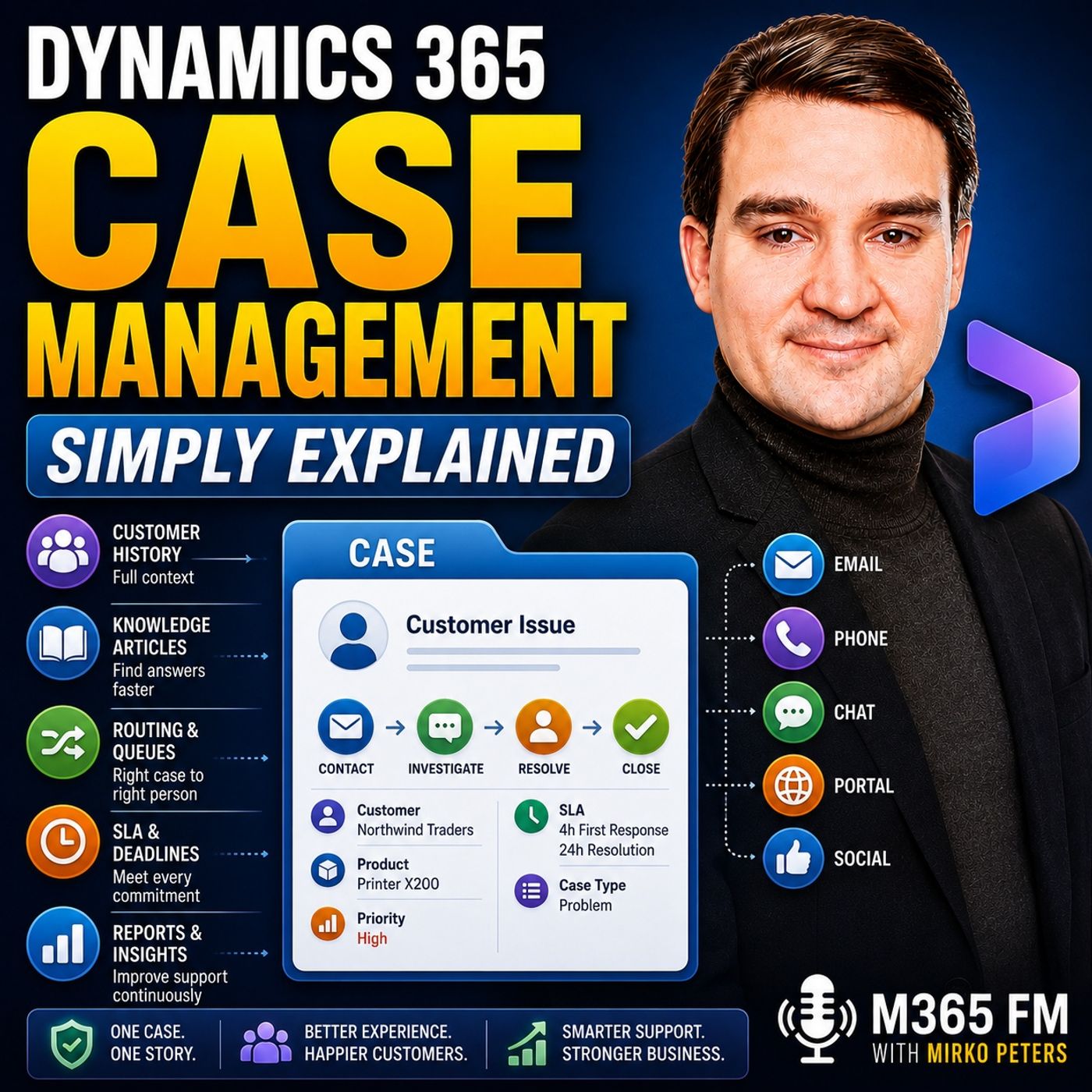
Dynamics 365 Case Management gives customer service teams one central place to manage customer issues from the first contact through resolution. Instead of information being scattered across emails, calls, chats, notes, and separate systems, each customer problem becomes a structured case containing the issue, customer context, activities, ownership, priority, service commitments, and final resolution. In this episode of M365 FM, Mirko Peters explains how Dynamics 365 Customer Service uses cases, queues, routing, SLAs, knowledge articles, Copilot, entitlements, and automation to create a more consistent support experience. ㅤ
WHAT IS A CASE IN DYNAMICS 365?
A case represents one customer issue that requires an answer or resolution. It could be a damaged product, billing question, login problem, technical issue, or request for help. Customers can have multiple cases simultaneously because each problem is managed separately. Cases can be connected to contacts and accounts while recording information such as the subject, product, priority, case type, description, and responsible owner. This creates a single working record for the entire support issue rather than forcing agents to reconstruct the customer story from multiple systems. ㅤ
KEEPING THE COMPLETE CUSTOMER HISTORY TOGETHER
Emails, calls, notes, appointments, tasks, chats, and other activities can remain connected to the same case. When ownership changes, the next agent can understand what happened without asking the customer to explain everything again. This customer context becomes particularly important for complex cases involving several agents or previous troubleshooting attempts. The case shows the immediate problem while the broader customer record provides information about previous interactions, products, and support history. ㅤ
ENTITLEMENTS AND CUSTOMER SUPPORT AGREEMENTS
Not every customer receives the same level of support. Dynamics 365 can use entitlements to represent the support terms associated with a customer. An entitlement might define warranty coverage, available support hours, permitted numbers of cases, or premium service conditions. Agents can therefore understand what support applies before committing resources or making promises to customers. ㅤ
KNOWLEDGE MANAGEMENT FOR FASTER RESOLUTION
Customer service teams frequently solve the same problems repeatedly. Dynamics 365 Knowledge Management allows organizations to maintain approved articles containing troubleshooting instructions, explanations, screenshots, standard answers, and other reusable support information. Agents can search these articles while working on cases instead of recreating solutions from memory. This can improve consistency and make organizational knowledge more accessible to less experienced support agents. ㅤ
COPILOT CASE SUMMARIES
Long-running cases can contain substantial amounts of information. Copilot can help agents understand that history by generating concise case summaries from information such as the customer, subject, product, priority, description, case type, and recent activities. The summary provides a faster starting point, particularly when a case changes ownership. Agents still review the underlying information and apply their own judgment before deciding what to do next. ㅤ
AUTOMATIC CASE CREATION
Customers can contact support through channels such as email, phone, chat, social media, and self-service portals. Dynamics 365 can use record creation rules to turn supported incoming communications into structured cases. For example, an email sent to a shared support address can automatically create a case rather than remaining unnoticed in a mailbox. Existing conversations can remain associated with their original cases while genuinely new problems receive separate records. ㅤ
QUEUES AND ROUTING
Once a case exists, it needs to reach the appropriate team. Dynamics 365 queues provide shared work areas where teams can manage incoming cases. Organizations might create separate queues for billing, technical support, returns, products, languages, regions, or different levels of urgency. Routing rules can evaluate information contained within a case and automatically direct it toward the appropriate queue or agent. Cases can also be manually reassigned when human judgment determines that a particular specialist is better suited to handle the problem. ㅤ
PARENT CASES, CHILD CASES AND DUPLICATES
Sometimes many customers report problems caused by the same underlying issue. Dynamics 365 can use parent and child cases to connect those individual customer reports to a larger problem. This allows teams to investigate the underlying issue centrally while maintaining individual customer records and communications. Duplicate cases can also be merged so multiple agents don't unknowingly work on the same problem. ㅤ
SERVICE LEVEL AGREEMENTS AND RESPONSE TIMES
Getting a case to the correct person isn't enough. Customers also expect organizations to meet agreed response and resolution times. Dynamics 365 Service Level Agreements, or SLAs, can attach time-based targets to cases. First-response targets measure how quickly the organization acknowledges the customer, while resolution targets measure how long the organization has to completely address the issue. Different support agreements, priorities, and case types can have different targets. Agents can see which cases are approaching deadlines, while alerts and escalation processes can help teams respond before service commitments are missed. ㅤ
BUSINESS PROCESS FLOWS FOR CONSISTENT SUPPORT
Business Process Flows provide agents with structured stages for handling cases. A process might move through intake, investigation, diagnosis, and resolution while requiring important information at each stage. This helps newer agents understand what information they need while providing experienced teams with a consistent process. Managers can also identify stages where cases frequently become delayed. ㅤ
RESOLVING AND REOPENING CASES
Sending an email doesn't automatically mean the customer's problem has been solved. Teams should record how the issue was resolved and then formally close the case. Resolution information creates useful history for future interactions. If the original solution doesn't work, the case can be reopened so the team continues with the existing history instead of creating another disconnected record. ㅤ
USING CASE DATA TO IMPROVE CUSTOMER SERVICE
Individual cases also become valuable operational data. Managers can analyze time to resolution, time spent in different stages, first-contact resolution, queue workloads, reopened cases, and recurring issue categories. Patterns can reveal broader problems. Increasing case volumes around one product could indicate a product issue, while repeated questions may indicate that documentation or knowledge articles need improvement. Case management therefore supports both individual customer service and continuous improvement across the support organization. ㅤ
CUSTOMER SELF-SERVICE
Some customers don't need direct assistance from an agent. Self-service experiences can allow customers to create requests, check case status, provide additional information, and access approved knowledge content themselves. This can reduce routine support demand while allowing customer service agents to concentrate on problems requiring investigation, explanation, or human judgment. ㅤ
MICROSOFT 365 AND POWER PLATFORM INTEGRATION
Dynamics 365 Case Management can work alongside familiar Microsoft technologies. Outlook can support email communication, Teams can help employees collaborate on difficult cases, SharePoint can manage related documents, Power BI can provide reporting and dashboards, and Power Platform can extend processes with additional forms and automation. The tools surrounding the process may change, but the Dynamics 365 case remains the central record connecting the customer problem, activities, ownership, service commitments, and resolution. ㅤ
THE KEY TAKEAWAY
Dynamics 365 Case Management isn't simply a ticketing system. It provides a structured lifecycle for customer issues from initial contact through routing, investigation, service commitments, knowledge, collaboration, resolution, and reporting. By keeping the customer, problem, communication history, support agreement, ownership, deadlines, and final answer connected to one record, customer service teams can reduce lost context, avoid duplicated work, and provide customers with a more consistent support experience. Subscribe to M365 FM for more Microsoft Knowledge Nuggets and Simply Explained episodes covering Dynamics 365, Microsoft 365, Power Platform, Copilot, AI, Azure, security, governance, and the Microsoft ecosystem.
Become a supporter of this podcast: https://www.spreaker.com/podcast/m365-fm-modern-work-security-and-productivity-with-microsoft-365--6704921/support.
🚀 Want to be part of m365.fm?
Then stop just listening… and start showing up.
👉 Connect with me on LinkedIn and let’s make something happen:
- 🎙️ Be a podcast guest and share your story
- 🎧 Host your own episode (yes, seriously)
- 💡 Pitch topics the community actually wants to hear
- 🌍 Build your personal brand in the Microsoft 365 space
This isn’t just a podcast — it’s a platform for people who take action.
🔥 Most people wait. The best ones don’t.
👉 Connect with me on LinkedIn and send me a message:
"I want in"
Let’s build something awesome 👊
Frequently Asked Questions
What is a case in Dynamics 365 Customer Service?
A case represents a single customer issue, question, or request that requires an answer or resolution. It acts as a central working record containing the customer's context, problem description, activities, and final resolution.
How do SLAs work in Dynamics 365 Case Management?
Service Level Agreements (SLAs) attach time-based targets to cases to track first-response and resolution commitments. They provide agents with time indicators to prioritize urgent issues and help prevent missed deadlines.
What are entitlements in Dynamics 365?
Entitlements represent the support agreements associated with a customer or account. They define warranty coverage, available support hours, permitted numbers of cases, or premium service conditions before agents commit resources.
How does Copilot assist agents with Dynamics 365 cases?
Copilot generates concise case summaries from extensive histories, including customer details, product information, descriptions, and recent activities. This provides agents with a fast briefing, especially during handoffs.
00:00:00,000 --> 00:00:04,120
A customer emails about a broken order, then calls the next day, then opens a chat because
2
00:00:04,120 --> 00:00:07,560
nobody seems to know what happened, and they repeat the same story every time, while
3
00:00:07,560 --> 00:00:11,360
your support team hunts through inboxes, notes, and separate tools.
4
00:00:11,360 --> 00:00:15,240
That Uhtmer is exactly what Dynamics 365 Case Management fixes.
5
00:00:15,240 --> 00:00:18,840
Think of a case like one labeled folder inside a busy office building, where every part
6
00:00:18,840 --> 00:00:22,280
of a customer problem goes into that folder or from the first question to the final answer.
7
00:00:22,280 --> 00:00:24,640
Uhtmer Mirko Peters from M365FM.
8
00:00:24,640 --> 00:00:29,360
And in this knowledge nugget, you outmell see how cases, routing, response deadlines,
9
00:00:29,360 --> 00:00:32,080
and articles and closure all fit together.
10
00:00:32,080 --> 00:00:34,480
What a case actually is 520 words.
11
00:00:34,480 --> 00:00:36,040
So what exactly is a case?
12
00:00:36,040 --> 00:00:40,200
A case is one record for one customer issue that needs an answer or a fix, and the issue
13
00:00:40,200 --> 00:00:44,600
could be a damaged product, a billing question, a login problem, or a request for help using
14
00:00:44,600 --> 00:00:45,600
a service.
15
00:00:45,600 --> 00:00:48,920
HeroTemps the thing, one customer can have several cases at once.
16
00:00:48,920 --> 00:00:53,080
A single customer might ask about an invoice on Monday, report a failed device on Tuesday,
17
00:00:53,080 --> 00:00:54,920
and need help changing an address on Friday.
18
00:00:54,920 --> 00:00:58,840
Those are separate problems, so Dynamics 365 keeps them in separate case records instead
19
00:00:58,840 --> 00:01:02,160
of piling every conversation into one confusing thread.
20
00:01:02,160 --> 00:01:05,280
When an agent creates a case, they link it straight to the customer.
21
00:01:05,280 --> 00:01:09,400
That customer may be a contact you meaning an individual person or an account meaning
22
00:01:09,400 --> 00:01:10,600
the company they work for.
23
00:01:10,600 --> 00:01:14,520
So if Jamie from Northwind traders reports a problem, the case can point to both Jamie and
24
00:01:14,520 --> 00:01:18,920
the company, and anyone opening the record can see who needs help and which organization
25
00:01:18,920 --> 00:01:20,600
the issue belongs to.
26
00:01:20,600 --> 00:01:24,240
The case also needs a plain description of the problem, usually starting with a title
27
00:01:24,240 --> 00:01:29,680
like "Oprinter stops after software update AU" or "O will customer charge twice for annual
28
00:01:29,680 --> 00:01:35,600
plan" AU and that title helps people scan a list of open cases without opening every record.
29
00:01:35,600 --> 00:01:37,920
Below that title the agent adds the detail.
30
00:01:37,920 --> 00:01:39,560
What happened when did it begin?
31
00:01:39,560 --> 00:01:42,760
What has the customer already tried, which product it involves and whether it automates a
32
00:01:42,760 --> 00:01:45,160
question, a request, or a fault?
33
00:01:45,160 --> 00:01:48,920
These details turn a vague message into work that somebody can own and solve.
34
00:01:48,920 --> 00:01:50,480
Letotemps break it down further.
35
00:01:50,480 --> 00:01:53,800
A case can carry a subject, product, priority, and case type.
36
00:01:53,800 --> 00:01:57,840
The subject groups the issue into an area like billing or technical support, the product
37
00:01:57,840 --> 00:02:02,720
identifies what the customer uses, the priority tells the team how quickly to look at it, and
38
00:02:02,720 --> 00:02:07,320
the case type gives the team another way to sort work based on their support process.
39
00:02:07,320 --> 00:02:11,120
None of these fields solve the customer or temers problem by themselves, but they help
40
00:02:11,120 --> 00:02:15,280
the support team see the work clearly, especially when hundreds of cases arrive from different
41
00:02:15,280 --> 00:02:16,280
customers.
42
00:02:16,280 --> 00:02:19,920
A team dealing with a serious service failure should know, temate, have to search through
43
00:02:19,920 --> 00:02:21,400
general questions to find it.
44
00:02:21,400 --> 00:02:25,120
Now a case is no attempt to just form someone fills in and forgets.
45
00:02:25,120 --> 00:02:27,920
It becomes the working record for the whole conversation.
46
00:02:27,920 --> 00:02:32,000
Emails can connect to the case, phone calls can appear there, and an agent can add notes
47
00:02:32,000 --> 00:02:35,960
after a chat, set a follow-up task, or record an appointment.
48
00:02:35,960 --> 00:02:40,480
Each activity stays with the same customer problem, so the next person does now attempt,
49
00:02:40,480 --> 00:02:42,520
need to rebuild the story from scratch.
50
00:02:42,520 --> 00:02:46,480
Imagine an agent starts working the morning and then hands the case to a product specialist
51
00:02:46,480 --> 00:02:47,480
after lunch.
52
00:02:47,480 --> 00:02:51,120
Without a case record, the specialist might receive one short message like, "Oh, can
53
00:02:51,120 --> 00:02:52,120
you look at this?"
54
00:02:52,120 --> 00:02:54,360
A/O, which is now admit enough.
55
00:02:54,360 --> 00:02:57,920
With the case record, they can see the original issue, customer details, what happened during
56
00:02:57,920 --> 00:03:00,760
the call, and what the first agent already checked.
57
00:03:00,760 --> 00:03:02,880
That autumn is a much better hand off.
58
00:03:02,880 --> 00:03:07,440
Dynamics 365 keeps the case in a clear state as it moves through the support process.
59
00:03:07,440 --> 00:03:11,200
It can stay active while the team investigates, and once the team fixes the issue or gives
60
00:03:11,200 --> 00:03:13,600
the final answer, they resolve it.
61
00:03:13,600 --> 00:03:17,280
If the request no longer needs work, "Oh, maybe it came in by mistake or the customer
62
00:03:17,280 --> 00:03:19,960
withdrew, it how the team can cancel it."
63
00:03:19,960 --> 00:03:21,960
Active, resolved, and canceled.
64
00:03:21,960 --> 00:03:26,800
Now, those three states give the team a shared view of where each issue sits, so nobody
65
00:03:26,800 --> 00:03:31,840
needs to guess whether a case still needs attention and managers don't know, Tim, Artet,
66
00:03:31,840 --> 00:03:36,320
need to treat old finished work like a fresh customer problem.
67
00:03:36,320 --> 00:03:41,240
One record gives you control, and the full customer history gives the agent context.
68
00:03:41,240 --> 00:03:43,400
The customer's story behind the case.
69
00:03:43,400 --> 00:03:45,360
A case tells you what needs fixing.
70
00:03:45,360 --> 00:03:48,080
The customer record tells you what led to this moment.
71
00:03:48,080 --> 00:03:52,760
When an agent opens a case in Dynamics 365 customer service, they can look beyond the latest
72
00:03:52,760 --> 00:03:53,760
message.
73
00:03:53,760 --> 00:03:57,480
They see the bigger picture are you, earlier cases, past emails, the products connected to
74
00:03:57,480 --> 00:04:02,360
the customer and their support history, context changes the conversation, why does context
75
00:04:02,360 --> 00:04:03,360
matter?
76
00:04:03,360 --> 00:04:05,440
Imagine a customer reports a device failure.
77
00:04:05,440 --> 00:04:09,760
If the agent only sees today's message, they may start with basic questions.
78
00:04:09,760 --> 00:04:10,760
What model is it?
79
00:04:10,760 --> 00:04:11,760
When did it start?
80
00:04:11,760 --> 00:04:12,760
Did you restart it?
81
00:04:12,760 --> 00:04:16,520
But the customer has already contacted support twice this week, the first agent sent
82
00:04:16,520 --> 00:04:20,480
troubleshooting steps, the second arranged a replacement part, a third agent who sees
83
00:04:20,480 --> 00:04:23,000
that history won't ask the customer to start over.
84
00:04:23,000 --> 00:04:26,680
Instead, they say, "I can see you already tried those steps and the replacement part didn't
85
00:04:26,680 --> 00:04:27,680
fix it.
86
00:04:27,680 --> 00:04:28,680
Let's try the next thing."
87
00:04:28,680 --> 00:04:32,400
That feels very different from, "Can you explain the problem again?"
88
00:04:32,400 --> 00:04:35,240
This is often called a 360 degree customer view.
89
00:04:35,240 --> 00:04:36,920
The name sounds fancy, but it's simple.
90
00:04:36,920 --> 00:04:41,560
It means the agent sees the customer from more than one angle, not just one isolated message.
91
00:04:41,560 --> 00:04:45,600
The agent sees the person, they see the company, they see earlier support requests, previous
92
00:04:45,600 --> 00:04:47,760
conversations and the products connected to them.
93
00:04:47,760 --> 00:04:50,960
For a support team, that replaces guessing with a clear starting point.
94
00:04:50,960 --> 00:04:53,480
Now not every customer receives the same kind of support.
95
00:04:53,480 --> 00:04:57,680
A customer might have bought a warranty, their company might pay for a set number of support
96
00:04:57,680 --> 00:05:02,400
hours, or they might have a contract that allows a certain number of cases or premium support
97
00:05:02,400 --> 00:05:03,400
with faster help.
98
00:05:03,400 --> 00:05:06,920
Dynamics 365 tracks all of this through entitlements.
99
00:05:06,920 --> 00:05:10,920
An entitlement is the customer outtempt support agreement inside the system.
100
00:05:10,920 --> 00:05:13,680
Think of it as the service terms attached to their account.
101
00:05:13,680 --> 00:05:18,040
Before an agent promises an engineer over a TMS time or starts chargeable work, they check
102
00:05:18,040 --> 00:05:19,360
what support applies.
103
00:05:19,360 --> 00:05:20,640
That avoids awkward surprises.
104
00:05:20,640 --> 00:05:24,200
For example, a customer might still have warranty cover for a failed product.
105
00:05:24,200 --> 00:05:26,040
The case can follow that path.
106
00:05:26,040 --> 00:05:28,520
Another customer may have used all their support hours.
107
00:05:28,520 --> 00:05:31,320
The agent sees that before committing to work outside the agreement.
108
00:05:31,320 --> 00:05:33,840
It also helps the support team treat customers fairly.
109
00:05:33,840 --> 00:05:37,360
The agent doesn't need to search through old contracts or ask another department.
110
00:05:37,360 --> 00:05:41,080
The support terms sit with the customer information right where the agent can find them, then
111
00:05:41,080 --> 00:05:42,400
there's the knowledge base.
112
00:05:42,400 --> 00:05:44,760
The TMS solve the same problems over and over.
113
00:05:44,760 --> 00:05:49,000
Password resets, set up instructions, a known error after an update, a billing question
114
00:05:49,000 --> 00:05:52,760
with a standard answer, a knowledge article stores that answer in one place.
115
00:05:52,760 --> 00:05:56,400
Inside the service workspace, an agent can search for articles while working on a case.
116
00:05:56,400 --> 00:06:00,960
An article might include a plain explanation, steps, a screenshot, or the exact checks the
117
00:06:00,960 --> 00:06:02,280
team should complete.
118
00:06:02,280 --> 00:06:06,240
Instead of each agent writing their own version from memory, they use a shared answer the
119
00:06:06,240 --> 00:06:07,520
team has reviewed.
120
00:06:07,520 --> 00:06:08,920
That keeps support consistent.
121
00:06:08,920 --> 00:06:10,480
It also helps newer agents.
122
00:06:10,480 --> 00:06:14,240
They don't need years of experience to handle common problems well because the team's known
123
00:06:14,240 --> 00:06:16,760
fixes are available when they need them.
124
00:06:16,760 --> 00:06:20,280
Co-pilot case summaries help with another common problem, long case histories.
125
00:06:20,280 --> 00:06:23,400
A case can collect many emails, notes, and updates over time.
126
00:06:23,400 --> 00:06:26,080
Reading everyone takes time, especially after a hand off.
127
00:06:26,080 --> 00:06:30,600
Co-pilot creates a short case summary that pulls together the case title, customer, subject,
128
00:06:30,600 --> 00:06:33,880
product, priority, case type, description, and recent activity.
129
00:06:33,880 --> 00:06:36,000
It's a quick brief before the agent starts work.
130
00:06:36,000 --> 00:06:38,640
The agent still checks the record and uses their judgment.
131
00:06:38,640 --> 00:06:42,480
But they understand the situation faster that helps when the customer is waiting and the
132
00:06:42,480 --> 00:06:44,760
case has passed through several hands.
133
00:06:44,760 --> 00:06:48,400
Once the agent understands the customer and the problem, the case needs to reach the right
134
00:06:48,400 --> 00:06:50,960
person.
135
00:06:50,960 --> 00:06:54,840
From intake to the right queue, a customer can ask for help in many ways.
136
00:06:54,840 --> 00:06:59,360
Email, phone call, chat, social media, a self-service portal, the channel changes but the support
137
00:06:59,360 --> 00:07:02,520
team still needs one clear place to manage the request.
138
00:07:02,520 --> 00:07:07,280
Dynamics 365 can create cases from those conversations when the setup includes record creation
139
00:07:07,280 --> 00:07:08,280
rules.
140
00:07:08,280 --> 00:07:11,440
Think about an email arriving at a shared support address.
141
00:07:11,440 --> 00:07:15,120
Instead of leaving it in a mailbox until someone spots it, a rule turns that email into
142
00:07:15,120 --> 00:07:16,120
a case.
143
00:07:16,120 --> 00:07:18,840
The message becomes the start of work inside customer service.
144
00:07:18,840 --> 00:07:20,520
That cuts down on manual copying.
145
00:07:20,520 --> 00:07:23,160
The same idea applies to other connected channels.
146
00:07:23,160 --> 00:07:27,680
The team chooses which messages create a new case and which belong on an existing one.
147
00:07:27,680 --> 00:07:29,960
A reply to an open issue stays with that issue.
148
00:07:29,960 --> 00:07:31,680
A new question gets its own case.
149
00:07:31,680 --> 00:07:33,960
Then the case needs a home while someone takes ownership.
150
00:07:33,960 --> 00:07:35,240
That home is often a queue.
151
00:07:35,240 --> 00:07:37,360
A queue is a shared work tray for a team.
152
00:07:37,360 --> 00:07:41,480
It isn't one agent's inbox and it doesn't belong to the person who first saw the request.
153
00:07:41,480 --> 00:07:44,800
Instead it gives the whole team a place to see work waiting for attention.
154
00:07:44,800 --> 00:07:49,040
Imagine a company with a billing team, a technical support team and a returns team.
155
00:07:49,040 --> 00:07:50,440
Each team has its own queue.
156
00:07:50,440 --> 00:07:54,400
Billing questions go to billing, product faults go to technical support.
157
00:07:54,400 --> 00:07:56,960
Return requests go to the people who know the return process.
158
00:07:56,960 --> 00:07:58,600
That sounds simple because it is.
159
00:07:58,600 --> 00:08:02,040
Clear sorting saves people from passing work around blindly.
160
00:08:02,040 --> 00:08:03,400
Routing rules help with that sorting.
161
00:08:03,400 --> 00:08:07,800
A routing rule checks the details on a case and sends it to the right queue or person.
162
00:08:07,800 --> 00:08:10,840
A case about a specific product goes to the product team.
163
00:08:10,840 --> 00:08:13,280
A case from a certain region goes to local support.
164
00:08:13,280 --> 00:08:15,320
A serious issue goes to an urgent queue.
165
00:08:15,320 --> 00:08:17,520
A general question waits with the standard team.
166
00:08:17,520 --> 00:08:19,880
Some organizations root work based on skill.
167
00:08:19,880 --> 00:08:23,200
For example, a customer writing in French needs an agent who speaks French.
168
00:08:23,200 --> 00:08:26,000
A technical issue needs someone trained on a certain product.
169
00:08:26,000 --> 00:08:30,560
Routing puts the case closer to the person who can solve it instead of treating every request the same.
170
00:08:30,560 --> 00:08:32,960
Automation helps but people still make decisions.
171
00:08:32,960 --> 00:08:36,680
A team lead might look at a difficult case and assign it directly to a senior agent.
172
00:08:36,680 --> 00:08:38,720
Maybe someone already knows the customer.
173
00:08:38,720 --> 00:08:42,520
Maybe the problem crosses several products and needs experience a rule can't judge.
174
00:08:42,520 --> 00:08:45,560
Manual assignment gives the team room for that human choice.
175
00:08:45,560 --> 00:08:47,240
Ownership can change during a case.
176
00:08:47,240 --> 00:08:50,480
An agent might need more information and return the case to a queue.
177
00:08:50,480 --> 00:08:53,320
A team might discover the issue belongs to another department.
178
00:08:53,320 --> 00:08:57,400
Or an urgent request might need escalation when the normal team can't resolve it.
179
00:08:57,400 --> 00:09:01,600
Dynamics 365 keeps the work moving instead of leaving it with someone stuck.
180
00:09:01,600 --> 00:09:04,640
Now, sometimes one issue creates many cases.
181
00:09:04,640 --> 00:09:07,400
Picture a software outage affecting dozens of customers.
182
00:09:07,400 --> 00:09:11,160
Each customer contacts support separately, so each report needs its own case.
183
00:09:11,160 --> 00:09:13,680
But all reports connect to one larger problem.
184
00:09:13,680 --> 00:09:18,920
A parent case tracks that wider issue while child cases track individual customer reports beneath it.
185
00:09:18,920 --> 00:09:20,800
That gives the support team two views at once.
186
00:09:20,800 --> 00:09:23,400
They work on the underlying outage through the parent case.
187
00:09:23,400 --> 00:09:26,160
While each child case keeps the right customer informed.
188
00:09:26,160 --> 00:09:30,080
When they find the fix, they don't investigate the same outage from scratch for every caller.
189
00:09:30,080 --> 00:09:32,800
Duplicate cases create a similar problem on a smaller scale.
190
00:09:32,800 --> 00:09:35,400
A customer might email and call about the same issue.
191
00:09:35,400 --> 00:09:38,440
Or two agents might open cases before noticing the other one.
192
00:09:38,440 --> 00:09:42,080
Instead of splitting effort, the team can merge similar cases.
193
00:09:42,080 --> 00:09:45,080
One case becomes the main record and the work stays together.
194
00:09:45,080 --> 00:09:47,200
Nobody should solve the same problem twice,
195
00:09:47,200 --> 00:09:50,240
getting a case to the right queue and person starts the work.
196
00:09:50,240 --> 00:09:53,920
And the customer expects a response within the time they were promised.
197
00:09:53,920 --> 00:09:57,120
Keeping promises with SLA's and guided work.
198
00:09:57,120 --> 00:09:59,240
Getting a case to the right person is only half the job
199
00:09:59,240 --> 00:10:01,960
because the customer also expects help within the time you promised.
200
00:10:01,960 --> 00:10:03,560
And that's where a service level agreement,
201
00:10:03,560 --> 00:10:06,120
I'll call it an SLR, comes in.
202
00:10:06,120 --> 00:10:08,080
An SLA attaches a clock to the case,
203
00:10:08,080 --> 00:10:11,000
so the team knows exactly how long they have to meet a customer promise.
204
00:10:11,000 --> 00:10:14,320
Whether it's replying for the first time or fully resolving the issue.
205
00:10:14,320 --> 00:10:15,960
But here, O, to miss the thing.
206
00:10:15,960 --> 00:10:17,800
Those are not always the same deadline.
207
00:10:17,800 --> 00:10:20,720
Take a customer who expects an acknowledgement within one hour,
208
00:10:20,720 --> 00:10:24,680
even if the technical team needs two business days to find and test the fix.
209
00:10:24,680 --> 00:10:27,560
Dynamics 365 tracks the first response target
210
00:10:27,560 --> 00:10:29,280
and a resolution target separately,
211
00:10:29,280 --> 00:10:33,160
so the team can act quickly without pretending every issue can be fixed instantly.
212
00:10:33,160 --> 00:10:35,720
Now, imagine a customer who's service has stopped working.
213
00:10:35,720 --> 00:10:37,880
They don't expect a complete repair in 10 minutes,
214
00:10:37,880 --> 00:10:40,600
but they do expect someone to confirm the problem is known,
215
00:10:40,600 --> 00:10:43,040
explain what happens next and keep them informed.
216
00:10:43,040 --> 00:10:45,360
The first response target tracks that first contact,
217
00:10:45,360 --> 00:10:48,840
while the resolution target tracks the full path to an answer or fix.
218
00:10:48,840 --> 00:10:51,120
And different customers can have different promises.
219
00:10:51,120 --> 00:10:53,800
A company with premium support gets faster response targets
220
00:10:53,800 --> 00:10:55,560
than a customer on a standard plan.
221
00:10:55,560 --> 00:10:59,280
A high priority outage gets a shorter deadline than a routine.
222
00:10:59,280 --> 00:11:00,680
How do I question?
223
00:11:00,680 --> 00:11:04,200
Support agreements, priority and case type all shape the time rules that apply
224
00:11:04,200 --> 00:11:06,080
that keeps the process fair and clear.
225
00:11:06,080 --> 00:11:09,160
Without SLA's, an agent might work from the oldest item in a list
226
00:11:09,160 --> 00:11:11,840
while a time sensitive case quietly passes its deadline.
227
00:11:11,840 --> 00:11:14,760
With SLA's, the case screen shows time indicators
228
00:11:14,760 --> 00:11:17,400
that tell the agent which promise needs attention first.
229
00:11:17,400 --> 00:11:18,760
So you'll see the pressure building.
230
00:11:18,760 --> 00:11:20,760
A case with plenty of time left needs work,
231
00:11:20,760 --> 00:11:24,480
but a case nearing its response deadline needs attention now.
232
00:11:24,480 --> 00:11:26,640
Teams can also set alerts or escalation steps
233
00:11:26,640 --> 00:11:28,800
when a target is close or has already passed
234
00:11:28,800 --> 00:11:31,960
so a supervisor can step in before the customer has to chase the team.
235
00:11:31,960 --> 00:11:36,400
Time targets guide urgency and business process flows guide the work itself.
236
00:11:36,400 --> 00:11:39,800
A business process flow is a set of stages shown inside the case.
237
00:11:39,800 --> 00:11:41,760
It gives an agent a clear pass to follow
238
00:11:41,760 --> 00:11:44,360
based on how the organization once case is handled.
239
00:11:44,360 --> 00:11:47,600
The stages may move from intake to investigation to resolution
240
00:11:47,600 --> 00:11:49,720
with the right questions and checks at each point,
241
00:11:49,720 --> 00:11:52,200
think of it as a checklist with a place in the process.
242
00:11:52,200 --> 00:11:54,560
A new agent doesn't have to guess which details matter
243
00:11:54,560 --> 00:11:56,600
before sending a case to a specialist.
244
00:11:56,600 --> 00:11:58,360
The flow can ask for the product,
245
00:11:58,360 --> 00:12:01,600
issue type, impact, and other information the next team needs.
246
00:12:01,600 --> 00:12:03,440
A more experienced agent can move faster,
247
00:12:03,440 --> 00:12:06,600
but the shared path still keeps the team working in the same direction.
248
00:12:06,600 --> 00:12:09,800
Here's a scenario, a high priority service outage arrives.
249
00:12:09,800 --> 00:12:13,240
The case enters the urgent queue and its SLA starts counting down.
250
00:12:13,240 --> 00:12:15,280
The agent confirms the customer's details,
251
00:12:15,280 --> 00:12:17,720
records the impact and sends the first response
252
00:12:17,720 --> 00:12:19,880
before that response target expires.
253
00:12:19,880 --> 00:12:23,080
Next, the process flow moves the case into diagnosis,
254
00:12:23,080 --> 00:12:26,080
where the team gathers error details and checks for related reports.
255
00:12:26,080 --> 00:12:27,640
The case then moves into resolution
256
00:12:27,640 --> 00:12:29,280
when the team identifies the cause
257
00:12:29,280 --> 00:12:30,920
and prepares the customer update.
258
00:12:30,920 --> 00:12:33,760
That sequence gives managers a clearer picture too.
259
00:12:33,760 --> 00:12:36,040
They can see whether cases slow down during intake,
260
00:12:36,040 --> 00:12:38,520
diagnosis, or the final customer response.
261
00:12:38,520 --> 00:12:40,520
The flow doesn't solve the problem for the team,
262
00:12:40,520 --> 00:12:43,560
but it stops basic steps from disappearing during a busy day.
263
00:12:43,560 --> 00:12:46,760
Dynamics 365 can also control which status changes agents
264
00:12:46,760 --> 00:12:48,240
can choose at different points.
265
00:12:48,240 --> 00:12:50,800
These are called status reason transitions,
266
00:12:50,800 --> 00:12:53,080
which sounds technical, but the idea is simple.
267
00:12:53,080 --> 00:12:55,080
A case should move through sensible steps.
268
00:12:55,080 --> 00:12:57,120
You don't want someone to mark a case resolved
269
00:12:57,120 --> 00:12:59,520
while it still waits for a required internal check
270
00:12:59,520 --> 00:13:02,840
or jump from a new case straight to cancelled without recording why.
271
00:13:02,840 --> 00:13:05,400
The allowed choices can change as the case changes.
272
00:13:05,400 --> 00:13:07,800
For example, a case under investigation may allow an agent
273
00:13:07,800 --> 00:13:10,560
to place it on hold while waiting for customer details.
274
00:13:10,560 --> 00:13:13,760
After the customer replies, the agent can return it to active work.
275
00:13:13,760 --> 00:13:16,280
When the issue is fixed, the case can move to resolve.
276
00:13:16,280 --> 00:13:17,920
That creates a cleaner case history.
277
00:13:17,920 --> 00:13:19,640
A reply alone doesn't finish the work.
278
00:13:19,640 --> 00:13:21,920
The team needs to record how the issue ended,
279
00:13:21,920 --> 00:13:24,040
then close the case properly.
280
00:13:24,040 --> 00:13:26,680
Resolution, learning, and better service.
281
00:13:26,680 --> 00:13:29,040
Sending a reply doesn't automatically close a case.
282
00:13:29,040 --> 00:13:30,520
The team needs to record the resolution,
283
00:13:30,520 --> 00:13:32,360
which means writing down what fixed the issue
284
00:13:32,360 --> 00:13:34,480
or what final answer the customer received.
285
00:13:34,480 --> 00:13:38,000
That might be replacement device sent, duplicate payment refunded,
286
00:13:38,000 --> 00:13:40,720
or customer updated the setting that blocked access.
287
00:13:40,720 --> 00:13:42,680
That note becomes part of the customer record
288
00:13:42,680 --> 00:13:45,040
and it gives the next agent a useful starting point.
289
00:13:45,040 --> 00:13:47,480
If the same customer contact support again months later
290
00:13:47,480 --> 00:13:50,200
with a related problem, sometimes the first fix doesn't work.
291
00:13:50,200 --> 00:13:53,320
Maybe the customer follows the instructions and the error returns.
292
00:13:53,320 --> 00:13:55,920
Maybe a replacement part arrives but doesn't solve the fault.
293
00:13:55,920 --> 00:13:58,320
In that situation, the team can reopen the case
294
00:13:58,320 --> 00:14:00,280
or place it back in a queue for more work
295
00:14:00,280 --> 00:14:03,240
rather than starting a brand new record with no history.
296
00:14:03,240 --> 00:14:05,280
The case continues from where the team left off.
297
00:14:05,280 --> 00:14:06,720
That matters when ownership changes.
298
00:14:06,720 --> 00:14:09,160
A new agent can see what the previous agent tried,
299
00:14:09,160 --> 00:14:11,840
what the customer confirmed, and what still needs checking.
300
00:14:11,840 --> 00:14:13,960
The customer doesn't need to explain the whole story
301
00:14:13,960 --> 00:14:15,920
from the beginning just because a different person
302
00:14:15,920 --> 00:14:16,800
picked up the work.
303
00:14:16,800 --> 00:14:19,520
Over time, all those cases also tell the support team
304
00:14:19,520 --> 00:14:21,600
what's happening beyond one customer problem.
305
00:14:21,600 --> 00:14:23,840
Managers can look at time to resolution
306
00:14:23,840 --> 00:14:27,000
which tracks how long cases take from opening to closure.
307
00:14:27,000 --> 00:14:28,560
They can look at stage time which shows
308
00:14:28,560 --> 00:14:30,040
where cases spend their time.
309
00:14:30,040 --> 00:14:32,400
They can also watch first contact resolution,
310
00:14:32,400 --> 00:14:34,320
meaning how often the first person who speaks
311
00:14:34,320 --> 00:14:36,760
to the customer can solve the issue without a handoff.
312
00:14:36,760 --> 00:14:38,000
Workload matters too.
313
00:14:38,000 --> 00:14:40,080
If one queue fills up every Monday morning,
314
00:14:40,080 --> 00:14:41,200
the team can see it.
315
00:14:41,200 --> 00:14:44,240
If technical cases spend days waiting for an internal check,
316
00:14:44,240 --> 00:14:46,080
that delay appears in the case data.
317
00:14:46,080 --> 00:14:47,640
If one team closes cases quickly,
318
00:14:47,640 --> 00:14:49,280
but customers keep reopening them,
319
00:14:49,280 --> 00:14:50,800
the team has a reason to look closer
320
00:14:50,800 --> 00:14:52,840
at the quality of those first fixes.
321
00:14:52,840 --> 00:14:55,000
The numbers don't explain everything by themselves.
322
00:14:55,000 --> 00:14:57,640
They point the team to what questions worth asking.
323
00:14:57,640 --> 00:14:59,440
Why are cases about one product rising?
324
00:14:59,440 --> 00:15:02,480
Why does a certain case type take longer than expected?
325
00:15:02,480 --> 00:15:05,080
Why are agents repeatedly searching for the same answer,
326
00:15:05,080 --> 00:15:07,240
but not finding a useful knowledge article?
327
00:15:07,240 --> 00:15:10,200
Patterns turn daily support work into practical learning.
328
00:15:10,200 --> 00:15:12,760
A rise in similar cases may point to a product fault.
329
00:15:12,760 --> 00:15:15,240
It may show that a recent update confused customers.
330
00:15:15,240 --> 00:15:18,200
It may reveal that an instruction guide needs clearer steps.
331
00:15:18,200 --> 00:15:20,400
Instead of treating every request as unrelated,
332
00:15:20,400 --> 00:15:22,760
the team can spot the shared cause and work on it.
333
00:15:22,760 --> 00:15:24,400
That can reduce future case volume.
334
00:15:24,400 --> 00:15:26,120
Customer feedback belongs in that picture too.
335
00:15:26,120 --> 00:15:29,040
A closed case may show that the team met its response target,
336
00:15:29,040 --> 00:15:31,000
but the customer may still feel frustrated
337
00:15:31,000 --> 00:15:33,520
if they had to contact support three times.
338
00:15:33,520 --> 00:15:34,960
Looking at both the case history
339
00:15:34,960 --> 00:15:37,720
and feedback gives managers a fuller view of the experience.
340
00:15:37,720 --> 00:15:40,120
Some customers would rather avoid creating a case at all.
341
00:15:40,120 --> 00:15:41,760
That's where a self-service portal can help.
342
00:15:41,760 --> 00:15:44,400
Through a portal, customers can create a request,
343
00:15:44,400 --> 00:15:46,560
check its status, add new information,
344
00:15:46,560 --> 00:15:48,240
or read approved support articles
345
00:15:48,240 --> 00:15:49,880
without calling the support team.
346
00:15:49,880 --> 00:15:53,040
For simple questions, that can save time for everyone.
347
00:15:53,040 --> 00:15:55,040
A customer can check a delivery status
348
00:15:55,040 --> 00:15:57,360
or follow a setup guide when it suits them.
349
00:15:57,360 --> 00:15:59,600
Meanwhile, agents can spend more time on issues
350
00:15:59,600 --> 00:16:01,720
that need a person to investigate, explain,
351
00:16:01,720 --> 00:16:02,880
or make a decision.
352
00:16:02,880 --> 00:16:05,520
Dynamics 365 customer service can also connect
353
00:16:05,520 --> 00:16:08,200
with familiar Microsoft tools around the case process.
354
00:16:08,200 --> 00:16:10,360
An agent may work with email throughout look,
355
00:16:10,360 --> 00:16:13,000
a team may discuss a difficult issue in teams.
356
00:16:13,000 --> 00:16:15,400
Documents and shared information can live in SharePoint.
357
00:16:15,400 --> 00:16:18,120
Power BI can turn case data into reports and dashboards
358
00:16:18,120 --> 00:16:21,040
while power platform tools can support extra forms, alerts,
359
00:16:21,040 --> 00:16:23,760
or automated steps around the team's own process.
360
00:16:23,760 --> 00:16:25,240
Each tool has its own job.
361
00:16:25,240 --> 00:16:27,160
The case remains the place where the support issue
362
00:16:27,160 --> 00:16:28,840
and its history stay connected,
363
00:16:28,840 --> 00:16:31,520
even when people use other tools to communicate, share files,
364
00:16:31,520 --> 00:16:32,720
or review the work.
365
00:16:32,720 --> 00:16:35,520
Case management isn't really about filling out a ticket screen.
366
00:16:35,520 --> 00:16:37,720
It's about giving every customer issue a clear path
367
00:16:37,720 --> 00:16:41,040
or recorded answer and a team that can learn from what happened.
368
00:16:41,040 --> 00:16:42,040
Conclusion.
369
00:16:42,040 --> 00:16:44,000
Keep the whole customer story together.
370
00:16:44,000 --> 00:16:46,040
So here's the real takeaway.
371
00:16:46,040 --> 00:16:49,640
Dynamics 365 case management keeps the issue, the work,
372
00:16:49,640 --> 00:16:52,320
the promise, and the result in one record.
373
00:16:52,320 --> 00:16:54,280
No more lost context or repeated fixes.
374
00:16:54,280 --> 00:16:56,000
Look at your own support process.
375
00:16:56,000 --> 00:16:58,400
Oh, where does customer information disappear?
376
00:16:58,400 --> 00:17:00,960
That's where bringing it all together changes everything.
377
00:17:00,960 --> 00:17:02,960
Subscribe on your favorite podcast platform
378
00:17:02,960 --> 00:17:04,920
for more Microsoft knowledge nuggets from me,
379
00:17:04,920 --> 00:17:07,320
Mirko Peters at M365, FM,
380
00:17:07,320 --> 00:17:08,840
where we explain the Microsoft tools
381
00:17:08,840 --> 00:17:10,680
behind everyday work in plain English.




