


 Apple Podcasts
 Spotify
 Youtube Music
 Spreaker
 Podchaser
 Amazon Music
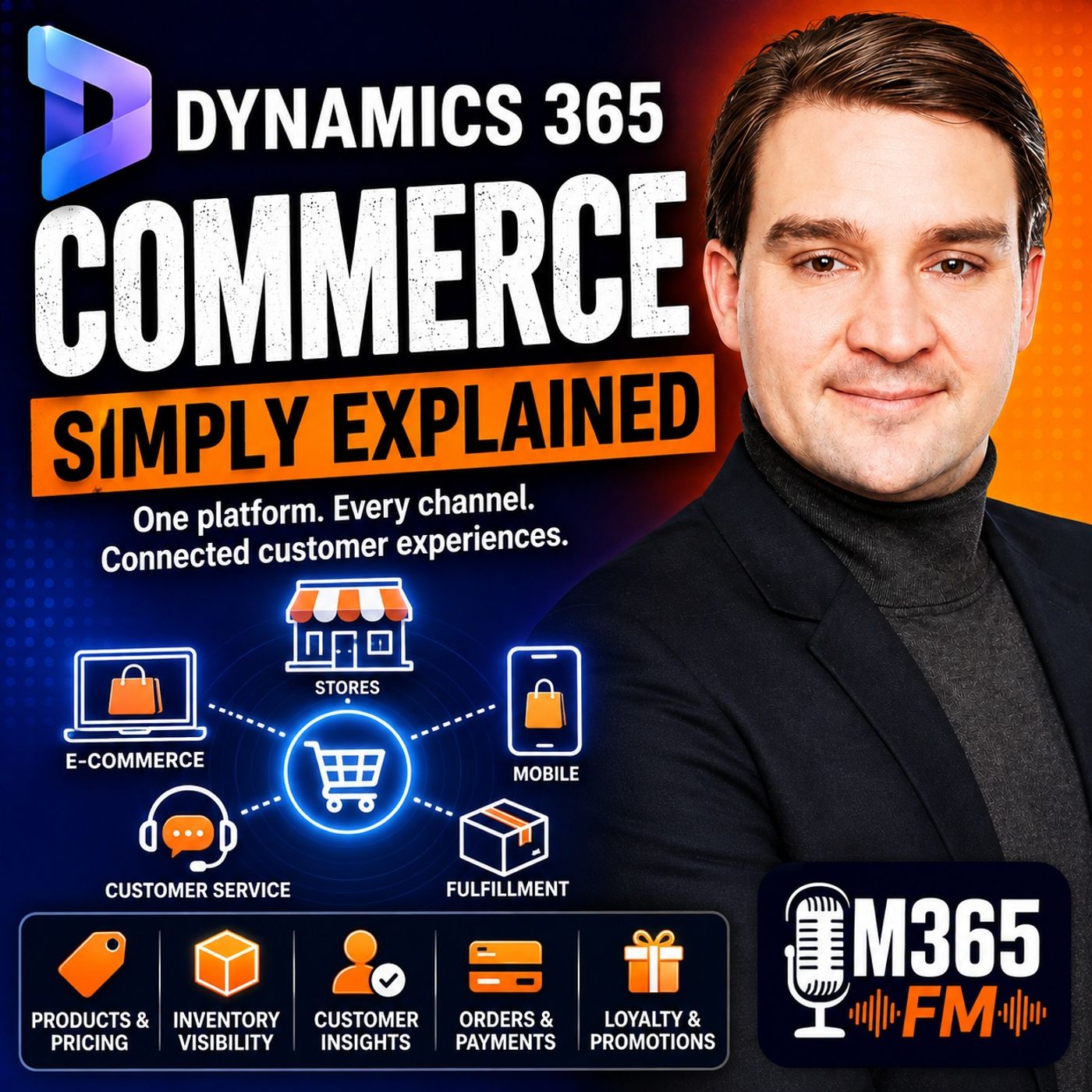
 Dynamics 365 Commerce - Simply Explained
Key Takeaways
- Dynamics 365 Commerce connects physical stores, e-commerce, point-of-sale systems, and back-office operations into a single unified platform for omnichannel retail.
- The Commerce Scale Unit acts as a headless engine that processes product information, pricing, and orders consistently across all customer-facing touchpoints.
- Store Commerce supports traditional checkouts and mobile devices across Windows, iOS, Android, and macOS, giving retail employees access to real-time inventory, customer lookup, and order management.
- Distributed Order Management uses automated business rules to determine the optimal fulfillment location from multiple stores and warehouses, improving inventory utilization.
- Dataverse and Azure Data Lake storage unify transaction data, customer history, and loyalty programs to eliminate data silos and empower informed decision-making.
A customer discovers a jacket online, checks whether it is available in a nearby store, orders it for pickup, and later returns it at another location. From the customer's perspective, this should be one simple shopping journey. Behind the scenes, however, that transaction can involve e-commerce, point of sale, inventory, customer information, pricing, fulfillment, payments, and returns.In this episode of Microsoft Knowledge Nuggets on M365 FM, Mirko Peters explains Microsoft Dynamics 365 Commerce in plain English and explores how it connects physical stores, e-commerce, point of sale, products, inventory, pricing, customers, orders, loyalty, fulfillment, and retail operations.Rather than treating stores, websites, and back-office systems as separate environments, Dynamics 365 Commerce provides a connected foundation for modern omnichannel retail.
WHAT IS DYNAMICS 365 COMMERCE?
Dynamics 365 Commerce is Microsoft's platform for connecting the processes behind selling products across physical stores, websites, and other commerce channels.Retailers need consistent answers to basic questions: What products do we sell? What does each product cost? Where is inventory available? Which orders require action? What has a customer purchased previously?When different systems provide different answers, problems quickly appear. A website might display one price while the store displays another. A product might appear available online even though the physical inventory is unavailable. Store employees may be unable to access an order created through the website.Dynamics 365 Commerce connects these activities around shared business information.It is therefore much more than an e-commerce website builder or point-of-sale application.
FROM DYNAMICS 365 RETAIL TO DYNAMICS 365 COMMERCE
Dynamics 365 Commerce evolved from Dynamics 365 Retail, which primarily focused on physical retail operations and point of sale.Modern shopping journeys no longer remain within a single channel.Customers might discover a product online, inspect it in a physical store, order it through their phone, collect it somewhere else, and later contact customer service.Commerce is designed around this reality.The individual channels become different entrances into the same connected retail operation rather than isolated businesses with separate information.
OMNICHANNEL RETAIL
Omnichannel commerce means customers can move between channels while the underlying business information remains connected.A customer might begin a purchase on a smartphone and complete it inside a store. Another customer might purchase online and collect the order from a local branch.Someone else might purchase online but return the item to a completely different physical store.The customer should not need to understand which internal system originally processed the transaction.Dynamics 365 Commerce connects customer-facing channels with products, prices, inventory, customer records, orders, and fulfillment information so retailers can create more consistent experiences across those channels.
REAL-TIME INVENTORY VISIBILITY
Inventory visibility is fundamental to omnichannel retail.If a website tells a customer that a product is available for collection, the business needs sufficient inventory information to support that promise.A product existing in the catalog does not necessarily mean it is physically available in the customer's preferred location.Dynamics 365 Commerce connects online shopping experiences with inventory information from stores and warehouses, allowing retailers to provide customers with more realistic availability information.This enables experiences such as checking local availability before visiting a store.
BUY ONLINE, PICK UP IN STORE
Buy Online, Pick Up In Store scenarios connect digital shopping with physical retail locations.A customer can find a product online, place the order, and select a nearby store as the collection point.Behind that simple customer choice, the retailer needs to know whether the selected location has appropriate inventory, whether the store can prepare the order, and when the product will realistically be ready.The store effectively becomes part of the e-commerce fulfillment network.This is one example of how Dynamics 365 Commerce turns physical retail locations into more than traditional sales floors.
SHIP FROM STORE
Stores can also become fulfillment locations.If a customer places an online order and a particular store has the required inventory, the retailer may choose to fulfill the order from that store rather than a central warehouse.This can potentially improve inventory utilization and give businesses additional options for fulfilling customer demand.The customer simply sees that the product can be delivered.Behind the scenes, Commerce helps connect the order with the location responsible for preparing it.
CROSS-CHANNEL RETURNS
Returns demonstrate why connected commerce information matters.Imagine a customer purchases an item online but later decides to return it at a physical store.In a disconnected environment, the employee might be unable to access the original online order and could tell the customer that online purchases must be handled through another system.With connected order and customer information, store employees can locate the relevant transaction and process supported return scenarios without treating the website and physical store as completely separate businesses.That creates a much more consistent customer experience.
ENDLESS AISLE
A physical store has limited shelf space. The retailer's wider inventory network does not necessarily have the same limitation.The endless aisle concept allows store employees to look beyond inventory physically available in their current location.If a customer wants a particular shoe size that has sold out locally, an employee may be able to check inventory elsewhere, place the order, and arrange delivery or pickup from another location.The physical shelf therefore stops defining the complete product selection available to the customer.
DISTRIBUTED ORDER MANAGEMENT
When several stores and warehouses can fulfill the same order, the retailer needs to determine which location should actually handle it.This is where Distributed Order Management becomes important.Dynamics 365 Commerce can use retailer-defined business rules to determine an appropriate fulfillment location based on factors such as available inventory, delivery commitments, and locations capable of fulfilling the order.Instead of every order entering a queue where employees manually determine the fulfillment location, the platform can help route orders according to established business rules.People still perform the physical work of picking, packing, shipping, and handing products to customers.
STORE COMMERCE AND POINT OF SALE
Physical store employees need fast access to information while customers are standing in front of them.The Store Commerce app provides point-of-sale capabilities for retail employees.Cashiers can use it at traditional checkout counters, while sales associates can use supported mobile devices around the store.According to the episode, Store Commerce supports environments including Windows, iOS, Android, and macOS, giving retailers flexibility in how employees interact with the platform.The point of sale becomes more than a payment terminal. It becomes an operational tool for helping customers.
WHAT STORE EMPLOYEES CAN DO
Store Commerce supports activities around the complete in-store customer interaction.Employees can process sales, find customers, check inventory, work with orders, handle returns, and access reporting.The platform can also support operational activities such as shifts and cash management.Different employees have different responsibilities, so role-based experiences can provide functionality appropriate to cashiers, managers, sales employees, or stock workers.The objective is to give employees access to the information required for their role without forcing them to navigate multiple disconnected applications.
CONSISTENT PRICING AND BUSINESS RULES
Customers expect prices and promotions to remain consistent across channels according to the retailer's policies.Commerce provides a shared foundation for product information, pricing, promotions, customer information, and order processing.Store employees might interact with this foundation through Store Commerce while online customers use the e-commerce storefront.Although the interfaces are different, they can rely on the same underlying commerce rules.This helps retailers reduce situations where customers encounter completely different information depending on which channel they use.
WHAT IS THE COMMERCE SCALE UNIT?
One of the important technical components explained in the episode is the Commerce Scale Unit.Think of it as an engine behind the customer-facing commerce experiences.A shopper might interact with a website. Another customer might use a mobile application. A store employee might use Store Commerce.Behind these different interfaces, the Commerce Scale Unit processes requests and applies commerce rules.Customers never need to know that this engine exists. They simply expect the correct product information, pricing, availability, promotions, and order actions.
Become a supporter of this podcast: https://www.spreaker.com/podcast/m365-fm-modern-work-security-and-productivity-with-microsoft-365--6704921/support.
🚀 Want to be part of m365.fm?
Then stop just listening… and start showing up.
👉 Connect with me on LinkedIn and let’s make something happen:
- 🎙️ Be a podcast guest and share your story
- 🎧 Host your own episode (yes, seriously)
- 💡 Pitch topics the community actually wants to hear
- 🌍 Build your personal brand in the Microsoft 365 space
This isn’t just a podcast — it’s a platform for people who take action.
🔥 Most people wait. The best ones don’t.
👉 Connect with me on LinkedIn and send me a message:
"I want in"
Let’s build something awesome 👊
Frequently Asked Questions
What is Dynamics 365 Commerce?
Dynamics 365 Commerce is Microsoft's omnichannel retail platform that connects physical stores, websites, point-of-sale systems, inventory, and back-office operations into a single unified workspace.
What is the Commerce Scale Unit?
The Commerce Scale Unit is the headless engine behind customer-facing experiences that processes requests and applies consistent business rules, pricing, and product information across all retail channels.
How does Store Commerce help retail employees?
Store Commerce is a point-of-sale application that runs on multiple devices, enabling store staff to process sales, check real-time inventory, handle cross-channel returns, and access customer records directly from the sales floor.
What is Distributed Order Management in Dynamics 365 Commerce?
Distributed Order Management uses retailer-defined business rules to automatically select the best fulfillment location—such as a specific store or warehouse—based on stock availability and delivery commitments.
00:00:00,000 --> 00:00:03,760
Think about a customer who buys a jacket on your website, chooses store pick-up, then
2
00:00:03,760 --> 00:00:06,280
decides it doesn't fit and returns it at a different location.
3
00:00:06,280 --> 00:00:08,080
Are you sound simple enough, right?
4
00:00:08,080 --> 00:00:11,720
But for many businesses, that one purchase touches separate systems.
5
00:00:11,720 --> 00:00:16,560
The website knows the order, the store register knows the return, a stock system, tracks
6
00:00:16,560 --> 00:00:20,600
where the jacket sits, and customer details live somewhere else entirely.
7
00:00:20,600 --> 00:00:23,320
That creates gaps, delays, and awkward conversations at the counter.
8
00:00:23,320 --> 00:00:29,160
I'm Mirko Peters from M365FM, and this knowledge nugget breaks down Dynamics 365 Commerce in plain
9
00:00:29,160 --> 00:00:30,160
English.
10
00:00:30,160 --> 00:00:31,920
Imagine a retail business as an office building.
11
00:00:31,920 --> 00:00:35,320
The website and physical stores are different entrances, but behind the scenes they should
12
00:00:35,320 --> 00:00:37,520
all lead into the same connected space.
13
00:00:37,520 --> 00:00:41,640
So what exactly is Dynamics 365 Commerce?
14
00:00:41,640 --> 00:00:46,640
What Dynamics 365 Commerce actually is?
15
00:00:46,640 --> 00:00:48,720
Here's the problem a retailer faces.
16
00:00:48,720 --> 00:00:53,120
You need one shared view of the basics, what products you sell, what each costs, where stock
17
00:00:53,120 --> 00:00:57,320
sits, which orders need action, and what a customer has bought before.
18
00:00:57,320 --> 00:01:01,040
What that shared view people spend their day checking systems against each other, oh, a
19
00:01:01,040 --> 00:01:04,760
store worker sees one price, the website shows another, and someone promises an item that
20
00:01:04,760 --> 00:01:06,400
isn't actually available.
21
00:01:06,400 --> 00:01:07,720
Nobody enjoys that.
22
00:01:07,720 --> 00:01:12,640
Dynamics 365 Commerce connects the work behind selling products across stores, websites,
23
00:01:12,640 --> 00:01:14,000
and back office teams.
24
00:01:14,000 --> 00:01:18,280
It gives a business one connected platform that handles everything customer see and everything
25
00:01:18,280 --> 00:01:19,280
they don't.
26
00:01:19,280 --> 00:01:20,880
Now notice I didn't call it a website builder.
27
00:01:20,880 --> 00:01:25,200
A website builder helps you create pages, people browse online, and a cash register system
28
00:01:25,200 --> 00:01:27,880
helps someone take payment at a counter.
29
00:01:27,880 --> 00:01:32,960
Dynamics 365 Commerce can support both, but it also connects them to product details, stock,
30
00:01:32,960 --> 00:01:37,120
pricing, customer records, orders, and the wider business work behind them.
31
00:01:37,120 --> 00:01:39,400
That shared connection changes the conversation.
32
00:01:39,400 --> 00:01:43,720
Instead of asking which system has the right answer, your team works from the same business
33
00:01:43,720 --> 00:01:47,200
information even when customers enter through different doors.
34
00:01:47,200 --> 00:01:51,720
Commerce grew from Dynamics 365 retail, which focused on physical shops and point of sale,
35
00:01:51,720 --> 00:01:55,120
but Microsoft expanded it because shopping no longer stays in one place.
36
00:01:55,120 --> 00:01:59,600
The person might look at a product online during lunch, visit a store after work, and ask
37
00:01:59,600 --> 00:02:01,400
customer service for help later.
38
00:02:01,400 --> 00:02:05,200
The purchase can move between channels while the business keeps the same record.
39
00:02:05,200 --> 00:02:09,440
Picture that office building again, or O, the physical shop is one entrance, the online
40
00:02:09,440 --> 00:02:12,280
store is another, and a call center can be another.
41
00:02:12,280 --> 00:02:16,920
Behind each door, Commerce connects people to shared rooms for products, prices, stock,
42
00:02:16,920 --> 00:02:18,240
orders, and customers.
43
00:02:18,240 --> 00:02:20,680
That doesn't mean every business runs exactly the same way.
44
00:02:20,680 --> 00:02:24,800
A retailer can set up product ranges, prices, and promotions for the channels it runs,
45
00:02:24,800 --> 00:02:27,280
while back office teams manage the business rules.
46
00:02:27,280 --> 00:02:30,840
Store workers and online shoppers then use those rules through screens designed for their
47
00:02:30,840 --> 00:02:31,840
jobs.
48
00:02:31,840 --> 00:02:35,840
Commerce also connects with other Dynamics 365 apps and Microsoft services.
49
00:02:35,840 --> 00:02:42,160
Oh, supply chain management handles products, inventory, warehouses, transportation, and distribution.
50
00:02:42,160 --> 00:02:46,440
Finance manages the financial side of store and online activity, and Dataverse helps business
51
00:02:46,440 --> 00:02:48,480
apps share information.
52
00:02:48,480 --> 00:02:52,560
Each app has its own job, but Commerce connects selling activity to the rest of the business.
53
00:02:52,560 --> 00:02:55,860
Now let's follow one purchase through that building, because that's where this becomes much
54
00:02:55,860 --> 00:02:58,520
easier to see.
55
00:02:58,520 --> 00:03:01,680
One customer journey across every channel.
56
00:03:01,680 --> 00:03:03,200
Welcome to another episode.
57
00:03:03,200 --> 00:03:05,920
Today we're breaking down the customer journey across every channel.
58
00:03:05,920 --> 00:03:06,920
Let's dive in.
59
00:03:06,920 --> 00:03:08,200
Imagine Maya is looking for a jacket.
60
00:03:08,200 --> 00:03:12,160
She opens the retailer's website on her phone, finds the color and size she wants, and checks
61
00:03:12,160 --> 00:03:15,360
whether the nearby store has stock before she leaves home.
62
00:03:15,360 --> 00:03:17,600
That stock answer has to be right out.
63
00:03:17,600 --> 00:03:20,760
If the site says it's available, the shelf better have it.
64
00:03:20,760 --> 00:03:25,440
Next 365, Commerce connects the online shop to real-time stock from stores and warehouses,
65
00:03:25,440 --> 00:03:29,880
so customers see what the business can actually promise, rather than every product in the catalog.
66
00:03:29,880 --> 00:03:33,280
A jacket might appear in the product list, but that doesn't mean it's sitting on a shelf
67
00:03:33,280 --> 00:03:34,280
nearby.
68
00:03:34,280 --> 00:03:37,840
When Maya sees her size is available for pickup, she places the order online and collects
69
00:03:37,840 --> 00:03:38,840
it at the store.
70
00:03:38,840 --> 00:03:42,120
If the local branch doesn't carry it, she can choose home delivery instead.
71
00:03:42,120 --> 00:03:45,680
The business could even send the jacket from a different store that has the stock.
72
00:03:45,680 --> 00:03:48,320
For Maya, those choices appear during checkout.
73
00:03:48,320 --> 00:03:52,040
During the scenes, the business needs to know exactly where the item sits, which location
74
00:03:52,040 --> 00:03:54,120
can prepare it and how quickly it can reach her.
75
00:03:54,120 --> 00:03:57,080
A store isn't just a place where people walk in and buy things anymore.
76
00:03:57,080 --> 00:04:01,040
It can prepare online orders, hold pickup orders and ship items to customers.
77
00:04:01,040 --> 00:04:04,680
That gives shoppers more ways to buy without forcing them to understand how the retailer
78
00:04:04,680 --> 00:04:05,680
runs its stock.
79
00:04:05,680 --> 00:04:07,640
Now, here's where it gets interesting.
80
00:04:07,640 --> 00:04:11,240
Say Maya picks up the jacket, takes it home and changes her mind.
81
00:04:11,240 --> 00:04:14,680
A few days later, she visits another branch and asks to return it there.
82
00:04:14,680 --> 00:04:18,520
The staff member should be able to find the original online order, see what Maya bought,
83
00:04:18,520 --> 00:04:21,840
and process the return without asking her to contact the website first.
84
00:04:21,840 --> 00:04:25,560
The order and customer record travel with the purchase, even though the sale began online
85
00:04:25,560 --> 00:04:27,600
and the return happens in a different store.
86
00:04:27,600 --> 00:04:31,360
That removes one of the most common frustrations in retail, being told that an item belongs
87
00:04:31,360 --> 00:04:32,360
to a different system.
88
00:04:32,360 --> 00:04:35,040
There's another useful moment at the store counter, too.
89
00:04:35,040 --> 00:04:39,000
Maya visits a branch to try on shoes, finds the right pair, but learns her size has sold
90
00:04:39,000 --> 00:04:40,000
out at that location.
91
00:04:40,000 --> 00:04:42,880
A disconnected store can only shrug and center elsewhere.
92
00:04:42,880 --> 00:04:47,160
As an endless aisle approach, the sales worker can look beyond that one shop's shelves.
93
00:04:47,160 --> 00:04:51,080
They can check stock in another store or warehouse, place an order for Maya, and arrange delivery
94
00:04:51,080 --> 00:04:54,320
to her home or pick up at a location that works for her.
95
00:04:54,320 --> 00:04:57,840
The physical shelf stops being the full limit of what the store can sell.
96
00:04:57,840 --> 00:05:01,160
Of course, someone still needs to decide where each order should come from.
97
00:05:01,160 --> 00:05:04,840
If several stores and warehouses hold the same shoe, sending it from the wrong place can
98
00:05:04,840 --> 00:05:08,880
add cost, slow delivery, or leave a local shop short of stock.
99
00:05:08,880 --> 00:05:12,840
Dynamics 365 Commerce includes distributed order management for this job.
100
00:05:12,840 --> 00:05:16,560
In plain English, it uses business rules to choose a suitable place to fulfill an order
101
00:05:16,560 --> 00:05:18,840
based on the choices the retailer sets.
102
00:05:18,840 --> 00:05:22,440
Those rules account for available stock, the delivery promise, and the places that can
103
00:05:22,440 --> 00:05:23,440
fulfill the order.
104
00:05:23,440 --> 00:05:27,280
So an order doesn't just land in one big queue waiting for a person to guess what to do.
105
00:05:27,280 --> 00:05:31,000
The system directs it to a store or warehouse that fits the retailer's rules while staff
106
00:05:31,000 --> 00:05:34,520
handle the actual picking, packing, pick up, or delivery work.
107
00:05:34,520 --> 00:05:37,440
Maya sees a simple choice, pick up or delivery.
108
00:05:37,440 --> 00:05:41,360
The retailer sees a chain of connected decisions that has to hold together from the first
109
00:05:41,360 --> 00:05:43,440
product search through the final return.
110
00:05:43,440 --> 00:05:47,960
That customer journey only works when the people in the store can act on the same information
111
00:05:47,960 --> 00:05:53,480
and they need tools built for the counter, the shop floor, and the stock room.
112
00:05:53,480 --> 00:05:54,960
The physical store.
113
00:05:54,960 --> 00:05:56,880
Store commerce and point of sale.
114
00:05:56,880 --> 00:05:59,040
At the counter, staff need fast answers.
115
00:05:59,040 --> 00:06:02,840
They can't stop a customer mid-purchase to open several systems and search for an order
116
00:06:02,840 --> 00:06:04,400
while a queue grows behind them.
117
00:06:04,400 --> 00:06:09,120
They need one screen that lets them sell, return, check stock, and help the person standing
118
00:06:09,120 --> 00:06:10,120
right there.
119
00:06:10,120 --> 00:06:11,920
The tool is the store commerce app.
120
00:06:11,920 --> 00:06:16,720
Store commerce is the point of sale app I'll often shorten to PO cell for people working
121
00:06:16,720 --> 00:06:17,720
in a physical shop.
122
00:06:17,720 --> 00:06:21,960
Akashi uses it at a fixed register and a sales worker carries it around on a mobile device
123
00:06:21,960 --> 00:06:23,880
to help customers wherever they are.
124
00:06:23,880 --> 00:06:26,560
The same app runs on a desktop, tablet, or phone.
125
00:06:26,560 --> 00:06:29,320
It works on Windows, iOS, Android, and Mac OS.
126
00:06:29,320 --> 00:06:30,640
That gives retailers flexibility.
127
00:06:30,640 --> 00:06:33,520
A big store might use traditional checkout counters.
128
00:06:33,520 --> 00:06:35,800
A smaller shop might use tablets.
129
00:06:35,800 --> 00:06:38,960
But either way, the sale is the same kind of transaction.
130
00:06:38,960 --> 00:06:41,480
Each of this, a sales worker near Maya and the shoes.
131
00:06:41,480 --> 00:06:46,000
Maya asks if her size is available, the worker searches, checks stock, finds the item, and
132
00:06:46,000 --> 00:06:47,800
completes the purchase right there.
133
00:06:47,800 --> 00:06:52,120
If Maya wants to return something instead, the worker can find her customer record or order
134
00:06:52,120 --> 00:06:54,160
and start the return from the same tool.
135
00:06:54,160 --> 00:06:55,320
Normal stuff, right?
136
00:06:55,320 --> 00:06:57,240
But it all depends on good information.
137
00:06:57,240 --> 00:07:00,960
Store commerce supports cash and carry sales, customer lookups, inventory checks, order
138
00:07:00,960 --> 00:07:02,680
work, returns, and reporting.
139
00:07:02,680 --> 00:07:06,680
Store staff can also manage things around the sale, like shifts in cash management, rather
140
00:07:06,680 --> 00:07:09,640
than treating the register as nothing more than a payment machine.
141
00:07:09,640 --> 00:07:12,880
A point of sale becomes a work tool for the whole store.
142
00:07:12,880 --> 00:07:14,400
Connection quality matters too.
143
00:07:14,400 --> 00:07:18,040
Internet isn't always perfect in stores, especially large buildings, remote locations,
144
00:07:18,040 --> 00:07:20,640
or places where the network drops for a while.
145
00:07:20,640 --> 00:07:24,240
Commerce runs in the cloud, but it can also use edge setups closer to the store so retailers
146
00:07:24,240 --> 00:07:26,240
can plan for their local conditions.
147
00:07:26,240 --> 00:07:28,000
Customers still expect the counter to work.
148
00:07:28,000 --> 00:07:31,760
That doesn't mean a store worker needs to understand cloud systems or network design.
149
00:07:31,760 --> 00:07:35,160
They open the app, follow the steps for their role, and help the customer.
150
00:07:35,160 --> 00:07:38,800
In the scenes, the retailer chooses the setup that keeps stores operating when connectivity
151
00:07:38,800 --> 00:07:39,800
changes.
152
00:07:39,800 --> 00:07:41,320
Roll-based screens keep that practical.
153
00:07:41,320 --> 00:07:43,880
A cashier needs a simple way to process a sale.
154
00:07:43,880 --> 00:07:47,480
A store manager needs different options, a stock worker needs product info.
155
00:07:47,480 --> 00:07:50,560
Commerce can tailor the experience for each role instead of putting every button in front
156
00:07:50,560 --> 00:07:51,560
of everyone.
157
00:07:51,560 --> 00:07:52,720
And here's a key point.
158
00:07:52,720 --> 00:07:56,400
The store sale follows the same business rules as an online sale.
159
00:07:56,400 --> 00:08:00,440
Prices, product details, customer info, and order records don't need different rules
160
00:08:00,440 --> 00:08:02,440
for the website and the shop floor.
161
00:08:02,440 --> 00:08:06,400
Half-use store commerce shoppers use the store front, but both pull from the same commerce
162
00:08:06,400 --> 00:08:10,960
foundation that keeps the experience consistent and staff don't have to remember a bunch of
163
00:08:10,960 --> 00:08:11,960
exceptions.
164
00:08:11,960 --> 00:08:14,640
So a physical store becomes more than shelves and a register.
165
00:08:14,640 --> 00:08:19,240
It becomes a connected part of the whole operation where staff can help customers buy, collect,
166
00:08:19,240 --> 00:08:24,360
return, or order products using the information the business already manages.
167
00:08:24,360 --> 00:08:29,080
But all those staff screens need a shared brain behind them, one place that handles products,
168
00:08:29,080 --> 00:08:33,080
orders, and prices before any screen asks for an answer.
169
00:08:33,080 --> 00:08:35,000
The engine behind the storefronts.
170
00:08:35,000 --> 00:08:38,720
So that shared brain I've been talking about has a name of the Commerce Scale Unit.
171
00:08:38,720 --> 00:08:42,320
It sounds technical, but think of it as the engine room that runs every selling rule behind
172
00:08:42,320 --> 00:08:43,720
a retailer's channels.
173
00:08:43,720 --> 00:08:47,560
Whether a customer buys through a website, a store app, or a custom shopping app, the business
174
00:08:47,560 --> 00:08:50,800
builds, this engine handles every single request.
175
00:08:50,800 --> 00:08:51,800
Customers never see it.
176
00:08:51,800 --> 00:08:55,400
They see a product page, a checkout screen, or a sales worker's device.
177
00:08:55,400 --> 00:08:59,680
During the scenes, the Commerce Scale Unit takes the requests, those screens send, and applies
178
00:08:59,680 --> 00:09:03,400
the same Commerce rules everywhere people buy, one set of logic every channel.
179
00:09:03,400 --> 00:09:04,400
That's the magic of it.
180
00:09:04,400 --> 00:09:06,400
This brings us to Headless Commerce.
181
00:09:06,400 --> 00:09:10,040
Headless simply means the selling engine lives apart from the screen a person looks at.
182
00:09:10,040 --> 00:09:14,280
The engine doesn't care if a customer uses a website, a phone app, a self-service kiosk,
183
00:09:14,280 --> 00:09:15,760
or a store worker's tablet.
184
00:09:15,760 --> 00:09:19,440
It gets a request, runs the business rules, and sends back the answer.
185
00:09:19,440 --> 00:09:24,680
The screen is the face, the Commerce Scale Unit is the working part behind that face.
186
00:09:24,680 --> 00:09:26,560
Notice I didn't say the screen does nothing.
187
00:09:26,560 --> 00:09:30,160
Oh, it does a lot, but the logic stays separate.
188
00:09:30,160 --> 00:09:34,080
Separating the two lets a retailer change or build a custom experience without rebuilding
189
00:09:34,080 --> 00:09:37,840
all the rules for products, prices, stock promotions, and orders each time.
190
00:09:37,840 --> 00:09:40,600
Imagine a retailer launching a new mobile app.
191
00:09:40,600 --> 00:09:44,720
Without this approach, the team might need to rebuild the logic that checks product availability,
192
00:09:44,720 --> 00:09:47,640
calculates prices, applies discounts, and creates orders.
193
00:09:47,640 --> 00:09:51,160
With Commerce, the new app can just connect to the same engine already used by the online
194
00:09:51,160 --> 00:09:52,880
store and the store commerce app.
195
00:09:52,880 --> 00:09:55,600
Instead of rules, it supports many customer experiences.
196
00:09:55,600 --> 00:09:58,480
That's the whole point, and here's why that matters.
197
00:09:58,480 --> 00:10:01,760
Customers don't care which technical system answered their question.
198
00:10:01,760 --> 00:10:05,340
They care that the price on their phone matches the price in the store, and that an item
199
00:10:05,340 --> 00:10:07,240
shown as available can actually be ordered.
200
00:10:07,240 --> 00:10:11,040
The connection between the screen and the Commerce Scale Unit works through APIs.
201
00:10:11,040 --> 00:10:15,360
API stands for Application Programming Interface, but you don't need to remember the full name.
202
00:10:15,360 --> 00:10:17,760
Picture a service counter in a large store.
203
00:10:17,760 --> 00:10:21,560
A website asks the counter, "What's the price of this item?"
204
00:10:21,560 --> 00:10:24,520
The counter checks the Commerce rules and returns the price.
205
00:10:24,520 --> 00:10:28,160
Another request might ask, "Can this customer order this item for pickup?"
206
00:10:28,160 --> 00:10:30,920
Or, "Please create an order for these products."
207
00:10:30,920 --> 00:10:35,080
The API carries those requests between the customer facing screen and the Commerce Engine.
208
00:10:35,080 --> 00:10:38,840
The website doesn't need to know how prices or orders work behind the scenes, though, it
209
00:10:38,840 --> 00:10:43,320
just asks for the result through the counter, and the Commerce Scale Unit applies the retailers'
210
00:10:43,320 --> 00:10:45,000
rules before answering.
211
00:10:45,000 --> 00:10:48,840
That setup also gives businesses room to build something beyond the standard storefront.
212
00:10:48,840 --> 00:10:51,560
They might create a shopping experience inside their own mobile app.
213
00:10:51,560 --> 00:10:53,600
A partner could build another sales channel.
214
00:10:53,600 --> 00:10:57,720
The same Commerce Engine can support those experiences, so the business doesn't start over
215
00:10:57,720 --> 00:11:00,960
with a different set of selling rules every time it opens a new door.
216
00:11:00,960 --> 00:11:04,560
Dynamics 365 Commerce also comes with its own e-commerce storefront.
217
00:11:04,560 --> 00:11:09,160
That's the website system customers actually see and click through IO, product information,
218
00:11:09,160 --> 00:11:11,840
images, menus, search results, checkout steps.
219
00:11:11,840 --> 00:11:16,800
It uses React, a web development framework that helps teams build interactive web pages.
220
00:11:16,800 --> 00:11:19,800
You don't need to be a web developer to understand the practical part.
221
00:11:19,800 --> 00:11:23,040
The storefront can prepare parts of a page on the server before it reaches a customer's
222
00:11:23,040 --> 00:11:27,720
browser, and it can also update parts of the page in the browser as the customer clicks,
223
00:11:27,720 --> 00:11:31,000
searches, filters, or adds products to a cart.
224
00:11:31,000 --> 00:11:34,960
That combination helps the site load pages and respond quickly to customer actions.
225
00:11:34,960 --> 00:11:39,320
A retailer can also use Site Builder, the web-based tool for people who manage pages and marketing
226
00:11:39,320 --> 00:11:40,320
content.
227
00:11:40,320 --> 00:11:43,360
They can work on the customer facing site without changing the Commerce Engine that handles
228
00:11:43,360 --> 00:11:45,960
product, price, and order requests behind it.
229
00:11:45,960 --> 00:11:49,520
The site and the engine have different jobs, but retailers don't all run stores under
230
00:11:49,520 --> 00:11:50,840
the same conditions.
231
00:11:50,840 --> 00:11:54,920
One location may have stable internet and work well with cloud services, while another
232
00:11:54,920 --> 00:11:58,080
sits somewhere with weak or unreliable connectivity.
233
00:11:58,080 --> 00:11:59,400
Commerce accounts for that difference.
234
00:11:59,400 --> 00:12:03,680
A Commerce Scale Unit can run in Microsoft's cloud, where Microsoft manages the service.
235
00:12:03,680 --> 00:12:08,080
It can also run as a self-hosted unit closer to a store, where the retailer manages that
236
00:12:08,080 --> 00:12:09,080
local setup.
237
00:12:09,080 --> 00:12:10,720
A business can use a mix of both.
238
00:12:10,720 --> 00:12:14,880
That choice lets retailers plan based on how each location works, rather than forcing
239
00:12:14,880 --> 00:12:16,880
every shop into one technical setup.
240
00:12:16,880 --> 00:12:21,240
A self-hosted unit can keep the same Commerce Logic closer to a store where internet access
241
00:12:21,240 --> 00:12:25,840
may cause problems, while cloud units support channels through Microsoft managed Azure
242
00:12:25,840 --> 00:12:26,840
regions.
243
00:12:26,840 --> 00:12:29,760
Store staff don't need to think about any of this while helping a customer.
244
00:12:29,760 --> 00:12:33,600
They use the screen in front of them, a shop uses the website or app in front of them.
245
00:12:33,600 --> 00:12:37,840
Yet each channel depends on the engine room responding with the right product information,
246
00:12:37,840 --> 00:12:40,520
price, stock answer, and order action.
247
00:12:40,520 --> 00:12:44,680
Once those sales start flowing, the information needs to stay connected too, because products,
248
00:12:44,680 --> 00:12:48,920
customer records, and stock can't each live in their own separate drawer.
249
00:12:48,920 --> 00:12:51,160
Data, loyalty, and safer buying.
250
00:12:51,160 --> 00:12:54,160
Every time you make a sale, you're creating information.
251
00:12:54,160 --> 00:12:56,720
Product, price, store, customer order details, ooh, all of it.
252
00:12:56,720 --> 00:13:00,760
If that information stays scattered, a business can sell all day and still struggle to see what
253
00:13:00,760 --> 00:13:02,680
people are actually buying.
254
00:13:02,680 --> 00:13:04,200
Dynamics 365.
255
00:13:04,200 --> 00:13:08,280
Commerce connects business data, with dataverse and Azure Data Lake storage.
256
00:13:08,280 --> 00:13:11,960
Dataverse works like a shared business filing cabinet for Microsoft Business Apps.
257
00:13:11,960 --> 00:13:16,240
Sales and customer service can use it to store and share business information, so teams
258
00:13:16,240 --> 00:13:20,280
aren't forced to copy the same customer or account details between separate tools.
259
00:13:20,280 --> 00:13:22,200
That creates a clearer customer record.
260
00:13:22,200 --> 00:13:26,320
Here's the thing, a customer might buy from the website, speak to a sales worker in a store,
261
00:13:26,320 --> 00:13:27,960
then contact support later.
262
00:13:27,960 --> 00:13:32,320
When the connected apps use shared information, each team can work from the same customer details
263
00:13:32,320 --> 00:13:35,040
instead of starting the conversation from scratch.
264
00:13:35,040 --> 00:13:38,040
Azure Data Lake storage handles a different kind of job.
265
00:13:38,040 --> 00:13:40,840
Picture it as a large storehouse for business data.
266
00:13:40,840 --> 00:13:44,640
Business can send transaction data there, along with information from the online shop, so
267
00:13:44,640 --> 00:13:48,760
the business can study activity over time instead of only looking at the latest sale.
268
00:13:48,760 --> 00:13:52,760
This gives teams more room to ask useful questions, which products sell well in certain
269
00:13:52,760 --> 00:13:56,800
stores, which categories bring in sales but leave little margin, which channel drives the
270
00:13:56,800 --> 00:13:57,800
most orders.
271
00:13:57,800 --> 00:14:02,440
Commerce reporting can help managers look across products, categories, employees, terminals,
272
00:14:02,440 --> 00:14:04,040
stores, and selling channels.
273
00:14:04,040 --> 00:14:08,400
A store worker can also see reports connected to the point of sale, while people in the back
274
00:14:08,400 --> 00:14:11,920
office can review activity across the business after data sinks.
275
00:14:11,920 --> 00:14:13,960
The reports don't run the store for anyone.
276
00:14:13,960 --> 00:14:18,320
They give people a clear review of what happened, so a manager can spot patterns before deciding
277
00:14:18,320 --> 00:14:21,760
what to change with stock, pricing, or promotions.
278
00:14:21,760 --> 00:14:23,920
Customer loyalty sits in the same connected picture.
279
00:14:23,920 --> 00:14:27,560
A retailer can set up a loyalty program where purchases earn points.
280
00:14:27,560 --> 00:14:31,360
A customer can later redeem those points on a future purchase, whether the business allows
281
00:14:31,360 --> 00:14:33,480
that installs online or both.
282
00:14:33,480 --> 00:14:36,240
That turns a simple purchase into an ongoing relationship.
283
00:14:36,240 --> 00:14:40,440
When a customer chooses to identify themselves, commerce can also bring their purchase history
284
00:14:40,440 --> 00:14:41,560
into the conversation.
285
00:14:41,560 --> 00:14:45,160
A sales worker may see information that helps them speak more clearly about what that person
286
00:14:45,160 --> 00:14:49,160
has bought before, while the online shop can show product recommendations based on buying
287
00:14:49,160 --> 00:14:51,160
patterns.
288
00:14:51,160 --> 00:14:52,840
Recommendations don't read a customer's mind.
289
00:14:52,840 --> 00:14:57,080
They use shopping and purchase information to suggest items a customer might want to see.
290
00:14:57,080 --> 00:15:01,000
That can help people find related products, but the retailer still needs sensible product
291
00:15:01,000 --> 00:15:04,720
data and a shopping experience that treats customers with respect.
292
00:15:04,720 --> 00:15:06,200
Online reviews need care too.
293
00:15:06,200 --> 00:15:10,040
Employment commerce includes ratings and reviews for e-commerce storefronts, so customers
294
00:15:10,040 --> 00:15:14,680
can post feedback and retailers can show ratings on product pages.
295
00:15:14,680 --> 00:15:19,160
As your cognitive services can automatically filter profane words in 40 languages and retailers
296
00:15:19,160 --> 00:15:24,800
also have moderator tools for handling concerns, feedback, removal requests, and data requests.
297
00:15:24,800 --> 00:15:27,400
A review system needs more than a star school.
298
00:15:27,400 --> 00:15:30,760
It needs a way to keep product pages useful without leaving every problem for a person to
299
00:15:30,760 --> 00:15:32,000
find by hand.
300
00:15:32,000 --> 00:15:35,920
Payment fraud creates another concern, especially when orders arrive through digital channels.
301
00:15:35,920 --> 00:15:41,400
Dynamics 365 fraud protection can connect with commerce to support real-time fraud decisions.
302
00:15:41,400 --> 00:15:45,360
The service uses information from its fraud protection network, device signals, and rules
303
00:15:45,360 --> 00:15:47,920
set by the business to help assess transactions.
304
00:15:47,920 --> 00:15:49,520
No software removes every risk.
305
00:15:49,520 --> 00:15:53,600
A retailer still needs clear policies and people who can handle exceptions, but connected
306
00:15:53,600 --> 00:15:57,600
fraud tools can help the business review online orders without treating every customer as
307
00:15:57,600 --> 00:15:58,600
a problem.
308
00:15:58,600 --> 00:16:02,520
So commerce brings together selling data, customer loyalty, reviews, and fraud checks around
309
00:16:02,520 --> 00:16:03,520
the purchase.
310
00:16:03,520 --> 00:16:07,000
It sounds like a lot because it is, the next question is simpler, which businesses actually
311
00:16:07,000 --> 00:16:11,480
need this platform and what work does it still leave to people.
312
00:16:11,480 --> 00:16:14,760
Who uses commerce and what it does not matter place?
313
00:16:14,760 --> 00:16:17,800
Picture a clothing brand with physical shops and its own website.
314
00:16:17,800 --> 00:16:21,840
That business needs the same product info, prices, stock numbers, and order details available
315
00:16:21,840 --> 00:16:23,400
in both places.
316
00:16:23,400 --> 00:16:27,640
Dynamics 365 commerce connects all those channels so everything stays consistent out, no more
317
00:16:27,640 --> 00:16:29,280
emailing spreadsheets back and forth.
318
00:16:29,280 --> 00:16:31,520
Does it matter if you run one shop or 50?
319
00:16:31,520 --> 00:16:32,600
Not really.
320
00:16:32,600 --> 00:16:36,080
What counts is that the store, the website, and the back office team all use the same shared
321
00:16:36,080 --> 00:16:39,160
information instead of passing updates between separate systems.
322
00:16:39,160 --> 00:16:41,000
That do tips the core idea.
323
00:16:41,000 --> 00:16:45,040
Commerce also works for manufacturers and distributors that sell to other businesses.
324
00:16:45,040 --> 00:16:49,520
Say a manufacturer gives its distributors a self-service portal where they check inventory,
325
00:16:49,520 --> 00:16:51,600
browse products, and place orders.
326
00:16:51,600 --> 00:16:55,240
That outermost B2B commerce and commerce supports those buying experiences through its commerce
327
00:16:55,240 --> 00:16:56,240
APIs.
328
00:16:56,240 --> 00:16:59,840
Notice the buyer is now empty a walk-in shop at this time.
329
00:16:59,840 --> 00:17:03,480
It could be a company placing repeat orders, checking availability, or arranging delivery
330
00:17:03,480 --> 00:17:04,800
for their own customers.
331
00:17:04,800 --> 00:17:06,680
Now does commerce replace the people?
332
00:17:06,680 --> 00:17:07,680
No.
333
00:17:07,680 --> 00:17:11,880
Back office teams still handle product setup, pricing, and promotions, stock and order tracking,
334
00:17:11,880 --> 00:17:13,760
and sales and margin reports.
335
00:17:13,760 --> 00:17:17,680
Commerce gives those teams connected tools, but it does now, temity, you turn retail into
336
00:17:17,680 --> 00:17:19,520
a system that runs on its own.
337
00:17:19,520 --> 00:17:20,520
People are still essential.
338
00:17:20,520 --> 00:17:24,520
Most people here owe commerce, and think it only means building an online shop.
339
00:17:24,520 --> 00:17:29,000
An online shop can be part of it, but commerce reaches far beyond that to into the store counter
340
00:17:29,000 --> 00:17:33,200
customer records, loyalty programs, product setup, order handling, and all the data behind
341
00:17:33,200 --> 00:17:34,680
those jobs.
342
00:17:34,680 --> 00:17:40,600
It does noten t replace your warehouse, store workers, delivery partners, or return process.
343
00:17:40,600 --> 00:17:44,880
Software can root in order based on rules, but a real person still picks the item, packs
344
00:17:44,880 --> 00:17:47,080
it, hands it over or puts it back on the shelf.
345
00:17:47,080 --> 00:17:51,240
If your business has messy product details or unclear rules, commerce just connects that
346
00:17:51,240 --> 00:17:52,240
mess faster.
347
00:17:52,240 --> 00:17:54,040
It does now, to map clean it up.
348
00:17:54,040 --> 00:17:55,480
So who should use it?
349
00:17:55,480 --> 00:17:58,960
Companies where store operations, online selling, and back office work all need to share the
350
00:17:58,960 --> 00:17:59,960
same information.
351
00:17:59,960 --> 00:18:01,840
Go back to the building picture.
352
00:18:01,840 --> 00:18:05,720
Commerce does know, temity, build the products, stock the shelves, or greet customers at
353
00:18:05,720 --> 00:18:06,720
the door.
354
00:18:06,720 --> 00:18:09,920
It connects all the entrances to the same business inside.
355
00:18:09,920 --> 00:18:12,360
Conclusion, the connected retail building.
356
00:18:12,360 --> 00:18:17,680
Think of Dynamics 365 Commerce as the system that links every shopping entrance, A/O store,
357
00:18:17,680 --> 00:18:21,920
website, phone A/O to the same products, stock, orders, and customer info.
358
00:18:21,920 --> 00:18:25,720
No more separate silos or manual updates between systems, are you?
359
00:18:25,720 --> 00:18:27,400
Everything works from the same foundation.
360
00:18:27,400 --> 00:18:29,080
That wraps up another knowledge nugget.
361
00:18:29,080 --> 00:18:33,280
Subscribe on your favorite podcast platform for more Microsoft knowledge nuggets with me,
362
00:18:33,280 --> 00:18:35,760
Mirko Peters at M365FM.
363
00:18:35,760 --> 00:18:39,400
Then continue with the next plain English Dynamics 365 Building Block.




