


 Apple Podcasts
 Spotify
 Youtube Music
 Spreaker
 Podchaser
 Amazon Music
 Dynamics 365 General Ledger - Simply Explained
Key Takeaways
- The Dynamics 365 General Ledger serves as the company's master financial record, bringing together all debit and credit entries into a single, consistent accounting structure.
- The chart of accounts acts as a financial filing cabinet with main accounts categorized into assets, liabilities, equity, revenue, and expenses to power balance sheets and income statements.
- Financial dimensions provide crucial extra labels like department, cost center, or location, allowing organizations to analyze spending without creating hundreds of redundant main accounts.
- Subledgers handle detailed operational records like accounts payable, accounts receivable, and inventory, feeding the necessary accounting entries directly into the general ledger.
- Posting profiles automate accounting rules behind the scenes, ensuring consistent debit and credit postings without requiring users to manually select accounts for every transaction.
- Vouchers create complete financial traceability by linking source documents, subledger transactions, and general ledger accounting entries in both directions.
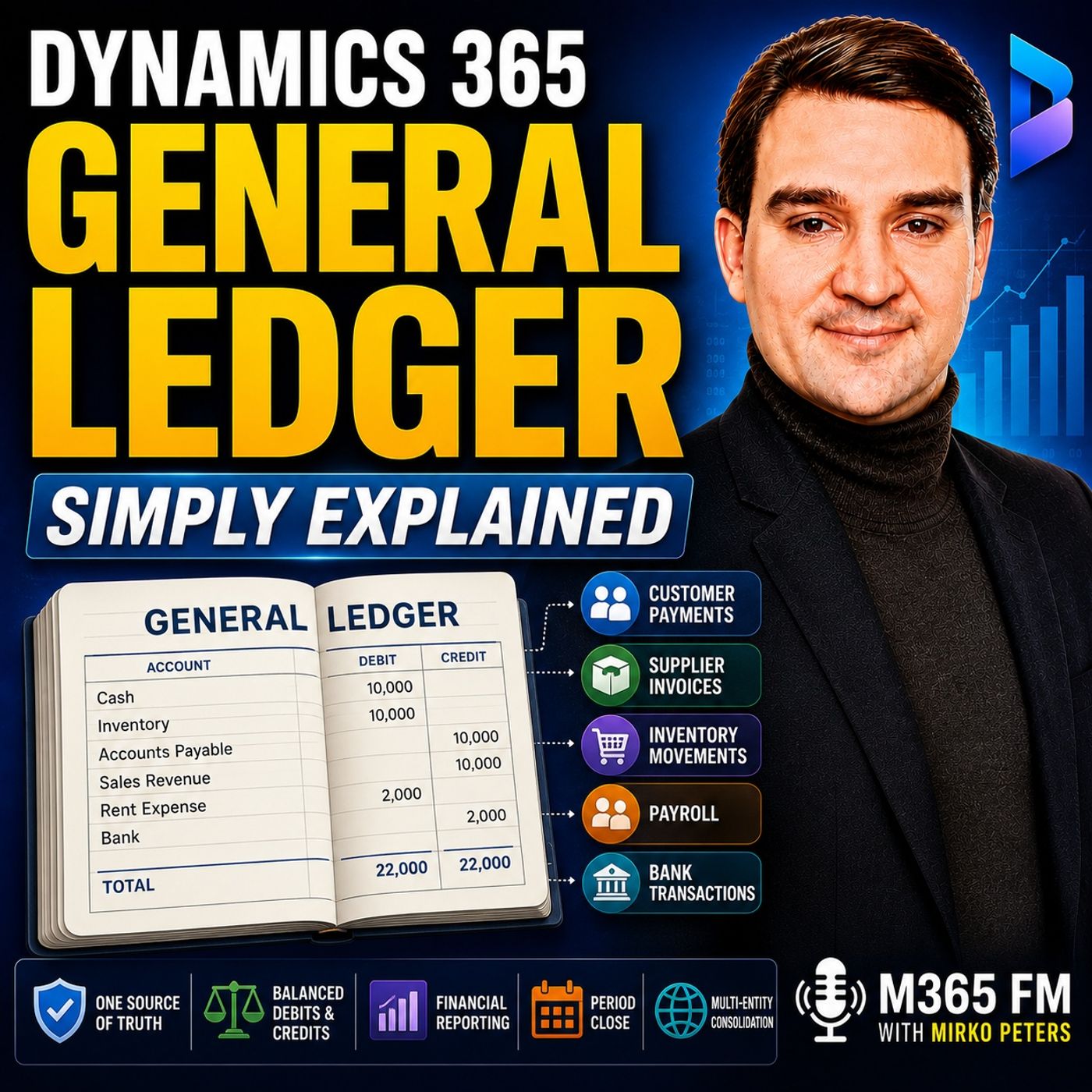
Dynamics 365 General Ledger provides the central financial record behind Dynamics 365 Finance. Customer payments, supplier invoices, inventory movements, payroll, bank transactions, taxes, accruals, and other financial events ultimately affect the company's financial position, and the general ledger brings those accounting entries together in a structured and traceable way. In this episode of M365 FM, Mirko Peters explains the Dynamics 365 General Ledger in plain English, including the chart of accounts, financial dimensions, subledgers, posting profiles, vouchers, journals, allocations, tax, period close, and consolidation.ㅤ
WHAT IS THE GENERAL LEDGER IN DYNAMICS 365?
The general ledger is the company's master financial record. Instead of finance teams piecing together numbers from separate spreadsheets and systems, financial transactions come together in one consistent accounting structure.The ledger contains debit and credit entries organized into accounts such as cash, sales revenue, inventory, rent expense, and accounts payable. Every financial event has two sides, and total debits and credits must remain balanced.Dynamics 365 Finance maintains a ledger for each legal entity, allowing individual companies within a larger organization to maintain their own financial records, reporting responsibilities, currencies, and accounting periods.ㅤ
CHART OF ACCOUNTS EXPLAINED
The chart of accounts provides the structure used to organize financial transactions. Think of it as a financial filing cabinet where each main account represents a specific category.Cash, inventory, accounts payable, sales revenue, and rent expense are examples of main accounts. These accounts are grouped into categories used for financial statements.Assets, liabilities, and equity appear on the balance sheet, while revenue and expenses contribute to the income statement. Correct account structures therefore form the foundation for reliable financial reporting.ㅤ
FINANCIAL DIMENSIONS
A main account tells finance what happened, but organizations often need additional information about where or why it happened.Financial dimensions provide those additional labels. An organization might use dimensions for department, cost center, business unit, or location.A travel expense can therefore remain in one travel expense account while dimensions identify whether the cost belongs to Sales, Support, Finance, London, Berlin, or another organizational unit.This allows companies to analyze financial performance without creating hundreds of unnecessary main accounts.ㅤ
ACCOUNT STRUCTURES AND FINANCIAL CONTROLS
Dynamics 365 Finance can use account structures to control which combinations of main accounts and financial dimensions are permitted.For example, a travel expense might require both a department and cost center, while another account may require fewer dimensions.These rules help prevent incomplete or inconsistent financial information from reaching the ledger and improve the quality of reporting across the organization.ㅤ
GENERAL LEDGER VS SUBLEDGERS
The general ledger provides the overall accounting record, while subledgers maintain the detailed operational information behind specific types of transactions.Accounts Payable tracks vendor invoices and payments. Accounts Receivable tracks customer invoices and incoming payments. Inventory tracks stock movements and value, while Fixed Assets tracks long-term assets such as equipment, vehicles, and buildings.Tax and production processes can also maintain specialized details.These subledgers feed accounting entries into the general ledger, allowing operational teams to retain the detail they need while finance receives the accounting impact required for reporting.ㅤ
HOW POSTING PROFILES WORK
Employees processing normal business transactions shouldn't have to manually determine every debit and credit account.Dynamics 365 Finance uses posting profiles and related accounting rules to determine which main accounts should receive particular transactions.When Accounts Payable processes a vendor invoice, for example, posting rules can automatically direct the liability to the appropriate accounts payable account while the other side of the transaction is posted according to the underlying purchase or expense.This creates more consistent accounting than asking individual users to determine postings manually.ㅤ
VOUCHERS AND FINANCIAL TRACEABILITY
A voucher provides an important connection between source documents, subledger transactions, and the accounting entries appearing in the general ledger.If a finance manager sees an amount in an account and wants to understand where it came from, the voucher can help trace the financial posting back to the corresponding vendor invoice, product receipt, customer invoice, or other business event.This traceability works in both directions. Finance can move from the ledger toward the source document or from the original transaction toward its accounting impact.ㅤ
HOW A PURCHASE REACHES THE GENERAL LEDGER
The episode follows a practical example involving a company purchasing 100 office chairs.The process begins with a purchase order. When the chairs arrive, a product receipt confirms that the company has received them. If the chairs are worth $10,000, inventory can receive a $10,000 debit while purchase accrual receives the corresponding $10,000 credit.The purchase accrual acts as a temporary accounting position because the goods have arrived but the vendor invoice hasn't yet been processed.When the invoice arrives, Dynamics 365 can clear the temporary purchase accrual and record the $10,000 obligation in accounts payable.One purchase therefore creates connected operational and accounting records without repeatedly entering the same financial information.ㅤ
DOUBLE-ENTRY ACCOUNTING
Dynamics 365 Finance follows double-entry bookkeeping. Every financial posting needs balanced debit and credit entries.If $10,000 is debited to one side of a transaction, an equal $10,000 must be credited somewhere else.The accounts involved depend on the business event, but the fundamental principle remains the same: total debits and total credits must balance.This provides the accounting structure that keeps the company's financial records internally consistent.ㅤ
JOURNAL ENTRIES
Not every accounting transaction begins with a purchase order, customer invoice, or inventory movement. Finance teams sometimes need to create journal entries directly.Journals can be used for adjustments, accruals, corrections, or other financial events that originate within the finance function.For example, if electricity was consumed during March but the corresponding invoice won't arrive until April, finance can create an accrual so the expense is represented in the appropriate accounting period.ㅤ
FINANCIAL ALLOCATIONS
Allocations allow organizations to distribute costs across accounts, departments, cost centers, or other dimensions according to defined rules.A fixed allocation might distribute head-office rent 50% to Sales, 30% to Support, and 20% to Finance.Variable allocations can distribute costs according to changing measures. Warehouse expenses, for example, could be distributed according to how much each business unit actually used the warehouse.This helps organizations represent shared costs more accurately in management reporting.ㅤ
TAX MANAGEMENT
Dynamics 365 Finance uses sales tax codes to define how taxes should be calculated and posted.Tax requirements can differ between countries, regions, states, counties, and cities, so tax configuration provides structured rules instead of requiring users to manually calculate taxes for individual transactions.When tax requirements change, organizations can update the appropriate configuration rather than relying on individual employees to remember new calculations.ㅤ
FISCAL CALENDARS AND ACCOUNTING PERIODS
The fiscal calendar determines how an organization's financial year is divided into accounting periods.These periods are commonly months and provide the structure used for month-end, quarter-end, and year-end financial activities.Transactions need to be recorded in the correct period so finance teams can accurately understand what happened during a particular part of the financial year.ㅤ
YEAR-END CLOSING
At year-end, Dynamics 365 Finance supports the process of preparing financial accounts for the next fiscal year.Revenue and expense accounts represent activity during a particular year, so their completed result moves through the closing process into equity.Balance-sheet accounts behave differently. Cash, inventory, accounts payable, and similar balances carry forward because those assets and obligations continue to exist when the calendar moves into a new financial year.ㅤ
CONSOLIDATION ACROSS LEGAL ENTITIES
Larger organizations may operate multiple legal entities while still requiring a combined view of overall financial performance.Consolidation combines financial information from multiple companies into an organizational view while each underlying legal entity continues maintaining its own financial records.Organizations can therefore preserve separate company accounting while still producing consolidated financial information for the wider group.ㅤ
Become a supporter of this podcast: https://www.spreaker.com/podcast/m365-fm-modern-work-security-and-productivity-with-microsoft-365--6704921/support.
🚀 Want to be part of m365.fm?
Then stop just listening… and start showing up.
👉 Connect with me on LinkedIn and let’s make something happen:
- 🎙️ Be a podcast guest and share your story
- 🎧 Host your own episode (yes, seriously)
- 💡 Pitch topics the community actually wants to hear
- 🌍 Build your personal brand in the Microsoft 365 space
This isn’t just a podcast — it’s a platform for people who take action.
🔥 Most people wait. The best ones don’t.
👉 Connect with me on LinkedIn and send me a message:
"I want in"
Let’s build something awesome 👊
Frequently Asked Questions
What is the general ledger in Dynamics 365 Finance?
The general ledger is the company's master financial record that brings together all debit and credit transactions into a structured, balanced accounting format. Instead of piecing together disconnected spreadsheets, finance teams use the ledger as a single source of truth for reliable reporting.
What is the difference between main accounts and financial dimensions?
Main accounts represent broad financial categories like cash, rent expense, or accounts payable that tell finance what happened. Financial dimensions provide additional labels like department, location, or cost center to explain where or why the financial event occurred.
How do subledgers connect to the general ledger?
Subledgers track detailed operational data for specific areas like accounts payable, accounts receivable, and inventory. While operational teams use subledgers for day-to-day tasks, these modules automatically feed balanced accounting entries into the general ledger.
How does voucher traceability work in Dynamics 365?
A voucher connects source documents, subledger entries, and general ledger postings. It allows finance managers to easily trace a ledger amount back to its original vendor invoice, product receipt, or customer bill.
00:00:00,000 --> 00:00:03,760
Welcome to another episode of Microsoft Knowledge Nuggets here on M365.
2
00:00:03,760 --> 00:00:05,400
FM, I'm your host, Mirko Peters.
3
00:00:05,400 --> 00:00:09,960
Today's topic is one that almost everyone has heard of, but few can explain in plain English.
4
00:00:09,960 --> 00:00:11,320
The General Ledger.
5
00:00:11,320 --> 00:00:15,480
Money moves through a company all day as customers pay invoices, someone approves,
6
00:00:15,480 --> 00:00:20,200
suppliers bills, payroll runs, stock arrives and money enters or leaves a bank account,
7
00:00:20,200 --> 00:00:23,640
and each of those events changes the company's financial picture.
8
00:00:23,640 --> 00:00:25,560
So what exactly is the General Ledger?
9
00:00:25,560 --> 00:00:29,760
Is it just another screen inside Dynamics 365 finance, full of accounting words that only
10
00:00:29,760 --> 00:00:31,080
finance people understand?
11
00:00:31,080 --> 00:00:32,080
It isn't.
12
00:00:32,080 --> 00:00:34,760
Think of it like the Master Ledger book in an office building.
13
00:00:34,760 --> 00:00:38,360
Every money event needs a place in that book, under the right heading, so the company
14
00:00:38,360 --> 00:00:42,160
can later see where its money came from, where it went and what remains.
15
00:00:42,160 --> 00:00:45,760
By the end of this episode, you'll understand what this actually is and how the pieces fit
16
00:00:45,760 --> 00:00:46,760
together.
17
00:00:46,760 --> 00:00:50,720
We'll start with the problem the General Ledger solves.
18
00:00:50,720 --> 00:00:51,960
The General Ledger.
19
00:00:51,960 --> 00:00:55,120
The company's Master Money Record 560 words.
20
00:00:55,120 --> 00:00:59,760
Imagine running a company with a spreadsheet for sales, another for supplier bills, a separate
21
00:00:59,760 --> 00:01:04,120
tool for payroll, and somebody's private file for bank payments, and that can work for
22
00:01:04,120 --> 00:01:05,440
a while.
23
00:01:05,440 --> 00:01:07,840
But soon, finance asks a simple question.
24
00:01:07,840 --> 00:01:09,720
How much cash do we have right now?
25
00:01:09,720 --> 00:01:13,440
One spreadsheet shows one number, the bank file shows another, and the sales team has a third
26
00:01:13,440 --> 00:01:16,880
number because the payment hasn't been copied across yet, so nobody knows which number belongs
27
00:01:16,880 --> 00:01:17,880
in the report.
28
00:01:17,880 --> 00:01:20,280
Here's the thing, that's the problem the General Ledger solves.
29
00:01:20,280 --> 00:01:24,560
It gives the company one financial record where all the accounting entries come together
30
00:01:24,560 --> 00:01:29,120
in a consistent way, instead of leaving finance to piece together numbers from disconnected
31
00:01:29,120 --> 00:01:30,120
files.
32
00:01:30,120 --> 00:01:34,520
In plain English, the General Ledger is a register of the company's debit and credit entries.
33
00:01:34,520 --> 00:01:39,120
Those entries sit under accounts like cash, sales revenue, rent expense, inventory, or accounts
34
00:01:39,120 --> 00:01:40,120
payable.
35
00:01:40,120 --> 00:01:42,440
You don't need to panic over debit and credit yet.
36
00:01:42,440 --> 00:01:45,520
Instead, think of them as the two sides of every financial event.
37
00:01:45,520 --> 00:01:49,880
When value enters one place, the system records where that value came from, or what the company
38
00:01:49,880 --> 00:01:52,560
now owes, and the two sides always match.
39
00:01:52,560 --> 00:01:54,520
That matching rule keeps the books balanced.
40
00:01:54,520 --> 00:01:58,000
Now let's talk about how Dynamics 365 Finance organizes this.
41
00:01:58,000 --> 00:02:02,000
It keeps the Ledger for each legal entity, which is the company that keeps its own financial
42
00:02:02,000 --> 00:02:06,880
records, submits its own reports, and may have its own tax and banking responsibilities.
43
00:02:06,880 --> 00:02:11,040
For example, a group might include a company in the United Kingdom and another in Germany,
44
00:02:11,040 --> 00:02:14,240
and while they can work together, each company needs its own financial record because each
45
00:02:14,240 --> 00:02:17,520
one has its own money, obligations, and reporting needs.
46
00:02:17,520 --> 00:02:21,160
So each legal entity gets one Ledger, the Ledger needs a few building blocks before people
47
00:02:21,160 --> 00:02:22,920
can post financial entries.
48
00:02:22,920 --> 00:02:26,600
The first building block is a chart of accounts, the list of account names and numbers that
49
00:02:26,600 --> 00:02:28,240
organize the company's money.
50
00:02:28,240 --> 00:02:32,680
It also needs a fiscal calendar that tells Dynamics 365 Finance how the financial year breaks
51
00:02:32,680 --> 00:02:34,040
into periods like months.
52
00:02:34,040 --> 00:02:37,960
And without it, the system can't place a transaction in the right accounting period, or help
53
00:02:37,960 --> 00:02:40,200
finance prepare a month and report.
54
00:02:40,200 --> 00:02:43,880
Then there's the accounting currency, sometimes called the home currency, which gives the Ledger
55
00:02:43,880 --> 00:02:48,200
a common money language for its financial records, even when the company buys or sells
56
00:02:48,200 --> 00:02:50,080
in other currencies.
57
00:02:50,080 --> 00:02:54,160
It's a company that buys stock in euros but prepares its accounts in British pounds.
58
00:02:54,160 --> 00:02:58,440
The purchase still needs to land in one central financial record using the company's accounting
59
00:02:58,440 --> 00:03:00,280
currency for its own reports.
60
00:03:00,280 --> 00:03:04,320
Those settings may sound like setup details, but they shape every posting that follows.
61
00:03:04,320 --> 00:03:07,000
So why does finance care so much about one shared record?
62
00:03:07,000 --> 00:03:08,960
Because reports need a number people can trust.
63
00:03:08,960 --> 00:03:12,600
And when a manager opens a balance report, they need to know it comes from the same financial
64
00:03:12,600 --> 00:03:16,360
record that supports the company's income statement and balance sheet, without having
65
00:03:16,360 --> 00:03:20,760
to ask whether someone forgot to update a spreadsheet after entering an invoice.
66
00:03:20,760 --> 00:03:23,000
The general ledger gives finance that common source.
67
00:03:23,000 --> 00:03:25,800
It doesn't replace the work happening across the company.
68
00:03:25,800 --> 00:03:29,840
People still buy products, send invoices, pay vendors, receive stock and run payroll, but
69
00:03:29,840 --> 00:03:33,480
the financial impact of those events reaches the ledger in a controlled form.
70
00:03:33,480 --> 00:03:37,520
That gives finance a clear answer when someone asks, why is this balance here?
71
00:03:37,520 --> 00:03:41,680
Double entry bookkeeping keeps that answer honest because every posted amount has an equal
72
00:03:41,680 --> 00:03:42,760
entry on the other side.
73
00:03:42,760 --> 00:03:47,320
So if the company records a debit of 100, it also records a credit of 100.
74
00:03:47,320 --> 00:03:48,320
No mystery math.
75
00:03:48,320 --> 00:03:52,320
The accounts change depending on what happened, but the total debit and total credit must balance
76
00:03:52,320 --> 00:03:57,220
and Dynamics 365 finance follows that rule when entries reach the ledger, helping stop
77
00:03:57,220 --> 00:04:00,720
a one-sided financial record from slipping into the books.
78
00:04:00,720 --> 00:04:04,000
So the general ledger is not a place where numbers go to disappear.
79
00:04:04,000 --> 00:04:07,680
It's the company's master money record built on shared rules and balanced entries, but
80
00:04:07,680 --> 00:04:12,040
a record this large needs a clear filing system and that starts with the chart of accounts.
81
00:04:12,040 --> 00:04:15,080
Chart of accounts and financial dimensions.
82
00:04:15,080 --> 00:04:17,160
The filing cabinet.
83
00:04:17,160 --> 00:04:18,400
Welcome back to Knowledge Nuggets.
84
00:04:18,400 --> 00:04:22,160
I'm Mirko Peters and today we're opening the financial filing cabinet out the chart
85
00:04:22,160 --> 00:04:24,240
of accounts and financial dimensions.
86
00:04:24,240 --> 00:04:26,720
So where does a transaction go once it lands in the ledger?
87
00:04:26,720 --> 00:04:27,920
It lands in an account.
88
00:04:27,920 --> 00:04:32,440
The chart of accounts is the structured list, a legal entity uses to sort its finances,
89
00:04:32,440 --> 00:04:35,000
picture it like a filing cabinet with label drawers.
90
00:04:35,000 --> 00:04:39,000
Each drawer has a purpose and every transaction needs to find its home.
91
00:04:39,000 --> 00:04:42,480
Just those labels, a company might know money moved, but it couldn't explain what that
92
00:04:42,480 --> 00:04:43,480
money meant.
93
00:04:43,480 --> 00:04:47,800
The chart of accounts holds the main accounts or the broad financial labels for transactions.
94
00:04:47,800 --> 00:04:52,520
Cash is a main account and so are sales revenue, rent expense, accounts payable and inventory.
95
00:04:52,520 --> 00:04:57,080
When a company pays office rent, money leaves cash and the cost goes into rent expense.
96
00:04:57,080 --> 00:05:00,920
Buying products for later sale puts value into inventory, receiving an unpaid supplier
97
00:05:00,920 --> 00:05:03,800
bill places the obligation in accounts payable.
98
00:05:03,800 --> 00:05:06,600
Each main account gives every entry a clear home.
99
00:05:06,600 --> 00:05:09,400
It's a simple idea but it shapes every finance report.
100
00:05:09,400 --> 00:05:12,920
Accounts fall into larger groups that finance users to prepare the balance sheet and income
101
00:05:12,920 --> 00:05:13,920
statement.
102
00:05:13,920 --> 00:05:17,720
Assets, liabilities and equity belong on the balance sheet, describing what the company
103
00:05:17,720 --> 00:05:20,360
owns, owes and the remaining ownership.
104
00:05:20,360 --> 00:05:24,080
Revenue and expenses go on the income statement, which answers a different question.
105
00:05:24,080 --> 00:05:26,320
Did the company earn more than it spent this period?
106
00:05:26,320 --> 00:05:28,040
Cash and inventory are assets.
107
00:05:28,040 --> 00:05:31,680
Accounts payable is a liability our money owed to suppliers.
108
00:05:31,680 --> 00:05:35,360
Sales revenue records income from goods or services, rent expense records operating
109
00:05:35,360 --> 00:05:36,360
costs.
110
00:05:36,360 --> 00:05:40,760
When accounts have the right categories, dynamics 365 finance can place amounts in the correct
111
00:05:40,760 --> 00:05:42,440
part of a financial report.
112
00:05:42,440 --> 00:05:45,680
But an account name alone often doesn't tell you enough, say you have one account called
113
00:05:45,680 --> 00:05:46,680
travel expense.
114
00:05:46,680 --> 00:05:49,800
It tells you money was spent on travel but it doesn't say who spent it or which part of
115
00:05:49,800 --> 00:05:50,800
the business paid.
116
00:05:50,800 --> 00:05:52,400
That's where financial dimensions come in.
117
00:05:52,400 --> 00:05:55,720
These are extra labels attached to every entry of things like department, cost center,
118
00:05:55,720 --> 00:05:57,280
business unit or location.
119
00:05:57,280 --> 00:06:00,400
Think of the main account as the subject line on a form.
120
00:06:00,400 --> 00:06:02,360
Dimensions fill in the details beneath.
121
00:06:02,360 --> 00:06:07,240
Local expense tells you the, what department might tell you it belongs to sales.
122
00:06:07,240 --> 00:06:09,440
Cost center could identify the team budget.
123
00:06:09,440 --> 00:06:11,840
Business unit separates company sections.
124
00:06:11,840 --> 00:06:15,360
Location shows whether the cost belonged to London, Berlin or another office.
125
00:06:15,360 --> 00:06:18,640
Now picture three employees booking flights for customer meetings.
126
00:06:18,640 --> 00:06:21,760
All three costs post to the same travel expense main account.
127
00:06:21,760 --> 00:06:27,400
But one entry carries sales as its department, another carry support and another carry finance.
128
00:06:27,400 --> 00:06:30,080
Finance can then look at total company travel spending.
129
00:06:30,080 --> 00:06:33,480
You can ask a sharper question, how much did sales spend on travel this month?
130
00:06:33,480 --> 00:06:34,920
How much did support spend?
131
00:06:34,920 --> 00:06:36,640
Did finance stay within its budget?
132
00:06:36,640 --> 00:06:39,320
The spending didn't need separate main accounts for each team.
133
00:06:39,320 --> 00:06:41,800
Awe, the dimensions provide those separate views.
134
00:06:41,800 --> 00:06:45,400
A company doesn't want people picking random labels and creating messy records.
135
00:06:45,400 --> 00:06:50,680
A travel cost might need a department and cost center, while a bank entry needs fewer details.
136
00:06:50,680 --> 00:06:54,000
Dynamics 365 finance controls this through account structures and rules.
137
00:06:54,000 --> 00:06:58,120
An account structure sets the allowed combination of main account and dimensions.
138
00:06:58,120 --> 00:07:02,800
In plain English it tells the system which labels go with which account and which values people
139
00:07:02,800 --> 00:07:03,800
can choose.
140
00:07:03,800 --> 00:07:07,600
For example, a travel expense entry might require a department and cost center.
141
00:07:07,600 --> 00:07:09,600
A cash entry might only allow a business unit.
142
00:07:09,600 --> 00:07:13,440
If someone tries to post a rent expense with a location that doesn't belong or leaves out
143
00:07:13,440 --> 00:07:17,680
a required department, the system stops the entry before it reaches the records.
144
00:07:17,680 --> 00:07:21,000
That keeps reports clean because the rules guide people right at the moment they enter
145
00:07:21,000 --> 00:07:22,280
the transaction.
146
00:07:22,280 --> 00:07:27,120
Larger organizations can also share one chart of accounts across several legal entities.
147
00:07:27,120 --> 00:07:31,000
They all use the same account list or cash sales revenue inventory or making group reporting
148
00:07:31,000 --> 00:07:32,280
easier to compare.
149
00:07:32,280 --> 00:07:35,600
But shared account names don't merge the companies into one record.
150
00:07:35,600 --> 00:07:37,760
Each legal entity keeps its own ledger.
151
00:07:37,760 --> 00:07:41,760
Imagine two companies using the same filing cabinet design in separate offices.
152
00:07:41,760 --> 00:07:45,400
The drawer labels match, but the papers inside belong to different companies.
153
00:07:45,400 --> 00:07:47,800
One company's cash balance doesn't mix with the others.
154
00:07:47,800 --> 00:07:50,520
So the chart of accounts tells you what each entry means.
155
00:07:50,520 --> 00:07:52,560
Financial dimensions add business detail.
156
00:07:52,560 --> 00:07:54,680
Account structures ensure the right combinations.
157
00:07:54,680 --> 00:07:56,840
But these labels only explain where an entry belongs.
158
00:07:56,840 --> 00:08:01,240
The next question is where that entry started and that takes us to sublegges.
159
00:08:01,240 --> 00:08:04,720
Ledger and sublegges, where transactions begin.
160
00:08:04,720 --> 00:08:07,960
Now let's talk about where all those transactions actually start.
161
00:08:07,960 --> 00:08:11,840
The general ledger holds the financial record for the whole legal entity, but it doesn't
162
00:08:11,840 --> 00:08:13,760
carry every day to day detail.
163
00:08:13,760 --> 00:08:16,200
That distinction saves a lot of confusion.
164
00:08:16,200 --> 00:08:20,360
When a buyer receives a vendor invoice, the business needs to know the vendor name,
165
00:08:20,360 --> 00:08:25,320
invoice number, due date, purchase order, payment status, tax details, and sometimes the line
166
00:08:25,320 --> 00:08:26,640
items.
167
00:08:26,640 --> 00:08:29,800
Finance needs the accounting result, but a financial report doesn't need to show every line
168
00:08:29,800 --> 00:08:31,560
from every supplier document.
169
00:08:31,560 --> 00:08:33,480
That detailed work lives in sublegges.
170
00:08:33,480 --> 00:08:37,880
A sublegger is the part of Dynamics 365 Finance that tracks detail for a specific kind of
171
00:08:37,880 --> 00:08:38,880
activity.
172
00:08:38,880 --> 00:08:42,600
Accounts payable tracks vendor invoices amounts owed and payments.
173
00:08:42,600 --> 00:08:48,560
Accounts, receivable tracks customer invoices, incoming payments, and what customers still owe.
174
00:08:48,560 --> 00:08:52,840
Factory tracks stock movements and value, fixed assets, tracks equipment, vehicles, or buildings
175
00:08:52,840 --> 00:08:54,480
the company owns long term.
176
00:08:54,480 --> 00:08:57,240
The tax module tracks tax codes and amounts.
177
00:08:57,240 --> 00:09:01,720
Production tracks the financial side of manufacturing, our materials, labor, and other costs
178
00:09:01,720 --> 00:09:03,800
that affect the final item cost.
179
00:09:03,800 --> 00:09:07,320
Each module keeps the detail its users need, but that doesn't mean these modules work in
180
00:09:07,320 --> 00:09:08,320
isolation.
181
00:09:08,320 --> 00:09:11,960
They feed accounting entries into the general ledger, keeping operational activity and financial
182
00:09:11,960 --> 00:09:13,200
records connected.
183
00:09:13,200 --> 00:09:14,720
Take a vendor invoice.
184
00:09:14,720 --> 00:09:17,200
Someone in accounts payable enters an invoice from a supplier.
185
00:09:17,200 --> 00:09:21,360
They see who sent it, what it covers, when payment is due, and whether it matches the purchase
186
00:09:21,360 --> 00:09:22,360
info.
187
00:09:22,360 --> 00:09:23,360
That's the document level view.
188
00:09:23,360 --> 00:09:27,280
Behind that invoice Dynamics 365 Finance creates the accounting effect, maybe the supplier
189
00:09:27,280 --> 00:09:28,800
charged for office rent.
190
00:09:28,800 --> 00:09:32,760
The system records the expense in the right account, and records the amount owed in accounts
191
00:09:32,760 --> 00:09:33,760
payable.
192
00:09:33,760 --> 00:09:37,440
The invoice stays visible in accounts payable, while it's debit and credit entries pass
193
00:09:37,440 --> 00:09:38,880
into the general ledger.
194
00:09:38,880 --> 00:09:41,320
One business event creates two useful views.
195
00:09:41,320 --> 00:09:44,760
The operational view asks, which supplier do we need to pay and when?
196
00:09:44,760 --> 00:09:48,920
The accounting view asks, which accounts changed because of this invoice?
197
00:09:48,920 --> 00:09:51,480
You might wonder how the system knows which accounts to use.
198
00:09:51,480 --> 00:09:55,680
Nobody wants staff guessing every debit and credit account while entering a normal invoice.
199
00:09:55,680 --> 00:09:58,520
Dynamics 365 Finance uses posting profiles for that.
200
00:09:58,520 --> 00:10:02,320
A posting profile contains rules behind the scenes that point the system to the correct
201
00:10:02,320 --> 00:10:04,200
main accounts for a transaction type.
202
00:10:04,200 --> 00:10:08,200
In accounts payable, a vendor posting profile can direct the owed amount to the accounts
203
00:10:08,200 --> 00:10:09,200
payable account.
204
00:10:09,200 --> 00:10:12,840
Other rules based on the invoice details direct the other side of the entry.
205
00:10:12,840 --> 00:10:16,880
Think of posting profiles as accounting instructions built into the process.
206
00:10:16,880 --> 00:10:19,240
People still enter the real business document.
207
00:10:19,240 --> 00:10:23,360
The system applies the company's financial rules using the accounts and dimensions allowed
208
00:10:23,360 --> 00:10:24,360
for that activity.
209
00:10:24,360 --> 00:10:27,640
That creates a more consistent result than asking every user to decide the accounting from
210
00:10:27,640 --> 00:10:28,640
scratch.
211
00:10:28,640 --> 00:10:32,720
There's also a shared reference that helps follow the trail, it's called a voucher.
212
00:10:32,720 --> 00:10:36,760
A voucher links the source document, the sub ledger accounting entries, and the entries
213
00:10:36,760 --> 00:10:38,240
that reach the general ledger.
214
00:10:38,240 --> 00:10:42,000
If a finance user sees an amount in the ledger and needs to know where it came from, the voucher
215
00:10:42,000 --> 00:10:43,880
helps trace it back to the source.
216
00:10:43,880 --> 00:10:46,840
That matters when someone asks a very normal question.
217
00:10:46,840 --> 00:10:48,640
What is this amount?
218
00:10:48,640 --> 00:10:52,680
Instead of searching across reports, emails, and folders, the team can follow the voucher
219
00:10:52,680 --> 00:10:57,440
from a ledger entry to the vendor invoice, product receipt, customer invoice, or other
220
00:10:57,440 --> 00:10:59,320
source document.
221
00:10:59,320 --> 00:11:02,560
The voucher doesn't replace the original document, it connects the financial record to
222
00:11:02,560 --> 00:11:03,560
that document.
223
00:11:03,560 --> 00:11:07,320
So when you open a vendor invoice in accounts payable, you're looking at the business document
224
00:11:07,320 --> 00:11:08,320
and payment details.
225
00:11:08,320 --> 00:11:11,780
When you open the voucher or ledger transactions, you're looking at the financial
226
00:11:11,780 --> 00:11:13,460
posting behind that document.
227
00:11:13,460 --> 00:11:14,740
Same event, different purpose.
228
00:11:14,740 --> 00:11:19,020
This split lets operational teams work with the detail they need, while finance can review
229
00:11:19,020 --> 00:11:23,660
organized account balances and prepare reports without turning every report into a long
230
00:11:23,660 --> 00:11:26,180
list of invoice lines.
231
00:11:26,180 --> 00:11:29,260
The general ledger stays focused on the accounting record.
232
00:11:29,260 --> 00:11:32,500
Sub ledgers keep business detail close to the people who need it.
233
00:11:32,500 --> 00:11:35,900
Vouchers and posting profiles connect both sides, so a number on a report can still lead
234
00:11:35,900 --> 00:11:37,460
back to the event that created it.
235
00:11:37,460 --> 00:11:41,340
Now let's follow a simple purchase from ordering goods through to the accounting entries
236
00:11:41,340 --> 00:11:42,820
it creates.
237
00:11:42,820 --> 00:11:44,260
A purchase example.
238
00:11:44,260 --> 00:11:46,220
How money moves through dynamics.
239
00:11:46,220 --> 00:11:47,220
365.
240
00:11:47,220 --> 00:11:50,660
So your company orders 100 office chairs from a supplier.
241
00:11:50,660 --> 00:11:52,740
The process starts with a purchase order.
242
00:11:52,740 --> 00:11:56,460
That document outlines what the company plans to buy, from whom, at what price, and how
243
00:11:56,460 --> 00:11:57,460
many chairs.
244
00:11:57,460 --> 00:12:01,380
At this point it's just a commitment, oh, a plan, not a transaction.
245
00:12:01,380 --> 00:12:04,300
The chairs haven't arrived yet, and no invoice has been sent.
246
00:12:04,300 --> 00:12:08,940
When the delivery shows up, someone records a product receipt inside dynamics 365.
247
00:12:08,940 --> 00:12:11,860
This step confirms the company actually received the chairs.
248
00:12:11,860 --> 00:12:14,860
Inventory goes up because you now physically control 100 more chairs.
249
00:12:14,860 --> 00:12:19,500
And right at that moment, dynamics 365 can create an accounting entry for the receipt.
250
00:12:19,500 --> 00:12:20,500
Let's simplify that.
251
00:12:20,500 --> 00:12:24,100
Say the chairs cost $10,000 in the company's accounting currency.
252
00:12:24,100 --> 00:12:27,740
Inventory gets a debit of $10,000, purchase a cruel gets a credit of $10,000.
253
00:12:27,740 --> 00:12:29,060
Don't let those terms confuse you.
254
00:12:29,060 --> 00:12:34,340
A debit simply records that value entered inventory, oh, the company now owns items worth $10,000.
255
00:12:34,340 --> 00:12:38,220
The credit records the other side, the amount tied to goods received, but not yet billed.
256
00:12:38,220 --> 00:12:42,260
Besides equal $10,000, so the company has the chairs, but no invoice yet.
257
00:12:42,260 --> 00:12:46,540
Purchase a cruel acts as a temporary holding spot, a yo, a placeholder between receiving the
258
00:12:46,540 --> 00:12:48,140
goods and getting the bill.
259
00:12:48,140 --> 00:12:51,820
It says, we received value and we expect a vendor charge to match it.
260
00:12:51,820 --> 00:12:54,620
Both sides are equal, which is exactly what the system needs.
261
00:12:54,620 --> 00:12:59,660
That balance matters because dynamics 365 checks that total debits and total credit match
262
00:12:59,660 --> 00:13:01,380
when it creates the accounting entry.
263
00:13:01,380 --> 00:13:05,580
If only the inventory side existed, the records would show extra value without showing where
264
00:13:05,580 --> 00:13:06,860
it came from.
265
00:13:06,860 --> 00:13:08,180
Accounting doesn't work that way.
266
00:13:08,180 --> 00:13:11,100
The amount needs two sides, our source and a destination.
267
00:13:11,100 --> 00:13:15,380
A few days later, the invoice arrives, the accounts payable team enters and posts it.
268
00:13:15,380 --> 00:13:19,100
The system can match the invoice to the purchase order and the product receipt so the company
269
00:13:19,100 --> 00:13:23,500
can compare, what it ordered, what it received and what the vendor charged.
270
00:13:23,500 --> 00:13:26,740
When the invoice posts, the temporary purchase a cruel amount clears.
271
00:13:26,740 --> 00:13:32,180
The system debits, purchase a cruel for $10,000, a yo, reducing the amount held there, oh,
272
00:13:32,180 --> 00:13:35,100
and credits accounts payable for $10,000.
273
00:13:35,100 --> 00:13:37,500
That's the thing what the company now owes the vendor.
274
00:13:37,500 --> 00:13:38,500
Notice what changed here.
275
00:13:38,500 --> 00:13:41,140
The inventory posting already recorded that the chairs arrived.
276
00:13:41,140 --> 00:13:43,780
The vendor invoice doesn't add the chairs a second time.
277
00:13:43,780 --> 00:13:47,860
It just changes the company's obligation from a temporary placeholder to a specific amount
278
00:13:47,860 --> 00:13:49,300
owed to a specific vendor.
279
00:13:49,300 --> 00:13:52,020
That gives different teams exactly the information they need.
280
00:13:52,020 --> 00:13:54,100
The warehouse team confirms the chairs arrived.
281
00:13:54,100 --> 00:13:56,180
The buyer checks the purchase order.
282
00:13:56,180 --> 00:14:00,100
Accounts payable sees the invoice and payment due date and finance sees the accounting entries
283
00:14:00,100 --> 00:14:03,380
that moved through inventory purchase a cruel and accounts payable.
284
00:14:03,380 --> 00:14:07,660
There's one purchase, but each part of Dynamics 365 records only the piece that belongs
285
00:14:07,660 --> 00:14:08,660
to it.
286
00:14:08,660 --> 00:14:10,660
Every posting also gets a voucher reference.
287
00:14:10,660 --> 00:14:14,940
Say a finance manager sees a $10,000 movement in the inventory account on a report and wants
288
00:14:14,940 --> 00:14:15,940
to know why.
289
00:14:15,940 --> 00:14:19,020
They can use the voucher to trace that amount back through the product receipt, the purchase
290
00:14:19,020 --> 00:14:21,260
order, and eventually the vendor invoice.
291
00:14:21,260 --> 00:14:23,020
That turns, where did this number come from?
292
00:14:23,020 --> 00:14:24,340
Into a traceable question.
293
00:14:24,340 --> 00:14:26,060
The trail goes both directions.
294
00:14:26,060 --> 00:14:29,140
Someone reviewing the invoice can open the related financial posting.
295
00:14:29,140 --> 00:14:32,820
Someone reviewing the ledger can trace back to the document that started the entry.
296
00:14:32,820 --> 00:14:36,540
Those spreadsheets often break this link, one person updates an inventory file.
297
00:14:36,540 --> 00:14:40,500
Someone else enters a vendor bill into an accounts file, finance copies totals into another
298
00:14:40,500 --> 00:14:41,580
workbook at month end.
299
00:14:41,580 --> 00:14:46,380
A missing row, a changed amount, or a late update leaves the records out of step.
300
00:14:46,380 --> 00:14:51,740
Dynamics 365 keeps the purchase activity and accounting entries connected as the work happens.
301
00:14:51,740 --> 00:14:55,100
People still need to enter accurate information and follow the company's approval process
302
00:14:55,100 --> 00:14:58,220
or the system won't turn a bad invoice into a good one.
303
00:14:58,220 --> 00:15:01,740
But it reduces repeated entry and keeps the original documents close to the financial
304
00:15:01,740 --> 00:15:03,020
postings they create.
305
00:15:03,020 --> 00:15:05,700
That single purchase creates only a few entries.
306
00:15:05,700 --> 00:15:08,500
Across a normal day, a company posts many more.
307
00:15:08,500 --> 00:15:12,820
Those postings build the financial record and finance uses them for recurring work throughout
308
00:15:12,820 --> 00:15:14,620
the accounting period.
309
00:15:14,620 --> 00:15:16,380
What finance does with the ledger?
310
00:15:16,380 --> 00:15:19,540
Daily work, period close, and tax.
311
00:15:19,540 --> 00:15:23,860
Not every accounting event starts with a purchase order, invoice, or stock movement.
312
00:15:23,860 --> 00:15:26,260
Sometimes finance needs to post a journal entry directly.
313
00:15:26,260 --> 00:15:29,500
A journal entry records an adjustment or a financial event that comes straight from
314
00:15:29,500 --> 00:15:33,620
the finance team are you like correcting a posting, recording in a cruel, or moving an amount
315
00:15:33,620 --> 00:15:35,500
between accounts at period end.
316
00:15:35,500 --> 00:15:39,780
It gives finance a controlled way to record work that doesn't start in another part of
317
00:15:39,780 --> 00:15:41,300
Dynamics 365.
318
00:15:41,300 --> 00:15:45,220
Imagine an electricity bill covers the last few days of March, but the invoice won't arrive
319
00:15:45,220 --> 00:15:46,380
until April.
320
00:15:46,380 --> 00:15:49,540
Finance can post in a cruel in March, so the March accounts include the costs that belongs
321
00:15:49,540 --> 00:15:50,540
there.
322
00:15:50,540 --> 00:15:54,300
When the invoice arrives later, the team handles the actual document that keeps the financial
323
00:15:54,300 --> 00:15:58,060
period focused on what happened during that period, not just on when paperwork came
324
00:15:58,060 --> 00:15:59,060
in.
325
00:15:59,060 --> 00:16:00,620
It also uses allocations.
326
00:16:00,620 --> 00:16:04,020
An allocation distributes an amount across other accounts, departments, or cost centers
327
00:16:04,020 --> 00:16:06,260
using rules the company defines.
328
00:16:06,260 --> 00:16:08,580
A fixed allocation follows set percentages.
329
00:16:08,580 --> 00:16:14,820
If head office rent should split 50% to sales, 30% to support, and 20% to finance, the system
330
00:16:14,820 --> 00:16:16,420
applies those percentages.
331
00:16:16,420 --> 00:16:19,020
A variable allocation changes based on a measure.
332
00:16:19,020 --> 00:16:23,340
For example, shared warehouse costs might spread across business units based on how many
333
00:16:23,340 --> 00:16:25,220
items each unit handled.
334
00:16:25,220 --> 00:16:28,420
One team uses more of the warehouse so it receives more of the cost.
335
00:16:28,420 --> 00:16:32,260
The original cost remains traceable, while reports show where the business chose to carry
336
00:16:32,260 --> 00:16:33,260
that cost.
337
00:16:33,260 --> 00:16:35,300
Tax needs the same kind of control.
338
00:16:35,300 --> 00:16:36,980
Dynamics 365.
339
00:16:36,980 --> 00:16:41,100
Finance uses sales tax codes to store the information needed for tax posting.
340
00:16:41,100 --> 00:16:45,660
A tax code can define the rate or amount to collect or pay, along with the method used
341
00:16:45,660 --> 00:16:47,500
to apply it to a transaction.
342
00:16:47,500 --> 00:16:50,900
Tax requirements differ by country, region, state, county, and city.
343
00:16:50,900 --> 00:16:55,220
So the code gives the system rules for the tax part of a sale or purchase, rather than
344
00:16:55,220 --> 00:16:58,420
leaving users to type a different calculation each time.
345
00:16:58,420 --> 00:17:02,540
When rules change, the company updates the tax setup, no need for handwritten notes or
346
00:17:02,540 --> 00:17:03,940
remembering exceptions.
347
00:17:03,940 --> 00:17:05,780
Then comes the rhythm of the financial year.
348
00:17:05,780 --> 00:17:09,140
A fiscal calendar splits the year into periods, often months.
349
00:17:09,140 --> 00:17:14,340
As each period ends, finance reviews the entries, posts needed adjustments, and prepares reports
350
00:17:14,340 --> 00:17:15,660
for that slice of time.
351
00:17:15,660 --> 00:17:19,380
At year end, closing transactions prepare the income statement accounts for the next fiscal
352
00:17:19,380 --> 00:17:22,940
year, revenue and expense accounts track activity during one year.
353
00:17:22,940 --> 00:17:26,660
After the year closes, those accounts start the new year ready to record new income and
354
00:17:26,660 --> 00:17:27,660
new costs.
355
00:17:27,660 --> 00:17:31,460
Their completed result moves into the company's equity through the closing process.
356
00:17:31,460 --> 00:17:32,900
Balance sheet accounts work differently.
357
00:17:32,900 --> 00:17:36,740
Cash, inventory, accounts payable, and other balance sheet accounts carry their balances
358
00:17:36,740 --> 00:17:41,620
forward because the company still owns the cash or stock, and still owes any unpaid bills
359
00:17:41,620 --> 00:17:43,940
when the new year begins.
360
00:17:43,940 --> 00:17:45,620
Large groups face one more task.
361
00:17:45,620 --> 00:17:50,780
A parent organization may need one view of results from several subsidiary legal entities.
362
00:17:50,780 --> 00:17:54,260
Consolidation combines financial results from those companies into a single organization
363
00:17:54,260 --> 00:17:58,900
view I/O, even when the subsidiaries sit in the same database or separate databases.
364
00:17:58,900 --> 00:18:02,020
The individual company still keeps their own records.
365
00:18:02,020 --> 00:18:06,100
Consolidation gives the group a combined financial picture, so daily journals, allocations,
366
00:18:06,100 --> 00:18:10,460
tax postings, period work, year end closing, and consolidation all use the same financial
367
00:18:10,460 --> 00:18:11,460
foundation.
368
00:18:11,460 --> 00:18:15,540
Next, let's put those building blocks together without turning period close into an admin
369
00:18:15,540 --> 00:18:17,420
lesson.
370
00:18:17,420 --> 00:18:19,460
Putting the picture together.
371
00:18:19,460 --> 00:18:23,380
Think of the general ledger as your company's main financial filing cabinet.
372
00:18:23,380 --> 00:18:27,620
The chart of accounts names each drawer, dimensions add labels, and the calendar and currency
373
00:18:27,620 --> 00:18:29,900
set the rules for every entry.
374
00:18:29,900 --> 00:18:33,660
Subledgers send their detailed activity through balance postings, and vouchers keep a trail
375
00:18:33,660 --> 00:18:35,620
back to the original source document.
376
00:18:35,620 --> 00:18:36,860
That chair purchase?
377
00:18:36,860 --> 00:18:40,860
It moves from a daily transaction all the way into the financial statements, with a record
378
00:18:40,860 --> 00:18:42,420
someone can trace later.
379
00:18:42,420 --> 00:18:45,900
The general ledger isn't just data entry, it's how finance explains the company's financial
380
00:18:45,900 --> 00:18:47,380
position.
381
00:18:47,380 --> 00:18:48,380
Conclusion
382
00:18:48,380 --> 00:18:49,380
All the money.
383
00:18:49,380 --> 00:18:53,700
Follow a Dynamics 365 Finance Transaction through its account, dimension, source document,
384
00:18:53,700 --> 00:18:54,700
and voucher.
385
00:18:54,700 --> 00:18:56,620
Everything becomes much clearer.
386
00:18:56,620 --> 00:19:00,060
Subscribe on your favorite podcast platform and share this knowledge nugget with someone
387
00:19:00,060 --> 00:19:02,060
learning Dynamics 365 Finance.




