


 Apple Podcasts
 Spotify
 Youtube Music
 Spreaker
 Podchaser
 Amazon Music
 Dynamics 365 Inventory Management - Simply Explained
Key Takeaways
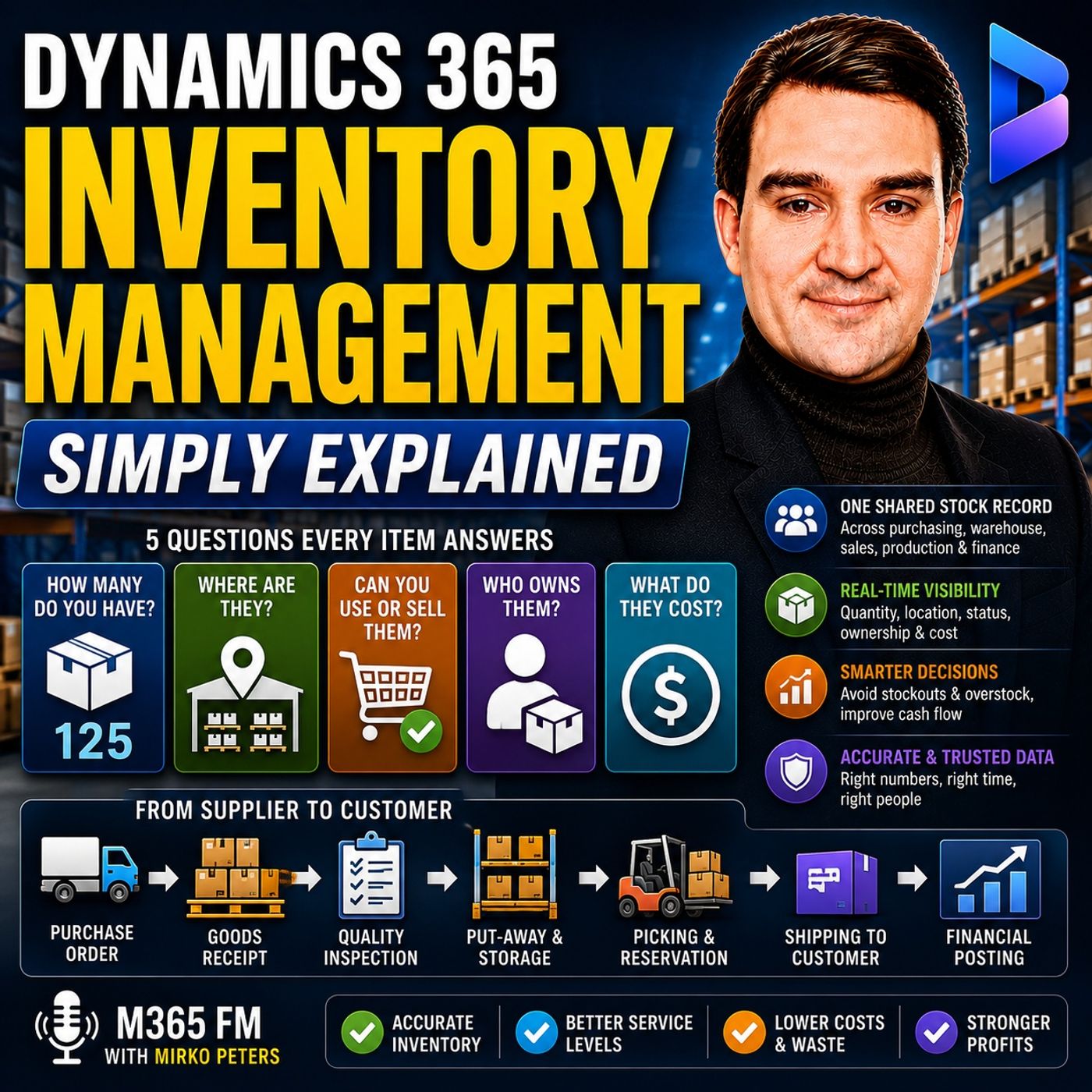
- Dynamics 365 Inventory Management replaces isolated spreadsheets with a single shared record that connects purchasing, warehousing, sales, production, and finance.
- Every tracked item in Dynamics 365 answers five fundamental questions: how many you have, where they sit, whether you can use them, who owns them, and what they cost.
- Inventory dimensions use storage labels (site, warehouse, location) and tracking labels (batch numbers, serial numbers) to transform generic stock quantities into actionable operational data.
- The system tracks the complete lifecycle of stock from the initial purchase order and goods receipt through quarantine, put-away, internal transfers, reservations, and final customer shipment.
- Dynamics 365 automatically connects operational inventory movements with financial records using item groups and costing methods like FIFO, weighted average, and standard cost.
Dynamics 365 Inventory Management gives businesses one shared record for the products, materials, parts, and other stock moving through their organization. Instead of purchasing, warehouse, sales, production, and finance maintaining separate versions of inventory information, Dynamics 365 connects quantities, locations, availability, ownership, movements, and financial value. In this episode of M365 FM, Mirko Peters explains how Dynamics 365 Inventory Management works from supplier receipt to customer shipment — including inventory dimensions, reservations, transfers, costing, cycle counting, safety stock, consignment inventory, and the connection between inventory and finance. ㅤ
WHAT IS DYNAMICS 365 INVENTORY MANAGEMENT?
Inventory Management provides a shared stock record across the business. For every item, organizations need to answer five fundamental questions: How many do we have? Where are they? Can we use or sell them? Who owns them? And what are they worth? Dynamics 365 brings those answers together. Purchasing records incoming goods, warehouse teams record movements, sales records what leaves, production records materials consumed, and finance receives the financial value associated with those transactions. ㅤ
WHY INVENTORY MANAGEMENT MATTERS
Too little inventory creates stockouts, delayed customer orders, lost sales, and potentially interrupted production. Too much inventory creates a different problem: money becomes trapped on warehouse shelves. Products also carry risks while sitting in inventory. They can expire, become damaged, go out of style, or simply stop selling. Inventory management therefore isn't about maximizing stock. The objective is maintaining enough inventory to satisfy demand without unnecessarily tying up working capital. ㅤ
MORE THAN FINISHED PRODUCTS
Inventory doesn't only mean products waiting to be sold. A manufacturer might track raw materials such as wood, screws, fabric, or components. Materials being transformed into products can become work in progress, while completed products become finished goods. Businesses may also track spare parts, packaging, replacement components, cleaning supplies, and materials required for service operations. Dynamics 365 provides a common inventory structure for these different types of stock. ㅤ
THE DIGITAL RECORD BEHIND EVERY ITEM
Every inventory item needs an identity inside Dynamics 365. This normally includes an item number, description, and unit of measure. Units of measure become particularly important when organizations purchase and sell products differently. A supplier might sell something by the box while customers purchase individual packs. Dynamics needs to understand the relationship between those units so purchasing, sales, warehouse, and finance teams interpret inventory quantities consistently. ㅤ
PRODUCT VARIANTS
Some products have multiple variations. Clothing might differ by size and color, while manufactured products can have different styles or configurations. Dynamics 365 can distinguish between these combinations rather than treating them as one generic quantity. The organization can therefore know that it has twelve black medium shirts in one warehouse and six white large shirts somewhere else rather than simply knowing that eighteen shirts exist. ㅤ
INVENTORY DIMENSIONS EXPLAINED
Inventory dimensions are labels that help Dynamics distinguish where inventory is located and exactly which inventory is being tracked. Storage dimensions describe location. These can include site, warehouse, and the specific location within a warehouse. Tracking dimensions identify particular inventory through information such as batch numbers and serial numbers. Together, these dimensions transform a generic stock quantity into information people can actually use operationally. ㅤ
SITES, WAREHOUSES AND LOCATIONS
A site represents a broader business location such as a factory or distribution center. Within a site, organizations can operate multiple warehouses. Locations provide another level of detail by identifying where inventory physically sits inside the warehouse. Instead of telling someone that a component is somewhere inside Warehouse A, Dynamics can provide a specific aisle, rack, shelf, or bin location. This becomes increasingly important as warehouse size and inventory complexity increase. ㅤ
BATCH AND SERIAL NUMBER TRACKING
Batch numbers identify groups of products received or produced together. They become important when organizations need to track expiration dates, quality information, supplier history, or product recalls. Serial numbers identify individual units. A laptop, medical device, or industrial machine can therefore maintain its own identity throughout inventory processes. This can support warranty claims, servicing, returns, and precise traceability. ㅤ
FROM PURCHASE ORDER TO GOODS RECEIPT
Inventory can begin its operational journey with a purchase order. The purchase order records what the organization expects to receive, the quantity ordered, the supplier, and the intended destination. When the shipment arrives, employees compare the physical delivery with that expectation. Once the goods receipt is recorded, Dynamics knows the inventory has physically arrived. This creates an important distinction between inventory that has merely been ordered and inventory that is actually present. ㅤ
QUARANTINE AND INVENTORY STATUS
Physically receiving inventory doesn't necessarily mean it should immediately become available. Some goods require quality inspection, expiry checks, testing, or regulatory verification. Dynamics can represent inventory in quarantine or assign a status preventing it from being used prematurely. Warehouse employees can see that the inventory exists while sales and production understand that it isn't currently available for consumption or customer orders. ㅤ
PUT-AWAY AND INTERNAL MOVEMENTS
After receiving and inspection, goods normally need to move from the receiving area into their appropriate storage locations. Dynamics records these internal movements so the system reflects where inventory physically resides. This means the inventory history doesn't stop when a delivery enters the building. It continues as stock moves between receiving areas, storage locations, warehouses, and sites. ㅤ
TRANSFER ORDERS
Organizations frequently move inventory between warehouses or sites. A transfer order records this movement. When goods leave the sending warehouse but haven't yet arrived at the destination, Dynamics can represent them as inventory in transit. The stock therefore hasn't simply disappeared from the system. The sending location knows what left, the receiving location knows what to expect, and discrepancies can be investigated against a documented movement. ㅤ
INVENTORY RESERVATIONS
When a customer places an order, inventory can be reserved specifically for that demand. Reservation means the quantity is no longer simply available for anyone to promise. It has been allocated to a particular requirement. This reduces the risk of two salespeople promising the same limited stock to different customers and becomes especially valuable when availability is low or delivery commitments are important. ㅤ
PICKING, PACKING AND SHIPPING
Once inventory is committed to an order, warehouse employees can pick the goods from their storage locations, prepare them for shipment, and dispatch them to the customer. When the goods ship, Dynamics records that inventory has left the warehouse and updates the available quantity. The transaction history can therefore provide a connected chain from supplier receipt through internal storage and eventually customer delivery. ㅤ
RETURNS, CORRECTIONS AND ADJUSTMENTS
Real inventory processes aren't perfect. Customers return products, items become damaged, workers discover incorrect quantities, and physical stock sometimes differs from the quantity recorded in the system. Dynamics can record returns, counting differences, movement corrections, and inventory adjustments. These records provide a history showing what changed and can help organizations identify recurring problems such as inaccurate receiving, damaged stock, incorrect locations, or missing warehouse movements. ㅤ
THE FINANCIAL VALUE OF INVENTORY
Inventory isn't only a physical quantity. It represents money the organization has already invested. When goods arrive, warehouse teams see additional units while finance needs to understand the corresponding inventory value. When inventory leaves, finance needs to recognize the financial impact of that movement. Dynamics connects the operational inventory record with the company's financial records so quantity and value remain connected. ㅤ
ITEM GROUPS AND THE GENERAL LEDGER
Item groups help organize similar products and influence how inventory transactions connect with financial accounts. Organizations might create separate groups for raw materials, spare parts, and finished products. The associated financial configuration determines which general ledger accounts receive the accounting impact of purchases, sales, adjustments, production activities, and other inventory transactions. This connection helps warehouse operations and finance work from the same underlying item activity. ㅤ
Become a supporter of this podcast: https://www.spreaker.com/podcast/m365-fm-modern-work-security-and-productivity-with-microsoft-365--6704921/support.
🚀 Want to be part of m365.fm?
Then stop just listening… and start showing up.
👉 Connect with me on LinkedIn and let’s make something happen:
- 🎙️ Be a podcast guest and share your story
- 🎧 Host your own episode (yes, seriously)
- 💡 Pitch topics the community actually wants to hear
- 🌍 Build your personal brand in the Microsoft 365 space
This isn’t just a podcast — it’s a platform for people who take action.
🔥 Most people wait. The best ones don’t.
👉 Connect with me on LinkedIn and send me a message:
"I want in"
Let’s build something awesome 👊
Frequently Asked Questions
What is Dynamics 365 Inventory Management?
Dynamics 365 Inventory Management is a centralized system that gives businesses one shared record for all products, materials, and stock moving through their organization, connecting quantities, locations, availability, movements, and financial values.
What are inventory dimensions in Dynamics 365?
Inventory dimensions are labels used by the system to distinguish where inventory is located using storage dimensions (site, warehouse, location) and which exact stock is being tracked using tracking dimensions (batch and serial numbers).
How do inventory reservations work in Dynamics 365?
Reservations allocate specific stock quantities to a particular customer or order so that the items are no longer available for general promises, preventing sales teams from overselling limited inventory.
Why is inventory costing important in Dynamics 365?
Inventory costing assigns financial values to stock movements, ensuring that warehouse operations and finance work from the same data when tracking asset values, cost of goods sold, and general ledger accounts.
00:00:00,000 --> 00:00:02,960
Welcome to another Knowledge Nugget on M365 FM.
2
00:00:02,960 --> 00:00:04,160
I'm your host, Mirko Peters.
3
00:00:04,160 --> 00:00:06,480
Today we're talking about inventory management.
4
00:00:06,480 --> 00:00:08,120
The stock you can't see can cost you.
5
00:00:08,120 --> 00:00:09,680
Can you answer five questions about
6
00:00:09,680 --> 00:00:11,640
a single item in your warehouse this second?
7
00:00:11,640 --> 00:00:12,480
How many do you have?
8
00:00:12,480 --> 00:00:13,320
Where are they?
9
00:00:13,320 --> 00:00:14,160
Can you sell them?
10
00:00:14,160 --> 00:00:15,600
Who owns them and what do they cost?
11
00:00:15,600 --> 00:00:17,120
For most businesses, those answers
12
00:00:17,120 --> 00:00:19,160
live in completely different places.
13
00:00:19,160 --> 00:00:20,640
A spreadsheet says one thing,
14
00:00:20,640 --> 00:00:22,320
a warehouse can't says another,
15
00:00:22,320 --> 00:00:24,080
and finance has a third number.
16
00:00:24,080 --> 00:00:26,560
Think of Dynamics 365 inventory management
17
00:00:26,560 --> 00:00:28,920
like a shared filing cabinet for every box, part,
18
00:00:28,920 --> 00:00:30,520
and product your company handles.
19
00:00:30,520 --> 00:00:32,800
When stock moves, it's record moves to,
20
00:00:32,800 --> 00:00:34,080
by the end of this episode,
21
00:00:34,080 --> 00:00:36,080
you'll follow one item from supplier delivery
22
00:00:36,080 --> 00:00:37,520
to customer shipment O,
23
00:00:37,520 --> 00:00:39,160
including the money attached to it.
24
00:00:39,160 --> 00:00:43,000
Why inventory management exists?
25
00:00:43,000 --> 00:00:45,680
Imagine you sell coffee machines.
26
00:00:45,680 --> 00:00:47,040
A customer places an order,
27
00:00:47,040 --> 00:00:48,640
but the warehouse has none left,
28
00:00:48,640 --> 00:00:50,880
so sales promises a delivery date anyway,
29
00:00:50,880 --> 00:00:52,880
purchasing rushes to call a supplier,
30
00:00:52,880 --> 00:00:55,320
and the customer may decide to buy somewhere else.
31
00:00:55,320 --> 00:00:56,360
That's a stock out.
32
00:00:56,360 --> 00:00:58,280
Two little stock means delayed orders,
33
00:00:58,280 --> 00:01:00,280
lost sales and unhappy customers.
34
00:01:00,280 --> 00:01:02,200
It can also stop production entirely out
35
00:01:02,200 --> 00:01:04,760
if you build machines and run out of one small part,
36
00:01:04,760 --> 00:01:06,160
the whole line may wait,
37
00:01:06,160 --> 00:01:07,840
but filling every shelf with extra stock
38
00:01:07,840 --> 00:01:09,160
doesn't solve the problem.
39
00:01:09,160 --> 00:01:10,800
Every box on a shelf represents money
40
00:01:10,800 --> 00:01:12,200
your company already spent,
41
00:01:12,200 --> 00:01:13,280
you pay to store it,
42
00:01:13,280 --> 00:01:14,560
and some goods can break,
43
00:01:14,560 --> 00:01:15,800
expire, go out of style,
44
00:01:15,800 --> 00:01:17,120
or simply stop selling.
45
00:01:17,120 --> 00:01:18,600
That money can't pay a supplier,
46
00:01:18,600 --> 00:01:19,480
fund a new project,
47
00:01:19,480 --> 00:01:21,760
or cover payroll while it sits in the warehouse.
48
00:01:21,760 --> 00:01:24,360
Inventory management helps you find the middle ground,
49
00:01:24,360 --> 00:01:26,480
you need enough stock to meet customer demand,
50
00:01:26,480 --> 00:01:27,880
but not so much that your warehouse
51
00:01:27,880 --> 00:01:29,840
turns into a very expensive storage room.
52
00:01:29,840 --> 00:01:31,680
An inventory doesn't only mean finished products
53
00:01:31,680 --> 00:01:32,840
ready for customers.
54
00:01:32,840 --> 00:01:35,120
A furniture maker tracks wood, screws, fabric,
55
00:01:35,120 --> 00:01:36,800
and painters raw materials.
56
00:01:36,800 --> 00:01:38,600
Once workers start building a chair,
57
00:01:38,600 --> 00:01:40,960
those partly completed chairs become work in progress,
58
00:01:40,960 --> 00:01:42,760
and when the chair is ready for sale,
59
00:01:42,760 --> 00:01:44,560
it becomes a finished good.
60
00:01:44,560 --> 00:01:46,560
A company might also track spare parts,
61
00:01:46,560 --> 00:01:48,040
cleaning supplies, packaging,
62
00:01:48,040 --> 00:01:49,640
or replacement parts for service work,
63
00:01:49,640 --> 00:01:51,720
or those may not appear in the final product,
64
00:01:51,720 --> 00:01:54,040
but the business still needs them to keep running.
65
00:01:54,040 --> 00:01:55,800
Now picture the old way of doing this.
66
00:01:55,800 --> 00:01:57,800
Purchasing keeps a list of what it ordered,
67
00:01:57,800 --> 00:01:59,680
warehouse staff can't what arrived,
68
00:01:59,680 --> 00:02:01,360
sales tracks customer orders,
69
00:02:01,360 --> 00:02:02,680
production tracks what it used,
70
00:02:02,680 --> 00:02:04,320
and finance tracks the cost.
71
00:02:04,320 --> 00:02:05,400
Each team works hard,
72
00:02:05,400 --> 00:02:07,720
but with separate lists, the numbers drift apart.
73
00:02:07,720 --> 00:02:08,800
Someone receives a delivery,
74
00:02:08,800 --> 00:02:10,480
but updates the spreadsheet later.
75
00:02:10,480 --> 00:02:12,080
Someone moves a pallet to another warehouse,
76
00:02:12,080 --> 00:02:13,400
but forgets to tell sales.
77
00:02:13,400 --> 00:02:14,400
Someone ships an order,
78
00:02:14,400 --> 00:02:16,960
but finance doesn't see the cost until days later.
79
00:02:16,960 --> 00:02:19,040
That creates arguments over a simple question.
80
00:02:19,040 --> 00:02:20,960
How much stock do we actually have?
81
00:02:20,960 --> 00:02:23,040
Dynamics 365 Inventory Management
82
00:02:23,040 --> 00:02:25,280
gives these teams one shared stock record.
83
00:02:25,280 --> 00:02:27,000
Purchasing records incoming goods,
84
00:02:27,000 --> 00:02:28,680
warehouse staff record movements,
85
00:02:28,680 --> 00:02:30,160
sales records what leaves,
86
00:02:30,160 --> 00:02:31,880
production records materials used,
87
00:02:31,880 --> 00:02:34,640
and finance sees the value behind those movements.
88
00:02:34,640 --> 00:02:35,920
Nobody needs to build a new version
89
00:02:35,920 --> 00:02:37,680
of the same spreadsheet every Friday.
90
00:02:37,680 --> 00:02:40,200
The goal isn't to make warehouses feel more technical,
91
00:02:40,200 --> 00:02:42,360
it's to give people a current shared answer
92
00:02:42,360 --> 00:02:43,200
when they need one.
93
00:02:43,200 --> 00:02:44,480
Can we fulfill this order?
94
00:02:44,480 --> 00:02:46,080
Where should we send the next delivery?
95
00:02:46,080 --> 00:02:49,040
Why does the physical count differ from the system?
96
00:02:49,040 --> 00:02:50,280
To answer those questions,
97
00:02:50,280 --> 00:02:53,120
dynamics needs more than a product name and a number.
98
00:02:53,120 --> 00:02:54,560
It needs a clear record of what changed
99
00:02:54,560 --> 00:02:56,400
each time an item moves.
100
00:02:56,400 --> 00:02:58,600
The digital record behind every item.
101
00:02:58,600 --> 00:03:01,360
Welcome to another episode of Microsoft Knowledge Nuggets
102
00:03:01,360 --> 00:03:02,880
here on M365.
103
00:03:02,880 --> 00:03:04,320
FM, I'm your host, MocoPeters.
104
00:03:04,320 --> 00:03:07,360
Today we're talking about what happens inside Dynamics 365
105
00:03:07,360 --> 00:03:09,320
when stock moves from one place to another.
106
00:03:09,320 --> 00:03:12,160
So what exactly does Dynamics 365 record
107
00:03:12,160 --> 00:03:14,920
when an item changes hands or changes location?
108
00:03:14,920 --> 00:03:16,480
Here's the simplest definition.
109
00:03:16,480 --> 00:03:17,920
It tracks five things.
110
00:03:17,920 --> 00:03:18,880
How much you have?
111
00:03:18,880 --> 00:03:20,520
Where it sits, whether you can use it,
112
00:03:20,520 --> 00:03:21,960
who owns it and what it costs.
113
00:03:21,960 --> 00:03:23,360
That sounds straightforward,
114
00:03:23,360 --> 00:03:25,840
but each part answers a different business question.
115
00:03:25,840 --> 00:03:26,760
Let's break it down.
116
00:03:26,760 --> 00:03:29,400
Quantity tells you how many coffee machines are there?
117
00:03:29,400 --> 00:03:33,120
Location answers which building, warehouse, or shelf holds them.
118
00:03:33,120 --> 00:03:36,480
Status says can we sell them or are they waiting for inspection?
119
00:03:36,480 --> 00:03:39,160
Ownership explains do we own these machines yet?
120
00:03:39,160 --> 00:03:41,680
Or is a supplier storing them here?
121
00:03:41,680 --> 00:03:44,960
And cost answers, what value sits in this stock?
122
00:03:44,960 --> 00:03:47,560
The starting point for all of this is the product record.
123
00:03:47,560 --> 00:03:50,280
Every item needs an identity inside the system.
124
00:03:50,280 --> 00:03:52,880
That's usually an item number and a clear description.
125
00:03:52,880 --> 00:03:56,600
You also define the unit you counted in our each box,
126
00:03:56,600 --> 00:03:58,680
pallet, kilogram, or meter.
127
00:03:58,680 --> 00:04:01,320
This is where small things can turn into big problems.
128
00:04:01,320 --> 00:04:03,240
If purchasing buys coffee filters by the box,
129
00:04:03,240 --> 00:04:04,920
but sales sells them by the pack,
130
00:04:04,920 --> 00:04:07,600
Dynamics needs to understand how those units relate.
131
00:04:07,600 --> 00:04:09,680
Otherwise, one team thinks it has 10 boxes
132
00:04:09,680 --> 00:04:12,040
while another thinks it has 10 individual filters.
133
00:04:12,040 --> 00:04:13,440
That's a recipe for confusion.
134
00:04:13,440 --> 00:04:15,120
Some products also come in variations.
135
00:04:15,120 --> 00:04:17,240
A t-shirt might come in small, medium, and large.
136
00:04:17,240 --> 00:04:19,480
It could be black, blue, or white.
137
00:04:19,480 --> 00:04:21,840
A single product can have different sizes, colors,
138
00:04:21,840 --> 00:04:23,640
styles, or configurations.
139
00:04:23,640 --> 00:04:25,240
The system can treat each combination
140
00:04:25,240 --> 00:04:26,600
as its own stock record.
141
00:04:26,600 --> 00:04:28,480
So you don't just have a t-shirt.
142
00:04:28,480 --> 00:04:31,080
You might have 12 black medium t-shirts in one warehouse
143
00:04:31,080 --> 00:04:33,120
and six white, large t-shirts somewhere else.
144
00:04:33,120 --> 00:04:34,880
That's the kind of detail that matters
145
00:04:34,880 --> 00:04:37,480
when a customer asks for something specific.
146
00:04:37,480 --> 00:04:39,240
Dynamics uses inventory dimensions
147
00:04:39,240 --> 00:04:40,920
to keep those details straight.
148
00:04:40,920 --> 00:04:43,080
That phrase sounds technical, but it simply
149
00:04:43,080 --> 00:04:45,560
means the labels that help the system tell one piece
150
00:04:45,560 --> 00:04:46,920
of stock from another.
151
00:04:46,920 --> 00:04:48,320
They answer two practical questions.
152
00:04:48,320 --> 00:04:50,680
Where is the item and which exact item is it?
153
00:04:50,680 --> 00:04:53,200
Let's break it down into the major components.
154
00:04:53,200 --> 00:04:55,200
First, there are storage dimensions.
155
00:04:55,200 --> 00:04:57,120
These describe the place where stock sits.
156
00:04:57,120 --> 00:04:58,840
Dynamics can track a site, a warehouse,
157
00:04:58,840 --> 00:05:00,840
and a location within that warehouse.
158
00:05:00,840 --> 00:05:02,440
Think of it like an item address.
159
00:05:02,440 --> 00:05:04,440
The site represents a broad business place,
160
00:05:04,440 --> 00:05:07,400
a, like a factory area or distribution center.
161
00:05:07,400 --> 00:05:09,840
Inside that site, you might have several warehouses.
162
00:05:09,840 --> 00:05:13,080
Perhaps one for received goods, one for finished goods,
163
00:05:13,080 --> 00:05:14,400
and one for returns.
164
00:05:14,400 --> 00:05:15,760
Then you can go deeper.
165
00:05:15,760 --> 00:05:18,520
A location points to the precise spot inside the warehouse,
166
00:05:18,520 --> 00:05:21,400
like an aisle, rack, shelf, and bin.
167
00:05:21,400 --> 00:05:23,400
So instead of telling a warehouse worker,
168
00:05:23,400 --> 00:05:25,360
the machine parts are somewhere in warehouse A.
169
00:05:25,360 --> 00:05:29,400
The system can say, check aisle four, rack two, shelf three, bin one.
170
00:05:29,400 --> 00:05:31,880
That saves time when someone needs to find stock quickly.
171
00:05:31,880 --> 00:05:33,920
Storage dimensions tell you where it sits,
172
00:05:33,920 --> 00:05:36,480
but tracking dimensions tell you which stock it is.
173
00:05:36,480 --> 00:05:38,960
Batch numbers U, sometimes called lot numbers O,
174
00:05:38,960 --> 00:05:41,360
group items that arrived or were produced together.
175
00:05:41,360 --> 00:05:44,280
They matter when goods have expiry dates, test results,
176
00:05:44,280 --> 00:05:46,320
or a supplier record you might need later.
177
00:05:46,320 --> 00:05:49,360
Imagine a food company receives two deliveries of the same source.
178
00:05:49,360 --> 00:05:52,240
The jars look identical, but one batch expires in June
179
00:05:52,240 --> 00:05:53,800
and the other in September.
180
00:05:53,800 --> 00:05:56,960
If a quality issue appears, the business needs to find the affected batch
181
00:05:56,960 --> 00:05:58,920
without pulling every jar from every shelf.
182
00:05:58,920 --> 00:06:00,440
Serial numbers go even further.
183
00:06:00,440 --> 00:06:03,240
A serial number identifies one individual item,
184
00:06:03,240 --> 00:06:06,440
one laptop, one medical device, or one industrial machine.
185
00:06:06,440 --> 00:06:09,240
That helps with repairs, warranty claims, returns, and recalls
186
00:06:09,240 --> 00:06:11,400
because you can trace one exact unit.
187
00:06:11,400 --> 00:06:13,240
When you open the on-hand view in Dynamics,
188
00:06:13,240 --> 00:06:15,440
you don't get one vague company-wide number.
189
00:06:15,440 --> 00:06:18,200
You can see stock by site, warehouse, location, batch,
190
00:06:18,200 --> 00:06:20,480
serial number, and other details your business needs.
191
00:06:20,480 --> 00:06:23,040
You can also see whether quantity is physically present,
192
00:06:23,040 --> 00:06:26,320
available for use, reserved for an order, or held back.
193
00:06:26,320 --> 00:06:28,160
This is why a product name alone isn't enough.
194
00:06:28,160 --> 00:06:31,040
The final building block is the item transaction history.
195
00:06:31,040 --> 00:06:34,000
Each time stock arrives, ships, transfers, gets counted,
196
00:06:34,000 --> 00:06:36,320
receives a correction, or goes into production,
197
00:06:36,320 --> 00:06:37,920
Dynamics records a transaction.
198
00:06:37,920 --> 00:06:40,720
That history gives people a way to investigate instead of guess.
199
00:06:40,720 --> 00:06:43,400
If the count looks wrong, you can look back at the item record
200
00:06:43,400 --> 00:06:45,840
and ask which movement changed this number.
201
00:06:45,840 --> 00:06:47,160
That's the magic of it.
202
00:06:47,160 --> 00:06:49,400
Next, let's follow one item through its daily journey
203
00:06:49,400 --> 00:06:51,560
because these records become much easier to understand
204
00:06:51,560 --> 00:06:52,840
when stock starts moving.
205
00:06:52,840 --> 00:06:56,440
From supplier delivery to customer order.
206
00:06:56,440 --> 00:06:57,960
Imagine your coffee machine business order
207
00:06:57,960 --> 00:06:59,720
is 100 water pumps from a supplier.
208
00:06:59,720 --> 00:07:01,160
The purchase order starts the journey.
209
00:07:01,160 --> 00:07:03,960
It records what you expect, how many units you ordered,
210
00:07:03,960 --> 00:07:06,280
who will send them, and where they should arrive.
211
00:07:06,280 --> 00:07:07,880
Before the truck reaches your building,
212
00:07:07,880 --> 00:07:10,240
the business already has a clear expectation.
213
00:07:10,240 --> 00:07:12,480
That matters because an expected delivery isn't stock,
214
00:07:12,480 --> 00:07:13,320
you can sell.
215
00:07:13,320 --> 00:07:15,320
When the shipment arrives, someone checks the delivery
216
00:07:15,320 --> 00:07:16,720
against the purchase order.
217
00:07:16,720 --> 00:07:18,320
Did the supplier send the right pumps?
218
00:07:18,320 --> 00:07:20,160
Did they send a hundred or 98?
219
00:07:20,160 --> 00:07:21,760
Did they arrive at the right warehouse?
220
00:07:21,760 --> 00:07:23,400
Once the goods receipt is recorded,
221
00:07:23,400 --> 00:07:25,680
Dynamics knows the pumps physically arrived.
222
00:07:25,680 --> 00:07:27,840
The system can increase the physical stock record,
223
00:07:27,840 --> 00:07:29,480
but that doesn't always mean the pumps are ready
224
00:07:29,480 --> 00:07:30,800
for a customer order.
225
00:07:30,800 --> 00:07:32,600
Some goods need inspection first.
226
00:07:32,600 --> 00:07:35,680
A food company may check a batch for damage or expiry dates,
227
00:07:35,680 --> 00:07:38,320
and manufacturer may test a part before it enters production.
228
00:07:38,320 --> 00:07:40,080
A business handling regulated goods
229
00:07:40,080 --> 00:07:42,480
may need proof that the shipment meets its rules.
230
00:07:42,480 --> 00:07:44,880
In Dynamics, stock can go into a quarantine area
231
00:07:44,880 --> 00:07:47,920
or receive a status that prevents people from using it too early.
232
00:07:47,920 --> 00:07:50,000
Warehouse staff can see that the pumps arrived.
233
00:07:50,000 --> 00:07:53,520
Sales and production can also see they aren't available yet.
234
00:07:53,520 --> 00:07:55,120
That avoids a painful mistake,
235
00:07:55,120 --> 00:07:58,200
or promising a customer stock that still needs approval.
236
00:07:58,200 --> 00:08:00,800
After inspection, the pumps move from the receiving area
237
00:08:00,800 --> 00:08:02,480
to their normal storage location.
238
00:08:02,480 --> 00:08:04,280
This is called put away, although the real work
239
00:08:04,280 --> 00:08:06,040
might involve a forklift, a pallet truck,
240
00:08:06,040 --> 00:08:07,920
or someone carrying a small box to a shelf.
241
00:08:07,920 --> 00:08:08,920
The movement matters.
242
00:08:08,920 --> 00:08:10,720
A delivery dock is not where the pumps belong
243
00:08:10,720 --> 00:08:11,960
for the next six months.
244
00:08:11,960 --> 00:08:13,840
The warehouse team needs them in the right place,
245
00:08:13,840 --> 00:08:16,160
so someone can find them when an order comes in.
246
00:08:16,160 --> 00:08:17,880
Dynamics records the internal move
247
00:08:17,880 --> 00:08:20,200
from receiving to the assigned warehouse location.
248
00:08:20,200 --> 00:08:22,200
Now imagine demand changes at another site.
249
00:08:22,200 --> 00:08:24,400
Your main warehouse holds 80 pumps.
250
00:08:24,400 --> 00:08:27,440
A service center in another city needs 24 repair work.
251
00:08:27,440 --> 00:08:29,240
You don't want the service team to simply take them
252
00:08:29,240 --> 00:08:31,840
from a shelf and hope somebody updates a list later.
253
00:08:31,840 --> 00:08:33,480
A transfer order records the request
254
00:08:33,480 --> 00:08:35,800
and the movement between warehouses or sites.
255
00:08:35,800 --> 00:08:37,840
While the goods travel, dynamics can treat them
256
00:08:37,840 --> 00:08:39,800
as in transit, they haven't disappeared
257
00:08:39,800 --> 00:08:41,880
and they also haven't arrived at the destination.
258
00:08:41,880 --> 00:08:43,800
That gives both locations a clearer picture.
259
00:08:43,800 --> 00:08:45,720
The sending warehouse knows the stock lift.
260
00:08:45,720 --> 00:08:48,520
The receiving warehouse knows what it should expect.
261
00:08:48,520 --> 00:08:50,800
If the truck arrives short, the difference has a record
262
00:08:50,800 --> 00:08:52,320
that someone can investigate.
263
00:08:52,320 --> 00:08:53,680
Then a customer places an order.
264
00:08:53,680 --> 00:08:55,920
The sales order tells the business what the customer wants
265
00:08:55,920 --> 00:08:57,120
and when they need it.
266
00:08:57,120 --> 00:08:59,520
If stock exists and the business chooses to commit it
267
00:08:59,520 --> 00:09:02,360
to that customer, dynamics can reserve the quantity.
268
00:09:02,360 --> 00:09:05,560
Reservation means those pumps are no longer just general stock.
269
00:09:05,560 --> 00:09:07,240
They are set aside for a specific order,
270
00:09:07,240 --> 00:09:09,600
so another salesperson doesn't promise the same units
271
00:09:09,600 --> 00:09:10,440
to someone else.
272
00:09:10,440 --> 00:09:13,400
This matters most when stock is low or when one customer
273
00:09:13,400 --> 00:09:15,440
has a delivery deadline you need to meet.
274
00:09:15,440 --> 00:09:18,040
The warehouse then picks the pumps from their storage location.
275
00:09:18,040 --> 00:09:20,440
For a simple operation, a worker may print a picking list
276
00:09:20,440 --> 00:09:21,560
and collect the goods.
277
00:09:21,560 --> 00:09:24,400
In a large operation, warehouse management can direct that work
278
00:09:24,400 --> 00:09:26,480
through mobile scanning and warehouse rules.
279
00:09:26,480 --> 00:09:28,640
The inventory record stays involved either way.
280
00:09:28,640 --> 00:09:31,400
After picking, the order moves through packing and shipment.
281
00:09:31,400 --> 00:09:33,240
Once the goods ship, dynamics records
282
00:09:33,240 --> 00:09:34,640
that the pumps left the warehouse.
283
00:09:34,640 --> 00:09:36,480
The quantity available to the business changes
284
00:09:36,480 --> 00:09:38,840
and the item history now shows a complete chain
285
00:09:38,840 --> 00:09:40,640
from supplier receipt through internal storage
286
00:09:40,640 --> 00:09:42,000
and customer delivery.
287
00:09:42,000 --> 00:09:45,160
But real warehouse work rarely follows a perfect straight line.
288
00:09:45,160 --> 00:09:48,040
A customer might return a pump because it arrived damaged.
289
00:09:48,040 --> 00:09:50,520
A worker may discover two units broken on a shelf.
290
00:09:50,520 --> 00:09:52,240
During a stock count, the physical number
291
00:09:52,240 --> 00:09:54,040
may differ from the number in the system.
292
00:09:54,040 --> 00:09:56,920
Dynamics can record returns, counting differences, movement
293
00:09:56,920 --> 00:09:58,880
corrections and manual adjustments.
294
00:09:58,880 --> 00:10:01,920
These actions shouldn't become a quiet way to erase mistakes.
295
00:10:01,920 --> 00:10:04,520
They create a trail that tells people what changed when it changed
296
00:10:04,520 --> 00:10:05,560
and why.
297
00:10:05,560 --> 00:10:07,120
That trail helps teams find patterns.
298
00:10:07,120 --> 00:10:09,480
Maybe the same location keeps producing count errors.
299
00:10:09,480 --> 00:10:11,400
Maybe a supplier shipment often arrives short.
300
00:10:11,400 --> 00:10:13,960
Maybe returned goods need a clearer inspection process
301
00:10:13,960 --> 00:10:15,560
before they go back into stock.
302
00:10:15,560 --> 00:10:17,560
Quantity tells you what happened to the pumps.
303
00:10:17,560 --> 00:10:19,080
But every pump also carries a cost
304
00:10:19,080 --> 00:10:21,120
and that is where warehouse activity connects directly
305
00:10:21,120 --> 00:10:21,920
with finance.
306
00:10:21,920 --> 00:10:24,160
Subscribe on your favorite podcast platform
307
00:10:24,160 --> 00:10:27,320
and share this with someone starting their journey.
308
00:10:27,320 --> 00:10:29,080
The money attached to stock.
309
00:10:29,080 --> 00:10:31,840
So those pumps sitting on your warehouse shelves,
310
00:10:31,840 --> 00:10:33,920
they're more than just physical objects waiting to ship.
311
00:10:33,920 --> 00:10:35,960
Their money the company has already spent
312
00:10:35,960 --> 00:10:38,080
and that money stays in the company's financial records
313
00:10:38,080 --> 00:10:40,040
as an asset until the pumps are sold,
314
00:10:40,040 --> 00:10:43,120
used, written off or leaf stock in some other way.
315
00:10:43,120 --> 00:10:45,880
That simple link changes how you look at a receipt.
316
00:10:45,880 --> 00:10:48,080
Here's the thing, oh, when 100 pumps
317
00:10:48,080 --> 00:10:50,760
arrive, the warehouse team sees 100 units.
318
00:10:50,760 --> 00:10:52,400
But finance also needs to know the value
319
00:10:52,400 --> 00:10:54,040
that just got added to inventory.
320
00:10:54,040 --> 00:10:56,040
And when those pumps ship out to a customer,
321
00:10:56,040 --> 00:10:58,160
the warehouse sees shelf space opening up
322
00:10:58,160 --> 00:11:00,840
while finance needs to record the cost of goods leaving.
323
00:11:00,840 --> 00:11:03,160
Dynamics connects those two views automatically.
324
00:11:03,160 --> 00:11:04,360
That's where item groups come in.
325
00:11:04,360 --> 00:11:07,040
Think of an item group as a way to organize similar products
326
00:11:07,040 --> 00:11:09,400
so the system knows how to handle their finances.
327
00:11:09,400 --> 00:11:11,800
For example, you might put spare parts in one group,
328
00:11:11,800 --> 00:11:13,280
finished coffee machines in another
329
00:11:13,280 --> 00:11:14,760
and raw materials in a third.
330
00:11:14,760 --> 00:11:17,120
Behind the scenes, those groups tell dynamics
331
00:11:17,120 --> 00:11:19,160
which general ledger accounts should receive
332
00:11:19,160 --> 00:11:22,040
the financial side of every purchase, sale, adjustment
333
00:11:22,040 --> 00:11:23,480
or production activity.
334
00:11:23,480 --> 00:11:25,640
Now you don't need to be an accountant to follow this.
335
00:11:25,640 --> 00:11:28,720
The general ledger is simply the company's main financial record,
336
00:11:28,720 --> 00:11:31,800
AU, the official account book, where finance tracks everything.
337
00:11:31,800 --> 00:11:34,040
Assets, costs, sales, the whole picture.
338
00:11:34,040 --> 00:11:36,760
Inventory management sends all those stock related amounts
339
00:11:36,760 --> 00:11:38,920
into that record using the rules you've set up
340
00:11:38,920 --> 00:11:40,040
in your item groups.
341
00:11:40,040 --> 00:11:43,240
That means at month end, the warehouse team and finance team
342
00:11:43,240 --> 00:11:45,600
aren't comparing two different systems
343
00:11:45,600 --> 00:11:47,520
and arguing about whose number is right.
344
00:11:47,520 --> 00:11:50,360
They're both looking at the same item activity in dynamics,
345
00:11:50,360 --> 00:11:52,680
but there's still one big question that needs answering.
346
00:11:52,680 --> 00:11:54,400
What does one pump actually cost?
347
00:11:54,400 --> 00:11:56,440
That depends on the costing method you choose.
348
00:11:56,440 --> 00:11:58,600
A costing method is just the rule dynamics users
349
00:11:58,600 --> 00:12:01,280
when it assigns a cost to stock leaving inventory.
350
00:12:01,280 --> 00:12:02,440
Let me give you an example.
351
00:12:02,440 --> 00:12:04,320
Five hostains for first and first out,
352
00:12:04,320 --> 00:12:06,720
say you buy 50 pumps in January for $20 each,
353
00:12:06,720 --> 00:12:09,400
then another 50 in February for $24 each.
354
00:12:09,400 --> 00:12:11,360
When you ship 10 pumps using FIFO,
355
00:12:11,360 --> 00:12:14,080
dynamics treats the oldest pumps as leaving first AU,
356
00:12:14,080 --> 00:12:17,280
so those 10 come from your January batch at $20 each.
357
00:12:17,280 --> 00:12:19,800
This method often fits goods where you physically want to use
358
00:12:19,800 --> 00:12:22,240
older stock before newer stock, like food, medicine
359
00:12:22,240 --> 00:12:23,800
or anything that can become outdated.
360
00:12:23,800 --> 00:12:25,480
Weighted average takes a different approach.
361
00:12:25,480 --> 00:12:27,680
Instead of keeping January's cost and February's cost
362
00:12:27,680 --> 00:12:29,640
separate for every outgoing unit,
363
00:12:29,640 --> 00:12:32,600
it blends the cost of all available units into one average.
364
00:12:32,600 --> 00:12:34,880
So if you buy similar pumps at different prices,
365
00:12:34,880 --> 00:12:37,200
the system calculates an average cost per pump
366
00:12:37,200 --> 00:12:40,040
based on total stock value divided by total units.
367
00:12:40,040 --> 00:12:42,240
That makes sense when individual units get mixed together
368
00:12:42,240 --> 00:12:44,320
and you don't need to track each delivery separately.
369
00:12:44,320 --> 00:12:46,040
Moving average also uses an average,
370
00:12:46,040 --> 00:12:48,760
but the average changes every time new stock arrives
371
00:12:48,760 --> 00:12:49,800
at a new price.
372
00:12:49,800 --> 00:12:52,200
Standard cost works differently, oh,
373
00:12:52,200 --> 00:12:54,440
the company sets an expected cost for an item
374
00:12:54,440 --> 00:12:56,720
then records any differences between that planned cost
375
00:12:56,720 --> 00:12:58,240
and what you actually pay.
376
00:12:58,240 --> 00:13:01,000
Each method answers the same question in its own way.
377
00:13:01,000 --> 00:13:03,280
What cost should follow this item out of inventory?
378
00:13:03,280 --> 00:13:06,040
But costs don't just change when you receive a delivery or ship
379
00:13:06,040 --> 00:13:06,760
an order.
380
00:13:06,760 --> 00:13:09,400
A manufacturer might issue raw materials into production,
381
00:13:09,400 --> 00:13:11,240
then bring finished goods back into stock
382
00:13:11,240 --> 00:13:12,640
with a new cost attached.
383
00:13:12,640 --> 00:13:15,120
A cycle count correction can change inventory value.
384
00:13:15,120 --> 00:13:17,040
Damaged goods written off can reduce it.
385
00:13:17,040 --> 00:13:19,720
That's exactly why inventory can't sit apart from finance.
386
00:13:19,720 --> 00:13:21,760
If your warehouse records show 500 pumps,
387
00:13:21,760 --> 00:13:24,480
but finance thinks you have the value of 450,
388
00:13:24,480 --> 00:13:26,840
you've got a problem, AU, even if nobody notices it
389
00:13:26,840 --> 00:13:28,040
on the warehouse floor.
390
00:13:28,040 --> 00:13:30,680
Every decision about profit, cash purchasing, and sales
391
00:13:30,680 --> 00:13:33,560
depends on both the quantity and the cost being accurate.
392
00:13:33,560 --> 00:13:35,440
Once dynamics keeps those records together,
393
00:13:35,440 --> 00:13:37,120
you can look beyond just today's count
394
00:13:37,120 --> 00:13:40,080
and start making smarter stock decisions every day.
395
00:13:40,080 --> 00:13:42,760
Visibility, reordering, and daily control.
396
00:13:42,760 --> 00:13:44,480
Once you can trust your stock records,
397
00:13:44,480 --> 00:13:46,520
daily decisions get a whole lot easier.
398
00:13:46,520 --> 00:13:48,200
A buyer doesn't have to call around every warehouse
399
00:13:48,200 --> 00:13:50,000
and ask someone to physically check for an item.
400
00:13:50,000 --> 00:13:52,200
They can see exactly what's on hand across sites,
401
00:13:52,200 --> 00:13:54,680
warehouses, and locations, oh, including stock
402
00:13:54,680 --> 00:13:56,880
that's in transit or waiting for inspection.
403
00:13:56,880 --> 00:13:58,360
And that distinction matters.
404
00:13:58,360 --> 00:14:01,920
You might own 500 units total, but only 300 are actually
405
00:14:01,920 --> 00:14:03,560
available to promise to customers.
406
00:14:03,560 --> 00:14:06,520
Some are in transit, some are waiting for quality checks,
407
00:14:06,520 --> 00:14:08,640
and some are already reserved for other orders.
408
00:14:08,640 --> 00:14:10,840
Dynamics helps you see the usable quantity,
409
00:14:10,840 --> 00:14:12,760
not just the biggest possible number.
410
00:14:12,760 --> 00:14:15,280
That clear view also supports better reordering.
411
00:14:15,280 --> 00:14:17,440
Every business needs to know when to buy more.
412
00:14:17,440 --> 00:14:19,800
But the answer isn't just about today's quantity.
413
00:14:19,800 --> 00:14:22,320
You also need to think about how fast the item sales,
414
00:14:22,320 --> 00:14:24,200
how long your supplier takes to deliver,
415
00:14:24,200 --> 00:14:27,280
and how much buffer stock you want in case demand spikes suddenly.
416
00:14:27,280 --> 00:14:29,360
That extra cushion is called safety stock.
417
00:14:29,360 --> 00:14:31,400
Think of it as your backup plan for the day's things
418
00:14:31,400 --> 00:14:32,560
don't go as planned.
419
00:14:32,560 --> 00:14:34,640
A supplier delivers late, a customer places
420
00:14:34,640 --> 00:14:36,240
a bigger order than usual.
421
00:14:36,240 --> 00:14:38,640
A production line uses more material than expected.
422
00:14:38,640 --> 00:14:41,320
Without that buffer, one surprise can stop everything.
423
00:14:41,320 --> 00:14:42,560
But too much buffer?
424
00:14:42,560 --> 00:14:44,640
You're back to storing money on shelves.
425
00:14:44,640 --> 00:14:48,160
Dynamics gives you the data to set those stock levels more carefully
426
00:14:48,160 --> 00:14:51,120
and to review them when demand or supplier lead times change.
427
00:14:51,120 --> 00:14:53,240
But all of this only works if your system records
428
00:14:53,240 --> 00:14:54,680
match the real world.
429
00:14:54,680 --> 00:14:57,560
That's why counting inventory is still part of daily control.
430
00:14:57,560 --> 00:14:59,920
Some teams do a full stock take once a year,
431
00:14:59,920 --> 00:15:01,760
while others count smaller groups of items
432
00:15:01,760 --> 00:15:02,600
throughout the year.
433
00:15:02,600 --> 00:15:04,320
Oh, that's called cycle counting.
434
00:15:04,320 --> 00:15:05,760
The process is straightforward.
435
00:15:05,760 --> 00:15:07,480
You count what's actually on the shelf,
436
00:15:07,480 --> 00:15:10,040
compare it to what Dynamics says should be there,
437
00:15:10,040 --> 00:15:13,000
and investigate any difference before posting a correction.
438
00:15:13,000 --> 00:15:14,920
That difference could come from damage, theft,
439
00:15:14,920 --> 00:15:16,800
a missed scan, a wrong location,
440
00:15:16,800 --> 00:15:18,800
or an old mistake from a previous movement.
441
00:15:18,800 --> 00:15:20,160
The correction fixes the number.
442
00:15:20,160 --> 00:15:21,640
The investigation fixes the process.
443
00:15:21,640 --> 00:15:23,320
Dynamics can also help you spot stock
444
00:15:23,320 --> 00:15:24,840
that's been sitting too long.
445
00:15:24,840 --> 00:15:27,720
Inventory aging shows you items that haven't moved in a while.
446
00:15:27,720 --> 00:15:30,680
That's crucial for goods with expiry dates, seasonal products,
447
00:15:30,680 --> 00:15:33,760
old spare parts, or items customers don't want anymore.
448
00:15:33,760 --> 00:15:36,360
Catch that old stock early, and you have options.
449
00:15:36,360 --> 00:15:38,640
You can sell it at a discount, move it to a location
450
00:15:38,640 --> 00:15:39,760
where demand is higher,
451
00:15:39,760 --> 00:15:42,920
return it if your agreement allows, or simply stop buying more.
452
00:15:42,920 --> 00:15:45,080
Wait until your shelves are full of outdated stock,
453
00:15:45,080 --> 00:15:46,600
and those options disappear.
454
00:15:46,600 --> 00:15:49,520
Not every item deserves the same level of attention either.
455
00:15:49,520 --> 00:15:52,560
ABC Analysis helps you sort items by their financial impact.
456
00:15:52,560 --> 00:15:55,640
A small number of items might account for most of your inventory value.
457
00:15:55,640 --> 00:15:59,080
Oh, those need close accounts, tighter reorder decisions,
458
00:15:59,080 --> 00:16:00,400
and more careful review.
459
00:16:00,400 --> 00:16:02,240
Low-cost items that move frequently,
460
00:16:02,240 --> 00:16:03,440
they can have simpler controls.
461
00:16:03,440 --> 00:16:05,400
The goal isn't to treat everything the same.
462
00:16:05,400 --> 00:16:07,080
It's to spend your time where a mistake
463
00:16:07,080 --> 00:16:09,240
would cost the business the most.
464
00:16:09,240 --> 00:16:11,120
There's also a special case worth knowing,
465
00:16:11,120 --> 00:16:12,640
consignment inventory.
466
00:16:12,640 --> 00:16:15,120
Imagine a supplier puts their parts in your warehouse,
467
00:16:15,120 --> 00:16:16,720
but the supplier still owns them.
468
00:16:16,720 --> 00:16:19,040
The stock is right there next to your production team,
469
00:16:19,040 --> 00:16:20,400
ready to use when needed,
470
00:16:20,400 --> 00:16:21,960
but it doesn't become your inventory
471
00:16:21,960 --> 00:16:24,040
until you actually take ownership.
472
00:16:24,040 --> 00:16:26,280
Dynamics contract that difference, oh,
473
00:16:26,280 --> 00:16:28,280
your team sees the parts are on site
474
00:16:28,280 --> 00:16:30,440
while finance keeps the ownership clear.
475
00:16:30,440 --> 00:16:31,600
When you use that part,
476
00:16:31,600 --> 00:16:33,360
the system records the ownership change
477
00:16:33,360 --> 00:16:34,640
and the cost becomes yours.
478
00:16:34,640 --> 00:16:35,480
This is great.
479
00:16:35,480 --> 00:16:36,920
When you need quick access to stock
480
00:16:36,920 --> 00:16:39,000
without paying for everything upfront.
481
00:16:39,000 --> 00:16:40,960
All of this works because purchasing, sales,
482
00:16:40,960 --> 00:16:42,760
production, warehouse, and finance teams
483
00:16:42,760 --> 00:16:44,280
are all working from shared data.
484
00:16:44,280 --> 00:16:46,640
Reports can pull from the same stock history.
485
00:16:46,640 --> 00:16:48,920
Other business systems can connect to that history too,
486
00:16:48,920 --> 00:16:50,920
rather than creating another separate list.
487
00:16:50,920 --> 00:16:55,120
Still, one common mix-up can confuse new dynamics users.
488
00:16:55,120 --> 00:16:57,680
Inventory management and warehouse management work closely
489
00:16:57,680 --> 00:16:59,800
together, but they don't mean the same thing.
490
00:16:59,800 --> 00:17:02,040
That's a topic for another knowledge nugget.
491
00:17:02,040 --> 00:17:04,640
Inventory management and warehouse management
492
00:17:04,640 --> 00:17:06,040
related not the same.
493
00:17:06,040 --> 00:17:09,320
Let's clear up a common point of confusion.
494
00:17:09,320 --> 00:17:11,000
Inventory management and warehouse management
495
00:17:11,000 --> 00:17:12,240
solve different problems.
496
00:17:12,240 --> 00:17:13,840
Inventory management keeps the company
497
00:17:13,840 --> 00:17:15,160
wide record of stock.
498
00:17:15,160 --> 00:17:16,560
It answers the big questions.
499
00:17:16,560 --> 00:17:17,600
How much do we have?
500
00:17:17,600 --> 00:17:18,440
Where is it recorded?
501
00:17:18,440 --> 00:17:19,280
Can we use it?
502
00:17:19,280 --> 00:17:20,400
And what is it worth?
503
00:17:20,400 --> 00:17:22,200
That record follows stock everywhere
504
00:17:22,200 --> 00:17:25,000
through purchasing, sales, production, transfers,
505
00:17:25,000 --> 00:17:26,680
returns, and counts.
506
00:17:26,680 --> 00:17:28,520
Warehouse management is about the physical work
507
00:17:28,520 --> 00:17:29,840
inside the warehouse.
508
00:17:29,840 --> 00:17:31,920
It guides workers through receiving goods,
509
00:17:31,920 --> 00:17:35,040
putting them away, picking orders, and loading shipments.
510
00:17:35,040 --> 00:17:38,000
In more detailed setups, workers use mobile devices
511
00:17:38,000 --> 00:17:39,760
to scan barcodes and track pallets
512
00:17:39,760 --> 00:17:41,320
with license plate numbers.
513
00:17:41,320 --> 00:17:42,400
Think of it this way.
514
00:17:42,400 --> 00:17:44,480
Inventory management is the master filing cabinet.
515
00:17:44,480 --> 00:17:47,240
It holds the complete stock story for the whole business.
516
00:17:47,240 --> 00:17:49,320
Warehouse management helps people carry out
517
00:17:49,320 --> 00:17:51,680
the work on the warehouse floor using the information
518
00:17:51,680 --> 00:17:52,960
in that cabinet.
519
00:17:52,960 --> 00:17:54,440
One records the story.
520
00:17:54,440 --> 00:17:56,400
The other helps workers handle stock accurately
521
00:17:56,400 --> 00:17:58,200
and quickly at the physical location.
522
00:17:58,200 --> 00:18:00,200
Not every company needs the same depth.
523
00:18:00,200 --> 00:18:02,480
A small distributor might start with clear item records,
524
00:18:02,480 --> 00:18:04,360
warehouses, transfers, and counts.
525
00:18:04,360 --> 00:18:06,840
A larger operation with many workers, bins, pallets,
526
00:18:06,840 --> 00:18:10,000
and fast-moving orders may need deeper warehouse processes.
527
00:18:10,000 --> 00:18:11,960
But either way, every department needs
528
00:18:11,960 --> 00:18:14,040
the same item history.
529
00:18:14,040 --> 00:18:14,960
Conclusion.
530
00:18:14,960 --> 00:18:16,920
One shared stock story dynamics.
531
00:18:16,920 --> 00:18:20,200
365 Inventory Management records the full life of stock,
532
00:18:20,200 --> 00:18:22,720
from supplier receipt and storage through customer shipment
533
00:18:22,720 --> 00:18:24,000
and financial value.
534
00:18:24,000 --> 00:18:26,840
It's one shared stock story for your entire business.
535
00:18:26,840 --> 00:18:28,600
Thanks for watching another Knowledge Nugget.
536
00:18:28,600 --> 00:18:30,880
Subscribe for more episodes with me, Mirko Peters,
537
00:18:30,880 --> 00:18:32,600
on M365 FM.
538
00:18:32,600 --> 00:18:35,840
And watch the next episode to see how Dynamics 365 Supply Chain
539
00:18:35,840 --> 00:18:38,760
Management connects purchasing, warehouses, and planning
540
00:18:38,760 --> 00:18:41,680
around that same shared stock record.




