


 Apple Podcasts
 Spotify
 Youtube Music
 Spreaker
 Podchaser
 Amazon Music
 Dynamics 365 Procurement and Sourcing - Simply Explained
Key Takeaways
- Mirko Peters explains how Dynamics 365 Procurement and Sourcing connects the entire source-to-pay process within a single controlled platform.
- Sourcing focuses on finding and selecting the right vendor, while procurement manages the actual purchasing lifecycle from requests to vendor payments.
- Direct procurement handles goods tied directly to production, whereas indirect procurement covers operational necessities like office supplies, software, and services.
- Purchase requisitions and internal approval workflows ensure spending is reviewed and budgeted before any financial commitments are made with a vendor.
- Three-way matching automatically compares the purchase order, product receipt, and vendor invoice to prevent payment errors and discrepancies.
What happens when someone at work needs a new laptop, raw materials for production, safety equipment, consulting services, or even a cleaning contract? In many organizations, purchasing still involves emails, spreadsheets, approval messages, vendor quotes, delivery notes, and invoices spread across different systems. Dynamics 365 Procurement and Sourcing connects these activities into one controlled source-to-pay process. In this episode of M365 FM, Mirko Peters explains how Dynamics 365 Supply Chain Management connects purchase requisitions, sourcing, vendors, RFQs, purchase orders, receiving, invoice matching, approvals, Accounts Payable, and vendor payments.
WHAT IS DYNAMICS 365 PROCUREMENT AND SOURCING?
Procurement and sourcing are closely related, but they describe different parts of the purchasing process. Sourcing focuses on finding and selecting the right vendor. The organization considers products, prices, delivery dates, terms, discounts, and the vendor's ability to meet its requirements. Procurement manages what happens when the organization actually buys something: the request, approval, purchase order, receipt, invoice, and eventually payment. Together, these activities create the source-to-pay process.
SOURCE-TO-PAY EXPLAINED
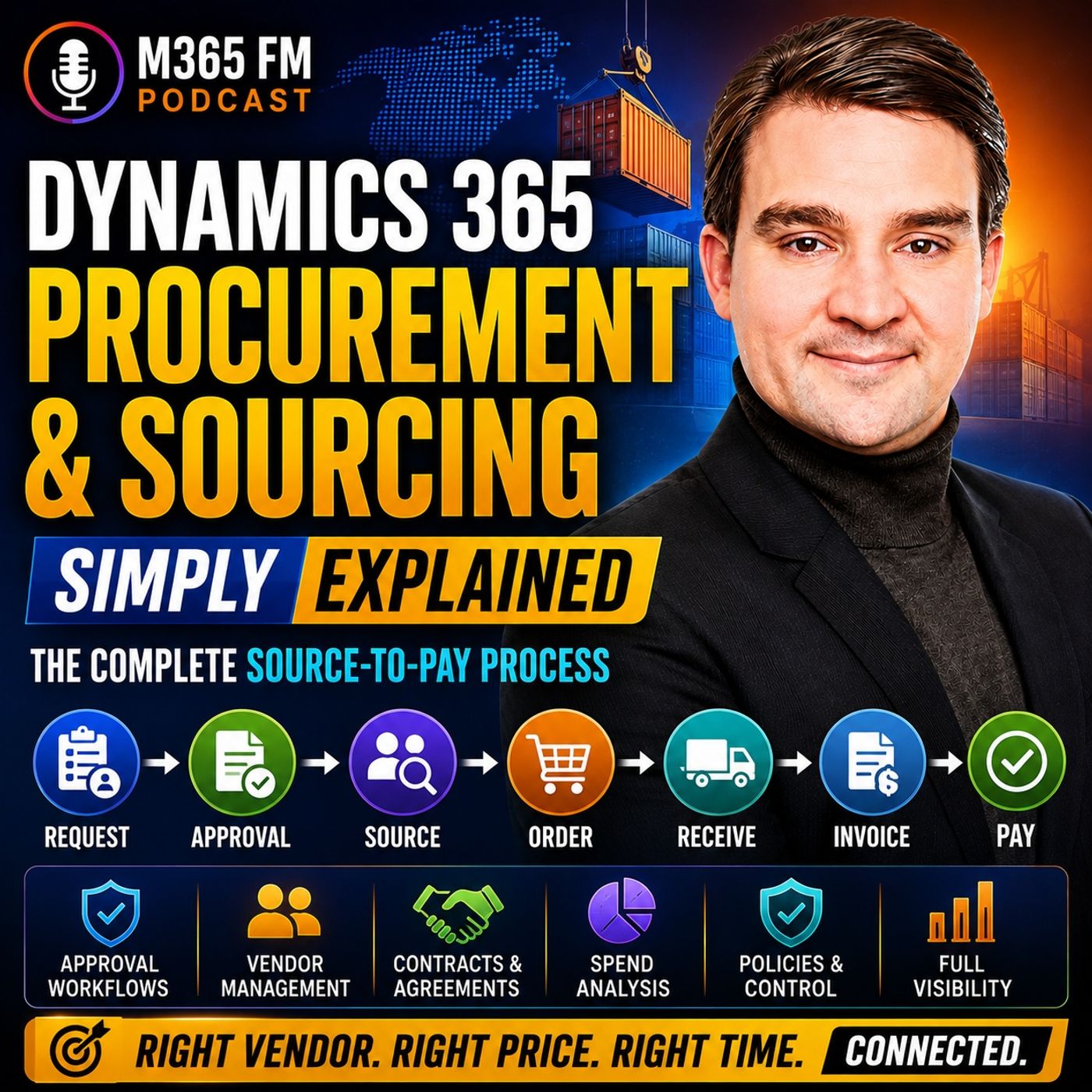
Source-to-pay describes the complete journey from identifying a business requirement to paying the supplier. The organization identifies what it needs, finds or selects an appropriate vendor, creates an order, receives the goods or services, processes the vendor invoice, and eventually pays the supplier. The individual steps aren't particularly unusual. The value comes from keeping them connected. Instead of approvals disappearing into email and invoices arriving without context, Dynamics 365 maintains the purchasing trail from the original request through payment.
DIRECT VS INDIRECT PROCUREMENT
Businesses typically purchase two broad categories of goods and services. Direct procurement covers goods or services directly connected to what the company produces or sells. A furniture manufacturer purchasing wood, screws, and fabric is buying direct materials. Indirect procurement covers products and services required to operate the business but which don't become part of the finished product. Examples include laptops, office furniture, training, repairs, cleaning, software, and legal services. Dynamics 365 can support both types while maintaining controlled purchasing processes.
PURCHASE REQUISITIONS
A purchase requisition is an internal request to buy something. An employee can specify what is required, the quantity, and potentially where the purchase should be delivered. Importantly, the requisition doesn't yet create a commitment with a vendor. That gives the organization an opportunity to review the requirement, check budgets, apply purchasing policies, and obtain the appropriate approvals before money is committed.
PROCUREMENT CATALOGS
Common purchases can begin through procurement catalogs. Think of the catalog as the organization's approved internal shopping shelf. Instead of somebody entering a vague request for "safety gloves," employees can select an approved product with an established description, supplier option, and price. Catalogs simplify purchasing for employees while helping the organization guide demand toward products and suppliers it already understands.
PROCUREMENT CATEGORIES
Not every purchase belongs in a product catalog. Organizations also purchase consulting, repairs, training, legal services, and other requirements that might not have a traditional item number. Procurement categories allow these purchases to be classified according to what the organization is buying. Examples could include safety supplies, computer equipment, professional services, building repairs, or training. This allows purchasing controls and spend analysis to work even when the purchase isn't a physical inventory item.
APPROVAL WORKFLOWS
A purchase shouldn't automatically proceed simply because somebody requested it. Dynamics 365 can use approval workflows, spending limits, purchasing policies, and budget controls to determine who needs to review a request. A small purchase might require one manager's approval. A larger expenditure could additionally require a budget owner or purchasing manager. The approval path can depend on factors such as amount, department, category, and company policy. Dynamics 365 records those approvals as part of the purchasing history.
REQUEST FOR QUOTATION
When the organization hasn't already selected a supplier, purchasing can create a Request for Quotation, commonly called an RFQ. Several vendors can receive the same requirements and provide their prices and commercial terms. One vendor might offer the lowest price but require three weeks for delivery. Another might cost slightly more but deliver next week. Dynamics 365 keeps those responses connected with the sourcing process so buyers can compare options before making a decision.
VENDOR MANAGEMENT
Vendor records contain information required for the organization's purchasing relationship with suppliers. Vendor catalogs can describe products available from particular suppliers, while approved vendor lists can identify which suppliers are permitted for specific products. This helps organizations control where employees and buyers purchase goods. Instead of choosing a supplier simply because somebody found one online, the purchasing process can guide users toward vendors the organization has already approved.
PURCHASE AGREEMENTS
A purchase agreement records longer-term commercial arrangements between the organization and a vendor. For example, the business might agree to purchase a particular quantity or spend a certain amount over an established period in return for agreed commercial terms. When purchases occur under that agreement, buyers don't need to renegotiate the complete arrangement every time. This is particularly useful for frequently purchased goods and strategic vendor relationships.
TRADE AND REBATE AGREEMENTS
Trade agreements can record vendor prices or discounts that apply during particular periods. If a supplier agrees to provide safety gloves at a discounted price for six months, Dynamics 365 can maintain that pricing arrangement. Rebate agreements address another scenario: the supplier returns money when agreed purchasing quantities or spending thresholds are reached. Together, these capabilities help organizations maintain negotiated commercial conditions within the purchasing process instead of relying on individual buyers to remember them.
THE PURCHASE ORDER
Once the organization knows what it needs and who will supply it, the purchasing decision becomes a Purchase Order, or PO. The purchase order formally describes what the organization intends to buy. It identifies the vendor, products or services, quantities, prices, delivery requirements, and payment terms. The PO becomes the central commercial record that purchasing, warehouse employees, finance teams, and the supplier can work against.
HOW PURCHASE ORDERS ARE CREATED
Purchase orders can originate from several sources. An approved purchase requisition can become a PO. A buyer can release purchases against an existing purchase agreement. Planned demand can create planned purchase orders that later become real orders. Buyers can also manually create purchase orders when they already know exactly what needs to be purchased and which supplier should provide it. Different purchasing scenarios can therefore enter the process differently while ultimately creating the same controlled purchase record.
PURCHASE ORDER APPROVAL AND CONFIRMATION
The organization can require internal approval before a purchase order becomes an external commitment. This separates two important decisions. First, the organization approves spending its own money. Then the purchase order can be confirmed with the vendor, establishing the agreed products, quantities, prices, delivery dates, and terms. This creates a clearer purchasing process than sending an order externally before the appropriate internal approval has occurred.
DELIVERY SCHEDULES
Not every purchase order arrives in one delivery. A supplier might deliver part of an order immediately and the remainder the following week. Delivery schedules allow one purchase order to contain planned deliveries across multiple dates. The organization maintains one connected purchasing record while representing what is actually expected to happen operationally.
DIRECT DELIVERY
Some purchased goods never need to enter the organization's own warehouse. With direct delivery, a supplier ships products directly to the organization's customer. Dynamics 365 can connect the customer sales order with the corresponding vendor purchase order. This eliminates an unnecessary warehouse stop while maintaining the relationship between the customer demand and the supplier fulfilling that demand.
SUPPLEMENTARY ITEMS AND CHARGES
Purchase orders can contain more than the primary item being purchased. Dynamics 365 can suggest supplementary products that may be required, optional, or included with another item. Charges such as freight and handling can also be associated with the purchase order or individual lines. This matters because the advertised product price doesn't necessarily represent the complete purchasing cost. Keeping additional charges connected to the order provides a clearer view of what the purchase actually costs.
Become a supporter of this podcast: https://www.spreaker.com/podcast/m365-fm-modern-work-security-and-productivity-with-microsoft-365--6704921/support.
🚀 Want to be part of m365.fm?
Then stop just listening… and start showing up.
👉 Connect with me on LinkedIn and let’s make something happen:
- 🎙️ Be a podcast guest and share your story
- 🎧 Host your own episode (yes, seriously)
- 💡 Pitch topics the community actually wants to hear
- 🌍 Build your personal brand in the Microsoft 365 space
This isn’t just a podcast — it’s a platform for people who take action.
🔥 Most people wait. The best ones don’t.
👉 Connect with me on LinkedIn and send me a message:
"I want in"
Let’s build something awesome 👊
Frequently Asked Questions
What is the difference between sourcing and procurement in Dynamics 365?
Sourcing focuses on finding and selecting the right vendor based on price, quality, and delivery terms. Procurement manages the actual purchasing process, including requisitions, approvals, purchase orders, receiving, and invoice matching.
What is a purchase requisition in Dynamics 365 Supply Chain Management?
A purchase requisition is an internal request made by an employee or manager to buy goods or services. It does not commit the organization to a vendor yet, allowing time for budget checks, purchasing policies, and internal approvals.
How does three-way matching work in Accounts Payable?
Three-way matching automatically compares the purchase order, the product receipt, and the vendor invoice to ensure that the company only pays for what was actually ordered and received.
What is the difference between direct and indirect procurement?
Direct procurement involves goods and services directly tied to what a company produces or sells, such as raw materials. Indirect procurement covers items needed to operate the business that do not become part of the finished product, such as laptops, cleaning services, and office furniture.
00:00:00,000 --> 00:00:02,120
What happens when someone at work needs a new laptop,
2
00:00:02,120 --> 00:00:04,760
raw materials for production or a cleaning service?
3
00:00:04,760 --> 00:00:06,720
In many companies, the old answer meant email,
4
00:00:06,720 --> 00:00:08,040
spreadsheets, paper forms,
5
00:00:08,040 --> 00:00:10,640
and somebody trying to track down an invoice weeks later.
6
00:00:10,640 --> 00:00:13,000
Welcome to another episode of Microsoft Knowledge Nuggets
7
00:00:13,000 --> 00:00:14,840
on M365, FM.
8
00:00:14,840 --> 00:00:16,440
I'm Mirko Peters, and today we are looking
9
00:00:16,440 --> 00:00:18,200
at procurement and sourcing A.O.,
10
00:00:18,200 --> 00:00:19,840
the connected processor company uses
11
00:00:19,840 --> 00:00:22,200
to buy goods and services from vendors.
12
00:00:22,200 --> 00:00:24,520
Think of it like one front desk in an office building.
13
00:00:24,520 --> 00:00:27,160
Every request, approval, order, delivery, invoice,
14
00:00:27,160 --> 00:00:29,520
and payment passes through the same place.
15
00:00:29,520 --> 00:00:31,440
We will follow one purchase all the way
16
00:00:31,440 --> 00:00:33,240
from the first request through the controls
17
00:00:33,240 --> 00:00:35,120
working behind the scenes.
18
00:00:35,120 --> 00:00:38,640
One, what procurement and sourcing actually covers?
19
00:00:38,640 --> 00:00:40,600
Procurement and sourcing might sound like a long name
20
00:00:40,600 --> 00:00:42,760
for buying things, and it is about buying,
21
00:00:42,760 --> 00:00:45,080
but the two words describe different jobs.
22
00:00:45,080 --> 00:00:47,960
Sourcing is the work of finding and choosing the right vendor.
23
00:00:47,960 --> 00:00:49,920
Think of a company that needs gloves, helmets,
24
00:00:49,920 --> 00:00:52,080
safety signs, and protective glasses.
25
00:00:52,080 --> 00:00:54,640
Before anyone places an order, someone has to decide
26
00:00:54,640 --> 00:00:57,160
who can supply the right products at an acceptable price
27
00:00:57,160 --> 00:01:00,160
by the required date under terms of the company accepts.
28
00:01:00,160 --> 00:01:01,080
That is sourcing.
29
00:01:01,080 --> 00:01:02,960
Procurement starts once the company needs
30
00:01:02,960 --> 00:01:04,400
to manage the actual purchase.
31
00:01:04,400 --> 00:01:06,880
It covers the request, the approvals, the purchase order,
32
00:01:06,880 --> 00:01:09,040
the delivery, the invoice, and the payment.
33
00:01:09,040 --> 00:01:11,800
Together, this process is called source to pay.
34
00:01:11,800 --> 00:01:13,800
The name describes the full path.
35
00:01:13,800 --> 00:01:16,640
A business identifies a need, chooses a supplier,
36
00:01:16,640 --> 00:01:19,240
sends an order, receives the goods or service,
37
00:01:19,240 --> 00:01:20,600
gets an invoice from the vendor,
38
00:01:20,600 --> 00:01:22,320
and then finance pays the vendor.
39
00:01:22,320 --> 00:01:23,800
Each step connects to the next.
40
00:01:23,800 --> 00:01:25,160
You would think that is obvious,
41
00:01:25,160 --> 00:01:28,040
but many businesses still run these steps in separate places.
42
00:01:28,040 --> 00:01:29,600
An employee sends a request by email,
43
00:01:29,600 --> 00:01:31,440
a manager approves it in a chat message.
44
00:01:31,440 --> 00:01:34,160
A buyer keeps order details in a spreadsheet.
45
00:01:34,160 --> 00:01:36,200
The warehouse checks a paper delivery note.
46
00:01:36,200 --> 00:01:37,680
Accounts payable receives an invoice
47
00:01:37,680 --> 00:01:39,160
that has no clear link to the order.
48
00:01:39,160 --> 00:01:40,960
People can still buy things that way,
49
00:01:40,960 --> 00:01:42,320
but they lose the thread.
50
00:01:42,320 --> 00:01:43,800
A buyer cannot know that the warehouse
51
00:01:43,800 --> 00:01:45,560
already received part of an order.
52
00:01:45,560 --> 00:01:47,640
Finance can end up paying the same invoice twice
53
00:01:47,640 --> 00:01:49,440
if it arrives through two different channels.
54
00:01:49,440 --> 00:01:51,160
Managers only discover the cost
55
00:01:51,160 --> 00:01:53,600
after the money has left the company.
56
00:01:53,600 --> 00:01:55,720
When someone asks who approved this,
57
00:01:55,720 --> 00:01:58,000
the answer means a long search through inboxes.
58
00:01:58,000 --> 00:02:01,360
Dynamics 365 puts that trail into one connected platform,
59
00:02:01,360 --> 00:02:04,320
procurement and sourcing lives inside Dynamics 365,
60
00:02:04,320 --> 00:02:05,520
supply chain management,
61
00:02:05,520 --> 00:02:08,400
where a company handles the movement and availability of goods,
62
00:02:08,400 --> 00:02:10,720
and it connects with finance and accounts payable
63
00:02:10,720 --> 00:02:13,240
for recording invoices, tracking what it owes,
64
00:02:13,240 --> 00:02:14,600
and processing payment.
65
00:02:14,600 --> 00:02:16,920
So purchasing does not sit alone in a corner.
66
00:02:16,920 --> 00:02:18,880
The warehouse can record that goods arrived,
67
00:02:18,880 --> 00:02:21,400
finance can see the invoice tied to that purchase,
68
00:02:21,400 --> 00:02:23,080
and accounts payable can check
69
00:02:23,080 --> 00:02:24,760
what was ordered against what arrived,
70
00:02:24,760 --> 00:02:26,800
and what the vendor built.
71
00:02:26,800 --> 00:02:28,760
Each team sees only the part they need,
72
00:02:28,760 --> 00:02:31,080
while the purchase remains one connected record.
73
00:02:31,080 --> 00:02:32,600
Now there are two types of buying.
74
00:02:32,600 --> 00:02:34,560
Direct procurement covers goods or services
75
00:02:34,560 --> 00:02:37,080
tied to what a company produces or sells.
76
00:02:37,080 --> 00:02:39,680
A furniture maker buying wood, screws and fabric
77
00:02:39,680 --> 00:02:41,200
is buying direct materials.
78
00:02:41,200 --> 00:02:42,040
Without those materials,
79
00:02:42,040 --> 00:02:43,960
it cannot build the product itself.
80
00:02:43,960 --> 00:02:45,520
Indirect procurement covers the things
81
00:02:45,520 --> 00:02:46,960
that keep the business running,
82
00:02:46,960 --> 00:02:49,560
but do not become part of the item sold AU laptops,
83
00:02:49,560 --> 00:02:51,400
office furniture, training, repairs,
84
00:02:51,400 --> 00:02:53,640
cleaning, software or legal advice.
85
00:02:53,640 --> 00:02:56,200
Both are important, but they often start in different ways.
86
00:02:56,200 --> 00:02:59,120
Production demand can tell the company it needs more parts,
87
00:02:59,120 --> 00:03:01,120
and employee can request a new monitor,
88
00:03:01,120 --> 00:03:03,600
a facilities manager can need a repair service.
89
00:03:03,600 --> 00:03:05,800
Dynamics 365 handles all these different needs
90
00:03:05,800 --> 00:03:07,760
while keeping the purchasing path clear.
91
00:03:07,760 --> 00:03:10,480
Let us use one simple example through this episode.
92
00:03:10,480 --> 00:03:12,240
Imagine a warehouse manager notices
93
00:03:12,240 --> 00:03:14,400
the team needs new safety equipment, oh,
94
00:03:14,400 --> 00:03:17,400
some helmets are damaged, the supply of protective gloves is low.
95
00:03:17,400 --> 00:03:19,240
The manager needs enough equipment for the team,
96
00:03:19,240 --> 00:03:21,960
and the company needs a clear record before money is committed.
97
00:03:21,960 --> 00:03:23,400
That purchase starts with a need,
98
00:03:23,400 --> 00:03:24,920
and every controlled purchase starts
99
00:03:24,920 --> 00:03:26,680
when someone asks for something.
100
00:03:26,680 --> 00:03:30,320
Two, from internal request to the right vendor.
101
00:03:30,320 --> 00:03:32,560
Here's how the whole buying process starts,
102
00:03:32,560 --> 00:03:34,880
your warehouse manager spots a need for safety equipment,
103
00:03:34,880 --> 00:03:37,600
and the first record created inside Dynamics 365
104
00:03:37,600 --> 00:03:39,000
is a purchase requisition.
105
00:03:39,000 --> 00:03:42,000
A purchase requisition is an internal request to buy something.
106
00:03:42,000 --> 00:03:44,960
It tells the company what a person needs, how much,
107
00:03:44,960 --> 00:03:46,720
and often where it should go.
108
00:03:46,720 --> 00:03:50,000
Notice that this request doesn't promise anything to a vendor yet.
109
00:03:50,000 --> 00:03:51,520
That distinction keeps the early part
110
00:03:51,520 --> 00:03:53,520
of buying under your company's control.
111
00:03:53,520 --> 00:03:55,640
The warehouse manager can request 20 helmets
112
00:03:55,640 --> 00:03:57,160
and several boxes of gloves,
113
00:03:57,160 --> 00:03:59,040
but no supplier receives an order
114
00:03:59,040 --> 00:04:01,080
until the right people review it.
115
00:04:01,080 --> 00:04:03,880
For common purchases, the request may start in a product catalog.
116
00:04:03,880 --> 00:04:06,240
Think of the catalog as your company's approved shopping
117
00:04:06,240 --> 00:04:06,920
shelf.
118
00:04:06,920 --> 00:04:09,640
Instead of typing a vague request like safety gloves,
119
00:04:09,640 --> 00:04:11,320
the employee can choose an approved product
120
00:04:11,320 --> 00:04:13,840
with a known description, supplier option, and price
121
00:04:13,840 --> 00:04:14,840
already attached.
122
00:04:14,840 --> 00:04:16,800
That saves time, but it also keeps people
123
00:04:16,800 --> 00:04:19,680
from buying random products that don't meet company rules.
124
00:04:19,680 --> 00:04:21,880
Not every request fits inside a catalog though.
125
00:04:21,880 --> 00:04:23,640
A company may need a one-time repair,
126
00:04:23,640 --> 00:04:25,400
a consultant training, or a service that
127
00:04:25,400 --> 00:04:26,880
isn't stored as a physical product.
128
00:04:26,880 --> 00:04:30,120
In that case, Dynamics 365 can use a procurement category.
129
00:04:30,120 --> 00:04:32,360
A procurement category group spending by what it is.
130
00:04:32,360 --> 00:04:35,240
For example, the company could use categories such as safety supplies,
131
00:04:35,240 --> 00:04:38,040
building repairs, legal services, or computer equipment.
132
00:04:38,040 --> 00:04:39,920
The requester can describe what they need
133
00:04:39,920 --> 00:04:41,560
and place it in the right category,
134
00:04:41,560 --> 00:04:43,880
even when there isn't an item number on a shelf.
135
00:04:43,880 --> 00:04:46,040
Now, a request shouldn't simply turn into a purchase
136
00:04:46,040 --> 00:04:47,640
because someone clicked submit.
137
00:04:47,640 --> 00:04:49,720
The company can set spending limits, budget checks,
138
00:04:49,720 --> 00:04:51,120
and approval workflows.
139
00:04:51,120 --> 00:04:53,960
A small request for gloves might go to the warehouse manager.
140
00:04:53,960 --> 00:04:55,760
A larger request for safety equipment
141
00:04:55,760 --> 00:04:58,200
might also need approval from the department budget owner
142
00:04:58,200 --> 00:04:59,520
or purchasing team.
143
00:04:59,520 --> 00:05:01,040
The route can change based on the amount
144
00:05:01,040 --> 00:05:02,560
the department or the purchasing rule
145
00:05:02,560 --> 00:05:03,920
tied to that type of spend.
146
00:05:03,920 --> 00:05:06,040
That means people don't need to remember
147
00:05:06,040 --> 00:05:08,440
every approval rule themselves.
148
00:05:08,440 --> 00:05:11,600
Dynamics 365 sends the request through the right path,
149
00:05:11,600 --> 00:05:14,160
while the request keeps its history inside the system.
150
00:05:14,160 --> 00:05:16,800
Suppose the manager requests a large amount of equipment
151
00:05:16,800 --> 00:05:19,760
and the company doesn't yet know which vendor should receive the business.
152
00:05:19,760 --> 00:05:23,400
Purchasing can create a request for quotation, often called an RFQ.
153
00:05:23,400 --> 00:05:26,320
An RFQ asks several vendors to bid for the same need.
154
00:05:26,320 --> 00:05:29,040
The buyer sends the requirements, such as helmet type,
155
00:05:29,040 --> 00:05:31,640
glove size, quantities, and requested delivery date.
156
00:05:31,640 --> 00:05:33,680
Each vendor can return a price and their terms.
157
00:05:33,680 --> 00:05:36,680
Maybe one vendor costs less but can't deliver for three weeks.
158
00:05:36,680 --> 00:05:39,440
Another costs a little more but can supply everything next Tuesday.
159
00:05:39,440 --> 00:05:41,560
The buyer can compare those answers before choosing.
160
00:05:41,560 --> 00:05:43,400
Price matters but it isn't the only thing.
161
00:05:43,400 --> 00:05:45,360
Delivery dates, product details, discounts,
162
00:05:45,360 --> 00:05:47,880
and the vendor out himself's ability to meet the request
163
00:05:47,880 --> 00:05:49,400
all shape the choice.
164
00:05:49,400 --> 00:05:51,400
The system keeps the bids connected to the request
165
00:05:51,400 --> 00:05:54,520
rather than leaving the comparison buried in a string of emails.
166
00:05:54,520 --> 00:05:56,240
Before a buyer selects anyone,
167
00:05:56,240 --> 00:05:59,080
Dynamics 365 also keeps vendor records.
168
00:05:59,080 --> 00:06:02,280
A vendor record contains the company details needed for purchasing,
169
00:06:02,280 --> 00:06:03,880
such as the vendor out, TM,
170
00:06:03,880 --> 00:06:06,600
as name and the information used for the business relationship.
171
00:06:06,600 --> 00:06:09,720
Vender catalogs can show the products that a vendor supplies
172
00:06:09,720 --> 00:06:13,560
and vendors can publish those catalogs to help keep the information current.
173
00:06:13,560 --> 00:06:16,720
For tighter control, a product can have an approved vendor list.
174
00:06:16,720 --> 00:06:20,240
This tells the buyer which vendors the company has approved for that product.
175
00:06:20,240 --> 00:06:23,120
It guides the choice and can stop someone from selecting a supplier
176
00:06:23,120 --> 00:06:25,200
the company never intended to use.
177
00:06:25,200 --> 00:06:28,720
Some vendor relationships also involve terms negotiated ahead of time.
178
00:06:28,720 --> 00:06:30,520
A purchase agreement records a longer term deal
179
00:06:30,520 --> 00:06:31,960
between the company and a vendor.
180
00:06:31,960 --> 00:06:34,040
The company may agree to buy a certain quantity
181
00:06:34,040 --> 00:06:36,040
or spend a certain amount over a period
182
00:06:36,040 --> 00:06:38,040
and the vendor agrees to the related terms.
183
00:06:38,040 --> 00:06:40,520
Trade agreements record vendor prices or discounts
184
00:06:40,520 --> 00:06:42,560
that apply during specific dates.
185
00:06:42,560 --> 00:06:45,120
So if the safety equipment vendor has agreed to give a lower price
186
00:06:45,120 --> 00:06:46,720
on gloves for the next six months,
187
00:06:46,720 --> 00:06:49,040
Dynamics 365 can store that arrangement
188
00:06:49,040 --> 00:06:52,160
instead of asking every buyer to remember it.
189
00:06:52,160 --> 00:06:55,680
Re-bate agreements can also track cases where a vendor pays money back
190
00:06:55,680 --> 00:06:58,360
after the company reaches a purchase amount of volume.
191
00:06:58,360 --> 00:07:00,600
By this point, the company knows what it needs,
192
00:07:00,600 --> 00:07:03,000
who can supply it and what terms apply.
193
00:07:03,000 --> 00:07:06,720
The search is over, but the vendor still needs a formal order.
194
00:07:06,720 --> 00:07:10,520
Three, the purchase order, the company out-hams written promise.
195
00:07:10,520 --> 00:07:12,760
The buyer has chosen the safety equipment vendor.
196
00:07:12,760 --> 00:07:15,680
Now the company needs a purchase order, usually called a PO.
197
00:07:15,680 --> 00:07:17,360
A purchase order is the formal document
198
00:07:17,360 --> 00:07:20,160
that tells the vendor exactly what the company intends to buy.
199
00:07:20,160 --> 00:07:22,640
It names the vendor, lists the items or services,
200
00:07:22,640 --> 00:07:24,560
shows the quantity and agreed price
201
00:07:24,560 --> 00:07:26,880
and includes the delivery date and payment terms.
202
00:07:26,880 --> 00:07:29,400
For our warehouse, the PO might list 20 helmets,
203
00:07:29,400 --> 00:07:32,400
10 boxes of gloves, and a delivery date for next Tuesday.
204
00:07:32,400 --> 00:07:34,200
It turns a buying decision into a clear record
205
00:07:34,200 --> 00:07:35,760
that both sides can work from.
206
00:07:35,760 --> 00:07:38,720
Nobody needs to guess which glove type the company asked for,
207
00:07:38,720 --> 00:07:42,400
how many units it expects, or which price the buyer agreed with the vendor.
208
00:07:42,400 --> 00:07:44,320
A purchase order can begin in several ways.
209
00:07:44,320 --> 00:07:47,160
Most often, it comes from an approved purchase requisition.
210
00:07:47,160 --> 00:07:49,400
The warehouse manager asked for the safety equipment,
211
00:07:49,400 --> 00:07:51,040
the right people approved that request
212
00:07:51,040 --> 00:07:52,880
and purchasing turns it into a PO.
213
00:07:52,880 --> 00:07:54,600
It can also come from a purchase agreement.
214
00:07:54,600 --> 00:07:57,840
If the company already arranged a longer term deal with the safety vendor,
215
00:07:57,840 --> 00:08:00,480
the buyer can create a release order against that agreement
216
00:08:00,480 --> 00:08:02,400
instead of building every detail from scratch.
217
00:08:02,400 --> 00:08:04,120
Sometimes demand creates the order.
218
00:08:04,120 --> 00:08:05,640
A company may plan to buy materials
219
00:08:05,640 --> 00:08:07,680
because it expects future production needs
220
00:08:07,680 --> 00:08:11,600
and Dynamics 365 can create planned purchase orders from that demand.
221
00:08:11,600 --> 00:08:13,320
When the company releases a planned order,
222
00:08:13,320 --> 00:08:15,160
it becomes a real purchase order.
223
00:08:15,160 --> 00:08:16,520
Then there are direct purchases,
224
00:08:16,520 --> 00:08:18,240
a buyer may create a PO manually
225
00:08:18,240 --> 00:08:20,160
when there is no earlier requisition,
226
00:08:20,160 --> 00:08:22,240
agreement, or planned demand behind it.
227
00:08:22,240 --> 00:08:24,920
This can happen when a buyer already knows what the company needs
228
00:08:24,920 --> 00:08:26,600
and which vendor will supply it.
229
00:08:26,600 --> 00:08:29,000
Different starting points, same destination.
230
00:08:29,000 --> 00:08:30,880
Before the purchase order moves forward,
231
00:08:30,880 --> 00:08:32,680
the company can require approval.
232
00:08:32,680 --> 00:08:34,160
The buyer prepares the order,
233
00:08:34,160 --> 00:08:36,240
but the order may need an internal sign off based
234
00:08:36,240 --> 00:08:39,200
on the company auto amounts rules before it reaches the vendor.
235
00:08:39,200 --> 00:08:40,400
That separates two decisions.
236
00:08:40,400 --> 00:08:42,520
First, the company approves its own commitment,
237
00:08:42,520 --> 00:08:44,720
then the company confirms the order with the vendor,
238
00:08:44,720 --> 00:08:47,640
showing that both sides have agreed on what will happen.
239
00:08:47,640 --> 00:08:49,880
A confirmed PO is more than an internal note.
240
00:08:49,880 --> 00:08:52,120
It records that the order has reached the vendor
241
00:08:52,120 --> 00:08:54,680
and an agreement exists around the purchase.
242
00:08:54,680 --> 00:08:58,600
Dynamics 365 also saves buyers from retyping the same information
243
00:08:58,600 --> 00:09:00,760
every time they order from a familiar vendor.
244
00:09:00,760 --> 00:09:02,480
The vendor record can fill in details
245
00:09:02,480 --> 00:09:04,560
such as delivery information, payment terms,
246
00:09:04,560 --> 00:09:05,760
and other usual settings.
247
00:09:05,760 --> 00:09:07,080
The buyer still checks the order
248
00:09:07,080 --> 00:09:09,600
and can change details when the situation calls for it,
249
00:09:09,600 --> 00:09:11,760
but the normal information starts in the right place.
250
00:09:11,760 --> 00:09:15,080
That reduces typing and keeps repeated orders more consistent.
251
00:09:15,080 --> 00:09:17,760
Delivery does not always happen in one box on one day.
252
00:09:17,760 --> 00:09:19,520
Imagine the vendor has all the gloves now,
253
00:09:19,520 --> 00:09:21,200
but only half the helmets are ready.
254
00:09:21,200 --> 00:09:23,680
A delivery schedule lets the company split one purchase order
255
00:09:23,680 --> 00:09:25,920
into planned deliveries across different dates.
256
00:09:25,920 --> 00:09:28,520
The PO can show that 10 helmets arrive next Tuesday,
257
00:09:28,520 --> 00:09:30,320
the remaining 10 arrive a week later,
258
00:09:30,320 --> 00:09:32,440
and the gloves arrive with the first shipment.
259
00:09:32,440 --> 00:09:34,000
One order remains connected,
260
00:09:34,000 --> 00:09:36,760
while the delivery plan matches what can actually happen.
261
00:09:36,760 --> 00:09:39,360
Some purchases never arrive at the company at all.
262
00:09:39,360 --> 00:09:41,600
Direct delivery means the vendor ships the product
263
00:09:41,600 --> 00:09:44,880
straight to the company, irutmscustomer.
264
00:09:44,880 --> 00:09:47,240
For example, a business sells a specialist item
265
00:09:47,240 --> 00:09:49,080
but does not keep it in its own warehouse.
266
00:09:49,080 --> 00:09:51,040
It can create a sales order for the customer
267
00:09:51,040 --> 00:09:53,160
and a related purchase order for the vendor.
268
00:09:53,160 --> 00:09:55,200
The vendor ships directly to the customer,
269
00:09:55,200 --> 00:09:57,840
while Dynamics 365 connects the related sales
270
00:09:57,840 --> 00:09:59,920
and purchasing steps behind the scenes.
271
00:09:59,920 --> 00:10:02,640
This avoids an unnecessary stop at the company out-hym as
272
00:10:02,640 --> 00:10:04,720
own warehouse and keeps the customer order
273
00:10:04,720 --> 00:10:06,480
and vendor order tied together,
274
00:10:06,480 --> 00:10:07,920
so people can follow the same item
275
00:10:07,920 --> 00:10:09,760
through both sides of the transaction.
276
00:10:09,760 --> 00:10:11,920
A purchase order can include more than the main item.
277
00:10:11,920 --> 00:10:13,520
Some products need related items.
278
00:10:13,520 --> 00:10:14,920
When the company orders helmets,
279
00:10:14,920 --> 00:10:18,280
it may also need replacement vises or mounting parts.
280
00:10:18,280 --> 00:10:21,400
Dynamics 365 can propose supplementary items,
281
00:10:21,400 --> 00:10:23,240
which might be required, optional,
282
00:10:23,240 --> 00:10:25,040
or included at no extra cost.
283
00:10:25,040 --> 00:10:27,560
The buyer sees the related need while building the order,
284
00:10:27,560 --> 00:10:30,320
rather than discovering it after the main shipment arrives.
285
00:10:30,320 --> 00:10:31,400
Then there are charges.
286
00:10:31,400 --> 00:10:33,760
Frate, handling, and similar costs can belong
287
00:10:33,760 --> 00:10:35,160
on the purchase order too.
288
00:10:35,160 --> 00:10:36,680
A charge may apply to the whole order
289
00:10:36,680 --> 00:10:37,880
or to a particular order line
290
00:10:37,880 --> 00:10:39,920
depending on how the company needs to record it.
291
00:10:39,920 --> 00:10:42,040
That matters because a low-product price
292
00:10:42,040 --> 00:10:45,200
does not tell the full cost if delivery adds a large fee.
293
00:10:45,200 --> 00:10:47,680
Recording the charge with the order keeps that cost
294
00:10:47,680 --> 00:10:48,800
connected to the purchase
295
00:10:48,800 --> 00:10:50,920
instead of leaving it on a separate note.
296
00:10:50,920 --> 00:10:52,720
The vendor now has a confirmed order
297
00:10:52,720 --> 00:10:55,200
with clear items, prices, dates and terms,
298
00:10:55,200 --> 00:10:56,840
but a confirmed order only records
299
00:10:56,840 --> 00:10:59,080
what the company expects to happen.
300
00:10:59,080 --> 00:11:01,080
Dynamics 365 still needs proof
301
00:11:01,080 --> 00:11:03,320
when the goods or services actually arrive.
302
00:11:03,320 --> 00:11:07,240
Four, receiving goods and checking the invoice.
303
00:11:07,240 --> 00:11:09,520
The truck pulls up to the warehouse
304
00:11:09,520 --> 00:11:10,680
with the helmets and gloves.
305
00:11:10,680 --> 00:11:12,520
Before anyone marks the order complete,
306
00:11:12,520 --> 00:11:15,480
the warehouse team needs to check what actually arrived.
307
00:11:15,480 --> 00:11:17,600
They register the arrival, compare the shipment
308
00:11:17,600 --> 00:11:18,760
to the purchase order,
309
00:11:18,760 --> 00:11:21,040
and post a product receipt against that order.
310
00:11:21,040 --> 00:11:22,920
A product receipt is simply the system out here
311
00:11:22,920 --> 00:11:24,840
Mr. Léz's record that goods showed up.
312
00:11:24,840 --> 00:11:26,400
Hero Tems, the thing.
313
00:11:26,400 --> 00:11:28,960
The PO lists 20 helmets and 10 boxes of gloves,
314
00:11:28,960 --> 00:11:30,840
but the driver delivers only 10 helmets
315
00:11:30,840 --> 00:11:32,240
and all 10 boxes of gloves.
316
00:11:32,240 --> 00:11:34,240
The warehouse posts what it actually received,
317
00:11:34,240 --> 00:11:35,800
not what the company hoped would arrive.
318
00:11:35,800 --> 00:11:38,160
The remaining 10 helmets stay open on the purchase order
319
00:11:38,160 --> 00:11:39,600
until the vendor delivers them
320
00:11:39,600 --> 00:11:40,920
or the buyer changes the order.
321
00:11:40,920 --> 00:11:42,240
That keeps the record honest.
322
00:11:42,240 --> 00:11:43,680
Once the product receipt posts,
323
00:11:43,680 --> 00:11:45,000
the purchase order changes.
324
00:11:45,000 --> 00:11:46,960
The system now separates the ordered quantity
325
00:11:46,960 --> 00:11:48,240
from the received quantity,
326
00:11:48,240 --> 00:11:50,360
so buyers, warehouse staff and finance
327
00:11:50,360 --> 00:11:52,920
can see where the order sits without calling each other.
328
00:11:52,920 --> 00:11:56,080
For stock items, receiving also updates inventory.
329
00:11:56,080 --> 00:11:57,760
The gloves appear as available stock,
330
00:11:57,760 --> 00:11:59,760
ready for the warehouse team to use.
331
00:11:59,760 --> 00:12:01,960
If the items belong to a specific project,
332
00:12:01,960 --> 00:12:04,200
a fixed asset, or a direct delivery,
333
00:12:04,200 --> 00:12:06,320
Dynamics 365 can record the purchase
334
00:12:06,320 --> 00:12:08,560
against that intended use instead.
335
00:12:08,560 --> 00:12:10,880
The company knows more than our wayboat gloves,
336
00:12:10,880 --> 00:12:12,800
how it knows whether the gloves arrived,
337
00:12:12,800 --> 00:12:15,400
how many arrived, and where they belong.
338
00:12:15,400 --> 00:12:17,800
Not every purchase reaches a loading dock though.
339
00:12:17,800 --> 00:12:20,160
Imagine the company hires a safety trainer for a day,
340
00:12:20,160 --> 00:12:21,600
pays for software access,
341
00:12:21,600 --> 00:12:23,440
or brings in an outside repair service.
342
00:12:23,440 --> 00:12:25,320
There outgums no pallet to count,
343
00:12:25,320 --> 00:12:27,560
and no warehouse arrival to register.
344
00:12:27,560 --> 00:12:29,600
For services and other non-physical purchases,
345
00:12:29,600 --> 00:12:31,360
the company can use a simpler route.
346
00:12:31,360 --> 00:12:33,080
Depending on how it sets up the purchase,
347
00:12:33,080 --> 00:12:35,240
it can register receipt on the purchase order
348
00:12:35,240 --> 00:12:36,560
without a warehouse step,
349
00:12:36,560 --> 00:12:39,480
or it can move straight to the vendor invoice.
350
00:12:39,480 --> 00:12:41,080
The same question still applies,
351
00:12:41,080 --> 00:12:44,040
did the company receive what it agreed to buy?
352
00:12:44,040 --> 00:12:45,240
For a training service,
353
00:12:45,240 --> 00:12:47,400
the answer might be that the training took place.
354
00:12:47,400 --> 00:12:50,000
For a repair, someone confirms the work is complete.
355
00:12:50,000 --> 00:12:51,760
The record does not need a box or barcode
356
00:12:51,760 --> 00:12:53,640
to prove the company received something,
357
00:12:53,640 --> 00:12:55,480
then the vendor invoice arrives.
358
00:12:55,480 --> 00:12:57,280
The invoice enters accounts payable,
359
00:12:57,280 --> 00:12:59,720
the part of Dynamics 365 that records
360
00:12:59,720 --> 00:13:02,600
what the company owes vendors and prepares payments.
361
00:13:02,600 --> 00:13:04,760
The invoice links back to the purchase order,
362
00:13:04,760 --> 00:13:06,440
so accounts payable does not treat it
363
00:13:06,440 --> 00:13:08,440
as an isolated bill with no history.
364
00:13:08,440 --> 00:13:10,880
This is where a simple check prevents a lot of trouble.
365
00:13:10,880 --> 00:13:13,160
Dynamics 365 compares three things,
366
00:13:13,160 --> 00:13:14,320
what the company ordered,
367
00:13:14,320 --> 00:13:16,600
what the company received, and what the vendor billed.
368
00:13:16,600 --> 00:13:17,840
People call this matching.
369
00:13:17,840 --> 00:13:19,920
Plain English, does the bill match the deal?
370
00:13:19,920 --> 00:13:22,920
The purchase order might show 20 helmets at an agreed price.
371
00:13:22,920 --> 00:13:26,040
The product receipt might show only 10 helmets arrived so far.
372
00:13:26,040 --> 00:13:28,200
If the vendor sends an invoice for 20,
373
00:13:28,200 --> 00:13:29,520
the system can show the difference
374
00:13:29,520 --> 00:13:30,800
before the company pays.
375
00:13:30,800 --> 00:13:32,960
That outams three way matching.
376
00:13:32,960 --> 00:13:34,880
The three records are the purchase order,
377
00:13:34,880 --> 00:13:37,000
the product receipt, and the invoice.
378
00:13:37,000 --> 00:13:40,160
When they agree, accounts payable has a clear path forward.
379
00:13:40,160 --> 00:13:42,480
When the price differs, the invoice quantity exceeds
380
00:13:42,480 --> 00:13:45,480
the received quantity, or a line appears that nobody ordered,
381
00:13:45,480 --> 00:13:47,440
the company can stop and investigate.
382
00:13:47,440 --> 00:13:49,080
Maybe the vendor sent the invoice early,
383
00:13:49,080 --> 00:13:51,040
maybe freight appeared as a separate amount
384
00:13:51,040 --> 00:13:52,560
that the buyer needs to check.
385
00:13:52,560 --> 00:13:54,600
Maybe the vendor simply typed the wrong quantity.
386
00:13:54,600 --> 00:13:56,720
The point is not to assume bad intent.
387
00:13:56,720 --> 00:13:58,640
It out means to catch a difference
388
00:13:58,640 --> 00:14:01,000
while the company can still ask a clear question,
389
00:14:01,000 --> 00:14:03,200
rather than after payment leaves the bank.
390
00:14:03,200 --> 00:14:05,360
Each invoice also needs a place in the company,
391
00:14:05,360 --> 00:14:07,800
O, TM, CS financial records,
392
00:14:07,800 --> 00:14:10,200
that euthams the job of accounting distributions.
393
00:14:10,200 --> 00:14:13,240
They tell Dynamics 365 how to record the cost.
394
00:14:13,240 --> 00:14:16,280
The safety gloves might belong to warehouse operating costs.
395
00:14:16,280 --> 00:14:19,120
A new forklift might belong to a fixed asset account.
396
00:14:19,120 --> 00:14:21,400
A project purchase might need its cost recorded
397
00:14:21,400 --> 00:14:22,480
against that project.
398
00:14:22,480 --> 00:14:25,160
One invoice can even split across more than one place.
399
00:14:25,160 --> 00:14:28,640
For example, if two warehouse teams share an order of gloves,
400
00:14:28,640 --> 00:14:31,480
the company can divide the cost between their departments.
401
00:14:31,480 --> 00:14:33,480
Finance can then see where the money went,
402
00:14:33,480 --> 00:14:35,280
without trying to rebuild that answer later
403
00:14:35,280 --> 00:14:36,960
from a vague invoice description.
404
00:14:36,960 --> 00:14:39,320
After the invoice matches and any needed checks finish,
405
00:14:39,320 --> 00:14:41,240
it can move through an approval process.
406
00:14:41,240 --> 00:14:42,880
Posting the invoice records, the amount,
407
00:14:42,880 --> 00:14:45,040
the company owes the vendor an accounts payable.
408
00:14:45,040 --> 00:14:46,240
The bill is now a payable.
409
00:14:46,240 --> 00:14:48,400
Payment terms help determine when it is due.
410
00:14:48,400 --> 00:14:51,160
Accounts payable can prepare the due invoices for payment
411
00:14:51,160 --> 00:14:53,240
and once the company processes that payment,
412
00:14:53,240 --> 00:14:56,640
Dynamics 365 clears the vendor balance for that invoice.
413
00:14:56,640 --> 00:14:58,960
The order has now moved from an expected delivery
414
00:14:58,960 --> 00:15:01,280
to a recorded cost and a completed payment.
415
00:15:01,280 --> 00:15:02,840
But this trail does more than pay one bill.
416
00:15:02,840 --> 00:15:05,080
It gives the company a usable record of every decision
417
00:15:05,080 --> 00:15:07,480
and every handoff tied to that purchase.
418
00:15:07,480 --> 00:15:10,720
Five, controls visibility and better vendor decisions.
419
00:15:10,720 --> 00:15:12,680
A connected purchase record also lets the company
420
00:15:12,680 --> 00:15:15,320
control buying before a problem reaches finance.
421
00:15:15,320 --> 00:15:17,480
Purchasing policies set the ground rules.
422
00:15:17,480 --> 00:15:19,200
They guide what employees may request,
423
00:15:19,200 --> 00:15:21,880
which vendors they can use and when a purchase needs approval
424
00:15:21,880 --> 00:15:23,600
before anyone commits company money.
425
00:15:23,600 --> 00:15:25,440
Think about the safety equipment request.
426
00:15:25,440 --> 00:15:26,920
The company might require warehouse staff
427
00:15:26,920 --> 00:15:28,360
to choose approved safety products
428
00:15:28,360 --> 00:15:31,400
while only the purchasing team can choose a new vendor.
429
00:15:31,400 --> 00:15:33,880
A small replacement order may need one approval
430
00:15:33,880 --> 00:15:36,080
but a large order for a whole new team
431
00:15:36,080 --> 00:15:38,440
may need a budget owner and a purchasing manager.
432
00:15:38,440 --> 00:15:40,080
The rules sit inside the process.
433
00:15:40,080 --> 00:15:41,280
People don't know what to do that need to search
434
00:15:41,280 --> 00:15:42,560
for a policy document.
435
00:15:42,560 --> 00:15:44,000
Guess who needs to approve something
436
00:15:44,000 --> 00:15:46,640
or forward an email until somebody replies.
437
00:15:46,640 --> 00:15:49,000
Dynamics 365 can root the request
438
00:15:49,000 --> 00:15:52,080
based on the department, the amount, the type of purchase
439
00:15:52,080 --> 00:15:53,520
or the policy attached to it.
440
00:15:53,520 --> 00:15:55,240
That root is called a workflow.
441
00:15:55,240 --> 00:15:57,600
A workflow gives requests, purchase orders,
442
00:15:57,600 --> 00:16:00,600
and invoices a clear path from one person to the next.
443
00:16:00,600 --> 00:16:02,400
Each person can approve, reject,
444
00:16:02,400 --> 00:16:04,480
or send the record back for changes
445
00:16:04,480 --> 00:16:06,760
and the system records the action.
446
00:16:06,760 --> 00:16:08,560
No more wondering whether an approval happened
447
00:16:08,560 --> 00:16:10,000
in a long email chain.
448
00:16:10,000 --> 00:16:11,560
This also helps when someone is away.
449
00:16:11,560 --> 00:16:14,560
The work does not disappear into that person out in box
450
00:16:14,560 --> 00:16:16,800
with no sign of where it stopped.
451
00:16:16,800 --> 00:16:19,200
The company can see the current step and act on it.
452
00:16:19,200 --> 00:16:20,640
Vendors can take part two
453
00:16:20,640 --> 00:16:22,600
when the company uses the vendor portal.
454
00:16:22,600 --> 00:16:25,200
The vendor portal gives a vendor a place to view requests
455
00:16:25,200 --> 00:16:27,360
for quotation or purchase orders shared with them.
456
00:16:27,360 --> 00:16:29,520
They can respond to a request for quotation
457
00:16:29,520 --> 00:16:31,440
and they can confirm an order directly
458
00:16:31,440 --> 00:16:33,600
when the company sends a confirmation request.
459
00:16:33,600 --> 00:16:36,080
That gives both sides the same document to work from.
460
00:16:36,080 --> 00:16:37,880
Instead of a buyer sending a PDF,
461
00:16:37,880 --> 00:16:38,960
then waiting for a reply,
462
00:16:38,960 --> 00:16:40,880
then typing the reply back into the system,
463
00:16:40,880 --> 00:16:42,400
the vendor can confirm the details
464
00:16:42,400 --> 00:16:43,840
through the connected process.
465
00:16:43,840 --> 00:16:45,160
The buyer can see the response
466
00:16:45,160 --> 00:16:47,040
without rebuilding the record by hand.
467
00:16:47,040 --> 00:16:48,880
Once purchases move through the system,
468
00:16:48,880 --> 00:16:50,920
the company also collects useful information
469
00:16:50,920 --> 00:16:52,840
without creating another spreadsheet.
470
00:16:52,840 --> 00:16:55,120
Spend analysis answers a simple question,
471
00:16:55,120 --> 00:16:56,680
where is the money going?
472
00:16:56,680 --> 00:16:59,120
A purchasing manager can review spending by vendor,
473
00:16:59,120 --> 00:17:01,600
product procurement category, or department.
474
00:17:01,600 --> 00:17:03,880
Maybe the company thinks it buys gloves from one supplier,
475
00:17:03,880 --> 00:17:05,480
but the records show several teams
476
00:17:05,480 --> 00:17:07,520
buying similar gloves from different vendors.
477
00:17:07,520 --> 00:17:09,600
Maybe a department spends more on outside repairs
478
00:17:09,600 --> 00:17:10,720
than expected.
479
00:17:10,720 --> 00:17:12,280
Those details give the company a reason
480
00:17:12,280 --> 00:17:14,640
to ask better questions before the next purchase.
481
00:17:14,640 --> 00:17:16,680
Vendor performance analysis looks at the vendor side
482
00:17:16,680 --> 00:17:17,880
of the same story.
483
00:17:17,880 --> 00:17:20,000
Buyers can compare purchasing and delivery results
484
00:17:20,000 --> 00:17:22,240
when they decide who should receive future orders.
485
00:17:22,240 --> 00:17:24,400
A low price on paper may not look so attractive
486
00:17:24,400 --> 00:17:26,440
if the vendor repeatedly delivers late,
487
00:17:26,440 --> 00:17:29,440
ships incomplete orders or cannot meet the agreed terms.
488
00:17:29,440 --> 00:17:31,320
The company can use its own purchase records
489
00:17:31,320 --> 00:17:33,200
when it reviews that vendor relationship.
490
00:17:33,200 --> 00:17:34,400
Then there is the audit trail.
491
00:17:34,400 --> 00:17:36,160
An audit trail lets someone trace a purchase
492
00:17:36,160 --> 00:17:37,320
through its full history.
493
00:17:37,320 --> 00:17:38,960
They can start with the original request,
494
00:17:38,960 --> 00:17:40,040
see who approved it,
495
00:17:40,040 --> 00:17:41,280
review the purchase order,
496
00:17:41,280 --> 00:17:42,800
check the receipt, find the invoice,
497
00:17:42,800 --> 00:17:44,480
and see the payment that cleared it.
498
00:17:44,480 --> 00:17:46,320
That record helps finance and audit teams,
499
00:17:46,320 --> 00:17:49,600
but it also helps ordinary people answer ordinary questions.
500
00:17:49,600 --> 00:17:50,640
Why did we buy this?
501
00:17:50,640 --> 00:17:51,520
Who chose this vendor?
502
00:17:51,520 --> 00:17:52,640
Did the goods arrive?
503
00:17:52,640 --> 00:17:54,120
Has the invoice already been paid?
504
00:17:54,120 --> 00:17:56,160
The answer sits with the purchase record.
505
00:17:56,160 --> 00:17:58,120
Go back to the office building from the start.
506
00:17:58,120 --> 00:17:59,800
The purchasing desk, the receiving dock,
507
00:17:59,800 --> 00:18:01,880
and the finance desk have different jobs,
508
00:18:01,880 --> 00:18:04,280
but they are all looking at parts of the same purchase
509
00:18:04,280 --> 00:18:06,960
instead of passing loose papers between separate rooms.
510
00:18:06,960 --> 00:18:10,200
Our warehouse manager, our TMS,
511
00:18:10,200 --> 00:18:13,480
request for helmets and gloves now has a full history.
512
00:18:13,480 --> 00:18:15,440
The request followed the company policy,
513
00:18:15,440 --> 00:18:16,920
the right people approved it,
514
00:18:16,920 --> 00:18:18,560
the vendor supplied the equipment,
515
00:18:18,560 --> 00:18:20,720
warehouse staff recorded the delivery.
516
00:18:20,720 --> 00:18:23,160
Accounts payable match the invoice and paid it.
517
00:18:23,160 --> 00:18:26,520
One simple distinction keeps all of these building blocks clear.
518
00:18:26,520 --> 00:18:29,080
Sourcing helps the company choose who to buy from
519
00:18:29,080 --> 00:18:30,840
while procurement manages what happens
520
00:18:30,840 --> 00:18:33,000
after the company decides to buy.
521
00:18:33,000 --> 00:18:36,320
Ah, conclusion, one connected record from need to payment.
522
00:18:36,320 --> 00:18:37,480
Here's the big picture.
523
00:18:37,480 --> 00:18:39,800
Procurement and sourcing takes all those scattered handoffs
524
00:18:39,800 --> 00:18:41,960
and turns them into one tracked company process.
525
00:18:41,960 --> 00:18:43,720
A request doesn't vanish into an inbox
526
00:18:43,720 --> 00:18:46,120
and approval doesn't live only in someone's memory
527
00:18:46,120 --> 00:18:48,120
and an invoice doesn't arrive without a clear link
528
00:18:48,120 --> 00:18:49,600
to the decision behind it.
529
00:18:49,600 --> 00:18:51,520
Instead, the company has one connected record
530
00:18:51,520 --> 00:18:53,400
that follows the purchase all the way through
531
00:18:53,400 --> 00:18:55,280
that gives you a clear answer when you need one.
532
00:18:55,280 --> 00:18:56,960
You can see the order as the buyer.
533
00:18:56,960 --> 00:18:58,480
The warehouse sees what's expected.
534
00:18:58,480 --> 00:19:00,360
Finance knows what the company owes
535
00:19:00,360 --> 00:19:02,640
and manages to see exactly where spending is going,
536
00:19:02,640 --> 00:19:04,840
buying still involves people, vendors, goods,
537
00:19:04,840 --> 00:19:06,560
services and decisions.
538
00:19:06,560 --> 00:19:08,600
Dynamics 365 doesn't remove those things.
539
00:19:08,600 --> 00:19:09,880
It keeps the record of them together
540
00:19:09,880 --> 00:19:12,640
so you can buy with fewer loose ends and fewer surprises.
541
00:19:12,640 --> 00:19:14,640
Subscribe on your favorite podcast platform
542
00:19:14,640 --> 00:19:15,800
and share this knowledge nugget
543
00:19:15,800 --> 00:19:17,920
with someone starting to learn Dynamics 365
544
00:19:17,920 --> 00:19:19,120
procurement and sourcing.




