
Beyond Retrieval: Implementing LLM Wikis and Advanced Memory Layers for Enterprise AI
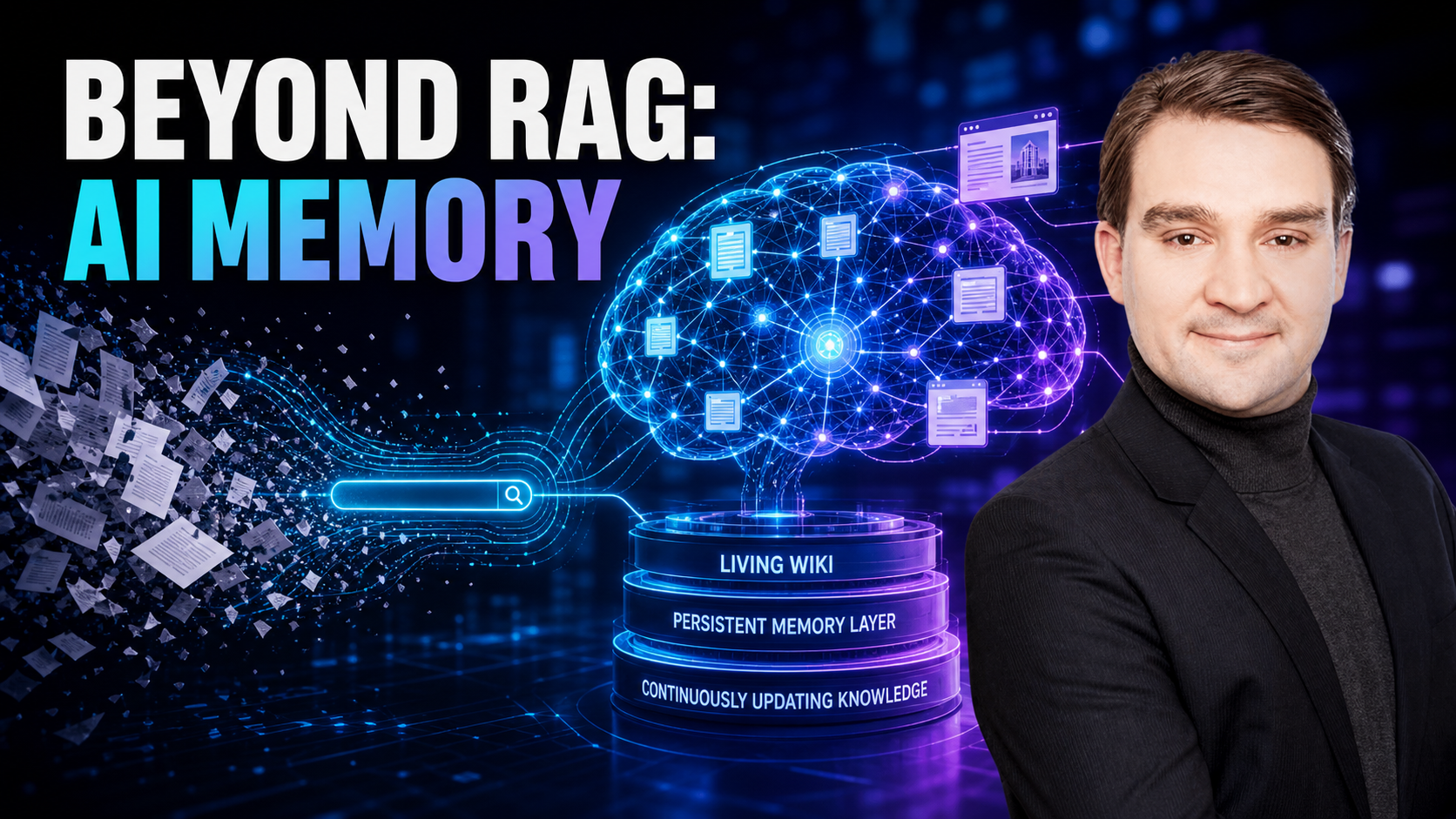
Welcome back to the podcast and our companion blog! Today, we are diving deep into a topic that has been dominating architectural whiteboards across the enterprise tech landscape: moving beyond traditional Retrieval-Augmented Generation. If you have been building generative AI solutions for your organization, you have undoubtedly hit the wall of standard RAG. You know the pain points: fragmented document chunks, lost context, hallucinations, and a profound lack of an overarching understanding of how your company actually operates.
Enterprise AI is maturing rapidly. We are no longer satisfied with chatbots that simply read a PDF and summarize a single paragraph. Organizations demand intelligent systems that reason, retain institutional knowledge, and evolve alongside the business. To achieve this, we must look at emerging paradigms like LLM Wikis and advanced memory layers. Let us unpack how these technologies work, why they are replacing traditional retrieval methods, and how you can implement them within your enterprise architecture.
Introduction: The Limits of Traditional RAG in Enterprise AI
For the past few years, Retrieval-Augmented Generation has been the gold standard for grounding Large Language Models in proprietary enterprise data. The mechanics are familiar: take a massive corpus of documents, slice them into bite-sized chunks, embed those chunks into a vector database, and perform a similarity search when a user asks a prompt. Inject the top matching chunks into the model context, and voilà—you have a system that answers questions based on your internal documentation.
However, as enterprise deployments scale, the cracks in this foundation are becoming glaringly obvious. Traditional RAG is stateless and fundamentally myopic. It treats every user query as an isolated event, searching for localized text fragments without understanding the global web of relationships that define an enterprise. If an engineer asks about a legacy microservice, traditional RAG might pull three snippets from an outdated readme file. It misses the Slack discussions, the pull request comments, the architectural decision records, and the tribal knowledge held by senior developers.
Furthermore, vector search struggles with synthesis. It excels at finding documents that use similar words to the query, but it fails miserably at connecting disparate dots across thousands of documents. The result is a brittle system that hallucinates when faced with complex, multi-hop reasoning tasks. To truly empower Microsoft AI solutions and other enterprise platforms, we need to graduate from mere retrieval to persistent, structured memory.
Understanding the Context Window and Memory Bottleneck
To understand why we need advanced memory layers, we must first look at the hardware and architectural constraints of the models themselves. Modern foundational models boast massive context windows—ranging from 128,000 tokens to upwards of a million tokens. This has led some developers to adopt a naive "stuffing" approach: why use a vector database at all when you can just drop the entire company knowledge base directly into the prompt?
The reality of production environments quickly disabuses teams of this notion. While large context windows are technologically impressive, they introduce severe economic, latency, and cognitive bottlenecks.
The Economics of Massive Contexts
Sending hundreds of thousands of tokens with every single API call or local model execution is cost-prohibitive. As the input size scales, so does inference latency. Users sitting in a corporate chat interface waiting twenty seconds for a response will quickly abandon the tool. Efficiency remains paramount in enterprise environments.
The Lost-in-the-Middle Phenomenon
Research consistently demonstrates that LLMs suffer from attention degradation when dealing with massive blocks of text. Information placed at the very beginning or the very end of a massive context window is recalled accurately, but critical details buried in the middle are frequently ignored or misinterpreted. Relying on sheer context size is not a viable strategy for long-term organizational memory.
This memory bottleneck requires a fundamental rethink. Instead of treating the AI as an amorphous search engine that reads everything anew with every prompt, we must design systems that mimic human memory—hierarchical, structured, and capable of long-term consolidation.
What is an LLM Wiki? Architectural Overview
Enter the concept of the LLM Wiki. Unlike a static vector database or a traditional human-maintained wiki (like Confluence or SharePoint), an LLM Wiki is a dynamic, self-updating knowledge repository generated, maintained, and queried by agents powered by Large Language Models.
Imagine a living knowledge base where incoming data streams—emails, transcripts, commit logs, documents, and chat messages—are continuously ingested not as raw vector chunks, but as entities and relationships. The LLM Wiki processes this incoming stream, resolves entity names, updates existing articles, creates new pages, and maintains a clean, hierarchical network of concepts.
Core Components of an LLM Wiki Architecture
Building an LLM Wiki requires a sophisticated orchestration layer. Here are the core architectural blocks:
- Ingestion and Extraction Pipeline: Unstructured and semi-structured data is parsed. Named Entity Recognition (NER) and relationship extraction models identify key business concepts, projects, people, and assets.
- Knowledge Graph Synthesis Layer: Instead of flat text chunks, extracted information is mapped into a dynamic knowledge graph. This graph tracks how concepts relate to one another across the organization.
- Autonomous Editing Agents: A background set of LLM-driven agents acts as editors and curators. They review new information, cross-reference it with the existing wiki, detect contradictions, and synthesize updates.
- Semantic and Relational Query Engine: When a user asks a question, the system traverses the knowledge graph and retrieves synthesized wiki articles rather than fragmented paragraphs.
This approach transforms messy enterprise data into a coherent, structured encyclopedia that evolves in real-time alongside your business operations.
Persistent vs. Ephemeral Memory: Shifting the Paradigm
To fully grasp the power of this shift, we must contrast ephemeral memory with persistent architectural memory.
Ephemeral memory is what happens in standard RAG and basic chat sessions. The memory exists only for the duration of the API call or the user session. Once the window closes, the context vanishes. If the user discovered a brilliant workaround to a software bug during the conversation, that insight is lost forever unless manually copied into a static document.
Persistent memory, by contrast, writes learnings back to the system core. When an LLM Wiki processes a successful troubleshooting session, it updates the relevant wiki page, ensuring that the next time any user in the organization asks about that bug, the institutional memory is instantly available.
The Lifecycle of Enterprise Knowledge
In a persistent memory model, knowledge flows through a continuous lifecycle:
- Capture: Raw interactions and documents are ingested from enterprise sources.
- Consolidation: Background processes distill raw data into abstract concepts, weeding out noise and redundant information.
- Storage: Concepts are stored within structured wiki pages and relational graphs.
- Retrieval and Application: Users and applications query the structured memory layer to drive high-accuracy decision making.
- Evolution: As policies or codebases change, the wiki pages are dynamically refactored by autonomous agents.
This shift moves enterprise AI from a stateless question-answering tool to a stateful, learning colleague.
Integrating Advanced Memory Layers into Microsoft AI Ecosystems
For organizations deeply embedded in the Microsoft enterprise ecosystem, implementing these advanced memory layers leverages powerful existing infrastructure while supercharging native AI capabilities. Tools like Azure OpenAI Service, Semantic Kernel, and Microsoft Copilot Studio provide the ideal foundation for building LLM Wikis.
Leveraging Azure OpenAI and Semantic Kernel
Semantic Kernel is an open-source SDK that lets developers easily build agents that combine LLMs with conventional programming languages. Its memory plugins and planner architectures are perfectly suited for orchestrating LLM Wikis. By combining Azure Cognitive Search with graph databases hosted on Azure Cosmos DB, enterprise architects can build robust hybrid memory systems.
Enhancing Microsoft Copilot and Extensibility
When deploying Microsoft 365 Copilot across an enterprise, users often run into limitations when querying highly specific, siloed organizational knowledge. By integrating an LLM Wiki as an advanced memory layer behind Copilot plugins, you provide the model with a synthesized, highly accurate map of internal operations. Instead of Copilot searching blindly across millions of SharePoint files, it queries the LLM Wiki, retrieving crisp, contextual, pre-digested answers.
Real-World Enterprise Use Cases and Knowledge Management
Theory is exciting, but let us look at how LLM Wikis and advanced memory layers solve tangible enterprise pain points across different departments.
Software Engineering and Technical Documentation
In large engineering organizations, documentation is notoriously out of date. Codebases change daily, while README files are updated monthly at best. An LLM Wiki connected to GitHub repositories, Jira boards, and internal communication channels automatically updates system architecture pages. When a junior developer asks an AI assistant how authentication works, it does not read a year-old architecture diagram; it reads the live, agent-curated wiki page reflecting the current microservice topology.
Customer Support and Technical Account Management
Enterprise support teams deal with complex, recurring customer issues. Traditional RAG systems pull up old support tickets, many of which contain dead ends, incorrect troubleshooting steps, or unresolved escalations. An LLM Wiki consolidates ticket histories into definitive troubleshooting guides. Agents get immediate access to verified solutions rather than sorting through pages of chat transcripts.
Human Resources and Corporate Compliance
Company policies—from expense reporting to remote work guidelines—frequently evolve. Employees often get confused by conflicting information found in old emails and outdated intranet pages. An LLM Wiki acts as the single source of truth, continuously monitored and updated by HR operations agents to ensure 100% compliance and clarity.
Implementation Strategies and Overcoming Technical Challenges
Deploying an LLM Wiki in a production enterprise environment is not without its hurdles. Architecture teams must navigate several complex technical challenges.
Managing Hallucinations in Autonomous Editors
When you give an LLM agent the autonomy to edit and update wiki pages, you run the risk of the model hallucinating false information into your core knowledge base. Mitigating this requires strict guardrails, deterministic validation scripts, and human-in-the-loop review workflows for critical enterprise domains.
Handling Access Control and Data Governance
Enterprise security is paramount. A standard vector database relies on metadata filtering to enforce role-based access control (RBAC). In an LLM Wiki where information from various sources is synthesized and merged into a single article, maintaining granular data lineage and access permissions becomes infinitely more complex. Architects must ensure that synthesized wiki pages respect the underlying security boundaries of the source documents.
Cost and Latency Optimization
Running background consolidation agents and continuous graph updates consumes compute resources and API tokens. Enterprises must implement smart caching strategies, batch processing during off-peak hours, and lightweight local models for routine entity extraction tasks to keep operational costs manageable.
Conclusion: The Future of Autonomous Enterprise Knowledge
As we look toward the future of enterprise artificial intelligence, it is clear that static Retrieval-Augmented Generation was merely the first stepping stone. To unlock true productivity, automation, and strategic reasoning, organizations must move beyond simple search and retrieval.
Implementing LLM Wikis and advanced memory layers allows businesses to transform raw, unstructured data into a living, breathing digital brain. By combining persistent storage, autonomous curation agents, and robust cloud ecosystems like those provided by Microsoft, enterprises can build AI systems that truly understand their business context, retain institutional knowledge, and scale with intelligence.
Thank you for tuning into today's deep dive. Make sure to subscribe to the podcast, share this blog post with your engineering and architecture teams, and stay tuned as we continue exploring the bleeding edge of enterprise AI implementation.

Microsoft MVP | Host of M365.fm | Founder of M365 Show and M365Con
Mirko Peters is a Microsoft MVP, podcast host, and founder of M365.fm, M365 Show, and M365Con. His work connects Microsoft practitioners through podcast interviews, livestreams, and community events.
At M365.fm, Mirko hosts conversations with Microsoft MVPs, product experts, architects, and community contributors. Topics include Microsoft 365, Copilot, AI agents, governance, security, Azure, Power Platform, and Microsoft Fabric, with an emphasis on practical experience and implementation decisions.
M365.fm is the podcast and learning platform. M365 Show brings experts together for livestreams, while M365Con provides an online conference setting for community learning.
Official website: Mirko Peters (https://www.mirkopeters.com/). Recognition: Mirko Peters — Microsoft MVP profile (https://mvp.microsoft.com/de-DE/mvp/profile/9b0ca797-db5a-493a-a845-8b9158046cf5). Connect on LinkedIn (https://www.linkedin.com/in/m365showpodcast/).




