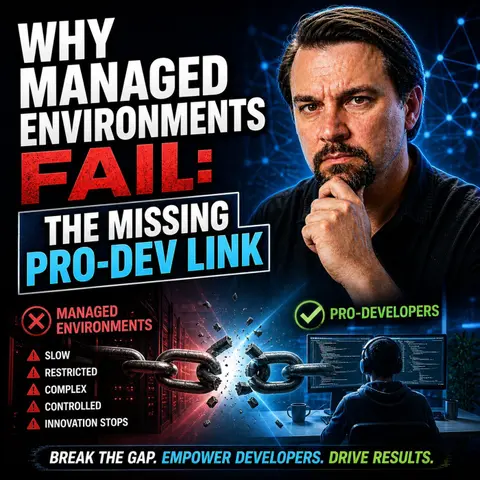
Bridging the Gap: Why Power Platform Governance Needs Professional Development Practices
Welcome back to the podcast blog! If you have been following our audio episodes, you know we frequently dive deep into the everyday friction points that IT administrators, citizen developers, and enterprise architects face. Today, we are expanding on a topic that has generated massive discussions within our community: the persistent disconnect between corporate governance policies and real-world delivery in large organizations. Many teams struggle to turn rigid compliance frameworks into agile, functioning business solutions without slowing down innovation. To solve this dilemma, organizations must look beyond traditional low-code guardrails and start adopting professional development disciplines.
In this post, we will unpack why standard governance models often fall short, how Managed Environments promise control but can inadvertently create productivity barriers, and why a dual approach combining low-code agility with pro-code rigor is essential. By embedding robust lifecycle practices like source control, automated release pipelines, and CI/CD integrations, your organization can foster innovation while keeping shadow IT at bay.
Understanding Power Platform Governance
Governance Defined
You need a clear understanding of governance to manage your Power Platform environment effectively. Governance means setting up rules, roles, and processes to keep your data, apps, and reports secure and compliant. It helps you control who can create, share, and change solutions. Good governance also supports adoption by making sure everyone knows their responsibilities and boundaries.
Here is a table that shows important aspects of Power Platform governance:
| Aspect | Description |
|---|---|
| Audit Logging | Tracks changes and access to data for compliance and reporting. |
| Compliance | Ensures your organization meets legal and industry standards. |
| Governance Framework | Defines roles for admins and users, and sets up policies for security and data governance. |
| Continuous Improvement | Uses feedback and audits to update governance practices as your needs change. |
You should also create a governance strategy that includes regular audits, a central place for training, and clear policies. This approach helps you manage risk and support innovation.
Delivery Explained
Delivery focuses on building and launching solutions that solve business problems. You and your team use Power Platform tools to create apps, automate tasks, and build BI reports. Delivery needs structure, clear roles, and a plan that matches your organization’s goals.
Here is how delivery differs from governance:
| Aspect | Governance Process | Delivery Process |
|---|---|---|
| Focus | Risk management, security, and enabling users | Structured roles and project alignment |
| Objectives | Empower users and minimize risks | Meet business goals and deliver value |
| Challenges | Overloaded IT, lack of control, slow adoption | Fast pace, unclear ownership, lifecycle management issues |
You must balance delivery speed with control. If you move too fast, you risk losing control over data and reporting. If you move too slow, you may block innovation.
Interdependencies
Governance and delivery depend on each other. You need governance to set boundaries and protect your environment. At the same time, you need delivery to drive adoption and show the value of Power Platform. When you align governance frameworks with delivery, you support both compliance and business goals.
- Governance gives you control and helps you manage change.
- Delivery brings innovation and solves real problems.
- Both need clear policies, strong data governance, and good reporting.
Tip: Involve both IT and business teams in your governance board. This helps you create policies that work for everyone and support Power BI governance and BI reporting needs.
When you connect governance and delivery, you build a strong foundation for Power Platform success. You can manage risk, support change control, and drive adoption across your organization.
The Missing Link in Governance Models
Policy vs. Practice
You often see a gap between governance policies and real-world delivery. Policies set rules for your environment, but they do not always translate into effective action. Many organizations struggle to track active makers and solutions in production. This lack of visibility leads to ungoverned solutions and weak accountability. You may find that your governance foundation does not support sustainable community growth. As a result, adoption slows and the value of the platform remains unrealized.
You can address this gap by using practical tools and workflows. For example, you might:
- Implement approval workflows for new environment requests.
- Set up formal approval processes for changes to data policies.
- Use automation kits like the CoE Starter Kit to manage requests.
- Establish workflows for user management changes.
- Review and approve governance settings regularly.
These steps help you align your governance strategy with real-world needs. You gain control over data and reporting, which supports compliance and BI governance. You also build a foundation for change control and strategic decision-making.
The Human Factor
Culture shapes how you approach governance. Your organization’s size and values influence what good governance looks like. You need to tailor your governance model to fit your unique context. Corporate culture determines how teams respond to policies and how they adopt new practices.
Consider these points:
- Governance models must match your organizational culture.
- Culture affects the effectiveness of governance.
- You should define governance based on your team’s needs and values.
When you align governance with culture, you encourage innovation and adoption. You empower teams to make decisions and share insights. This approach helps you build a strong BI community and supports power BI governance.
Note: Involve your business and IT teams in governance discussions. This creates a sense of ownership and improves adoption.
The Ghost Town Effect
You may notice the ghost town effect when initial governance measures create excitement but fail to sustain engagement. Teams start strong, but adoption drops as the platform becomes difficult to use for complex solutions. Delays and unclear ownership cause frustration. Confidence in the platform fades, and teams quietly abandon tools meant to boost productivity.
This effect leads to shadow IT, where teams move critical workloads to unmanaged systems. You lose control and visibility, making compliance and reporting harder. The ghost town effect blocks innovation and reduces the value of your environment.
To prevent this, you need a governance strategy that supports both simple and advanced workloads. You should focus on clear ownership, strong change control, and regular communication. These steps help you maintain adoption and drive BI insights across your organization.
Tip: Track key metrics like active makers and solutions in production. This gives you real insights into adoption and helps you adjust your governance strategy.
You bridge the gap between policy and practice by focusing on culture, practical workflows, and ongoing engagement. You build a sustainable environment that supports governance, delivery, and innovation.
Managed Environments: Promise vs. Reality

Control and Visibility
Managed Environments in Power Platform offer you a structured way to manage your environment. You gain tools that help you set clear policies, assign ownership, and monitor activity. This approach supports power platform governance by giving you more control and visibility over your data, apps, and users. You can break large environments into smaller, focused ones. Each environment has a clear owner, which makes accountability simple. Admin tools provide summary insights, so you can track BI usage and reporting with ease.
Here is a table that shows the main benefits of Managed Environments, as recognized by Microsoft and industry experts:
| Benefit | Description |
|---|---|
| Governance | Tools for managing Power Platform at scale with less effort. |
| Security | Enterprise-grade features like data loss prevention and access management. |
| Compliance | Standardized processes and automated data validation. |
| Innovation | Rapid innovation within a secure and controlled environment. |
| Risk Mitigation | Balances creativity with risk management for data integrity and regulatory compliance. |
You can use these features to support BI governance and power BI governance, ensuring that your organization meets compliance needs while encouraging innovation.
Productivity Barriers
You may face productivity barriers when you use Managed Environments. Sometimes, teams resist change because they worry about data loss or do not see the value in new tools. Some people think Power Platform is only for demos, not for real business solutions. Others may not have enough time or support to learn new ways of working. Leaders might not buy in, which slows adoption and makes it hard to build momentum.
Here are some common productivity barriers and ways to address them:
- IT teams may fear data loss. You can show them the strong governance and security features.
- Some users do not know what to build. Host show-and-tell sessions to spark ideas.
- Developers may worry about job security. Explain how they can add value by building APIs and custom components.
- People may not have time or training. Offer support and highlight how Power Platform saves time.
You can overcome these barriers by communicating benefits, providing training, and recognizing hard work. This strategy helps you drive adoption and build a strong BI community.
Shadow IT Risks
Shadow IT happens when teams use tools outside your approved environment. This can create risks for data security, compliance, and reporting. In large enterprises, shadow IT can account for up to 40% of IT spending. About 41% of employees use shadow IT practices, and 57% of small and medium businesses struggle with shadow technology.
You can reduce shadow IT risks by using clear governance policies and strong change control. Assign ownership, monitor BI usage, and keep communication open. When you support both business and IT teams, you build trust and keep critical workloads inside your managed environment.
Tip: Use M365.fm resources to stay updated on best practices for power platform governance, BI governance, and power BI governance. This helps you align your strategy with your organization’s goals and maintain compliance.
Dual Approach to Governance

Low-Code vs. Pro-Code Needs
You face a unique challenge when you try to balance low-code and pro-code development in your environment. Low-code tools let business users build apps quickly, while pro-code solutions require deeper engineering skills. You need a governance model that supports both approaches. Managed Environments give IT admins insight cards to monitor top makers, apps, and flows. Solution Checker tools alert you when solutions break security or performance rules. Automated ALM support helps you move solutions securely and keeps audit trails for compliance. These tools help you maintain control and quality as you scale your adoption.
| Governance Approach | Description |
|---|---|
| Managed Environments | IT admins use insight cards to monitor makers, apps, and flows for tenant hygiene. |
| Solution Checker Tool | Alerts IT about security, performance, or reliability issues before production deployment. |
| Automated ALM Support | Simplifies lifecycle management and provides visibility and audit trails for IT. |
You need to match your governance strategy to the needs of both business users and professional developers. This approach supports innovation and ensures your BI solutions meet compliance standards.
Separating Workloads
You must separate workloads to keep your environment organized and secure. Environment segmentation helps you create tiers for development, testing, staging, and production. Managed Environments apply unified policies across these tiers, supporting governance and security. Secure ALM pipelines protect your data and help you meet regulatory requirements. You should communicate with makers and users to gain support for your environment strategy. Make sure low-code developers know where to build their applications.
| Key Component | Description |
|---|---|
| Environment Segmentation | Tiered environments for development, testing, staging, and production. |
| Managed Environments | Unified policies for governance and security across all environments. |
| Secure ALM Pipelines | Regulatory compliance and collaboration without data leakage. |
- Identify if a low-code app can reduce manual work.
- Assess the risk of the low-code solution.
- Decide if the process needs stronger engineering discipline for compliance or customer commitments.
This process helps you keep BI workloads organized and supports power BI governance.
Fusion of Business and Engineering
You drive innovation when you bring business and engineering teams together. Fusion teams include business technologists, professional developers, and IT departments. You collaborate and co-develop apps using Power Apps, which bridges the gap between business and engineering. Co-development best practices reduce silos and optimize application delivery. You build a strong BI community by encouraging teamwork and sharing insights.
Tip: Form fusion teams to enhance collaboration and support BI governance. This approach helps you manage change and build solutions that meet business needs.
You create a governance model that adapts to your organization’s needs. You support adoption, maintain control, and foster innovation. This dual approach helps you build a sustainable environment for power platform governance.
Embedding Lifecycle Practices
Source Control
You need to treat your Power Platform solutions like any other software project. Source control helps you track every change, protect your work, and improve collaboration. When you use source control, you can roll back mistakes and see who made each update. This practice builds trust and keeps your environment organized.
To integrate source control into your governance model, follow these steps:
- Set up continuous integration pipelines for your solutions.
- Connect these pipelines to your source control system.
- Run the pipeline every time someone creates a pull request. This should include tests and security checks.
- Give real-time feedback on quality by showing test results in pull requests.
- Display build status with small reports or badges in your source control system.
These steps help you maintain control and support BI governance. You can see the current state of your solutions and make better decisions about adoption and change.
Release Pipelines
Release pipelines automate how you move solutions from development to production. They help you deliver updates faster and with fewer errors. You can use release pipelines to enforce policies and keep your data safe.
Here is a table that shows how release pipelines improve your Power Platform projects:
| Benefit/Feature | Description |
|---|---|
| Centralized Management | Admins can govern projects at scale with less effort, ensuring compliance. |
| Improved Productivity | Pipelines boost productivity for makers, developers, and admins. |
| Cost Efficiency | Lower total cost of ownership through streamlined processes. |
| Compliance and Safety | Secure environments with approval-based deployments and audit logs. |
| Scalability | Pipelines adapt to your business needs and support gradual ALM adoption. |
Release pipelines help you manage BI workloads and keep your environment secure. You can deliver value quickly while following your organization’s policies.
Ownership Models
Clear ownership is key for lifecycle management. You should not treat ownership as an afterthought. It forms the foundation for responsible Power Platform use. You need to make sure every app, flow, and report has a clear owner.
Follow these steps to build strong ownership models:
- Recognize that ownership is essential for governance and BI success.
- Assign co-owners for all non-personal assets. This gives you backup if someone leaves or changes roles.
- Use service accounts or application users for critical or long-running automations.
You can also use tools like the Center of Excellence Starter Kit to track ownership. PowerShell scripts help you audit and fix ownership gaps. Some organizations use Syskit Point for extra management features.
When you set up strong ownership models, you support adoption and keep your environment healthy. You also make it easier to manage BI solutions and protect your data.
CI/CD Integration
You can boost your Power Platform projects by integrating CI/CD practices. CI/CD stands for Continuous Integration and Continuous Delivery. These practices help you automate the process of building, testing, and deploying solutions. You gain faster releases, fewer errors, and better quality. You also keep your environment organized and secure.
You start by connecting your Power Platform solutions to a source control system. This system tracks every change and protects your work. You can set up pipelines that run tests and check for issues each time you update your solution. These pipelines help you catch problems early and keep your BI workloads running smoothly.
Here is a simple workflow for CI/CD integration:
- You commit your solution to source control.
- The pipeline runs tests and checks for security issues.
- You review the results and fix any errors.
- The pipeline deploys your solution to a test environment.
- You approve the deployment and move it to production.
Tip: Use automated pipelines to enforce your policies and keep your data safe. You can set rules that block deployments if tests fail or if security checks find problems.
You can use tools like Azure DevOps or GitHub Actions to build your pipelines. These tools let you automate tasks and keep your BI solutions up to date. You can also set up approval steps to make sure only trusted changes reach production. This gives you more control and helps you meet compliance requirements.
Here is a table that shows the benefits of CI/CD integration:
| Benefit | Description |
|---|---|
| Faster Releases | You deliver BI solutions quickly and respond to business needs. |
| Fewer Errors | Automated tests catch mistakes before they reach users. |
| Stronger Control | You enforce policies and protect your environment. |
| Better Quality | You improve BI solution quality with regular testing. |
| Data Security | Pipelines keep your data safe and support compliance. |
You can also use CI/CD to support change management. When you automate deployments, you reduce manual work and make it easier to track updates. You build trust in your environment and encourage teams to adopt best practices.
Note: CI/CD integration is not just for developers. Business users can benefit from automated testing and deployment. You help everyone deliver BI solutions faster and with more confidence.
You create a strong foundation for Power Platform governance when you embed CI/CD practices. You support innovation, maintain control, and protect your data. You also make it easier to enforce your policies and drive adoption across your organization.
Aligning Governance with Delivery
Collaborative Models
You can align governance with delivery by adopting collaborative models that fit your organization’s culture and user needs. Many successful companies use a mix of centralized and decentralized approaches. For example:
- Equinor blends central and local teams, letting decentralized groups develop solutions while keeping overall control.
- Zurich organizes nearly 20 teams by business unit or country, balancing governance with empowerment.
- Schlumberger supports innovation through a strong Center of Excellence, which maintains compliance and control.
These models show that you can create an environment where business and IT teams work together. You set clear policies, but you also give teams the freedom to solve problems and share insights. This approach helps you manage BI workloads and adapt to change.
Empowering Teams
Empowering both IT and business users is key to successful Power Platform governance. You can use several practical methods to support your teams:
| Method | Description |
|---|---|
| Governance-first approach | Set guardrails before adoption, creating safe boundaries for innovation. |
| Center of Excellence (CoE) | Build an operational backbone for governance, enabling faster and safer development. |
| Data Loss Prevention (DLP) | Use policies to ensure responsible and secure use of data across the platform. |
| Community of practice | Foster user enablement and training, giving citizen developers resources and support. |
You can also provide training programs, establish governance templates, and create communities of practice. These steps help you build skills, encourage collaboration, and support BI adoption. When you empower teams, you unlock new insights and drive better results.
Measuring Success
You need to measure how well your governance aligns with delivery. Tracking the right metrics gives you a clear view of progress and highlights areas for improvement. Here are some common metrics:
| Metric | Description |
|---|---|
| Incident response time | Time taken to identify and resolve issues before and after implementation. |
| Efficiency improvement | Time saved on tasks after using Power Platform solutions. |
| Revenue increase | Impact on revenue after new applications or processes go live. |
| Employee productivity | Output and time taken to complete tasks before and after implementation. |
| Total cost of ownership | All costs of owning and maintaining systems compared to Power Platform costs. |
| Employee satisfaction | Survey results and analytics before and after new system implementation. |
| Brand reputation | Public perception of your company’s products and services. |
| Employee skills and capabilities | Workforce skills and knowledge contributing to success. |
| Innovation | Ability to develop new products or services that meet market demands. |
You can use these metrics to gain BI insights and show the value of your governance strategy. Regular measurement helps you adjust your approach, maintain control, and support ongoing improvement.
Tip: Align your metrics with business goals to ensure your governance delivers real value.
In conclusion, bridging the gap between governance and delivery requires moving past rigid policies and embracing professional development practices. By adopting adaptive, dual-mode governance and embedding robust lifecycle processes, organizations can successfully eliminate shadow IT and clear operational bottlenecks. Whether you are managing environments, establishing fusion teams, or implementing CI/CD pipelines, your strategy must balance security with speed. To hear an in-depth conversation and explore these concepts further, make sure to listen to our corresponding episode, Power Platform Managed Environments Need Pro-Dev Practices. Taking these steps today will ensure your organization builds a secure, flexible, and sustainable low-code future.
🎧 Listen to this episode
Want a practical explanation of Power Platform Managed Environments Need Pro-Dev Practices? This episode breaks down the topic in clear language and shows why it matters for Microsoft 365, Azure, Power Platform, security, AI, and modern work.
Listen to this episode if you want to:
- Understand the key concepts behind Power Platform Managed Environments Need Pro-Dev Practices
- See how it fits into the wider Microsoft technology ecosystem
- Learn where it can create practical value for your organization
You may also enjoy these related M365 FM episodes:
- Azure Managed Disks - Simply Explained
- Managed Identities - Simply Explained
- Power Platform Governance Best Practices with Craig White [MVP]
- Use Managed Identity with PowerShell for Microsoft Graph
- Migrate Azure File Sync to Managed Identity
Discover more practical Microsoft conversations on M365 FM.

Microsoft MVP | Host of M365.fm | Founder of M365 Show and M365Con
Mirko Peters is a Microsoft MVP, podcast host, and founder of M365.fm, M365 Show, and M365Con. His work connects Microsoft practitioners through podcast interviews, livestreams, and community events.
At M365.fm, Mirko hosts conversations with Microsoft MVPs, product experts, architects, and community contributors. Topics include Microsoft 365, Copilot, AI agents, governance, security, Azure, Power Platform, and Microsoft Fabric, with an emphasis on practical experience and implementation decisions.
M365.fm is the podcast and learning platform. M365 Show brings experts together for livestreams, while M365Con provides an online conference setting for community learning.
Official website: Mirko Peters (https://www.mirkopeters.com/). Recognition: Mirko Peters — Microsoft MVP profile (https://mvp.microsoft.com/de-DE/mvp/profile/9b0ca797-db5a-493a-a845-8b9158046cf5). Connect on LinkedIn (https://www.linkedin.com/in/m365showpodcast/).
Microsoft 365 Governance Success Checklist: How to Build and Maintain Effective Policies