
Mastering CRUD Operations and Change Tracking in LINQ to SQL
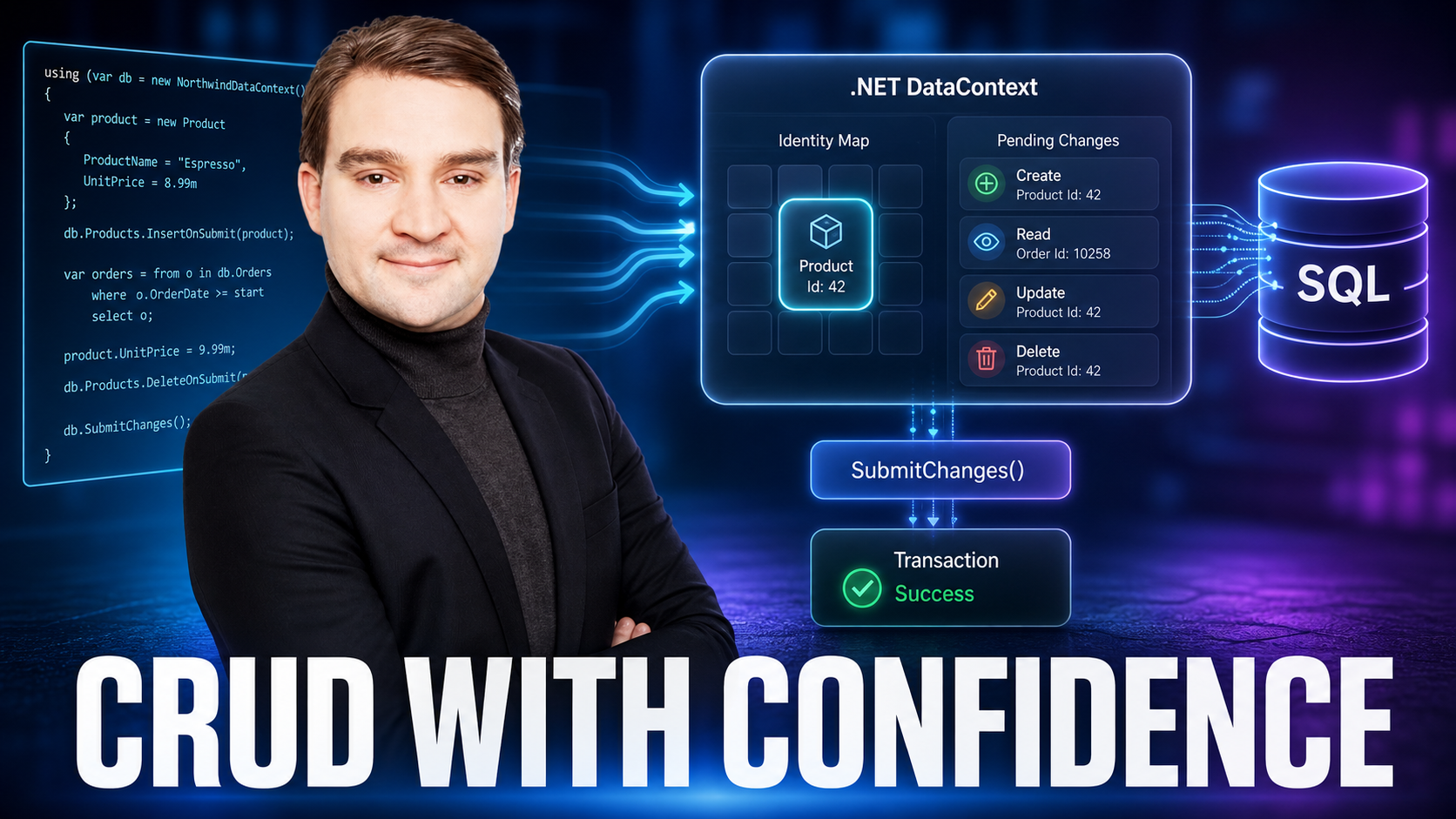
Welcome back to the podcast! Today, we are expanding on our recent discussions about data access strategies. If you want to catch up on the foundational debates surrounding database frameworks, make sure to listen to our related episode on LINQ to SQL vs EF Core for .NET Data Access. In this deep dive, we are pulling back the curtain on how the DataContext manages identity tracking, inserts, updates, and deletes to keep your database interactions efficient and safe.
Introduction to DataContext Identity Tracking
When you build robust data-driven applications in .NET, understanding how your ORM manages object identity is critical. The DataContext in LINQ to SQL acts as an identity map and change tracker. When you query a database row multiple times within the lifetime of a single context, LINQ to SQL does not create multiple duplicate object instances in memory. Instead, it maintains a reference to the exact same object instance. This built-in identity tracking prevents synchronization bugs, reduces memory overhead, and establishes the foundation for efficient change detection when it is time to submit your modifications back to SQL Server.
Managing Entity States and Change Tracking
Change tracking is the engine that drives your data manipulation workflows. As you load entities, modify their properties, or instantiate new ones, the DataContext meticulously notes every state transition. It monitors whether an object is brand new, unmodified, modified, or marked for deletion. Because the framework maintains this internal state machine, you do not have to write tedious boilerplate code to manually inspect which fields changed. When you eventually call your commit logic, the context automatically knows precisely which rows require database synchronization, ensuring that your application logic remains clean, maintainable, and remarkably concise.
Executing Inserts and Understanding State Transitions
Adding new data to your SQL Server database should feel intuitive, and LINQ to SQL accomplishes this through a clear separation between object creation and database persistence. When you want to insert a record, you instantiate your entity class, assign values to its properties, and register it with the context.
Under the hood, calling InsertOnSubmit transitions your entity into a pending insert state. The data context logs this intention without immediately firing a database command, allowing you to batch operations or coordinate multiple additions within a single unit of work. Once you invoke SubmitChanges(), the framework translates those object states into optimized SQL INSERT statements, handles primary key generation, and updates your local object graph with any database-generated values.
Handling Updates and Conflict Resolution
Updating existing records requires a balance between developer convenience and data integrity. With LINQ to SQL, updating data usually follows a simple fetch-modify-commit pattern: you query the record, alter its property values, and submit the changes. However, enterprise environments demand robust conflict resolution.
Because multiple users or threads might attempt to modify the same row simultaneously, the framework employs optimistic concurrency controls. By comparing the original values loaded by the context against the current state of the database during submission, LINQ to SQL can detect concurrency violations. If a collision occurs—meaning another process updated the record in the interim—an exception is thrown, giving your application the chance to handle concurrency conflicts gracefully rather than silently overwriting critical business data.
Safe Deletions and Maintaining Referential Integrity
Deleting records is more than just removing a row; it requires maintaining strict referential integrity across your relational database schema. LINQ to SQL provides mechanisms like DeleteOnSubmit for single entities and bulk extensions for handling multiple records simultaneously.
Before executing a delete operation, it is essential to account for foreign key constraints and dependent child tables. Deleting a parent record without handling or cascading its children will trigger database exceptions. For scenarios where historical audit trails matter, developers frequently adopt a soft-delete strategy—updating an IsDeleted flag via LINQ rather than physically removing the row—thereby preserving relational integrity while hiding inactive data from standard application queries.
Performance Optimization for CRUD Operations
Maximizing the efficiency of your CRUD operations requires deliberate optimization choices. Unoptimized change tracking or chatty database calls can quickly degrade application performance. To keep your system lightning-fast, consider the following optimization strategies:
- Limit the scope and lifetime of your
DataContextinstances to avoid memory bloat and stale cached entities. - Use projections (the
Selectclause) to retrieve only the columns you actually need, minimizing network traffic and memory allocation. - Implement server-side paging using
SkipandTakerather than loading entire tables into memory. - Leverage compiled queries for repetitive, parameterized read operations to bypass SQL translation overhead.
- Batch your operations thoughtfully and handle bulk updates or deletes when dealing with large volumes of data.
Conclusion
Mastering CRUD operations and change tracking in LINQ to SQL gives you a profound advantage when building high-performance, maintainable .NET applications. By understanding how the DataContext handles object identity, state transitions, concurrency conflicts, and performance optimizations, you can write clean C# code that translates seamlessly into efficient SQL Server commands. For a broader comparison on architectural data access choices, don't forget to listen to our companion episode on LINQ to SQL vs EF Core for .NET Data Access. Experiment with these patterns in your own projects, refine your change tracking workflows, and keep your data layer operating at peak efficiency!

Microsoft MVP | Host of M365.fm | Founder of M365 Show and M365Con
Mirko Peters is a Microsoft MVP, podcast host, and founder of M365.fm, M365 Show, and M365Con. His work connects Microsoft practitioners through podcast interviews, livestreams, and community events.
At M365.fm, Mirko hosts conversations with Microsoft MVPs, product experts, architects, and community contributors. Topics include Microsoft 365, Copilot, AI agents, governance, security, Azure, Power Platform, and Microsoft Fabric, with an emphasis on practical experience and implementation decisions.
M365.fm is the podcast and learning platform. M365 Show brings experts together for livestreams, while M365Con provides an online conference setting for community learning.
Official website: Mirko Peters (https://www.mirkopeters.com/). Recognition: Mirko Peters — Microsoft MVP profile (https://mvp.microsoft.com/de-DE/mvp/profile/9b0ca797-db5a-493a-a845-8b9158046cf5). Connect on LinkedIn (https://www.linkedin.com/in/m365showpodcast/).





