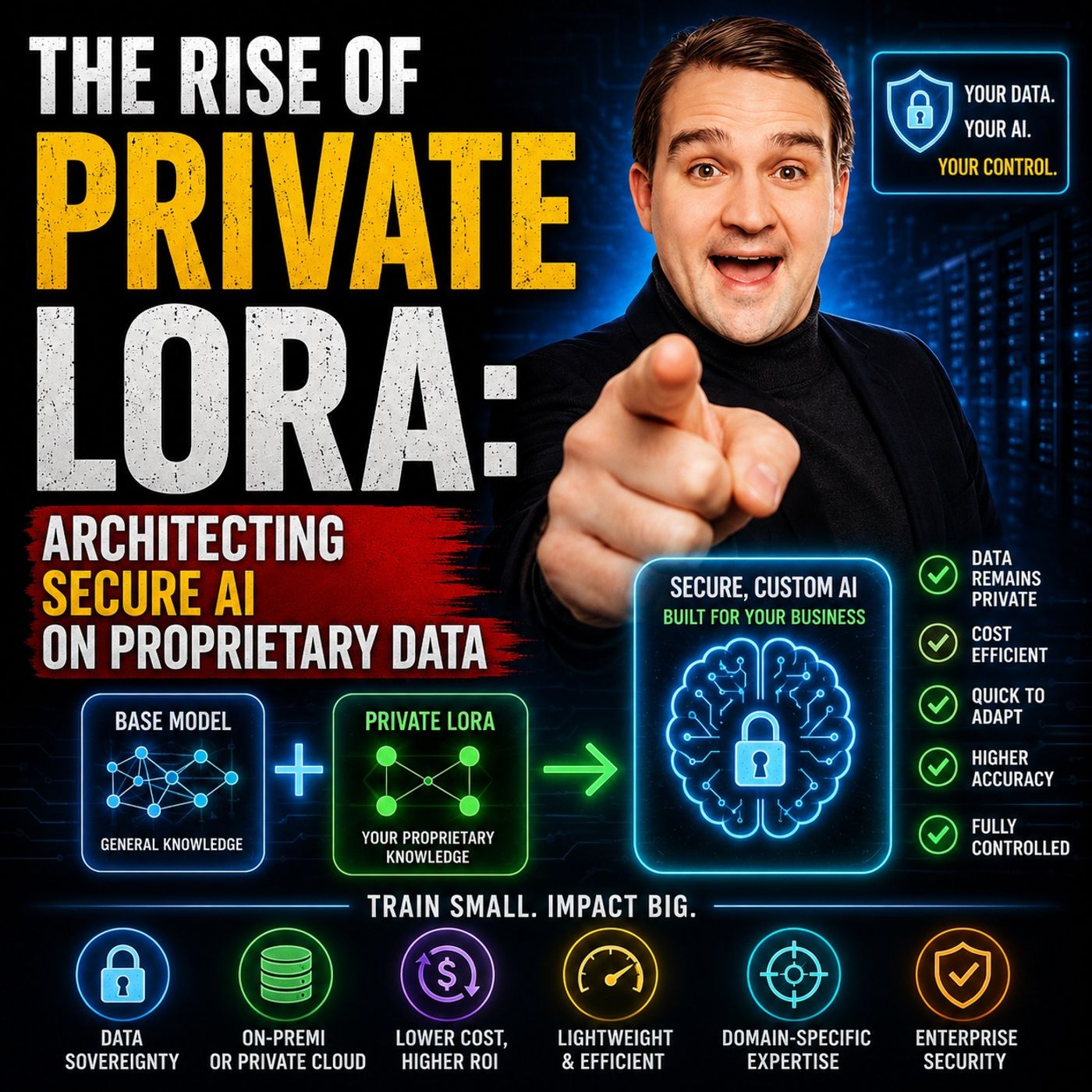
Mastering Data Sovereignty with Private LoRA in Enterprise AI
Welcome back to our ongoing exploration of enterprise artificial intelligence, data security, and modern architectural patterns. As organizations increasingly adopt generative AI to drive business value, they run into a massive roadblock: how to leverage large language models without sacrificing corporate secrets, proprietary datasets, and strict regulatory compliance. In today's landscape, data sovereignty is no longer just a technical checkbox—it is a critical legal and strategic mandate. Organizations handling confidential information need absolute guarantees that their raw inputs, fine-tuning artifacts, and metadata will not leak into public training corpora or become vulnerable to shadow AI usage.
To help unpack these challenges, we recently produced a dedicated podcast episode exploring this exact phenomenon. You can dive right into the core audio discussion by checking out the associated episode on Private LoRA for Secure AI on Proprietary Enterprise Data. In this companion blog post, we are going to expand extensively on those themes, walking through the architecture, technical foundations, real-world implementations, and security considerations required to successfully deploy Private LoRA within a modern enterprise environment.
Private LoRA for Secure AI
Why Data Sovereignty Matters
When building advanced AI systems, protecting your proprietary data is an absolute prerequisite. Data sovereignty gives you total authority over the physical location of your data, the jurisdictions it traverses, and who is permitted to access it. Industry leaders like Microsoft position solutions like Private LoRA to help enterprises meet rigorous compliance frameworks. By deploying models directly on-premises, within sovereign clouds, or at the network edge, your sensitive corporate information stays securely within your own perimeter. This strategy guarantees data locality and halts unauthorized egress.
Data sovereignty is not just a technical requirement. It is a legal and strategic necessity for enterprises that handle regulated or confidential information.
To better understand how Private LoRA enforces sovereignty at the infrastructure level, consider the following structural properties:
| Key Properties | Description |
|---|---|
| On-premise and edge deployability | You can run models on your own hardware, including private data centers and sovereign clouds. |
| Data locality and privacy | All inference and fine-tuning happen inside your network, so raw client data never leaves. |
| Data residency | Your data stays within legally required jurisdictions, helping you stay compliant. |
| No external data egress | No data goes to third-party services, so you control the flow of information. |
Physical isolation ensures that your raw information never leaves your corporate intranet, satisfying the strictest regulatory mandates across global markets.
Proprietary Data and AI Risks
Feeding proprietary data into consumer-grade or public cloud AI tools introduces severe enterprise risks. Many standard cloud AI arrangements grant providers the right to harvest user inputs and telemetry to update their foundational models. If your organization handles financial records, healthcare data, or IP-heavy codebases, risking leakage into a shared model is unacceptable.
- Dependence on a single cloud AI provider creates strategic lock-in and leaves you vulnerable to unilateral price hikes and restrictive usage policies.
- True data sovereignty guarantees your workloads remain portable. Most default cloud AI offerings lack this capability.
- Shadow AI remains a pervasive threat, with employees pasting company secrets into unsanctioned browser-based chatbots.
- Exposing sensitive records to public services can permanently embed your intellectual property into external training sets.
Data breaches involving shadow AI cost organizations millions of dollars and frequently stem from poor endpoint access controls. Recent enterprise shadow AI incidents highlight the severity of these vulnerabilities:
| Incident Description | Consequence | Date |
|---|---|---|
| Customer service AI agent leaked sensitive account data | Millions in fines and remediation costs | March 2025 |
| Replit’s AI coding agent deleted a live production database | Irreversible system damage | July 2025 |
| Slack’s AI summarization feature leaked data from private channels | Exposure of sensitive information | August 2024 |
Private LoRA eliminates these vulnerabilities by keeping all training and adaptation tightly guarded within your operational boundaries.
Technical Foundations
LoRA Basics
Organizations can adapt AI models to specific enterprise contexts utilizing LoRA technology. LoRA (Low-Rank Adaptation) bypasses the need to retrain entire multi-billion parameter models. Instead, it freezes the base weights and introduces lightweight, trainable rank decomposition matrices. This reduces the parameter footprint drastically, allowing teams to fine-tune models on modest hardware like a single GPU. It preserves the model's foundational capabilities while cleanly layering on domain-specific intelligence.
How Private LoRA Works
Private LoRA extends standard adapter training by integrating robust privacy engineering frameworks. Techniques like federated fine-tuning enable decentralized adaptation without exposing local records. Methods such as Fed-SB freeze main model adapters while transmitting only lightweight update matrices. Advanced approaches like SHE-LoRA apply homomorphic encryption to sensitive model layers, allowing secure mathematical operations over encrypted parameters.
Privacy Mechanisms
Data Isolation
Private LoRA utilizes multi-tenant isolation architectures. This ensures that even in shared server environments, distinct organizational datasets never intersect. Your data stays securely partitioned and fully under your direct administration.
Encryption and Differential Privacy
Enterprise deployments utilize layered encryption protocols, combining Network Session Keys (NwkSKey) for transport verification with Application Session Keys (AppSKey) for end-to-end data confidentiality. Coupled with differential privacy injections, these systems render reverse-engineering and membership inference attacks mathematically infeasible.
Architecture and Implementation
Deployment Models
Selecting the right deployment topology is essential for balancing security, latency, and cost.
On-Premises vs. Cloud
Organizations can choose fully isolated on-premise infrastructure, secure sovereign cloud enclaves, or hybrid models. Common implementation frameworks include:
- Outdoor gateway deployment for wide coverage zones.
- Public carrier networks for large-scale enterprise reach.
- Private dedicated enterprise networks for maximum asset control.
- Indoor gateway installations embedded within local server racks.
- Roaming extensions across trusted corporate partners.
- Hybrid architectures blending local and cloud nodes.
Private infrastructure completely removes reliance on external vendors, cutting recurring SaaS subscription expenses and keeping network traffic internally optimized.
VPC and Guardrails
Virtual Private Clouds (VPCs) combined with role-based access controls and network segmentation establish rigid perimeters around your generative AI inference nodes.
Cost and Performance
Private LoRA dramatically changes the economic equation of enterprise AI deployment.
Quantization and Efficiency
Quantization reduces the memory footprint of AI models, letting engineers run large architectures on consumer-grade or mid-tier enterprise hardware. Systems like LoRA-Inlaid enable a single frozen base model to dynamically load thousands of distinct low-rank adapters in memory without hurting system stability.
Tip: Quantization introduces negligible accuracy degradation at 8-bit precision. Always run local validation benchmarks before production deployment.
Single-GPU Use Cases
By slashing computational overhead, teams can fine-tune and run robust models on a single GPU. Here is how cost and resource requirements compare between legacy approaches and LoRA:
| Method | Cost Range |
|---|---|
| Traditional Fine-Tuning | $10,000 - $50,000 |
| LoRA with Unsloth | $300 - $1,500 |
Compliance and Governance
Meeting requirements set by the EU AI Act requires rigorous logging, data lineage tracking, and verifiable residency controls. Private LoRA's localized framework naturally supports these governance demands.
Security Model
Threat Scenarios
Security teams must account for advanced threat vectors, including membership inference attacks designed to verify if a specific proprietary record was included in training runs, alongside synthetic data backdoor audits.
Security Guarantees
Robust enterprise architectures rely on layered defense models:
- Network security authenticates endpoint devices.
- Application security isolates payloads from network operators.
- Symmetric-key cryptography safeguards communications.
- AppSKey guarantees confidentiality between client and server.
- NwkSKey ensures transmission integrity.
- AES encryption standards protect key exchange workflows.
| Security Layer | Purpose | Technology Used |
|---|---|---|
| Network Security | Device authenticity | Symmetric-key |
| Application Security | Data confidentiality | AppSKey, AES |
| Data Integrity | Message protection | NwkSKey, AES |
Mitigating Data Leakage
Mitigating leakage requires rigorous data sanitization, strict role-based access policies, differential privacy obfuscation, and routine penetration testing.
Practical Challenges
Balancing Privacy and Performance
Adding noise layers for differential privacy can occasionally impact model utility. Finding the sweet spot between strict mathematical privacy guarantees and peak inference accuracy remains a core engineering balancing act.
Integration with Existing Systems
Modern enterprises integrate Private LoRA by hosting open-weights foundation models in private VPCs and dynamically swapping adapter weights based on incoming user intent vectors at runtime.
Managing Model Drift
Combatting model drift requires scheduled retraining cycles, automated Population Stability Index (PSI) monitoring, and human-in-the-loop validation checkpoints.
Real-World Impact
Enterprise Use Cases
From industrial IoT and logistics optimization to smart facility management, organizations utilize Private LoRA to secure operational telemetry and internal knowledge bases.
Evaluation Results
Real-world implementations demonstrate massive improvements in speed, hardware efficiency, and total cost of ownership compared to legacy cloud training pipelines.
| Metric | Traditional Fine-Tuning | Private LoRA |
|---|---|---|
| Deployment Time | Weeks | Hours |
| Hardware Requirement | Multi-GPU | Single GPU |
| Cost | High | Low |
| Data Residency Control | Limited | Full |
Lessons Learned
Successful enterprise AI initiatives begin with clear data governance, cross-functional alignment between IT and legal teams, and continuous model monitoring.
Competitive Advantages
Compliance and Trust
Maintaining data localization within corporate boundaries simplifies compliance with GDPR, HIPAA, and the EU AI Act, fostering deep trust with enterprise clients.
Cost Savings
By avoiding massive full-model training runs, organizations achieve up to 100x cost efficiencies, turning expensive AI R&D into a scalable, high-margin operational capability.
Future-Proofing AI
Adopting open weights combined with localized adaptation strategies protects your business from vendor lock-in and shifting regulatory landscapes.
FAQ
What is Private LoRA?
Private LoRA is an efficient fine-tuning technique that adapts open-weights AI models on proprietary data while maintaining total data locality and security.
How does Private LoRA protect my data?
You keep your data inside your network. Encryption and privacy tools prevent leaks. You decide who can access your information.
Can I use Private LoRA on a single GPU?
Yes, low-rank adaptation drastically lowers memory requirements, making single-GPU fine-tuning fully viable for enterprise teams.
Does Private LoRA help with compliance?
| Regulation | Benefit |
|---|---|
| GDPR | Data stays local |
| EU AI Act | Full audit trails |
It ensures adherence to privacy mandates and provides transparent audit logging.
How do I integrate Private LoRA with my systems?
You connect Private LoRA to your current AI setup. You use adapters and routers to serve domain-specific responses. You keep your workflow simple.
What industries use Private LoRA?
- Healthcare
- Government
- Manufacturing
- Smart buildings
- Logistics
How often should I update my Private LoRA models?
Regular updates using fresh corporate data prevent model drift and maintain high accuracy.
Can I monitor and audit my Private LoRA deployment?
Yes, comprehensive access logging and telemetry tracking allow organizations to easily prove compliance.
🎧 Listen to this episode
Want a practical explanation of Private LoRA for Secure AI on Proprietary Enterprise Data? This episode breaks down the topic in clear language and shows why it matters for Microsoft 365, Azure, Power Platform, security, AI, and modern work.
Listen to this episode if you want to:
- Understand the key concepts behind Private LoRA for Secure AI on Proprietary Enterprise Data
- See how it fits into the wider Microsoft technology ecosystem
- Learn where it can create practical value for your organization
You may also enjoy these related M365 FM episodes:
- From Data to Intelligent Agents: Building Trusted Enterprise AI with Microsoft AI Foundry with Shubhangi Goyal [MVP]
- Private RAG Security: Authorization-Aware Data Retrieval
- Secure External Data Sharing with Power Pages and Nicholas Hayduk [MVP]
- Design an Enterprise AI Factory for GPUs, Data, and MLOps
- Secure Microsoft Fabric Data Pipelines
Discover more practical Microsoft conversations on M365 FM.
Last reviewed: July 2026.
Who Should Listen
This episode is for Microsoft administrators, architects, developers, security professionals, and business leaders who need a practical foundation before making implementation, operations, or governance decisions.
🎧 You Should Also Listen To
- Microsoft Fabric — A strongly related next step for extending this topic.
- Microsoft Fabric OneLake — A strongly related next step for extending this topic.
- Power BI Copilot — A strongly related next step for extending this topic.

Microsoft MVP | Host of M365.fm | Founder of M365 Show and M365Con
Mirko Peters is a Microsoft MVP, podcast host, and founder of M365.fm, M365 Show, and M365Con. His work connects Microsoft practitioners through podcast interviews, livestreams, and community events.
At M365.fm, Mirko hosts conversations with Microsoft MVPs, product experts, architects, and community contributors. Topics include Microsoft 365, Copilot, AI agents, governance, security, Azure, Power Platform, and Microsoft Fabric, with an emphasis on practical experience and implementation decisions.
M365.fm is the podcast and learning platform. M365 Show brings experts together for livestreams, while M365Con provides an online conference setting for community learning.
Official website: Mirko Peters (https://www.mirkopeters.com/). Recognition: Mirko Peters — Microsoft MVP profile (https://mvp.microsoft.com/de-DE/mvp/profile/9b0ca797-db5a-493a-a845-8b9158046cf5). Connect on LinkedIn (https://www.linkedin.com/in/m365showpodcast/).