Securing Intelligent Agents and Model Context Protocol Tools
Welcome back to another deep dive into the world of enterprise technology, modern work, and cloud security. If you have been following our podcast journey, you know we love breaking down complex architectural concepts into practical, actionable insights that IT professionals, developers, and business leaders can actually use. Recently, we explored foundational infrastructure topics, such as in our related episode on Azure Local - Simply Explained, where we uncovered how hybrid environments are managed and secured at the edge. Today, we are taking those core themes of governance, security, and scalability and shifting our focus to the bleeding edge of enterprise technology: artificial intelligence, autonomous intelligent agents, and the Model Context Protocol.
As organizations rapidly adopt generative AI, the number of AI-powered applications, copilots, intelligent agents, and automated workflows continues to explode. What often begins as a single experimental chatbot in a department quickly multiplies into dozens of interconnected AI services. These services talk to different large language models, enterprise APIs, internal databases, and external SaaS providers. Without centralized oversight, this rapid expansion creates a Wild West scenario characterized by fragmented security policies, inconsistent access controls, unpredictable token costs, and a complete lack of visibility. In this post, we will unpack how organizations can leverage modern tooling to secure intelligent agents, govern Model Context Protocol servers, and implement robust Zero Trust strategies.
Introduction to the Enterprise AI Security Challenge
The enterprise AI landscape is fundamentally different from traditional software ecosystems. In the past, applications communicated through rigid, deterministic API calls with predictable inputs and outputs. Today, generative AI and intelligent agents introduce probabilistic behavior. Agents can make autonomous decisions, interpret unstructured data, invoke tools, and chain multiple operations together to accomplish complex business goals. While this unlocks unprecedented productivity and automation potential, it also shatters traditional perimeter-based security models.
Consider the typical journey of an AI initiative within a modern corporation. A development team spins up a customer service bot. Shortly after, another team builds an HR copilot that queries employee records. A third team integrates an automated finance workflow that reads invoices and interacts with enterprise resource planning systems. Each of these solutions requires connectivity to foundational AI models. If every application connects directly to external AI providers or internal model endpoints, the attack surface grows exponentially. Credentials get hardcoded or scattered across configuration files, access permissions become overly broad, and security teams lose the ability to audit what data the AI is actually accessing.
Furthermore, the risks extend beyond data exfiltration and unauthorized access. Autonomous agents equipped with powerful tools can inadvertently execute destructive actions, trigger infinite processing loops, or fall victim to sophisticated prompt injection attacks. Addressing these challenges requires more than just good coding practices; it demands a dedicated architectural layer designed specifically to govern, monitor, and secure AI traffic. This is precisely where modern gateway technologies and identity management platforms intersect to form a unified defensive perimeter.
Understanding Microsoft AI Gateway and Azure API Management
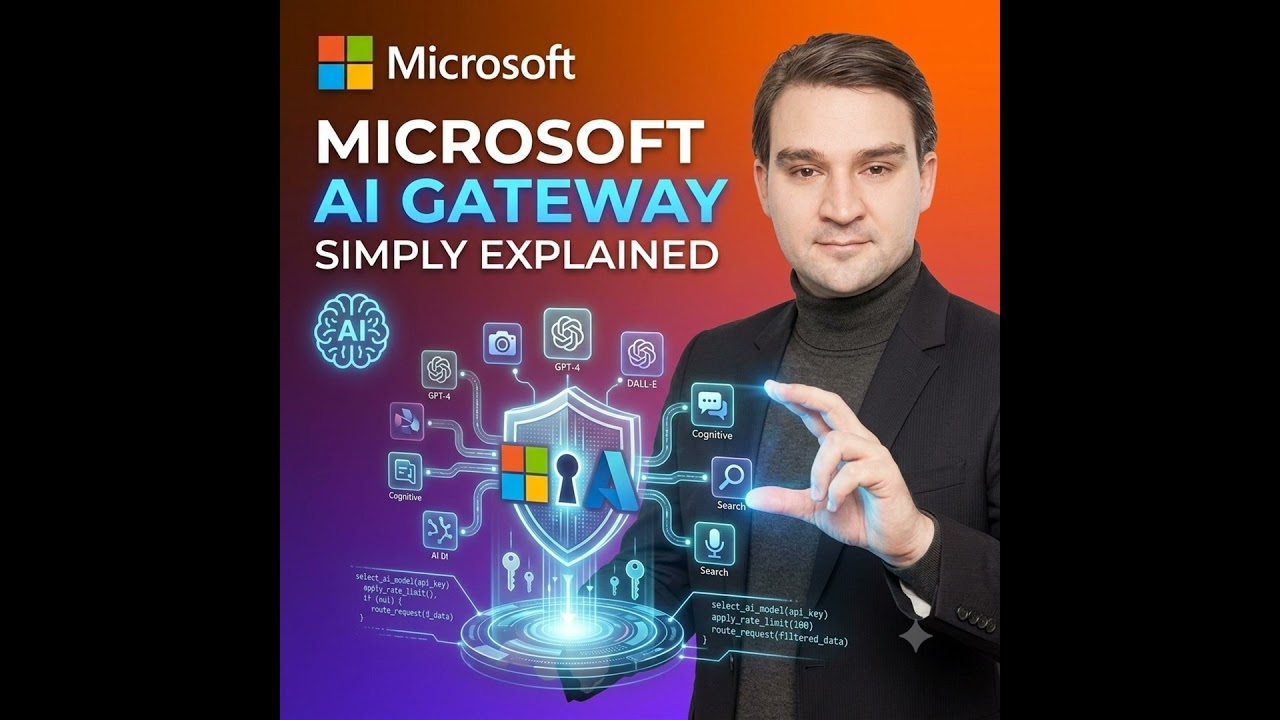
To tame the chaos of sprawling AI deployments, organizations need a centralized control plane. Enter the Microsoft AI Gateway, which extends the robust capabilities of Azure API Management to introduce centralized governance over all AI-related traffic. Rather than allowing every application, copilot, and agent to communicate directly with various model endpoints, organizations can channel all traffic through a single, highly secure, and managed entry point.
Azure API Management has long served as the gold standard for securing, publishing, and managing traditional enterprise APIs. By extending these capabilities into the realm of generative AI, Microsoft provides a unified framework where authentication, authorization, rate limiting, logging, and security policies are enforced consistently across the board. Development teams can remain focused on building brilliant intelligent business applications, while platform engineering and security teams maintain absolute control over governance, compliance, and operational standards.
One of the standout architectural benefits of this approach is the total decoupling of applications from individual AI model deployments. In a legacy setup, if an application is hardcoded to use a specific model version from a specific provider, migrating to a new model or handling a regional outage requires cumbersome code changes and deployment cycles. With the Microsoft AI Gateway, applications interact with a stable, abstracted endpoint. The gateway intelligently routes requests behind the scenes to Azure OpenAI, Microsoft Foundry, Anthropic, Google Gemini, Amazon Bedrock, or any other approved model provider. This gives enterprise architects the flexibility to balance workloads across multiple regions, optimize operational costs, implement seamless failover strategies, and adopt newer, more efficient models without ever disrupting the underlying application code.
Securing Model Context Protocol (MCP) and Agent-to-Agent Communication
As intelligent agents evolve from answering static questions to taking active steps within business environments, the mechanisms they use to interact with data must also mature. This brings us to the Model Context Protocol, commonly known as MCP, and the rising phenomenon of Agent-to-Agent (A2A) communication. MCP provides a standardized way for AI models and agents to securely connect with external data sources, enterprise tools, and APIs.
However, opening up pathways for agents to interact with HR systems, financial databases, and customer records introduces massive security implications. If an intelligent agent can execute database queries or invoke backend APIs, what prevents a malicious user from manipulating the agent via prompt injection to extract sensitive payroll records or modify customer accounts? Securing MCP servers and A2A communication requires rigorous validation at every single step of the interaction chain.
The Microsoft AI Gateway steps in to provide centralized governance for MCP servers and agent interactions by acting as an enforcement point for identity, authorization, and content safety. When an agent attempts to invoke an MCP tool or communicate with another specialized agent, the request passes through the gateway. Here, the system inspects the payload, validates the caller's credentials, evaluates content safety policies to block malicious prompts or data leaks, and ensures that the requested operation complies with organizational compliance mandates. This architectural rigor ensures that agents can collaborate and utilize tools effectively without compromising the integrity of the broader enterprise ecosystem.
Applying Zero Trust Principles and Microsoft Entra ID to Intelligent Agents
In the era of autonomous agents and distributed AI systems, the traditional corporate perimeter is effectively obsolete. Organizations must operate under the core tenet of Zero Trust: never trust, always verify, and assume breach. When applied to artificial intelligence, Zero Trust means that no intelligent agent, copilot, or model endpoint should be granted implicit access to data or systems simply because it resides within the corporate network.
Integrating Microsoft Entra ID with the Microsoft AI Gateway brings enterprise-grade identity and access management directly to the AI tier. Instead of relying on static API keys that can be easily leaked or compromised, every AI agent, service, and application is assigned a distinct, cryptographically secure identity using Microsoft Entra ID managed identities.
Through fine-grained role-based access control (RBAC) and attribute-based access control (ABAC), security teams can enforce the principle of least privilege. Every AI agent receives only the absolute minimum permissions required to perform its specific assigned task. For instance, a customer support agent may be granted permission to read product catalogs and view basic shipping statuses, but it will be strictly barred from accessing financial ledgers or employee HR files. Combined with continuous access evaluation, Conditional Access policies, and strict token validation, this identity-driven security model ensures that even if an agent is compromised, the blast radius is tightly contained and immediate remediation actions can be taken.
Managing Token Costs, Performance, and AI Observability
Securing intelligent agents is only half the battle; organizations must also manage the operational realities of running large-scale AI workloads. Unlike traditional software, which typically incurs fixed infrastructure or per-seat licensing costs, generative AI introduces variable consumption expenses driven entirely by token usage. Without proactive monitoring and governance, token costs can spiral out of control overnight due to inefficient prompt engineering, runaway agent loops, or unoptimized model selection.
The Microsoft AI Gateway provides sophisticated financial and operational controls to keep these expenses in check. Platform teams can implement request throttling, daily token budgets, quotas, traffic prioritization, and semantic caching. Semantic caching is particularly powerful; if multiple users or agents ask similar questions, the gateway can return the cached response instantly without invoking the underlying model, drastically reducing both latency and token consumption.
Equally important is the concept of AI observability. Traditional application performance monitoring tools often lack the context needed to debug AI interactions. The gateway logs comprehensive metadata for every single AI request, including the calling application, the selected model, exact token consumption counts, response status codes, execution latency, and the specific tool executions triggered by agents. This deep observability empowers platform teams to identify poorly optimized prompts, detect anomalous consumption patterns that may indicate a security breach, optimize model routing based on cost-to-performance ratios, and accurately charge back AI operational expenses to the respective business units consuming the resources.
Building a Scalable and Secure Foundation for Enterprise AI
As we look toward the future of enterprise technology, it is clear that artificial intelligence will continue to weave itself into the fabric of daily business operations. However, sustainable AI adoption cannot be achieved through ad-hoc integrations and scattered security policies. It requires a strategic, unified foundation that balances rapid innovation with unyielding security and compliance.
The Microsoft AI Gateway is not just another AI model or agent-building framework; it is the essential governance layer that makes enterprise-scale AI safe, manageable, and cost-effective. By intelligently combining Azure API Management, Microsoft Entra ID, Azure AI Foundry, Model Context Protocol tools, Agent-to-Agent communication protocols, robust content safety filters, and comprehensive telemetry, organizations unlock a powerful architecture designed for the future.
For organizations currently navigating their AI journey, the best approach is to start small. Begin with a single managed workload, establish clear governance and Zero Trust policies from day one, and gradually expand toward a standardized enterprise AI platform. By doing so, you ensure that your organization remains agile, innovative, and secure in an increasingly intelligent world.
Be sure to check out our related podcast episode on Azure Local - Simply Explained to learn more about how Microsoft technologies are empowering secure, hybrid cloud architectures across the enterprise. Until next time, keep innovating securely!

Founder of M365 Show, M365con.net & m365.fm
Mirko Peters is a Microsoft 365 expert, content creator, and founder of m365.fm, a platform dedicated to sharing practical insights on modern workplace technologies. His work focuses on Microsoft 365 governance, security, collaboration, and real-world implementation strategies.
Through his podcast and written content, Mirko provides hands-on guidance for IT professionals, architects, and business leaders navigating the complexities of Microsoft 365. He is known for translating complex topics into clear, actionable advice, often highlighting common mistakes and overlooked risks in real-world environments.
With a strong emphasis on community contribution and knowledge sharing, Mirko is actively building a platform that connects experts, shares experiences, and helps organizations get the most out of their Microsoft 365 investments.