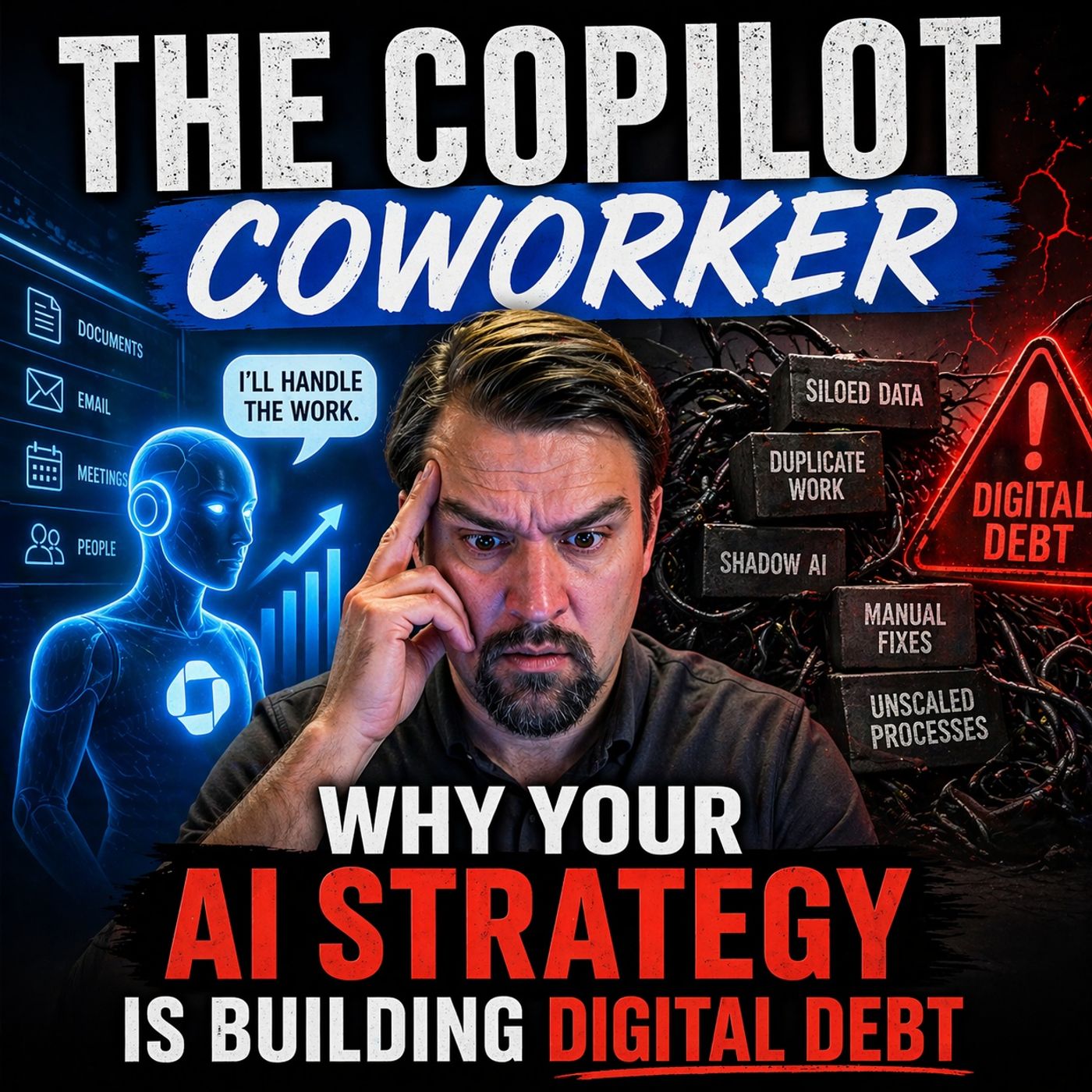
The Illusion of Output: Why Microsoft Copilot Is Fueling the AI Productivity Paradox
Welcome back to the podcast blog! If you have been following our recent conversations, you know we love diving deep into the intersection of modern work, artificial intelligence, and the enterprise ecosystem. Today, we are expanding on a phenomenon that is quietly keeping CIOs and team leaders awake at night. We are talking about the illusion of output and why introducing tools like Microsoft Copilot might actually be fueling a massive productivity paradox in your organization. If you want to hear our audio deep-dive on this exact phenomenon, make sure to check out our companion episode, How Microsoft Copilot Creates Digital Debt.
Let us look at the reality on the ground. Statistics show that an overwhelming 81% of office workers genuinely believe that artificial intelligence enhances their personal performance. Furthermore, AI chatbots and assistant tools regularly claim to save users anywhere from 64% to 90% of task time. Yet, when executive leadership looks at the bottom line, those dramatic time-savings rarely translate into higher corporate earnings or increased win rates. In fact, only a tiny fraction of perceived productivity improvements make it to the financial ledger. Why is there such a massive chasm between high-volume output metrics and real business outcomes? Let us break it down.
The AI Productivity Paradox
Illusion of Output Gains
When you first introduce AI tools into your daily workflow, the immediate visual is striking. Your team is generating documents, synthesizing emails, and writing code at three times the normal speed. This surge in throughput creates a powerful impression of efficiency. However, research from institutions like the MIT Media Lab demonstrates that these localized gains can be entirely misleading. Organizations often measure success by sheer volume—the number of deliverables produced per hour. But when win rates, customer satisfaction scores, and project cycle times stay completely flat or even decline, you are caught firmly in the AI productivity paradox.
Users frequently fall victim to automation bias, blindly trusting AI-generated suggestions without applying rigorous skepticism. This overreliance quietly erodes independent reasoning and professional judgment. By absorbing advanced language models straight into legacy workflows without altering the underlying processes, companies inadvertently reinforce old habits. The result is a shiny, high-tech facade of productivity rather than genuine operational transformation.
The 3x Productivity Trap
The 3x Productivity Trap occurs when your technology stack triples the volume of generated content, but your decision-making processes grind to a crawl. You find yourself buried beneath unverified summaries, synthetic meeting transcripts, and sprawling digital artifacts. More information does not inherently equal faster or better choices. While communication cycles speed up, more than 40% of enterprise AI initiatives fail to deliver their expected business value simply because organizations treat intelligent coworkers like simple search bars instead of strategic workflow partners.
Digital Debt in the Workplace
Digital debt accumulates rapidly when you adopt generative platforms without establishing clear architectural governance. This debt manifests as unverified documentation, frequent functional rework, and cognitive atrophy. Recent workplace studies indicate a troubling negative correlation between heavy, unmonitored AI usage and long-term critical thinking abilities. Without robust training and deliberate oversight, teams trade deep expertise for superficial speed, creating a massive structural liability.
| Measurable Impact | Description |
|---|---|
| Erosion of Critical Thinking Skills | Studies show a negative correlation between heavy AI usage and independent problem-solving abilities. |
| Increased Reliance on AI | Overreliance on automated suggestions leads to diminished domain expertise over time. |
| Functional Rework | High rates of rework arise directly from inadequate onboarding and unverified AI outputs. |
AI Strategy: Hidden Symptoms
Beneath the optimistic metrics reported in quarterly software reviews, hidden organizational symptoms often threaten long-term success. Recognizing these warning signs early allows leaders to pivot before morale and performance take a permanent hit.
Context Loss
Knowledge Erosion
Relying on decentralized tools without a unified strategy introduces severe context loss. Knowledge erosion happens when essential background details vanish as employees bounce between disparate applications or delegate tasks blindly. Over time, this fragmentation cripples your team's institutional memory.
Communication Gaps
Toggling constantly between applications drains cognitive energy and fractures team focus. The average digital worker switches tools thousands of times a week, spending precious hours simply reorienting themselves after every disruption.
Technical Debt
Automation Overload
Adding modern software layers without deprecating outdated legacy workflows creates severe technical complexity. Rather than streamlining operations, automation overload forces developers and staff to spend more hours maintaining systems and less time innovating.
Legacy Friction
When cutting-edge models collide with brittle, outdated enterprise platforms, friction is inevitable. Employees struggle to bridge the gap between old procedures and new tools, leading to adoption drop-offs and widespread user frustration.
Employee Disengagement
Reduced Ownership
When automated assistants drive the bulk of daily deliverables, workers can experience a dangerous sense of detachment. Reduced personal ownership saps internal motivation and degrades a healthy culture of professional accountability.
Skill Atrophy
When workers stop exercising their core competencies because an algorithm provides instant answers, skill atrophy sets in. Alarmingly, significant numbers of employees report that poorly integrated AI initiatives actually increase their overall workload rather than alleviating it, accelerating burnout.
Root Causes of Productivity Loss
Flawed AI Strategy
Adopting technology simply to chase industry trends creates a dangerous strategy vacuum. When tools are deployed for non-core issues without clearly defined Key Performance Indicators (KPIs), companies run headfirst into AI-solutionism. Automating tasks that add zero strategic value only generates cognitive clutter.
Human Factors
Workplace transformation relies heavily on human empathy, collaborative intuition, and emotional connection—elements that algorithms simply cannot replicate. Unproductive pseudo-work drains human attention spans, accelerating cognitive erosion and diminishing the quality of complex decisions.
Organizational Gaps
Siloed data architectures, broken communication pathways, and misaligned departmental priorities form massive barriers to effective technology integration. Localized performance improvements often create enterprise-wide bottlenecks if structural workflows remain unaddressed.
Measuring Productivity in the AI Era
Output vs. Real Productivity
A spike in the volume of emails, chat messages, and auto-generated reports does not mean your business is performing better. Real productivity is measured by strategic outcomes, resilient customer relationships, and quality decision-making—not by the sheer weight of digital output.
Key Metrics
To evaluate your digital transformation accurately, you must shift your measurement framework away from raw volume and toward meaningful impact indicators:
- Decision quality and problem-solving resilience.
- Project cycle times from conception to final delivery.
- Employee engagement and cultural sentiment scores.
- Task relevance and alignment with core organizational goals.
- Error rates and the frequency of functional rework.
- Data accuracy and institutional knowledge retention.
Feedback Loops
Closing the loop between employee experience and technical deployment is essential. Actively gathering internal feedback allows leadership to spot disengagement trends early, refine operational workflows, and build lasting organizational trust.
Disengagement and Workforce Impact
Rapid technological shifts without proper change management can deeply unsettle a workforce. When roles become ambiguous and teams struggle to understand how algorithms impact their job security, employee disengagement spikes. Furthermore, management burnout compounds the issue, with a vast majority of global workers reporting feeling fundamentally unengaged at work.
Knowledge transfer breaks down when insights remain trapped within isolated silos or inside individual heads. Without deliberate knowledge management, companies face severe leadership pipeline risks. Traditional supervisory competencies must evolve toward human-centric oversight, ethical auditing, and strategic mentoring.
Solutions: Rethinking AI Strategy
Context Capture
To combat context loss, organizations must audit their workflows, establish minimum viable documentation rules, and build knowledge graphs that explicitly link project requirements, human decisions, and final implementations.
Governance and Coworking Norms
Establishing rigorous governance frameworks and clear coworking norms ensures that autonomous tools operate within secure compliance guardrails. Setting explicit expectations around output validation protects your enterprise from security vulnerabilities.
Human-in-the-Loop
Maintaining human expertise throughout the entire lifecycle of a project ensures that systems remain adaptable and ethical. Studies show that when users treat assistants as collaborative learning partners rather than final authorities, overall problem-solving performance scales dramatically.
Strategic Learning
Personalized development pathways and continuous upskilling programs ensure your team stays resilient. Cultivating an agile culture where employees share insights and adapt swiftly to new capabilities prevents skill atrophy and drives true innovation.
Realigning for Sustainable Productivity
Balancing Automation and Human Value
Sustainable productivity requires deliberate curation. Reserve automated tools for predictable, high-volume operational tasks, while fiercely protecting the workflows that demand human judgment, empathy, and creative problem-solving.
Investing in Workforce Development
Forward-thinking enterprises reinvest the efficiency gains from automation directly into comprehensive employee training programs. Cultivating core digital skills across your entire workforce raises the organizational ceiling rather than simply trimming the operational floor.
Leadership’s Role
Leaders must transition from managing raw output to auditing system behaviors. By leveraging integrated compliance tools like Microsoft Purview alongside Microsoft Copilot, administrators can enforce strict data retention policies, monitor compliance in real time, and protect sensitive organizational assets while encouraging safe innovation.
FAQ
What is the main risk of using AI without a clear strategy?
You risk generating vast amounts of unverified pseudo-work that increases digital noise without improving core business outcomes or profitability.
How can AI increase digital debt in your workplace?
When teams accept unverified content and synthetic summaries without proper review, errors and disorganized artifacts accumulate, slowing down future decision-making.
Why do some teams feel less engaged after adopting AI?
Over-automation can detach workers from core responsibilities, making their daily contributions feel less meaningful and reducing professional ownership.
How do you measure real gains from AI tools?
Focus on decision quality, error reduction, cycle times, and employee alignment rather than simple volume metrics like document counts or message frequency.
What steps help you avoid skill loss when using AI?
Actively maintain human-in-the-loop review processes, encourage critical thinking, and treat AI as a collaborative assistant rather than a replacement for human judgment.
Can AI replace human judgment in important decisions?
No. While AI can analyze data rapidly, human leaders must provide ethical oversight, contextual evaluation, and ultimate accountability.
How does governance improve AI use in your organization?
Governance provides explicit compliance rules, security guardrails, and validation standards that minimize risks and build organizational trust.
What is the best way to balance AI and human value?
Automate repetitive administrative workflows while intentionally safeguarding and investing in tasks that require human empathy, strategy, and critical insight.
🎧 Listen to this episode
Want a practical, conversational breakdown of How Microsoft Copilot Creates Digital Debt? This episode explores why your AI strategy might be building hidden liabilities and how to fix them across Microsoft 365, Azure, security, and modern work architectures.
Listen to this episode if you want to:
- Understand the architectural concepts behind AI digital debt
- See how productivity illusions impact the broader Microsoft ecosystem
- Learn practical ways to drive authentic business value with modern tools
You may also enjoy these related M365 FM episodes:
- Microsoft 365 Copilot Agents: Real Business Value with Steve Corey [MVP]
- Copilot for Dynamics 365 Finance and Operations - Simply Explained
- Zero Trust AI Security with Microsoft Copilot and Azure – Mourtaza Fazlehoussen [MVP]
- Copilot in Microsoft Entra ID - Simply Explained
- Copilot for Microsoft Fabric - Simply Explained
Discover more practical Microsoft conversations on M365 FM.

Microsoft MVP | Host of M365.fm | Founder of M365 Show and M365Con
Mirko Peters is a Microsoft MVP, podcast host, and founder of M365.fm, M365 Show, and M365Con. His work connects Microsoft practitioners through podcast interviews, livestreams, and community events.
At M365.fm, Mirko hosts conversations with Microsoft MVPs, product experts, architects, and community contributors. Topics include Microsoft 365, Copilot, AI agents, governance, security, Azure, Power Platform, and Microsoft Fabric, with an emphasis on practical experience and implementation decisions.
M365.fm is the podcast and learning platform. M365 Show brings experts together for livestreams, while M365Con provides an online conference setting for community learning.
Official website: Mirko Peters (https://www.mirkopeters.com/). Recognition: Mirko Peters — Microsoft MVP profile (https://mvp.microsoft.com/de-DE/mvp/profile/9b0ca797-db5a-493a-a845-8b9158046cf5). Connect on LinkedIn (https://www.linkedin.com/in/m365showpodcast/).