Why Pure Vector Search Fails Enterprise AI (And How to Fix It)
When you start deploying generative AI across your organization, you quickly realize that standard Retrieval-Augmented Generation (RAG) setups lean heavily on pure vector search. On paper, it sounds like magic: convert your documents into vector embeddings, store them in a high-dimensional vector database, and let semantic similarity find the answers. But if you have tested this in a production environment with real enterprise data, you already know the harsh reality. Pure vector search fails when faced with quantitative metrics, exact keyword dependencies, strict regulatory compliance, and massive scaling. It leads to context collapse, hallucinations, and frustration.
To deliver reliable, trusted answers in enterprise systems like Microsoft Copilot, you have to look beyond simple vector similarity. You need a strategy that bridges the gap between conceptual intent and strict exact-match requirements. If you want to explore the underlying architectural shifts required to achieve this, make sure to listen to the related podcast episode: Improve Microsoft Copilot Accuracy Beyond Vector Search.
Pure Vector Search Limitations

Precision Issues
Context Loss
You often need your AI to understand the full context of your queries. When you rely on pure vector search, the system can lose important details. Embedding models focus on semantic similarity, which means they may ignore critical metadata like audience or recency. This leads to context collapse. For example, if you search for "Python developers in San Francisco with 5+ years of experience," the system might return candidates from Seattle. The AI misses the exact location and experience requirements. ByteDance's testing showed only 58% relevant results for queries needing exact matches. You see how context loss can affect your business decisions.
Irrelevant Results
You expect accurate answers, but retrieval inaccuracies often occur. Vector embeddings must stay in sync with your source data, which changes frequently. Updating embeddings is costly and can cause inconsistencies. Precision issues lead to irrelevant or outdated information. Sometimes, the AI returns results that do not match your criteria, causing hallucinations. The lack of business logic prevents effective filtering by department or product. Biases in embeddings also impact search quality. You may find that the AI cannot understand relationships within your organization, making it harder to find the right information.
Compliance Challenges
Audit Risks
Regulated industries face strict requirements. Attackers can exploit the vector search process by crafting targeted queries to infer sensitive information. If someone gains access to storage, they can exfiltrate the entire dataset. This creates offline inference risks. You must protect your data from these threats.
Regulatory Concerns
| Layer | Description |
|---|---|
| Application | Attackers can exploit the vector search process by crafting targeted queries to infer sensitive information. |
| Storage | If attackers access the storage, they can exfiltrate the entire dataset, leading to offline inference attacks. |
| Regulatory Risk | Both attack vectors pose significant privacy violations and regulatory risks, such as GDPR and HIPAA compliance issues. |
You must comply with regulations like GDPR and HIPAA. Privacy violations can lead to fines and loss of trust. Pure vector search does not always provide the controls needed for compliance.
Performance Bottlenecks
Scaling Problems
You want your AI to handle large datasets. Research shows that vector similarity search accuracy drops by 12% at 100,000 pages. As your data grows, the system becomes unreliable. Vector search treats each query in isolation, missing past interactions and complex relationships. Accuracy collapses to 20-30% on intricate tasks. Static embeddings fail to capture evolving information, leading to outdated decisions.
Latency
| Impact Area | Description |
|---|---|
| User Experience | High latency leads to delays that frustrate users and degrade satisfaction. |
| System Throughput | Increased latency can reduce the number of queries processed per second. |
| Real-Time Decision-Making | Latency affects the timeliness of decisions, potentially leading to poor outcomes. |
| Retrieval Quality | Systems may compromise on accuracy, resulting in smaller top-K values and reduced precision. |
| Optimization Techniques | To meet performance SLAs, systems may use aggressive caching and approximate nearest neighbor shortcuts, which can degrade retrieval precision and recall. |
You need fast answers. High latency slows down your AI, making users unhappy and reducing system throughput. Real-time decisions become harder. To speed things up, systems may cut corners, which lowers retrieval quality and precision.
Tip: When you evaluate AI search tools, check how they handle context, compliance, and performance. These factors shape your results and impact your business.
Hybrid RAG: The New Standard
Hybrid RAG has become the new benchmark for enterprise AI search. You now see organizations like m365.fm’s Copilot adopting this approach to deliver reliable, accurate results. This method combines the strengths of vector embeddings and keyword search, such as BM25, to address the challenges of trust, precision, and domain-specific language.
Vector and Keyword Integration
User Intent vs. Exact Language
You want your AI to understand what you mean, not just what you say. Hybrid RAG uses semantic search to capture your intent, even when you phrase things differently. At the same time, keyword search ensures the system does not miss exact terms that matter for your business. For example, if you ask about "quarterly revenue," the system recognizes both the concept and the specific phrase. This dual approach helps you get answers that match your needs, whether you use common language or specialized terms.
Hybrid retrieval combines keyword and semantic search, which improves the quality of results and leads to more accurate AI responses. You experience fewer repeated queries and faster first-time resolution. This builds trust in AI-driven decisions. The quality of AI responses links directly to the quality of the retrieved context, so you receive consistent answers and fewer escalations.
Handling Internal Jargon
Every organization has its own language. Hybrid RAG addresses this by using both semantic similarity and exact keyword matching. The system can use synonym dictionaries tailored to your industry, so it finds documents with any relevant term. If your company uses unique acronyms or product names, hybrid search ensures these terms are not lost. You get results that reflect your internal jargon and domain-specific terminology. This balance between semantic and keyword methods means you do not miss critical information.
Hybrid search optimizes retrieval by balancing semantically relevant content with exact matches. You benefit from a system that understands both complex intent and the specific language your team uses.
Semantic Reranking Layer
Prioritizing Relevant Answers
After retrieving a broad set of candidate documents, hybrid RAG uses a semantic reranking layer. This step acts as a filter. The system scores and reorders the results based on how relevant they are to your query. You see the most useful answers at the top, even if they were not the first ones found. This process helps you find the right information quickly, especially when you need to make important decisions.
Semantic reranking plays a crucial role in hybrid RAG systems. It uses a cross-encoder reranker to identify and promote relevant passages that may not have been among the top-ranked items. This method enhances the overall answer relevance and ensures you get the best possible response.
Moving Beyond Similarity Scores
You need more than just similar words. Hybrid RAG moves past basic similarity scores by evaluating the true relevance of each result. The system considers factors like context, factual accuracy, and grounding. This approach reduces the risk of hallucinations and ensures you receive answers you can trust.
Here are some common metrics used to evaluate the effectiveness of semantic reranking layers in enterprise AI search:
| Metric | Description |
|---|---|
| Precision | Measures how many retrieved results are relevant. |
| Recall | Measures how many relevant results were retrieved. |
| Mean Reciprocal Rank (MRR) | Assesses the quality of ranking based on the position of the first relevant result. |
| Normalized Discounted Cumulative Gain (nDCG) | Evaluates ranking quality by considering the position of relevant results. |
| User Satisfaction Surveys | Collects feedback on user experience and satisfaction. |
| Click-Through Rates (CTRs) | Measures the effectiveness of search results based on user clicks. |
| Factual Accuracy | Evaluates the correctness of the information retrieved. |
| Grounding Score | Assesses how well the retrieved information is grounded in the context. |
| Hallucination Rate | Measures the frequency of incorrect or fabricated information in results. |
Note: By using these metrics, you can measure the performance of your hybrid RAG system and ensure it meets your business needs.
Hybrid RAG stands out as the new standard because it brings together the best of both worlds. You gain trust, precision, and the ability to handle complex, domain-specific queries. This approach helps you move from experimental projects to reliable, production-grade AI systems.
Hybrid Search Benefits for Enterprises
Improved Recall and Accuracy
You want your enterprise AI to find the right information every time. Hybrid retrieval gives you better recall and accuracy than using only one method. By combining vector and keyword search, you get results that match both your intent and the exact words you use. This approach helps you find answers that are both relevant and precise.
Look at the numbers. In enterprise tasks like regulatory question answering, hybrid search systems show clear improvements over single-method systems. The table below compares different search methods on real-world datasets:
| System | Task / Dataset | Recall@10 | MAP / NDCG@10 | Note |
|---|---|---|---|---|
| BM25 (vanilla) | Regulatory QA | 0.7611 | 0.6237 | |
| Dense (fine-tuned) | Regulatory QA | 0.8103 | 0.6286 | |
| Hybrid (α=0.65) | Regulatory QA | 0.8333 | 0.7016 | ≈+7 pp Gain |
| RRF(BM25,NPR) | TREC-COVID | — | 52.32 (R@1K) | +48% rel. over dense only |
| DAT (LLM-tuned) | SQuAD | 0.8740 | — | +7.5% over fixed hybrid |
| LightRetriever hybrid | BEIR | — | 54.4 nDCG@10 | 95% of full LLM baseline |
| COS-Mix hybrid | Proprietary | 0.77 | — | Contextual Precision 0.98 |
You can also see the improvement in this chart:
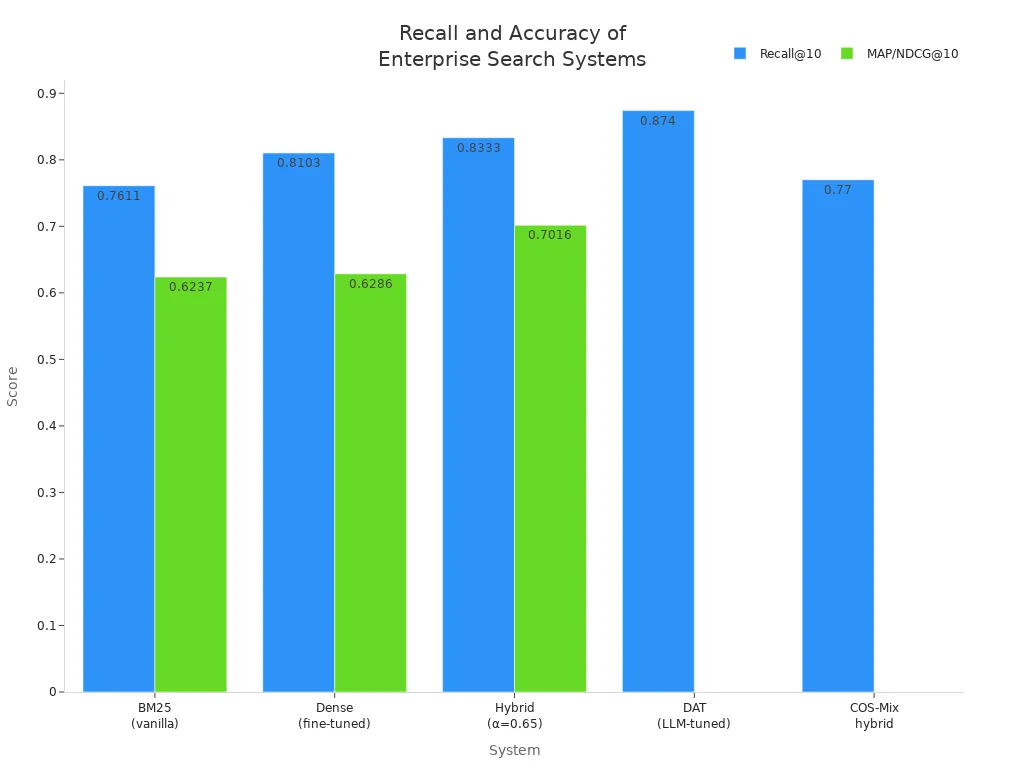
Hybrid RAG systems help you achieve higher recall and accuracy. This means you get more relevant results and fewer missed answers.
Enhanced Context and Insights
You need your AI to understand not just what you ask, but also the context behind your questions. Hybrid search uses both graph and vector methods to give you results that are precise and meaningful. This approach solves the problem of missing technical terms or internal jargon that pure vector search often faces.
- If you are a developer searching for "authentication middleware," you will find exact function names and related security documents.
- If you work in support and look for "database connection timeout," you will see the exact error code and helpful troubleshooting guides.
Hybrid search also improves the retrieval of internal knowledge. You get answers from trusted and verified sources. This builds credibility and trust in your AI system. By combining graph search for filtering and vector search for finding similar articles, you receive reliable and explainable results. You can make better decisions because you have the right context and deeper insights.
Compliance and Security
You must protect your data and follow strict rules. Hybrid search gives you better compliance and security than pure vector search. The table below shows how hybrid search compares:
| Feature | Hybrid Search | Pure Vector Search |
|---|---|---|
| Accuracy | Combines semantic relevance and relational context | Often returns irrelevant or hallucinated results |
| Explainability | Provides explainable AI outputs | Lacks contextual accuracy |
| Compliance and Security | Ensures contextual accuracy for compliance needs | May miss crucial relationships |
Hybrid search ensures your results are accurate and explainable. You can meet compliance needs because the system understands both the context and the relationships in your data. This reduces the risk of missing important connections and helps you stay secure.
Tip: When you choose an AI search solution, look for hybrid RAG systems. They offer better performance, stronger compliance, and more reliable answers for your business.
Cost Efficiency
You want your enterprise AI to deliver value without breaking the bank. Hybrid search offers a cost-efficient approach that helps you optimize your resources and reduce unnecessary expenses. When you use hybrid retrieval, you automate the search process. This automation lowers the need for manual data management and cuts operational costs. You spend less time sorting through information, and your team can focus on more important tasks.
Hybrid search also improves performance by using both vector and keyword methods. Keyword search algorithms do not rely on expensive GPUs, so you save on cloud costs related to storage and computation. You can implement hybrid RAG with reduced memory usage compared to pure semantic search engines. This means you pay less for infrastructure while maintaining high-quality results.
You benefit from enhanced efficiency and productivity. AI search solutions streamline your business operations, making your workflow more fiscally responsible. You avoid the high costs that come with maintaining large-scale semantic similarity models. Hybrid systems balance semantic and keyword approaches, so you get accurate answers without overspending.
Here is a quick overview of how hybrid search compares to pure vector or semantic methods in terms of cost:
| Feature | Hybrid Search | Pure Vector Search | Pure Semantic Search |
|---|---|---|---|
| Memory Usage | Lower | Higher | Higher |
| GPU Requirement | Minimal | Moderate | High |
| Cloud Storage Cost | Reduced | Increased | Increased |
| Manual Data Management | Automated | Manual | Manual |
| Productivity Impact | High | Moderate | Moderate |
Tip: You can maximize your budget by choosing hybrid RAG. This approach gives you reliable context and performance while keeping your operational costs low.
Hybrid retrieval helps you scale your AI solutions efficiently. You avoid bottlenecks and maintain consistent results as your data grows. By combining semantic and keyword search, you ensure that your system remains cost-effective and sustainable. You can trust this method to deliver the right answers without sacrificing your financial goals.
Hybrid Graph-Vector RAG Techniques

Graph and Semantic Retrieval
You want your enterprise search to deliver both accuracy and depth. Hybrid graph-vector rag achieves this by combining the strengths of graphrag with semantic and keyword-based retrieval. Graphrag uses structured relationships between data points, while semantic search uncovers meaning and intent. When you integrate graph structures with BM25 and vector search, you get a system that excels at both precision and context.
Consider this table that highlights the impact of this integration:
| Evidence Type | Description |
|---|---|
| Hybrid RAG | Combines graph-based and vector-based retrieval for better Q&A performance. |
| Knowledge Graphs | Fusing graphs with vector rag improves answer faithfulness and context. |
| Explainability | BM25 adds transparency, supporting explainable AI for your team. |
Hybrid graph-vector rag reduces risk by covering blind spots. For example, if your legal team searches for “termination rights under insolvency risk,” sparse retrieval finds the exact phrase, while semantic methods surface related concepts like “contract dissolution.” This dual approach ensures you do not miss critical information.
Structured Knowledge Representation
You need your AI to support both fact-finding and advanced reasoning. Hybrid graph-vector rag provides this by using graphrag to organize knowledge in a structured way. This structure supports flexible and transparent search. You can adapt to new business needs and integrate different data sources with ease.
Here are some benefits of structured knowledge representation in hybrid graph-vector rag:
- Supports both simple lookups and complex reasoning tasks.
- Offers more flexibility than pure graphrag systems.
- Delivers greater transparency than traditional vector-only solutions.
- Makes it easier to maintain and refresh your data.
- Enables reusable knowledge graphs across teams, boosting collaboration.
This approach helps you build trust in your AI systems and ensures your data stays relevant.
Privacy and Performance
You must protect sensitive information and maintain high performance. Hybrid graph-vector rag addresses privacy by supporting privacy-preserving techniques. Financial institutions use these systems to comply with regulations and keep client data safe. For example, a bank can use differential privacy to answer customer questions about financial products without exposing personal details.
Performance also matters. Hybrid graph-vector rag balances recall and accuracy, which is crucial for financial and regulated industries. On-device solutions may run slightly slower than cloud-based ones, but they offer better privacy. Some privacy methods, like homomorphic encryption, can slow things down, but hybrid graph-vector rag lets you choose the right balance for your needs.
Tip: When you use hybrid graph-vector rag, you gain a system that delivers accurate, explainable, and secure results—helping your business make better decisions every day.
RAG in Real-World Enterprise Use Cases
Financial Services
You see rapid changes in financial services. Companies use rag to improve their operations and customer experience. Many organizations rely on ai to process large amounts of proprietary data. You can look at the table below to understand how different companies benefit from this technology.
| Company | Application Description | Benefits |
|---|---|---|
| Rocket Companies | Streamlined mortgage processing by integrating proprietary financial data. | Reduced processing times and improved customer experiences. |
| Shorenstein Properties | Automated file tagging and organized proprietary data more efficiently. | Improved data accessibility and management, leading to increased operational efficiency. |
| Cohere | Ensured AI systems cite their sources, integrating external texts for verification. | Reduced errors and enhanced reliability and transparency of AI-generated content. |
| NVIDIA | Connected large language models with proprietary customer data and authoritative research. | Enabled accurate responses to user queries, enhancing productivity and reducing hallucinations. |
| IBM | Equipped models with specific information for domain-specific applications. | Improved accuracy and relevance in AI-generated responses across different sectors. |
You can see how these companies use hybrid retrieval to reduce errors and speed up processes. This approach helps you manage sensitive financial information and deliver reliable answers to your clients.
Healthcare
You want your healthcare system to provide accurate and fast diagnoses. Hybrid retrieval improves patient care by connecting live patient records with the latest medical research. You can see the benefits in these examples:
- Diagnostic processes become faster when you combine patient histories with up-to-date medical insights.
- Clinicians access both patient data and recent studies, which improves diagnostic accuracy.
- According to McKinsey, diagnosis time dropped by 20% after implementing hybrid retrieval in medical settings.
You gain better outcomes for patients and more confidence in your healthcare decisions.
Legal and E-Discovery
You need to handle complex legal queries and manage large volumes of documents. Hybrid retrieval helps you find relevant information quickly and accurately. The table below shows how different use cases benefit from this approach.
| Use Case | Description |
|---|---|
| Enterprise sales and account management | Retrieves and validates data across multiple systems, ensuring accuracy in contract status queries. |
| Technical support and documentation | Analyzes logs and retrieves relevant documentation, giving support agents accurate information for troubleshooting. |
| Financial analysis and reporting | Handles sequential dependencies in data retrieval, allowing for comprehensive financial comparisons and variance analysis. |
| Ecommerce product discovery | Decomposes complex customer queries into multiple retrieval needs, ensuring all constraints are met for product searches. |
You improve efficiency and reduce the risk of missing important details. Hybrid retrieval supports your legal team by providing explainable and trustworthy results.
Tip: You can use hybrid retrieval in many industries to solve real-world problems and deliver better outcomes for your business.
Customer Support
You want your customer support team to solve problems quickly and accurately. Hybrid RAG technology helps you achieve this goal by combining the strengths of vector and keyword search. This approach allows your AI-powered support agents to understand the context of each customer’s request. The system can cross-reference a customer’s history, find similar past cases, and suggest solutions that fit the specific situation.
An AI-powered support agent that understands context can cross-reference the customer’s history, identify similar past cases, and propose a solution tailored to their specific situation. This reduces costly escalations, accelerates resolution times, and turns customer support into a proactive, value-driven function.
When you use RAG in your support operations, you notice several key improvements:
- Reduced operational overhead
- Fewer errors
- Enhanced customer service quality
- Shorter search-to-decision cycles
You no longer need to rely on manual searches or guesswork. The AI retrieves relevant information from your knowledge base, previous tickets, and documentation. This means your agents spend less time searching and more time helping customers. You see faster response times and higher satisfaction rates.
Hybrid RAG also helps your team handle complex or unusual questions. If a customer asks about a rare issue, the system finds similar cases and provides step-by-step solutions. Your agents feel more confident because they have access to the right information at the right time. This reduces the number of escalations to higher-level support.
You can also use RAG to automate responses for common questions. The AI suggests accurate answers based on your company’s policies and past resolutions. This frees up your team to focus on more challenging problems. You improve efficiency and keep your support costs under control.
Customer support teams benefit from better insights as well. You can track which issues come up most often and identify trends. This helps you improve your products and services over time. Your customers notice the difference. They get faster, more accurate answers and feel valued by your company.
Tip: When you use hybrid RAG for customer support, you transform your help desk into a proactive, efficient, and customer-focused operation.
Transitioning to Hybrid RAG
Migration Steps
You can move to a hybrid approach by following a clear set of steps. Start by assessing your current search system and identifying gaps in accuracy or context. Next, select a platform or tool that supports both vector and keyword search. Plan your migration in phases. Begin with a pilot project on a small dataset. Test the new system and compare results with your old approach. Involve your team early so everyone understands the benefits and changes. Document each step and create a feedback loop for continuous improvement.
Data Preparation
Preparing your data is essential for a successful transition. You need a strategy that focuses on valuable sources and builds a repeatable pipeline. Follow these best practices:
- Create a data preparation strategy. Identify which sources matter most for your business.
- Choose a vector database. This helps you use embeddings for effective retrieval.
- Develop a retrieval strategy. Combine keyword and semantic similarity methods to improve performance.
- Ensure security and compliance. Protect sensitive information at every stage.
- Optimize prompt engineering. Define templates and formats for clear communication with your language model.
- Govern your RAG architecture. Monitor and manage your knowledge base to keep it accurate and relevant.
A well-prepared dataset supports both the semantic and keyword sides of your hybrid approach. This foundation helps you get the most out of your new system.
Monitoring and Improvement
Once you launch your hybrid RAG system, you need to monitor its performance. Track key indicators like success rate, response time, and consistency. Use real-time dashboards and anomaly detection tools to spot issues quickly. Collect user feedback through in-app tools that let users rate responses or report problems. Analyze this feedback to find trends and prioritize improvements.
You should also measure how much CPU and GPU your system uses. Keep an eye on the cost of API calls and check the balance between performance and expenses. Use A/B testing and human review to refine your models. Active learning systems can help you use feedback to fine-tune your approach over time.
Tip: Regular monitoring and user feedback keep your hybrid RAG system accurate, efficient, and trusted by your team.
Avoiding Pitfalls
You want your transition to hybrid RAG to succeed. Many organizations face challenges during this process. You can avoid common mistakes by planning carefully and staying aware of potential risks.
Common Pitfalls When Moving to Hybrid RAG
| Pitfall | Description | How to Avoid |
|---|---|---|
| Incomplete Data Mapping | Missing connections between old and new systems. | Map all data sources before launch. |
| Overlooking Security | Failing to update privacy controls. | Review and update security policies. |
| Ignoring User Feedback | Not listening to users during migration. | Collect feedback and adjust plans. |
| Poor Testing | Skipping thorough testing of hybrid features. | Test each feature with real data. |
| Lack of Training | Not preparing your team for new workflows. | Train staff and provide resources. |
You need to map your data sources. If you miss this step, your AI may return incomplete or inaccurate results. You should review your privacy and security policies. Hybrid RAG systems often require new controls to protect sensitive information. You must listen to your users. Their feedback helps you spot issues early and improve your system.
Tip: Always test your hybrid RAG features with real business data. This ensures your system works as expected and meets your needs.
You should train your team. Staff who understand the new workflows can use the system more effectively. Training reduces confusion and helps everyone adapt quickly.
Checklist for a Smooth Transition
- Map all data sources and connections.
- Update privacy and security controls.
- Collect user feedback during each phase.
- Test hybrid features with real-world scenarios.
- Provide training and support for your team.
You can use this checklist to guide your migration. Each step helps you avoid costly mistakes and keeps your project on track.
Watch for Hidden Risks
You may face hidden risks during your transition. For example, legacy systems can create compatibility issues. You should check for outdated formats or unsupported integrations. Hybrid RAG systems may also require new hardware or software. You need to plan for these changes.
Note: Regular reviews help you catch problems early. Schedule check-ins with your team and update your plan as needed.
You can avoid pitfalls by staying proactive. Careful planning, testing, and training make your transition smoother. You build a reliable hybrid RAG system that supports your business goals.
The Future of Hybrid RAG in Enterprise AI
Industry Trends
You see the enterprise AI landscape changing quickly. Hybrid RAG is now the production baseline for many organizations. You need accuracy, cost efficiency, and strong governance. Companies want precision retrieval at scale. They use targeted retrieval and adaptive pipelines to get the best results. Agentic orchestration is also growing. This means you can build complex workflows that fix themselves when errors happen. Composable modular ecosystems let you connect hybrid RAG with unified analytics platforms. You can see these trends in the table below:
| Trend Description | Key Focus Areas |
|---|---|
| Hybrid RAG as production baseline | Accuracy, cost efficiency, governance |
| Precision retrieval at scale | Targeted retrieval, adaptive pipelines |
| Agentic orchestration | Complex workflows, self-correcting reliability |
| Composable modular ecosystems | Integration with unified analytics platforms |
You notice that selecting the right RAG architecture is now a strategic decision. Enterprises want systems that deliver actionable insights, accountability, and adaptability. You must keep up with these trends to stay competitive.
Next-Gen Applications
You will see hybrid RAG power the next generation of enterprise AI tools. Neural search models will work together with graph-based systems. You can expect neural pipelines to handle both structured and unstructured data. Neural agents will automate research, compliance checks, and customer support. Neural document understanding will help you extract facts from contracts, emails, and reports. Neural-driven analytics will give you real-time insights from massive datasets. Neural-powered chatbots will answer questions using both neural and keyword signals. Neural workflows will connect different business units and speed up decision-making. Neural monitoring tools will track system health and alert you to problems. Neural security layers will protect sensitive information. Neural compliance engines will check for regulatory risks. Neural personalization will tailor results for each user. Neural summarization will condense long documents for quick review. Neural translation will break language barriers in global teams. Neural recommendation systems will suggest actions based on past behavior. Neural anomaly detection will spot unusual patterns in your data. Neural forecasting will predict trends and help you plan ahead. Neural optimization will fine-tune your business processes. Neural integration tools will connect with cloud and on-premises systems. Neural explainability features will show you why the AI made a decision. Neural feedback loops will let you improve the system over time. Neural benchmarking will help you measure performance. Neural collaboration tools will support teamwork across departments. Neural visualization will turn complex data into easy-to-read charts. Neural voice assistants will help you interact with your data hands-free. Neural edge computing will bring AI closer to where data is created. Neural federated learning will let you train models without sharing raw data. Neural privacy controls will keep your information safe. Neural auditing will track every action for compliance. Neural lifecycle management will keep your AI up to date. Neural deployment tools will make it easy to roll out new features. Neural innovation will drive the future of enterprise AI.
Note: As enterprises adopt AI-driven transformations, you will see RAG systems meet growing demands for information retrieval and actionable insights.
Preparing for Change
You need to prepare for the future of hybrid RAG. Start by building a roadmap for AI adoption. Train your team on neural and hybrid technologies. Invest in data quality and governance. Test new neural applications in small pilots before scaling up. Monitor industry trends and update your strategy often. Work with partners who understand neural search and hybrid RAG. Set clear goals for accuracy, cost, and compliance. Use feedback from users to improve your systems. Stay flexible so you can adapt to new neural innovations. You will build a foundation for sustainable, trustworthy AI in your organization.
Tip: Stay curious and keep learning. The future of enterprise AI belongs to those who embrace change and invest in neural-powered solutions.
You now see why hybrid RAG stands as the enterprise standard. You gain accuracy, trust, and business value when you move beyond pure vector search. Start by reviewing your current AI search tools. Explore solutions like Copilot from m365.fm to guide your transition. Take small steps, monitor results, and train your team. You prepare your organization for the future of search and build a foundation for sustainable, trustworthy AI.
FAQ
What is hybrid RAG in enterprise AI?
Hybrid RAG combines vector search and keyword search. You get both semantic understanding and exact matches. This approach helps you find accurate and relevant answers in your business data.
Why does pure vector search struggle with compliance?
Pure vector search often lacks explainability. You may find it hard to trace how the AI found an answer. This makes it difficult to meet strict compliance and audit requirements.
How does hybrid search improve accuracy?
Hybrid search uses both intent and exact terms. You get results that match your meaning and your words. This dual method reduces irrelevant answers and increases precision.
Can hybrid RAG handle internal company jargon?
Yes. Hybrid RAG recognizes your unique terms and acronyms. You see results that reflect your organization’s language and context.
Is hybrid RAG more expensive to run?
No. Hybrid RAG often reduces costs. You use fewer resources by combining efficient keyword search with targeted vector retrieval. This balance saves on cloud and hardware expenses.
How do I start moving to hybrid RAG?
You begin by reviewing your current search tools. Choose a platform that supports both vector and keyword methods. Test with a small dataset before scaling up.
What industries benefit most from hybrid RAG?
You see strong results in finance, healthcare, legal, and customer support. Any industry that needs accuracy, compliance, and trust can benefit from hybrid RAG.
Does hybrid RAG help prevent AI hallucinations?
Yes. Hybrid RAG uses semantic reranking and grounding. You get answers based on real data, which lowers the risk of hallucinated or made-up information.
🎧 Listen to this episode
Want a practical explanation of Improve Microsoft Copilot Accuracy Beyond Vector Search? This episode breaks down the topic in clear language and shows why it matters for Microsoft 365, Azure, Power Platform, security, AI, and modern work.
Listen to this episode if you want to:
- Understand the key concepts behind Improve Microsoft Copilot Accuracy Beyond Vector Search
- See how it fits into the wider Microsoft technology ecosystem
- Learn where it can create practical value for your organization
You may also enjoy these related M365 FM episodes:
- HNSW vs DiskANN for Vector Search in Azure AI Search
- Microsoft Copilot Coworker Architecture Beyond Prompting
- Fix Microsoft 365 Copilot Accuracy with Information Architecture
- Improve SharePoint Document Libraries with New UX and Copilot
- Azure AI Search – Simply Explained
Discover more practical Microsoft conversations on M365 FM.

Microsoft MVP | Host of M365.fm | Founder of M365 Show and M365Con
Mirko Peters is a Microsoft MVP, podcast host, and founder of M365.fm, M365 Show, and M365Con. His work connects Microsoft practitioners through podcast interviews, livestreams, and community events.
At M365.fm, Mirko hosts conversations with Microsoft MVPs, product experts, architects, and community contributors. Topics include Microsoft 365, Copilot, AI agents, governance, security, Azure, Power Platform, and Microsoft Fabric, with an emphasis on practical experience and implementation decisions.
M365.fm is the podcast and learning platform. M365 Show brings experts together for livestreams, while M365Con provides an online conference setting for community learning.
Official website: Mirko Peters (https://www.mirkopeters.com/). Recognition: Mirko Peters — Microsoft MVP profile (https://mvp.microsoft.com/de-DE/mvp/profile/9b0ca797-db5a-493a-a845-8b9158046cf5). Connect on LinkedIn (https://www.linkedin.com/in/m365showpodcast/).