


 Apple Podcasts
 Spotify
 Youtube Music
 Spreaker
 Podchaser
 Amazon Music
 Dynamics 365 Autonomous Agents - Simply Explained
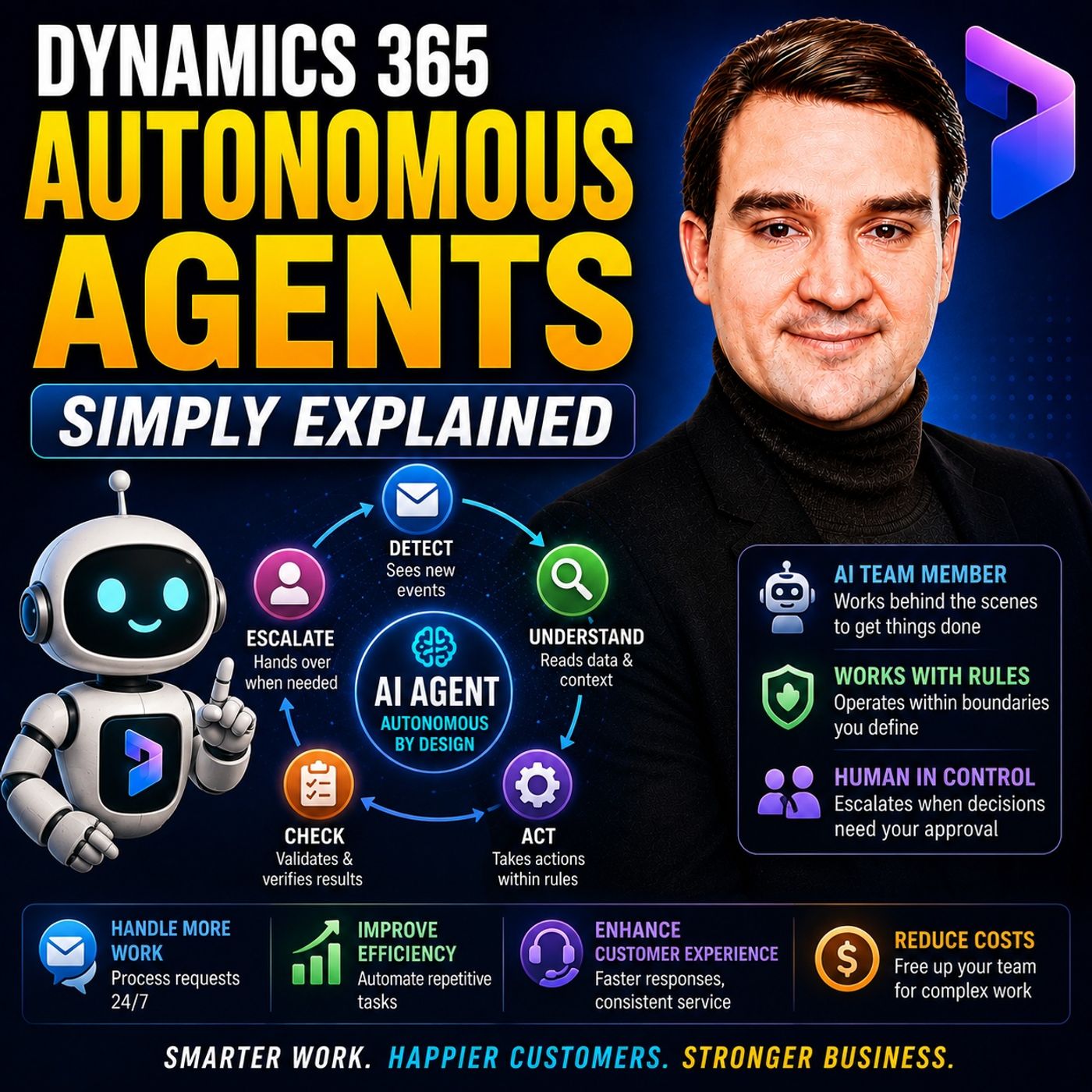
Key Takeaways
- Dynamics 365 Autonomous Agents move AI beyond answering questions and generating content by proactively watching for specific business events and taking action within organizational guardrails.
- Unlike Copilot, which waits for a user to prompt it at the front desk, autonomous agents operate behind the scenes like digital team members with narrow, well-defined jobs.
- While traditional automation follows rigid 'if-this-then-that' rules, autonomous agents leverage generative AI and business context in Dynamics 365 to interpret messages, review records, and choose permitted actions.
- Organizations retain full control over agent behavior by establishing clear permissions, data access boundaries, approval points, and human oversight for consequential decisions.
- Starting with a narrow, repetitive process—such as drafting follow-up messages, sorting inbound sales leads, or updating support cases—allows organizations to safely test and refine agent autonomy.
Dynamics 365 Autonomous Agents move AI beyond answering questions and generating content. Instead of waiting for someone to prompt them, autonomous agents can watch for specific business events, understand the context stored in Dynamics 365, choose between permitted actions, and continue a defined process within rules established by the organization. In this episode of M365 FM, Mirko Peters explains how autonomous agents differ from Copilot and traditional automation, where Microsoft is applying them across Dynamics 365, and why permissions, guardrails, approvals, and human oversight remain essential. ㅤ
WHAT ARE DYNAMICS 365 AUTONOMOUS AGENTS?
An autonomous agent is a specialized AI tool designed to perform a narrow business job. It can review business information, choose from allowed next steps, and carry out work toward a defined goal. The important word is defined. An autonomous agent isn't given unrestricted control of a business process. Organizations determine its job, the information it can access, the actions it can perform, and when it must involve a person. Think of it as a digital team member with a specific job description rather than a general-purpose AI system. ㅤ
COPILOT VS AUTONOMOUS AGENTS
Copilot typically waits for a person to request assistance. A user asks a question, requests information, generates a draft, or asks Copilot to summarize something. An autonomous agent works differently. It can react when something happens, such as a new customer case arriving, a customer sending another message, a new sales lead entering the system, or an order requiring confirmation. A useful analogy is an office building. Copilot works at the reception desk helping people who approach it, while autonomous agents work behind the scenes performing specific operational jobs. ㅤ
AUTONOMOUS AGENTS VS TRADITIONAL AUTOMATION
Traditional automation is extremely useful when processes follow predictable rules: if something happens, perform a predefined action. Agents add another layer by interpreting context. They can read customer messages, examine connected records, use approved knowledge, and select between actions their configuration permits. Generative AI provides the language understanding, while autonomous behavior connects that understanding to business actions. The agent might identify an issue, find relevant knowledge, update a record, prepare a response, or escalate the situation to a person. ㅤ
WHY DYNAMICS 365 DATA MATTERS
Generic AI can understand a sentence such as "my delivery still hasn't arrived," but it doesn't automatically know which customer, order, shipment, previous conversation, or support case that statement relates to. Dynamics 365 provides the business context. Customer records, cases, orders, sales leads, financial records, previous conversations, and other connected information allow an agent to understand the situation within the organization's actual business process. This context is what turns general AI capabilities into practical business assistance. ㅤ
CUSTOMER INTENT AGENT
Customer service provides some of the clearest examples of autonomous agents. The Customer Intent Agent can analyze customer conversations and cases to identify patterns in why customers are contacting an organization. Customer questions continually change as companies launch products, modify services, change delivery partners, or introduce new billing processes. The agent can help identify emerging topics instead of requiring managers to manually analyze hundreds of customer conversations. These insights can help organizations improve self-service experiences, knowledge content, and support processes. ㅤ
CASE MANAGEMENT AGENT
The Case Management Agent helps with routine activities across the customer service case lifecycle. It can assist with creating cases, updating information, progressing work toward resolution, following up, and closing cases according to the organization's configured processes. The objective isn't to remove customer service representatives. Instead, the agent can reduce repetitive administrative work surrounding cases so service professionals can spend more time understanding customer situations and handling exceptions. Organizations remain responsible for defining when cases require review, approval, or direct human intervention. ㅤ
CUSTOMER KNOWLEDGE MANAGEMENT AGENT
Useful support knowledge frequently becomes trapped inside closed cases, agent notes, and previous conversations. The Customer Knowledge Management Agent can examine completed case information to identify potentially reusable knowledge and gaps in existing support content. However, not everything contained within an old case should automatically become official guidance. A workaround may be outdated, customer-specific, or based on an exception. The agent can surface useful material while people determine what should become trusted organizational knowledge. ㅤ
SALES QUALIFICATION AGENT
Sales teams can receive large numbers of inbound leads with very different levels of potential. Researching every prospect and deciding where sellers should focus can consume significant amounts of time. The Sales Qualification Agent for Dynamics 365 Sales can help research and prioritize inbound leads and develop personalized sales emails to begin conversations. Salespeople still determine which opportunities deserve attention, review communications, contribute their own customer knowledge, and build the relationships required to actually close deals. ㅤ
SALES ORDER AGENT IN BUSINESS CENTRAL
Order processing provides another example of repetitive business work. Customer orders can arrive through email and other channels, requiring employees to interpret the request, enter information, verify details, and prepare confirmation. The Sales Order Agent in Dynamics 365 Business Central can support the order intake process from initial entry through confirmation. This reduces manual data entry while allowing people to concentrate on exceptions, unusual requests, and customer situations requiring judgment. ㅤ
FINANCIAL RECONCILIATION AGENTS
Finance teams perform substantial amounts of repetitive preparation and reconciliation work, particularly around financial period closing. The Financial Reconciliation Agent can assist with preparing and cleansing datasets used during period-close activities. The Account Reconciliation Agent in Dynamics 365 Finance can help match and clear transactions between subledgers and the general ledger. Accountants remain responsible for investigating discrepancies and determining whether the organization's financial information is correct. ㅤ
SUPPLIER COMMUNICATIONS AGENT
Procurement teams frequently spend time contacting suppliers to confirm purchase orders and expected delivery dates. The Supplier Communications Agent for Dynamics 365 Supply Chain Management can support this communication and help identify potential delivery delays earlier. Instead of procurement specialists manually chasing every routine confirmation, the agent can support standard follow-up while people concentrate on supplier relationships and problems requiring negotiation or intervention. ㅤ
SCHEDULING OPERATIONS AGENT
Field Service schedules rarely remain unchanged throughout the day. Traffic, cancellations, urgent jobs, and conflicting bookings can disrupt carefully planned technician schedules. The Scheduling Operations Agent for Dynamics 365 Field Service can help dispatchers adjust schedules as circumstances change. Dispatchers remain responsible for decisions involving customer priorities, difficult commitments, and other situations where business judgment matters. ㅤ
PERMISSIONS AND GUARDRAILS
The critical question isn't simply whether an autonomous agent can take action. Organizations need to determine exactly which actions it is permitted to take. Can the agent read a customer record? Can it update the record? Can it prepare an email? Can it send that email without approval? Can it recommend closing a case, or can it actually close one? Clear permissions and guardrails turn a broad AI capability into a controlled business process. Agents should only have access to the information and tools necessary for their assigned job. ㅤ
WHY HUMAN OVERSIGHT STILL MATTERS
Autonomous doesn't mean unsupervised. Agents can misunderstand customer requests, operate on incomplete information, or produce responses that don't fit a specific situation. Processes involving customer promises, financial transactions, exceptions, privacy, or consequential business decisions require appropriate human control. Organizations should review agent activity, analyze employee and customer feedback, inspect affected records, improve instructions and knowledge sources, and adjust permissions when necessary. ㅤ
HOW TO START WITH AUTONOMOUS AGENTS
A sensible first autonomous-agent project is a narrow, repetitive process where mistakes can be identified and corrected. Organizations might begin with drafting follow-up messages for review, sorting incoming requests, researching leads, or completing routine case information. Teams can then measure the results, improve instructions, refine permissions, and determine whether the agent should receive additional autonomy. Starting small provides an opportunity to understand how the agent behaves before connecting it to more consequential processes. ㅤ
Become a supporter of this podcast: https://www.spreaker.com/podcast/m365-fm-modern-work-security-and-productivity-with-microsoft-365--6704921/support.
🚀 Want to be part of m365.fm?
Then stop just listening… and start showing up.
👉 Connect with me on LinkedIn and let’s make something happen:
- 🎙️ Be a podcast guest and share your story
- 🎧 Host your own episode (yes, seriously)
- 💡 Pitch topics the community actually wants to hear
- 🌍 Build your personal brand in the Microsoft 365 space
This isn’t just a podcast — it’s a platform for people who take action.
🔥 Most people wait. The best ones don’t.
👉 Connect with me on LinkedIn and send me a message:
"I want in"
Let’s build something awesome 👊
Frequently Asked Questions
What are Dynamics 365 Autonomous Agents?
Dynamics 365 Autonomous Agents are specialized AI tools designed to perform narrow business jobs by reviewing data, interpreting context, and carrying out work toward a defined goal without requiring manual prompts for every step.
What is the difference between Copilot and autonomous agents?
Copilot acts like a receptionist waiting for a user to approach it with a direct question or prompt, whereas autonomous agents work behind the scenes reacting to incoming events, support cases, or orders on their own.
Why is Dynamics 365 data important for autonomous agents?
Dynamics 365 provides essential business context—such as customer records, past cases, and order histories—turning general AI capabilities into practical assistance that understands specific organizational workflows.
Are autonomous agents fully unsupervised?
No, autonomous agents operate within strict permissions, guardrails, and rules set by the organization, and human oversight remains essential for handling exceptions, approvals, and consequential business decisions.
00:00:00,000 --> 00:00:03,540
Imagine you run a busy customer service desk where messages keep coming in,
2
00:00:03,540 --> 00:00:06,060
cases need updates, and customers are waiting.
3
00:00:06,060 --> 00:00:09,760
While the answers they need are buried in old notes nobody has time to dig through.
4
00:00:09,760 --> 00:00:12,920
A copilot handles direct questions when someone walks up and asks,
5
00:00:12,920 --> 00:00:15,040
but an autonomous agent is different AU.
6
00:00:15,040 --> 00:00:17,860
It has a specific job, watches for work that needs doing,
7
00:00:17,860 --> 00:00:20,640
and takes action on its own within the rules you give it.
8
00:00:20,640 --> 00:00:22,960
I'm Mirko Peters from M365, FM.
9
00:00:22,960 --> 00:00:25,280
This knowledge nugget explains the idea in plain English.
10
00:00:25,280 --> 00:00:28,840
By the end you'll know what Dynamics 365 Autonomous Agents actually do,
11
00:00:28,840 --> 00:00:32,440
where they work and why people still stay in charge of the important decisions.
12
00:00:32,440 --> 00:00:35,780
Think of a business like an office building, copilot works at the front desk,
13
00:00:35,780 --> 00:00:41,920
helping visitors who walk up and ask, while agents handle the jobs that happen behind the scenes.
14
00:00:41,920 --> 00:00:46,120
The simple definition, a digital team member, with a narrow job.
15
00:00:46,120 --> 00:00:48,960
Repeat work eats up a lot of time in most companies.
16
00:00:48,960 --> 00:00:53,080
A sales rep sorts incoming leads, a service rep fills in the same case fields
17
00:00:53,080 --> 00:00:55,920
and accountant matches records before the book's close,
18
00:00:55,920 --> 00:00:59,560
and a supply chain worker chases a supplier for a delivery date,
19
00:00:59,560 --> 00:01:03,040
even though the purchase order already has most of the details.
20
00:01:03,040 --> 00:01:06,080
Each task looks small on its own, but the pile grows fast.
21
00:01:06,080 --> 00:01:07,680
So what exactly is an autonomous agent?
22
00:01:07,680 --> 00:01:10,440
It's a specialized AI tool that reviews business data,
23
00:01:10,440 --> 00:01:13,960
picks from a loud next steps, and carries out work toward a defined goal.
24
00:01:13,960 --> 00:01:17,080
It doesn't get a vague instruction like run the company AU.
25
00:01:17,080 --> 00:01:21,000
It gets a narrow job with clear boundaries and that narrow focus is the whole point.
26
00:01:21,000 --> 00:01:24,280
Imagine the office building again, copilot sits at the reception desk.
27
00:01:24,280 --> 00:01:28,480
You walk up and ask for help, and copilot answers your question, finds information,
28
00:01:28,480 --> 00:01:29,840
or helps you write something.
29
00:01:29,840 --> 00:01:33,000
Autonomous agents work in the rooms behind reception AU.
30
00:01:33,000 --> 00:01:35,800
One might handle the mail room sorting incoming requests,
31
00:01:35,800 --> 00:01:38,560
another works the service desk keeping cases up to date,
32
00:01:38,560 --> 00:01:43,040
and a third sits in the accounts office helping staff match financial records.
33
00:01:43,040 --> 00:01:45,840
Many people hear agent and think of a chatbot.
34
00:01:45,840 --> 00:01:48,440
A chatbot waits for you to type a question and then replies,
35
00:01:48,440 --> 00:01:51,600
"Oh, useful for a conversation, but it's just talking."
36
00:01:51,600 --> 00:01:54,320
An autonomous agent can react when something changes.
37
00:01:54,320 --> 00:01:56,960
When a new case arrives, a customer sends another message,
38
00:01:56,960 --> 00:02:00,400
or an order needs confirmation, the agent reviews the situation
39
00:02:00,400 --> 00:02:03,760
and continues the process without someone prompting every single step.
40
00:02:03,760 --> 00:02:05,200
That's the real difference.
41
00:02:05,200 --> 00:02:09,440
Old-style automation handles repeat work too, but follows a fixed path.
42
00:02:09,440 --> 00:02:11,000
If this happens, do that.
43
00:02:11,000 --> 00:02:13,320
If a field has this value, send that email.
44
00:02:13,320 --> 00:02:17,160
Fixed flow still work when everything stays predictable, and agent adds context.
45
00:02:17,160 --> 00:02:19,080
It reads the words in a customer message,
46
00:02:19,080 --> 00:02:22,960
looks at the connected record and chooses between actions its rules allow.
47
00:02:22,960 --> 00:02:25,680
It isn't blindly following a rigid list AU,
48
00:02:25,680 --> 00:02:27,920
it's working with the information right in front of it.
49
00:02:27,920 --> 00:02:30,320
Generative AI helps with the language part.
50
00:02:30,320 --> 00:02:33,520
It can read a long message, identify what the person needs,
51
00:02:33,520 --> 00:02:37,240
write a draft response, or pull a useful answer from your knowledge base.
52
00:02:37,240 --> 00:02:40,240
But writing text alone doesn't complete a business task.
53
00:02:40,240 --> 00:02:43,080
Autonomous behavior connects that understanding to action.
54
00:02:43,080 --> 00:02:46,320
For example, the agent might identify a common support request,
55
00:02:46,320 --> 00:02:51,640
suggest the right knowledge article, update a case field, or ask a person to review something outside its rules.
56
00:02:51,640 --> 00:02:55,160
Your business decides which of those actions it can take on its own.
57
00:02:55,160 --> 00:02:56,640
And this part often gets missed,
58
00:02:56,640 --> 00:02:59,480
an autonomous agent doesn't have free access to everything.
59
00:02:59,480 --> 00:03:03,400
Your organization sets its instructions, data access permissions and approval points,
60
00:03:03,400 --> 00:03:06,560
and the agent works inside that defined space AU,
61
00:03:06,560 --> 00:03:10,280
like a new team member who can enter certain rooms, use certain files,
62
00:03:10,280 --> 00:03:12,120
and complete certain kinds of work.
63
00:03:12,120 --> 00:03:15,040
So it's not magic or a general purpose robot.
64
00:03:15,040 --> 00:03:20,160
It's an AI worker with a narrow job, a set of rules and real business data to work from.
65
00:03:20,160 --> 00:03:23,520
Next, let's look at the office where those agents find that information.
66
00:03:23,520 --> 00:03:29,440
That's Dynamics 365, where they work Dynamics 365 as the business office.
67
00:03:29,440 --> 00:03:33,400
So where do these agents get the specific details they need to turn a general answer
68
00:03:33,400 --> 00:03:35,280
into something useful for your business?
69
00:03:35,280 --> 00:03:37,960
That outtems Dynamics 365.
70
00:03:37,960 --> 00:03:41,960
Think of it as the business office itself with connected rooms for customer records,
71
00:03:41,960 --> 00:03:46,760
sales leads, support cases, orders, money, and supply work.
72
00:03:46,760 --> 00:03:50,760
A customer record tells you who someone is and what they outtem, the bought.
73
00:03:50,760 --> 00:03:54,720
A case shows past conversations, fixes, and who owns the next step.
74
00:03:54,720 --> 00:03:57,360
An order reveals what was promised, where it should go,
75
00:03:57,360 --> 00:03:59,160
and whether anyone still needs to confirm.
76
00:03:59,160 --> 00:04:01,960
That context is what changes the answer.
77
00:04:01,960 --> 00:04:06,600
A generic AI tool here's the sentence, "Omi Delivery" still has no time to arrive.
78
00:04:06,600 --> 00:04:10,000
But it has no clue which delivery you mean, whether the order shipped,
79
00:04:10,000 --> 00:04:12,120
or if there are terms in open case.
80
00:04:12,120 --> 00:04:16,040
Dynamics 365 holds all those business facts in one place.
81
00:04:16,040 --> 00:04:17,720
Her outtems are real scenario.
82
00:04:17,720 --> 00:04:20,400
A customer sends a message asking where their order is,
83
00:04:20,400 --> 00:04:24,000
and that message enters a support conversation or becomes part of a case.
84
00:04:24,000 --> 00:04:26,440
But the message alone tells only half the story.
85
00:04:26,440 --> 00:04:28,960
The agent looks at the customer record connected to that message
86
00:04:28,960 --> 00:04:31,680
and sees if this person contacted support yesterday,
87
00:04:31,680 --> 00:04:33,520
if a colleague already replied,
88
00:04:33,520 --> 00:04:34,880
what product they ordered,
89
00:04:34,880 --> 00:04:37,360
and which knowledge article covers late deliveries.
90
00:04:37,360 --> 00:04:41,160
Then it suggests the next step or carries out an action the organization allows.
91
00:04:41,160 --> 00:04:43,680
Maybe it points the service rep to the right answer,
92
00:04:43,680 --> 00:04:47,080
updates the case with a summary, or prepares a reply for review.
93
00:04:47,080 --> 00:04:50,400
The exact job depends on how the company configured the agent.
94
00:04:50,400 --> 00:04:53,960
But here, ointments the thing, the agent does not want to work in a vacuum.
95
00:04:53,960 --> 00:04:56,960
It works with the record in front of it, the knowledge it can access,
96
00:04:56,960 --> 00:04:58,840
and the permissions attached to its role.
97
00:04:58,840 --> 00:05:01,520
When it lacks information, reaches a sensitive decision,
98
00:05:01,520 --> 00:05:03,600
or needs approval, a person steps in.
99
00:05:03,600 --> 00:05:05,800
People still handle the difficult cases.
100
00:05:05,800 --> 00:05:09,480
Like a customer disputing a charge, a shipment involving a serious failure,
101
00:05:09,480 --> 00:05:11,800
or someone asking for an exception to policy.
102
00:05:11,800 --> 00:05:16,600
Those situations need judgment, authority, and a conversation no agent should complete alone.
103
00:05:16,600 --> 00:05:18,520
Behind the scenes, the path is fairly simple.
104
00:05:18,520 --> 00:05:21,800
Information comes in, the agent reviews the relevant business record,
105
00:05:21,800 --> 00:05:25,560
and approved knowledge takes, suggests, or roots the next action.
106
00:05:25,560 --> 00:05:28,040
And the result goes back into the same record.
107
00:05:28,040 --> 00:05:31,320
That way the team can see what happened without hunting across separate tools.
108
00:05:31,320 --> 00:05:33,160
That record matters more than it sounds.
109
00:05:33,160 --> 00:05:36,840
Without it, a service rep might read a customer email in one place,
110
00:05:36,840 --> 00:05:39,880
search order details in another, check old notes somewhere else,
111
00:05:39,880 --> 00:05:41,960
and then type the same update into a case.
112
00:05:41,960 --> 00:05:45,160
Dynamics 365 brings those work areas together,
113
00:05:45,160 --> 00:05:48,120
so the agent uses the same context as the people on the team.
114
00:05:48,120 --> 00:05:49,960
Generic AI knows how language works,
115
00:05:49,960 --> 00:05:54,440
but a Dynamics 365 agent uses language while looking at the actual business situation
116
00:05:54,440 --> 00:05:57,480
connected to that customer, order, lead, or case.
117
00:05:57,480 --> 00:06:00,120
It does not mean just read the question.
118
00:06:00,120 --> 00:06:02,920
It connects the question to the work already happening around it,
119
00:06:02,920 --> 00:06:05,560
within the access and rules the organization sets.
120
00:06:05,560 --> 00:06:08,360
That do TMEs where these agents become easier to picture,
121
00:06:08,360 --> 00:06:09,880
especially in customer service,
122
00:06:09,880 --> 00:06:11,960
where incoming questions, case updates,
123
00:06:11,960 --> 00:06:14,040
and shared knowledge all meet in one place.
124
00:06:14,040 --> 00:06:18,040
Service agents, finding intent, managing cases,
125
00:06:18,040 --> 00:06:19,160
keeping knowledge.
126
00:06:19,160 --> 00:06:24,360
Current customer service gives us the clearest view of what autonomous agents can do,
127
00:06:24,360 --> 00:06:26,680
support teams deal with the same pattern every day.
128
00:06:26,680 --> 00:06:29,800
Our lots of conversations, lots of small updates,
129
00:06:29,800 --> 00:06:32,600
and useful answers trapped inside work people finished weeks ago.
130
00:06:32,600 --> 00:06:35,160
Let's start with the customer intent agent.
131
00:06:35,160 --> 00:06:37,240
An intent is the reason the customer contacts you,
132
00:06:37,240 --> 00:06:40,600
like our e-con-automate sign-in, our "oh, where is my order?"
133
00:06:40,600 --> 00:06:42,680
"A or A or A" I need to return this item.
134
00:06:42,680 --> 00:06:45,400
A/O support teams need to know these reasons,
135
00:06:45,400 --> 00:06:47,320
because they shape the help articles,
136
00:06:47,320 --> 00:06:50,040
self-service options, and training their people need.
137
00:06:50,040 --> 00:06:53,240
But customer questions don't know to to match these days still.
138
00:06:53,240 --> 00:06:55,960
A company launches a new product, changes a delivery partner,
139
00:06:55,960 --> 00:06:57,400
or updates a billing process,
140
00:06:57,400 --> 00:07:00,440
and then customers start asking new questions in their own words.
141
00:07:00,440 --> 00:07:02,680
The old list of topics no longer fits.
142
00:07:02,680 --> 00:07:05,720
The customer intent agent looks through past and current cases
143
00:07:05,720 --> 00:07:08,200
and customer conversations to find those patterns.
144
00:07:08,200 --> 00:07:10,520
Instead of a manager reading hundreds of chats by hand,
145
00:07:10,520 --> 00:07:13,240
the agent spots that many people mention the same problem
146
00:07:13,240 --> 00:07:15,240
and suggests a new intent for that topic.
147
00:07:15,240 --> 00:07:17,080
That helps keep self-service from going stale
148
00:07:17,080 --> 00:07:20,840
by recommending the knowledge article most likely to help with a customer-automass issue.
149
00:07:20,840 --> 00:07:24,280
That recommendation can support a customer trying to solve a problem alone,
150
00:07:24,280 --> 00:07:28,280
or it can help a service rep find the right answer faster during a conversation.
151
00:07:28,280 --> 00:07:32,280
The agent does no-mud-invent company policy, or it works with the knowledge the company approves
152
00:07:32,280 --> 00:07:34,840
while helping the team see where that knowledge needs work.
153
00:07:34,840 --> 00:07:37,640
Now think about the case itself, A/O.
154
00:07:37,640 --> 00:07:41,240
The work record for a customer problem, that includes the customer A/O,
155
00:07:41,240 --> 00:07:42,680
TM.piles.missage.
156
00:07:42,680 --> 00:07:45,080
Notes from service reps, the current status,
157
00:07:45,080 --> 00:07:47,080
and the steps taken to solve it.
158
00:07:47,080 --> 00:07:49,480
Creating and updating those records takes time,
159
00:07:49,480 --> 00:07:52,120
especially when a team handles a high volume of requests.
160
00:07:52,120 --> 00:07:55,480
The case management agent in Dynamics 365 Customer Service
161
00:07:55,480 --> 00:07:59,160
helps with the case lifecycle, out creating cases, updating them,
162
00:07:59,160 --> 00:08:02,280
moving them toward resolution, following up and closing them.
163
00:08:02,280 --> 00:08:05,480
A service rep spends less time filling in routine details,
164
00:08:05,480 --> 00:08:08,520
and more time reading the customer-autom situation carefully.
165
00:08:08,520 --> 00:08:10,040
Every support team works differently.
166
00:08:10,040 --> 00:08:13,320
One company wants a case closed only after a customer confirms,
167
00:08:13,320 --> 00:08:16,360
another needs a manager to review cases above a certain level,
168
00:08:16,360 --> 00:08:19,400
and some cases need a specific follow-up after a set period.
169
00:08:19,400 --> 00:08:22,920
Administrators shape the case management agent around those local rules,
170
00:08:22,920 --> 00:08:27,160
so it follows the company U/TMA's process rather than a generic path.
171
00:08:27,160 --> 00:08:29,960
It handles repeat steps, but the organization decides
172
00:08:29,960 --> 00:08:32,520
when a person needs to check the work or take control.
173
00:08:32,520 --> 00:08:35,800
There are terms another problem in service that many teams know well.
174
00:08:35,800 --> 00:08:37,960
A skilled support rep solves a tricky issue,
175
00:08:37,960 --> 00:08:40,600
writes useful notes, and closes the case.
176
00:08:40,600 --> 00:08:42,840
Later, another customer reports the same problem,
177
00:08:42,840 --> 00:08:45,160
but the answer sits buried in old case notes,
178
00:08:45,160 --> 00:08:47,880
a chat transcript, or a summary that nobody thinks to search.
179
00:08:47,880 --> 00:08:51,080
That U/Temarts, where the customer-knowledge management agent comes in,
180
00:08:51,080 --> 00:08:54,920
it examines completed case details to pull useful knowledge, find gaps,
181
00:08:54,920 --> 00:08:59,160
and keep knowledge current while checking for the company-autom that his compliance needs.
182
00:08:59,160 --> 00:09:02,760
Think of a support team, or a team as old case notes,
183
00:09:02,760 --> 00:09:05,240
like loose papers spread across many drawers.
184
00:09:05,240 --> 00:09:07,800
Someone may have written the perfect answer six months ago,
185
00:09:07,800 --> 00:09:11,080
but it would now, to may, it help the next customer if nobody can find it.
186
00:09:11,080 --> 00:09:13,800
The knowledge agent helps turn repeat answers into material
187
00:09:13,800 --> 00:09:16,760
the team can review and place in a shared knowledge folder.
188
00:09:16,760 --> 00:09:19,000
People still review what becomes official guidance
189
00:09:19,000 --> 00:09:21,720
because a case note can describe a one-time exception,
190
00:09:21,720 --> 00:09:25,080
an outdated workaround, or advice that only fit one customer.
191
00:09:25,080 --> 00:09:26,760
The agent helps surface the material,
192
00:09:26,760 --> 00:09:29,320
but people decide what should become a trusted article.
193
00:09:29,320 --> 00:09:32,120
Here out, Merser, real example, a customer writes,
194
00:09:32,120 --> 00:09:33,720
"Omi deliveries late again.
195
00:09:33,720 --> 00:09:35,640
Can you tell me what is happening?"
196
00:09:35,640 --> 00:09:37,800
A.O. the customer intent agent recognizes
197
00:09:37,800 --> 00:09:39,880
that this belongs to a delivery-related topic
198
00:09:39,880 --> 00:09:42,120
and points toward the right knowledge article.
199
00:09:42,120 --> 00:09:43,560
If the request needs a case,
200
00:09:43,560 --> 00:09:46,200
the case management agent helps capture the details,
201
00:09:46,200 --> 00:09:50,360
update the record, and support the next steps under the team i.e. our team's rules.
202
00:09:50,360 --> 00:09:54,040
After the issue closes, the customer knowledge management agent
203
00:09:54,040 --> 00:09:57,560
reviews the case for information that may improve the help content later.
204
00:09:57,560 --> 00:09:59,720
If the late delivery came from a new problem,
205
00:09:59,720 --> 00:10:01,560
many customers now report,
206
00:10:01,560 --> 00:10:03,560
a person investigates, approves a new article
207
00:10:03,560 --> 00:10:05,400
or speaks directly with the customer.
208
00:10:05,400 --> 00:10:08,200
The agents reduce the repeat admin work around the case,
209
00:10:08,200 --> 00:10:10,600
while the service team handles the judgment calls.
210
00:10:10,600 --> 00:10:13,640
Service agents focus on customer questions and shared answers.
211
00:10:13,640 --> 00:10:16,040
In other parts of the business, agents take on different jobs,
212
00:10:16,040 --> 00:10:18,760
from sorting sales leads to checking financial records
213
00:10:18,760 --> 00:10:20,280
and following up with suppliers.
214
00:10:20,280 --> 00:10:24,680
Sales, finance, and supply chain agents with different desks.
215
00:10:24,680 --> 00:10:27,960
Customer service is only one part of the picture.
216
00:10:27,960 --> 00:10:29,960
Actually, you'll find the same pattern everywhere,
217
00:10:29,960 --> 00:10:32,680
O. sales teams, finance teams, purchasing teams,
218
00:10:32,680 --> 00:10:35,400
dispatchers all have work that follows a routine
219
00:10:35,400 --> 00:10:38,280
where the details change from one record to the next,
220
00:10:38,280 --> 00:10:39,960
but the shape stays the same.
221
00:10:39,960 --> 00:10:41,160
So let's start with sales.
222
00:10:41,160 --> 00:10:43,880
Imagine a salesperson receives a large number of inbound leads.
223
00:10:43,880 --> 00:10:46,360
Some people are ready to talk, others are just looking around,
224
00:10:46,360 --> 00:10:48,200
and a few may not fit the company at all.
225
00:10:48,200 --> 00:10:49,000
Here's the issue.
226
00:10:49,000 --> 00:10:51,080
Someone still needs to research each one
227
00:10:51,080 --> 00:10:52,840
and decide who deserves attention first.
228
00:10:52,840 --> 00:10:54,280
That's where the sales qualification agent
229
00:10:54,280 --> 00:10:56,280
for Dynamics 365 sales steps.
230
00:10:56,280 --> 00:10:58,520
In now, it helps with that early sorting work.
231
00:10:58,520 --> 00:11:01,160
This agent can research and prioritize inbound leads,
232
00:11:01,160 --> 00:11:04,120
then develop personalized sales emails to start a conversation.
233
00:11:04,120 --> 00:11:06,920
But here's the thing, it doesn't close a deal by itself,
234
00:11:06,920 --> 00:11:08,680
and it doesn't replace the salesperson
235
00:11:08,680 --> 00:11:10,200
who builds trust with the customer.
236
00:11:10,200 --> 00:11:13,160
Instead, it helps the salesperson begin with a clearer list.
237
00:11:13,160 --> 00:11:15,240
Picture a crowded sales inbox on Monday morning
238
00:11:15,240 --> 00:11:18,440
where without help, a rep might spend hours opening messages,
239
00:11:18,440 --> 00:11:19,800
searching for company details,
240
00:11:19,800 --> 00:11:21,880
and drafting similar first replies.
241
00:11:21,880 --> 00:11:23,640
The agent can prepare that early work,
242
00:11:23,640 --> 00:11:25,160
so the rep can focus on the leads
243
00:11:25,160 --> 00:11:27,560
that look most ready for a real conversation.
244
00:11:27,560 --> 00:11:30,920
Now, a person still decides what good sales contact looks like.
245
00:11:30,920 --> 00:11:32,600
They review the email before it goes out,
246
00:11:32,600 --> 00:11:34,600
add their own knowledge, and decide whether a lead
247
00:11:34,600 --> 00:11:37,320
deserves a call while the agent handles the repeat research
248
00:11:37,320 --> 00:11:39,000
and drafting around the edges.
249
00:11:39,000 --> 00:11:42,120
Small and medium-sized businesses often face a related job
250
00:11:42,120 --> 00:11:44,040
after a customer decides to buy.
251
00:11:44,040 --> 00:11:46,680
An order arrives through email or another channel,
252
00:11:46,680 --> 00:11:49,160
and someone needs to enter it, check the details,
253
00:11:49,160 --> 00:11:52,360
capture the customer's preferences, and send confirmation.
254
00:11:52,360 --> 00:11:55,000
That work can take time, especially when orders arrive
255
00:11:55,000 --> 00:11:56,520
in different formats.
256
00:11:56,520 --> 00:11:59,880
The sales order agent in Dynamics 365 Business Central
257
00:11:59,880 --> 00:12:01,960
handles the order intake process from entry
258
00:12:01,960 --> 00:12:03,560
all the way through confirmation.
259
00:12:03,560 --> 00:12:05,400
This agent can interact with customers
260
00:12:05,400 --> 00:12:07,560
while gathering the information needed for an order,
261
00:12:07,560 --> 00:12:10,040
so the team doesn't need to copy every detail by hand
262
00:12:10,040 --> 00:12:11,640
before moving the order forward.
263
00:12:11,640 --> 00:12:14,040
Now, Finance has its own pile of repeat work.
264
00:12:14,040 --> 00:12:15,960
Before a financial period closes,
265
00:12:15,960 --> 00:12:17,880
teams need to prepare and clean data sets
266
00:12:17,880 --> 00:12:19,880
where numbers sit in different records,
267
00:12:19,880 --> 00:12:21,480
formatting needs attention,
268
00:12:21,480 --> 00:12:24,040
and people spend long stretches finding information
269
00:12:24,040 --> 00:12:25,880
that doesn't match.
270
00:12:25,880 --> 00:12:27,400
The Financial Reconciliation Agent
271
00:12:27,400 --> 00:12:30,040
for Microsoft 365 Co-Pilot for Finance
272
00:12:30,040 --> 00:12:31,880
helps prepare and cleanse data sets
273
00:12:31,880 --> 00:12:33,160
for that period-close work,
274
00:12:33,160 --> 00:12:34,600
think of it as sorting paperwork
275
00:12:34,600 --> 00:12:37,160
before the accountant begins the serious review.
276
00:12:37,160 --> 00:12:39,320
It doesn't decide whether the company's financial reports
277
00:12:39,320 --> 00:12:41,880
are correct or finance professionals
278
00:12:41,880 --> 00:12:43,480
still own that responsibility.
279
00:12:43,480 --> 00:12:46,600
There's another agent inside Dynamics 365 Finance,
280
00:12:46,600 --> 00:12:48,360
the Account Reconciliation Agent.
281
00:12:48,360 --> 00:12:50,040
It helps match and clear transactions
282
00:12:50,040 --> 00:12:52,440
between sub-ledges and the General Ledger O,
283
00:12:52,440 --> 00:12:53,720
those terms sound technical.
284
00:12:53,720 --> 00:12:54,920
So let's keep this simple.
285
00:12:54,920 --> 00:12:57,320
A sub-ledger holds detailed records for one area,
286
00:12:57,320 --> 00:12:59,400
like customer payments or supplier bills,
287
00:12:59,400 --> 00:13:01,720
while the General Ledger holds the larger financial record
288
00:13:01,720 --> 00:13:02,760
for the business.
289
00:13:02,760 --> 00:13:04,680
Accountants need those records to agree,
290
00:13:04,680 --> 00:13:05,800
and when they don't,
291
00:13:05,800 --> 00:13:07,240
someone needs to find the gap.
292
00:13:07,240 --> 00:13:09,320
The agent helps with the matching and clearing work,
293
00:13:09,320 --> 00:13:11,240
so accountants can spend more of their time
294
00:13:11,240 --> 00:13:13,000
investigating records that don't fit
295
00:13:13,000 --> 00:13:15,880
rather than checking every obvious match one by one.
296
00:13:15,880 --> 00:13:18,200
Supply chain teams have another kind of follow-up problem.
297
00:13:18,200 --> 00:13:20,440
A business sends a purchase order to a supplier,
298
00:13:20,440 --> 00:13:22,120
but the team still needs confirmation
299
00:13:22,120 --> 00:13:24,200
that the supplier can deliver it when expected.
300
00:13:24,200 --> 00:13:25,320
If nobody follows up,
301
00:13:25,320 --> 00:13:26,920
a delay can sit unnoticed
302
00:13:26,920 --> 00:13:28,840
until it becomes a customer problem.
303
00:13:28,840 --> 00:13:31,320
The Supply Accomunications Agent for Dynamics,
304
00:13:31,320 --> 00:13:33,240
365 Supply Chain Management,
305
00:13:33,240 --> 00:13:34,840
handles collaboration with suppliers
306
00:13:34,840 --> 00:13:36,360
to confirm order delivery.
307
00:13:36,360 --> 00:13:38,920
It can handle work connected to confirming purchase orders
308
00:13:38,920 --> 00:13:41,160
and help spot possible delays earlier.
309
00:13:41,160 --> 00:13:43,880
That way, procurement specialists can spend more time
310
00:13:43,880 --> 00:13:46,520
on the supplier relationships and delivery problems
311
00:13:46,520 --> 00:13:48,760
that need a human conversation.
312
00:13:48,760 --> 00:13:50,520
Field service adds movement to the picture.
313
00:13:50,520 --> 00:13:53,080
A dispatcher may plan a technician's day carefully,
314
00:13:53,080 --> 00:13:54,760
but then traffic slows someone down,
315
00:13:54,760 --> 00:13:57,320
a customer cancels, or two bookings collide.
316
00:13:57,320 --> 00:13:58,920
The schedule that looked fine at 8 o'clock
317
00:13:58,920 --> 00:14:01,000
may create gaps and conflicts by lunchtime.
318
00:14:01,000 --> 00:14:04,440
The scheduling operations agent for Dynamics 365 Field Service
319
00:14:04,440 --> 00:14:07,480
helps dispatchers adjust schedules as those conditions change.
320
00:14:07,480 --> 00:14:09,880
It helps them work toward better schedules for technicians
321
00:14:09,880 --> 00:14:12,360
when the day refuses to follow the original plan.
322
00:14:12,360 --> 00:14:14,200
The dispatchers still decide what makes sense
323
00:14:14,200 --> 00:14:15,720
for their customers and their staff,
324
00:14:15,720 --> 00:14:17,880
especially when a change involves priority work
325
00:14:17,880 --> 00:14:19,640
or a difficult customer promise.
326
00:14:19,640 --> 00:14:21,400
So these agents work at different desks,
327
00:14:21,400 --> 00:14:23,240
but their jobs follow the same shape.
328
00:14:23,240 --> 00:14:25,720
The sales qualification agent works with leads,
329
00:14:25,720 --> 00:14:28,280
the reconciliation agents work with financial records,
330
00:14:28,280 --> 00:14:30,520
the supplier agent works with purchase orders
331
00:14:30,520 --> 00:14:33,400
and the scheduling agent works with technician appointments.
332
00:14:33,400 --> 00:14:35,560
Each one focuses on a defined business task,
333
00:14:35,560 --> 00:14:37,560
uses the data connected to that task,
334
00:14:37,560 --> 00:14:39,800
takes only the actions it has permission to take
335
00:14:39,800 --> 00:14:42,360
and leaves a record of the work for the people who follow.
336
00:14:42,360 --> 00:14:45,240
More action can save time,
337
00:14:45,240 --> 00:14:47,480
but it also raises a fair question
338
00:14:47,480 --> 00:14:50,280
who decides what an agent can read, change, and send.
339
00:14:50,280 --> 00:14:53,640
Control, trust, and the human team.
340
00:14:53,640 --> 00:14:57,320
Here's a myth I want to clear up right away.
341
00:14:57,320 --> 00:15:00,840
Don't ask whether an agent can act, ask who decided what it can do.
342
00:15:01,880 --> 00:15:04,280
Every action comes from choices the organization made
343
00:15:04,280 --> 00:15:06,120
before it ever touched a customer record
344
00:15:06,120 --> 00:15:08,040
and order or a financial transaction.
345
00:15:08,040 --> 00:15:09,240
People remain responsible.
346
00:15:09,240 --> 00:15:11,400
Your company chooses the job, sets the rules,
347
00:15:11,400 --> 00:15:13,240
and decides the data the agent can see,
348
00:15:13,240 --> 00:15:14,600
the actions it can take,
349
00:15:14,600 --> 00:15:16,840
and the moments where a human must approve the next step.
350
00:15:16,840 --> 00:15:19,480
An agent may handle the routine path,
351
00:15:19,480 --> 00:15:21,160
but it doesn't carry the responsibility
352
00:15:21,160 --> 00:15:22,760
for a bad customer promise,
353
00:15:22,760 --> 00:15:25,080
an incorrect payment or a sensitive decision.
354
00:15:25,080 --> 00:15:28,200
Let's bring back the reception desk analogy.
355
00:15:28,200 --> 00:15:29,560
Think of EntraID,
356
00:15:29,560 --> 00:15:31,320
Microsoft's identity service,
357
00:15:31,320 --> 00:15:33,720
as the reception desk for the digital workplace.
358
00:15:33,720 --> 00:15:36,120
When an employee signs in EntraID,
359
00:15:36,120 --> 00:15:38,120
helps confirm who that person is
360
00:15:38,120 --> 00:15:39,640
and what rooms they may enter.
361
00:15:39,640 --> 00:15:41,720
The same idea controls the agent O.
362
00:15:41,720 --> 00:15:44,520
It should only reach the records and tools needed
363
00:15:44,520 --> 00:15:45,720
for its assigned job,
364
00:15:45,720 --> 00:15:47,960
not wander through every part of the business
365
00:15:47,960 --> 00:15:49,320
that keeps the job narrow.
366
00:15:49,320 --> 00:15:50,760
Before an agent starts work,
367
00:15:50,760 --> 00:15:52,840
the organization needs clear guardrails.
368
00:15:52,840 --> 00:15:54,520
What may it read, what may it update,
369
00:15:54,520 --> 00:15:56,680
can it prepare an email or can it send one,
370
00:15:56,680 --> 00:15:58,600
can it suggest a case should close
371
00:15:58,600 --> 00:16:00,840
or does a service rep need to approve that closure?
372
00:16:01,240 --> 00:16:04,040
Those decisions are what turn a broad AI idea
373
00:16:04,040 --> 00:16:05,800
into a controlled business process.
374
00:16:05,800 --> 00:16:08,360
A sensible first project usually involves repeatable work
375
00:16:08,360 --> 00:16:10,200
where a mistake has a clear way back.
376
00:16:10,200 --> 00:16:12,120
Maybe the agent drafts follow-up messages
377
00:16:12,120 --> 00:16:13,960
for review, sorts incoming requests
378
00:16:13,960 --> 00:16:15,480
or fills in routine case details.
379
00:16:15,480 --> 00:16:16,760
The team can check the results,
380
00:16:16,760 --> 00:16:17,560
correct errors,
381
00:16:17,560 --> 00:16:18,440
and improve the setup
382
00:16:18,440 --> 00:16:20,040
before allowing more independent action.
383
00:16:20,040 --> 00:16:20,840
Start small,
384
00:16:20,840 --> 00:16:22,680
but that doesn't mean ignoring the risks.
385
00:16:22,680 --> 00:16:24,680
An agent can misunderstand a request,
386
00:16:24,680 --> 00:16:26,040
use poor information
387
00:16:26,040 --> 00:16:27,160
or produce an answer
388
00:16:27,160 --> 00:16:29,160
that doesn't fit the customer's situation.
389
00:16:29,160 --> 00:16:30,840
If it reaches data, it shouldn't see
390
00:16:30,840 --> 00:16:32,200
the problem grows quickly.
391
00:16:32,200 --> 00:16:34,600
Some industries also face strict rules about privacy,
392
00:16:34,600 --> 00:16:36,440
record keeping, and how decisions are checked.
393
00:16:36,440 --> 00:16:38,360
So the work continues after setup
394
00:16:38,360 --> 00:16:40,440
and teams need to review what the agent did,
395
00:16:40,440 --> 00:16:42,680
read feedback from employees and customers,
396
00:16:42,680 --> 00:16:44,600
and inspect the records it touched.
397
00:16:44,600 --> 00:16:46,280
If it repeatedly misses context,
398
00:16:46,280 --> 00:16:48,440
the organization can adjust its instructions,
399
00:16:48,440 --> 00:16:50,040
improve its approved knowledge,
400
00:16:50,040 --> 00:16:51,080
change permissions,
401
00:16:51,080 --> 00:16:52,840
or add a human approval point.
402
00:16:52,840 --> 00:16:54,280
The agent needs supervision
403
00:16:54,280 --> 00:16:57,000
just like any process that affects customers or money.
404
00:16:57,000 --> 00:16:58,360
This changes the human job,
405
00:16:58,360 --> 00:16:59,640
but it doesn't remove it.
406
00:16:59,640 --> 00:17:01,560
Instead of copying details between records
407
00:17:01,560 --> 00:17:03,080
or chasing routine updates,
408
00:17:03,080 --> 00:17:05,000
people can focus on the exceptions,
409
00:17:05,000 --> 00:17:06,440
the unclear cases,
410
00:17:06,440 --> 00:17:09,160
and the decisions that need experience and accountability.
411
00:17:09,160 --> 00:17:10,600
Someone still owns the outcome,
412
00:17:10,600 --> 00:17:12,200
and that's the simple rule to remember.
413
00:17:12,200 --> 00:17:14,600
An agent can carry out a defined piece of work,
414
00:17:14,600 --> 00:17:16,280
but people decide the boundaries
415
00:17:16,280 --> 00:17:18,760
and remain answerable for what happens inside them.
416
00:17:18,760 --> 00:17:19,560
Other.
417
00:17:19,560 --> 00:17:20,280
Conclusion.
418
00:17:20,280 --> 00:17:22,520
One job, clear rules, human oversight.
419
00:17:22,520 --> 00:17:24,360
So here's the bottom line.
420
00:17:24,360 --> 00:17:26,680
Dynamics 365 Autonomous Agents
421
00:17:26,680 --> 00:17:29,720
handle one specific job using context already in your work,
422
00:17:29,720 --> 00:17:30,680
but you set the rules,
423
00:17:30,680 --> 00:17:31,880
you approve the actions,
424
00:17:31,880 --> 00:17:33,160
and you own the outcome.
425
00:17:33,160 --> 00:17:34,280
That's the whole point.
426
00:17:34,280 --> 00:17:36,280
Subscribe on your favorite podcast platform
427
00:17:36,280 --> 00:17:37,880
for more plain English knowledge nuggets,
428
00:17:37,880 --> 00:17:40,520
and share this with someone who hears AI agents
429
00:17:40,520 --> 00:17:42,920
and still pictures a chatbot answering questions.




