


 Apple Podcasts
 Spotify
 Youtube Music
 Spreaker
 Podchaser
 Amazon Music
 Microsoft Agent Framework - Simply Explained
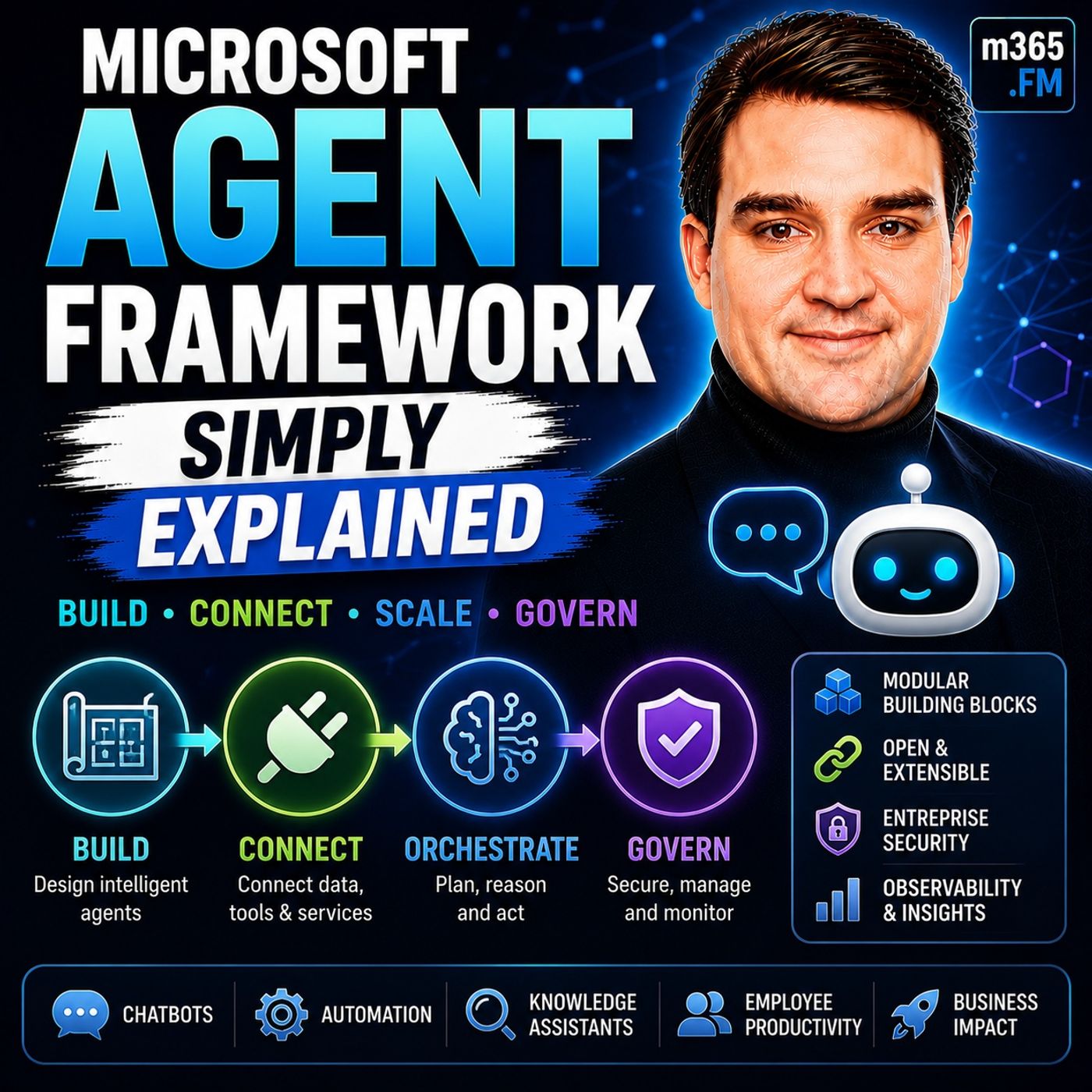
Quick Answer: Microsoft Agent Framework is an important Microsoft topic for teams that need clearer technical decisions, safer implementation, and practical operational value. This episode explains what it does, where it fits in the Microsoft ecosystem, and the key considerations for administrators, architects, and business stakeholders.
The Microsoft Agent Framework is an open, multi-language framework designed for creating production-grade AI agents and multi-agent workflows. This framework allows you to develop intelligent agents that can reason, plan, and execute tasks autonomously. Its significance lies in enhancing user interaction through features like modular coordination and deterministic workflows. These capabilities enable agents to collaborate effectively, improving the quality and efficiency of user interactions. As you explore this framework, you'll find that it empowers you to create innovative solutions tailored to modern technology needs.
- Key improvements in user interaction include:
- Modular, stateful coordination for effective teamwork among agents.
- Deterministic workflows that facilitate seamless collaboration.
- Support for various interaction patterns to enhance user experience.
- A visual DevUI for workflow visualization and functionality testing.
Key Takeaways
- The Microsoft Agent Framework enables the creation of intelligent agents that can work autonomously, enhancing user interactions.
- Key features include modular coordination, deterministic workflows, and a visual DevUI for easy workflow management.
- Implementing the framework involves setting up a repository, configuring Azure AI Foundry, and connecting to Bing Search.
- The framework supports multiple programming languages, making it accessible for developers with different backgrounds.
- Using the framework can significantly boost productivity by automating tasks and creating intelligent assistants for various applications.
- Compliance and security are prioritized, ensuring that AI implementations adhere to necessary standards and protect user data.
- The framework's versatility allows for applications in customer support, research, development, and education, enhancing efficiency across industries.
- Explore the official documentation and tutorials to get started and fully leverage the capabilities of the Microsoft Agent Framework.
Overview of Microsoft Agent Framework

Key Features
The Microsoft Agent Framework (MAF) offers a range of powerful features that set it apart from other AI agent frameworks. Here are some of the standout capabilities:
| Feature | Description |
|---|---|
| Agents | Long-lived runtime components that use LLMs to interpret inputs, call tools, maintain session state, and generate responses. |
| Workflows | Graph-based orchestration engines that connect agents and functions, enforce execution order, and support checkpointing and human-in-the-loop scenarios. |
| High-Level Architecture | Composed of model clients, agent sessions, context providers, middleware pipeline, MCP clients, and workflow engine. |
| Version 1.0 Features | Production-ready stability, A2A protocol, MCP support, multi-agent orchestration patterns, middleware pipeline, and DevUI debugger. |
MAF excels in creating conversational multi-agent systems. It supports self-reflective coordination patterns and structured conversations for collaborative tasks. This framework integrates seamlessly with the Semantic Kernel, providing enterprise-grade features that enhance its functionality.
Implementation Steps
To implement the Microsoft Agent Framework in your project, follow these steps:
- Repository Setup: Clone the laboratory repository and verify the Python version.
- Azure AI Foundry Setup: Create an Azure AI Foundry resource and project, deploy required models and services, and configure an Azure Search Service.
- Configure Grounding with Bing Search: Connect the Azure Search resource to your AI Foundry project.
These steps will help you get started with MAF effectively. The framework supports multiple programming languages, including .NET and Python, making it accessible for developers with different backgrounds.
Integration with Other Technologies
The Microsoft Agent Framework integrates well with various Microsoft technologies, enhancing its capabilities. Here are some key integration features:
| Feature | Description |
|---|---|
| Unified SDK and Runtime | Provides an open-source SDK for developing multi-agent systems. |
| Deployment to Azure AI Foundry | Facilitates managed orchestration and enterprise-grade features. |
| Agent2Agent (A2A) | Enables collaboration between agents across different environments. |
| Model Context Protocol (MCP) | Allows agents to advertise capabilities and ensure reliable tool calls. |
| OpenAPI Tooling | Standardizes agent observability and API interactions. |
This integration allows you to leverage existing Microsoft tools and services, streamlining your development process.
Getting Started
For those new to the Microsoft Agent Framework, several resources can help you begin:
- Getting Started with Microsoft Agent Framework: This guide provides an overview of MAF, including runnable demos and core concepts.
- Microsoft Agent Framework Reaches Release Candidate: This resource includes simple code examples in Python and .NET to help you create your first agents quickly.
By utilizing these resources, you can quickly familiarize yourself with the framework and start building your own AI agents.
Benefits of the Microsoft Agent Framework
The Microsoft Agent Framework offers numerous benefits that can significantly enhance productivity and ensure compliance and security in your organization. By leveraging this framework, you can create intelligent agents that streamline workflows and improve user experiences.
Productivity Enhancements
Using the Microsoft Agent Framework can lead to transformative productivity improvements. Here are some key enhancements you can expect:
- Intelligent Assistants: The framework enables the development of intelligent, autonomous assistants across the Microsoft 365 ecosystem. These assistants enhance productivity in applications like Outlook and Teams.
- Multi-Agent Systems: Transitioning from traditional chatbots to multi-agent systems introduces memory, reasoning, and orchestration. This shift allows agents to handle complex tasks more efficiently.
- Built-in Agents: The framework includes built-in agents such as Researcher, Analyst, and Project Manager. These agents are specifically designed to boost enterprise productivity.
- Task Automation: Automating repetitive tasks reduces the time you spend on manual work, allowing you to focus on more strategic activities.
You can also expect increased throughput and process optimization, leading to efficiency gains in task completion. Enhanced employee and customer experience metrics indicate improved satisfaction and engagement.
Compliance and Security Features
The Microsoft Agent Framework prioritizes compliance and security, ensuring that your AI implementations adhere to necessary standards. Here are some critical features:
- Responsible AI Policies: All agents must follow principles such as fairness, reliability, safety, privacy, security, inclusiveness, transparency, and accountability.
- Data Privacy Compliance: Agents operate under strict data privacy principles, using only the necessary data for their functions.
- Data Residency Compliance: The framework ensures that agents function in environments that meet data residency and sovereignty requirements.
- Data Retention Policies: Defined retention periods for logs and data help maintain compliance with organizational policies.
In addition to compliance, the framework includes robust security features to protect user data. Here’s a summary of some key security measures:
| Security Feature | Description |
|---|---|
| Authentication | Microsoft Entra ID provides a foundation for role-based access control and OBO authentication. |
| Encryption at Rest | Uses FIPS 140-2 compliant 256-bit AES encryption for data protection. |
| Encryption in Transit | Ensures all communication is encrypted during transmission. |
| Customer-Managed Keys | Supports bring-your-own key vault for enhanced data security. |
| Secure API Key Storage | Managed through Azure Key Vault for secure storage. |
By utilizing the Microsoft Agent Framework, you can enhance productivity while ensuring compliance and security in your AI implementations.
Use Cases for Microsoft Agent Framework
The Microsoft Agent Framework opens up a world of possibilities across various industries. You can leverage this framework to create intelligent agents that enhance productivity and streamline processes. Here are some notable applications in business:
- Customer Support Agents: These agents can search knowledge bases, classify user intent, and draft responses. They improve response times and enhance customer satisfaction.
- Research Assistants: These agents gather information, summarize evidence, and produce structured reports. They save time and ensure accuracy in data handling.
- Developer Agents: These agents inspect code, run tools, and assist with maintenance tasks. They help developers focus on more complex issues by automating routine checks.
- Business Process Agents: These agents coordinate approvals, API calls, and document generation. They facilitate smoother workflows and reduce bottlenecks.
- Multi-Agent Workflows: In this setup, specialized agents handle planning, retrieval, analysis, review, and final response generation. This collaborative approach enhances efficiency.
- Microsoft 365 Agents: These agents use the Microsoft Agent Framework as the orchestration layer while relying on the Microsoft 365 Agents SDK for channels and conversation management. This integration maximizes the potential of existing Microsoft tools.
In the realm of education, the Microsoft Agent Framework also plays a crucial role. You can create agents that enhance teaching and learning experiences:
- Pedagogical Agents: These agents automate and personalize learning, making education more engaging for students.
- Teaching Assistance Agents: They automate key tasks for educators, allowing teachers to focus on instruction rather than administrative duties.
- Student Support Agents: These agents provide personalized learning guidance, helping students navigate their educational journeys effectively.
The versatility of the Microsoft Agent Framework allows you to explore innovative use cases in emerging industries. Here’s a summary of some of its features:
| Feature | Description |
|---|---|
| Combines strengths | Merges conversational agent patterns with enterprise features like state management and security. |
| Deep integration | Native connectors for Microsoft 365 services such as Office, Teams, and Dynamics. |
| Multi-language support | Supports .NET and Python for diverse development needs. |
| Session management | Provides state management and type safety for production workloads. |
| Security | Integrates with Azure AD for role-based access control. |
By utilizing the Microsoft Agent Framework, you can transform how businesses operate and enhance educational experiences. The potential applications are vast, and the framework empowers you to create solutions that meet modern demands.
The Microsoft Agent Framework stands out as a powerful tool for developing intelligent agents. Its features, such as open standards and interoperability, enhance collaboration between agents. You can leverage this framework to create solutions that improve productivity and streamline processes in various industries.
Consider exploring the potential applications of the Microsoft Agent Framework in your projects. Whether you aim to automate customer support or enhance educational experiences, this framework offers the flexibility and control you need.
For further learning, check out the official documentation and tutorials available online. Embrace the future of AI with the Microsoft Agent Framework!
FAQ
What is the Microsoft Agent Framework?
The Microsoft Agent Framework is a unified platform for creating AI agents. It simplifies the development of intelligent systems that can reason, plan, and execute tasks autonomously.
Which programming languages does it support?
You can use multiple programming languages with the Microsoft Agent Framework, including Python and .NET. This flexibility allows you to work in your preferred environment.
How do I get started with the framework?
To start, clone the repository, set up Azure AI Foundry, and configure grounding with Bing Search. Follow the official documentation for detailed steps.
Can I integrate the framework with other Microsoft services?
Yes, the Microsoft Agent Framework integrates seamlessly with various Microsoft technologies, enhancing its capabilities and allowing you to leverage existing tools.
What are the key benefits of using this framework?
Using the Microsoft Agent Framework boosts productivity, enhances user experiences, and ensures compliance with security standards. It helps streamline workflows and automate tasks effectively.
Are there built-in agents available?
Yes, the framework includes built-in agents like Researcher, Analyst, and Project Manager. These agents are designed to enhance productivity across various applications.
How does the framework ensure data security?
The Microsoft Agent Framework incorporates robust security features, including encryption, role-based access control, and compliance with data privacy regulations to protect user data.
What types of applications can I build with it?
You can build a wide range of applications, including customer support agents, research assistants, and educational tools. The framework's versatility allows for innovative solutions across industries.
🎧 You Should Also Listen To
- AI Agents – Simply Explained provides the next practical learning step and adds useful context for this topic.
- Microsoft Fabric Real-Time Intelligence – Simply Explained provides the next practical learning step and adds useful context for this topic.
Last reviewed: July 2026.
🚀 Want to be part of m365.fm?
Then stop just listening… and start showing up.
👉 Connect with me on LinkedIn and let’s make something happen:
- 🎙️ Be a podcast guest and share your story
- 🎧 Host your own episode (yes, seriously)
- 💡 Pitch topics the community actually wants to hear
- 🌍 Build your personal brand in the Microsoft 365 space
This isn’t just a podcast — it’s a platform for people who take action.
🔥 Most people wait. The best ones don’t.
👉 Connect with me on LinkedIn and send me a message:
"I want in"
Let’s build something awesome 👊
1
00:00:00,000 --> 00:00:03,640
Today's topic is one that almost everyone has heard of, but almost no one can actually explain.
2
00:00:03,640 --> 00:00:05,120
I'm talking about AI agents.
3
00:00:05,120 --> 00:00:08,800
You've probably heard the term in a meeting, read it in a blog post or seen it in a headline.
4
00:00:08,800 --> 00:00:10,280
Everyone's talking about them.
5
00:00:10,280 --> 00:00:13,760
But ask someone to define one, and the answers get fuzzy real fast.
6
00:00:13,760 --> 00:00:17,280
The hype is loud, the definitions are vague, and the phrase gets thrown around so loosely,
7
00:00:17,280 --> 00:00:19,000
it's lost almost all its meaning.
8
00:00:19,000 --> 00:00:20,760
Here's the most common mistake people make.
9
00:00:20,760 --> 00:00:23,400
They think an agent is just a chatbot with a fancier name.
10
00:00:23,400 --> 00:00:26,560
You ask it something, it replies, that's not an agent, that's a chatbot.
11
00:00:26,560 --> 00:00:28,720
And there is a real difference between the two.
12
00:00:28,720 --> 00:00:29,720
So what changed?
13
00:00:29,720 --> 00:00:31,880
Why is everyone suddenly obsessed with agents?
14
00:00:31,880 --> 00:00:35,120
And more importantly, why should you care if you're not a developer?
15
00:00:35,120 --> 00:00:38,960
By the end of this episode, you'll understand what an AI agent actually is,
16
00:00:38,960 --> 00:00:44,000
why Microsoft built a whole framework around them, and why this matters for the way you work.
17
00:00:44,000 --> 00:00:47,200
What exactly is an AI agent?
18
00:00:47,200 --> 00:00:50,200
You already know how a chatbot works, you type something, it responds.
19
00:00:50,200 --> 00:00:54,920
That's a conversation, it's reactive, it waits for you to say something, then it replies.
20
00:00:54,920 --> 00:00:57,240
An agent is different, it doesn't just answer.
21
00:00:57,240 --> 00:01:00,520
It acts, think, decide, act, that's the simplest definition I can give you.
22
00:01:00,520 --> 00:01:01,320
Here's how it works.
23
00:01:01,320 --> 00:01:02,800
First, the agent thinks.
24
00:01:02,800 --> 00:01:06,080
It uses a large language model to reason about what you actually need,
25
00:01:06,080 --> 00:01:07,800
not just what you typed, but what you meant.
26
00:01:07,800 --> 00:01:10,120
If you say book a meeting with Sarah next Tuesday,
27
00:01:10,120 --> 00:01:12,160
the agent doesn't just repeat that back to you,
28
00:01:12,160 --> 00:01:15,680
it thinks about what that request really means, then it decides.
29
00:01:15,680 --> 00:01:17,560
It breaks your request into steps.
30
00:01:17,560 --> 00:01:21,280
Book a meeting becomes a plan, check your calendar, find a free slot,
31
00:01:21,280 --> 00:01:24,280
check Sarah's availability, send an invite, the agent doesn't guess,
32
00:01:24,280 --> 00:01:25,760
it creates a sequence of actions.
33
00:01:25,760 --> 00:01:29,040
Finally, it acts, it calls tools and services to make it happen.
34
00:01:29,040 --> 00:01:31,360
It doesn't tell you how to book a meeting, it books the meeting,
35
00:01:31,360 --> 00:01:34,960
it doesn't explain how to check the weather, it checks the weather and gives you the answer.
36
00:01:34,960 --> 00:01:38,640
So think about the difference, a chatbot is reactive, it waits for your next question.
37
00:01:38,640 --> 00:01:42,320
An agent is proactive, you give it a goal and it goes off and works on it.
38
00:01:42,320 --> 00:01:45,000
It might come back with questions if it needs more information,
39
00:01:45,000 --> 00:01:47,560
but it doesn't need you to hold its hand through every step.
40
00:01:47,560 --> 00:01:49,920
A chatbot is like a reference desk at a library,
41
00:01:49,920 --> 00:01:52,720
you ask where a book is and they point you to the right aisle.
42
00:01:52,720 --> 00:01:56,120
An agent is like a personal assistant who has keys to the building.
43
00:01:56,120 --> 00:01:59,840
You say, "I need information about our top clients for tomorrow's meeting"
44
00:01:59,840 --> 00:02:02,920
and they go find it, organize it and hand you a briefing document.
45
00:02:02,920 --> 00:02:06,040
You didn't tell them where to look or what format to use, they figured it out.
46
00:02:06,040 --> 00:02:08,840
But the secret isn't just the LLM, the language model is smart,
47
00:02:08,840 --> 00:02:10,760
but by itself it's just a brain with no hands.
48
00:02:10,760 --> 00:02:13,680
What makes something an agent is the combination of three things.
49
00:02:13,680 --> 00:02:16,200
Reasoning, the ability to think through a problem.
50
00:02:16,200 --> 00:02:18,840
Tools, the ability to act on the world.
51
00:02:18,840 --> 00:02:22,040
And memory, the ability to remember what happened before,
52
00:02:22,040 --> 00:02:25,360
put those three together and you have something that doesn't just answer questions,
53
00:02:25,360 --> 00:02:26,760
it gets things done.
54
00:02:26,760 --> 00:02:29,080
Before the framework, the fragmented landscape.
55
00:02:29,080 --> 00:02:32,600
So if agents are so useful, why isn't everyone already building them?
56
00:02:32,600 --> 00:02:35,880
The short answer is that until recently, it was a messy process.
57
00:02:35,880 --> 00:02:38,200
You had to stitch together multiple tools yourself,
58
00:02:38,200 --> 00:02:41,280
kind of like trying to build a car by buying parts from different manufacturers
59
00:02:41,280 --> 00:02:42,880
and hoping they fit together.
60
00:02:42,880 --> 00:02:46,040
Microsoft's first attempt at fixing this was semantic kernel,
61
00:02:46,040 --> 00:02:48,640
an SDK for integrating AI into applications.
62
00:02:48,640 --> 00:02:50,840
Powerful stuff, but it was a toolbox, not a blueprint.
63
00:02:50,840 --> 00:02:54,000
It gave you the pieces you still had to figure out how to assemble them.
64
00:02:54,000 --> 00:02:56,160
Then came Autogen from Microsoft Research.
65
00:02:56,160 --> 00:02:58,800
This framework explored multi-agent conversations
66
00:02:58,800 --> 00:03:01,400
where AI agents talk, debate and collaborate.
67
00:03:01,400 --> 00:03:05,400
Cutting edge, yes, but it was experimental, not built for production systems.
68
00:03:05,400 --> 00:03:09,600
So developers had a tough choice, semantic kernel was stable and enterprise ready,
69
00:03:09,600 --> 00:03:12,000
but lacked the advanced orchestration patterns.
70
00:03:12,000 --> 00:03:14,840
Autogen had the cool multi-agent capabilities,
71
00:03:14,840 --> 00:03:17,640
but wasn't something you'd run in a live environment.
72
00:03:17,640 --> 00:03:21,120
Each had its own learning curve, its own way of doing things, its own community.
73
00:03:21,120 --> 00:03:22,560
And it wasn't just Microsoft.
74
00:03:22,560 --> 00:03:23,960
Other frameworks popped up.
75
00:03:23,960 --> 00:03:26,080
Langchain, crew AI, doesn't others.
76
00:03:26,080 --> 00:03:27,760
The ecosystem was all over the place.
77
00:03:27,760 --> 00:03:29,400
If you wanted to build agents at work,
78
00:03:29,400 --> 00:03:32,320
you had to become an expert in a rapidly changing world.
79
00:03:32,320 --> 00:03:33,560
Which framework do you learn?
80
00:03:33,560 --> 00:03:34,720
Which one will survive?
81
00:03:34,720 --> 00:03:36,560
Which one is Microsoft actually backing?
82
00:03:36,560 --> 00:03:38,160
For a beginner, it was overwhelming.
83
00:03:38,160 --> 00:03:41,440
Imagine you're a developer at a company exploring AI agents.
84
00:03:41,440 --> 00:03:43,600
You research and find five different frameworks.
85
00:03:43,600 --> 00:03:46,680
Each with its own documentation, its own patterns, its own community,
86
00:03:46,680 --> 00:03:48,040
you don't know where to start.
87
00:03:48,040 --> 00:03:49,800
You don't know which one to bet your time on.
88
00:03:49,800 --> 00:03:51,880
That fragmentation created a real barrier.
89
00:03:51,880 --> 00:03:53,360
It wasn't just about learning a tool.
90
00:03:53,360 --> 00:03:55,880
It was about betting on an entire ecosystem.
91
00:03:55,880 --> 00:03:59,760
And as agent use cases moved from experiments into real business processes,
92
00:03:59,760 --> 00:04:01,880
Microsoft realized this wasn't sustainable.
93
00:04:01,880 --> 00:04:05,640
They needed one framework, one unified approach, one answer to the question.
94
00:04:05,640 --> 00:04:07,320
How do I build an agent?
95
00:04:07,320 --> 00:04:09,600
What is Microsoft agent framework?
96
00:04:09,600 --> 00:04:11,440
So Microsoft took the two frameworks they had,
97
00:04:11,440 --> 00:04:14,440
semantic kernel and autogen, and combined them into one.
98
00:04:14,440 --> 00:04:18,920
The result is the Microsoft agent framework, a single unified SDK
99
00:04:18,920 --> 00:04:21,960
that brings together the enterprise stability of semantic kernel
100
00:04:21,960 --> 00:04:24,880
with the cutting edge multi agent patterns from autogen.
101
00:04:24,880 --> 00:04:28,200
The teams that built those two frameworks now work together on this one.
102
00:04:28,200 --> 00:04:30,920
This framework launched in preview in late 2025
103
00:04:30,920 --> 00:04:34,000
and reached version 1.0 in July, 2026.
104
00:04:34,000 --> 00:04:37,400
That timeline is important because it tells you this isn't a research project
105
00:04:37,400 --> 00:04:38,200
or an experiment.
106
00:04:38,200 --> 00:04:39,840
It's a production-ready product.
107
00:04:39,840 --> 00:04:42,480
Microsoft is saying, "Build your real systems on this."
108
00:04:42,480 --> 00:04:43,480
It's also open source.
109
00:04:43,480 --> 00:04:47,960
You can find it on GitHub with over 7,000 stars and more than 100 contributors.
110
00:04:47,960 --> 00:04:49,040
The community is active.
111
00:04:49,040 --> 00:04:52,720
There are weekly office hours where you can talk to the engineering team directly.
112
00:04:52,720 --> 00:04:54,480
That's not something you get with a closed product.
113
00:04:54,480 --> 00:04:57,880
The framework supports Python and Bennet as first-class languages,
114
00:04:57,880 --> 00:05:00,720
whether you're a CI developer or a Python developer,
115
00:05:00,720 --> 00:05:01,720
you get the same experience.
116
00:05:01,720 --> 00:05:04,760
That's a big deal because many AI frameworks are Python only.
117
00:05:04,760 --> 00:05:08,480
Microsoft made a deliberate choice to treat both languages equally.
118
00:05:08,480 --> 00:05:09,960
And here's something that might surprise you.
119
00:05:09,960 --> 00:05:12,640
The framework supports over seven different model providers.
120
00:05:12,640 --> 00:05:15,840
Microsoft Foundry, Azure OpenAI, OpenAI, Anthropic,
121
00:05:15,840 --> 00:05:19,840
Cloud, Amazon Bedrock, Google Gemini, even local models through Alama.
122
00:05:19,840 --> 00:05:23,000
You write your agent logic once and it works across all of them.
123
00:05:23,000 --> 00:05:24,480
You're not locked into one provider,
124
00:05:24,480 --> 00:05:26,400
switch from OpenAI to Anthropic,
125
00:05:26,400 --> 00:05:29,560
and you change your configuration value, not your entire code base.
126
00:05:29,560 --> 00:05:31,480
The framework has two major components.
127
00:05:31,480 --> 00:05:32,880
Agents are the building blocks,
128
00:05:32,880 --> 00:05:35,600
individual reasoning units that can think and act.
129
00:05:35,600 --> 00:05:38,680
Workflows are the orchestration layer that ties multiple agents together.
130
00:05:38,680 --> 00:05:42,600
You can have one agent doing one job or a whole team working on a complex task.
131
00:05:42,600 --> 00:05:45,520
There's also something called declarative definitions.
132
00:05:45,520 --> 00:05:47,560
You define an agent's behavior in a YAML file.
133
00:05:47,560 --> 00:05:50,280
That means your agent configuration is version controllable,
134
00:05:50,280 --> 00:05:52,520
put it in Git, review it in pull requests,
135
00:05:52,520 --> 00:05:54,520
deploy it through CI/CD pipelines.
136
00:05:54,520 --> 00:05:56,720
For enterprise teams, that's a huge advantage.
137
00:05:56,720 --> 00:05:58,360
But here's what I want you to understand.
138
00:05:58,360 --> 00:06:01,560
This framework isn't just for developers building complex systems.
139
00:06:01,560 --> 00:06:03,440
It's designed for enterprise scenarios,
140
00:06:03,440 --> 00:06:06,400
security compliance, observability, human-in-the-loop approvals,
141
00:06:06,400 --> 00:06:07,880
these are built-in, not bolted on.
142
00:06:07,880 --> 00:06:12,200
And that's what makes it different from the experimental frameworks that came before.
143
00:06:12,200 --> 00:06:15,080
The building blocks, agents, tools, memory, workflows.
144
00:06:15,080 --> 00:06:17,320
Let's break it down into the four core concepts.
145
00:06:17,320 --> 00:06:21,040
Get these right and you understand 90% of what this framework does.
146
00:06:21,040 --> 00:06:23,000
First up agents, they're the fundamental unit.
147
00:06:23,000 --> 00:06:26,400
Each agent has a name, a set of instructions and access to tools.
148
00:06:26,400 --> 00:06:28,800
It's a reasoning unit that can think and act.
149
00:06:28,800 --> 00:06:31,840
You tell it who it is, what it should do, and what resources it can use.
150
00:06:31,840 --> 00:06:33,280
Everything else flows from that.
151
00:06:33,280 --> 00:06:36,240
Next tools, these are the hands of the agent functions,
152
00:06:36,240 --> 00:06:38,760
APIs or external services the agent can call,
153
00:06:38,760 --> 00:06:42,600
weather data, calendar access, database queries, file operations.
154
00:06:42,600 --> 00:06:44,880
The agent doesn't know how to do these things by itself.
155
00:06:44,880 --> 00:06:47,880
It needs tools to reach out into the world and take action.
156
00:06:47,880 --> 00:06:49,720
You can write simple functions yourself,
157
00:06:49,720 --> 00:06:52,840
or they can be MCP servers, model context protocol.
158
00:06:52,840 --> 00:06:55,880
That's a standard way to connect agents to external services.
159
00:06:55,880 --> 00:06:57,280
Think of it as a universal plug.
160
00:06:57,280 --> 00:07:02,040
If a service supports MCP, your agent can use it without custom integration code,
161
00:07:02,040 --> 00:07:05,800
then there's memory, this is the brain's storage, two types exist.
162
00:07:05,800 --> 00:07:07,920
Session level memory is short term.
163
00:07:07,920 --> 00:07:10,480
It remembers what happened during a single conversation.
164
00:07:10,480 --> 00:07:12,120
Context providers are long term.
165
00:07:12,120 --> 00:07:15,360
They remember preferences and facts across multiple conversations.
166
00:07:15,360 --> 00:07:17,920
Memories what makes an agent feel intelligent.
167
00:07:17,920 --> 00:07:20,520
Without it, every interaction starts from scratch.
168
00:07:20,520 --> 00:07:23,920
You introduce yourself, and the next time you talk, it's forgotten.
169
00:07:23,920 --> 00:07:27,760
With memory, the agent knows who you are, what you've discussed, and what you care about.
170
00:07:27,760 --> 00:07:31,920
It's the difference between talking to a stranger and talking to a colleague who knows your work.
171
00:07:31,920 --> 00:07:33,120
Finally, workflows.
172
00:07:33,120 --> 00:07:36,680
This is the orchestration layer where you define multiple agents working together.
173
00:07:36,680 --> 00:07:38,360
Workflows can be sequential.
174
00:07:38,360 --> 00:07:39,960
Step A, then step B.
175
00:07:39,960 --> 00:07:41,200
They can be concurrent.
176
00:07:41,200 --> 00:07:44,920
Multiple agents working in parallel on different parts of the same problem.
177
00:07:44,920 --> 00:07:46,120
Or they can be conditional.
178
00:07:46,120 --> 00:07:47,560
If this happens, go here.
179
00:07:47,560 --> 00:07:49,360
If that happens, go there.
180
00:07:49,360 --> 00:07:50,960
Workflows also support checkpointing.
181
00:07:50,960 --> 00:07:54,640
If something fails halfway through, the system can resume from where it left off.
182
00:07:54,640 --> 00:07:55,760
It doesn't start over.
183
00:07:55,760 --> 00:07:59,840
That's important for long-running tasks that might take hours or involve multiple steps.
184
00:07:59,840 --> 00:08:01,880
Human and the loop patterns are built in two.
185
00:08:01,880 --> 00:08:05,640
Agents can pause and ask for approval before taking sensitive actions.
186
00:08:05,640 --> 00:08:10,160
If an agent is about to send an email or approve a payment, it can stop and wait for a human
187
00:08:10,160 --> 00:08:11,160
to say yes.
188
00:08:11,160 --> 00:08:12,640
That's essential for regulated industries.
189
00:08:12,640 --> 00:08:14,080
Here's a real-world example.
190
00:08:14,080 --> 00:08:16,320
Imagine a sales preparation agent.
191
00:08:16,320 --> 00:08:18,160
You have a meeting with a client tomorrow.
192
00:08:18,160 --> 00:08:20,400
You tell the agent, help me prepare.
193
00:08:20,400 --> 00:08:22,400
It checks your calendar to confirm the time.
194
00:08:22,400 --> 00:08:24,560
It pulls CRM data to see the client's history.
195
00:08:24,560 --> 00:08:27,640
It searches marketing materials for relevant case studies.
196
00:08:27,640 --> 00:08:30,640
It generates a briefing document and a PowerPoint presentation.
197
00:08:30,640 --> 00:08:32,840
Or without you doing anything, that's not a chatbot.
198
00:08:32,840 --> 00:08:33,840
That's an agent.
199
00:08:33,840 --> 00:08:34,840
Why should you care?
200
00:08:34,840 --> 00:08:35,840
What's practical value?
201
00:08:35,840 --> 00:08:37,400
You understand what the framework is.
202
00:08:37,400 --> 00:08:38,400
But here's the thing.
203
00:08:38,400 --> 00:08:41,280
Why should you care if you're not a developer building AI systems?
204
00:08:41,280 --> 00:08:44,600
The answer is that this framework doesn't just live in a developer's terminal.
205
00:08:44,600 --> 00:08:47,360
It powers tools that everyday business users interact with.
206
00:08:47,360 --> 00:08:51,360
Agents built with the framework can be published directly to Microsoft Teams and Copilot chat.
207
00:08:51,360 --> 00:08:54,160
That means your organization's agents live where you already work.
208
00:08:54,160 --> 00:08:57,960
You don't need a separate app to install and you log in to remember or a learning curve.
209
00:08:57,960 --> 00:09:00,000
You just open Teams and the agent is there.
210
00:09:00,000 --> 00:09:03,040
For IT and business decision makers, this matters even more.
211
00:09:03,040 --> 00:09:05,840
The framework provides enterprise controls that actually matter.
212
00:09:05,840 --> 00:09:10,080
You get identity management through Entra ID, access control, so agents only see what they're
213
00:09:10,080 --> 00:09:15,360
supposed to audit trails so you know what every agent did and when and data governance.
214
00:09:15,360 --> 00:09:17,840
So sensitive information stays protected.
215
00:09:17,840 --> 00:09:19,800
And here's a problem you might not have thought about.
216
00:09:19,800 --> 00:09:21,520
Shadow AI is real.
217
00:09:21,520 --> 00:09:26,240
Employees are using unsanctioned AI tools every day, pasting company data into public chatbots,
218
00:09:26,240 --> 00:09:29,640
uploading sensitive documents to unknown servers and hoping for the best.
219
00:09:29,640 --> 00:09:33,680
IT teams know this is happening but they can't stop it by banning tools.
220
00:09:33,680 --> 00:09:35,120
People will find a way.
221
00:09:35,120 --> 00:09:40,760
This framework gives IT a way to offer approved secure agents that still feel modern.
222
00:09:40,760 --> 00:09:45,040
Instead of telling employees don't use AI, you can say use these agents instead.
223
00:09:45,040 --> 00:09:48,720
They're safe, they're governed, and they work with your data.
224
00:09:48,720 --> 00:09:51,440
There's also the problem of agents sprawl and it's already happening.
225
00:09:51,440 --> 00:09:54,040
Teams are creating agents faster than anyone can track.
226
00:09:54,040 --> 00:09:57,920
The framework gives you a single place to manage, monitor and govern all of them.
227
00:09:57,920 --> 00:10:01,440
You can see which agents are being used, which ones are collecting dust and which ones need
228
00:10:01,440 --> 00:10:02,440
attention.
229
00:10:02,440 --> 00:10:04,040
Cost visibility is another big one.
230
00:10:04,040 --> 00:10:08,240
You can see exactly how much each agent costs to run, which agents are expensive, which
231
00:10:08,240 --> 00:10:10,520
ones are efficient and where to optimize.
232
00:10:10,520 --> 00:10:13,720
That's not something you get with a collection of random tools and scripts.
233
00:10:13,720 --> 00:10:15,040
The bottom line is this.
234
00:10:15,040 --> 00:10:19,080
This framework makes AI agents practical, safe and manageable for real organizations.
235
00:10:19,080 --> 00:10:21,840
There's not just about building cool technology.
236
00:10:21,840 --> 00:10:25,760
It's about building something that works in a real business with real constraints.
237
00:10:25,760 --> 00:10:27,640
Security, compliance, budget, governance.
238
00:10:27,640 --> 00:10:31,360
If you're responsible for any of those things, this framework matters to you.
239
00:10:31,360 --> 00:10:33,120
How it fits into the bigger picture.
240
00:10:33,120 --> 00:10:35,400
So where does the agent framework actually fit?
241
00:10:35,400 --> 00:10:36,880
It's not a standalone product.
242
00:10:36,880 --> 00:10:38,680
It's one piece of a much bigger puzzle.
243
00:10:38,680 --> 00:10:40,280
Let's look at how everything connects.
244
00:10:40,280 --> 00:10:42,160
Start with Azure AI Foundry.
245
00:10:42,160 --> 00:10:43,200
Think of it this way.
246
00:10:43,200 --> 00:10:47,640
The agent framework is how you build your agents and foundry is where they live and run.
247
00:10:47,640 --> 00:10:52,400
It handles all the heavy lifting, infrastructure, scaling, monitoring, security.
248
00:10:52,400 --> 00:10:55,960
You build locally, you deploy to Foundry and your agent runs in a production environment
249
00:10:55,960 --> 00:10:58,520
with enterprise controls, simple.
250
00:10:58,520 --> 00:11:02,280
Now if you're not a developer, you've got another option, co-pilot studio.
251
00:11:02,280 --> 00:11:03,560
This is the low-code path.
252
00:11:03,560 --> 00:11:06,200
You use a visual interface to define what your agent does,
253
00:11:06,200 --> 00:11:09,040
connect it to data sources and publish it to teams.
254
00:11:09,040 --> 00:11:10,280
No code required.
255
00:11:10,280 --> 00:11:13,040
The agent framework is for developers who want full control.
256
00:11:13,040 --> 00:11:14,480
They complement each other.
257
00:11:14,480 --> 00:11:16,480
Deep customization, use the framework.
258
00:11:16,480 --> 00:11:17,600
Need to move fast.
259
00:11:17,600 --> 00:11:19,520
Use co-pilot studio.
260
00:11:19,520 --> 00:11:23,520
Then there's Microsoft 365 co-pilot, the user facing side.
261
00:11:23,520 --> 00:11:26,720
Agents built with the framework can show up right inside co-pilot,
262
00:11:26,720 --> 00:11:29,400
so users interact with them through a familiar interface,
263
00:11:29,400 --> 00:11:31,960
the same co-pilot they already use for work.
264
00:11:31,960 --> 00:11:34,720
No new tool to learn, no new workflow to adopt.
265
00:11:34,720 --> 00:11:37,520
But here's where the real value shines, the intelligence layer.
266
00:11:37,520 --> 00:11:38,600
It has three parts.
267
00:11:38,600 --> 00:11:42,600
Work IQ connects to your personal data, email, calendar, chats.
268
00:11:42,600 --> 00:11:47,240
Foundry IQ connects to organizational knowledge, documents, policies, shared resources,
269
00:11:47,240 --> 00:11:49,600
and fabric IQ connects to business data.
270
00:11:49,600 --> 00:11:52,480
Sales numbers, customer records, operational metrics.
271
00:11:52,480 --> 00:11:54,160
Agents can pull from all three.
272
00:11:54,160 --> 00:11:55,640
That's what makes them truly useful.
273
00:11:55,640 --> 00:11:57,360
They don't just answer general questions.
274
00:11:57,360 --> 00:11:58,480
They have context.
275
00:11:58,480 --> 00:12:02,400
They know who you are, what you're working on, and what data matters to your business.
276
00:12:02,400 --> 00:12:06,120
When an agent prepares a briefing document for a sales meeting, it's not guessing.
277
00:12:06,120 --> 00:12:09,240
It's pulling from your calendar, your CRM, your marketing materials,
278
00:12:09,240 --> 00:12:10,840
and your company's knowledge base.
279
00:12:10,840 --> 00:12:11,840
All in one request.
280
00:12:11,840 --> 00:12:14,000
And it all works with Microsoft's security model.
281
00:12:14,000 --> 00:12:15,240
Enter ID for identity,
282
00:12:15,240 --> 00:12:16,640
Intune for device management,
283
00:12:16,640 --> 00:12:18,200
Defender for threat protection.
284
00:12:18,200 --> 00:12:22,040
If your organization already uses these tools, the framework fits right in.
285
00:12:22,040 --> 00:12:24,040
No need to build a separate security layer.
286
00:12:24,040 --> 00:12:27,680
For organizations already using Microsoft 365 Azure and Power Platform,
287
00:12:27,680 --> 00:12:29,640
this framework is the natural next step.
288
00:12:29,640 --> 00:12:31,000
You're not starting from scratch.
289
00:12:31,000 --> 00:12:32,600
You're extending what you already have.
290
00:12:32,600 --> 00:12:34,320
The long term vision, simple.
291
00:12:34,320 --> 00:12:36,280
Agents become as common as apps.
292
00:12:36,280 --> 00:12:39,320
Every business process gets an agent layer, not replacing people,
293
00:12:39,320 --> 00:12:43,600
but helping them work faster with better information and fewer repetitive tasks.
294
00:12:43,600 --> 00:12:45,960
This framework is how you build that layer.
295
00:12:45,960 --> 00:12:48,000
Getting started, your first step.
296
00:12:48,000 --> 00:12:49,000
Here's the good news.
297
00:12:49,000 --> 00:12:51,400
You don't need to be an AI expert to get started.
298
00:12:51,400 --> 00:12:52,400
There are two paths.
299
00:12:52,400 --> 00:12:54,400
The no-code path is co-pilot studio.
300
00:12:54,400 --> 00:12:57,720
Visual interface, drag, drop, configure, no code required.
301
00:12:57,720 --> 00:12:59,840
You can have something working in hours, not days.
302
00:12:59,840 --> 00:13:03,520
If your goal is to solve a specific business problem fast, this is your path.
303
00:13:03,520 --> 00:13:05,400
The code path is the agent framework itself.
304
00:13:05,400 --> 00:13:07,880
You install the packages for Python or Punch and Net,
305
00:13:07,880 --> 00:13:09,520
and you use the VS Code extension.
306
00:13:09,520 --> 00:13:13,440
And the extension is worth talking about because it includes AI-powered skills.
307
00:13:13,440 --> 00:13:14,760
You tell it what you want.
308
00:13:14,760 --> 00:13:18,320
Create a sales prep agent that checks my calendar and pulls CRM data,
309
00:13:18,320 --> 00:13:20,480
and it scaffolds the entire project for you.
310
00:13:20,480 --> 00:13:22,400
The code configuration files everything.
311
00:13:22,400 --> 00:13:23,400
It's not a blank page.
312
00:13:23,400 --> 00:13:24,520
It's a running start.
313
00:13:24,520 --> 00:13:27,520
The extension also includes something called the agent inspector.
314
00:13:27,520 --> 00:13:30,840
This is a visual tool that shows you what your agent is doing in real time, step by step.
315
00:13:30,840 --> 00:13:31,920
You can see it thinking.
316
00:13:31,920 --> 00:13:33,600
You can see which tools it's calling.
317
00:13:33,600 --> 00:13:34,920
You can see where it's getting stuck.
318
00:13:34,920 --> 00:13:37,080
It's like having a debugger that speaks plain English.
319
00:13:37,080 --> 00:13:40,720
If you're already using semantic kernel or autogen, there are migration assistants that
320
00:13:40,720 --> 00:13:44,560
analyze your existing code and generate a step by step migration plan.
321
00:13:44,560 --> 00:13:46,040
You don't have to start from scratch.
322
00:13:46,040 --> 00:13:47,720
The framework is open source.
323
00:13:47,720 --> 00:13:52,600
The GitHub repo is at GitHub, COM, Microsoft, agent framework, samples, documentation,
324
00:13:52,600 --> 00:13:54,160
discussion forums all there.
325
00:13:54,160 --> 00:13:55,440
The community is active.
326
00:13:55,440 --> 00:13:59,080
There are weekly office hours where you can talk to the engineering team directly.
327
00:13:59,080 --> 00:14:00,880
That's not something you get with most frameworks.
328
00:14:00,880 --> 00:14:02,160
The key message is this.
329
00:14:02,160 --> 00:14:03,320
Starts small.
330
00:14:03,320 --> 00:14:05,680
Build a single agent that does one useful thing.
331
00:14:05,680 --> 00:14:07,040
Maybe it checks your calendar.
332
00:14:07,040 --> 00:14:08,520
Maybe it summarizes your emails.
333
00:14:08,520 --> 00:14:10,080
Maybe it looks up customer information.
334
00:14:10,080 --> 00:14:11,080
See how it feels.
335
00:14:11,080 --> 00:14:12,080
Then scale up.
336
00:14:12,080 --> 00:14:14,120
The most important thing is to understand the concepts.
337
00:14:14,120 --> 00:14:15,920
And that's what this episode was about.
338
00:14:15,920 --> 00:14:18,280
Let me wrap it up by tying these pieces together.
339
00:14:18,280 --> 00:14:20,000
An agent isn't a chatbot.
340
00:14:20,000 --> 00:14:23,160
It's a system that thinks, decides, and acts on its own.
341
00:14:23,160 --> 00:14:26,960
The framework exists because building agents the old way meant juggling incompatible tools
342
00:14:26,960 --> 00:14:29,040
and frameworks that didn't talk to each other.
343
00:14:29,040 --> 00:14:30,800
That fragmentation made everything confusing.
344
00:14:30,800 --> 00:14:35,280
So Microsoft built one way to build, one way to deploy, and one way to manage.
345
00:14:35,280 --> 00:14:39,360
No more switching between frameworks or stitching together mismatched pieces.
346
00:14:39,360 --> 00:14:41,200
For beginners, here's the simple takeaway.
347
00:14:41,200 --> 00:14:42,920
AI agents aren't magic.
348
00:14:42,920 --> 00:14:47,080
They're structured systems that reason, use tools, and remember context.
349
00:14:47,080 --> 00:14:49,200
Microsoft gave you a complete framework to build them.
350
00:14:49,200 --> 00:14:50,760
And it's production ready right now.
351
00:14:50,760 --> 00:14:52,040
This isn't hype.
352
00:14:52,040 --> 00:14:56,120
Agents are becoming a normal part of how we work just like apps and websites did years ago.
353
00:14:56,120 --> 00:14:57,200
The tools are here.
354
00:14:57,200 --> 00:15:01,000
The community is active, and your first agent is closer than you think.
355
00:15:01,000 --> 00:15:05,560
If you want to explore more, start with the GitHub repo and the VS Code extension.
356
00:15:05,560 --> 00:15:08,760
Subscribe on your favorite podcast platform and share this with someone starting their

Founder of m365.fm, m365.show and m365con.net
Mirko Peters is a Microsoft 365 expert, content creator, and founder of m365.fm, a platform dedicated to sharing practical insights on modern workplace technologies. His work focuses on Microsoft 365 governance, security, collaboration, and real-world implementation strategies.
Through his podcast and written content, Mirko provides hands-on guidance for IT professionals, architects, and business leaders navigating the complexities of Microsoft 365. He is known for translating complex topics into clear, actionable advice, often highlighting common mistakes and overlooked risks in real-world environments.
With a strong emphasis on community contribution and knowledge sharing, Mirko is actively building a platform that connects experts, shares experiences, and helps organizations get the most out of their Microsoft 365 investments.




