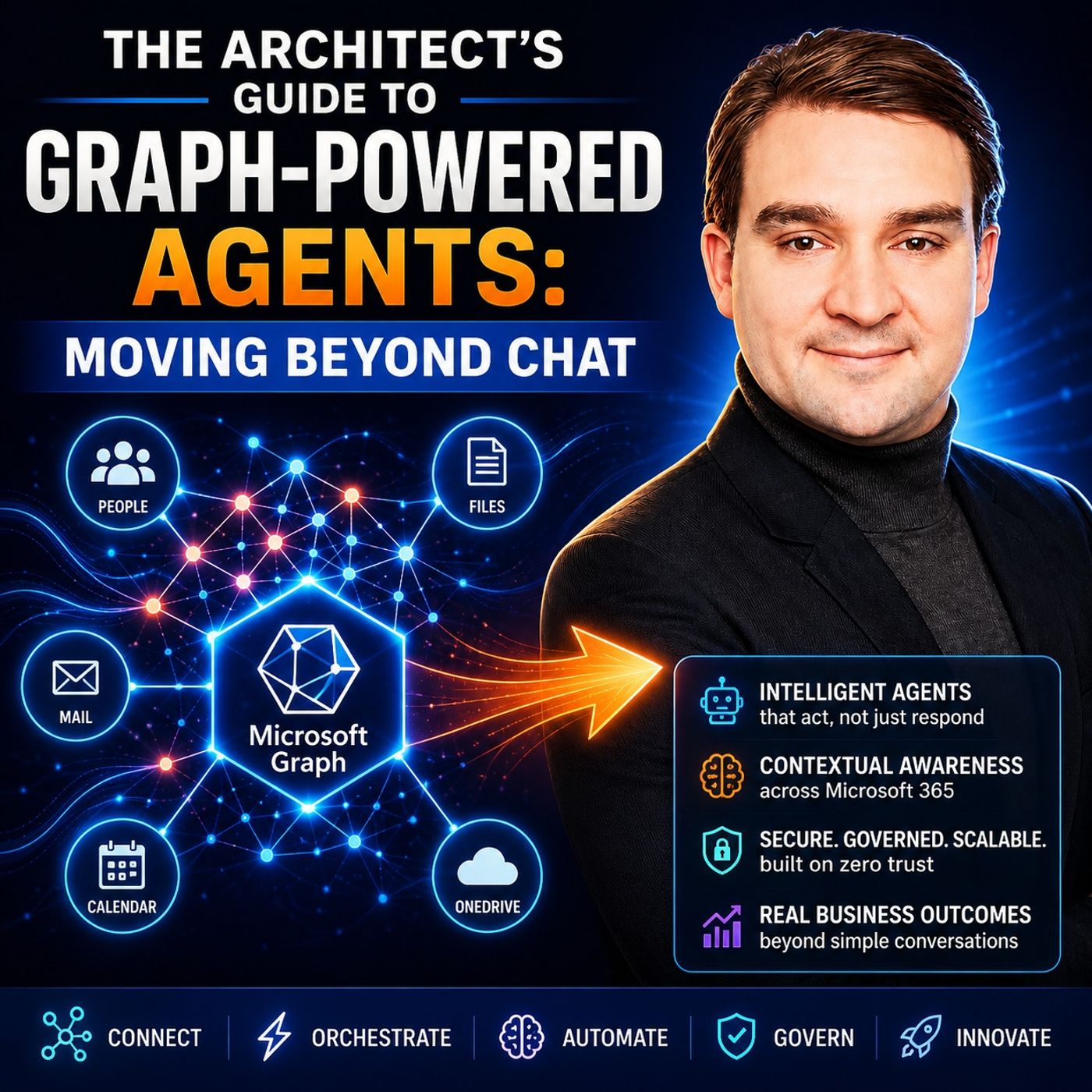
Beyond Chatbots: Why Enterprise Architecture Needs Graph-Powered AI Agents
Welcome back to the podcast blog! Today, we are expanding on a critical shift happening across enterprise ecosystems. If you have been keeping up with our recent episodes, you know that the conversation around artificial intelligence has moved well past simple proof-of-concepts and single-turn interfaces. Organizations are no longer satisfied with static helpers that forget everything the moment a browser tab closes. Instead, enterprise architecture is evolving to embrace dynamic, context-aware systems capable of autonomous reasoning. In this comprehensive deep dive, we will explore how graph-powered AI agents are reshaping modern business infrastructure, driving deep automation, and revolutionizing how we interact with corporate data. If you want a concise, spoken-word breakdown of these concepts, be sure to check out the related podcast episode, Graph-Powered AI Agents: An Enterprise Architecture Guide.
Key Takeaways
- Graph-powered agents go beyond chatbots by using advanced AI to automate complex tasks and improve productivity.
- Microsoft Graph connects people and data, enabling agents to access the right information at the right time for better decision-making.
- Architects can enhance workflows and decision-making by leveraging graph databases for context-aware AI systems.
- Explainability in AI agents builds trust by allowing users to understand how decisions are made through transparent reasoning.
- Persistent memory in agents helps avoid mistakes and improves adaptability by learning from past actions.
- Security and compliance are crucial; implement strict permissions and monitoring to protect data and ensure agent accountability.
- Multi-agent orchestration allows agents to collaborate effectively, improving task management and operational efficiency.
- Using GraphRAG pipelines enhances the accuracy of AI responses by combining retrieval and generation for better contextual understanding.
What Are Graph-Powered Agents?
Evolution from Chatbots to AI Agents
You have likely seen chatbots answer simple questions or follow basic scripts. These tools work with fixed rules and cannot adapt to new situations. Modern AI agents change this landscape. They use advanced models and learn from every interaction. This shift allows them to handle complex tasks and make decisions on their own.
Here is a table that shows the main differences between traditional chatbots and modern AI agents:
| Feature | Traditional Chatbots | Modern AI Agents |
|---|---|---|
| Architecture | Rule-based with predefined logic | Built around large language models (LLMs) |
| Learning and Adaptation | Limited or no memory of past interactions | Continuously learn and adapt from past conversations |
| Decision-making | Follows scripted flows without deeper analysis | Can autonomously make decisions based on complex data |
| Integration and Scalability | Requires manual intervention for new tasks | Seamlessly integrates with other systems and scales |
| Operational Efficiency | Frequent script adjustments needed | Uses feedback loops for continuous improvement |
| Training and Implementation | Extensive manual setup required | Faster and more intuitive deployment |
| Reasoning across turns | Rigid intent taxonomy, struggles with unpredictability | Can reason about tasks and maintain context |
You can see that graph-powered agents go far beyond simple chatbots. They use graph database AI agents to connect information, remember past actions, and reason through multi-step problems.
Role of Microsoft Graph
Microsoft Graph acts as the digital nervous system for your organization. It connects people, documents, and workflows into a single knowledge graph. This structure lets AI agents access the right data at the right time. You can use Microsoft Graph to orchestrate AI agents, streamline workflows with Microsoft 365 Copilot, and extend capabilities via APIs.
Why Architects Should Care
As an architect, you shape how your organization uses technology. Graph-powered agents help you automate workflows, improve decision-making, and create an integrated knowledge base that provides context-awareness across the enterprise.
Graph Database AI Agents: Core Principles
Explainability and Reasoning
You want your agents to make decisions that you can understand and trust. Graph databases provide a rich context layer for AI, which helps you trace how agents reach their conclusions. When agents use a knowledge graph, they can cite specific relationships and facts that led to their recommendations. This transparency builds trust and makes it easier for you to explain AI-driven insights to stakeholders.
Memory and Context with Knowledge Graphs
Knowledge graphs enhance organizational memory by structuring information as interconnected entities and relationships. This structure allows agents to maintain continuity in their understanding, avoid repeating mistakes, and make informed decisions based on historical data.
Security, Identity, and Governance
You must protect your data and ensure agents operate within strict boundaries. Best practices include maintaining an agent registry, defining clear decision rights, using narrow permission bundles, short-lived credentials, and continuous authorization.
Building Graph-Powered Agents
You play a key role in building agents that drive organizational architecture forward. You need to select the right graph databases, integrate AI models, and orchestrate workflows for scalable solutions.
Selecting Graph Databases
Open-source graph databases like FalkorDB, Neo4j, and Memgraph offer flexibility and speed, while enterprise options like Amazon Neptune and Azure Cosmos DB provide advanced security and scalability for production environments.
Integrating AI Models
Integrating AI models with graph databases unlocks advanced reasoning. Utilizing structured tool calling and the Model Context Protocol (MCP) establishes a standardized framework linking AI systems to external tools and data sources.
Workflow Orchestration
Deploying multiple agents requires managing communication, coordination, specialization, and supervisory layers to ensure reliable outcomes and robust enterprise performance.
GraphRAG Pipelines in AI
You use GraphRAG pipelines to boost the accuracy of AI agents by combining retrieval and generation. This method allows agents to access structured knowledge, traverse subgraphs, perform multi-hop reasoning, and produce highly relevant answers based on governed metadata.
Human–AI Organization Design
Designing human-AI organizational systems helps agents collaborate and scale. Utilizing graph-based structures, supervisory layers, and robust AI governance platforms ensures compliance, reduces technical debt, and improves overall organizational intelligence.
Best Practices and Guardrails
Building reliable agents requires structured data models, system observability, deterministic query generation, strict access control, authentication, authorization, encryption, and continuous auditing.
Implementation Examples
Leveraging sample architectures, code patterns for subgraph extraction, and performance optimization techniques ensures your graph-powered agent deployments scale successfully in enterprise production environments.
FAQ
What is a graph-powered agent?
You use a graph-powered agent to automate tasks and make decisions. It connects to a knowledge graph, understands relationships, and reasons through complex problems. This agent helps you improve accuracy and efficiency in your organization.
How does Microsoft Graph support agent development?
Microsoft Graph connects your people, documents, and workflows. You use it to give agents secure access to business data. This foundation helps you build agents that automate processes and deliver real results.
Why is explainability important in AI agents?
You need to trust your AI agents. Explainability lets you see how agents make decisions. This builds confidence and helps you meet compliance requirements. You can review each step the agent takes.
How do graph-powered agents improve organizational intelligence?
You gain organizational intelligence when agents use knowledge graphs. These agents connect data, remember past actions, and share insights. This helps your teams make better decisions and adapt quickly.
What security features protect my data with graph-powered agents?
You control access with authentication and authorization. Microsoft Graph uses strong security measures. You can track every agent action with audit logs. This keeps your data safe and supports compliance.
Can I use multiple agents together in my organization?
Yes, you can deploy several agents to handle different tasks. Multi-agent orchestration lets agents collaborate, share memory, and solve complex problems. You manage these agents with supervisory layers for better control.
How do graph-powered agents scale in large enterprises?
You scale agents by choosing the right graph database and using workflow orchestration. Microsoft Graph and enterprise tools help you manage many agents. This supports growth and maintains high performance.
What is the impact of graph-powered agents on organizational intelligence?
You see a boost in organizational intelligence when agents automate workflows and share knowledge. This leads to faster decisions, improved accuracy, and a smarter workplace.
🎧 Listen to this episode
Want a practical explanation of Graph-Powered AI Agents? This episode breaks down the topic in clear language and shows why it matters for Microsoft 365, Azure, Power Platform, security, AI, and modern work.
Listen to this episode if you want to:
- Understand the key concepts behind Graph-Powered AI Agents
- See how it fits into the wider Microsoft technology ecosystem
- Learn where it can create practical value for your organization
You may also enjoy these related M365 FM episodes:
- From SaaS to AI Agents: Managing Enterprise Architecture Entropy
- From Data to Intelligent Agents: Building Trusted Enterprise AI with Microsoft AI Foundry with Shubhangi Goyal [MVP]
- Microsoft Graph: The Enterprise Nervous System
- Microsoft Graph Automation Architecture: Beyond Scripts
- Microsoft Graph and PowerShell for Enterprise Automation
Discover more practical Microsoft conversations on M365 FM.
Last reviewed: July 2026.
Who Should Listen
This episode is for Microsoft practitioners, architects, developers, security professionals, and IT leaders evaluating the topic in a real-world environment.
🎧 You Should Also Listen To
- AI Agents — A relevant next step that adds practical context to this topic.
- Model Context Protocol — A relevant next step that adds practical context to this topic.
- Microsoft AI Agent Harness — A relevant next step that adds practical context to this topic.

Microsoft MVP | Host of M365.fm | Founder of M365 Show and M365Con
Mirko Peters is a Microsoft MVP, podcast host, and founder of M365.fm, M365 Show, and M365Con. His work connects Microsoft practitioners through podcast interviews, livestreams, and community events.
At M365.fm, Mirko hosts conversations with Microsoft MVPs, product experts, architects, and community contributors. Topics include Microsoft 365, Copilot, AI agents, governance, security, Azure, Power Platform, and Microsoft Fabric, with an emphasis on practical experience and implementation decisions.
M365.fm is the podcast and learning platform. M365 Show brings experts together for livestreams, while M365Con provides an online conference setting for community learning.
Official website: Mirko Peters (https://www.mirkopeters.com/). Recognition: Mirko Peters — Microsoft MVP profile (https://mvp.microsoft.com/de-DE/mvp/profile/9b0ca797-db5a-493a-a845-8b9158046cf5). Connect on LinkedIn (https://www.linkedin.com/in/m365showpodcast/).