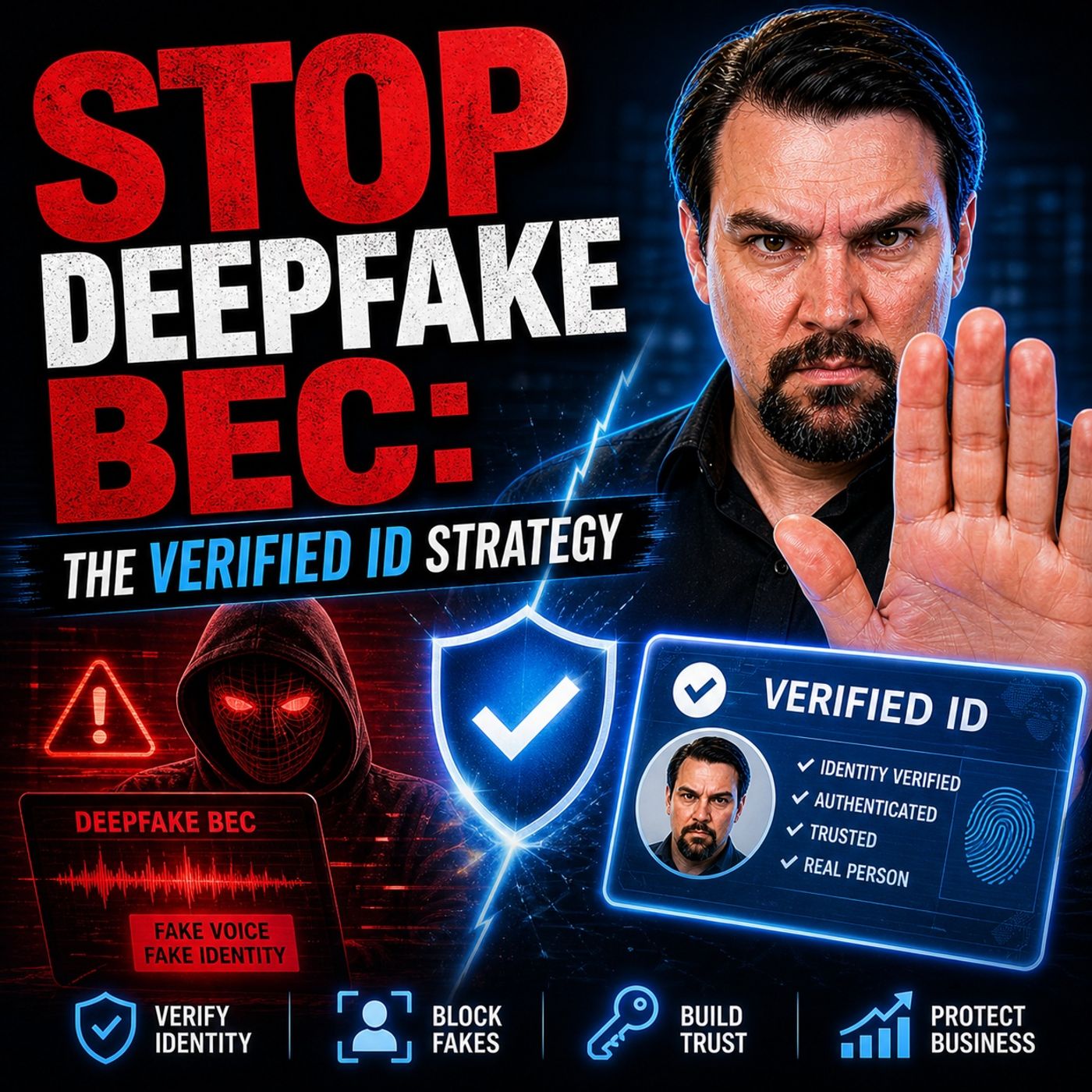
Beyond Email Protocols: Why SPF, DKIM, and DMARC Aren't Enough Against Deepfakes
When it comes to securing corporate inboxes, organizations have long relied on standard email authentication protocols as their primary shield. If you have spent any time in IT security, you know the holy trinity of email defense: Sender Policy Framework (SPF), DomainKeys Identified Mail (DKIM), and Domain-based Message Authentication, Reporting, and Conformance (DMARC). For years, setting up these records correctly meant you could effectively block domain spoofing, keep phishing emails at bay, and ensure that messages claiming to be from your organization actually originated from authorized infrastructure. But the cybersecurity landscape has radically shifted, and the tools we have relied on for decades are facing an unprecedented blind spot.
Enter the era of artificial intelligence and synthetic media. Cybercriminals are no longer relying solely on clumsy text-based phishing emails filled with typos. Instead, they are leveraging advanced generative AI to execute sophisticated Business Email Compromise (BEC) attacks enhanced by deepfakes. These threats bypass the technical checks of traditional email protocols effortlessly because the problem is no longer just about who sent the email—it is about the malicious intent hidden within content that technical protocols simply cannot read. In this post, we will explore why your current email security stack is falling short against deepfake threats and what your organization must do to build a truly resilient defense.
Introduction to Email Security and Deepfake Threats
To understand the depth of the challenge, we first need to look at how threat actors have adapted. Traditional email security protocols were built for a simpler internet. They were designed to stop bad actors from hijacking your domain name or injecting fake headers into messages. When properly implemented, DMARC, SPF, and DKIM create a robust verification loop that tells receiving servers whether an email has authorization and integrity. However, these protocols are fundamentally infrastructure validators, not content arbiters. They do not read the prose, listen to the attached audio, or evaluate whether the person asking for a wire transfer is actually who they claim to be.
As artificial intelligence tools have become democratized, the barrier to entry for creating hyper-realistic synthetic media has plummeted. Attackers can now harvest public-facing video clips, conference recordings, and voice memos of corporate executives to clone their voices and likenesses with startling accuracy. Statistics show a staggering surge in these tactics. In 2023, less than 5 percent of business email compromise attacks incorporated deepfake technology. By 2026, that number climbed to 40 percent. Furthermore, the FBI reported a 25 percent year-over-year increase in deepfake-enabled BEC attacks, with overall deepfake incidents surging over 300 percent annually. When an attacker can combine a cleanly authenticated email with a voice clone or a real-time video deepfake, your standard email filters are rendered virtually useless.
Deepfake BEC Attacks Explained
What Is Deepfake BEC
You may be familiar with traditional Business Email Compromise, where a fraudster poses as a vendor or a C-suite executive to request urgent payments or sensitive data. Deepfake BEC takes this malicious playbook and supercharges it with artificial intelligence. Rather than stopping at a text message or an email, attackers weave synthetic audio, video, or conversational elements into the attack chain. They can mimic the exact cadence, accent, and vocal quirks of your CEO or chief financial officer. These attacks do not try to trick you with a typo-laden email address; instead, they exploit your trust by making you believe you are interacting directly with a familiar authority figure via voice or video.
How Deepfake BEC Differs from Traditional Threats
The fundamental differentiator between legacy BEC and modern deepfake BEC is the medium of deception. Traditional threats rely entirely on text-based manipulation. If you receive an email from your boss asking you to buy gift cards or shift funds, your internal alarm bells might ring if the tone feels slightly off. Deepfake BEC shatters those traditional detection mechanisms by introducing realistic audio or video. You might pick up a phone call that sounds indistinguishable from your manager, or join a quick video conference where a synthetic avatar nods along while speaking with your director's voice. This multi-channel approach exploits your natural human tendencies toward trust and urgency in ways that text filters cannot possibly catch.
Deepfake technology has changed BEC threats by allowing criminals to impersonate authority figures more convincingly. This makes it easier for them to manipulate you and bypass traditional security filters.
Here is a table that shows the main differences:
| Aspect | Traditional BEC | Deepfake BEC |
|---|---|---|
| Communication Method | Text-based communication | Incorporates voice calls or video |
| Deception Techniques | Relies on written requests | Uses realistic synthetic media |
| Detection Evasion | Can be caught by text filters | Bypasses checks with audio/video |
Deepfake BEC attacks can manipulate you more effectively because of realistic voice or video. They exploit urgency and authority, making them more dangerous than traditional phishing. Internal security checks often fail to stop these attacks, which increases the risk for your organization.
The Role of AI in Deepfake BEC
Artificial intelligence serves as the engine driving these complex frauds. Threat actors use AI models to scrape corporate websites, social media profiles, and earnings call recordings to gather training data on key personnel. They clone voices and writing styles to ensure their initial phishing contact feels authentic. A typical deepfake BEC campaign follows a calculated progression:
- Attackers collect OSINT (Open Source Intelligence) details about your executives and corporate hierarchy.
- They feed audio and video samples into AI models to generate convincing voice clones or deepfake video assets.
- Personalized phishing emails or introductory messages are sent to targets, often passing all technical authentication checks.
- Attackers escalate the interaction by jumping to phone calls, voicemails, or video meetings to reinforce pressure.
- The ultimate objective is achieved when the victim transfers funds or hands over credentials under the illusion of executive approval.
Major financial institutions and enterprises have reported alarming incidents involving voice-cloning fraud that bypassed standard security gates. In one notable case, an employee transferred significant funds after interacting with a deepfake audio stream. Deepfake BEC is not merely an evolution of phishing; it is an entirely new category of synthetic fraud.
SPF, DKIM, and DMARC: How They Work
SPF Overview
To understand why these protocols fail against deepfakes, we must first review what they actually do. SPF, or Sender Policy Framework, verifies whether the mail server transmitting a message has explicit authorization to send emails on behalf of a specific domain. When an email arrives at your gateway, the receiving system checks the domain's DNS records for an SPF entry. If the sending server's IP address aligns with the approved list, the message passes SPF. While this mechanism stops basic spoofing where attackers fake the domain in the envelope, it completely ignores the visible "From" address seen by the end user, leaving plenty of room for social engineering.
DKIM Overview
DKIM, or DomainKeys Identified Mail, introduces cryptographic validation into the equation. It attaches a digital signature to outgoing emails, which the receiving mail system verifies using a public key published in the domain's DNS. If the signature matches, you have cryptographic proof that the message content has not been altered in transit. While DKIM guarantees message integrity, it cannot tell you anything about the intent of the sender. Attackers frequently leverage compromised legitimate email accounts—which naturally pass DKIM signatures—to launch convincing phishing campaigns or lay the groundwork for a deepfake escalation.
DMARC Overview
DMARC brings SPF and DKIM together under a unified policy framework. It allows domain owners to define instructions for receiving mail servers on how to handle messages that fail SPF or DKIM checks, while also providing valuable forensic reporting. DMARC protects the visible "From" header, effectively stopping exact-domain spoofing. While it is a critical baseline control for any organization, DMARC does not analyze the semantic content or psychological intent of a message. An attacker can easily register a cousin domain, configure valid SPF, DKIM, and DMARC records for that fraudulent domain, and then use AI to craft deepfake-backed scams that sail right through your DMARC-protected gateway.
Tip: SPF, DKIM, and DMARC work best together. They stop many phishing emails, but they cannot detect deepfake threats that use audio or video to trick you.
Here is a table that summarizes the main functions of these protocols:
| Protocol | Main Function | How it Works | Strengths | Limitations |
|---|---|---|---|---|
| SPF | Verifies sending mail server's authorization | Checks server’s IP against SPF record in DNS | Prevents domain spoofing; easy setup | Does not validate visible “From” address; limited against phishing alone |
| DKIM | Ensures email content integrity and sender identity | Adds cryptographic signature; verified via public key in DNS | Guarantees message integrity; builds trust | Can be broken by forwarding; needs key management |
| DMARC | Combines SPF and DKIM; manages unauthenticated mail | Evaluates SPF/DKIM; applies policy and sends reports | Gives control to domain owners; reduces phishing | Needs SPF/DKIM to work; complex configuration |
You should use these protocols as part of your defense, but always stay alert for deepfake and phishing attacks that can bypass technical controls.
What These Protocols Protect
It is vital to maintain a clear perspective on the boundaries of email authentication. SPF, DKIM, and DMARC are designed exclusively to protect your messaging infrastructure against impersonation at the transport layer. They ensure that messages purporting to come from your domain are genuinely tied to your mail servers, and that the text has not been tampered with mid-flight.
Let’s break down what each protocol covers:
- SPF checks if the email comes from an authorized server, blocking unauthorized senders from using your domain name.
- DKIM adds a digital signature, ensuring the message body and headers remain unchanged since dispatch.
- DMARC operationalizes SPF and DKIM, dictating quarantine or rejection policies for failing messages and delivering visibility reports.
Here is a table to help you see what these protocols protect:
| Protocol | Protects Against | Does Not Protect Against |
|---|---|---|
| SPF | Fake sender servers, some phishing | Deepfake, content-based phishing, voice/video scams |
| DKIM | Message tampering, some phishing | Deepfake, social engineering, voice/video scams |
| DMARC | Domain spoofing, some phishing | Deepfake, intent-based attacks, voice/video scams |
Crucially, none of these protocols evaluate the cognitive content of an email or the secondary communication channels an attacker might use. If an email passes every technical check because it originates from a compromised vendor account, and that email is followed by a deepfake phone call, your email authentication protocols will show a clean bill of health while your organization suffers a catastrophic security breach.
Note: SPF, DKIM, and DMARC help you stop many phishing emails, but they do not protect you from deepfake attacks or advanced fraud. You need extra layers of security to defend against these modern threats.
You must stay vigilant against the evolution of phishing. Authentication protocols are a necessary foundation, but they are entirely insufficient on their own when confronting modern fraud.
Limitations for Deepfake BEC
Sender Authentication vs. Content Verification
The core vulnerability in relying solely on protocols like DMARC is the stark chasm between sender authentication and content verification. SPF, DKIM, and DMARC verify technical alignment, but they remain utterly blind to malicious semantics. An attacker can successfully authenticate an email through a lookalike or newly registered domain, satisfying every DMARC requirement, while the message body contains a finely tuned social engineering hook crafted by artificial intelligence.
Because these protocols operate entirely at the transport and DNS layers, they cannot detect when an executive's identity is being weaponized in the text. This gap allows cybercriminals to craft highly convincing phishing lures that bypass traditional mail filters entirely. The protocol checks the infrastructure, but it knows nothing about the human being allegedly sitting behind the keyboard.
Here is a table that shows the main limitations:
| Protocol | Limitation |
|---|---|
| SPF | Does not verify email content and lacks instructions for handling failures. |
| DKIM | Verifies message integrity but does not dictate actions on failures and can fail in forwarding scenarios. |
| DMARC | Requires correct SPF and/or DKIM setup to enforce policies effectively. |
Understanding these constraints reveals why security teams cannot afford complacency. Technical authentication ensures mail delivery hygiene, but it does nothing to stop deepfake fraud or business email compromise originating from authenticated sources.
Why Deepfake BEC Attacks Succeed
Deepfake BEC attacks succeed because they exploit the psychological vulnerabilities of human targets while navigating cleanly around technical roadblocks. When an employee receives an email that passes all security checks, coupled with a voicemail or video clip that sounds and looks identical to their manager, cognitive defenses drop. Furthermore, structural vulnerabilities in global email routing—such as SMTP smuggling exploits affecting numerous public and private mail services—have historically allowed sophisticated attackers to bypass authentication gateways altogether.
Consider the metrics surrounding executive and security leader confidence:
- 60% of cybersecurity leaders lack confidence in countering deepfake attacks.
- 38% rate traditional awareness training as moderately effective or worse against deepfake audio.
- 39% rate training as moderately effective or worse against deepfake video.
- 28% believe AI-generated phishing is still in its infancy.
- 25% categorize deepfake audio attacks as early-stage threats with massive room for escalation.
This lack of confidence is well-founded. Attackers are combining multi-channel synthetic media with perfectly authenticated emails, creating a recipe for deception that defeats legacy security postures.
Common Security Misconceptions
A persistent myth in IT administration is that achieving a DMARC policy of p=none provides tangible security protection. In reality, p=none is merely a monitoring state designed for gathering reporting data; it does nothing to block unauthenticated or spoofed mail. Organizations must progress to p=quarantine or p=reject to enforce protective boundaries.
Another common misconception is that transactional or internal-only domains do not require rigorous authentication. Failing to secure these domains leaves flank exposures that attackers can exploit. Finally, many administrators assume that implementing DMARC is prohibitively complex, whereas modern deployment tools and automated guidance have streamlined compliance significantly.
Here is a table that clears up common myths:
| Myth | Truth |
|---|---|
| You only need to reach a DMARC policy of p=none to protect yourself. | A policy of p=none is just for reporting and does not provide actual protection against phishing. A stronger policy like p=quarantine or p=reject is needed for true security. |
| We only send transactional emails, so these changes don’t apply to us. | Transactional emails also require sender authentication to ensure delivery and protect the brand. Proper authentication helps avoid spam filters and builds trust. |
| Implementing these changes will require major technical expertise. | Many tools and resources are available to simplify compliance, making it accessible even for non-technical users. |
Note: You must understand that deepfake BEC attacks can bypass traditional protocols. You need to combine technical controls with human awareness and advanced detection tools. Attackers use deepfake technology to create convincing phishing messages. You must stay vigilant and update your security practices to defend against modern fraud.
Deepfake BEC Attack Methods

Real-World Scenarios
Deepfake attacks are no longer theoretical sci-fi scenarios. In January 2024, a multinational engineering firm, Arup, fell victim to a staggering deepfake fraud incident. Attackers utilized real-time video and audio deepfakes during a virtual conference call to impersonate the company's Chief Financial Officer and other senior executives. The synthetic avatars and voices were so convincing that finance employees willingly transferred $25 million across multiple transactions. This landmark incident proved that sophisticated threat actors are actively blending multi-channel synthetic media to completely circumvent standard corporate verification workflows and security best practices.
Deepfake Techniques in BEC
Fraudsters rely heavily on C-suite impersonation because organizational hierarchies naturally induce compliance. When a threat actor successfully clones the voice or video likeness of a CEO, division head, or finance director, they weaponize authority against lower-level employees who handle sensitive financial transactions. These techniques consistently yield massive financial losses because they short-circuit rational skepticism.
Deepfake BEC campaigns typically leverage several overlapping tactics:
- Synthetic voice cloning deployed via telephone calls or voicemail drops.
- Real-time video manipulation during virtual meetings to spoof executive presence.
- AI-assisted email drafting that mirrors the exact communication style and lexicon of the targeted executive.
- Coordinated multi-channel assaults where an authenticated email is instantly backed up by a deepfake phone call.
Human Factors in Deepfake BEC
Ultimately, deepfake BEC targets human psychology rather than technical code. Attackers lean heavily on well-established principles of social engineering to manipulate victims into immediate compliance.
| Principle | Description |
|---|---|
| Authority | Attackers impersonate authority figures, leading individuals to comply without questioning. |
| Urgency | Messages create time pressure, prompting quick and unreflective actions. |
| Social proof | Claims of conformity, such as colleagues completing updates, leverage social influence. |
| Scarcity | Limited-time offers create fear of missing out, increasing compliance. |
| Reciprocity | Providing something of value creates an obligation to reciprocate, enhancing compliance likelihood. |
| Liking | People are more likely to comply with requests from those they like or feel connected to. |
Stay cautious. Deepfake BEC is not just a technical problem. It targets your trust, your habits, and your willingness to help.
Defending Against Deepfake BEC
Employee Training
Because deepfake BEC targets human perception, employee education remains an essential line of defense. However, traditional awareness training focused solely on spotting bad grammar or suspicious email headers is no longer enough. Organizations must invest in immersive deepfake simulation training platforms that expose staff to synthetic media scenarios in a controlled environment. By experiencing simulated deepfake video calls or voice clones from synthetic executives during training, employees build the muscle memory required to pause, reflect, and verify unusual requests before taking action.
Advanced Threat Detection
Technology must complement human awareness. Modern security architectures incorporate advanced threat detection systems driven by artificial intelligence and machine learning. These tools analyze behavioral baselines across communication channels to flag anomalies that standard email filters miss.
| Technology Type | Description |
|---|---|
| AI-powered fraud detection | Utilizes artificial intelligence to identify fraudulent activities, including deepfake attempts. |
| Anomaly detection systems | Monitors for unusual patterns that may indicate deepfake BEC attempts. |
| Deepfake detection tools | Specialized tools designed to identify AI-generated content, enhancing security against deepfakes. |
Out-of-Band Verification
One of the simplest yet most effective countermeasures against deepfake BEC is strict adherence to out-of-band verification protocols. Whenever an employee receives an urgent or high-risk request involving wire transfers, credential sharing, or policy overrides—regardless of how authentic the email, voice, or video call appears—they must verify the request through an independent, pre-established channel.
- Out-of-band verification requires confirming unusual requests through a second, independent communication medium, such as calling back on a known, internal corporate extension.
- Users should validate sensitive instructions through two separate, pre-approved pathways to ensure that a compromised primary channel does not compromise the entire verification loop.
Policy Improvements
Technical controls and training must be backed by uncompromising organizational policies. Review your corporate governance framework to ensure that high-risk financial and administrative actions require multi-person approval workflows and strict role-based access controls. Establish crystal-clear reporting procedures so employees feel empowered to flag suspicious communications without fear of repercussions.
| Policy Type | Benefit |
|---|---|
| Multi-channel verification | Stops fraud by requiring checks in two ways |
| Role-based approval | Limits who can approve high-risk actions |
| Incident reporting | Helps you respond quickly to suspicious activity |
| Regular policy reviews | Keeps your defenses up to date |
Tip: Clear policies help you stop phishing and deepfake attacks. When everyone knows the rules, you reduce mistakes and keep your organization safe.
Microsoft Entra Verified ID Solution
How Entra Verified ID Works
To truly solve the deepfake BEC crisis, organizations must transition from recognition-based trust to cryptographic, evidence-based verification. Microsoft Entra Verified ID provides a robust decentralized identity solution that allows organizations to cryptographically verify both the identity and the authority of individuals before granting access or approving high-risk actions.
Entra Verified ID integrates visual verification mechanisms, including government-issued photo ID checks and liveness detection during onboarding, ensuring that the person holding a credential is physically present and verified. By combining device attestation, behavioral biometrics, and verifiable credentials, you eliminate the vulnerabilities associated with trusting a familiar voice or face alone.
Note: Entra Verified ID does not replace your current controls. It adds a strong layer that focuses on proof, not just recognition.
Authority Verification vs. Identity Verification
Identity verification confirms who a person is, but authority verification determines whether that person has the specific mandate to execute a high-risk transaction. Entra Verified ID utilizes an issuer-holder-verifier architecture that gives organizations precise control over credential issuance and revocation.
| Dimension | IDV-issued credential | Org-issued credential |
|---|---|---|
| Issuer | Third-party identity verification provider | Your organization through its own Verified ID authority |
| Trust Anchor | The IDV's issuer DID and reputation | Your organization's DID and onboarding process |
| Portability | Higher portability across employers | Strongest inside a known workforce or partner boundary |
| Revocation | Controlled by the IDV | Controlled directly by the organization |
| Cost | Partner-priced with fees | Core issuance included with Entra |
| Data Liability | More raw identity evidence stays with the IDV | More assurance and evidence handling decisions stay with the organization |
| Best-fit Scenarios | Pre-employment proofing, account recovery | Workforce access, B2B trust inside known boundaries |
Integrating Entra Verified ID with Existing Security
You do not need to discard your existing Microsoft 365 security investments to adopt Entra Verified ID. It integrates smoothly into your Zero Trust strategy, operating alongside conditional access policies, endpoint protection, and advanced threat analytics. By requiring a verifiable credential for sensitive workflows—such as large financial transfers or administrative overrides—you neutralize deepfake BEC attempts because an attacker cannot forge cryptographic authority.
Tip: Use Entra Verified ID to confirm both identity and authority. This step helps you stop deepfake bec attacks and keep your organization safe.
You cannot rely on SPF, DKIM, and DMARC alone to stop deepfake BEC attacks. These tools do not block lookalike domains or AI-powered impersonation.
SPF, DKIM, and DMARC do not prevent lookalike domain attacks, cousin domain attacks, or impersonation via free webmail accounts. These protocols rely on human judgment, which can be easily manipulated by AI-generated content.
You need a multi-layered defense. Start with employee education, risk management, and best practices. Add advanced solutions like Microsoft Entra Verified ID for authority verification.
- In 2024, BEC attacks caused $2.9 billion in losses in the United States alone.
- The average BEC scam cost businesses $137,132 per individual incident.
Use phishing simulations, continuous monitoring, and regular training to measure your defenses and keep your organization safe.
🎧 Listen to this episode
Want a practical explanation of Stop Deepfake Business Email Compromise with Verified ID? This episode breaks down the topic in clear language and shows why it matters for Microsoft 365, Azure, Power Platform, security, AI, and modern work.
Listen to this episode if you want to:
- Understand the key concepts behind Stop Deepfake Business Email Compromise with Verified ID
- See how it fits into the wider Microsoft technology ecosystem
- Learn where it can create practical value for your organization
You may also enjoy these related M365 FM episodes:
- Service Principal Security: Stop Using Personal Accounts
- Stop Microsoft Copilot Prompt Injection with Azure Logic Apps
- Stop Outsourcing Human Judgment to Microsoft Copilot
- Stop Azure Cost Entropy with Ownership and Budget Controls
- How to Stop AI Agents from Deleting Important Emails
Discover more practical Microsoft conversations on M365 FM.

Microsoft MVP | Host of M365.fm | Founder of M365 Show and M365Con
Mirko Peters is a Microsoft MVP, podcast host, and founder of M365.fm, M365 Show, and M365Con. His work connects Microsoft practitioners through podcast interviews, livestreams, and community events.
At M365.fm, Mirko hosts conversations with Microsoft MVPs, product experts, architects, and community contributors. Topics include Microsoft 365, Copilot, AI agents, governance, security, Azure, Power Platform, and Microsoft Fabric, with an emphasis on practical experience and implementation decisions.
M365.fm is the podcast and learning platform. M365 Show brings experts together for livestreams, while M365Con provides an online conference setting for community learning.
Official website: Mirko Peters (https://www.mirkopeters.com/). Recognition: Mirko Peters — Microsoft MVP profile (https://mvp.microsoft.com/de-DE/mvp/profile/9b0ca797-db5a-493a-a845-8b9158046cf5). Connect on LinkedIn (https://www.linkedin.com/in/m365showpodcast/).