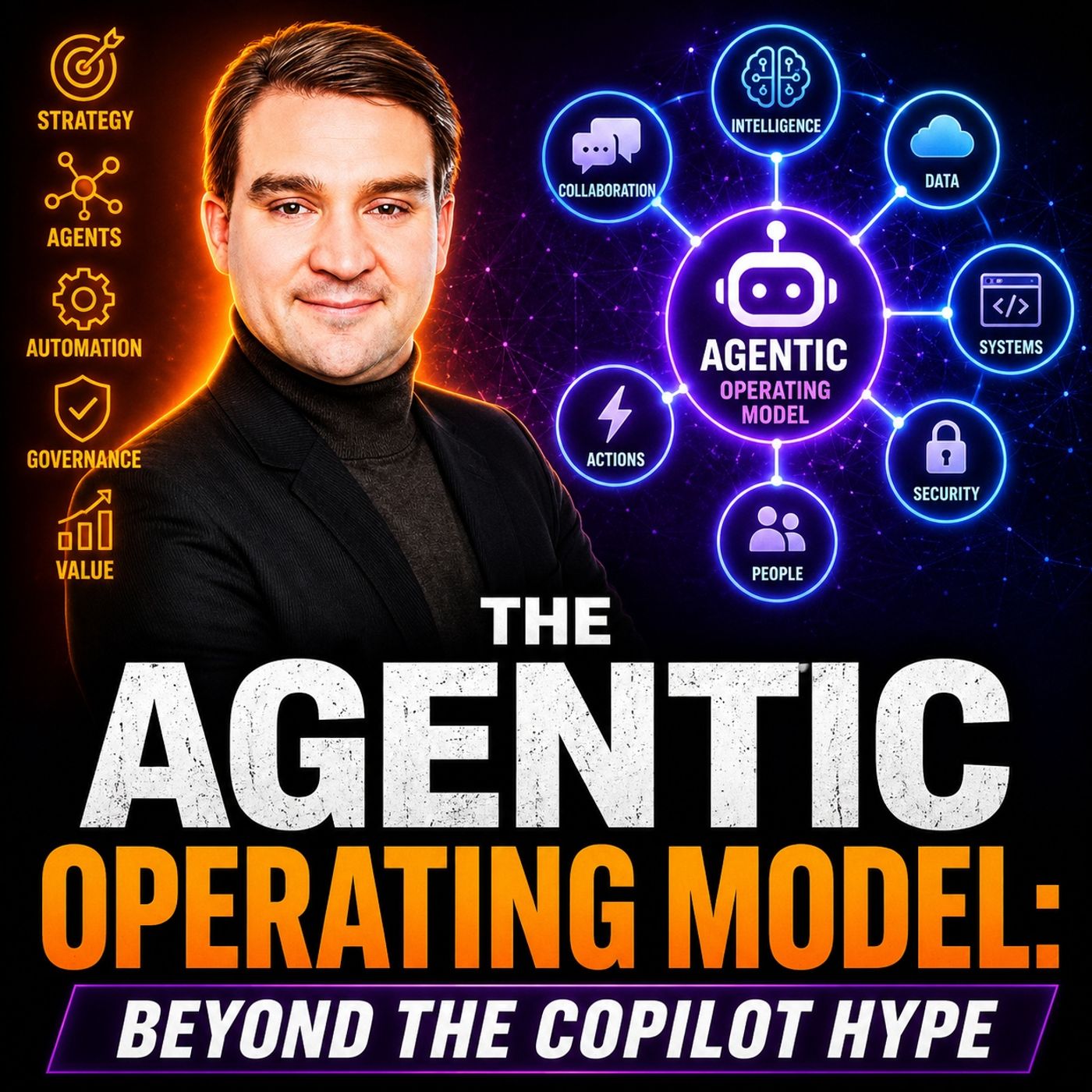
Beyond the Prompt: Why Your Business Needs an Agentic Operating Model
Welcome to our deep dive into the evolution of workplace technology. If you have ever felt like your team spends more time managing AI prompts than actually getting work done, you are not alone. While basic chat assistants have introduced millions of knowledge workers to the potential of artificial intelligence, they still require constant human supervision to cross the finish line. Today, we are moving past the limitations of traditional chat tools and exploring why organizations are transitioning toward fully autonomous, multi-agent frameworks. This shift is not just an incremental upgrade; it is a fundamental redesign of how business gets done.
In our latest podcast episode, Agentic Operating Model for Enterprise AI and Copilot, we unpack the mechanics behind this massive enterprise shift. We examine how agentic frameworks operate in real-world Microsoft environments, tackle the security and data architecture choices that matter most, and explore how autonomous agents are reshaping productivity metrics. In this post, we will expand on those themes, breaking down everything from architectural layers to practical implementation strategies so your business can harness the full power of agentic AI.
Agentic Operating Model Overview
What Is the Agentic Operating Model
You see the agentic operating model as a new way to use AI in your business. This model lets you redesign workflows by integrating AI agents that perform knowledge-heavy tasks. These agents do more than assist; they actively participate in executing tasks within your systems and processes. You move from a human-centric execution model to one where AI shares responsibility. This change requires new management approaches and clear governance.
- The agentic operating model enables you to:
- Assign AI agents to specific tasks with clear boundaries.
- Create a workforce where AI agents and humans work together.
- Build systems that support both human and AI execution.
Microsoft Agent 365 shows how this model works in practice. You can break down complex requests into manageable steps. The agent coordinates actions across Word, Excel, Teams, and Outlook. It continues to work over time, giving you progress updates and checkpoints for intervention.
Why Agentic AI Matters
You need agentic AI because it delivers real value for your organization. It helps you automate tasks, improve customer service, and make better decisions. You see measurable outcomes when you use agentic AI in your workflows.
| Key Factor | Explanation |
|---|---|
| Data hygiene is critical. | Incomplete or incorrect data limits the effectiveness of agentic AI, so you must centralize your data. |
| Projects require clearly set expectations. | Without defined success metrics, you risk ambiguity and budget cuts. |
| Cost concerns are especially salient for SMBs. | Financial constraints often lead smaller businesses to abandon projects. |
Agentic AI uses both static and liquid context. Static context includes documented knowledge and procedures. Liquid context reflects the real-time state of work across your organization. Agent 365 leverages real-time signals, so you get decisions that match your current operations. You move beyond document retrieval and into intelligent decision-making.
Tip: You should focus on data quality and clear goals when deploying agentic AI. This approach helps you maximize value and avoid common pitfalls.
Key Differences from Copilot AI
You notice clear differences between agentic AI and Copilot AI. Copilot AI relies on human prompts and works as an advanced chat interface. Agentic AI manages complex workflows and makes decisions using integrated data.
| Feature/Capability | Agentic AI | Copilot AI |
|---|---|---|
| Workflow Handling | Autonomously manages complex workflows without human intervention | Requires human prompts to function |
| Decision Making | Makes decisions based on integrated data from various systems | Limited to generative responses |
| Customer Service Interaction | Handles full lifecycle of service interactions autonomously | Functions as a decision tree chatbot |
| Operational Cost Reduction Prediction | Expected to resolve 80% of issues without human help, reducing costs by 30% | Not applicable |
| Research and Analysis Capability | Synthesizes findings from multiple sources into structured analysis | Limited to user-provided information |
Agentic AI shifts your business from reactive automation to proactive resolution. You see agents that anticipate needs and act before problems arise. Agent 365 coordinates multiple steps and app interactions, delivering end-to-end outcomes instead of isolated outputs. This shift represents a fundamental change in how you manage and execute tasks.
- You benefit from:
- AI that coordinates actions across applications.
- End-to-end outcomes rather than single outputs.
- Visible progress and checkpoints for human review.
You unlock greater value with the agentic operating model. You build systems that reason, coordinate, and act at machine speed. You move your organization into a new era of AI-driven transformation.
Copilot Hype vs. Agentic AI
Copilot AI Limitations
Task Boundaries
You may find Copilot AI helpful for simple tasks, but it often struggles with complex workflows. Copilot AI works best when you give it clear, single-step instructions. It cannot manage tasks that require multiple steps or coordination across different systems. This limitation creates boundaries that restrict how much value you can extract from your AI investment.
The following table highlights some of the most common limitations you might encounter with Copilot AI in enterprise settings:
| Limitation Type | Description |
|---|---|
| Unauthorized actions | Risks of compromised agents or connectors leading to misuse of access to sensitive information. |
| Data exfiltration | Complex data flows from various sources increase the risk of data leakage. |
| Inadvertent financial commitments | Automation may lead to unintended purchases or bookings without proper confirmations. |
| Auditability and forensics | Need for reliable logs and trails for long-running automated tasks to ensure accountability. |
| Site fragility and brittle automation | Changes in web interfaces can disrupt automation, leading to incorrect outcomes. |
You see that these boundaries limit the effectiveness of Copilot AI. You may need to step in frequently to correct errors or handle exceptions.
Human Dependency
Copilot AI depends heavily on your input. You must prompt it for every action, and you remain responsible for the outcome. This dependency means you cannot fully automate processes or trust the AI to handle tasks independently. You may notice that Copilot AI supports your thinking and preparation, but you still own the results.
Note: Copilot AI can help you with routine questions, but it cannot drive progress on its own.
Need for Agentic Operating Model
You need a new approach when you want to move beyond these limitations. The agentic operating model gives you a way to redesign workflows so that AI agents can own task progression and system progress. With agentic AI, you shift from simply retrieving documents to making intelligent decisions based on real-time data.
The table below compares how workflow redesign and value generation differ between Copilot AI and agentic models:
| Model | Workflow Redesign | Value Generation |
|---|---|---|
| Copilot AI | AI supports thinking and preparation | Human owns the outcome |
| Agentic AI | AI owns task progression | System owns progress |
Agentic AI, as seen in Microsoft Agent 365, moves you past the limitations of Copilot AI. You can assign agents to handle entire processes, not just single tasks. These agents use both static and liquid context to make decisions that reflect the current state of your business. You gain more value because the system can act proactively, reducing your need to intervene.
You see a real impact when you adopt the agentic operating model. You empower your organization to automate complex workflows, improve accountability, and generate measurable results. This shift helps you unlock the full potential of AI and prepares your business for the future.
Agentic Operating Model Architecture

The agentic operating model gives you a clear structure for building enterprise-ready autonomous AI. You can see how each layer works together to create agentic systems that reason, collaborate, and act with minimal human input. This architecture helps you scale agentic AI across your organization while keeping control and oversight.
| Layer | Description |
|---|---|
| Cognitive Layer | Defines how intelligence is instantiated, using multiple specialized models for specific tasks. |
| Coordination Layer | Governs agent interactions, shifting from centralized orchestration to decentralized swarm intelligence. |
| Control Layer | Addresses the management of agent performance and decision-making processes. |
| Governance Layer | Ensures compliance and oversight across the operating model. |
Cognitive Layer
The cognitive layer forms the "brain" of agentic systems. You use this layer to give your autonomous AI the ability to understand, reason, and adapt. In Agent 365, the cognitive layer uses multiple specialized models to handle different tasks. This approach lets you match the right intelligence to each business need.
Reasoning and Adaptation
You want your agentic AI to do more than follow scripts. The cognitive layer uses advanced mechanisms to help agents think and learn. These mechanisms include:
| Mechanism | Description |
|---|---|
| Cognitive Loop Architecture | Agents follow a cycle of perception, analysis, planning, action, and learning. This loop helps them improve decisions and adapt to new situations. |
| Contextual Understanding | Agents keep track of the situation and use context to give relevant responses. This prevents mistakes and keeps actions appropriate. |
| Problem Decomposition | Agents break down complex problems into smaller steps. This makes it easier to solve big challenges and use resources wisely. |
| Goal-Driven Planning | Agents set goals, plan steps, and adjust as things change. This keeps them focused and flexible. |
| Knowledge Representation | Agents use knowledge graphs and smart search to find the right information fast. This supports better decisions across large data sets. |
| Adaptability Features | Agents update their plans when they get new information. They use learning algorithms to improve without losing stability or performance. |
You benefit from agentic systems that can reason through complex scenarios and adapt to changes in real time. This makes your autonomous AI more reliable and valuable.
Coordination Layer
The coordination layer helps your agentic systems work together. You need this layer to manage how multiple autonomous AI agents interact, share tasks, and avoid conflicts. In Agent 365, the coordination layer supports both centralized and decentralized collaboration.
Multi-Agent Collaboration
You can use several patterns to coordinate agentic AI in your enterprise:
| Mechanism/Pattern | Description |
|---|---|
| Policy Constraints | Agents follow enterprise rules for data privacy and compliance. |
| Audit Logs | The system records all agent actions for accountability. |
| Escalation Triggers | Agents alert humans when they find problems or exceptions. |
| Sandboxing | High-risk actions run in safe environments before going live. |
| Centralized Orchestrator | A manager agent assigns tasks to worker agents, like a team leader. |
| Hierarchical Orchestration | Multiple layers of agents manage and execute tasks, similar to a company org chart. |
| Decentralized Swarms | Agents self-organize and negotiate, working together like a swarm of ants. |
| Governed Context Layer | The system resolves conflicts and provides a shared understanding for all agents. |
You gain flexibility by choosing the right collaboration pattern for your needs. This layer lets your agentic systems scale from small teams to large, enterprise-wide networks of autonomous AI.
Control Layer
The control layer ensures your agentic systems act safely and effectively. You use this layer to manage how autonomous AI executes tasks and makes decisions. Agent 365 uses several mechanisms to keep agent actions reliable and within set boundaries.
Task Execution
You can trust your agentic AI to perform tasks because the control layer uses:
| Mechanism | Function |
|---|---|
| Confidence Thresholds | Agents only act when their reasoning meets a set confidence score. This blocks risky actions. |
| Behavioral Baselines | The system sets limits on what agents can do, preventing errors or overreach. |
| Guardrail Agents | Special agents monitor outputs and step in if actions go beyond safe limits. |
You see fewer mistakes and more consistent results. The control layer gives you peace of mind as you scale agentic systems and autonomous AI across your business.
Tip: When you design agentic operating model architectures, focus on how each layer supports autonomy, safety, and collaboration. This approach helps you build robust agentic systems that deliver real value.
Governance Layer
Policy and Identity Management
You need strong governance to manage agentic AI in your organization. The governance layer gives you control over agent identities, policies, and lifecycle management. This layer helps you build trust and accountability. You see how Agent 365 uses these principles to create a secure and reliable environment for digital workers.
Agent identities play a key role in agentic operating models. You assign each agent a unique identity. This identity tracks ownership, actions, and permissions. You move away from generic service accounts and use dedicated agent personas. This change improves traceability and makes it easier to audit agent activity.
You must manage the lifecycle of each agent. You create agents, monitor their actions, and retire them when they are no longer needed. You use clear policies to define what agents can do. You set boundaries for data access and task execution. You enforce these rules with real-time monitoring and compliance checks.
Agent 365 uses a layered governance framework. You see how each layer supports policy and identity management:
| Layer | Description |
|---|---|
| 1 | Identity & Persona Registry: Centralized record for agent ownership and accountability, enforcing least privilege. |
| 2 | Orchestration & Mediation Layer: Manages communication and conflict resolution between agents, ensuring policy adherence. |
| 3 | Context & Memory Layer: Ensures continuity and HIPAA compliance while managing sensitive data access. |
| 4 | Guardrail & Compliance Layer: Provides real-time monitoring and oversight to prevent unauthorized actions. |
| 5 | Lifecycle & Decommissioning Layer: Manages the entire lifecycle of agents, from creation to decommissioning, ensuring accountability. |
You use the Identity & Persona Registry to keep a record of every agent. You enforce least privilege, so agents only access what they need. The Orchestration & Mediation Layer helps agents communicate and resolve conflicts. You make sure agents follow your policies at all times.
The Context & Memory Layer protects sensitive data. You ensure compliance with regulations like HIPAA. You use the Guardrail & Compliance Layer to monitor agent actions in real time. You prevent unauthorized activity and keep your systems safe.
You manage the entire lifecycle of agents with the Lifecycle & Decommissioning Layer. You track agents from creation to retirement. You keep your environment clean and accountable.
Tip: You should review agent identities and policies regularly. This practice helps you maintain security and compliance as your agentic AI grows.
You embed autonomy within explicit governance layers. You give agents freedom to act, but you set clear boundaries. You use policy enforcement, identity management, and real-time oversight to scale agentic AI safely. You build a foundation for trust and accountability in your enterprise.
Organizational Readiness for Agentic AI

Readiness Assessment
You must assess your organization’s readiness before you deploy agentic AI. This process starts with understanding your unique enterprise processes. You need to ensure transparency and trust in your AI systems. Addressing human factors, such as identity disruption and trust navigation, is essential. Preparing your workflows for AI integration helps you avoid common pitfalls.
- Assess your current workflows and identify areas for AI integration.
- Build transparency into your AI systems to foster trust.
- Prepare your teams for changes in roles and responsibilities.
- Address concerns about identity and accountability as you move to agent identities.
Culture and Leadership
Your culture and leadership set the tone for successful AI adoption. Leaders must champion the transformation and communicate a clear vision. Employees need to feel supported as they adapt to new ways of working. Transparent communication helps reduce resistance and builds trust in agentic systems.
Skills and Talent
You need the right skills and talent to support agentic AI. Upskill your workforce in areas like data literacy, AI ethics, and digital collaboration. Consider partnering with AI consulting services to fill gaps and accelerate your journey. A skilled team ensures your agentic model delivers measurable business impact.
Data Requirements
Quality and Accessibility
High-quality data is essential for agentic AI systems. Your data must be accurate, complete, and properly formatted for AI consumption. Data quality often determines whether your deployment succeeds or fails.
| Evidence | Description |
|---|---|
| High-quality data is essential for the success of agentic AI systems. | Organizations should ensure that their data is accurate, complete, and properly formatted for AI consumption. |
| Data quality is widely regarded as the single most influential factor in determining whether an agentic AI deployment succeeds or fails in production. | This highlights the critical role of data quality in the deployment process. |
| AI agents are only as reliable as the data they operate on. | Poorly governed enterprise data can lead to incorrect decisions by AI agents. |
| Data quality, accessibility, and lineage are foundational requirements. | Organizations must address these areas before deploying agentic AI. |
You should also ensure data accessibility. Make sure your systems allow agents to access the information they need while maintaining security and compliance.
Real-Time Integration
Agentic systems require real-time data integration. Many organizations struggle with structural misalignment when integrating AI into existing workflows. Traditional hierarchies may clash with the cross-functional collaboration needed for agentic models. You must design workflows that support real-time signals and decision-making. Security frameworks should address both intended and unexpected behaviors of AI agents.
Change Management
Stakeholder Engagement
Engage stakeholders early in your transformation. Employees may resist AI adoption due to fears of job loss. Transparent communication and involvement help build trust and reduce resistance. You should explain how agentic systems improve customer experience and create new opportunities.
Training and Upskilling
Training and upskilling are vital for successful AI operating models. Provide ongoing education on new tools, processes, and best practices. Support your teams as they transition from service accounts to agent identities. Registration, ownership management, and retirement controls ensure accountability and trust.
Tip: Start with a clear plan for agent registration and ownership. Assign unique identifiers to each agent and establish clear lines of responsibility.
By focusing on readiness, data quality, and change management, you prepare your organization for agentic AI. This approach helps you unlock automation consulting services, drive business impact, and achieve sustainable AI adoption.
Agentic AI in Practice
Success Stories
Industry Examples
You can see how organizations use Agent 365 to transform their operations. Many companies across different industries have adopted this agentic operating model. They report improvements in speed, quality, and decision-making. For example, KPMG uses Agent 365 to deliver services faster and with more consistency. Integra LifeSciences relies on it for better operational performance and quicker, data-driven decisions. Other organizations have seen lower costs per claim, faster processing, and improved customer outcomes.
| Organization | Measurable Outcomes |
|---|---|
| KPMG | Improved speed, quality, and consistency in service delivery |
| Integra LifeSciences | Enhanced operational performance and faster, data-driven decisions |
| General | Lower cost per claim, faster processing, better customer outcomes |
These examples show how agentic AI can help you achieve real business value. You can automate complex workflows and make smarter decisions in real time.
Measurable Outcomes
When you deploy agentic AI, you often see measurable results. Companies report faster turnaround times and higher customer satisfaction. You may notice reduced operational costs and fewer manual errors. Agent 365 helps you track these outcomes, so you can prove the value of your investment. Many organizations find that agentic AI leads to better compliance and more reliable processes.
Lessons from Failure
Common Pitfalls
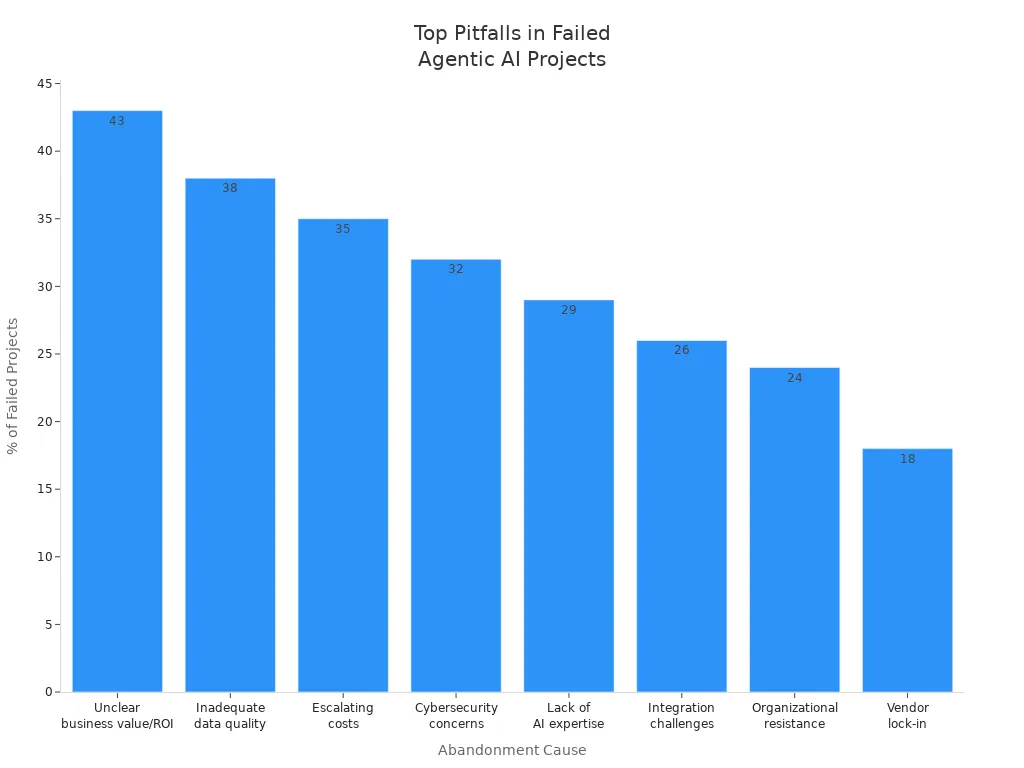
Not every agentic AI project succeeds. Some organizations face challenges that lead to project failure. The most common reasons include unclear business value, poor data quality, and rising costs. Lack of internal expertise and integration issues with legacy systems also cause problems. You may encounter resistance from employees or concerns about cybersecurity.
| Abandonment Cause | % of Failed Projects | Most Affected Company Size | Average Timeline to Failure (Months) |
|---|---|---|---|
| Unclear business value/ROI | 43% | Mid-Market | 6-9 |
| Inadequate data quality or availability | 38% | All sizes | 3-6 |
| Escalating costs | 35% | SMB | 3-5 |
| Cybersecurity and risk management concerns | 32% | Enterprise | 8-12 |
| Lack of internal AI expertise | 29% | Mid-Market | 4-8 |
| Integration challenges with legacy systems | 26% | Enterprise | 6-10 |
| Organizational resistance and change management failure | 24% | Enterprise | 10-14 |
| Vendor lock-in concerns | 18% | Mid-Market | 5-7 |
Recovery Strategies
You can avoid these pitfalls by setting clear goals and measuring progress. Focus on data quality from the start. Invest in training your team and building internal AI expertise. Engage stakeholders early and address their concerns. When you face integration challenges, work with partners who understand both your legacy systems and new AI solutions. Regular reviews and transparent communication help you stay on track and recover quickly if problems arise.
Tip: Start small, learn from early deployments, and scale your agentic AI as your organization gains confidence.
Governance and Risk in Agentic Operating Model
Governance Structures
You need strong governance structures to keep your agentic operating model safe and effective. These structures help you enforce policies, meet compliance needs, and track every action your AI agents take. Good governance gives you control and builds trust in your system.
- The governance layer assigns accountability for agent behavior. You make sure each agent follows your organization’s rules and meets regulatory standards.
- Accountability mechanisms give every agent a clear business owner and a defined risk profile. You always know who is responsible for each agent.
- Proactive controls help you prevent problems before they happen. You do not wait for audits to find issues. Instead, you set up checks that stop mistakes early.
- Digital provenance lets you trace every action and decision made by your agents. You can see what happened, when, and why.
These structures help you manage risk and keep your AI agents working as intended.
Risk Management
You must manage risk when you use AI agents in your business. Agent 365 helps you do this by centralizing governance and connecting your agents to enterprise security and compliance tools. You assign each agent a unique identity using Microsoft Entra. This makes it easy to track actions and set clear ownership.
Agent 365 lets you apply the same policies to all your agents. You use role-based access control to decide what each agent can do. You also monitor agent behavior all the time. This approach helps you spot problems quickly and keep your data safe. You can trust that your AI agents follow your company’s rules and meet industry standards.
Accountability and Transparency
You need clear accountability and transparency when you use agentic AI. The right mechanisms help you show how decisions are made and who is responsible. The table below lists some key tools you can use:
| Mechanism | Description |
|---|---|
| Governance frameworks | You set up a structure to oversee AI systems and make sure someone is always accountable. |
| Ethical oversight | You check that AI decisions are fair and open, especially in sensitive areas. |
| Audit trails | You keep records of every decision made by AI, which is important for regulated industries. |
| Compliance with regulatory standards | You design your AI systems to follow the law and meet all required standards. |
These tools help you build trust in your AI systems. You can show regulators, customers, and your team that your AI agents act responsibly and transparently.
Tip: Review your governance and risk controls often. This keeps your agentic operating model strong as your business and technology change.
Actionable Steps for Leaders
Strategic Adoption
You play a critical role in shaping how your organization uses AI. Treat AI as a core part of your future strategy, not just an experiment. Build governance, talent, and infrastructure to support integration into daily operations. Make decisions quickly to avoid falling behind competitors. Address common roadblocks such as lack of cohesion and poor alignment with leadership vision. Commit to a strategic path, even if you do not have every use case mapped out.
- Treat AI as a central pillar of your business strategy.
- Invest in governance frameworks and skilled teams.
- Build infrastructure that supports scalable AI deployment.
- Act decisively to maintain a competitive edge.
- Align leadership vision with operational execution.
- Move forward with a clear commitment, rather than waiting for perfect conditions.
Tip: When you unlock value with AI, you create new opportunities for growth and innovation.
Roadmap for Agentic AI
You need a clear roadmap to implement the agentic operating model at scale. Start by identifying automation targets that are high in volume but low in complexity. Evaluate whether to buy or build your AI architecture. Map out workflows and plan for exception handling. Validate your approach with human-in-the-loop processes before launching in production. Optimize your systems after launch for continuous improvement.
| Phase | Duration | Goal |
|---|---|---|
| 1 | Weeks 1-2 | Identify high-volume, low-complexity automation targets. |
| 2 | Week 3 | Evaluate Buy vs. Build architectures. |
| 3 | Weeks 4-6 | Workflow mapping and exception handling. |
| 4 | Weeks 7-8 | Validation and Grounding with Human-in-the-Loop. |
| 5 | Month 3+ | Production Launch and Optimization. |
You can use Agent 365 to build intelligent operating systems that support this roadmap. The model helps you coordinate agents, manage identities, and ensure compliance at every stage.
Measuring Success
You must measure the impact of your agentic AI initiatives to prove their value. Focus on metrics that matter at operational, strategic, and transformational levels. Track and communicate the value your agents deliver. Connect agent outcomes to your enterprise objectives.
- Measure direct financial impact, such as revenue growth and profitability.
- Track how agentic AI supports your business goals.
- Communicate results to stakeholders clearly and regularly.
- Focus on tangible business results, not just productivity gains.
Note: Enterprises now prioritize business outcomes over traditional efficiency metrics when evaluating AI success.
By following these steps, you can lead your organization through a successful transition to the agentic operating model. You will build systems that reason, act, and deliver measurable value.
You now see how the agentic operating model transforms enterprise value creation.
Agentic AI marks a leap from content creation to autonomous action and problem-solving. It orchestrates multi-agent collaboration and adapts to real-time context, reducing manual work and operational costs.
You must move beyond Copilot hype by focusing on governance, agent identities, and real-time signals. To prepare for the future, prioritize operational readiness, data infrastructure, and change management.
- Build agentic systems on open standards for flexibility.
- Develop talent and pilot programs for measurable results.
| Trend Description | Evidence |
|---|---|
| Surge in multi-agent system inquiries | 1,445% increase by 2025 |
| Task-specific AI agent integration | 40% by 2026 |
| SLMs surpassing LLMs in relevance | 72% of executives by 2030 |
You shape the next era of AI by embracing agentic architectures that drive lasting impact. To hear more about this transformative approach, make sure to listen to our dedicated episode, Agentic Operating Model for Enterprise AI and Copilot.
FAQ
What is the agentic operating model?
You use the agentic operating model to let AI agents act as digital workers. These agents reason, coordinate, and make decisions in your business processes. This model helps you automate complex tasks and improve outcomes.
How does Agent 365 differ from Copilot AI?
Agent 365 acts as a governed digital worker. You see it manage tasks, make decisions, and use real-time data. Copilot AI works as an assistant that needs your prompts. Agent 365 operates with more autonomy and accountability.
Why do agent identities matter?
You assign each agent a unique identity. This lets you track actions, set permissions, and ensure accountability. You move away from shared service accounts. Agent identities help you build trust and meet compliance needs.
What is liquid context in agentic AI?
Liquid context means your AI agents use real-time signals and data. They adapt to changes as they happen. This helps you get decisions that match your current business state, not just past information.
How do you prepare your data for agentic AI?
You start by checking your data for accuracy and completeness. You organize it so agents can access what they need. High-quality data helps your agentic AI make better decisions and avoid errors.
What governance controls do you need for agentic AI?
You set clear policies for what agents can do. You monitor agent actions and review audit logs. You use identity management to control access. These steps help you keep your AI safe and compliant.
How do you measure success with agentic AI?
You track outcomes like cost savings, faster processes, and improved customer satisfaction. You connect agent actions to business goals. Regular reviews help you see the value your agentic AI delivers.
🎧 Listen to this episode
Want a practical explanation of Agentic Operating Model for Enterprise AI and Copilot? This episode breaks down the topic in clear language and shows why it matters for Microsoft 365, Azure, Power Platform, security, AI, and modern work.
Listen to this episode if you want to:
- Understand the key concepts behind Agentic Operating Model for Enterprise AI and Copilot
- See how it fits into the wider Microsoft technology ecosystem
- Learn where it can create practical value for your organization
You may also enjoy these related M365 FM episodes:
- Protect Enterprise Architecture from Agentic Copilot Risk
- Build an Enterprise AI Operating Model for Scale
- Platform Engineering: The New Operating Model for Azure
- Mixture of Experts for Enterprise Copilot and AI Agents
- Agentic AI with Copilot Studio and Dataverse MCP with Nathan Rose [MVP]
Discover more practical Microsoft conversations on M365 FM.
Last reviewed: July 2026.
Who Should Listen
This episode is for Microsoft administrators, architects, developers, security professionals, and business leaders who need a practical foundation before making implementation, operations, or governance decisions.
🎧 You Should Also Listen To
- AI Agents — A strongly related next step for extending this topic.
- Power Platform — A strongly related next step for extending this topic.
- Microsoft Graph Data Connect — A strongly related next step for extending this topic.

Microsoft MVP | Host of M365.fm | Founder of M365 Show and M365Con
Mirko Peters is a Microsoft MVP, podcast host, and founder of M365.fm, M365 Show, and M365Con. His work connects Microsoft practitioners through podcast interviews, livestreams, and community events.
At M365.fm, Mirko hosts conversations with Microsoft MVPs, product experts, architects, and community contributors. Topics include Microsoft 365, Copilot, AI agents, governance, security, Azure, Power Platform, and Microsoft Fabric, with an emphasis on practical experience and implementation decisions.
M365.fm is the podcast and learning platform. M365 Show brings experts together for livestreams, while M365Con provides an online conference setting for community learning.
Official website: Mirko Peters (https://www.mirkopeters.com/). Recognition: Mirko Peters — Microsoft MVP profile (https://mvp.microsoft.com/de-DE/mvp/profile/9b0ca797-db5a-493a-a845-8b9158046cf5). Connect on LinkedIn (https://www.linkedin.com/in/m365showpodcast/).