Mastering Character Consistency with Seedance 2.0
Welcome back, creators and tech enthusiasts! If you have ever experimented with generative video, you already know the familiar frustration: you type out a magnificent prompt, the AI generates a stunning, Oscar-worthy shot, and then—in the very next scene—your protagonist completely transforms into a different person. Character drift, flickering textures, and jarring background shifts have historically plagued independent AI filmmakers. But the paradigm is shifting. In this post, we are diving deep into how next-generation tools are conquering these limitations once and for all, giving you the absolute power to lock in visual stability across complex scenes and fast-paced action.
To fully grasp how these pieces fit together into a production-grade pipeline, make sure you listen to our companion podcast episode, AI Movie Production with Copilot, Seedance, and Higgsfield, where we break down the real-world operational choices and architecture that matter for modern creators.
Introduction to AI Movie Production and Character Consistency
We are living through a massive turning point in digital media. The days of struggling with isolated, disconnected AI models that operate in silos are rapidly coming to an end. Today, creators can orchestrate an entire feature-length film workflow using a unified technical ecosystem. However, achieving professional-grade results requires more than just stringing together cool clips. It demands rigorous character consistency, predictable scene transitions, and absolute creative control over every single frame.
When characters shift their facial features, clothing, or hair styles mid-sentence, it instantly breaks the audience's suspension of disbelief. Solving this challenge unlocks the true potential of generative cinema, allowing independent creators to produce high-impact narratives that rival traditional Hollywood blockbusters at a fraction of the cost.
Architecture of AI Movies: Unified Approach
The architecture of AI movies has fundamentally changed how you approach storytelling. Instead of fighting with random outputs from disparate generators, you can now leverage a cohesive pipeline. This unified approach brings order, predictability, and governance to every stage of production.
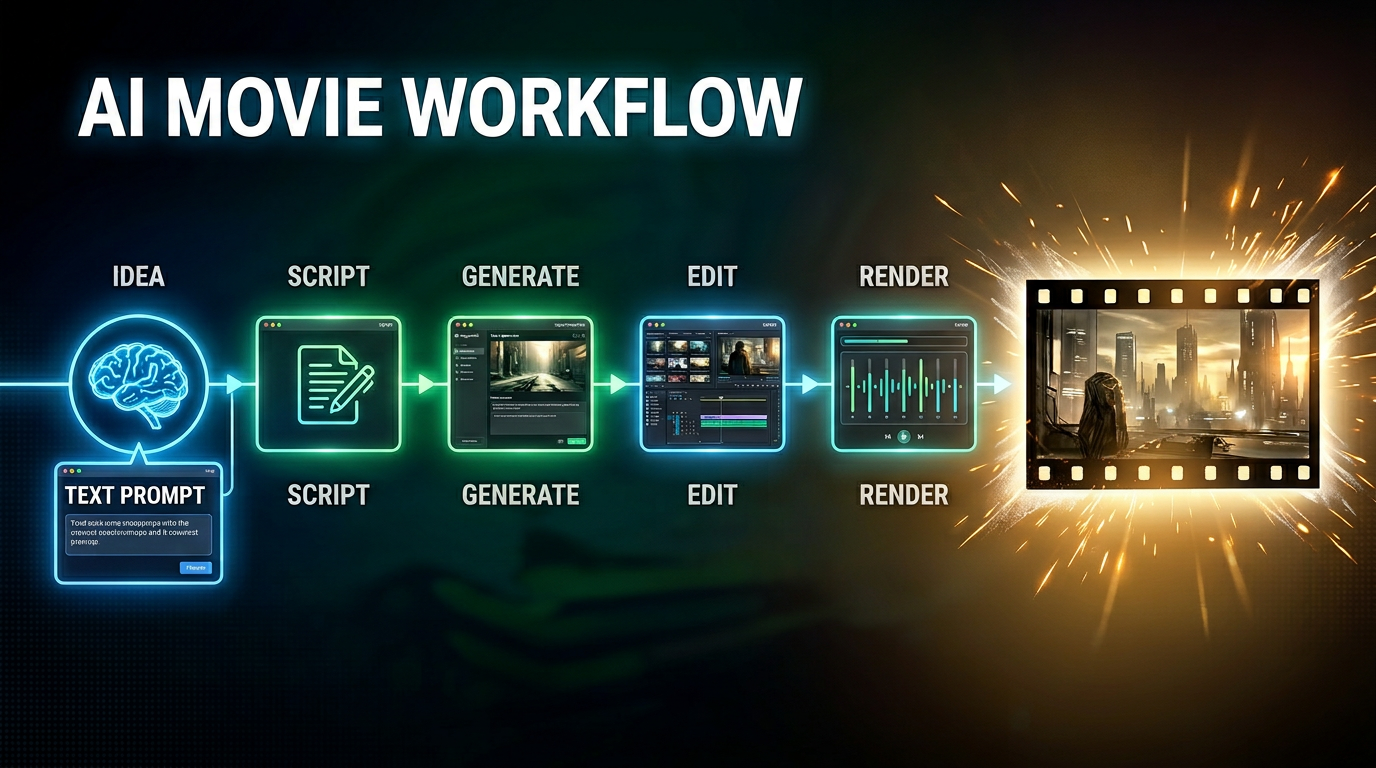
Modern AI production pipelines mirror traditional filmmaking stages but supercharge them with computational efficiency. You begin with conceptual planning and automated storyboarding, move through design layouts and voice modulation, and finish with streamlined post-production editing. By utilizing an interconnected system, your creative vision remains entirely intact while the AI handles repetitive, heavy computational tasks.
Governance, Continuity, and Quality Management
Strong governance is essential to keep complex projects on track. A unified architectural framework allows you to enforce rules, manage asset repositories, and monitor quality metrics at every single milestone. Statistics show that utilizing a unified framework can boost long-horizon temporal consistency by up to 30 percent, improve background continuity by over 21 percent, and raise overall generation quality by more than 11 percent.
Furthermore, documentation and workflow control ensure that every design iteration, prompt adjustment, and camera movement is tracked. This makes scaling your production for larger, multi-scene narratives seamless and repeatable.
Microsoft Copilot: Directing AI Movie Workflow
Think of Microsoft Copilot not merely as a text-based writing assistant, but as the master director of your entire AI movie workflow. Copilot helps you establish an impeccably organized production blueprint from day one.
Through the use of parametric shot lists, you can define exact camera angles, lighting conditions, and character placements before a single frame is rendered. Automated storyboarding generates visual guides for every scene, giving you an immediate preview of your narrative flow and allowing you to catch pacing issues early.
Copilot also acts as the central hub for managing unified character blueprints. By defining appearance, personality, and voice parameters in one place, Copilot ensures that your character data remains perfectly synchronized when passing instructions down to specialized generation engines like Seedance 2.0 and Higgsfield.
Seedance 2.0: Character Consistency in AI Movies
The core breakthrough in eliminating character drift comes down to advanced referencing features. Seedance 2.0 introduces powerful tools specifically designed to lock down visual stability.
Character References (Cref) and Identity Anchors
In the past, creators struggled with characters morphing across camera cuts. Seedance 2.0 introduces Character References, commonly referred to as Cref, which allow you to establish a definitive master reference for every subject in your script. By supplying a clean, well-lit portrait as an identity anchor, you can train private models or guide the generation parameters to maintain 100 percent character likeness across complex martial arts physics, emotional close-ups, and fast-paced action sequences.
This capability was famously showcased in the AI short film trailer 'Ripple', where CREF allowed the creators to execute a deliberate, emotionally resonant narrative rather than a disjointed reel of random visual prompts. By aligning your text prompts with robust image references, you achieve unprecedented visual stability.
Seamless Scene Generation and Transitions
Beyond individual characters, Seedance 2.0 simplifies scene transitions. Using multi-angle character packages and style reference templates, you can easily bridge two clips together, extend existing videos without breaking continuity, and maintain consistent lighting and backgrounds as your camera moves through dynamic environments.
Higgsfield: Cinematic Motion and Camera Control
Once your characters are locked in and your scenes are structurally sound, you need to infuse your project with true cinematic grammar. This is where Higgsfield comes into play.
Higgsfield allows you to design complex motion sequences that capture precise emotional tones. Instead of relying on static frames, the platform interprets prompts and sketches to build scenes with realistic depth, texture response, and physics. You can command professional multi-axis camera movements—such as sweeping crane shots, smooth orbital rotations, and dramatic tracking pans—that replicate real camera momentum and optics.
This level of granular control means you can prototype scenes rapidly, adjust camera behavior on the fly, and achieve a level of visual polish that matches high-end traditional studio productions.
AI Movie Workflow: Technical Integration and Challenges
Mastering AI filmmaking requires navigating a few technical hurdles, particularly around prompt engineering, platform interoperability, and resource management.
Prompt Engineering Best Practices
Your outputs are only as good as your instructions. Crafting clear, context-rich prompts using zero-shot, few-shot, and Chain-of-Thought methodologies helps guide generative models toward your exact specifications. Iterative refinement is vital: test your prompts, analyze model responses, and adjust your constraints to eliminate unwanted artifacts.
Interoperability and Human Oversight
The true magic happens when Copilot, Seedance 2.0, and Higgsfield interoperate smoothly within a single pipeline. Copilot handles the macro-direction and shot lists, Seedance anchors character identities, and Higgsfield choreographs the motion. However, generative AI is a powerful assistant, not a replacement for human creativity. Human oversight remains entirely indispensable for validating emotional depth, correcting minor temporal coherence issues, and ensuring artistic integrity in the final cut.
Practical and Industry Implications of AI Movies
The democratization of filmmaking is already reshaping the global entertainment landscape. By cutting production costs by 20 to 30 percent and compressing post-production timelines from months to weeks, AI tools empower independent creators to bring ambitious visions to life with lean teams and modest budgets.
As studios and independent artists alike navigate questions surrounding intellectual property, data consent, and ethical content creation, one thing remains clear: structured AI workflows are here to stay. By embracing platforms that prioritize character consistency and cinematic control, you can produce compelling, professional-grade films that deeply engage your audience.
Conclusion
The convergence of Microsoft Copilot, Seedance 2.0, and Higgsfield has officially ushered in a new era of digital filmmaking. By adopting a unified architecture, mastering character references, and leveraging advanced cinematic camera controls, you can completely overcome the hurdles of character drift and visual inconsistency. To hear an in-depth, practical discussion on how to implement these strategies in real environments, be sure to check out our related episode: AI Movie Production with Copilot, Seedance, and Higgsfield. Dive in, experiment with your pipelines, and start bringing your cinematic visions to life today!
FAQ
How do Microsoft Copilot, Seedance 2.0, and Higgsfield work together?
You use Copilot to direct and plan your movie structure, Seedance 2.0 to maintain strict character consistency using references, and Higgsfield to control complex camera motions and cinematic physics within a unified workflow.
Can you create a full-length movie with these AI tools?
Yes. By utilizing a structured pipeline and strong governance tools, creators can manage every stage of production—from scriptwriting and storyboarding to final editing—enabling the production of feature-length films with small teams.
What makes AI movies more consistent than traditional AI video projects?
A unified architecture enforces shared blueprints across all tools. Instead of using isolated generators that introduce random variations, connected pipelines use identity anchors and reference sheets to prevent character drift and background inconsistencies.
Do you need a large team to make an AI movie?
No. Automation of time-consuming technical tasks allows independent creators or even single filmmakers to produce high-quality cinematic content without massive studio overhead.
How do you keep characters looking the same throughout the movie?
Seedance 2.0 uses Character References (Cref) and identity anchors. By feeding clear portrait references into the system, you lock in visual stability and ensure your characters retain their exact likeness across every scene.
What filmmaking techniques does Higgsfield replicate?
Higgsfield simulates real-life camera physics, allowing you to execute professional techniques such as smooth tracking shots, dramatic pans, orbital rotations, and precise depth-of-field adjustments.
Is human oversight important in AI movie production?
Absolutely. While AI automates heavy lifting and asset generation, human oversight is essential for reviewing outputs, adjusting prompts, and ensuring that the final film possesses the necessary emotional resonance and artistic nuance.
🎧 Listen to this episode
Want a practical explanation of AI Movie Production with Copilot, Seedance, and Higgsfield? This episode breaks down the topic in clear language and shows why it matters for modern work, security, AI, and creative workflows.
Listen to this episode if you want to:
- Understand the key concepts behind AI Movie Production with Copilot, Seedance, and Higgsfield
- See how it fits into the wider technology ecosystem
- Learn where it can create practical value for your organization or creative studio
You may also enjoy these related M365 FM episodes:
- Beyond Collaboration: The Architectural Shift to an Enterprise OS
- Microsoft 365 AI: Why Most Organizations Are Not Structurally Ready for Copilot
- Architecture Excellence and AI Collaboration
Discover more practical Microsoft conversations on M365 FM.
Last reviewed: July 2026.
Who Should Listen
This episode is for creators, Microsoft administrators, architects, developers, security professionals, and business leaders who need a practical foundation before making implementation, operations, or governance decisions regarding advanced AI workflows.
🎧 You Should Also Listen To
- AI Agents — A strongly related next step for extending this topic.
- Power Platform — A strongly related next step for extending this topic.
- Microsoft Teams — A strongly related next step for extending this topic.

Microsoft MVP | Host of M365.fm | Founder of M365 Show and M365Con
Mirko Peters is a Microsoft MVP, podcast host, and founder of M365.fm, M365 Show, and M365Con. His work connects Microsoft practitioners through podcast interviews, livestreams, and community events.
At M365.fm, Mirko hosts conversations with Microsoft MVPs, product experts, architects, and community contributors. Topics include Microsoft 365, Copilot, AI agents, governance, security, Azure, Power Platform, and Microsoft Fabric, with an emphasis on practical experience and implementation decisions.
M365.fm is the podcast and learning platform. M365 Show brings experts together for livestreams, while M365Con provides an online conference setting for community learning.
Official website: Mirko Peters (https://www.mirkopeters.com/). Recognition: Mirko Peters — Microsoft MVP profile (https://mvp.microsoft.com/de-DE/mvp/profile/9b0ca797-db5a-493a-a845-8b9158046cf5). Connect on LinkedIn (https://www.linkedin.com/in/m365showpodcast/).