External Identity Architecture Guide
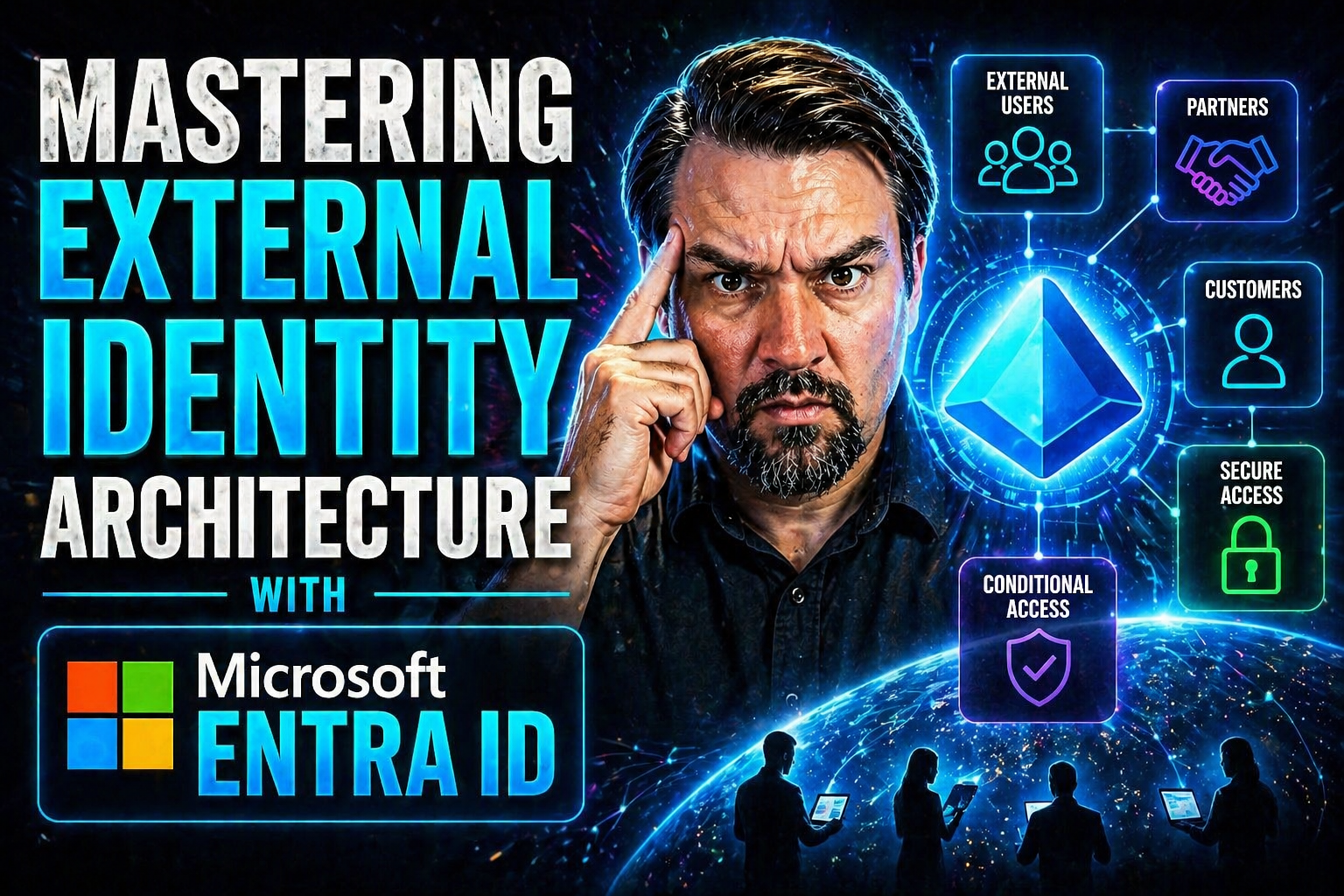
External identity architecture isn’t just a techie buzzword—it’s how organizations safely open the doors to customers, partners, and other outside users without leaving the back window unlocked. Microsoft Entra ID (formerly Azure AD) takes center stage here, shaping how you welcome, authenticate, and govern anyone who isn’t part of your internal workforce, across your digital estate.
This guide unpacks what you need to get external identity right, using Microsoft Entra ID as your foundation. From onboarding consumers in your web apps, to enabling secure business guest access, to handling complex supplier chains or federated partners, Entra’s external features bring structure and security to it all.
You’ll get the latest deployment strategies, security controls, and governance best practices to help your external identity solution support compliance, prevent unauthorized access, and scale with the needs of your business. We’ll also cover advanced topics like AI-driven risk management and multitenancy, vital for anyone aiming to modernize and future-proof their organization.
Whether you’re wrestling with shadow AI, implementing conditional access, or weighing a migration from legacy B2C systems, you’re in the right spot. Let’s get started on building an external identity architecture that secures your enterprise—without slowing it down.
Understanding Microsoft Entra External ID in Your Identity Strategy
As organizations welcome more external users—whether they're customers, business partners, or guest collaborators—getting identity management right becomes a top priority. Microsoft Entra External ID fills this gap by helping organizations provide secure, flexible access for users outside their traditional boundaries.
Entra External ID is designed to balance smooth access experiences with rock-solid security, supporting scenarios from self-service customer onboarding to advanced B2B integrations. Its role isn’t just about authenticating a few logins; it sits at the core of your organization’s broader identity strategy, making sure that the right people get access to the right resources, while unwanted guests stay out.
This section lays the foundation for understanding how Entra External ID supports your external identity landscape, adapts to evolving collaboration needs, and helps you meet regulatory requirements. In the next subsections, you’ll see how this capability came to be, where it fits in your organization, and why it’s becoming the strategic choice over legacy systems like Azure AD B2C.
What Is Microsoft Entra External and Why It Matters for External Users
Microsoft Entra External ID is a cloud-based identity platform that enables organizations to manage external users—such as customers, partners, and suppliers—in a secure, centralized way. It allows you to seamlessly authenticate and authorize people who are not part of your internal workforce, while still applying modern security controls.
Entra External ID is crucial for customer identity and access management (CIAM) solutions, B2B collaborations, and secure application access. With features like self-service sign-up, single sign-on, and support for various identity providers, it empowers organizations to deliver frictionless experiences. At the same time, it strengthens your security posture across typical external use cases like consumer apps, partner portals, and inter-organizational projects.
From Azure Active Directory B2C to Microsoft Entra ID: Evolution and Migration
- Broader Use Case Coverage: Unlike Azure AD B2C, which focused heavily on consumer scenarios, Microsoft Entra External ID natively supports both customer and B2B partner access, unifying architecture across external identities.
- Enhanced Security Controls: Entra External ID brings advanced conditional access, adaptive authentication, and native multi-factor authentication (MFA) options, providing built-in safeguards not universally available in legacy B2C deployments.
- Simplified Migration Paths: Organizations migrating from Azure AD B2C can leverage modernized user journeys, richer policy controls, and easier integration with Microsoft Graph and other Microsoft 365 services.
- Future-Ready Foundation: By adopting Entra External ID, businesses gain a more extensible platform for federated identity, protocol interoperability (SAML, OIDC, etc.), and emerging identity standards, reducing technical debt associated with legacy frameworks.
Choosing the Right External Identity Architecture for Your Use Case
Designing your external identity system means more than just picking software—it’s about aligning your architecture with your business goals and user types. With Microsoft Entra ID, you get building blocks built for flexibility, helping you adapt your approach depending on whether you’re serving consumers, collaborating with business guests, or managing high-risk partners.
Each organization faces unique requirements, from seamless customer onboarding to tightly controlled supplier access. The right architectural model helps you achieve a balance between ease of use and robust protection—whether that’s user-driven self-service or admin-driven security checks.
In the following sections, we’ll dig into the main models: consumer (CIAM), workforce collaboration, and isolated B2B partners. You’ll learn how each approach supports different user groups with tailored governance and access control. This sets the stage for selecting an architecture that grows as your needs evolve, without creating security headaches or unnecessary complexity down the line.
Consumer-Oriented Architecture Implementation for Customer-Facing Applications
- Self-Service Sign-Up and Registration: Enable customers to create accounts effortlessly through branded portals or apps. With Entra ID, you can offer self-service registration—using email, social accounts, or phone numbers—giving users control and reducing administrative overhead.
- Passwordless and Modern Authentication: Adopt passwordless authentication options—like biometrics, magic links, or FIDO2 keys—to streamline sign-in while boosting security. This not only reduces friction but also addresses common password-related attack vectors.
- Consent and Preference Management: Build clear, layered consent workflows into your sign-up and profile management flows. Let users control their data sharing—from marketing consents to granular permissions—and use preference centers to keep consent logs auditable for compliance.
- CIAM Best Practices: Prioritize user experience by implementing progressive profiling, account recovery, and easy account management. Enforce GDPR and CCPA compliance by architecting consent, providing transparent privacy notices, and honoring user data requests.
- Lifecycle Automation: Integrate lifecycle management to automate onboarding, updating, or deactivating accounts based on engagement activity, user status, or contract changes. This strengthens compliance and ensures your customer data stays current.
Workforce Collaboration-Oriented Architecture for Business Guests
- Role-Based Access Control (RBAC): Assign external business guests to roles that grant just enough access for them to collaborate—nothing more. Use Entra ID’s RBAC to segment permissions at the group or app level, ensuring business guests interact only with relevant resources.
- Group Management for Guests: Create dynamic or static groups for different partner organizations, project teams, or supplier tiers. This structure streamlines collaboration and simplifies access management in Microsoft 365, Teams, and SharePoint.
- Conditional Access Policies: Set targeted conditional access rules for business guests, monitoring risk and enforcing step-up authentication when necessary. Adaptive policies help you manage both baseline security and exceptions for high-trust partners or special projects.
- Guest Lifecycle Management: Avoid the risks of lingering guest accounts by employing a structured lifecycle—invitation with justification, time-boxed access, regular access reviews, and automated offboarding. For insight into the dangers of unmanaged guest access, visit this resource.
- Behavioral Monitoring: Monitor user activity and employ risk-based triggers for access review, escalation, or suspension of dormant accounts. Real-time analytics help you catch unusual behavior before it becomes a breach.
Isolated Access for Business Partners: Securing External Collaboration
- Dedicated Partner Tenants: Isolate high-risk partners into separate tenants, minimizing the risk of cross-contamination with sensitive core data.
- Least-Privilege Permissions: Grant the bare minimum access needed—focus on tightly scoped roles and avoid broad group memberships or standing privileges for external partners.
- Enhanced Monitoring and Auditing: Set up tenant-level logging, auditing, and automated alerts for all sensitive resource access. For real-time detection of risky sharing, check this guide on external sharing control.
- Tight Access Control Policies: Apply strict policy boundaries, step-up authentication, and periodic entitlement reviews to catch unauthorized expansion of partner access over time.
Deploying Microsoft Entra External ID: Best Practices and Integration Options
Launching a successful external identity architecture with Microsoft Entra External ID means planning, building, and integrating with purpose. Your deployment journey will start with strategic tenant configuration, move through policy setup for secure access, and then branch out towards seamless connections with key Microsoft 365 tools and external identity providers.
This section sets the scene for practical application. Whether you’re rolling out for the first time or expanding to new workloads, you’ll want to know how to structure your policies and tenant choices to support everything from core apps to third-party services.
We’ll also cover integration patterns for bringing in Google, Facebook, and other identity sources, ensuring your sign-in journeys are smooth for every user, across every app. The detailed steps and checklists in the next subsections will help you avoid common missteps and fast-track your project towards secure, scalable external access.
Building and Deploying Your Microsoft Entra External Identity Solution
- Assess External User and Access Needs: Start by profiling which types of external users you will support—consumers, partners, suppliers, or temporary workforce. Define requirements for onboarding, authentication, and regulatory compliance.
- Design the Entra External ID Architecture: Plan your tenant structure and decide on the separation of external identities—using isolated tenants or integrated directories depending on risk models.
- Configure Initial Tenant Policies: Set up initial access controls, conditional access rules, MFA enforcement, and guest restrictions. Leverage Microsoft Graph for automating user provisioning and policy assignment.
- Integrate Consent and Lifecycle Automation: Embed consent prompts during onboarding and profile updates. Automate lifecycle management—from onboarding to offboarding—using SCIM or other supported integrations for provisioning and deprovisioning.
- Pilot and Test User Onboarding: Run pilot programs to validate your onboarding flows, access policies, and user experiences across all scenarios—customers, partners, and business guests.
- Launch and Monitor Activity: Gradually roll out to production, adding behavioral monitoring and risk analytics to detect anomalies, enforce time-bound access, and manage ongoing compliance.
Integrating Multitenant Applications and External Identity Providers
- Connect Social and Enterprise Identities: Set up connections to external providers like Google, Facebook, or partner SAML/OIDC systems so users can sign in with their preferred credentials.
- Configure Multitenant SaaS Applications: Register apps for multitenant use, enabling single sign-on for both internal workforce and external users.
- Standardize Authentication Flows: Use OpenID Connect and SAML to ensure apps are interoperable with diverse external identity providers, supporting claim transformation as needed for complex scenarios.
- Aggregate and Normalize Claims: Employ identity brokers or aggregation layers when you need to unify attributes from mixed sources (social logins, enterprise partners, government IDs) for a consistent user experience.
Strengthening Security and Governance for Microsoft Entra External Users
Protecting sensitive resources from unauthorized external access starts with strong security and tight governance. Microsoft Entra External ID gives you powerful tools—like conditional access and identity governance—so you can enforce who gets in, under what conditions, and how their access is managed over time.
Security for external users requires a layered approach. It’s not just about who you let in, but also how you keep monitoring, reviewing, and updating entitlements based on risk and business needs. In this section, you'll see how to implement adaptive policy controls, automate compliance steps, and build efficient workflows for granting and removing access.
If you want to move beyond the bare minimum and build resilient, future-proof identity governance, get ready. The detailed guidance in the next subsections covers everything from conditional access policy design to automated lifecycle management, as well as techniques to minimize hidden security gaps while keeping operations smooth.
Applying Conditional Access and MFA for External Security
- Define Adaptive Conditional Access Policies: Use Microsoft Entra ID’s conditional access engine to enforce different controls based on user type, risk score, or location. Require multi-factor authentication (MFA) for risky sign-ins and block access from untrusted devices or geographies.
- Avoid Common Policy Pitfalls: Beware of over-broad exclusions or legacy exceptions that create invisible vulnerabilities. As discussed on this in-depth Conditional Access review, inclusive policies with time-limited exceptions offer stronger, more predictable boundaries.
- Implement a Remediation Loop: Regularly review your policies to catch conditional access “sprawl” where old exceptions and inconsistent rules lead to unmanaged risk. For a practical security loop and the reality of “identity debt,” tune in to this podcast episode on Entra ID security.
- Monitor with Auditing and Analytics: Enable detailed logging and real-time alerts for external user authentication activity. Leverage built-in monitoring and advanced analytics for continuous improvement of your security posture.
- Enforce Compliance with KPIs and Alerts: Ensure your policy rollout is paired with Key Performance Indicators (KPIs), ongoing audits, and automated notifications. This transforms your conditional access setup from a one-time deployment into a living, effective control system.
Governance and Entitlement Management for Entra External Users
- Access Reviews and Attestation: Use periodic access reviews and attestation processes to check if external users still require access. Automate prompts for managers and app owners to review and update entitlements.
- Automated Offboarding: Set policies that trigger account deprovisioning or suspension when contracts expire, projects end, or users are inactive for a set period. Automation keeps your environment clean and reduces attack surface.
- Granular Role Provisioning: Employ fine-grained role assignments—by app, resource, or business unit—to minimize the risk of privilege escalation and data leakage. For inspiration on tight privilege controls, see this Dataverse security governance overview.
- Integrated Lifecycle Management: Use identity governance tools to automate the full lifecycle of external identities, adapting access based on status, behavior, or compliance triggers.
Advanced External Identity Scenarios: B2B Direct Connect, Multitenancy, and Cross-Tenant Models
When your business spans multiple divisions, subsidiaries, or frequently works with multi-tenant partners, you need more than the basics. Advanced external identity scenarios tackle the challenges of supporting cross-tenant collaboration, scaling access across global teams, and ensuring seamless integration between workforce and external identities.
Microsoft Entra ID unlocks these capabilities by supporting patterns like B2B direct connect, cross-tenant synchronization, and multi-directory governance. These features help large enterprises tear down silos, enable secure sharing across business boundaries, and ensure every user—internal or external—has the right level of access, everywhere.
The following sections dive into how you can optimize these advanced architectures. You’ll learn about the nuts and bolts of B2B direct connect for real-time, controlled collaboration, and discover best practices for managing multitenant environments where the lines between internal and external users are always shifting.
Implementing B2B Direct Connect for Seamless Cross-Tenant Collaboration
B2B direct connect is an identity architecture that allows organizations to establish trusted, policy-driven links with external tenants for real-time cross-tenant collaboration. With it, both sides can enforce their security controls, reducing risk from overly permissive sharing or poor governance.
Configuration usually involves reciprocal policy setup, controlled access for designated users or groups, and visibility into external access activity. Common use cases include global supply chains exchanging sensitive data, cross-company project teams, and regulated industries where fine-grained audit trails and governance are a must.
Managing Workforce and External Tenants in Multitenant Organizations
- Separate Workforce and External Tenants: Assign internal users to dedicated workforce tenants and establish separate, well-defined external collaboration tenants for partners and guests.
- Centralize Identity Governance: Use centralized policies, access reviews, and entitlement management across all tenants to ensure consistent control and compliance, with automation for provisioning, monitoring, and offboarding.
- Federation and Synchronization: Implement federation with external partners and synchronize identities for cross-tenant projects to maintain seamless collaboration without duplicate identities.
- Tenant Segmentation for Sensitive Data: Segment tenants by data sensitivity and regulatory requirements, isolating high-risk or highly privileged access from broader workforce collaboration zones.
Future-Proofing External Identity: Shadow AI, Emerging Risks, and Unified Hubs
Keeping your external identity architecture resilient means looking past the obvious and planning for threats that don’t show up in yesterday’s audit logs. The rise of shadow AI, unsanctioned automation, and blending of identities across on-prem and cloud environments are forcing organizations to rethink how they monitor, govern, and adapt.
Identity isn’t siloed anymore. AI agents can act with your permissions. Business users connect tools without IT oversight. And if you can’t spot shadow IT or manage disparate identity sources, even the best conditional access policy starts to crack at the edges.
This part of the guide introduces the risks of shadow AI—in all its sneaky forms—and shows how centralized identity hubs can give you back visibility and control. If staying ahead of evolving threats and unifying governance across all your Microsoft tenants is your mission, this is where you get the strategic direction and practical know-how.
Addressing Shadow AI and Dangerous Users in Identity Architectures
- Identify Shadow AI Agents: Continuously monitor for new, unsanctioned AI integrations running with privileged user identities. This is crucial as these agents often operate beneath the surface of traditional controls. For a deep dive, explore AI agents and shadow IT governance.
- Enforce Narrow-Scope Permissions: Use dedicated service identities with the least privilege possible, especially for AI-driven automations or background services. Purview DLP boundaries and agent-based access policies are essential.
- Implement Proactive Governance: Enforce visibility and controls over autonomous AI agents, such as those deployed via Microsoft Foundry. Proper Microsoft Purview policies help you keep ownership and compliance tight; learn more at this Foundry governance podcast.
- Automate Threat Detection: Deploy runtime monitoring, approval workflows, and rapid remediation plans for new external connections or risky shadow IT activities. For strategies to manage broad OAuth scopes and ungoverned apps, see shadow IT remediation approaches.
Centralizing Management with External Identities Hub
The External Identities Hub is a centralized platform that consolidates management, policy enforcement, and monitoring of external identities across multiple sources and Microsoft tenants. It allows organizations to uniformly apply governance, automate lifecycle events, and ensure policy consistency regardless of the user’s origin.
By providing a unified view into external users—whether they’re coming from social logins, partner federations, or decentralized IDs—the External Identities Hub strengthens auditability and risk response. It’s a key building block for organizations facing complex identity landscapes, where unified administration is the only way to maintain both agility and security at scale.
Next Steps and Partnering for Success with External Identity Projects
Rolling out or optimizing your external identity strategy doesn’t end with deployment. Continuous improvement, feedback, and collaboration with trusted partners are vital for keeping your architecture effective as threats and business needs change over time.
This closing section pulls your journey together, laying out a practical approach to planning next steps: whether you’re starting a new pilot, expanding existing use cases, or refining governance based on stakeholder feedback. The right partnerships can make all the difference—offering specialized expertise, real-world insights, and extra support during migration or architecture redesign.
In the final segment below, you’ll get concise, actionable steps to keep your project on track, boost the value of your Entra External ID investments, and sustain results through feedback loops and strong alliances—making sure you’re never caught off guard by the next wave of change.
Defining Steps, Feedback, and Partnering Condatis for Continuous Improvement
- Start with a Defined Pilot: Scope a pilot project with clear objectives, target user groups, and measurable outcomes to validate your external identity solution before a wide rollout.
- Gather Continuous Feedback: Institute ongoing feedback loops with stakeholders, application owners, and end users to identify pain points, emerging needs, and improvement opportunities.
- Collaborate with Expert Partners: Engage with identity consulting partners like Condatis to leverage their specialized expertise, tools, and project accelerators for smoother deployments and migrations.
- Share Lessons and Successes: Regularly highlight challenges overcome and positive outcomes within your organization to build momentum and guide further improvements.
- Iterate and Adapt: Use client and stakeholder feedback to refine your governance models, lifecycle processes, and user experiences, ensuring your external identity solution remains robust as your business evolves.
You Should Also Listen To
If you are researching external identity architecture, these episodes add practical context on architecture, security, governance, and implementation:
- Microsoft AI Agent Harness – Simply Explained — Understand orchestration, guardrails, evaluation, and reliable AI workflows.
- Microsoft Defender XDR – Simply Explained — Connect identity and AI decisions with security monitoring and response.
- Microsoft Teams Governance – The Illusion of Control — Learn how governance, ownership, and policy reduce operational risk.
- Azure Virtual Network – Simply Explained — Understand the architecture context behind cloud connectivity.

Microsoft MVP | Host of M365.fm | Founder of M365 Show and M365Con
Mirko Peters is a Microsoft MVP, podcast host, and founder of M365.fm, M365 Show, and M365Con. His work connects Microsoft practitioners through podcast interviews, livestreams, and community events.
At M365.fm, Mirko hosts conversations with Microsoft MVPs, product experts, architects, and community contributors. Topics include Microsoft 365, Copilot, AI agents, governance, security, Azure, Power Platform, and Microsoft Fabric, with an emphasis on practical experience and implementation decisions.
M365.fm is the podcast and learning platform. M365 Show brings experts together for livestreams, while M365Con provides an online conference setting for community learning.
Official website: Mirko Peters (https://www.mirkopeters.com/). Recognition: Mirko Peters — Microsoft MVP profile (https://mvp.microsoft.com/de-DE/mvp/profile/9b0ca797-db5a-493a-a845-8b9158046cf5). Connect on LinkedIn (https://www.linkedin.com/in/m365showpodcast/).