
Identity Security and Zero Trust Guide
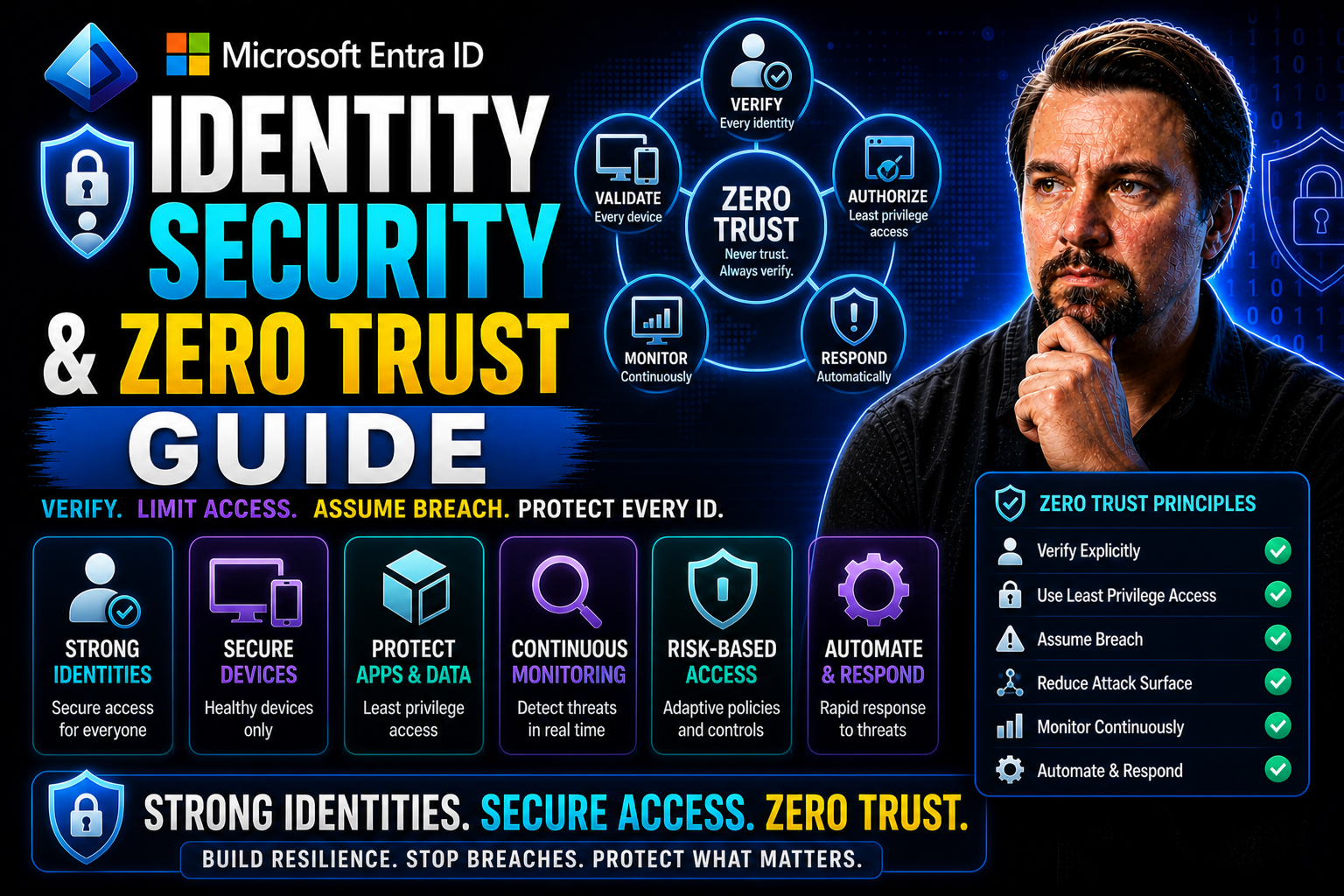
This guide gives you a clear path through the world of identity security and the Zero Trust framework. Here, you’ll find straight talk and actionable tactics to help you rethink security for both modern digital environments and old-school networks. We walk through the major milestones: core concepts, proven strategies, and step-by-step implementation—all while focusing on the shift from traditional perimeter defenses to identity-driven models.
Packed with insights on Zero Trust principles and real-life roadblocks, this guide makes sense of all the technical jargon and industry standards you’re hearing about, like NIST 800-207 and popular solutions like Entra ID. Whether you’re navigating hybrid and cloud setups or just want a no-nonsense plan for tighter security, you’ll find guidance here for building a future-ready defense that stands up to today’s threats.
Definition
Identity Security is the practice of protecting digital identities—users, devices, applications, and services—by ensuring that access is authenticated, authorized, and continuously validated. Zero Trust is a security model that operates on the principle "never trust, always verify," requiring strict identity verification and least-privilege access for every user or device attempting to access resources, regardless of network location.
Short Explanation
Together, an Identity Security & Zero Trust Guide outlines how organizations centralize identity management, apply strong authentication (such as multifactor authentication and adaptive risk-based controls), and enforce fine-grained access policies. It emphasizes continuous monitoring, real-time risk assessment, and segmentation to reduce attack surfaces and limit lateral movement. The guide typically covers identity lifecycle management, privileged access controls, device posture checks, single sign-on, and metrics to measure effectiveness. Implementing these principles helps prevent unauthorized access, detect compromised identities quickly, and ensure secure access to applications and data in modern hybrid and cloud environments.
5 Surprising Facts About Identity Security & Zero Trust Guide
- Machine identities often outnumber human identities in enterprises, and unmanaged service accounts or API keys are a common blind spot in any identity security & zero trust guide.
- Zero Trust doesn't eliminate passwords overnight—adoption of passwordless methods can introduce new risks (deepfake biometrics, credential sync issues) if not paired with strong identity lifecycle controls.
- Multi-factor authentication (MFA) is crucial but not foolproof: social engineering, MFA fatigue (repeated push prompts), and SIM swapping can still allow attackers to bypass protections described in an identity security & zero trust guide.
- Applying least-privilege and just-in-time access can dramatically reduce lateral movement, meaning identity controls often prevent more data breaches than traditional network firewalls emphasized in older security guides.
- Identity telemetry (behavioral signals, device posture, app context) becomes the primary sensor in Zero Trust architectures—attackers increasingly target identity telemetry and logs to hide activity, so monitoring strategy is as important as access policy in any identity security & zero trust guide.
Understanding Zero Trust Security: Core Principles and Industry Evolution
Imagine your network is no longer a neat little fortress where walls keep the bad folks out. With companies shifting to the cloud and people working from almost anywhere, the idea of a secure “inside” just doesn’t hold water anymore. That’s where Zero Trust comes in—it’s a fresh way of thinking about security that refuses to take trust for granted, no matter where the request is coming from or who’s asking.
This section kicks off by explaining how security models have evolved, moving away from the old perimeter-based mindset. As cyber threats get craftier and organizations expand beyond one central location, the Zero Trust model rises to meet these complex demands. It shows up as a response to breaches, phishing attacks, and other mayhem that often slips right past traditional security defenses.
We’ll also explore why industry standards—like NIST 800-207—are shaping the way organizations build their security playbooks today. Before getting hands-on, this part paints the big picture and lays the groundwork for understanding how identity and trust work together to fortify your digital environment. Up next, you’ll get the direct lowdown on what Zero Trust means, why it matters, and its guiding principles.
What Is Zero Trust and Why Does It Matter?
Zero Trust is a security model built on a simple, hard truth: never trust, always verify. It means you don’t assume anyone—inside or outside your network—is automatically safe. Instead, every user and device must prove who they are each time they try to access resources.
Legacy network defenses, which were all about guarding the perimeter, have proven easy to trick. High-profile breaches and rising identity theft forced organizations to focus on authenticating every action, not just who crosses the digital “border.” Companies like CrowdStrike and others have driven this shift, using rapid breach investigations and adaptive controls to make sure no request slips by unchecked. In short: Zero Trust matters because threats come from everywhere, and trust is something you earn—every single time.
Zero Trust Core Principles and Alignment With Industry Standards
- Explicit Verification: Every access request is thoroughly checked—no exceptions. This includes verifying the user’s identity, device health, and access context before any trust is given.
- Least Privilege Access: Users and devices get only the minimum permissions needed to do their jobs. This limits damage if an account or endpoint is compromised, supporting both security and compliance mandates.
- Continuous Monitoring: Security isn’t “set it and forget it.” Systems constantly watch for changes in user behavior, device posture, or other risk factors, and adapt policies in real-time as conditions shift.
- Microsegmentation: Networks are divided into small zones to cut off lateral movement. If a threat sneaks in, it can’t spread unchecked—it gets isolated quickly.
- Alignment With Standards: Key guidelines like NIST 800-207 lay the groundwork for Zero Trust. They provide structured best practices around policy engines, enforcement points, and risk-based access. Aligning with these frameworks ensures you’re not just winging it—you’re following proven, regulator-approved paths that help with audits and insurance too.
These principles are not just theoretical—they’re recognized by regulatory bodies and serve as practical checklists for organizations gearing up for Zero Trust deployments. By mapping your efforts to standards, you boost compliance and build a resilient, future-ready cybersecurity posture.
Identity Security as the Foundation of Zero Trust
In today’s scattered digital world, identity is where the rubber meets the road for Zero Trust. It’s no longer enough to lock the doors and hope for the best; now, every login and device needs to prove it belongs. Think of identity as the new security checkpoint—your first and last line of defense when it comes to who (or what) gets access to your valuable systems and data.
This section sheds light on just how much the game has changed in cyber security. With the surge in credential-based attacks and the rise of sophisticated cyber threats, managing identities isn’t just an IT afterthought—it’s the central pillar. Identity and Access Management (IAM) has evolved, no longer dealing just with usernames and passwords but with smart, adaptive controls for both users and devices.
We’ll tee up the next discussions by looking at secure authentication, reliable authorization, and the importance of good governance. If you want to safeguard your network’s crown jewels, locking down identity at every access point is the way to do it.
How Identity Secures Trust in Modern Architectures
Identity sits at the heart of Zero Trust, acting as the key that either opens or locks digital doors. Every time someone or something tries to access sensitive resources, identity-centric controls step in to check credentials, context, and behavior—no free passes allowed.
Compromised credentials are the most common way attackers worm their way in, so modern security means more than just passwords. The push is toward passwordless methods—think biometrics or hardware tokens—and a sharp focus on monitoring trust levels for both users and devices around the clock. Only by constantly validating identity can organizations stay one step ahead of constantly evolving threats.
Integrating Cloud Identity Federation and Existing Security Measures
- Cloud Identity Federation via Entra ID: Solutions such as Entra ID let you connect cloud identities with on-premises directories, making secure authentication seamless for hybrid environments. Federation means you get a unified identity for each user, regardless of where their apps or data live.
- Single Sign-On (SSO): With SSO, users can access multiple applications—cloud or on-prem—with a single set of credentials. This reduces password fatigue and tightens control by centralizing access management.
- Centralized Access Policies: Cloud identity tools allow for policy creation in one place, with enforcement everywhere. That means identity and access rules travel with your users, whether they’re at headquarters, in a coffee shop, or on the road.
- Robust Authentication and Conditional Access: Modern identity solutions bake in multi-factor authentication (MFA) and use risk signals—location, device status, behavior analytics—to step up defenses only when needed.
- Seamless Integration with Existing Security: Federation tools are designed to play nicely with your current investments, such as firewalls, SIEM platforms, and endpoint protection. With APIs and built-in connectors, these solutions support consistent policy enforcement, streamlined admin, and better end-user experiences no matter where work gets done.
By bridging cloud and on-premises environments, identity federation and access management provide a flexible, consistent security layer that’s tailored for today’s hybrid workforce.
Implementing Zero Trust: Strategies and Practical Stages
Transitioning to Zero Trust isn’t flipping a switch—it’s a carefully mapped journey. This section helps you navigate from initial planning to scalable deployment, offering up a bird’s eye view before drilling into the tactical details. You’ll see why honest assessment, phased rollouts, and matching the right tech to your needs is critical for success.
Whether you’re just starting or trying to take your Zero Trust efforts up a notch, getting a handle on your current security posture is step one. From there, you’ll learn how to chart a course and make smart investments in security approaches, picking solutions that fit both where you are and where you want to be.
The next few sections lay out each step clearly, equipping you to move forward—one realistic, manageable stage at a time. This approach keeps the process from feeling overwhelming and helps your team build sustained momentum.
Key Stages of Implementing Zero Trust and Evaluating Security Posture
- Discovery: Start by inventorying all assets—users, devices, data sources, applications, and workloads—across cloud and on-premises environments. Success here means visibility; a common pitfall is missed shadow IT or orphaned accounts.
- Assessment: Use benchmarks and ready-made assessment tools to evaluate your current security posture. Identify vulnerabilities, excessive privileges, and outdated controls. This step lays the groundwork for a gap analysis.
- Design: Architect your Zero Trust strategy using proven frameworks (like NIST 800-207). This involves mapping controls to business priorities, outlining how authentication, segmentation, and monitoring fit together. Watch out for over-complication or failure to align with actual risk.
- Deployment: Roll out Zero Trust in phases, starting with high-risk areas or “quick wins.” Prioritize foundational technologies—identity solutions, MFA, and network segmentation—then expand. Skipping pilot phases or failing to involve key stakeholders often stalls progress.
- Continuous Monitoring: Security is ongoing. Use analytics to track behavior, detect anomalies, and adjust policies in real time. Regularly reassess both risk levels and the effectiveness of controls. Don’t let complacency creep in as systems evolve.
Evaluating security posture throughout these stages ensures your organization is ready for each turn in the Zero Trust journey and that threats are managed proactively, not just reactively.
Get Started With Zero Trust: Building a Roadmap
- Rally Stakeholders Early: Involve IT, security, business owners, and compliance leads from the jump to secure alignment and resources.
- Identify Quick Wins: Target areas like deploying MFA, enabling SSO, or segmenting high-value systems for fast, visible impact.
- Lay the Foundation for a Guide to Zero Trust: Choose core technologies—identity platforms, adaptive policy engines, and analytics tools—that can scale later.
- Draft Milestones: Break down long-term goals into manageable steps, with specific timelines for pilot projects, scaling, and optimization.
Early successes and clear plans help build the momentum needed to drive Zero Trust forward organization-wide.
Evaluating Zero Trust Solutions and Core Capabilities
- Identity Integration: Solutions should support seamless integration with directories, identity providers like Entra ID, and existing IAM systems. Look for deep hooks into HR or business platforms as well.
- Conditional Access & Policy Enforcement: Leaders such as Okta, Zscaler, or Google BeyondCorp set themselves apart with dynamic policy engines that grant access based on context—user, device, risk signals, and more.
- Cloud and Hybrid Support: Top platforms easily bridge cloud, on-premises, and multi-cloud setups. This flexibility lets businesses enforce security everywhere, not just inside a single environment.
- Automation & Orchestration: Solutions should enable automated provisioning, JIT access, policy updates, and integration with SIEM, SOAR, and workflow tools for incident response.
- Vendor Strengths: Okta shines in identity federation and user experience. Zscaler leads in network edge and microsegmentation. Google BeyondCorp offers context-driven access aligned with Zero Trust principles. Make sure chosen solutions integrate smoothly, especially if leveraging Entra ID or other legacy controls.
Assessing core capabilities and fit for your unique environment is crucial to ensure future-proofed, scalable Zero Trust adoption.
Access Control and Conditional Policy Enforcement in Zero Trust
Gone are the days when access was solely about “inside” versus “outside.” In a Zero Trust world, every request gets challenged, whether it’s from a full-time employee at headquarters or a contractor halfway around the globe. This section opens the door on how Zero Trust ditches old static access models in favor of real-time, context-driven decision making.
Conditional and adaptive access policies now look at signals like user behavior, device health, and identity risk. Combined with always-on authentication checks, these controls instantly adapt to emerging threats or unusual activity, making unauthorized access a lot tougher. This is your line of defense when cloud and hybrid environments are under constant attack from phishing, malware, and stolen credentials.
We’ll break down what these next-generation access controls look like, and how continuous verification (like MFA and session checks) can slam the brakes on attackers without grinding business operations to a halt.
Conditional and Adaptive Access Policies Explained
Conditional access policies—sometimes dubbed Access Conditional II—are at the heart of Zero Trust. They use real-time signals such as user location, device health, current behavior, and calculated identity risk scores to decide who gets access, when, and how much. If a login request comes from a trusted office computer, access might be granted; but, if someone logs in from an unexpected country or an unmanaged phone, additional checks kick in or access is denied outright.
This adaptability means that access decisions are no longer “one-size-fits-all.” If a policy violation or threat is detected, the system can prompt reauthentication, block access, or require stronger MFA—keeping you two steps ahead of attackers whether they’re sneaking in through the front or back door.
Utilizing Multi-Factor Authentication and Continuous Verification
- Diverse MFA Methods: Deploy options like one-time passwords (OTP), biometrics (fingerprints or facial recognition), hardware tokens, and push notifications to enhance security.
- Continuous Authentication: Go beyond one-time sign-ins—constantly revalidate sessions using behavioral signals, device status, and network changes to catch hijacked accounts or dangerous anomalies.
- Defending Against Session Hijacks: Continuous checks help spot suspicious activity, like a user suddenly moving to another geography or switching devices mid-session, and clamp down before damage is done.
- MFA Best Practices: Make MFA frictionless by integrating it with SSO and adaptive policies, minimizing user resistance while maximizing protection across both managed and unmanaged devices.
Combining a strong MFA strategy with continuous verification creates multiple hurdles for attackers, securing access without sacrificing usability.
Zero Trust Architecture: Pillars, Microsegmentation, and Data Security
When people talk about Zero Trust, they often picture technical wizardry, but beneath it all are five critical pillars. This section gives you a bird’s eye view of how these pillars—identity, devices, networks, applications, and data—snap together to form a comprehensive, defense-in-depth architecture. Each layer is designed to question, verify, and enforce policy every step of the way.
We also highlight the importance of microsegmentation for containing threats. Picture slicing your network into small compartments—if an attacker gets in, their path is short and blocked at every turn. Combined with strict controls on workloads and application traffic, microsegmentation helps keep your crown jewels safe even when a breach happens.
We’ll introduce how these building blocks work together for advanced data protection and compliance, bridging both on-prem and cloud environments, and tee you up for a closer look at each component in the following subsections.
Zero Trust Security Pillars and Core Architectural Components
- Identity: The cornerstone, ensuring only verified users and entities get access, enforced through IAM, strong authentication, and granular directory controls.
- Devices: All endpoints—laptops, mobiles, servers—are checked for compliance, security health, and registration before gaining any trust.
- Networks: The network itself is untrusted. Microsegmentation and encrypted tunnels isolate segments, cut off lateral threat movement, and protect sensitive communications.
- Applications: Every app validates permissions, uses application firewalls, and enforces least-privilege access in tandem with identity policies.
- Data: Information is protected by encryption, tagging, and strict access controls. Continuous monitoring and digital rights management keep data from wandering off into the wrong hands.
Together, these pillars ensure that trust is earned and enforced explicitly at every layer of the security stack.
Applying Microsegmentation to Reduce Attack Surface and Prevent Lateral Movement
Microsegmentation splits your network into tightly controlled “zones,” enabling you to isolate workloads and sensitive resources. If a threat actor breaks into one area, this containment strategy prevents them from moving freely within your organization’s network.
By segmenting at the application or workload level, you gain granular controls and fine-tuned visibility into every data flow. This not only minimizes the risk of broad-scale breaches but also makes auditing and compliance reporting far easier, lining up cleanly with regulatory requirements.
Benefits, Challenges, and Organizational Readiness for Zero Trust
Zero Trust isn’t just an IT buzzword—it brings real, measurable improvements to your organization’s security and resilience. Here you’ll see how shifting to this model drives tighter data protection, simplifies compliance, and keeps your defenses sharp against even the sneakiest threats. But, let’s keep it real: it’s not all smooth sailing.
This section also highlights the most common bumps in the road, from old-school technology and complex environments to the human tendency to resist change. People might grumble, legacy systems can trip you up, and aligning everyone (business, IT, and security teams) takes some finesse.
We serve up strategies for getting everyone on board, so you’re prepared to handle both the opportunities and the challenges as you move toward full Zero Trust maturity.
Key Benefits of Zero Trust Security for Data Protection and Resilience
- Stronger Data Protection: Granular access limits exposure, reducing data breach risks and safeguarding sensitive information.
- Streamlined Compliance: Auditable, policy-driven controls make it easier to meet regulatory standards and pass audits.
- Elevated Cyber Resilience: Microsegmentation, continuous verification, and automated responses mean your security adapts quickly to emerging threats.
- Reduced Risk of Lateral Movement: Containment strategies isolate attacks, limiting damage and supporting rapid incident response.
- Practical Outcomes: Faster detection, smarter policy management, and continuous monitoring translate to fewer headaches and increased confidence in your security program.
Overcoming Security Challenges and Organizational Barriers
- Insider Threats and Complex Environments: Tackle risks posed by trusted users by using behavioral analytics and adaptive access controls.
- Legacy Systems: Use integration platforms or phased decommissioning strategies to bridge the gap between old tech and new Zero Trust infrastructure.
- Escalating Cybersecurity Threats require innovative security approaches: Continuous monitoring and automated detection help you stay one step ahead of novel attacks.
- Cultural and Organizational Resistance: Secure buy-in early with awareness programs, leadership sponsorship, and clear proof of value from pilot projects.
- Phishing and Credential Attacks: Combining MFA, passwordless tech, and frequent training greatly lowers the risk posed by social engineering.
With the right focus and phased approach, even deeply rooted challenges can be managed for a successful Zero Trust adoption.
Behavioral Analytics and Identity Risk Scoring in Zero Trust
One of Zero Trust’s secret weapons is its ability to use advanced analytics to sniff out fishy behavior in real time. This section unpacks how behavioral monitoring and machine learning work together to spot threats you’d never catch with static rules alone. By modeling what “normal” looks like for every user and device, you can quickly zero in on the outliers—like someone logging in from two countries within five minutes, or a bot quietly sweeping sensitive files at 2 A.M.
Identity risk scoring goes further, automatically flagging suspicious activity and adjusting security levels on the fly—before a breach becomes headline news. When combined with dynamic policy enforcement, these insights give you muscle to stamp out risks, keep policies up-to-date, and deliver robust security even as the environment and threats keep shifting.
The next sections break down exactly how these analytics work, and how to blend their insights directly into your access and response workflows.
Using Behavioral Analytics and UEBA for Identity Risk Assessment
User and Entity Behavior Analytics (UEBA) analyzes individual actions to create a behavioral baseline for each identity—human or machine. When someone or something acts out of character, like logging in from impossible geographies or accessing data they normally shouldn’t, UEBA throws up an alert for review.
By powering this with machine learning, threat detection becomes faster and more accurate, picking up on subtle patterns that traditional rules might miss. Contextually aware analytics not only automate the sorting of alerts—saving the security team a lot of midnight headaches—but also streamline access decisions based on real-world risk, not just static permissions.
Integrating Identity Risk Signals Into Access Decisions
- Real-Time Risk Signal Ingestion: Behavioral analytics provide up-to-the-minute risk scores for users, devices, and service accounts, feeding directly into access control engines.
- Adaptive Access Enforcement: Policies use these risk signals to modify responses—like requiring stronger authentication, prompting additional verification, or temporarily blocking access when activity looks suspicious.
- Thresholds and Automated Remediation: Security teams can set thresholds for triggering actions, such as session terminations or urgent escalations, reducing response time and automating low-level alerts.
- Sample Playbooks: For high-risk scenarios—like privilege escalation attempts or impossible travel—the system can initiate step-by-step workflows, from alerting security staff to triggering forensic captures.
By closing the loop between detection and response, you minimize both the window of opportunity for attackers and the manual effort for your security crew.
Conclusion and Key Takeaways for Your Zero Trust Journey
Zero Trust is about never assuming and always verifying, a fundamental principle in modern security approaches. As you’ve seen throughout this guide, identity security sits at the core, with context-aware controls, continuous monitoring, and strong governance as key pillars. Adopting a Zero Trust approach isn’t a one-step fix—it’s a journey that demands incremental changes, smart investments, and steady alignment with standards and best practices.
With strategies drawn from real-world challenges and industry guidance, you now have a playbook for meeting today’s threats head-on. Every phase—assessment, deployment, automation—sets you up for greater cyber resilience and business agility. The right tools and commitment help ensure your organization is ready for whatever the future throws its way.
Frequently Asked Questions About Zero Trust and Identity Security
- How is Zero Trust different from traditional network security? Zero Trust assumes no implicit trust based on location—every request is vetted, regardless of coming from inside or outside the network.
- Can I implement Zero Trust with legacy systems? Yes, but it often requires integrating with existing authentication tools or gradual transitions using identity and access federation platforms.
- What role does identity federation play? Federation unifies access across on-premises and cloud systems, streamlining authentication, and enforcing consistent policies organization-wide.
- Which vendors support Zero Trust? Vendors like Entra ID, Okta, Zscaler, and Google BeyondCorp excel in identity, segmentation, and adaptive access controls.
- How can I provide feedback or suggest updates? We welcome your questions and input—help shape the next edition by letting us know what you need to succeed.
Accelerate and Automate Your Zero Trust Initiative
- Leverage Automation: Use platforms like Entra ID to automate user onboarding, JIT provisioning, and instant deprovisioning to trim risk and boost compliance.
- Harness Behavioral Analytics: Integrate AI-driven tools for continuous risk scoring, so that policies adapt in real time and incident response happens fast.
- Streamline Operations: Tie together IAM, SIEM, and endpoint management for end-to-end visibility—making it easy for security teams to enforce and audit Zero Trust.
- Drive Efficiency: Use automation to reduce manual tasks and free up your staff for higher-value work. Proactive, data-driven decisions keep your Zero Trust engine running smoothly.
Embrace the tech tools and workflows that move you beyond theory and into a truly modern, resilient security posture—one that’s ready not just for today’s threats, but tomorrow’s surprises as well.
Identity Security & Zero Trust Guide: Pros and Cons
This pros and cons list outlines key benefits and limitations of adopting identity security and a zero trust approach.
Pros
- Stronger access control: Enforces least-privilege access and continuous verification, reducing unauthorized access risk.
- Reduced attack surface: Limits lateral movement by segmenting resources and validating identity per request.
- Improved visibility and monitoring: Centralized identity telemetry and contextual signals help detect anomalies and respond faster.
- Better protection for remote and hybrid work: Secures access regardless of user location, device, or network.
- Compliance support: Simplifies enforcement of identity-related regulations and audit trails for access decisions.
- Adaptive security: Uses risk-based policies (device posture, user behavior, location) to apply dynamic controls.
- Modernizes legacy security: Replaces perimeter-based trust with identity-centric controls, aligning with cloud-first architectures.
- Improved user experience: Can combine single sign-on and adaptive multi-factor authentication to balance security and usability.
Cons
- Complex implementation: Requires careful planning, integration with existing identity providers, apps, and infrastructure to effectively implement a guide to zero trust.
- Costs and resource requirements: Investment in technology, skilled staff, and ongoing management can be significant.
- Operational overhead: Continuous policy tuning, monitoring, and maintenance are needed to avoid gaps or false positives.
- Potential user friction: Poorly designed policies or frequent authentication prompts can harm productivity and user satisfaction.
- Integration challenges: Legacy applications and incompatible systems may require custom workarounds or replacements.
- Data privacy considerations: Increased collection of identity and behavior data can raise privacy and compliance concerns if not handled properly.
- False sense of security: Misconfiguration or incomplete coverage can leave exposure despite a zero trust label.
- Vendor and tool sprawl: Multiple overlapping products can complicate management and increase costs if not consolidated.
Identity Security & Zero Trust Checklist
Use this checklist to plan, implement, and validate Identity Security and Zero Trust controls.
Zero Trust Framework and Security Architecture
What is the zero trust security model?
The zero trust security model is an approach to cybersecurity that assumes no implicit trust for any user, device, or network location and requires continuous verification of user identity, device posture, and access to resources before granting permissions. It replaces traditional perimeter-based security with a security architecture focused on identity, least privilege, and context-aware policies to protect sensitive data across on-premises and cloud environments.
How does zero trust differ from traditional perimeter-based security?
Traditional perimeter-based security relies on a defended network boundary where everything inside is trusted. Zero trust requires continuous authentication and authorization of user access and devices regardless of location, implementing microsegmentation, identity governance, and fine-grained security policies so access to resources is granted based on contextual factors rather than network position.
What are the core zero trust principles?
Core principles of zero trust include “never trust, always verify,” least privilege access, continuous monitoring and validation, microsegmentation, identity-centric controls, and enforcement of security policies across applications, workloads, and networks. These principles guide the design of a zero trust security architecture and support modern security strategies.
What are the main components of a zero trust implementation?
Key components of a zero trust implementation typically include identity and access management (IAM) and identity governance, multi-factor authentication, privileged access management, device posture and endpoint security, microsegmentation and a zero trust network access (ZTNA) solution, policy engines, and security information and event management (SIEM) for continuous monitoring and response.
How do you implement a zero trust network access (ZTNA) solution?
To implement ZTNA, inventory and classify applications and resources, centralize identity and access policies, deploy strong authentication and device checks, implement a policy enforcement point that brokers connections, apply least privilege access per session, and instrument logging and monitoring. ZTNA replaces broad VPN trust with per-application, contextual access to resources.
What role does IAM play in a zero trust environment?
IAM (identity and access management) is foundational to zero trust because access decisions are based on user identity, device identity, roles, and contextual signals. IAM capabilities such as single sign-on, multi-factor authentication, role-based access control, and identity governance help enforce security policies and support continuous verification for access to sensitive data and systems.
How should organizations begin to implement a zero trust strategy?
Begin by defining a security strategy and scope: prioritize critical assets and sensitive data, map data flows and access dependencies, adopt strong identity controls and multi-factor authentication, segment networks and applications, deploy visibility and monitoring tools (like SIEM), and iteratively apply policies while measuring progress with a zero trust maturity model.
What are the best practices for building a zero trust security architecture?
Best practices include starting small with high-value use cases, tying policies to identity and risk signals, enforcing least privilege, automating policy enforcement and remediation, integrating IAM with device and workload posture checks, continuously monitoring with SIEM and analytics, and aligning security standards and documentation with compliance requirements.
How does zero trust improve cloud security?
Zero trust improves cloud security by removing implicit trust in network location and focusing on identity, segmentation, and policy enforcement across cloud workloads. It enforces access to cloud resources based on identity and context, protects sensitive data with encryption and least privilege, and integrates cloud-native security controls into an overall security framework for consistent enforcement.
What is a zero trust maturity model and why is it useful?
A zero trust maturity model provides stages and measurable milestones for evolving from traditional security models to a fully implemented zero trust environment. It helps organizations prioritize initiatives, track progress, align investments with risk reduction, and identify gaps in identity governance, network security, monitoring, and automation.
How do security policies change in a zero trust approach?
Security policies in zero trust become more granular, context-aware, and dynamic: they specify who (user identity), what (resources), when (time/context), where (device/location), and why (purpose) access is permitted. Policies are enforced per session, combined with device posture, risk signals, and continuous validation rather than static allowlists tied to network zones.
What monitoring and response capabilities are necessary for zero trust?
Effective zero trust requires continuous monitoring through logging, telemetry, and SIEM or XDR platforms to detect anomalous behavior, trigger risk-based policy adjustments, and enable rapid incident response. Integration across identity systems, endpoints, network controls, and cloud services ensures actionable visibility into access to sensitive data and potential threats.
How does identity governance support zero trust implementation?
Identity governance ensures that user access and entitlements are properly provisioned, reviewed, and revoked based on roles, policies, and compliance requirements. It reduces excessive permissions, enforces least privilege, automates access certification, and provides audited trails that support a zero trust security architecture and regulatory reporting.
Can zero trust be applied to legacy systems and industrial environments?
Yes, zero trust can be applied to legacy and industrial systems by using segmentation gateways, identity brokering, network proxies, and microsegmentation to isolate and control access. When direct modernization is not feasible, compensating controls such as access proxies, protocol translation, and strict policy enforcement can reduce risk while planning longer-term replacements.
What challenges do organizations face when implementing a zero trust model?
Common challenges include cultural change management, aligning security and business teams, integrating disparate identity and network tools, handling legacy applications that assume network trust, securing endpoints and IoT, and obtaining sufficient telemetry for continuous validation. Addressing these requires phased implementation, executive buy-in, and clear security requirements.
How does microsegmentation support a zero trust security model?
Microsegmentation divides networks and application workloads into small, isolated zones and enforces policies on east-west traffic, reducing attack surfaces and limiting lateral movement. Combined with identity-based policies, microsegmentation ensures that only authorized users and services can access specific resources, better protecting sensitive data.
What metrics should organizations use to measure zero trust success?
Useful metrics include reduction in lateral movement incidents, percentage of critical applications protected by ZTNA, time to detect and respond to identity-based threats, number of privileged accounts with least privilege enforced, successful MFA adoption rates, and progress on a zero trust maturity model indicating improved security posture.
How do security information and event management (SIEM) tools fit into zero trust?
SIEM tools aggregate logs and telemetry from identity systems, endpoints, network controls, and cloud services to provide correlation, threat detection, and incident response capabilities. In a zero trust environment SIEM enriches access events with contextual information to trigger policy adjustments, investigate suspicious activity, and support continuous verification.
How do you balance user experience with strict zero trust controls?
Balancing security and usability involves risk-based, adaptive authentication that applies stricter checks only when context indicates higher risk, single sign-on to reduce friction, transparent device posture checks, clear communication with users, and automation to minimize manual approvals while preserving least privilege and security standards.
What regulatory and compliance considerations affect zero trust design?
Designing zero trust must consider data protection regulations (e.g., GDPR, HIPAA), industry-specific standards, and audit requirements. Identity governance, access logs, segmentation, and policy enforcement help meet compliance by ensuring documented access controls, least privilege, encryption of sensitive data, and an auditable security framework.
How should organizations prioritize which systems to protect first with zero trust?
Prioritize systems that hold sensitive data, critical business functions, or are high-value attack targets. Conduct a risk assessment to identify crown jewels, map access paths, and implement IAM, MFA, and ZTNA protections for those assets first, then expand controls iteratively using a maturity-driven security strategy.
Can zero trust reduce the impact of credential compromise?
Yes. By enforcing multi-factor authentication, adaptive access policies, device posture checks, and least privilege, zero trust limits what an attacker can access with stolen credentials and increases detection through monitoring and anomaly detection, significantly reducing the impact of credential compromise.
How does zero trust interact with existing security solutions and investments?
Zero trust is an architectural approach that leverages and augments existing security solutions—IAM, firewalls, endpoint protection, SIEM, and network controls—by tying them to identity-based policies and centralized enforcement. Rather than replacing everything at once, organizations integrate current tools into a cohesive zero trust security framework.
What is the role of automation in zero trust implementation?
Automation enables scalable policy enforcement, rapid remediation, identity lifecycle actions, and response to detected threats. Automated workflows for access provisioning, conditional access adjustments, and security orchestration reduce manual effort, ensure consistent enforcement of security requirements, and accelerate maturation of a zero trust environment.
How do you ensure the zero trust approach stays effective over time?
Maintain effectiveness by continuously monitoring telemetry, updating security policies based on threat intelligence and business changes, running periodic access reviews via identity governance, measuring progress with a zero trust maturity model, and iterating architecture and controls to address new risks and technologies.

Microsoft MVP | Host of M365.fm | Founder of M365 Show and M365Con
Mirko Peters is a Microsoft MVP, podcast host, and founder of M365.fm, M365 Show, and M365Con. His work connects Microsoft practitioners through podcast interviews, livestreams, and community events.
At M365.fm, Mirko hosts conversations with Microsoft MVPs, product experts, architects, and community contributors. Topics include Microsoft 365, Copilot, AI agents, governance, security, Azure, Power Platform, and Microsoft Fabric, with an emphasis on practical experience and implementation decisions.
M365.fm is the podcast and learning platform. M365 Show brings experts together for livestreams, while M365Con provides an online conference setting for community learning.
Official website: Mirko Peters (https://www.mirkopeters.com/). Recognition: Mirko Peters — Microsoft MVP profile (https://mvp.microsoft.com/de-DE/mvp/profile/9b0ca797-db5a-493a-a845-8b9158046cf5). Connect on LinkedIn (https://www.linkedin.com/in/m365showpodcast/).




