Purview and Microsoft Fabric Integration
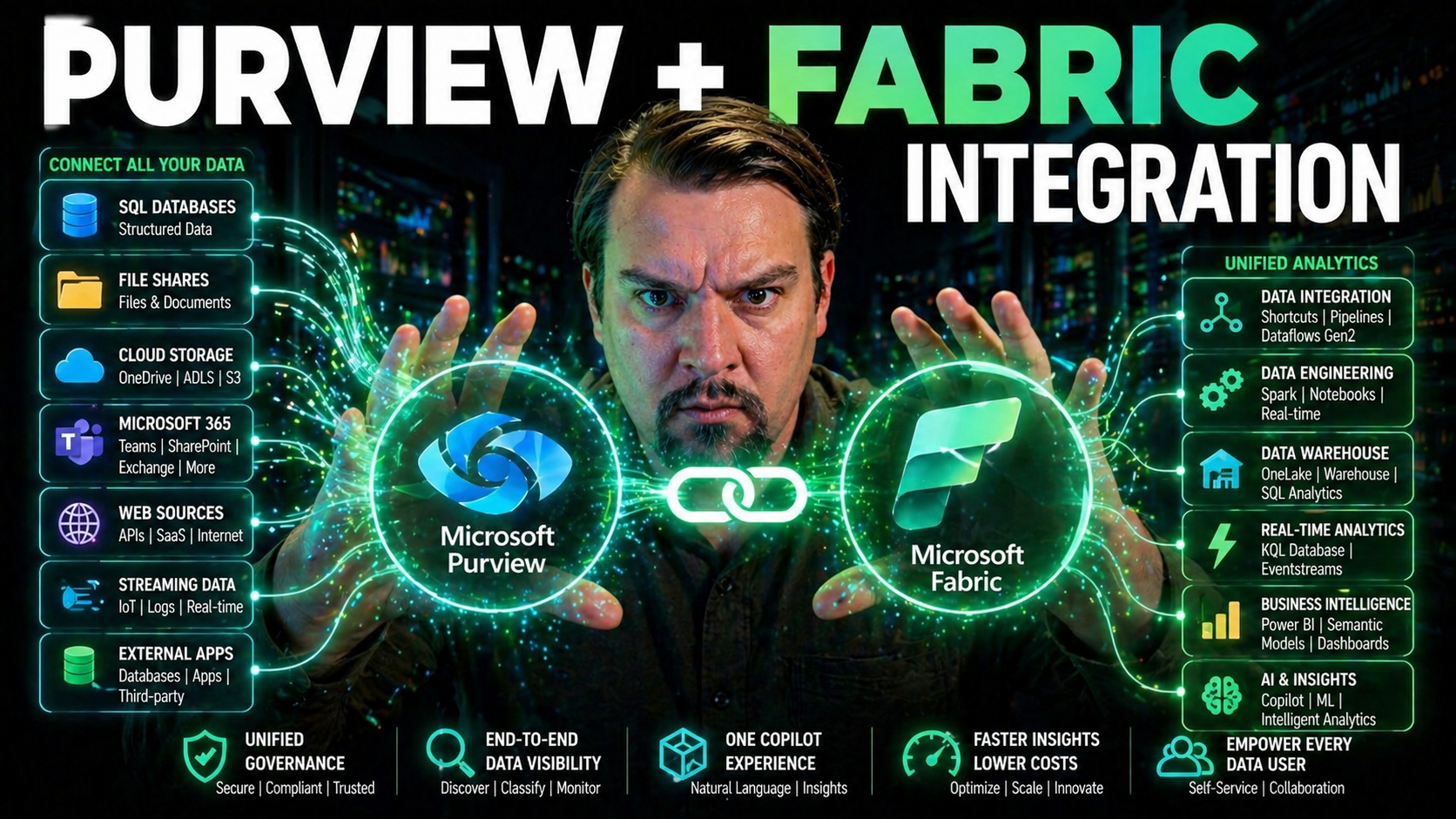
Data sprawl is everywhere you look—and the pressure is on for organizations using Microsoft 365, Azure, and Power Platform to get control over it all. Microsoft knows this, which is why they cooked up something powerful: the seamless integration of Fabric and Purview. When you combine Fabric’s unified analytics capabilities with Purview’s enterprise-grade data governance, you don’t just dodge compliance nightmares—you unlock business value and visibility that’s a game-changer for analytics and AI success.
This guide will take you through the core roles of Microsoft Fabric and Purview, show how they work together for iron-clad governance, and give practical, real-world steps for successful implementation. Whether you’re an IT architect, data lead, or business decision-maker, you’ll learn how to build trust in your data, stay ahead of compliance risk, and boost the value of every insight across your Microsoft cloud estate.
Understanding Microsoft Fabric and Purview
If you’re in the Microsoft ecosystem and you’re still wrangling your data landscape with duct tape and wishful thinking, now’s the time to catch up. At the heart of Microsoft’s modern data stack are Fabric—the unified analytics platform—and Purview—the command center for data governance. These two platforms have quickly become essentials for organizations looking to bring structure and sanity to their ever-growing seas of data.
But let’s be honest: with so many tools and acronyms flying around, it’s easy to lose the thread. Fabric promises to break down the silos between data engineering, business intelligence, and AI by pooling everything—structured and unstructured data—in one place. And Purview steps in to keep all that data governed, cataloged, and compliant, no matter what cloud (or clouds) you call home.
If you need more than promises and shiny marketing, you’re in luck. The next few sections will go straight into what each of these platforms is, what makes them tick, and—most importantly—why smart data governance isn’t just another IT chore, but a foundational play for trust, security, and real business outcomes in the Microsoft universe.
What Is Microsoft Fabric?
Microsoft Fabric is a unified, software-as-a-service (SaaS) analytics platform designed to pull all your data activities into a single, streamlined experience. It weaves together data engineering, data science, real-time analytics, and business intelligence, making it easier to move data from raw source all the way through to boardroom dashboards. At its core is OneLake, a data lake architecture that acts as a universal storage layer across the Microsoft ecosystem.
With native Power BI integration and support for multi-source data ingestion, Fabric simplifies what’s often a tangled mess of tools and workflows. Unlike legacy platforms or the standalone approach of Synapse, Fabric brings everything—dataflows, lakes, AI, and reporting—under one roof, ensuring governance and performance scale together with your organization.
What Is Microsoft Purview?
Microsoft Purview is Microsoft’s answer for unified data governance—across clouds, across data types, and across your whole data estate. It functions as a central hub for cataloging, classifying, and protecting data wherever it lives, whether that’s in Microsoft 365, Azure, or on-premises workloads. Purview automates discovery and categorization of data assets, applies sensitivity labels, and tracks end-to-end data lineage so compliance and governance aren’t afterthoughts.
Its policy management capabilities extend to regulatory compliance for GDPR, HIPAA, and more, making it much more than just a metadata tool. For organizations overwhelmed by document chaos, Purview offers a practical shield—helping teams stay audit-ready, collaborating securely, and managing lifecycle with confidence.
What Is Data Governance and Why Should You Care?
Data governance means establishing guardrails for your organization’s information. It’s about accuracy, privacy, compliance, and—crucially—building trust in analytics output. Without governance, bad things happen: you might breach regulations, suffer data leaks, or make business decisions on untamed, inaccurate data. Shadow IT and inconsistent rules only make it worse, especially with today’s sprawling Microsoft 365, Fabric, and Azure deployments.
Governance is more than tools and dashboards—it’s a discipline that combines people, process, and technology. Setting policies, assigning owners, and monitoring how data is accessed all contribute to a secure environment. Native Microsoft controls can help, but only intentional design and active management keep your compliance story from being just an illusion.
For Microsoft-centric organizations, getting governance right isn’t optional; it’s your ticket to accurate analytics, strong regulatory posture, and true business agility. You don’t want to get caught off guard or, worse, have your next audit expose gaping holes in your strategy. Trust starts with a foundation of well-governed data.
Building a Unified Data Ecosystem with Microsoft Data Fabric and Purview Integration
Bringing Fabric and Purview together isn’t just about adding another tool to your stack—it’s about transforming the way you manage, secure, and analyze data at scale. Integration closes the gap between IT governance and business analytics, fusing the strengths of a robust processing engine (Fabric) with the intelligence and control of a governance powerhouse (Purview).
This is where operational realities meet compliance needs. The union allows you to automate cataloging, enforce policies, and ensure every report or machine learning model is backed by trusted, auditable data. With integration, data flows seamlessly from source to insights, staying visible and governed from start to finish.
If you’ve ever dealt with a so-called “governed” environment that collapsed into chaos because policies were just documents with no teeth, you know why this matters. The upcoming sections make it clear how integration works, why taking a governance-first approach changes the game, and what true seamlessness looks like inside the Microsoft ecosystem. Don’t miss the pitfalls of treating governance as an afterthought in Fabric—the details ahead show how to do it right.
How Microsoft Data Fabric and Purview Integration Works
Microsoft Fabric and Purview connect natively, making governance a built-in layer rather than an after-the-fact scramble. Integration usually starts with connecting Fabric’s OneLake and workspaces directly to Purview using authentication tokens and enterprise identity management. Native connectors enable Purview to discover, scan, and classify data assets stored anywhere within Fabric—structured or unstructured—with no custom plumbing needed.
This integration supports bidirectional metadata synchronization. That means Purview not only catalogs assets in Fabric but also propagates tags, classifications, and sensitivity labels back into the Fabric environment. As a result, all governance rules and metadata remain consistent, even as assets move or change. Policy inheritance flows down from global Purview settings, ensuring new data inherit baseline protections and usage constraints.
Another key point is visibility—Purview surfaces Fabric’s dataflows, pipelines, and access patterns for full governance oversight. It covers authentication chains and allows central policy enforcement, minimizing gaps. Security stays tight via managed identities, RBAC, and, when needed, integration with Azure Key Vault for secret management, making it easy to secure pipelines and sensitive data end-to-end.
Adopting a Governance-First Approach to Data Management
Governance-first means making security and compliance central—not an afterthought—in your Microsoft data ecosystem. With Purview integrated into Fabric, every dataset, report, and data pipeline is aligned with corporate policies from day one. Here, policy enforcement isn’t just documentation but is embedded within your workflows, so controls are actually applied as data moves between systems and users.
This approach slashes risk, tightens audits, and gives you stronger defense against unauthorized access or accidental data leaks. Whether it's DLP, role-based access, or continuous monitoring, a governance-led model is how you keep the data wolf from your organizational door. For a deep dive on advanced scenarios, check out strategies for securing AI agents with Purview DLP policies.
Seamless Integration for Improved Utility
The joint platform is all about making life easier for technical teams and business users alike. With integration, you get unified data catalogs, in-place sensitivity labeling, and simplified data discovery—all from one interface. Business users can search, find, and request access to governed data assets without chasing down IT or toggling between apps.
This seamlessness not only cuts complexity and manual overhead, but also encourages adoption across the organization. With everything tracked and labeled automatically, there’s less risk of error and a significantly lower total cost of ownership.
Key Capabilities of Fabric and Purview Integration
Once Fabric and Purview join forces, you’re no longer patching together compliance or data discovery with manual effort or siloed tools. Integration unlocks a powerhouse of features—automated classification, deep lineage, unified asset cataloging, and more—that simplify governance while empowering analytics and business users.
Technology leaders can feel confident they’re not just checking compliance boxes. These capabilities mean data is cataloged, discoverable, and auditable—which are the pillars for secure analytics and effective data collaboration. In the next sections, you’ll see precisely how each key feature works beneath the hood and helps solve everyday challenges around compliance, data sharing, and operational transparency.
Notable Capabilities and Features
- Automated Data Classification: Purview uses built-in and custom rules to auto-tag sensitive data for faster compliance and risk reduction.
- Lineage Tracking: Visualizes the entire data journey from source ingestion to Power BI dashboards, simplifying impact analysis and debugging.
- Unified Metadata Catalog: Enables enterprise-wide search and discovery of data assets, cutting time spent hunting down critical information.
- Sensitivity Labeling: Applies and enforces privacy, retention, and access rules, even across cross-tenant data scenarios.
- Impact Analysis: Surfacing downstream effects before schema or data changes hit production, reducing breakages in analytics pipelines and regulatory processes.
For proactive user and data activity oversight, Purview Audit delivers robust logs for forensic investigations and compliance tracking.
Data Collaboration and Cataloging Across Platforms
With Purview’s catalog at the center, teams can discover, share, and manage data assets across the entire Microsoft cloud—Fabric, Power BI, and beyond. This allows seamless cross-functional collaboration, even across distributed or multi-tenant organizations. Asset ownership and access are always visible, which means subject-matter experts and business units can work together on analytics projects without risking data sprawl or compliance gaps.
This approach isn’t just for IT—it empowers business users too. For strategies to encourage accountability and secure collaboration without over-restricting users or AI, see guidance on sustainable data access and ownership governance.
Data Lineage and Impact Analysis Within Fabric
Integrating Purview with Fabric gives you transparent line-of-sight from raw data ingestion right through to final dashboards and reports. Having such lineage at your fingertips means you can quickly identify the sources of issues, debug failed pipelines, and trace data flows for compliance or audit purposes. Data lineage also underpins predictive impact analysis—by understanding where each data asset is used, you can prevent reports or applications from breaking after changes upstream.
This is crucial not just for regulatory compliance, but also to ensure the meaning and trustworthiness of data don’t erode over time. For deeper insight, read about the human side of preventing data model drift in Fabric environments.
Implementation Roadmap for Fabric and Purview
Implementing Fabric and Purview together isn’t an overnight job, but having a step-by-step roadmap takes the complexity out of the process. Success starts with mapping your data estate—knowing what you have and where it lives—then setting up and enforcing the right policies. Rolling out in phases ensures you avoid culture shock and gaps in adoption, and a focus on continuous improvement keeps things secure and efficient over time.
This structured approach prevents the chaos that comes from jumping in blind and helps you maximize ROI. It also highlights common traps—like letting policy drift undermine your governance, or missing the dark corners of shadow IT. The following sections walk through each phase, sharpening your organization’s data strategy with proven best practices and modern governance design. For lessons learned in Azure governance that apply equally well to Fabric and Purview rollouts, check the strategy for governance by design.
How to Map Your Data Estate
- Catalog all data assets: Use Purview connectors to automatically discover structured and unstructured data sources across Azure, Fabric, Microsoft 365, and other platforms.
- Identify system owners: Document ownership and support contacts for each data asset to clarify who’s responsible for accuracy, access, and lifecycle.
- Assess for Shadow IT: Scan your environment for unmanaged SaaS apps, orphaned assets, and rogue data flows using tools like Microsoft Defender for Cloud Apps—more on this in the Shadow IT remediation guide.
- Establish asset visibility: Use Purview’s unified view to address blind spots across hybrid and multi-cloud sources—this ensures no compliance or analytics gap slips through.
Defining and Enforcing Governance Policies
Configuring governance is all about setting up clear, enforceable rules using Purview’s templates for classification, retention, and access. Policies should map to both regulatory and internal security requirements, and can leverage approval workflows for changes. Real-time monitoring and automated labeling within Fabric keep these policies in force, closing gaps that could otherwise expose sensitive data or compliance risk.
To see how organizations are tying contracts, licenses, RBAC, and technical enforcement together for AI, dive into the practical Copilot governance policy framework.
Best Practices for Implementation Success
- Stakeholder alignment: Engage business, security, and data owners from Day One for buy-in and policy clarity.
- Phased rollout: Start small, build muscle memory, then expand Fabric-Purview integration to new domains.
- Targeted training: Provide continual training and create a learning hub to ensure adoption—see why a governed Copilot Learning Center makes the difference.
- Continuous feedback: Schedule regular check-ins and gather user input to drive improvements and resolve blockers quickly.
Continuously Monitor and Optimize Your Environment
Ongoing vigilance is non-negotiable. Use Purview analytics, audit logs, and alerts to monitor compliance, catch risk signals, and tune resource performance. Don’t wait for annual reviews—automated dashboards and Power BI integration make it easy to spot drift or security issues in near real time.
The goal is iterative improvement—fix issues as they arise and adjust policies or processes proactively. For more on continuous compliance, explore using Defender for Cloud and Power BI to centralize monitoring and reporting.
Real-World Scenarios Where Fabric and Purview Excel
Skeptical that governance and analytics hype ever pays off in the real world? Here’s where things get interesting. When Fabric and Purview work in tandem, organizations see measurable results—streamlined supply chain operations, deeper customer engagement, and smoother regulatory audits, to name a few. These aren’t vague promises, but outcomes grounded in practical use cases from industries under pressure to deliver real ROI and mitigate risk.
The following sections break down exactly how this integration transforms outcomes for logistics, marketing, and finance teams. Whether you’re contending with fragmented legacy systems, multi-cloud complexity, or regulatory scrutiny, you’ll find examples that speak to your reality and help you envision next steps. It’s time to move from theory to proven, actionable business value.
Supply Chain Optimization with Integrated Data Governance
By uniting Purview’s governance with Fabric’s analytics, organizations illuminate blind spots in their supply chain—turning scattered inventory and shipping data into trustworthy, real-time insights. This means inventory managers spot anomalies faster, logistics teams optimize routes on the fly, and partner compliance checks happen automatically, not as a last-minute scramble.
For logistics and finance teams facing new regulations, embedding audit-ready controls isn’t optional. See how continuous, system-level compliance is transforming operations under initiatives like EU’s ViDA—and how to design for auditable VAT and partner reporting from the ground up.
Personalized Customer Experience Through Governed Data
Targeted marketing and personalized service depend on not just customer data, but governed customer data. Purview ensures identity and behavioral data is classified and protected, while Fabric enables analytics and AI-driven segmentation—always with compliance in mind. Organizations can then use sensitive information (e.g., personal identifiers) safely, tailoring offers and experiences to customers without blowing up privacy or regulatory requirements.
For practical steps to keep your AI-driven campaigns compliant and traceable, dig into enforcing least-privilege controls and DLP across Microsoft Copilot and CRM systems.
Financial Reporting and Compliance Made Easy
Financial teams and compliance officers are under the gun to produce audit-ready, regulation-proof reports. When Purview and Fabric work together, data lineage and documentation are automated, ensuring every control check and policy event is logged. Automated compliance scorecards and audit-trail generators support GDPR, HIPAA, SOX, and more.
Don’t underestimate the hidden dangers—even in well-governed M365 environments, policy drift and behavior changes can undercut compliance. For insight into real compliance drift and how to guard against it, examine what’s lurking inside Microsoft 365 retention policies.
Latest Enhancements and The Future of Microsoft Fabric and Purview
Microsoft isn’t just shipping new features and calling it a day—they’re continuously reworking Fabric and Purview to keep up with how organizations use data, analytics, and AI. Forward-looking investments target not only more seamless integration, but also automation and cross-platform flexibility to meet the ever-stricter regulatory landscape in the U.S. and abroad.
The next sections highlight recent upgrades—everything from AI-driven policy engines to expanded Power BI coverage—and look ahead to what’s coming down the pipeline. Staying current means getting ahead of compliance change and unlocking new value from governed data. Adapting your platform as Microsoft evolves will be key to future-proofing analytics initiatives—and staying off auditors’ radar.
Recent Innovations and Product Enhancements
- Deeper Power BI integration: BI assets now auto-register inside Purview for unified search and access control.
- Automated sensitivity labeling: AI-driven models detect PII and auto-apply policies, slashing manual tagging effort.
- Lineage visualization improvements: Clearer mapping of cross-tenant and multi-cloud data relationships aid impact analysis.
- AI-powered governance insights: Automated recommendations for risk remediation and policy updates save countless admin hours.
- Better forensic auditing: Improved traceability for high-risk environments helps teams quickly investigate suspicious activity.
For context on what these changes fix (and what they can’t), check why descriptive lineage alone isn’t enough for policy enforcement.
Looking Ahead: The Future of Integrated Data Governance
Microsoft is betting big on AI-driven automation and proactive governance for its Fabric + Purview stack. Expect to see smarter, policy-aware agents that monitor, enforce, and adapt rules across multi-cloud environments. The direction is clear: break away from manual, spreadsheet-based oversight and move to cross-platform, real-time control for both data and AI assets.
This shift is also about bridging organizational silos—decentralized teams, federated stewardship, and dynamic policy inheritance will be the rule, not the exception. Standards will keep tightening, so agility and automation must be front and center. For an in-depth look at governance for enterprise-scale AI, explore the need for control planes in agent-based environments.
Staying Ahead as Government Standards Evolve
Regulatory requirements change—sometimes faster than IT teams can keep up. Microsoft is continually updating Fabric and Purview to not only track with new laws, but also to help organizations get ahead of coming challenges. Whether it’s U.S. privacy updates, EU digital taxation, or sector-specific mandates, platform innovation is focused on automating compliance and driving ethical data use at scale.
Stay proactive: use Microsoft’s roadmap and built-in compliance tools to keep your organization ready for whatever legal or ethical challenge comes next. Leaning into platform updates is the only way to avoid costly surprises when rules inevitably shift.
Getting Started and Next Steps with Fabric and Purview
Ready to take your first steps? Microsoft has made it easy(ish) to bring Purview and Fabric into your environment—if you know where to start. This section will walk you through the initial setup, what to expect from your first insights, and how to lay the groundwork for governed, future-proof analytics.
Whether you’re an admin looking to configure Purview for the first time, a data engineer tasked with onboarding assets, or a business stakeholder rallying support, you’ll find actionable steps and tips for avoiding common headaches. Links to practical resources and ongoing learning communities are here to keep you (and your organization) moving forward, making the transition from exploration to confident execution.
How to Access Purview and Set Up Your Admin Workspace
- Obtain Purview Licensing: Confirm you have the required Microsoft 365 or standalone Purview licenses; consult your reseller or admin portal to review SKU coverage and costs.
- Configure Basic Access: Use the Microsoft Purview portal to assign admin roles and permissions, enabling secure management and asset discovery right out of the gate.
- Establish Your Admin Workspace: Set up Purview governance workspaces aligned to your organization’s business units, connecting them to your Microsoft 365 environments for central policy enforcement and metadata management.
- Integrate Existing Systems: Leverage Fabric and Azure connectors to pull in data sources, and avoid classic pitfalls like granting excessive permissions or missing multi-tenant assets during onboarding.
First Purview Insights: What to Expect
After your first data scan, Purview delivers a dashboard packed with actionable metrics: discovered data assets across all registered systems, sensitivity labels applied, and heat-mapped areas of high-risk data concentration. You’ll see instant insights on compliance posture, potential policy violations, and asset ownership clarity, helping you prioritize next steps.
For admins and analysts, these insights set the stage for targeted data cleanup, shadow IT mitigation, and ongoing policy refinement—empowering your team to take immediate action for better data hygiene and regulatory readiness.
Ready to Build Your Data Foundation?
There’s never been a better time to put structure and security into your data universe. Integrating Fabric and Purview means you can build on a foundation that’s equally strong for analytics and compliant governance. Ready to get started? Microsoft offers a variety of trials, toolkits, and documentation, including step-by-step resources for new deployments—find more at Build Your Data Foundation.
Taking action now means fewer compliance headaches, more trustworthy analytics, and a head start on the data-driven initiatives of the future.
Next Steps: Move Forward with Fabric and Purview Integration
- Schedule a Guided Demo: Connect with Microsoft or a certified partner for a walkthrough tailored to your business challenges and compliance requirements.
- Explore Deep-Dive Documentation: Dive into Microsoft’s technical guides for Fabric and Purview integration, and see how advanced control mechanisms—like Entra Agent ID and MCP tool contracts for AI governance—apply in real-world environments.
- Join the Microsoft Community: Participate in online user groups, forums, and admin communities to ask questions and share lessons learned in deploying governed analytics at scale.
- Follow Power Platform Governance Best Practices: Don’t forget to invest in cross-stack governance—best practices for Power Platform security can help you close gaps and secure your data pipelines beyond analytics.
- Map Out Your Next Milestone: Use the insights and momentum from your initial rollout to onboard new domains, train additional users, and automate more policies for a robust, future-proof governance posture.
You Should Also Listen To
If you are exploring Purview and Fabric integration, these podcast episodes add practical context from Microsoft 365 architecture, governance, security, and AI. Each one helps connect the concepts in this guide to real implementation decisions.
- Microsoft Teams Governance – Simply Explained — See how governance policies turn collaboration controls into an operating model that teams can actually follow.
- Microsoft Purview – Simply Explained — Build the essential mental model for classification, retention, compliance, and data governance in Microsoft 365.
- Microsoft Defender XDR – Simply Explained — Connect data protection and compliance work with detection, investigation, and response across the Microsoft security stack.
- Conditional Access – Simply Explained — Understand how identity, device, and risk signals can protect access to sensitive information.
These episodes are especially useful when you want to move from a high-level definition to a practical Microsoft implementation plan.

Microsoft MVP | Host of M365.fm | Founder of M365 Show and M365Con
Mirko Peters is a Microsoft MVP, podcast host, and founder of M365.fm, M365 Show, and M365Con. His work connects Microsoft practitioners through podcast interviews, livestreams, and community events.
At M365.fm, Mirko hosts conversations with Microsoft MVPs, product experts, architects, and community contributors. Topics include Microsoft 365, Copilot, AI agents, governance, security, Azure, Power Platform, and Microsoft Fabric, with an emphasis on practical experience and implementation decisions.
M365.fm is the podcast and learning platform. M365 Show brings experts together for livestreams, while M365Con provides an online conference setting for community learning.
Official website: Mirko Peters (https://www.mirkopeters.com/). Recognition: Mirko Peters — Microsoft MVP profile (https://mvp.microsoft.com/de-DE/mvp/profile/9b0ca797-db5a-493a-a845-8b9158046cf5). Connect on LinkedIn (https://www.linkedin.com/in/m365showpodcast/).