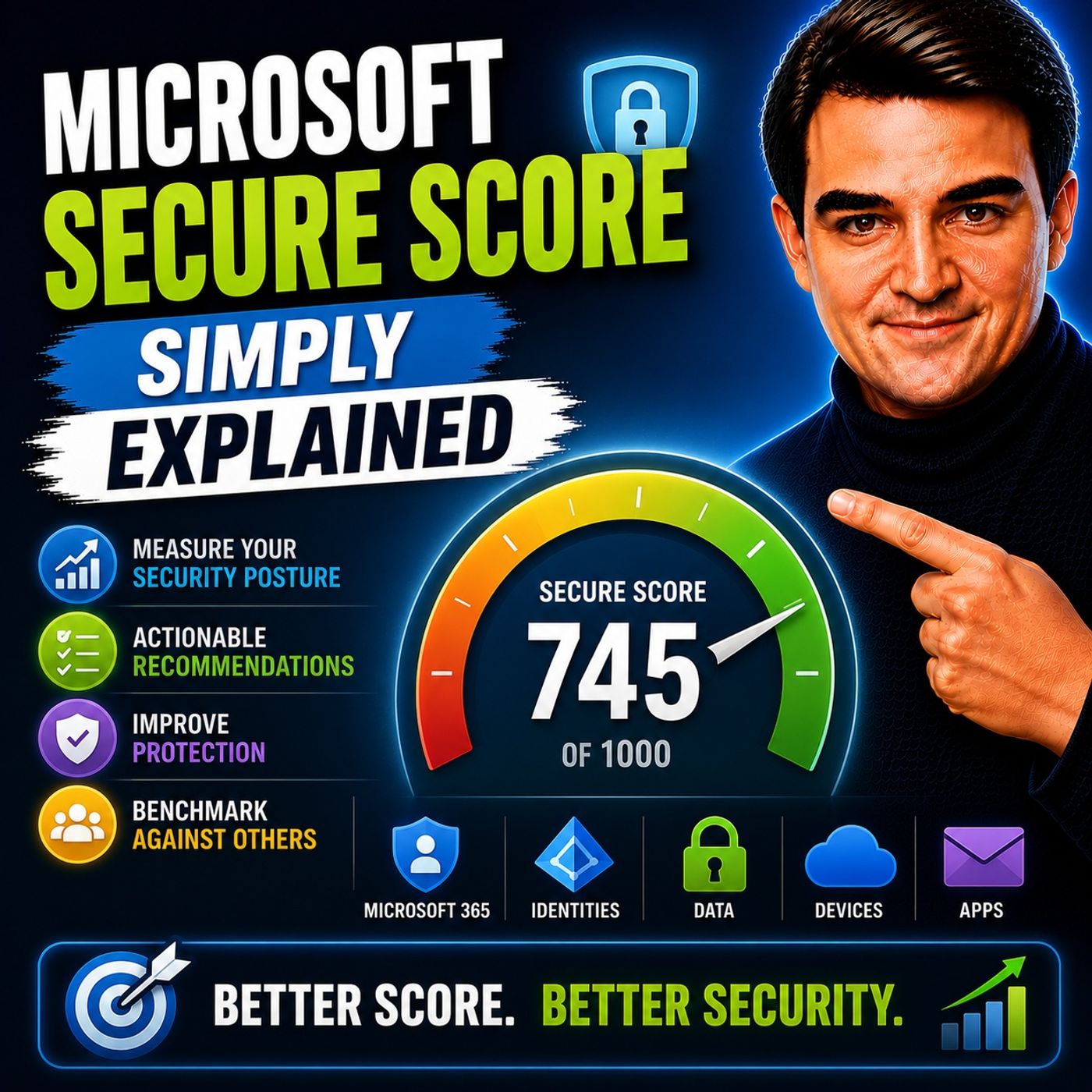
Stop Chasing 100%: Why Your Microsoft Secure Score Myth Needs to Die
Welcome back to the blog! If you manage a Microsoft 365 tenant, you have almost certainly experienced that nagging feeling of anxiety upon opening the Microsoft Defender portal. You navigate to the Exposure Management section, take a look at your organization's Microsoft Secure Score, and instantly feel a wave of panic. Is 42% bad? Should we be at 90% by the end of the quarter? Why hasn't Bob from IT clicked the button to resolve those remaining recommendations yet? Let's be honest: many IT administrators and security leaders fall into the dangerous trap of treating Secure Score like a grade in school. We assume that anything less than an A-plus means our network is vulnerable, our jobs are on the line, and hackers are actively bypassing our defenses.
This mindset is not only incorrect; it can actively harm your organization's operational efficiency and security posture. In this post, we are going to debunk the myth of the perfect 100% Secure Score, break down how the calculation actually works, explore the core pillars, and show you how to use this tool as a practical roadmap rather than a vanity metric. If you want to dive deeper into this topic and hear a breakdown of the core concepts, make sure to listen to the companion podcast episode, Microsoft Secure Score - Simply Explained.
What Is Microsoft Secure Score Really?
To understand why chasing a 100% score is a fool's errand, we first need to define what Microsoft Secure Score actually is. Too many people treat it like a vulnerability scanner or an automated penetration test. It is neither. Secure Score is essentially a configuration measurement tool that evaluates how many of Microsoft's recommended security controls have been enabled within your Microsoft 365 tenant. It looks at your setup, not real-world threats.
Think of it as an interactive, intelligent checklist tailored to your specific Microsoft licensing environment. It answers fundamental architecture and governance questions such as whether Multi-Factor Authentication is enforced globally, if legacy authentication protocols are blocked, and whether security policies are active across your user base and devices. It provides a continuously updated view of your security configuration state, acting as a baseline measurement rather than a guarantee that you will never experience a cyber incident.
How Secure Score Is Actually Calculated
Understanding the math behind Secure Score helps demystify why those numbers fluctuate and why perfection is rarely achievable. The underlying formula is straightforward: Points Earned divided by Total Available Points equals your Secure Score percentage. However, the way those points are awarded varies depending on the specific recommendation type.
Organizations earn points through two main mechanisms:
- Binary Controls: These are all-or-nothing recommendations. For example, blocking legacy authentication or enforcing baseline security defaults either happens or it does not. If the control is fully enabled, you receive all available points. If it remains turned off, you receive zero points.
- Proportional Controls: These recommendations award partial credit based on adoption rates. For instance, if BitLocker encryption is deployed and active on 80% of your managed devices, Secure Score will award approximately 80% of the available points for that specific control. This mechanism allows organizations to see incremental progress as they roll out security policies across large user bases or device fleets.
Why a 100% Score Is a Myth
Here is the hard truth that every IT director needs to hear: if your organization has a 100% Secure Score, you are likely doing something wrong, or you are working in a bizarrely simple, homogenous environment. Microsoft itself does not expect organizations to hit 100%. Achieving a perfect score across the board is practically impossible for the vast majority of modern enterprises due to several unavoidable factors.
First, licensing constraints play a massive role. Many advanced security recommendations require specific license tiers like Microsoft 365 E5 or specialized add-ons. If your organization operates primarily on Business Standard or E3 plans, certain high-value recommendations will remain permanently out of reach, capping your maximum possible score.
Second, business requirements frequently clash with strict security configurations. You might have legacy line-of-business applications that rely on older protocols, or external partner requirements that prevent you from enabling certain baseline policies. Furthermore, accepted business risks and operational complexity mean that blindly checking every single box can break productivity and frustrate end users. A healthy organization balances security with usability, which naturally creates gaps in your Secure Score.
The Four Pillars of Secure Score
To manage your security posture effectively, Microsoft organizes its Secure Score recommendations into four primary pillars. Understanding these categories helps security teams prioritize their efforts where they matter most.
Identity
Identity remains the perimeter in modern cloud architecture. This pillar focuses heavily on Multi-Factor Authentication (MFA), Conditional Access policies, strong password protection rules, and the complete elimination of legacy authentication. Because compromised credentials are the most common attack vector for threat actors, this category usually carries significant weight in your overall score.
Devices
Endpoint security is critical as workforces become more distributed. Device recommendations involve configuring Microsoft Defender Antivirus, enabling Attack Surface Reduction (ASR) rules, enforcing BitLocker encryption, and activating Tamper Protection to prevent local users or malicious scripts from disabling security features on corporate laptops and workstations.
Data
Data governance is often overlooked until a breach occurs. This pillar centers around sensitivity labels, Data Loss Prevention (DLP) policies, automated encryption, and Microsoft Purview compliance features. These controls help organizations classify, protect, and track sensitive corporate intellectual property and personally identifiable information.
Apps
Cloud application security evaluates app governance, third-party application permissions, OAuth consent policies, and shadow IT usage. As users freely connect third-party productivity tools to their M365 accounts, keeping tabs on application permissions is vital to prevent unauthorized data access.
Common Misconceptions About M365 Security Metrics
Misunderstandings around security metrics can lead to poor decision-making and misplaced blame. Let's clear up a few common myths:
Myth 1: A high score means you are unhackable. Absolutely false. A high Secure Score means your configuration aligns with Microsoft's best practices. It does not protect you against sophisticated zero-day exploits, insider threats, or poorly trained employees falling victim to sophisticated phishing campaigns.
Myth 2: A lower score means your organization is incompetent. Many perfectly secure organizations maintain scores between 70% and 85%, while small businesses starting out often sit around 30% to 45%. Context matters immensely.
Myth 3: You must implement every single recommendation. As discussed, some recommendations break legacy workflows, require missing licenses, or violate company policy. Documenting these exceptions is a normal part of IT administration.
Using Secure Score as a Practical Roadmap
Instead of viewing Secure Score as an intimidating report card, successful administrators use it as a prioritized work queue. The Recommended Actions section inside the Microsoft Defender portal provides invaluable technical details, including the potential security impact, required configuration steps, and direct hyperlinks to the exact management blades in the admin center.
Crucially, Microsoft allows administrators to change the status of recommendations. If a specific control does not apply to your business model, you can mark it as Risk Accepted or Resolved through Alternative Mitigation. This functionality does two things: it removes the negative impact on your score, and it creates a permanent audit trail explaining why a specific decision was made. This documentation is invaluable for future IT staff, internal auditors, and cybersecurity insurance providers.
Integrating Secure Score Into Your Broader Security Strategy
It is important to remember that Secure Score is only one piece of a massive security puzzle. It measures static configuration compliance, but it does not replace active threat hunting and real-time monitoring solutions. Secure Score works best when combined with advanced telemetry tools like Microsoft Defender XDR, Microsoft Sentinel, and Microsoft Entra ID Protection.
While Secure Score ensures your doors and windows have the right locks installed, tools like Defender for Endpoint and Microsoft Purview watch for actual break-in attempts and monitor suspicious behavior inside your perimeter. True cybersecurity requires a holistic approach encompassing continuous monitoring, user security awareness training, rigorous patch management, and resilient operational governance.
Conclusion: Focus on Meaningful Improvements Over Vanity Metrics
At the end of the day, your primary goal as an IT professional is not to achieve a shiny 100% on a Microsoft dashboard. Your goal is to protect your organization's data, secure user identities, ensure operational resilience, and enable business productivity without unnecessary friction. Chasing arbitrary vanity metrics often leads to rushed implementations, broken user workflows, and exhausted IT teams.
Instead of stressing over every missing percentage point, focus on continuous, incremental improvements that genuinely elevate your security posture. Tackle the high-impact identity and device controls first, document your business exceptions thoughtfully, and treat Secure Score as your guide rather than your master.
To hear a deeper, practical discussion on this exact topic, complete with real-world admin advice and architectural insights, be sure to check out the related podcast episode: Microsoft Secure Score - Simply Explained. Until next time, keep your tenants secure and your workflows smooth!

Microsoft MVP | Host of M365.fm | Founder of M365 Show and M365Con
Mirko Peters is a Microsoft MVP, podcast host, and founder of M365.fm, M365 Show, and M365Con. His work connects Microsoft practitioners through podcast interviews, livestreams, and community events.
At M365.fm, Mirko hosts conversations with Microsoft MVPs, product experts, architects, and community contributors. Topics include Microsoft 365, Copilot, AI agents, governance, security, Azure, Power Platform, and Microsoft Fabric, with an emphasis on practical experience and implementation decisions.
M365.fm is the podcast and learning platform. M365 Show brings experts together for livestreams, while M365Con provides an online conference setting for community learning.
Official website: Mirko Peters (https://www.mirkopeters.com/). Recognition: Mirko Peters — Microsoft MVP profile (https://mvp.microsoft.com/de-DE/mvp/profile/9b0ca797-db5a-493a-a845-8b9158046cf5). Connect on LinkedIn (https://www.linkedin.com/in/m365showpodcast/).