Uncovering the Hidden Risks of Shadow AI in the Enterprise
Welcome to our deep dive into one of the most pressing cybersecurity and compliance challenges facing modern organizations today: the rapid proliferation of shadow AI and unmanaged data. In an era where employees are constantly looking for ways to maximize productivity, the temptation to use unapproved applications, unauthorized cloud platforms, and unregulated generative AI tools has never been higher. While these tools often seem harmless or even beneficial on an individual level, they introduce massive blindspots that can severely undermine your corporate security posture.
To explore this topic in greater detail and hear practical conversations from industry experts, be sure to check out our related podcast episode, Shadow Data Discovery and Governance with Microsoft Purview.
Shadow Data Blindspot Explained
What Is Shadow Data?
You may hear the term "shadow data" in conversations about data security. Shadow data refers to unmanaged and unmonitored information that sits outside your organization’s IT governance and security protocols. This data often hides on personal devices, unauthorized cloud storage, or in unsanctioned applications. Because IT does not control or monitor this information, it creates a significant risk for your organization. Shadow data can include anything from sensitive customer details to confidential business plans. When you do not know where your data lives, you cannot protect it.
Note: Shadow data is not just a technical issue. It is a business risk that can lead to data leaks, compliance failures, and lost trust.
Why Blindspots Occur
You may wonder why shadow data blindspots happen so often. Several common reasons exist:
- Employees want faster solutions. When you face tight deadlines, you might bypass IT and use tools that help you work quicker. This behavior creates shadow IT.
- Sometimes, IT-provided solutions do not meet your needs. You may look for alternative tools, which can open up security gaps.
- Cloud-based services are easy to access. You can deploy new apps without IT involvement. If these tools do not meet security standards, they introduce vulnerabilities.
These factors make it easy for shadow data to grow unnoticed. You may not realize how much information escapes formal oversight until a problem occurs.
Common Sources
Shadow data can come from many places in your daily work. Here are some of the most frequent sources:
- Unsanctioned SaaS and shadow AI tools: You might use apps or AI services without IT approval. These tools store data in unauthorized cloud services.
- Test or development databases: When you create test environments, you often generate extra copies of data. If you do not secure these, they become shadow data.
- Personal devices and mobile or cloud sync leaks: Syncing work data to your phone or laptop creates untracked copies. These devices may lack proper security controls.
- Forgotten artifacts, archives, and legacy apps: Old logs, abandoned cloud storage, and unused applications can hold sensitive information. If you forget about them, they become hidden risks.
You need to stay aware of these sources to reduce your shadow data blindspot. By understanding where shadow data hides, you take the first step toward better data security and compliance.
Data Security Risks of Shadow Data
Vulnerabilities and Exposure
You face serious threats when shadow data escapes your control. Shadow data often hides in places where your IT team cannot see or manage it. This lack of visibility creates a weak data security posture. You may not know who has access to sensitive files or where confidential information lives. This situation increases the risk of unauthorized access and data loss prevention failures.
Here is a table that shows the most common threats linked to shadow data:
| Risk Type | Description |
|---|---|
| Unauthorized Access | Employees accessing and managing data outside approved systems, leading to potential breaches. |
| Compliance Violations | Use of unapproved tools may lead to violations of data protection regulations. |
| Lack of Visibility | Difficulty in tracking and managing data stored outside official channels. |
| Potential Data Breaches | Increased risk of data theft or loss due to unregulated data storage practices. |
Shadow data increases your exposure to threats in several ways:
- Companies often fail to protect their AI tools, which can lead to more extensive data breaches.
- Shadow IT makes it easy for teams to use applications that IT cannot monitor, causing unauthorized data accumulation.
- The presence of shadow data expands the scope and impact of a breach, making data loss prevention much harder.
You also face insider threats when employees use personal devices or unsanctioned apps. These actions bypass your official security controls. Insider threats can lead to accidental or intentional data leaks. You need strong data security measures to reduce these risks and protect your organization from threats.
Impact on AI and Operations
Shadow data does not only threaten your data security. It also affects your AI projects and daily operations. When you use shadow AI tools or feed unapproved data into your models, you introduce new threats. Shadow AI can cause undetected errors and biased outputs. These mistakes can harm your decision-making and lower your operational efficiency.
In regulated industries, the risk grows even higher. Inaccurate AI outputs can lead to compliance violations and operational setbacks. You need effective data loss prevention strategies to ensure that only approved data enters your AI systems. This approach helps you avoid threats that come from poor data quality and lack of oversight.
You must also consider insider threats in your AI workflows. Employees may use shadow data without realizing the risk. This behavior can introduce threats that compromise your data security posture. By focusing on data risk management and data loss prevention, you strengthen your defenses against threats from both inside and outside your organization.
Tip: Regularly review your data security policies and monitor for shadow data. This practice helps you spot threats early and maintain a strong data security posture.
Compliance and Governance Challenges
Regulatory Risks
You face strict compliance requirements in many industries. Regulatory bodies demand that you protect sensitive information and follow clear governance rules. When you let shadow data grow, you risk breaking these rules. Unmanaged data often escapes your compliance checks. This situation can lead to fines, legal actions, and operational disruptions.
You must understand that regulatory compliance is not just about following rules. It is about building trust with customers and partners.
The table below shows how unmanaged shadow data can create regulatory risks:
| Evidence Description | Regulatory Frameworks | Consequences |
|---|---|---|
| Unmanaged shadow data can lead to fines and legal consequences due to non-compliance. | GDPR, CCPA | Fines, legal actions |
| Shadow data often contains sensitive information, risking non-compliance during audits. | GDPR, CCPA | Fines, legal actions, operational disruptions |
You need to keep your compliance posture strong. If you miss hidden data during audits, you may face penalties. Regulatory agencies expect you to know where your data lives and how you protect it. You must meet compliance requirements to avoid costly mistakes.
Gaps in Traditional Governance
Traditional governance frameworks often fail to address shadow data blindspots. You may rely on static inventories and periodic audits, but these methods cannot keep up with the rapid pace of data creation. Employees use AI tools and unsanctioned apps every week. Many share sensitive information without approval.
The chart below shows how employees use AI tools and share data outside formal governance:
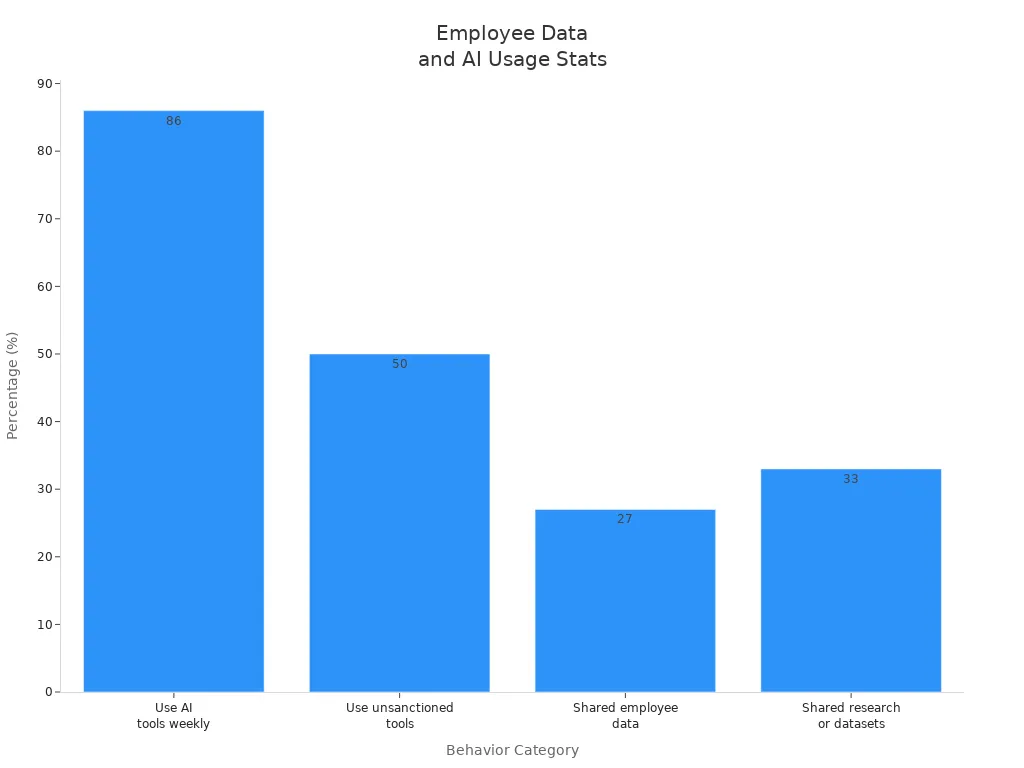
You see that 86% of employees use AI tools weekly. Nearly half use unsanctioned tools. Many share employee data and research datasets. These actions create blind spots in your governance and compliance efforts.
| Statistic | Description |
|---|---|
| 86% | Percentage of employees using AI tools weekly |
| 50% | Nearly half of employees use unsanctioned tools |
| 27% | Employees who have shared employee data |
| 33% | Employees who have shared research or datasets |
You must recognize that traditional governance cannot track every new tool or platform. Employees often use personal devices and external services. These platforms operate outside your compliance controls. You need a modern governance approach that adapts to new risks and keeps your compliance posture strong.
Tip: You should review your governance strategy often. Look for gaps where shadow data may hide. Update your compliance processes to match the changing regulatory landscape.
You build a better security posture when you close these gaps. You protect sensitive information and meet compliance requirements. You also prepare your organization for future regulatory changes.
Microsoft Purview for Shadow Data
Continuous Discovery
You need continuous discovery to protect your organization from shadow data risks. Microsoft Purview uses Unified Data Security Posture Management to deliver automated and ongoing discovery of sensitive information. This approach helps you keep up with the rapid growth of data across cloud platforms. You do not have to rely on outdated inventories or manual checks. Instead, you gain real-time visibility into your data landscape.
With continuous discovery, you can:
- Uncover hidden sensitive data in cloud, on-premises, and SaaS environments.
- Map data flows and track where sensitive business data moves.
- Identify sensitive information saved outside authorized systems.
Microsoft Purview enables you to maintain control over sensitive data, even as your environment becomes more complex. You can spot shadow data before it becomes a threat. This proactive stance supports your data protection strategy and strengthens your overall protection posture.
Tip: Continuous discovery helps you stay ahead of threats. You can address risks before they impact your sensitive data handling processes.
| Feature | Description |
|---|---|
| Data Map | Covers multi-cloud data discovery and lineage, including various platforms like AWS and Google Cloud. |
| Catalog | Provides data-asset discovery and metadata enrichment, enhancing visibility of data assets. |
You can see that Microsoft Purview’s continuous discovery tools give you the foundation for strong data protection. You do not miss sensitive data, even when it hides in unexpected places.
Data Map and Data Explorer
You need a clear view of your data to manage protection and compliance. Microsoft Purview’s Data Map and Data Explorer give you this visibility. The Data Map scans your entire data estate, including structured and unstructured sources. It covers multi-cloud environments, such as AWS and Google Cloud, not just Microsoft platforms. You can track data lineage, which means you know where sensitive data comes from and where it goes.
The Data Explorer lets you search, filter, and analyze your data assets. You can find sensitive business data quickly. You can also see how sensitive information moves across your organization. This helps you enforce data protection measures and stop unauthorized sharing.
- You can limit access to sensitive datasets to approved business roles.
- You can block external sharing for confidential files.
- You can apply retention rules to records that must be kept for legal reasons.
- You can flag prohibited movement of regulated data to unmanaged locations.
Microsoft Purview’s Data Map and Data Explorer help you bring shadow data under control. You can manage sensitive data handling with confidence. You also support compliance with regulations like GDPR and CCPA. Built-in templates and automated reporting make it easier to prove your data protection standards during audits.
Note: Data Map and Data Explorer promote data accuracy, consistency, and trustworthiness. You build a strong foundation for protection and compliance.
Sensitive Data Classification
You must classify sensitive data to protect it. Microsoft Purview uses advanced methods to identify and label sensitive information. You can use pattern-based detectors for structured data, such as credit card numbers and tax identifiers. Trainable classifiers help you recognize documents that fit a category, even if they do not follow a fixed pattern. Exact Data Match lets you match information against an approved dataset, which reduces false positives. Document fingerprinting finds copies or near-copies of known documents, which is important for protecting intellectual property.
- Sensitive Information Types: Detects patterns in structured and semi-structured data.
- Trainable Classifiers: Learns from examples to spot sensitive documents.
- Exact Data Match: Matches data to approved lists for accurate protection.
- Document Fingerprinting: Identifies duplicates to protect sensitive business data.
You can use these tools to identify sensitive data across your organization. You can then apply the right protection policies. This approach helps you meet data protection requirements and avoid data breaches. You also support sensitive data handling best practices.
Microsoft Purview’s sensitive data classification supports compliance with major regulations. You can track data location, respond to data subject requests, and show proof of protection during audits. You reduce the risk of unauthorized access and improve your overall protection strategy.
Callout: Accurate classification is the first step in strong data protection. You cannot protect what you cannot identify.
You can see that Microsoft Purview gives you the tools to discover, map, and classify sensitive data. You gain control over shadow data and strengthen your protection efforts. You also build trust with customers and partners by following high data protection standards.
Monitoring and Managing Shadow Data
Real-Time Monitoring
You need real-time monitoring to keep your data secure and compliant. Microsoft Purview gives you the tools to set up continuous monitoring across your entire data estate. Start by enabling real-time monitoring to detect policy violations, such as oversharing or unauthorized access. This approach allows you to spot risks as they happen, not after the fact. You can use data security posture management (DSPM) to focus on detection of shadow AI tools that may introduce new risks. DSPM supports monitoring by scanning for unapproved or unmanaged AI applications.
Follow these steps to set up real-time monitoring with Microsoft Purview:
- Enable continuous monitoring for all data sources, including cloud and on-premises environments.
- Configure detection rules to identify risky behaviors, such as attempts to move confidential data to unsanctioned locations.
- Set up automated alerts for monitoring so you receive notifications when a policy violation or suspicious activity occurs.
- Review recommendations provided by Purview to respond quickly and remediate issues before they escalate.
- Test your monitoring setup by simulating common shadow data scenarios, such as pasting sensitive information into an unapproved AI chatbot.
For example, if a user tries to share confidential files with an external party, Purview’s monitoring and detection features can block the action and alert your security team in real-time. This level of monitoring helps you maintain control and supports compliance efforts.
Information Barriers
You can use information barriers in Microsoft Purview to strengthen your monitoring strategy. These barriers restrict communication between users or groups, which is essential for organizations that need to protect sensitive information. By establishing internal boundaries, you prevent unauthorized interactions before they occur. This proactive monitoring approach helps you comply with regulations and avoid accidental data leaks.
Information barriers play a key role in monitoring by ensuring that teams with conflicting interests cannot share sensitive data. For example, you can separate research and sales teams to prevent insider trading or unintentional exposure of confidential information. Monitoring these boundaries helps you maintain confidentiality and trust within your organization.
Policy Enforcement
Policy enforcement is critical for effective monitoring and detection of shadow data. Microsoft Purview offers granular data loss prevention (DLP) policies for emails, files, and databases. You can set adaptive controls that adjust based on user context and threat signals. DLP connects to classification labels, so monitoring and detection of sensitive data automatically trigger the right policies.
You benefit from incident response automation, which integrates with Microsoft Defender or Sentinel. This integration allows for quick triage of DLP incidents detected during monitoring. Regular monitoring and testing of DLP policies ensure they remain effective and audit-ready. For example, if monitoring detects a user trying to export sensitive data, Purview can block the action and log the incident for review.
Tip: Consistent monitoring, detection, and enforcement help you stay ahead of threats and keep your data secure.
Building a Proactive Data Governance Strategy
Living Inventory Approach
You need a living inventory to manage your data effectively. A living inventory means you always know where your data lives and how it changes. Microsoft Purview helps you build this approach by scanning your data sources all the time. You do not have to guess where sensitive information hides. You see updates in real time. This method supports strong data governance and risk management.
You start by setting clear goals for your data governance program. Define what success looks like for your organization. Register your most important data sources in Microsoft Purview. Set up scans to keep your inventory fresh. Enrich your data with glossary terms and metadata. Work with business teams to check data ownership and lineage. This process helps you close gaps in risk management and keeps your data map up to date.
Tip: A living inventory gives you the power to spot risks early and respond quickly.
Integrating Purview with Workflows
You can make data governance part of your daily work by connecting Microsoft Purview to your existing tools. Purview works with Microsoft 365 apps like Teams, SharePoint, and OneDrive. You get better search and discovery across these platforms. This helps you find and manage shadow data before it becomes a problem for risk management.
- Microsoft Purview gives you a single place to manage data governance and security.
- You see how data moves between apps, which helps you understand data flows and dependencies.
- Purview extends protection to unmanaged apps, so you can address shadow AI risks without slowing down your teams.
- The platform automates fixes, such as removing public sharing links or applying data loss prevention policies.
You do not need to change how you work. Purview fits into your current workflows and makes risk management easier. You can focus on your main tasks while keeping your data safe.
Continuous Improvement
You should treat data governance as an ongoing journey. Start by reviewing how your catalog and policies work. Check if your controls catch all risks. Update your retention and compliance rules often. Run audits to make sure your risk management strategies stay strong.
- Use Microsoft Purview to monitor data quality and spot issues.
- Set up rules and schedule scans to check for problems.
- Create custom or AI-powered rules for better quality checks.
- Ask for feedback from different teams to improve adoption and close gaps.
You build trust when you show that you care about risk management. Regular updates and reviews help you stay ahead of new threats. You keep your data governance program strong and ready for the future.
Note: Continuous improvement means you never stop learning and adapting. Your data stays protected, and your organization stays ready for change.
Actionable Steps for Organizations
Getting Started with Purview
You can begin your journey to uncover shadow data by following a clear roadmap. Start with a thorough audit of your environment. Inventory all active shadow IT by checking browser extensions and reviewing firewall and proxy logs. This step helps you find unauthorized applications that may store or process sensitive data.
Next, assess the risks and usage patterns. Rank each shadow IT tool based on how often it is used and the level of risk it brings. This ranking helps you decide where to focus your efforts. Identify which tools are useful and compliant, and which ones are harmful. Integrate approved tools into your governance framework and block those that pose threats. Suggest safe alternatives to your teams.
You should generate regular reports on shadow IT usage. These reports help you track progress and spot new risks. Enforce policies for sanctioned applications. Review these policies often to keep them effective. Use specialized tools in Microsoft Purview for shadow IT discovery and monitoring. Always verify the security settings of approved tools. Address AI adoption early to manage unique data exposure risks. Define a clear approval pathway for tool access requests.
Checklist to Address Shadow Data Blindspots:
- Inventory active shadow IT.
- Assess risks and usage patterns.
- Identify useful and malicious shadow IT.
- Generate shadow IT reports.
- Enforce policies for sanctioned applications.
- Use specialized tools for discovery and monitoring.
- Verify security settings of approved tools.
- Address AI adoption proactively.
- Define an approval pathway for tool requests.
Stakeholder Engagement
You need strong stakeholder engagement for successful shadow data management. Different roles play key parts in this process. The table below shows typical stakeholders and their responsibilities:
| Role | Typical Stakeholders | Key Responsibilities |
|---|---|---|
| Executive Sponsorship | Legal, Compliance, Privacy, GRC, Risk Leaders | Provide requirements, enforce policies, allocate resources, and define success metrics. |
| Data Governance Program Owner | CISO, Data Privacy Officer, CIO, GRC Lead | Develop governance policies, define protection needs, ensure integration, and address regulatory compliance. |
| Data Literacy and Training | Training, Employee Development, Communications | Build data literacy programs, deliver role-based training, and support adoption. |
You should involve these groups early. Clear communication and training help everyone understand their role in protecting data.
Sustaining Data Security and Compliance
You must keep your data security and compliance efforts strong over time. Use identity and access management to control who can access different data levels. Conditional access lets you grant permissions based on user roles or other conditions. Authentication and authorization work together in Microsoft Purview to verify user identity and permissions.
Tip: Ongoing monitoring and regular policy reviews help you stay ahead of new risks. Make data governance a continuous process, not a one-time project.
You build a safer, more compliant organization when you follow these steps and keep improving your approach.
You face urgent risks from shadow data blindspots. Over 80% of organizations show signs of unapproved AI activity, and the average enterprise sees 223 data policy violations each month.
| Framework | Key Requirement | Shadow AI Risk |
|---|---|---|
| EU AI Act | Inventory, risk classification | High-risk deployments create liability, fines |
| GDPR | Lawful processing | Uncontrolled data triggers major penalties |
| HIPAA | PHI protection | Unauthorized AI use risks patient confidentiality |
Microsoft Purview empowers you with continuous discovery, advanced classification, and shared data views. Start by reviewing your policies, creating custom information types, and monitoring sensitive data. Build a culture of proactive governance by aligning strategy, embedding data stewards, and refining practices for future readiness.
FAQ
What is shadow data?
Shadow data is information that exists outside your organization’s official data management systems. You may find it in unsanctioned apps, personal devices, or forgotten storage. This data often escapes your security and compliance controls.
How does Microsoft Purview help you find shadow data?
Microsoft Purview uses continuous discovery to scan all your data sources. You get real-time mapping of structured and unstructured data across cloud and on-premises environments. This helps you uncover hidden or unmanaged data quickly.
Why should you care about shadow data?
Shadow data increases your risk of data breaches, compliance violations, and operational problems. You cannot protect or govern what you cannot see. Managing shadow data helps you keep your organization secure and compliant.
Can Microsoft Purview classify sensitive data automatically?
Yes. Microsoft Purview uses built-in and custom classifiers to identify sensitive information. You can detect patterns like credit card numbers or personal details. This automatic classification helps you apply the right protection policies.
What types of environments does Microsoft Purview support?
You can use Microsoft Purview with cloud, on-premises, and SaaS platforms. It works with Microsoft 365, Azure, AWS, Google Cloud, and many other data sources.
How do you start using Microsoft Purview for shadow data?
Start by connecting your data sources in Purview. Set up scans to discover and classify data. Review the data map and use built-in reports to monitor risks. You can then enforce policies to protect sensitive information.
Does Microsoft Purview help with regulatory compliance?
Yes. Microsoft Purview supports compliance with frameworks like GDPR, HIPAA, and the EU AI Act. You can track data location, respond to audits, and show proof of protection using built-in tools.
Who should be involved in managing shadow data?
You need a team approach. Involve IT, security, compliance, and business leaders. Everyone plays a role in identifying, monitoring, and protecting data. Training and clear communication help your team succeed.
🎧 Listen to this episode
Want a practical explanation of Shadow Data Discovery and Governance with Microsoft Purview? This episode breaks down the topic in clear language and shows why it matters for Microsoft 365, Azure, Power Platform, security, AI, and modern work.
Listen to this episode if you want to:
- Understand the key concepts behind Shadow Data Discovery and Governance with Microsoft Purview
- See how it fits into the wider Microsoft technology ecosystem
- Learn where it can create practical value for your organization
You may also enjoy these related M365 FM episodes:
- Microsoft Purview Data Governance for Information Architects
- Power Platform Governance Without Creating More Shadow IT
- Microsoft Copilot Governance Without Waiting for Perfect Data
- Power Platform Governance: From Shadow IT to Secure Scale
- Microsoft Fabric Governance Beyond Data Lineage
Discover more practical Microsoft conversations on M365 FM.
Last reviewed: July 2026.
Who Should Listen
This episode is for Microsoft administrators, architects, developers, security professionals, and business leaders who need a practical foundation before making implementation, operations, or governance decisions.
🎧 You Should Also Listen To
- Microsoft Security Copilot — A strongly related next step for extending this topic.
- Microsoft Defender for Endpoint — A strongly related next step for extending this topic.
- Microsoft Defender for Identity — A strongly related next step for extending this topic.
🎧 You Should Also Listen To
- Microsoft Purview – Simply Explained
Explore governance and compliance context.
- Teams Telephony – Simply Explained
Understand Teams calling and communication foundations.
- Microsoft 365 Governance Operating Model
Learn sustainable ownership and controls.

Microsoft MVP | Host of M365.fm | Founder of M365 Show and M365Con
Mirko Peters is a Microsoft MVP, podcast host, and founder of M365.fm, M365 Show, and M365Con. His work connects Microsoft practitioners through podcast interviews, livestreams, and community events.
At M365.fm, Mirko hosts conversations with Microsoft MVPs, product experts, architects, and community contributors. Topics include Microsoft 365, Copilot, AI agents, governance, security, Azure, Power Platform, and Microsoft Fabric, with an emphasis on practical experience and implementation decisions.
M365.fm is the podcast and learning platform. M365 Show brings experts together for livestreams, while M365Con provides an online conference setting for community learning.
Official website: Mirko Peters (https://www.mirkopeters.com/). Recognition: Mirko Peters — Microsoft MVP profile (https://mvp.microsoft.com/de-DE/mvp/profile/9b0ca797-db5a-493a-a845-8b9158046cf5). Connect on LinkedIn (https://www.linkedin.com/in/m365showpodcast/).