
Why Your Hybrid Security Model is Creating Dangerous Blind Spots
Welcome back to the podcast and our ongoing deep dive into enterprise security architecture. If you manage a modern IT environment, you are almost certainly living in a hybrid world. But as we explore in our latest episode, that hybrid reality comes with a hidden tax—one paid in missed threats, analyst burnout, and expanding blind spots. In this post, we are going to expand on those themes, unpacking why traditional hybrid security models are breaking down and how modern organizations are bridging the gap.
To dive straight into the audio companion for this discussion, make sure to listen to our featured podcast episode: Unify Hybrid Security with Microsoft Defender XDR.
Flaws of Hybrid Security
Complexity and Silos
Multiple Dashboards
Hybrid security models often lead to operational complexity. You may find yourself managing multiple dashboards from various vendors, each presenting different data formats and capabilities. This fragmentation complicates your security posture. The need to unify these siloed tools creates significant challenges. For instance, hybrid environments require you to extend security controls across both on-premises and cloud infrastructures. This dual responsibility can overwhelm your security teams, as they must enforce consistent policies and manage integration gaps.
- Integration Complexity: Unifying numerous security tools from different vendors can be technically demanding. Each tool has unique APIs and data formats, making it difficult to create a cohesive security platform.
- Visibility Gaps: Inconsistent telemetry formats can delay threat detection and response. A significant majority of organizations (75%) are expected to adopt hybrid cloud strategies by 2026, yet only 23% report having full visibility across their cloud environments.
Fragmented Tools
The reliance on siloed tools in hybrid security models increases the likelihood of inconsistent policies. This inconsistency can lead to missed threats and delayed incident responses. When security tools do not communicate effectively, you risk creating blind spots in your defenses. The complexity of managing these tools can result in a lack of comprehensive visibility, allowing attacks to exploit gaps between different domains.
Missed Threats
Alert Fatigue
Alert fatigue is a critical issue in hybrid security setups. Organizations receive an average of nearly 3,000 security alerts daily. Despite a decline in alert volume over recent years, 63% of alerts still go unaddressed. This overwhelming volume can cause your security operations center (SOC) analysts to miss real threats. Research indicates that alert fatigue leads to increased mean time to detect (MTTD) and mean time to respond (MTTR), raising the risk of breaches.
- Impact on Response: Alert fatigue results in billions in triage costs and analyst burnout. As organizations deploy more detection tools, the problem worsens, creating exploitable security gaps.
Lack of Visibility
The lack of visibility in hybrid environments directly contributes to missed threats. Fragmented visibility increases the likelihood of inconsistent policies and delayed incident response. The reliance on multiple security tools can lead to difficulties in managing security across hybrid cloud environments. A recent report highlighted that organizations often struggle with overlapping functionalities and manual processes, which can result in missed threats.
| Evidence Type | Statistic |
|---|---|
| Insider Threat Frequency | 74% of organizations report an increase in insider attacks. |
| Damage Severity | Insider threats cause 20 times more damage than external threats. |
| Average Breach Cost | $4.5 million per breach. |
Why Defender XDR is Essential

Unified Security Solution
Integration of Tools
Defender XDR provides a unified security solution that integrates various security domains, addressing the gaps created by siloed tools. By consolidating email, identity, endpoints, and cloud applications, Defender XDR ensures that you have a cohesive approach to security. This integration allows you to manage threats more effectively across your entire digital landscape.
- Key Benefits of Integration:
- Eliminates gaps in protection across different security domains.
- Enhances visibility into potential threats, allowing for quicker detection and response.
- Reduces complexity by providing a single interface for monitoring and managing security.
Defender XDR's unified dashboard allows you to monitor the entire digital environment from one interface. This holistic view is crucial for effective incident tracking, enabling you to quickly identify and respond to threats without the distraction of switching between multiple dashboards.
| Feature | Benefit |
|---|---|
| Centralized Visibility | Provides a unified view of threats across all access points, improving detection accuracy. |
| Automated Investigation | Responds to threats at machine speed, significantly reducing response times. |
| Streamlined Incident Management | Eliminates the need to switch between multiple platforms, optimizing workflows for faster response. |
Comprehensive Incident Management
With Defender XDR, incident management becomes more efficient. The platform allows you to streamline workflows and customize responses to fit your organization's needs. This flexibility helps you tailor automated responses, whether you choose immediate isolation of threats or alerts for further investigation.
- Advantages of Comprehensive Management:
- Customizable workflows enhance the efficiency of incident response.
- Automated actions minimize manual intervention, allowing your team to focus on strategic tasks.
- Real-time protection ensures that threats are addressed promptly, reducing the risk of breaches.
Proactive Threat Response
Automated Actions
Defender XDR automates threat response by integrating data from various security sources. This capability allows for rapid containment and remediation actions, significantly reducing the need for manual intervention. In contrast to traditional hybrid security models, which often operate in isolation, Defender XDR streamlines the response process, making it more efficient.
- Impact of Automation:
- Rapid response times lead to fewer successful attacks.
- Automation reduces the burden on security teams, allowing them to allocate resources more effectively.
Real-Time Detection
Real-time detection is a cornerstone of Defender XDR's capabilities. The platform continuously monitors your environment, identifying threats as they emerge. This proactive approach enables you to respond swiftly, minimizing potential damage.
- Case Study Insights:
Case Study Detection Tool Initial Detection Time Containment Time No. of Endpoints Affected Ransomware Attack EDR 20 mins 2 hrs 150 Ransomware Attack XDR 10 mins 30 mins 50 Insider Threat EDR 15 mins 1 hr 2 GB Insider Threat XDR 5 mins 20 mins 0 GB
These statistics illustrate the effectiveness of Defender XDR in reducing detection and containment times, showcasing its superiority over traditional models.
Cost Implications of Hybrid Security
Hidden Costs
Inefficiencies in Response
Hybrid security environments often lead to hidden costs that can significantly impact your budget. Inefficiencies in response can arise from various factors, including the complexity of managing multiple tools and the need for constant monitoring. Research shows that 94% of organizations report waste in their public cloud spending. Nearly half estimate that over 25% of their budget is lost to inefficiencies.
- Common Inefficiencies:
- Hidden costs associated with cloud services, such as egress fees and API request fees, often go unnoticed.
- Managing hybrid environments requires multiple network connections, which can increase operational expenses.
| Hidden Cost | Description |
|---|---|
| Scalability Challenges | As security needs grow, traditional systems often require significant investments in additional hardware and complex configurations to expand, leading to unforeseen costs. |
| Ongoing Maintenance | Maintaining traditional systems incurs continuous costs for upkeep, data management, and potential upgrades, which can accumulate over time. |
| Employee Monitoring Expenses | The need for staff to monitor feeds increases labor costs and diverts resources from other tasks, adding to the overall expense of maintaining security. |
| Cybersecurity Concerns | Ensuring the security of traditional systems requires ongoing monitoring and updates, which can be costly and complex, contributing to higher operational expenses. |
| Software Licensing Fees | Traditional systems often involve recurring costs for software upgrades and additional features, which can significantly impact the total cost of ownership. |
Resource Drain
The resource drain associated with hybrid security can be substantial. Organizations often find themselves allocating more personnel and financial resources to manage disparate systems. This diversion can hinder your ability to focus on strategic initiatives.
- Key Statistics:
- 62% of IT leaders exceeded their cloud storage budgets in the past year, with 49% of total cloud object storage bills spent on fees rather than storage capacity.
- Organizations running multiple cloud services often face operational inefficiencies, leading to increased costs.
Savings with Defender XDR
Reduced Breach Risks
Switching to Microsoft Defender XDR can lead to significant savings by reducing breach risks. The platform's real-time detection capabilities allow for faster identification and containment of threats. This proactive approach minimizes the financial impact of security incidents.
| Contribution Aspect | Explanation |
|---|---|
| Faster MTTD/MTTR | AI-driven correlation and automated containment help detect and contain threats before they escalate. |
| Lower breach and ransomware risk | Early detection of anomalies limits lateral movement and reduces the impact of attacks. |
| Higher ROI on existing tools | XDR connects existing security platforms, enhancing their effectiveness without additional costs. |
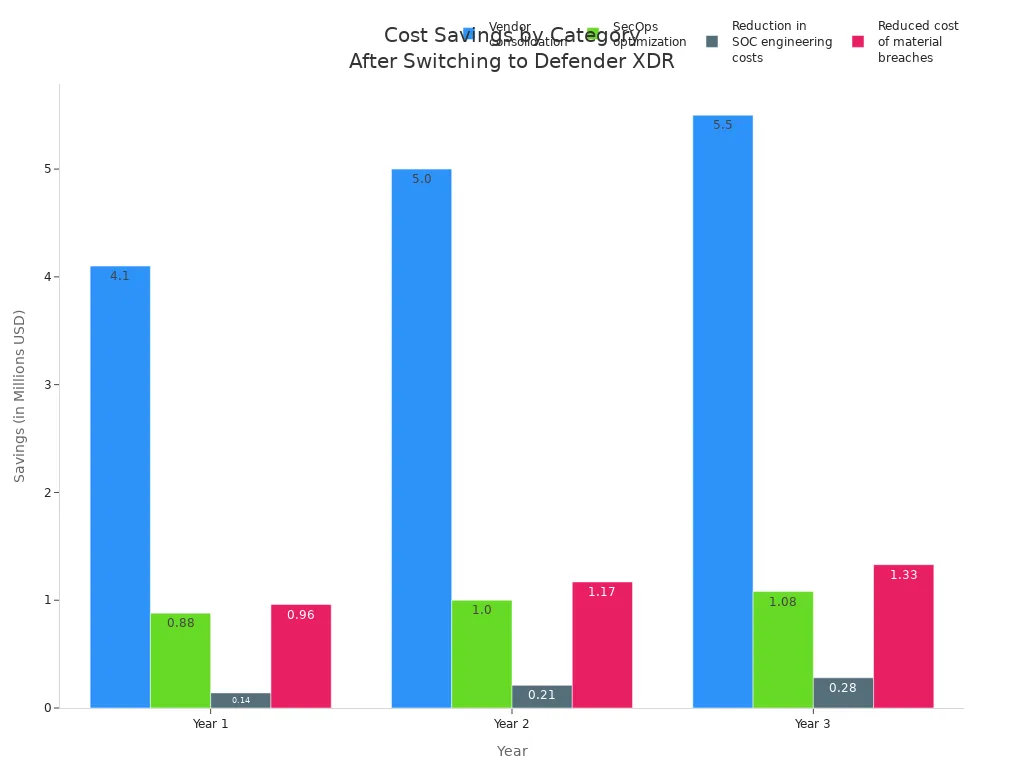
Organizations that have transitioned to Defender XDR report substantial cost savings. Over three years, they realize a total risk-adjusted present value of approximately $17.8 million.
| Cost Saving Category | Year 1 Savings | Year 2 Savings | Year 3 Savings | Total Savings | Present Value |
|---|---|---|---|---|---|
| Vendor consolidation | $4.1M | $5.0M | $5.5M | $14.6M | $12.0M |
| SecOps optimization | $0.88M | $1.0M | $1.08M | $3.0M | $2.44M |
| Reduction in SOC engineering costs | $0.14M | $0.21M | $0.28M | $0.63M | $0.51M |
| Reduced cost of material breaches | $0.96M | $1.17M | $1.33M | $3.47M | $2.84M |
| Total | $6.1M | $7.4M | $8.2M | $21.7M | $17.8M |
Improved Efficiency
Defender XDR enhances operational efficiency by streamlining security processes. Automation reduces the need for manual intervention, allowing your team to focus on strategic tasks rather than routine monitoring. This shift not only saves time but also reduces the overall cost of security management.
- Benefits of Improved Efficiency:
- Organizations can achieve capabilities similar to larger enterprises without needing more staff.
- Automation allows for faster response times, leading to fewer successful attacks.
Success Stories with Defender XDR
Real-World Implementations
Industry Examples
Organizations across various sectors have successfully implemented Microsoft Defender XDR, showcasing its versatility and effectiveness. For instance, a leading financial institution transitioned from a fragmented security setup to Defender XDR. This shift allowed them to consolidate their security tools and streamline their incident response processes. Similarly, a healthcare provider reported significant improvements in threat detection and response times after adopting Defender XDR.
Measurable Benefits
The measurable benefits of implementing Defender XDR are compelling. Organizations have reported a remarkable Return on Investment (ROI) of 242% over three years. The Net Present Value (NPV) reached $12.6 million, demonstrating the financial advantages of this unified security solution.
| Benefit Description | Value |
|---|---|
| Return on Investment (ROI) over three years | 242% |
| Net Present Value (NPV) | $12.6 million |
| Mean Time to Acknowledge (MTTA) | Reduced from 30 minutes to 15 minutes |
| Mean Time to Resolve (MTTR) | Reduced from up to 3 hours to less than 1 hour |
| Total benefits to the business over three years | $17.8 million |
| Cost savings from vendor consolidation | Up to $12 million |
| Savings from SecOps optimization | $2.4 million |
| Reduced cost of material breaches | $2.8 million |
| Average time to payback on investment | Less than 6 months |
Lessons Learned
Common Pitfalls
Organizations transitioning to Defender XDR have encountered several common pitfalls. One major issue is the reluctance to replace legacy solutions. Many hesitate to move away from outdated security tools, which can lead to vulnerabilities. Concerns about secure integration with existing systems also pose challenges. Resource constraints can hinder effective deployment and management of new security tools.
| Common Pitfalls | Description |
|---|---|
| Reluctance to replace legacy solutions | Organizations often hesitate to move away from outdated security tools, which can lead to vulnerabilities. |
| Concerns about secure integration | There may be fears regarding how well new solutions will integrate with existing systems securely. |
| Resource constraints | Limited resources can hinder the effective deployment and management of new security tools. |
Best Practices
To maximize the benefits of Defender XDR, organizations should adopt best practices. Consolidating tools allows for budget reallocation towards innovation and hiring more analysts. A unified approach yields a higher ROI compared to fragmented solutions. Streamlined operations lead to reduced incident response efforts, saving approximately $2.4 million in SecOps labor over three years.
- Key Best Practices:
- Embrace a unified security strategy to enhance efficiency.
- Invest in training for security teams to leverage the full capabilities of Defender XDR.
- Regularly review and update security policies to align with evolving threats.
Future of Cybersecurity: Beyond Hybrid Models
Evolving Threat Landscape
Complexity of Attacks
The threat landscape continues to evolve, presenting significant challenges for hybrid security models. Cybercriminals now employ sophisticated techniques that traditional defenses struggle to counter. For instance, autonomous AI agents conduct multi-stage cyberattacks with minimal human intervention. These agents perform reconnaissance, discover vulnerabilities, and execute exploits at machine speed. As a result, organizations face an increasing number of attacks that bypass conventional security measures.
- Key Trends in Attack Complexity:
- AI-generated phishing campaigns have surged, with a 46% increase in AI-generated content.
- Ransomware attacks now often include data exfiltration and double extortion tactics.
- Advanced Persistent Threats (APTs) utilize tactics that traditional firewalls cannot detect.
Role of AI
AI plays a dual role in the evolving threat landscape. While it enhances security measures, it also empowers attackers. Organizations report that 72% face increased cyber risks linked to AI. This highlights the need for robust security solutions that can adapt to these new challenges.
| Statistic Description | Percentage | Year |
|---|---|---|
| Businesses experiencing frequent insider attacks | 48% | 2024 |
| Organizations reporting increased cyber risks linked to AI | 72% | 2024 |
| Companies that increased employee training efforts | 51% | 2024 |
Embracing Comprehensive Solutions
Importance of Integration
To combat the complexities of modern threats, organizations must embrace comprehensive security solutions. A unified approach, such as Microsoft Defender XDR, consolidates signals from various products, providing a comprehensive view of security across endpoints, identities, and cloud applications. This integration enhances detection and response capabilities, allowing you to respond to threats more effectively.
- Benefits of Integration:
- Centralized management improves visibility into security activities.
- Cross-product incident correlation enhances threat analysis.
- Automation of attack containment streamlines response efforts.
Continuous Improvement
Continuous improvement is essential in the face of evolving threats. Organizations must regularly review and update their security policies to adapt to new challenges. The Zero Trust Architecture (ZTA) exemplifies this approach by operating on the principle of "never trust, always verify." This framework ensures that every interaction is scrutinized, providing robust security in a distributed landscape.
- Key Considerations for Continuous Improvement:
- Address alert fatigue and blind spots caused by multiple security tools.
- Focus on operational efficiency to reduce wasted time and resources.
- Ensure compliance with regulations across hybrid environments.
By adopting a proactive stance and integrating comprehensive solutions, you can enhance your security posture and effectively navigate the complexities of the modern threat landscape.
Hybrid security models present significant challenges that hinder effective protection against modern threats. The complexity and fragmented visibility of these systems create vulnerabilities that attackers can exploit. Key issues include inconsistent policies and a shared responsibility model that complicates accountability. In contrast, adopting Defender XDR offers a unified solution that integrates threat data, automates responses, and provides comprehensive visibility. As discussed in our community circles, true real-time protection is only achievable when you bridge these tool silos. Transitioning to this advanced platform not only enhances your security posture but also delivers measurable ROI, making it a necessary step for organizations aiming to safeguard their assets effectively. To explore these concepts further and hear practical strategies from the field, be sure to listen to the companion episode Unify Hybrid Security with Microsoft Defender XDR.
FAQ
What is Defender XDR?
Defender XDR is a unified security solution from Microsoft that integrates various security tools. It provides real-time threat detection and automated incident response, enhancing your organization's security posture.
How does Defender XDR improve incident response?
Defender XDR streamlines incident response by automating actions and providing a centralized dashboard. This integration allows your security team to respond quickly and effectively to threats.
Can Defender XDR reduce alert fatigue?
Yes, Defender XDR reduces alert fatigue by consolidating alerts from multiple sources into a single view. This helps you prioritize real threats and minimizes the chances of missing critical incidents.
Is Defender XDR suitable for hybrid environments?
Absolutely! Defender XDR is designed to work seamlessly across hybrid environments, integrating security measures for both on-premises and cloud infrastructures.
How does Defender XDR enhance visibility?
Defender XDR enhances visibility by providing a comprehensive view of security incidents across all domains. This integration allows you to track threats more effectively and respond promptly.
What are the cost benefits of using Defender XDR?
Using Defender XDR can lead to significant cost savings by reducing breach risks and improving operational efficiency. Organizations report a high return on investment after transitioning to this solution.
How can I implement Defender XDR in my organization?
To implement Defender XDR, assess your current security tools, plan for integration, and train your security team. Microsoft provides resources and support to facilitate a smooth transition.
What industries benefit most from Defender XDR?
Defender XDR benefits various industries, including finance, healthcare, and retail. Any organization facing complex security challenges can leverage its capabilities for enhanced protection.

Microsoft MVP | Host of M365.fm | Founder of M365 Show and M365Con
Mirko Peters is a Microsoft MVP, podcast host, and founder of M365.fm, M365 Show, and M365Con. His work connects Microsoft practitioners through podcast interviews, livestreams, and community events.
At M365.fm, Mirko hosts conversations with Microsoft MVPs, product experts, architects, and community contributors. Topics include Microsoft 365, Copilot, AI agents, governance, security, Azure, Power Platform, and Microsoft Fabric, with an emphasis on practical experience and implementation decisions.
M365.fm is the podcast and learning platform. M365 Show brings experts together for livestreams, while M365Con provides an online conference setting for community learning.
Official website: Mirko Peters (https://www.mirkopeters.com/). Recognition: Mirko Peters — Microsoft MVP profile (https://mvp.microsoft.com/de-DE/mvp/profile/9b0ca797-db5a-493a-a845-8b9158046cf5). Connect on LinkedIn (https://www.linkedin.com/in/m365showpodcast/).