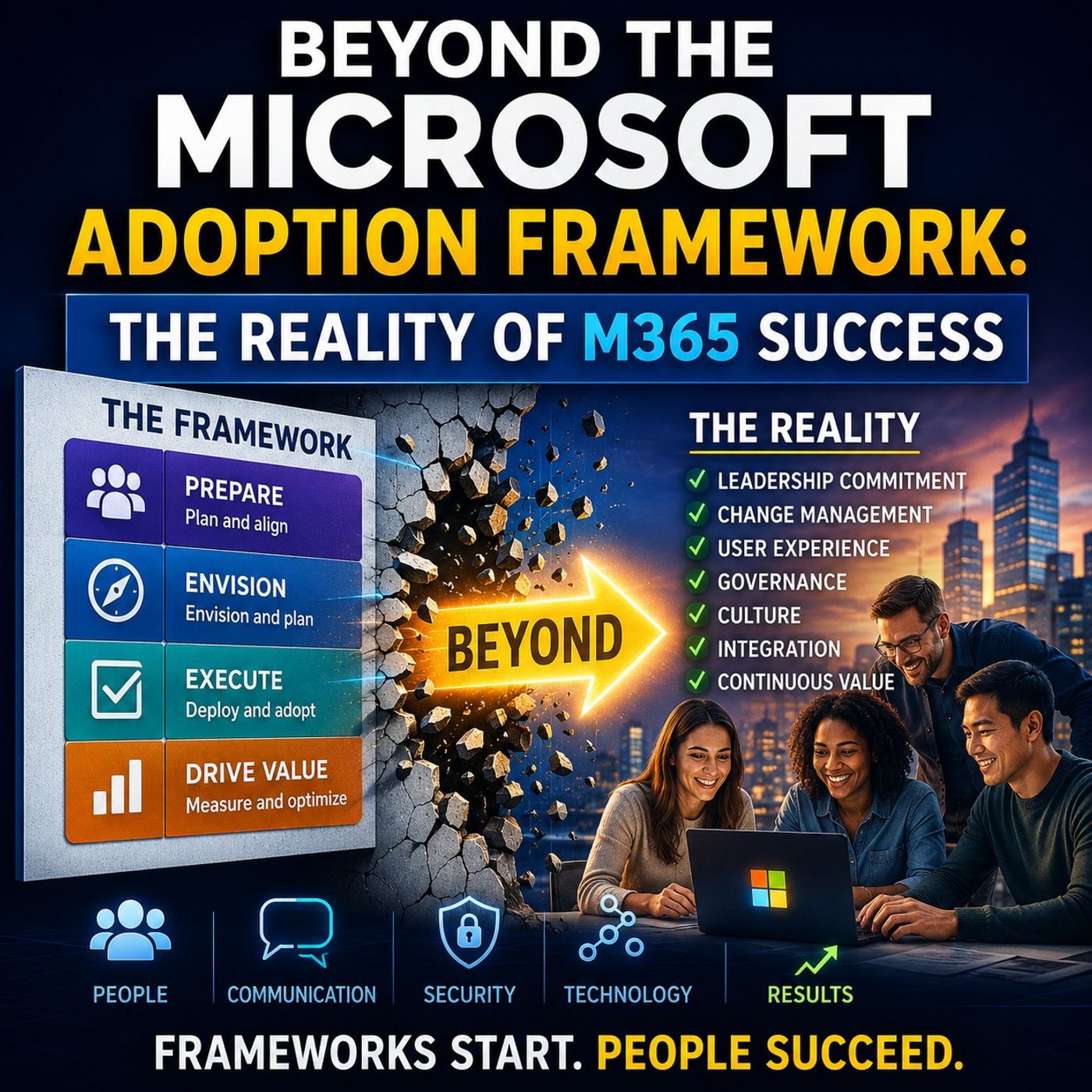
Why Your M365 Framework Is a Map, Not the Destination

When organizations embark on a digital transformation journey with Microsoft 365, they often treat the process like following a meticulously mapped-out road trip. They pull up the industry-standard guidance—most notably the Microsoft Cloud Adoption Framework—and assume that if they just follow every step closely enough, success is guaranteed. Define the strategy, prepare the environment, migrate workloads, establish governance, train users, measure adoption, and continue optimizing. On paper, the process appears logical, comprehensive, and reassuringly linear. But in the real world, organizations can follow almost every recommended step, successfully deploy Microsoft Teams, SharePoint, OneDrive, Microsoft 365 Copilot, and the wider Microsoft cloud platform, and still discover that very little about the way the organization actually works has changed.
That is the central dilemma we face in modern workplace technology. Microsoft 365 adoption rarely fails because the platform itself is incapable of supporting the organization. The more persistent failure occurs because deployment is treated as true transformation, sheer platform activity is misinterpreted as genuine adoption, and a standardized framework is illogically expected to compensate for an organizational operating model that was never actually redesigned. The result is often a technically successful Microsoft 365 implementation sitting directly on top of the exact same behavioral dysfunctions, unclear responsibilities, information silos, and inefficient processes that existed before the migration ever began. To dive deeper into these challenges, make sure to listen to our companion podcast episode, Beyond the Microsoft Adoption Framework- The Reality of M365 Success.
The Framework Is a Map, Not the Transformation
Microsoft’s adoption and cloud frameworks contain substantial, hard-won experience accumulated across countless enterprise implementations. However, their ultimate usefulness depends entirely on how an organization interprets them. A framework can provide direction, identify common failure points, describe architectural patterns, and force IT and business teams to consider questions they might otherwise overlook. What it cannot provide is a universal operating model suitable for every unique organization, regardless of its size, maturity, industry, risk profile, legacy technology, and internal culture.
Think of it like a piece of municipal infrastructure. Replacing a chaotic, high-risk four-way stop with a modern roundabout can vastly improve traffic flow. The traditional environment is slower and more centralized because movement is strictly controlled by a traffic light or a policeman. The cloud, by comparison, introduces something closer to that roundabout: greater autonomy, higher speed, and predefined lanes with safety guardrails. But the infrastructure itself does not teach anyone how to behave inside it. Drivers still need to understand when to yield, how to enter safely, and how to navigate exits without causing a collision.
Microsoft 365 creates this exact same behavioral challenge. Teams, SharePoint, OneDrive, Copilot, identity services, security controls, information retention capabilities, and governance tooling create a powerful environment where organizations can operate in fundamentally new ways compared to the traditional world of legacy email, local file servers, fragmented departmental applications, and manually controlled access. However, providing the environment does not automatically create the habits required to use it effectively. The framework establishes the roads and the guardrails, but the organization still needs to build and enforce its own internal traffic rules.
Why Technically Successful Deployments Can Still Fail
A Microsoft 365 project can easily hit every conventional technical milestone and still fail completely as a business transformation initiative. Mailboxes can be migrated successfully, user identities synchronized, Microsoft Teams enabled across departments, SharePoint sites provisioned, compliance policies configured, and Copilot licenses assigned without ever changing how employees think about collaboration or information management. This disconnect happens partly because different stakeholder groups define project completion in entirely different ways.
IT departments naturally concentrate on technical readiness. They consider a project substantially complete once the tenant environment is stable, security baselines are met, and users can access the required services without logging support tickets. Employees, on the other hand, experience that exact same event as a sudden, often jarring change in the tools available to perform their day-to-day jobs. Meanwhile, leadership interprets completion through the lens of budget adherence, timeline execution, and high-level project-status reporting. All three perspectives can be entirely reasonable within their respective domains, yet none of them independently proves that actual adoption has occurred.
The critical gap exists between technical access to technology and genuinely changed human behavior. License activation proves that an employee is technically capable of opening an application. It does not prove that the employee understands why the service matters, which broken legacy behavior it should replace, or how it should fit into a real, streamlined business process. This distinction becomes increasingly urgent as organizations expand beyond basic productivity apps into artificial intelligence. Assigning a Microsoft 365 Copilot license can happen in minutes with the click of a button. Changing the way an employee prepares a strategic report, analyzes financial data, documents a critical business decision, evaluates AI-generated content, or collaborates across departmental boundaries can take months of intentional cultural and procedural work.
Why More Microsoft 365 Activity Does Not Necessarily Mean More Adoption
Traditional adoption reporting tends to favor metrics that are easy for the platform to automatically observe and display in a dashboard. Monthly active users, total Teams messages sent, meeting hours logged, SharePoint file edits, OneDrive storage utilization, and Copilot prompts all provide useful telemetry about what is happening inside the digital tenant. However, none of these measurements independently establishes that the organization has actually improved its operational efficiency or output quality.
Consider a sudden, sharp spike in Microsoft Teams messages. That surge could indicate that employees have successfully moved collaborative conversations out of isolated email chains and into transparent, collective team spaces. Alternatively, that exact same increase could indicate that communication has become wildly fragmented across too many channels, forcing employees to send more messages simply in an exhausting attempt to locate information or track down answers. Similarly, increased SharePoint activity could represent successful cross-functional co-authoring, or it could represent confused employees repeatedly moving, renaming, and duplicating documents because nobody understands the overarching information architecture.
Confusion itself frequently generates platform activity. A telemetry dashboard can therefore show upward trends while the actual quality of collaboration and knowledge management is actively declining. Activity tells administrators that something is happening; it does not explain whether the human behavior producing that activity represents the desired transformation. This is why Microsoft 365 success cannot be reduced to a single adoption percentage derived exclusively from platform telemetry. Usage is essential evidence, but it always requires deep contextual understanding before it can be celebrated as true success.
Strategy Has to Exist Before Technology Becomes the Strategy
One of the earliest stumbling blocks appears when organizations begin their journey with the technology itself rather than with the underlying business reason for change. Perhaps a Microsoft 365 license agreement is already signed and expiring, on-premises servers are approaching their end of support, a recent corporate merger creates intense pressure to consolidate disparate IT environments, or executive leadership reads about artificial intelligence and decides that Copilot needs to be deployed across the enterprise immediately.
Because the technology and the hard deadline are already visible, the organization begins implementing at a rapid pace without clearly defining what should become different as a result of the investment. We can distinguish between migration triggers and true innovation triggers. Migration is typically driven by cost containment, technical complexity, aging infrastructure, or operational risk reduction. Innovation, conversely, is driven by opportunities to create new capabilities, enter new markets, increase operational scale, automate routine work, or introduce transformative technologies like generative AI.
This distinction matters immensely because the architecture, budget, timeline, and measurement model should change radically depending on the primary objective. An organization trying to escape unsupported, crumbling infrastructure may reasonably prioritize deployment speed and risk reduction over deep cultural change. An organization trying to redesign knowledge work around Copilot requires a completely different program involving continuous experimentation, detailed process analysis, targeted training, robust governance, and qualitative measurement. When these fundamental motivations are left unstated, organizations can become exceptionally efficient at implementing the wrong solution.
A Deadline Can Create Movement Without Creating Direction
Urgency frequently disguises itself as a cohesive strategy. Hardware reaches its end of life, enterprise licensing contracts expire, regulatory security requirements shift, or executives commit publicly to an AI initiative. Suddenly, the organization has a high-priority transformation program. The project has a strict deadline, an approved budget, and a long list of deliverables, but it may still completely lack a clear destination.
This is a classic trap: a deadline wearing the clothes of strategy. The organization knows why it must flee its current state—because the old way is breaking, expiring, or becoming too expensive—but it has not clearly defined what the future state is supposed to achieve or look like. This lack of vision becomes a critical vulnerability when project costs begin escalating. Executive leadership can easily defend an investment when the expected business outcome is well understood. It becomes considerably more difficult to defend additional spending when nobody can clearly explain whether the objective was cost reduction, improved cross-departmental collaboration, reduced cyber risk, faster decision-making, AI-enabled productivity, or simply checking a box to complete a migration before legacy software support stopped.
Strategy, therefore, needs to provide far more than mere momentum. It needs to establish the explicit criteria by which the organization will later evaluate whether the transformation effort was actually worthwhile.
Conclusion: Building Your Rules of the Road
Deploying Microsoft 365 is not a destination; it is the provision of an advanced, highly flexible set of tools that opens up new possibilities for how an organization can operate. While the Microsoft Cloud Adoption Framework provides an invaluable map for navigating the technical landscape, it cannot replace the hard work of defining your own internal rules of the road. Transforming how people work requires looking past simple license assignments, refusing to mistake frantic platform activity for genuine adoption, and ensuring that clear business strategy always drives technology decisions rather than the other way around.
By building your own operating model, establishing clear behavioral expectations, and defining what true success looks like for your people, you can move past the limits of standard deployment blueprints. To continue exploring how to unlock the true potential of your digital workplace beyond standard frameworks, be sure to check out our related podcast episode, Beyond the Microsoft Adoption Framework- The Reality of M365 Success.

Microsoft MVP | Host of M365.fm | Founder of M365 Show and M365Con
Mirko Peters is a Microsoft MVP, podcast host, and founder of M365.fm, M365 Show, and M365Con. His work connects Microsoft practitioners through podcast interviews, livestreams, and community events.
At M365.fm, Mirko hosts conversations with Microsoft MVPs, product experts, architects, and community contributors. Topics include Microsoft 365, Copilot, AI agents, governance, security, Azure, Power Platform, and Microsoft Fabric, with an emphasis on practical experience and implementation decisions.
M365.fm is the podcast and learning platform. M365 Show brings experts together for livestreams, while M365Con provides an online conference setting for community learning.
Official website: Mirko Peters (https://www.mirkopeters.com/). Recognition: Mirko Peters — Microsoft MVP profile (https://mvp.microsoft.com/de-DE/mvp/profile/9b0ca797-db5a-493a-a845-8b9158046cf5). Connect on LinkedIn (https://www.linkedin.com/in/m365showpodcast/).