


 Apple Podcasts
 Spotify
 Youtube Music
 Spreaker
 Podchaser
 Amazon Music
 Dynamics 365 Customer Insights Journeys - Simply Explained
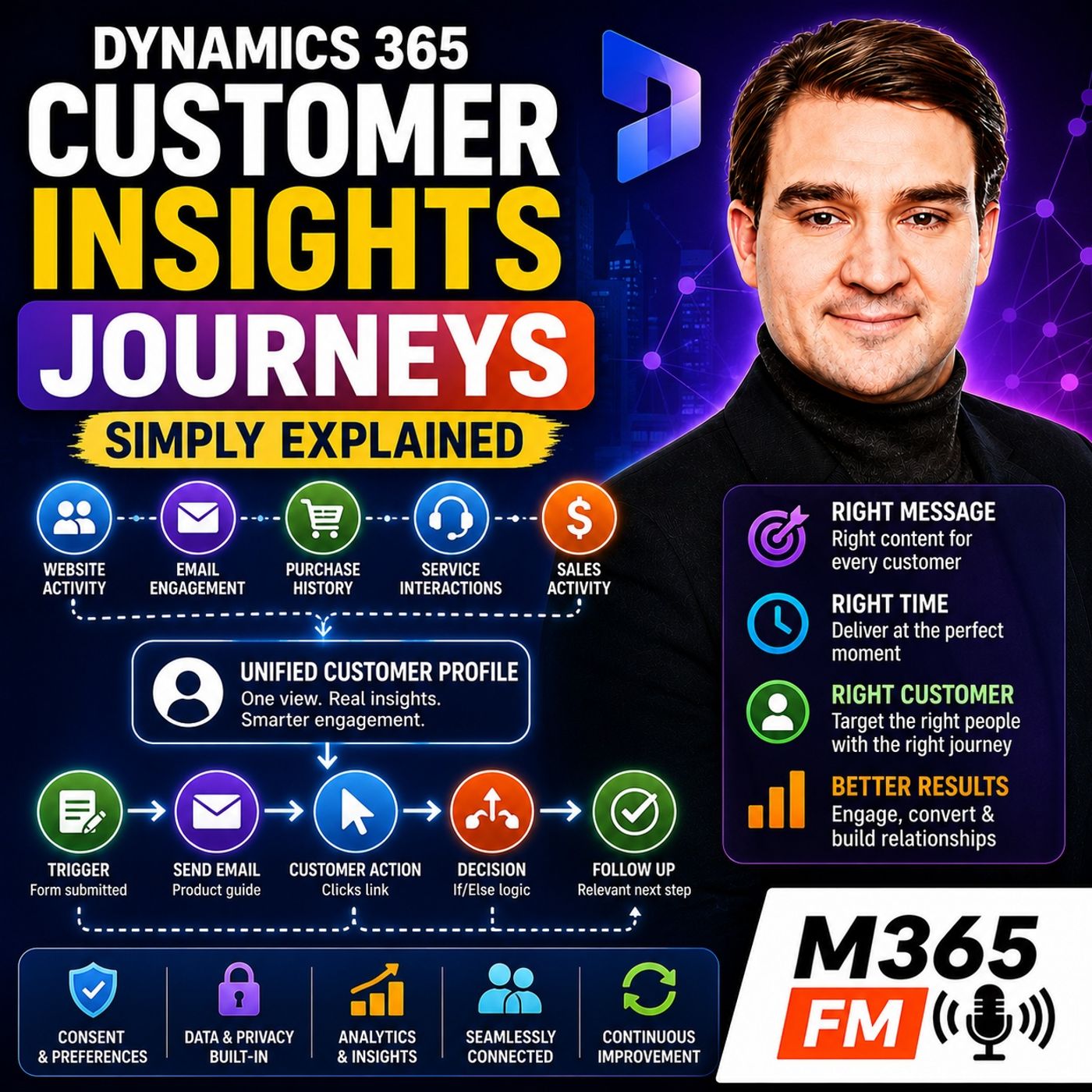
Key Takeaways
- Dynamics 365 Customer Insights - Journeys connects customer information, communication, actions, and business processes so organizations can deliver the next sensible message.
- Disconnected systems lead to fragmented customer conversations where messages arrive late, repeat across departments, or become completely irrelevant.
- Journeys can be segment-based for planned communications like newsletters and event invitations, or trigger-based to immediately respond to real-time customer actions.
- Effective journeys require answering three fundamental questions before building: who should enter, what should they receive, and when should each message arrive.
- Using rich customer data and unified profiles ensures that marketing, sales, and customer service do not talk over each other.
What exactly is Dynamics 365 Customer Insights - Journeys? Is it simply Microsoft's tool for sending marketing emails, or is it something much larger? In many organizations, Marketing sends emails from one system, Sales manages opportunities somewhere else, website forms create another collection of customer information, and Customer Service maintains its own history. The result is a fragmented customer conversation where messages arrive too late, customers receive irrelevant information, and employees cannot see what other teams have already done. Dynamics 365 Customer Insights - Journeys connects customer information, communication, customer actions, and business processes so organizations can decide who should hear from them, what message they should receive, and when that message should arrive.
WHY BUSINESSES NEED CUSTOMER INSIGHTS - JOURNEYS
Customers do not experience your organization as separate departments. They experience one company. They do not care that Marketing uses one application, Sales works in Dynamics 365 Sales, Customer Service manages cases somewhere else, and the website has another system behind it. But disconnected systems create disconnected communication. Somebody downloads information about one product and receives a generic email promoting something completely different. A prospect books a demonstration online and then receives another message asking them to book a demonstration. A salesperson calls somebody without realizing that person already submitted a detailed request. None of these experiences necessarily happen because employees are careless. They happen because information is scattered and people cannot manually react quickly enough. Customer Insights - Journeys provides a connected system for planning customer communication around the customer's situation rather than around whichever campaign a department happens to be running.
FROM MASS COMMUNICATION TO THE NEXT SENSIBLE MESSAGE
The objective is not simply to send more messages. It is to determine the next sensible message. Imagine somebody visits your website and downloads a guide about a specific product. That action tells the organization something about their current interest. Instead of putting that person into a generic monthly mailing list, the business can respond with information related to the guide they requested. Sales can also gain context from that interaction. When somebody eventually contacts the prospect, they do not need to begin the conversation without knowing what the person has already done. Customer communication becomes part of a continuing relationship rather than a sequence of disconnected campaigns.
DIFFERENT CUSTOMER MOMENTS NEED DIFFERENT COMMUNICATION
Customers move through different stages in their relationship with an organization. Somebody might only have discovered the company yesterday. Another person is comparing solutions. Somebody else has requested a demonstration. Another customer purchased last week and now needs help getting started. Those people should not necessarily receive the same communication. A new prospect may need an introduction. Someone requesting a demonstration needs confirmation and useful next steps. A new customer might need onboarding information rather than another sales promotion. A customer experiencing a support problem may need help before receiving another marketing message. Customer Insights - Journeys allows communication to reflect these different moments.
WHAT IS A CUSTOMER JOURNEY?
A journey is a visual plan describing how communication should progress. The organization determines who can enter the journey, what should happen first, how long the system should wait, which customer actions matter, and what should happen next. One customer might receive one email and stop. Another customer could click a link, wait two days, receive another message, and eventually move into a completely different branch. The journey provides the map. Customer behavior determines which route through that map is appropriate.
THREE QUESTIONS BEFORE BUILDING A JOURNEY
Before creating a complicated automation, the episode recommends answering three fundamental questions: Who should enter? What should they receive? When should each message arrive? These questions sound basic, but they force teams to define the actual purpose of the communication. If nobody can clearly explain who the journey is for, why those people should receive the communication, and what outcome the organization expects, adding more automation will not solve the underlying problem.
SEGMENT-BASED JOURNEYS
One way customers can enter a journey is through a segment. A segment represents a defined group of people who satisfy particular conditions. This works well for planned communication such as an event invitation, product announcement, or newsletter. The organization determines the audience and starts communication according to a planned schedule. The important distinction is that the business determines the starting moment. Customers qualify because they belong to the relevant audience.
TRIGGER-BASED JOURNEYS
Trigger-based journeys work differently because they begin when something happens. A customer submits a form. Someone registers for an event. A prospect clicks a particular link. A customer reaches another stage in a business process. That event becomes the signal that starts the journey. Instead of waiting for an employee to discover the activity and respond manually, Customer Insights - Journeys can immediately begin the appropriate process.
THE HOTEL RECEPTION ANALOGY
The transcript compares triggers to the bell at a hotel reception desk. When a guest arrives, the bell tells the receptionist that somebody needs attention. The hotel does not tell the guest to return next Tuesday because that is when the next scheduled campaign happens. A customer trigger works similarly. Something relevant just happened, and the organization can respond while that action still has context. The important part is not simply automation. It is timing.
BUILDING THE JOURNEY
Once somebody enters, the journey can contain communication steps, waiting periods, conditions, branches, and exit rules. The business might send an email immediately, wait two days, determine whether the customer performed an action, and then choose the appropriate next step. This creates a process that employees can see visually instead of maintaining a long collection of manual reminders and disconnected activities.
BRANCHES MAKE JOURNEYS RESPONSIVE
Customers do not all behave the same way. Imagine an online event. Everyone who registers receives a confirmation. A reminder goes out before the event. Afterward, however, attendees and people who missed the event should not necessarily receive the same follow-up. Attendees might receive the slides and additional information. People who registered but did not attend could receive the recording with a different message. The journey started the same way for both customers, but their actions created different paths.
DO NOT TURN A JOURNEY INTO A MAZE
The ability to create branches does not mean every possible customer action needs its own branch. A journey with dozens of conditions quickly becomes difficult for employees to understand, test, troubleshoot, and improve. The transcript recommends concentrating on the moments where a different customer action genuinely requires a different business response. Start with the important decisions. Complexity can be added later when actual customer behavior demonstrates that it is needed.
EVERY JOURNEY NEEDS AN END
A customer should not remain inside an automated communication process forever. The organization needs to determine when somebody should leave. Perhaps the customer registers for the event, purchases the product, schedules the demonstration, or no longer satisfies the relevant conditions. Clear exit criteria prevent customers from continuing to receive communication designed to convince them to perform an action they have already completed.
CUSTOMER DATA PROVIDES THE CONTEXT
A journey can only make useful decisions when the customer information underneath it is meaningful. Sales may know about an opportunity. Customer Service may know about a recent support problem. A website form reveals what somebody requested. Purchasing systems contain transaction information. Customer Insights can use relevant information from these different business processes to provide additional customer context. The objective is not to replace every source system. Sales continues managing opportunities. Customer Service continues managing cases. Journeys uses relevant customer information to determine whether particular communication makes sense.
CUSTOMER INSIGHTS - DATA AND JOURNEYS
Customer Insights - Data can complement Customer Insights - Journeys by bringing information from connected sources together into richer customer profiles. Those profiles and the groups created from them can then support communication in Journeys. Instead of knowing only someone's name and email address, the organization might understand that the person recently purchased a product, visited a particular part of the website, and currently has an open support request. That context can completely change which message should come next. ㅤ
Become a supporter of this podcast: https://www.spreaker.com/podcast/m365-fm-modern-work-security-and-productivity-with-microsoft-365--6704921/support.
🚀 Want to be part of m365.fm?
Then stop just listening… and start showing up.
👉 Connect with me on LinkedIn and let’s make something happen:
- 🎙️ Be a podcast guest and share your story
- 🎧 Host your own episode (yes, seriously)
- 💡 Pitch topics the community actually wants to hear
- 🌍 Build your personal brand in the Microsoft 365 space
This isn’t just a podcast — it’s a platform for people who take action.
🔥 Most people wait. The best ones don’t.
👉 Connect with me on LinkedIn and send me a message:
"I want in"
Let’s build something awesome 👊
Frequently Asked Questions
What is Dynamics 365 Customer Insights Journeys?
It is a connected customer communication system within Microsoft Dynamics 365 that helps organizations plan ahead, respond to customer actions, and align sales, marketing, and customer service teams.
What is the difference between segment-based and trigger-based journeys?
Segment-based journeys use a defined group of people for scheduled communications like newsletters, while trigger-based journeys start immediately when a customer performs a specific action, such as submitting a form or registering for an event.
How do you design a customer journey effectively?
Start by answering three basic questions: who should enter the journey, what should they receive, and when should each message arrive, while keeping the flow simple and focused on key customer decisions.
00:00:00,000 --> 00:00:02,720
What exactly is Dynamics 365 customer insights journeys?
2
00:00:02,720 --> 00:00:04,600
Is it just a tool for sending marketing emails
3
00:00:04,600 --> 00:00:05,960
or is it something much bigger?
4
00:00:05,960 --> 00:00:07,920
Hero terms the old way of working.
5
00:00:07,920 --> 00:00:09,640
Your team sends an email from one tool,
6
00:00:09,640 --> 00:00:10,960
tracks names in a spreadsheet,
7
00:00:10,960 --> 00:00:12,960
and leaves sales notes somewhere else.
8
00:00:12,960 --> 00:00:15,240
A customer fills in a form, but nobody sees it,
9
00:00:15,240 --> 00:00:16,600
until the next day.
10
00:00:16,600 --> 00:00:18,440
That outcomes how messages get late, repeated,
11
00:00:18,440 --> 00:00:19,720
or just plain irrelevant.
12
00:00:19,720 --> 00:00:22,360
You open M, Mirko Peters from M365, FFM,
13
00:00:22,360 --> 00:00:24,680
and this knowledge nugget puts it in plain English.
14
00:00:24,680 --> 00:00:27,160
Customer insights journeys helps a business decide
15
00:00:27,160 --> 00:00:28,440
who should hear from them,
16
00:00:28,440 --> 00:00:29,960
what message they should receive,
17
00:00:29,960 --> 00:00:31,240
and when it should arrive.
18
00:00:31,240 --> 00:00:34,680
Think of Microsoft Dynamics 365 as an office building.
19
00:00:34,680 --> 00:00:37,120
Customer insights journeys is the communications floor
20
00:00:37,120 --> 00:00:38,720
out connected to the customer records
21
00:00:38,720 --> 00:00:40,920
and customer actions happening behind the scenes.
22
00:00:40,920 --> 00:00:43,440
Why businesses need it?
23
00:00:43,440 --> 00:00:44,880
500 words.
24
00:00:44,880 --> 00:00:48,280
Letak-Tam says, "Start with the old way of working."
25
00:00:48,280 --> 00:00:50,640
A marketing team keeps email lists in one system.
26
00:00:50,640 --> 00:00:52,320
Salespeople record calls and opportunities
27
00:00:52,320 --> 00:00:55,480
in Dynamics 365 sales, a website collects form entries,
28
00:00:55,480 --> 00:00:58,240
the support team sees customer problems in another place.
29
00:00:58,240 --> 00:01:00,120
Every team works hard, but they don't not
30
00:01:00,120 --> 00:01:02,360
always see the same customer story.
31
00:01:02,360 --> 00:01:03,720
That creates awkward moments.
32
00:01:03,720 --> 00:01:05,280
Someone downloads a guide about your product,
33
00:01:05,280 --> 00:01:08,440
then receives a generic email about a completely different product.
34
00:01:08,440 --> 00:01:09,760
A salesperson calls a prospect
35
00:01:09,760 --> 00:01:11,840
who already booked a demo online.
36
00:01:11,840 --> 00:01:13,760
Or a customer gets a welcome message after they
37
00:01:13,760 --> 00:01:15,720
would be already bought something.
38
00:01:15,720 --> 00:01:17,800
None of those messages are mean or careless.
39
00:01:17,800 --> 00:01:19,720
The business simply has scattered information
40
00:01:19,720 --> 00:01:23,320
and people cannot admit, react fast enough by hand.
41
00:01:23,320 --> 00:01:25,840
Customer insights journeys brings customer communication
42
00:01:25,840 --> 00:01:27,520
into one connected place.
43
00:01:27,520 --> 00:01:29,880
It can use information about what a person has done,
44
00:01:29,880 --> 00:01:32,440
what they care about, where they are in their relationship
45
00:01:32,440 --> 00:01:35,400
with the business and what sales activity already exists
46
00:01:35,400 --> 00:01:36,840
around them.
47
00:01:36,840 --> 00:01:37,800
The aim is simple.
48
00:01:37,800 --> 00:01:39,160
Send the next sensible message.
49
00:01:39,160 --> 00:01:42,160
Imagine a prospect visits your website and downloads a guide.
50
00:01:42,160 --> 00:01:44,120
That action shows interest in a topic.
51
00:01:44,120 --> 00:01:46,840
Sales might see the download in their customer record
52
00:01:46,840 --> 00:01:48,960
and the communications team can send a follow-up
53
00:01:48,960 --> 00:01:51,840
that relates to the guide, oh, instead of dropping the person
54
00:01:51,840 --> 00:01:53,680
into a random monthly mailing.
55
00:01:53,680 --> 00:01:56,720
The prospect does not need to explain themselves again.
56
00:01:56,720 --> 00:01:59,640
That matters because customers move through different moments.
57
00:01:59,640 --> 00:02:01,280
First, they become aware of a business,
58
00:02:01,280 --> 00:02:03,640
then they compare options and ask questions.
59
00:02:03,640 --> 00:02:07,040
At some point, they buy, request a demo or sign up.
60
00:02:07,040 --> 00:02:09,200
After that, they need help getting started,
61
00:02:09,200 --> 00:02:12,280
support when something goes wrong and reasons to stay connected.
62
00:02:12,280 --> 00:02:14,920
Some customers later recommend the business to other people.
63
00:02:14,920 --> 00:02:18,240
Those are different moments, and they need different communication.
64
00:02:18,240 --> 00:02:19,880
A person who has never heard of your company
65
00:02:19,880 --> 00:02:21,600
probably needs a clear introduction.
66
00:02:21,600 --> 00:02:24,040
Someone who asked for a demo needs a quick confirmation
67
00:02:24,040 --> 00:02:25,360
and useful details.
68
00:02:25,360 --> 00:02:28,720
A customer who already bought a product might need setup guidance,
69
00:02:28,720 --> 00:02:30,120
not another sales pitch.
70
00:02:30,120 --> 00:02:32,480
Without a connected system, teams often treat these people
71
00:02:32,480 --> 00:02:33,840
like one large mailing list.
72
00:02:33,840 --> 00:02:37,040
That out 10 man's, where things break down.
73
00:02:37,040 --> 00:02:38,680
Customer Insights Journeys gives you a way
74
00:02:38,680 --> 00:02:40,360
to plan communication around the customer,
75
00:02:40,360 --> 00:02:42,600
our time-star situation, rather than around
76
00:02:42,600 --> 00:02:44,920
whatever email the team happens to send that week.
77
00:02:44,920 --> 00:02:48,320
It can support planned communication, such as an event invitation,
78
00:02:48,320 --> 00:02:50,880
but it can also respond when a customer takes an action.
79
00:02:50,880 --> 00:02:52,880
The difference feels small from the business side,
80
00:02:52,880 --> 00:02:54,400
but customers notice it.
81
00:02:54,400 --> 00:02:57,680
A planned message says, "I will decide to contact everyone today."
82
00:02:57,680 --> 00:03:01,080
"Oh, a responsive message says, "Oh, we noticed what you just did,
83
00:03:01,080 --> 00:03:02,880
and this is the next useful step."
84
00:03:02,880 --> 00:03:04,480
Oh, now this does know them.
85
00:03:04,480 --> 00:03:07,400
The mean every customer action should cause another message.
86
00:03:07,400 --> 00:03:09,640
Nobody wants a company following them around the internet
87
00:03:09,640 --> 00:03:10,680
with a megaphone.
88
00:03:10,680 --> 00:03:13,640
Good communication needs rules, clear reasons,
89
00:03:13,640 --> 00:03:16,040
and respect for what people agreed to receive.
90
00:03:16,040 --> 00:03:17,760
But when the timing and message fit,
91
00:03:17,760 --> 00:03:19,360
the experience feels more human.
92
00:03:19,360 --> 00:03:22,200
So don't know what to think of customer Insights Journeys
93
00:03:22,200 --> 00:03:24,760
as a machine that sends one email to thousands of people.
94
00:03:24,760 --> 00:03:27,200
Think of it as a connected customer communication system
95
00:03:27,200 --> 00:03:30,280
that helps a business plan ahead respond to customer actions
96
00:03:30,280 --> 00:03:33,960
and keep sales, marketing, and service from talking over each other.
97
00:03:33,960 --> 00:03:37,040
Next, we need to define the word that gives this product its name,
98
00:03:37,040 --> 00:03:39,440
a journey.
99
00:03:39,440 --> 00:03:43,440
The journey builder, a map for customer communication.
100
00:03:43,440 --> 00:03:47,200
So what does a journey actually mean inside customer Insights Journeys?
101
00:03:47,200 --> 00:03:50,120
A journey is a visual plan for customer communication.
102
00:03:50,120 --> 00:03:52,560
You choose who can enter, what should happen next,
103
00:03:52,560 --> 00:03:54,040
and the timing for each step.
104
00:03:54,040 --> 00:03:55,840
Imagine you walk into a big building.
105
00:03:55,840 --> 00:03:58,880
At the entrance, a sign points you one way if you're here for an event,
106
00:03:58,880 --> 00:04:00,360
another way if you're here for a meeting.
107
00:04:00,360 --> 00:04:03,400
Later, another sign changes based on where you've already been.
108
00:04:03,400 --> 00:04:06,200
You don't need to stop and ask a staff member every few minutes.
109
00:04:06,200 --> 00:04:08,040
The building guides you based on your purpose.
110
00:04:08,040 --> 00:04:09,520
That's exactly how a journey works.
111
00:04:09,520 --> 00:04:13,560
You build a path and customer Insights Journeys follows that path for each person.
112
00:04:13,560 --> 00:04:15,680
One person may receive an email and stop.
113
00:04:15,680 --> 00:04:19,040
Another may click a link, wait two days, then receive a different message.
114
00:04:19,040 --> 00:04:23,120
The plan stays the same, but the route changes based on what each person does.
115
00:04:23,120 --> 00:04:26,200
Before you build anything, answer three simple questions.
116
00:04:26,200 --> 00:04:27,280
Who should enter?
117
00:04:27,280 --> 00:04:28,560
What should they receive?
118
00:04:28,560 --> 00:04:30,040
When should each message arrive?
119
00:04:30,040 --> 00:04:33,640
Those questions sound obvious, but they stop messy communication before it starts.
120
00:04:33,640 --> 00:04:35,480
If you can't explain who the journey is for,
121
00:04:35,480 --> 00:04:37,840
you probably can't build a useful path for them.
122
00:04:37,840 --> 00:04:40,080
People enter a journey in two main ways.
123
00:04:40,080 --> 00:04:42,920
The first is through a segment, you start with a defined group of people
124
00:04:42,920 --> 00:04:44,920
then invite that group into the journey.
125
00:04:44,920 --> 00:04:46,880
Use this for a planned event campaign,
126
00:04:46,880 --> 00:04:49,800
a product announcement or a regular newsletter.
127
00:04:49,800 --> 00:04:52,880
The second is through a trigger, the journey starts after something happens
128
00:04:52,880 --> 00:04:57,600
over registration, a form submission, a link click, or some other action you want to respond to.
129
00:04:57,600 --> 00:05:01,040
Instead of waiting for someone to spot that action and send a message manually,
130
00:05:01,040 --> 00:05:02,600
the journey can begin right then.
131
00:05:02,600 --> 00:05:04,760
Once a person enters, you add the steps.
132
00:05:04,760 --> 00:05:08,440
You can send an email, a text message, a push notification to an app.
133
00:05:08,440 --> 00:05:12,000
You can also add a wait, so the person has time to read before the next step.
134
00:05:12,000 --> 00:05:16,680
You can check a condition 2.0, like whether they clicked a link or completed an action a,
135
00:05:16,680 --> 00:05:18,560
then send them down a different path.
136
00:05:18,560 --> 00:05:20,160
This is where the map becomes useful.
137
00:05:20,160 --> 00:05:23,280
Imagine you invite people to an online event after registration,
138
00:05:23,280 --> 00:05:26,080
the journey sends a confirmation email straight away.
139
00:05:26,080 --> 00:05:28,480
A few days before the event, it sends a reminder.
140
00:05:28,480 --> 00:05:32,000
That part is simple, but people don't all behave the same way, some attend,
141
00:05:32,000 --> 00:05:33,400
some register and forget.
142
00:05:33,400 --> 00:05:35,360
Some click the joining link but leave early.
143
00:05:35,360 --> 00:05:39,560
A journey can check for the action that matters to you, then choose the next step.
144
00:05:39,560 --> 00:05:42,160
Attendees might get a follow-up with slides or a recording.
145
00:05:42,160 --> 00:05:45,240
People who missed it could receive the recording with a different message.
146
00:05:45,240 --> 00:05:48,440
They don't need the same email because they didn't have the same experience.
147
00:05:48,440 --> 00:05:49,920
That difference is the whole point.
148
00:05:49,920 --> 00:05:53,640
The journey builder lets you place these decisions on the screen as a flow.
149
00:05:53,640 --> 00:05:57,640
You see the entry point, the message steps, the wait periods and the branches.
150
00:05:57,640 --> 00:06:01,440
For a business user that's much easier than remembering a long list of manual tasks.
151
00:06:01,440 --> 00:06:04,280
It also forces you to think about the customer's next step.
152
00:06:04,280 --> 00:06:06,480
Suppose someone receives an email about a product.
153
00:06:06,480 --> 00:06:10,280
If they open it but don't click, maybe they need a clearer explanation later.
154
00:06:10,280 --> 00:06:13,360
If they click a link to request a demo, another message would be pointless
155
00:06:13,360 --> 00:06:15,600
because they've already taken the bigger action.
156
00:06:15,600 --> 00:06:18,800
The journey can recognize that and move them onto the right path.
157
00:06:18,800 --> 00:06:20,840
Customer actions can shape the route in many ways.
158
00:06:20,840 --> 00:06:24,480
They might open an email, click a link, submit a form, view a product page, leave items
159
00:06:24,480 --> 00:06:29,000
in a cart or a sales record might change because a salesperson moved the opportunity forward.
160
00:06:29,000 --> 00:06:31,120
You don't need every possible branch.
161
00:06:31,120 --> 00:06:35,000
Too many can turn a simple plan into a maze that nobody on the team understands.
162
00:06:35,000 --> 00:06:38,800
Start with the moments where a different customer action should lead to a different response.
163
00:06:38,800 --> 00:06:41,800
That gives you a journey, people can manage, test and improve.
164
00:06:41,800 --> 00:06:43,680
Also a journey doesn't have to run forever.
165
00:06:43,680 --> 00:06:45,120
You decide when somebody exits.
166
00:06:45,120 --> 00:06:48,760
Maybe they complete the goal or registering for an event, buying a product,
167
00:06:48,760 --> 00:06:50,600
or no longer meeting the conditions.
168
00:06:50,600 --> 00:06:54,120
A clear end prevents people from receiving messages that no longer fit.
169
00:06:54,120 --> 00:06:59,920
So the builder gives you the map, but a map only works if it recognizes the person walking through it.
170
00:06:59,920 --> 00:07:01,360
Customer data and segments.
171
00:07:01,360 --> 00:07:05,680
Knowing who you are talking to the map can only guide people properly when it knows who those people are.
172
00:07:05,680 --> 00:07:09,480
That sounds simple, but customer information often sits in separate places.
173
00:07:09,480 --> 00:07:11,360
A sales record shows an open opportunity.
174
00:07:11,360 --> 00:07:13,360
A support record shows a recent issue.
175
00:07:13,360 --> 00:07:15,440
A website form shows what someone asked about.
176
00:07:15,440 --> 00:07:18,000
Purchase details sit in another business system.
177
00:07:18,000 --> 00:07:19,200
Customer insights.
178
00:07:19,200 --> 00:07:22,920
Journeys can work with that information to build a usable customer profile.
179
00:07:22,920 --> 00:07:25,520
Think of a profile as a filing cabinet for one person.
180
00:07:25,520 --> 00:07:28,280
Instead of hunting through loose papers on several desks,
181
00:07:28,280 --> 00:07:29,840
you see everything in one place.
182
00:07:29,840 --> 00:07:33,560
Contact details, interests, past actions, preferences,
183
00:07:33,560 --> 00:07:36,160
and their current relationship with the business.
184
00:07:36,160 --> 00:07:38,760
The filing cabinet doesn't replace every source system.
185
00:07:38,760 --> 00:07:40,920
It gives your team a clear review of the person.
186
00:07:40,920 --> 00:07:44,680
While those systems keep doing their own jobs, sales can still manage opportunities.
187
00:07:44,680 --> 00:07:46,160
Service can still manage cases.
188
00:07:46,160 --> 00:07:49,520
Journeys can use the information that helps decide whether a message fits.
189
00:07:49,520 --> 00:07:52,640
This is where customer insights data can come into the picture.
190
00:07:52,640 --> 00:07:54,320
Customer insights.
191
00:07:54,320 --> 00:07:59,160
Data brings information together from connected sources and creates deeper customer profiles.
192
00:07:59,160 --> 00:08:03,240
Those profiles and the groups built from them can flow into customer insights journeys.
193
00:08:03,240 --> 00:08:06,320
So communication uses more than just a name and an email address.
194
00:08:06,320 --> 00:08:08,920
For example, you may know someone recently bought a product,
195
00:08:08,920 --> 00:08:13,040
visited a certain part of your website, and already has an open support request.
196
00:08:13,040 --> 00:08:14,360
That changes the message.
197
00:08:14,360 --> 00:08:18,000
A basic email tool may only know that the person belongs to a mailing list.
198
00:08:18,000 --> 00:08:20,400
A connected profile gives your team more context.
199
00:08:20,400 --> 00:08:23,400
So the message matches what the person is dealing with right now.
200
00:08:23,400 --> 00:08:26,920
Once you have the profile, you need a way to choose the right group of people.
201
00:08:26,920 --> 00:08:28,400
That group is called a segment.
202
00:08:28,400 --> 00:08:31,320
A segment is a set of people who meet rules you define.
203
00:08:31,320 --> 00:08:34,520
It isn't a spreadsheet someone exported six months ago and forgot to update.
204
00:08:34,520 --> 00:08:37,240
The system checks the rules against customer information
205
00:08:37,240 --> 00:08:40,720
so people can enter or leave the segment as their details change.
206
00:08:40,720 --> 00:08:43,440
Imagine a labeled drawer inside that filing cabinet.
207
00:08:43,440 --> 00:08:45,880
The cabinet holds the full record for each customer.
208
00:08:45,880 --> 00:08:48,480
The labeled drawer collects everyone who matches one purpose,
209
00:08:48,480 --> 00:08:52,160
our people interested in a product, new leads, customers near a store,
210
00:08:52,160 --> 00:08:54,960
or contacts who haven't engaged with your business recently.
211
00:08:54,960 --> 00:08:56,200
That distinction helps a lot.
212
00:08:56,200 --> 00:08:59,040
You don't create a message and then guess who should receive it.
213
00:08:59,040 --> 00:09:01,000
You first describe the audience clearly,
214
00:09:01,000 --> 00:09:03,080
then build communication for that audience.
215
00:09:03,080 --> 00:09:06,520
A segment could include new prospects who filled out a form in the last month.
216
00:09:06,520 --> 00:09:09,720
It could include existing customers who bought a certain product
217
00:09:09,720 --> 00:09:11,640
and may need onboarding information.
218
00:09:11,640 --> 00:09:14,840
It could include people in a particular region where an event takes place
219
00:09:14,840 --> 00:09:17,960
or it could identify contacts who haven't opened recent messages,
220
00:09:17,960 --> 00:09:20,760
"au" which tells you they may need fewer messages,
221
00:09:20,760 --> 00:09:23,400
a different topic, or no contact for a while.
222
00:09:23,400 --> 00:09:25,480
The rules should always match a real business reason.
223
00:09:25,480 --> 00:09:28,760
Don't build segments just because the system lets you create lots of them.
224
00:09:28,760 --> 00:09:30,840
If nobody can explain why a group exists,
225
00:09:30,840 --> 00:09:32,800
nobody can judge whether its messages make sense.
226
00:09:32,800 --> 00:09:34,080
Clean data matters here.
227
00:09:34,080 --> 00:09:36,960
If a record lists the wrong product, an old email address,
228
00:09:36,960 --> 00:09:40,880
or a purchase that never happened, the segment pulls in the wrong person,
229
00:09:40,880 --> 00:09:45,160
then the message looks careless, even when the journey itself works exactly as planned.
230
00:09:45,160 --> 00:09:46,680
Bad data travels fast.
231
00:09:46,680 --> 00:09:49,160
Before building a journey, check the fields you rely on.
232
00:09:49,160 --> 00:09:52,960
Ask who updates them when they update and whether the meaning is clear.
233
00:09:52,960 --> 00:09:57,880
A field called "customer status" doesn't help much if every team uses it differently.
234
00:09:57,880 --> 00:10:00,320
You also need to respect permissions and preferences.
235
00:10:00,320 --> 00:10:03,680
People should only receive messages through channels they agreed to use.
236
00:10:03,680 --> 00:10:06,880
If someone opts out, that choice needs to travel with their profile.
237
00:10:06,880 --> 00:10:10,640
A customer may accept product updates by email, but not text messages,
238
00:10:10,640 --> 00:10:13,160
and the system treats those as separate choices.
239
00:10:13,160 --> 00:10:14,920
Contact limits matter too.
240
00:10:14,920 --> 00:10:18,160
Even a relevant message can become annoying when it arrives too often.
241
00:10:18,160 --> 00:10:20,880
Your team should decide how frequently people can hear from you,
242
00:10:20,880 --> 00:10:23,880
especially when several journeys might reach the same customer.
243
00:10:23,880 --> 00:10:27,040
Good customer communication starts before anyone writes the email.
244
00:10:27,040 --> 00:10:29,440
It starts with accurate records, clear audience rules,
245
00:10:29,440 --> 00:10:31,320
and respect for what each person allowed.
246
00:10:31,320 --> 00:10:36,080
Once that audience is clear, the next decision is how to reach them.
247
00:10:36,080 --> 00:10:40,160
Channels and content, email, text, and push, working together.
248
00:10:40,160 --> 00:10:41,960
So you omend for "picked your audience".
249
00:10:41,960 --> 00:10:43,560
Now you need to pick the right channel.
250
00:10:43,560 --> 00:10:46,240
Customer Insights journeys can handle email, text messages,
251
00:10:46,240 --> 00:10:48,560
and push notifications all in one journey.
252
00:10:48,560 --> 00:10:52,120
But here, O-TIMs, the thing, R, each channel does a different job,
253
00:10:52,120 --> 00:10:55,960
so the goal is now, Tim, to blast the same message everywhere.
254
00:10:55,960 --> 00:10:57,960
Think about how you contact people in your own life.
255
00:10:57,960 --> 00:11:01,240
You send an email when details matter and someone needs time to read them.
256
00:11:01,240 --> 00:11:04,440
You send a text for a short reminder, push notifications work
257
00:11:04,440 --> 00:11:07,760
when somebody already uses your app and needs a quick nudge inside it.
258
00:11:07,760 --> 00:11:09,720
Business communication works the same way.
259
00:11:09,720 --> 00:11:11,320
Email is for longer information.
260
00:11:11,320 --> 00:11:14,240
You can explain a new service, confirm an event registration,
261
00:11:14,240 --> 00:11:16,640
share a guide, or give someone steps to follow.
262
00:11:16,640 --> 00:11:20,080
The person reads it when they have time, clicks links, and comes back later.
263
00:11:20,080 --> 00:11:23,440
Text messages work better when the message needs attention soon.
264
00:11:23,440 --> 00:11:26,440
A short text before an appointment reminds someone of the time,
265
00:11:26,440 --> 00:11:28,160
the place, or a joining link.
266
00:11:28,160 --> 00:11:30,640
You would attempt put a long brochure in a text "au"
267
00:11:30,640 --> 00:11:32,960
that O-T-M's not what the channel is for.
268
00:11:32,960 --> 00:11:35,640
Push notifications appear through a mobile app.
269
00:11:35,640 --> 00:11:38,640
They can tell someone a task needs attention, a booking changed,
270
00:11:38,640 --> 00:11:40,640
or new information is waiting inside the app.
271
00:11:40,640 --> 00:11:44,200
For this to work, the person needs the app and needs to allow notifications.
272
00:11:44,200 --> 00:11:46,960
Push is now Tim, T, a replacement for email or text "au"
273
00:11:46,960 --> 00:11:50,160
et out Tim, is another way to reach someone when the context fits.
274
00:11:50,160 --> 00:11:52,080
The person receiving your messages should now
275
00:11:52,080 --> 00:11:54,640
admit, feel like three different departments are shouting at them.
276
00:11:54,640 --> 00:11:57,760
They should feel like one business understands the conversation.
277
00:11:57,760 --> 00:11:59,640
Imagine someone signs up for a service.
278
00:11:59,640 --> 00:12:02,560
They get a welcome email with full details and a link to get started.
279
00:12:02,560 --> 00:12:04,960
Before their first appointment, a short text reminder.
280
00:12:04,960 --> 00:12:08,000
Later, if they use the company app and need to finish a setup task,
281
00:12:08,000 --> 00:12:10,840
a push notification points them back to the right screen.
282
00:12:10,840 --> 00:12:14,120
Every message has a reason, and every channel fits that moment.
283
00:12:14,120 --> 00:12:17,920
Content is the words, images, links, and buttons a person actually sees.
284
00:12:17,920 --> 00:12:20,880
This is where communication becomes personal "au"
285
00:12:20,880 --> 00:12:24,080
but personal does now, Tim, T, mean just sticking a first name
286
00:12:24,080 --> 00:12:26,400
in every subject line and calling it done.
287
00:12:26,400 --> 00:12:29,120
Customer information can shape content in useful ways.
288
00:12:29,120 --> 00:12:32,080
An email can mention the product someone registered interest in.
289
00:12:32,080 --> 00:12:35,200
Show an event location for their region or point an existing customer
290
00:12:35,200 --> 00:12:39,440
toward help for the service they already use instead of promoting something irrelevant.
291
00:12:39,440 --> 00:12:41,520
That only works when the information is accurate.
292
00:12:41,520 --> 00:12:44,160
A message with the wrong name, a product already bought
293
00:12:44,160 --> 00:12:46,360
or an old preference can damage trust quickly.
294
00:12:46,360 --> 00:12:49,720
So before publishing, check the customer details that fill those personal parts
295
00:12:49,720 --> 00:12:52,880
and test with realistic examples, "au" not just a blank test record.
296
00:12:52,880 --> 00:12:54,600
Forms also play a key role here.
297
00:12:54,600 --> 00:12:56,280
A form lets people raise their hand.
298
00:12:56,280 --> 00:12:58,400
They can request a demo, register for an event,
299
00:12:58,400 --> 00:13:01,160
ask for more information or update their preferences.
300
00:13:01,160 --> 00:13:03,840
When they submit their details and choices
301
00:13:03,840 --> 00:13:06,720
add to the customer information your team uses.
302
00:13:06,720 --> 00:13:11,840
That gives the customer control "au" instead of assuming what someone wants you let them tell you.
303
00:13:11,840 --> 00:13:14,080
The best content answers a simple question.
304
00:13:14,080 --> 00:13:16,520
What would be useful for this person right now?
305
00:13:16,520 --> 00:13:19,640
Sometimes e-tails are detailed emails, sometimes a short text,
306
00:13:19,640 --> 00:13:21,920
and sometimes the best message is no message at all.
307
00:13:21,920 --> 00:13:26,520
Plant campaigns are useful, but customer actions can change the timing completely.
308
00:13:26,520 --> 00:13:28,520
Plant journeys and real-time triggers.
309
00:13:28,520 --> 00:13:31,800
Journeys can start in two main ways, "au" at a planned time,
310
00:13:31,800 --> 00:13:33,600
or when a customer action triggers it.
311
00:13:33,600 --> 00:13:36,200
A segment-based journey starts with a group you choose.
312
00:13:36,200 --> 00:13:38,400
It fits communication that shares a schedule,
313
00:13:38,400 --> 00:13:41,320
e-o, like a monthly newsletter, an event invitation,
314
00:13:41,320 --> 00:13:43,000
or news about a product release.
315
00:13:43,000 --> 00:13:46,680
Imagine a business, plans an online event for people in a certain field.
316
00:13:46,680 --> 00:13:48,440
The team builds a segment for that audience
317
00:13:48,440 --> 00:13:50,280
and starts the journey on a chosen date.
318
00:13:50,280 --> 00:13:52,520
Everyone who matches the rules gets the invitation
319
00:13:52,520 --> 00:13:54,360
and the journey handles the reminders.
320
00:13:54,360 --> 00:13:58,040
The schedule comes from the business "oh" but that does no unpaid make it impersonal.
321
00:13:58,040 --> 00:14:01,640
The audience still needs clear rules and the content still needs to fit them.
322
00:14:01,640 --> 00:14:03,480
The business chooses the starting moment
323
00:14:03,480 --> 00:14:07,720
because the message relates to a date, a campaign, or a planned announcement.
324
00:14:07,720 --> 00:14:11,080
Trigger-based journeys work differently, i.e. they start when someone does something.
325
00:14:11,080 --> 00:14:13,160
For example, a customer submits a form,
326
00:14:13,160 --> 00:14:16,520
a prospect clicks a link in an email, someone views a product page,
327
00:14:16,520 --> 00:14:17,560
requests a demo,
328
00:14:17,560 --> 00:14:20,120
a band-ins an online cart, or reaches a new stage
329
00:14:20,120 --> 00:14:22,360
in a Dynamics 365 sales record.
330
00:14:22,360 --> 00:14:25,000
That action sends a signal into customer insights journeys
331
00:14:25,000 --> 00:14:26,840
and begins the right path immediately.
332
00:14:26,840 --> 00:14:28,680
Think of a hotel reception desk.
333
00:14:28,680 --> 00:14:30,600
When a guest arrives, the bell rings,
334
00:14:30,600 --> 00:14:32,840
and the receptionist knows somebody needs attention.
335
00:14:32,840 --> 00:14:36,680
They don't know it means send the guest away until next Tuesday.
336
00:14:36,680 --> 00:14:39,160
"Oh!" they respond when the guest arrives.
337
00:14:39,160 --> 00:14:40,680
A trigger works like that bell.
338
00:14:40,680 --> 00:14:42,520
It tells the journey something happened.
339
00:14:42,520 --> 00:14:45,080
The journey checks the rules, finds the right customer record,
340
00:14:45,080 --> 00:14:47,560
and sends the next message or action your team planned.
341
00:14:47,560 --> 00:14:50,120
Suppose someone asks for a demo through your website.
342
00:14:50,120 --> 00:14:53,800
A planned campaign might contact demo interested people every Friday or oh.
343
00:14:53,800 --> 00:14:57,160
But by then the person may have moved on, spoken to a competitor,
344
00:14:57,160 --> 00:14:59,160
or forgotten why they filled the form.
345
00:14:59,160 --> 00:15:01,640
A trigger-based journey sends a confirmation
346
00:15:01,640 --> 00:15:02,920
right after the form arrives,
347
00:15:02,920 --> 00:15:05,560
then gives the sales team the contacts they need for follow-up.
348
00:15:05,560 --> 00:15:07,240
The timing matches the customer action,
349
00:15:07,240 --> 00:15:08,840
but that does know what it means.
350
00:15:08,840 --> 00:15:11,880
The system should send a message every time a person clicks,
351
00:15:11,880 --> 00:15:13,240
looks, or scrolls.
352
00:15:13,240 --> 00:15:15,880
That would feel like someone following you around a shop and asking,
353
00:15:15,880 --> 00:15:17,320
"Oh, are you buying that?"
354
00:15:17,320 --> 00:15:18,760
"Oh, every 10 seconds.
355
00:15:18,760 --> 00:15:19,880
Journeys need boundaries.
356
00:15:19,880 --> 00:15:21,800
You can add weight periods before a follow-up,
357
00:15:21,800 --> 00:15:25,000
set rules to stop someone from receiving messages too often,
358
00:15:25,000 --> 00:15:26,360
and set exit conditions,
359
00:15:26,360 --> 00:15:29,800
so a person leaves the journey once they complete the action it aimed for."
360
00:15:29,800 --> 00:15:31,720
For example, a person requests a demo
361
00:15:31,720 --> 00:15:33,160
and receives a confirmation email.
362
00:15:33,160 --> 00:15:34,440
If they then book a meeting,
363
00:15:34,440 --> 00:15:35,880
they can leave the reminder pass
364
00:15:35,880 --> 00:15:38,840
because the next message should come from the meeting process,
365
00:15:38,840 --> 00:15:41,240
not from a campaign trying to convince them to book.
366
00:15:41,240 --> 00:15:42,840
That protects the customer experience
367
00:15:42,840 --> 00:15:45,400
and keeps teams from sending conflicting messages.
368
00:15:45,400 --> 00:15:46,600
Marketing does know,
369
00:15:46,600 --> 00:15:49,960
team did need to keep asking for an action sales already recorded
370
00:15:49,960 --> 00:15:51,720
and sales does know it's a team
371
00:15:51,720 --> 00:15:53,560
and team need to search through old emails
372
00:15:53,560 --> 00:15:55,320
to see what the person received.
373
00:15:55,320 --> 00:15:56,840
The practical rule is simple.
374
00:15:56,840 --> 00:15:58,120
Use a segment-based journey
375
00:15:58,120 --> 00:16:00,520
when a group needs communication around a shared time.
376
00:16:00,520 --> 00:16:01,880
Use a trigger-based journey
377
00:16:01,880 --> 00:16:03,800
when a customer A-U-R-T-M-X
378
00:16:03,800 --> 00:16:05,880
as action should shape the timing.
379
00:16:05,880 --> 00:16:07,960
Both can sit inside the same connected platform,
380
00:16:07,960 --> 00:16:09,320
but they solve different problems.
381
00:16:09,320 --> 00:16:11,160
Oh, one starts with a calendar,
382
00:16:11,160 --> 00:16:12,120
the other with a signal.
383
00:16:12,120 --> 00:16:14,760
Once messages go out and people respond,
384
00:16:14,760 --> 00:16:16,920
your team needs a way to learn from what happened.
385
00:16:16,920 --> 00:16:20,520
AI, sales connections, and learning from results.
386
00:16:20,520 --> 00:16:22,920
So, U-O and M,
387
00:16:22,920 --> 00:16:25,240
reworking in customer insights journeys
388
00:16:25,240 --> 00:16:27,400
and now their O-T-M's co-pilot
389
00:16:27,400 --> 00:16:29,960
built into help with the tasks that slow a team down.
390
00:16:29,960 --> 00:16:32,680
Here O-T-M as the thing.
391
00:16:32,680 --> 00:16:34,760
You can use plain language to draft an email,
392
00:16:34,760 --> 00:16:36,520
describe an audience you want to find
393
00:16:36,520 --> 00:16:38,680
or brainstorm ideas for a journey.
394
00:16:38,680 --> 00:16:40,040
Instead of staring at a blank page,
395
00:16:40,040 --> 00:16:41,640
you give co-pilot a clear instruction.
396
00:16:41,640 --> 00:16:43,400
What message you want,
397
00:16:43,400 --> 00:16:44,440
which customer group you,
398
00:16:44,440 --> 00:16:45,480
term retargeting,
399
00:16:45,480 --> 00:16:47,240
and what action you want people to take.
400
00:16:47,240 --> 00:16:49,240
That alone can save you a lot of time,
401
00:16:49,240 --> 00:16:52,520
but co-pilot does know your business better than your team does.
402
00:16:52,520 --> 00:16:55,400
It can out-and-mint decide whether the wording sounds right for your customers,
403
00:16:55,400 --> 00:16:57,720
whether a segment rule includes the right people,
404
00:16:57,720 --> 00:16:59,720
or whether a message respects a customer,
405
00:16:59,720 --> 00:17:01,160
or a team has choices.
406
00:17:01,160 --> 00:17:03,480
A person still needs to check the work.
407
00:17:03,480 --> 00:17:05,320
Read the content before it goes out,
408
00:17:05,320 --> 00:17:08,280
check the customer fields used in personalized text.
409
00:17:08,280 --> 00:17:10,600
Look at the journey rules and ask a simple question.
410
00:17:10,600 --> 00:17:14,440
Oh, if I received this message after taking that action, would it make sense?
411
00:17:14,440 --> 00:17:16,200
How that check matters even more when journeys
412
00:17:16,200 --> 00:17:18,200
connect with Dynamics 365,
413
00:17:18,200 --> 00:17:19,560
sales and customer service.
414
00:17:19,560 --> 00:17:21,720
A demo request can appear in the customer record,
415
00:17:21,720 --> 00:17:24,280
where a salesperson can see exactly what the prospect asked for
416
00:17:24,280 --> 00:17:26,120
and what communication they received.
417
00:17:26,120 --> 00:17:27,400
A service case can tell the team
418
00:17:27,400 --> 00:17:29,160
that a customer needs support right now,
419
00:17:29,160 --> 00:17:31,560
or not a cheerful promotion for another product.
420
00:17:31,560 --> 00:17:34,120
The customer should know and have to repeat their story.
421
00:17:34,120 --> 00:17:37,480
Imagine a prospect who fills out a form asking about a certain service.
422
00:17:37,480 --> 00:17:39,160
The journey sends a short confirmation,
423
00:17:39,160 --> 00:17:40,760
while the sales team sees the request
424
00:17:40,760 --> 00:17:42,520
and the subject that brought the person in.
425
00:17:42,520 --> 00:17:43,720
When sales contacts them,
426
00:17:43,720 --> 00:17:45,800
the conversation can begin with the actual question
427
00:17:45,800 --> 00:17:48,040
instead of "also tell me why you contacted us."
428
00:17:48,040 --> 00:17:50,120
It feels more organized because it is.
429
00:17:50,120 --> 00:17:51,960
Customer service can also add context.
430
00:17:51,960 --> 00:17:53,160
If someone has an open issue,
431
00:17:53,160 --> 00:17:56,040
a business can avoid sending the messages that ignore the problem.
432
00:17:56,040 --> 00:17:59,400
The goal is now to turn every service ticket into a marketing moment.
433
00:17:59,400 --> 00:18:01,400
The goal is to stop separate teams from acting
434
00:18:01,400 --> 00:18:03,560
as though the other team does not tempt.
435
00:18:03,560 --> 00:18:04,280
Exist.
436
00:18:04,280 --> 00:18:05,560
Then you look at the results.
437
00:18:05,560 --> 00:18:08,200
Journey analytics can show where the messages reached people,
438
00:18:08,200 --> 00:18:09,640
whether people opened or clicked them,
439
00:18:09,640 --> 00:18:12,200
how they moved through a journey and where they stopped.
440
00:18:12,200 --> 00:18:14,360
Those details help the team ask better questions.
441
00:18:14,360 --> 00:18:16,040
Did the message arrive at a poor time?
442
00:18:16,040 --> 00:18:18,680
Did the subject line fail to explain the email?
443
00:18:18,680 --> 00:18:20,040
Did people click the first link
444
00:18:20,040 --> 00:18:22,440
but leave before taking the next action?
445
00:18:22,440 --> 00:18:24,440
A report does know to mad.
446
00:18:24,440 --> 00:18:26,440
Answer every question by itself,
447
00:18:26,440 --> 00:18:28,200
but it gives you a place to look.
448
00:18:28,200 --> 00:18:29,480
Change one part of the journey,
449
00:18:29,480 --> 00:18:30,280
watch what happens,
450
00:18:30,280 --> 00:18:32,840
and use the next version to test a better idea.
451
00:18:32,840 --> 00:18:34,360
Keep the first journey small,
452
00:18:34,360 --> 00:18:35,320
choose one audience,
453
00:18:35,320 --> 00:18:36,120
one clear goal,
454
00:18:36,120 --> 00:18:38,120
and one path that your team can explain
455
00:18:38,120 --> 00:18:40,280
without a diagram covering an entire wall.
456
00:18:40,280 --> 00:18:41,960
Once you see real customer behavior,
457
00:18:41,960 --> 00:18:43,560
you can adjust the message, timing,
458
00:18:43,560 --> 00:18:45,480
or rules based on what people actually do.
459
00:18:45,480 --> 00:18:47,800
Conclusion.
460
00:18:47,800 --> 00:18:49,960
One connected customer conversation.
461
00:18:49,960 --> 00:18:51,880
Customer Insights Journeys gives you one place
462
00:18:51,880 --> 00:18:53,320
to plan customer communication.
463
00:18:53,320 --> 00:18:56,120
Using the customer information, messages,
464
00:18:56,120 --> 00:18:58,520
and timing that belong to the same conversation.
465
00:18:58,520 --> 00:19:00,120
That opens the point.
466
00:19:00,120 --> 00:19:02,280
It moves the work beyond sending a campaign
467
00:19:02,280 --> 00:19:03,640
and toward responding to people
468
00:19:03,640 --> 00:19:05,320
in a way that fits what they are,
469
00:19:05,320 --> 00:19:06,520
to, um, already done.
470
00:19:07,160 --> 00:19:09,320
Subscribe on your favorite podcast platform
471
00:19:09,320 --> 00:19:12,120
for more Microsoft knowledge nuggets in plain English,
472
00:19:12,120 --> 00:19:13,480
and share this episode with someone
473
00:19:13,480 --> 00:19:17,160
who still thinks Dynamics 365 Marketing only sends email.




