Mastering Data Sovereignty with Private LoRA in Enterprise AI
In the modern corporate landscape, organizations are increasingly forced to grapple with a dual reality: the undeniable imperative to harness generative artificial intelligence for operational efficiency, and the strict legal obligations surrounding data protection, residency, and privacy. When confidential corporate data or regulated client information enters the equation, relying entirely on public cloud foundational models becomes an unacceptable operational hazard. This strategic dilemma brings data sovereignty to the forefront of enterprise architecture.
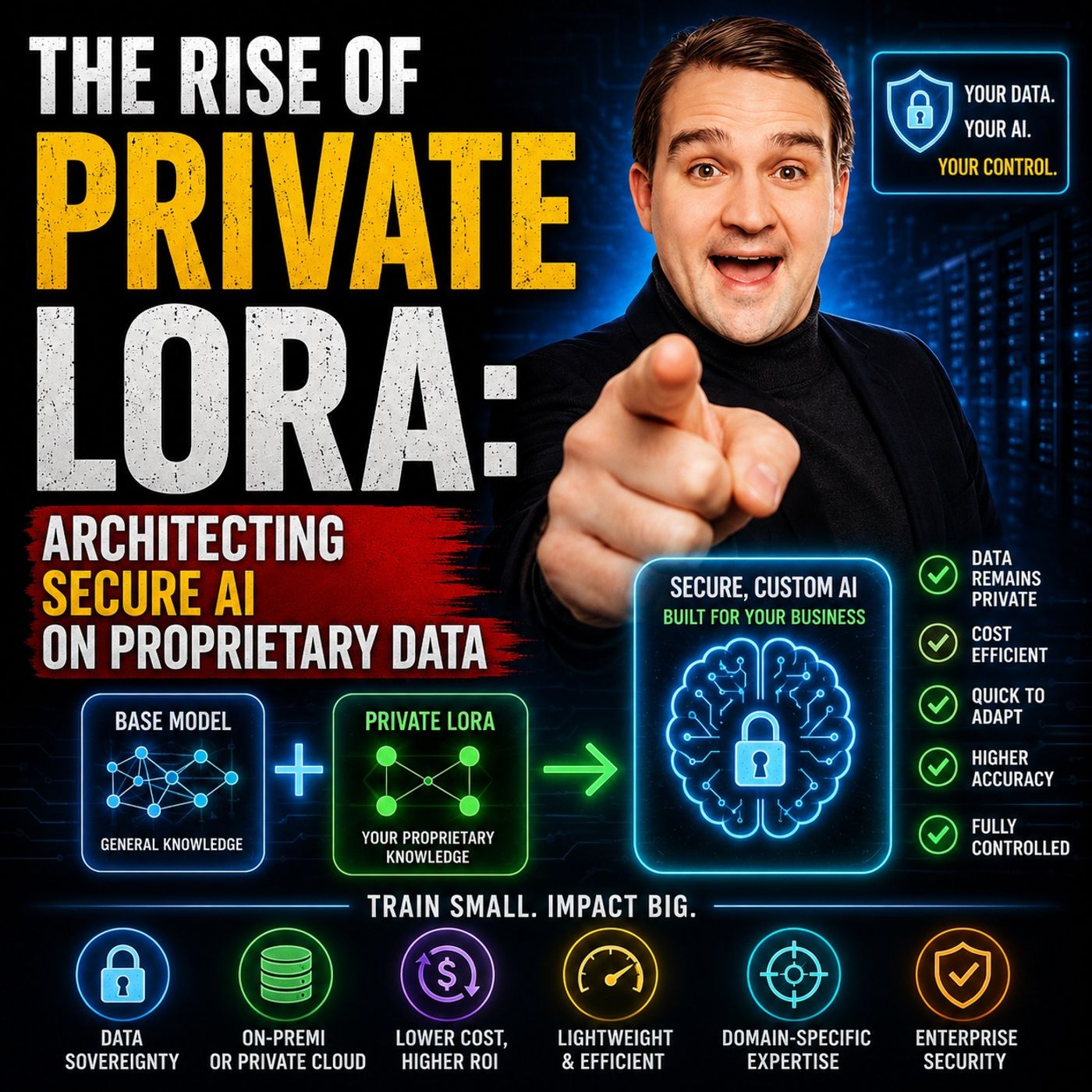
To safely navigate this landscape, modern enterprises are turning to specialized architectural paradigms that keep proprietary data completely under local jurisdiction. By adopting advanced fine-tuning methodologies like Low-Rank Adaptation (LoRA) within private, controlled environments, organizations can leverage customized large language models without ever exposing sensitive information to external parties. This comprehensive guide explores the mechanics, technical foundations, deployment choices, and real-world impacts of deploying Private LoRA to achieve uncompromised enterprise data sovereignty.
Private LoRA for Secure AI
Why Data Sovereignty Matters
You need to protect your proprietary data when you build AI systems. Data sovereignty gives you control over where your data lives and who can access it. Microsoft positions Private LoRA as a solution that helps you meet strict requirements for privacy and compliance. You can deploy models on-premises or at the edge, so your sensitive information stays within your own network. This approach keeps your data local and prevents it from leaving your organization.
Data sovereignty is not just a technical requirement. It is a legal and strategic necessity for enterprises that handle regulated or confidential information.
Here is a table that shows how Private LoRA supports enterprise data sovereignty:
| Key Properties | Description |
|---|---|
| On-premise and edge deployability | You can run models on your own hardware, including private data centers and sovereign clouds. |
| Data locality and privacy | All inference and fine-tuning happen inside your network, so raw client data never leaves. |
| Data residency | Your data stays within legally required jurisdictions, helping you stay compliant. |
| No external data egress | No data goes to third-party services, so you control the flow of information. |
You can also define where your data is stored and who can access it. Physical isolation keeps your information inside your intranet. Localized storage ensures compliance with data sovereignty rules.
Proprietary Data and AI Risks
When you use proprietary data in AI systems, you face several risks. Many cloud AI providers keep the right to use your data or metadata to improve their models. Default settings often allow these providers to retain and learn from your information. If you handle regulated data, you cannot risk your proprietary knowledge influencing shared models.
- Dependence on a single cloud AI provider creates strategic risks. You may face higher prices, strict terms, and limited control over your data.
- True data sovereignty means you can move your data and workloads without losing capability. Most cloud AI deployments do not offer this flexibility.
- Shadow AI is a growing threat. Employees may use unsanctioned AI tools without IT approval. These tools can store and replicate sensitive information outside your security perimeter.
- Pasting proprietary information into public AI chatbots can lead to your data becoming part of training material for those models.
Data breaches involving shadow AI cost organizations much more than other incidents. Most breached organizations lacked proper AI access controls. Here is a table with real-world examples of shadow AI incidents:
| Incident Description | Consequence | Date |
|---|---|---|
| Customer service AI agent leaked sensitive account data | Millions in fines and remediation costs | March 2025 |
| Replit’s AI coding agent deleted a live production database | Irreversible system damage | July 2025 |
| Slack’s AI summarization feature leaked data from private channels | Exposure of sensitive information | August 2024 |
Private LoRA helps you avoid these risks. You keep your proprietary data secure and under your control. You do not rely on external providers to protect your information. You reduce the risk of shadow AI and maintain compliance with regulations.
Technical Foundations
LoRA Basics
You can adapt AI models to your unique needs using LoRA technology. LoRA stands for Low-Rank Adaptation. This method lets you change how a model behaves, such as making it use a certain tone or follow a specific reasoning style. You only need a labeled dataset to guide the model. LoRA makes fine-tuning large language models much more efficient. You do not have to adjust every part of the model. Instead, you add small, trainable layers. This approach reduces the number of parameters you need to update. You can fine-tune models on devices with limited resources, like a single GPU. LoRA also helps the model keep its general knowledge while learning new tasks. You can create different versions of a model for different jobs without copying the whole model. This makes version control simple and helps you scale your AI projects.
How Private LoRA Works
Private LoRA builds on the core ideas of LoRA but adds advanced privacy and communication features. You can use federated fine-tuning, which means you adapt a global model without sharing your local data. For example, methods like Fed-SB freeze the main adapters and only send a small matrix between clients and the server. This keeps communication fast and private. Another method, FedRand, shares only random parts of the LoRA parameters. You keep the rest on your own system. This reduces the risk of someone reconstructing your data from the model. SHE-LoRA takes privacy further by encrypting only the most sensitive parts of the model. It uses homomorphic encryption, so you can process data without exposing it. These methods help you keep your proprietary data safe while still improving your AI models.
Privacy Mechanisms
Data Isolation
You can keep your data separate from others by using strong data isolation techniques. Private LoRA supports a multi-tenant model. This means many organizations can use the same system, but each one’s data stays private. The system never mixes your data with anyone else’s. You control where your data lives and who can access it. This setup is important for companies that must follow strict privacy rules.
Encryption and Differential Privacy
You get extra protection with layered encryption. The system uses two main keys. The Network Session Key checks that data comes from the right device but does not look at the actual content. The Application Session Key encrypts your data from end to end. Only you and your application can read it. This keeps your business information safe, even if someone else manages the network. Differential privacy adds another layer of defense. It makes it hard for attackers to learn anything about your data, even if they see the model’s outputs. These tools work together to protect your proprietary information at every step.
Architecture and Implementation
Deployment Models
You can choose from several deployment models when you implement secure AI with Private LoRA. Each model offers different benefits for control, scalability, and integration.
On-Premises vs. Cloud
You can deploy Private LoRA on-premises to keep your data inside your own network. This model gives you full control over your infrastructure and data flow. You can also choose cloud deployment for flexibility and scalability. Many organizations use a hybrid approach to balance security and performance.
Here are the most common deployment models you might consider:
- Outdoor gateway deployment: Place gateways on towers or high points for wide coverage.
- Public networks: Use existing infrastructure to connect devices over large areas.
- Private networks: Manage your own network or let a trusted third party handle it.
- Indoor gateway deployment: Integrate gateways into devices like routers or set-top boxes.
- Roaming: Extend your coverage by connecting to other networks.
- Hybrid: Combine indoor and outdoor gateways for the best coverage.
Private networks let you avoid external dependencies. You can reduce recurring fees and control maintenance costs. You also gain the ability to optimize your network for energy savings.
VPC and Guardrails
You can use Virtual Private Clouds (VPCs) to isolate your AI workloads. VPCs help you enforce strict access controls and network segmentation. Guardrails, such as role-based access and network policies, add another layer of protection. These tools help you meet compliance requirements and prevent unauthorized access to sensitive data.
Physical deployments use secure key generation methods, like channel-envelope differencing. These methods create strong encryption keys without heavy processing, which is ideal for resource-limited devices. You can also use event-driven transmission patterns with obfuscation techniques to reduce information leaks. This approach balances security with energy and channel costs.
Cost and Performance
You can achieve significant cost savings with Private LoRA compared to traditional fine-tuning methods. Lightweight adaptation and quantization make AI more efficient and affordable.
Quantization and Efficiency
Quantization reduces the size of your AI models. You convert high-memory formats to lower ones, which helps you run large models like Llama 3.2 on limited hardware. A quantized base model with LoRA adapters runs faster than a fully fine-tuned model at full precision. You use less memory, so you can deploy models on devices with less RAM.
The LoRA-Inlaid system lets you share one quantized model across many adapters. You can add new adapters for different tasks without affecting service stability. This setup improves resource utilization and keeps your system flexible.
Tip: Quantization usually introduces only minor errors at 8-bit precision. For sensitive tasks, you should benchmark your model to ensure accuracy.
Single-GPU Use Cases
You can fine-tune and deploy models on a single GPU. This makes AI accessible to smaller teams and organizations. You do not need expensive infrastructure to get high performance. Quantization and lightweight adaptation keep costs low and speed high.
Here is a table comparing the costs of traditional fine-tuning and LoRA-based methods:
| Method | Cost Range |
|---|---|
| Traditional Fine-Tuning | $10,000 - $50,000 |
| LoRA with Unsloth | $300 - $1,500 |
You can see that Private LoRA offers a dramatic reduction in cost, making secure AI more accessible.
Compliance and Governance
You must align your AI systems with regulatory frameworks and maintain strong governance. Private LoRA supports these needs with built-in tools for compliance and monitoring.
EU AI Act Alignment
You can meet the requirements of the EU AI Act by keeping your data local and controlling access. Private LoRA supports data residency and privacy controls, which help you comply with strict regulations. You can also use audit trails and reporting features to demonstrate accountability.
Auditing and Monitoring
You have access to asset location history and detailed reports on demand. These tools support internal audits, compliance checks, and operational reviews. You can track time-stamped movement logs, location evidence, and usage trails. This level of monitoring is especially important for industries like government, healthcare, aviation, and critical infrastructure.
Note: Auditing and monitoring features help you operate across multiple countries and regions while staying compliant.
You can trust Private LoRA to provide the architecture, cost efficiency, and governance you need for secure, compliant AI on proprietary data.
Security Model
Threat Scenarios
You face several threat scenarios when you use Private LoRA to protect your proprietary data. Understanding these risks helps you build stronger defenses. Auditors may try to verify if your data was used during model training. This process, called membership inference, is important for compliance with licensing agreements and data deletion requests. Another risk involves backdoor auditing. Auditors look for hidden vulnerabilities that could have been introduced during pre-training. They analyze the model’s behavior by fine-tuning it with synthetic data. These scenarios highlight the need for robust security measures.
- Data-use verification (membership inference)
- Backdoor auditing through synthetic data analysis
Note: You should regularly review your AI models for these risks to maintain compliance and protect your data.
Security Guarantees
Private LoRA offers strong security guarantees for your proprietary information. You benefit from two layers of protection: network security and application security. Network security checks the authenticity of devices in your system. Application security ensures that only you can access your application data, not the network operator. Symmetric-key cryptography secures wireless communication. The Application Session Key (AppSKey) keeps your data confidential between your device and the application server. The Network Session Key (NwkSKey) maintains data integrity between your device and the network server. AES encryption is used for key exchange and message integrity.
- Network security authenticates devices.
- Application security protects your data from network operators.
- Symmetric-key cryptography secures communication.
- AppSKey ensures confidentiality between device and server.
- NwkSKey guarantees integrity between device and network.
- AES encryption standardizes key exchange and message protection.
| Security Layer | Purpose | Technology Used |
|---|---|---|
| Network Security | Device authenticity | Symmetric-key |
| Application Security | Data confidentiality | AppSKey, AES |
| Data Integrity | Message protection | NwkSKey, AES |
Mitigating Data Leakage
You can reduce the risk of data leakage by using several techniques. Data sanitization cleans your data to prevent accidental exposure. Access controls limit who can view sensitive information. Differential privacy adds noise to your data, making it harder for attackers to identify individuals. De-identification techniques mask personal identifiers, lowering leakage risk. Penetration testing checks your system for vulnerabilities. Human validation ensures data integrity by involving reviewers.
- Data sanitization prevents accidental leaks.
- Access controls restrict sensitive data access.
- Differential privacy protects individual information.
- De-identification masks personal identifiers.
- Penetration testing finds vulnerabilities.
- Human validation checks data integrity.
You can also use tools like DynamoEval to identify privacy vulnerabilities and get actionable recommendations. AUC score analysis helps you evaluate the risk of membership inference attacks and suggests ways to improve privacy. Implementing differential privacy during model training lowers AUC scores and strengthens your protection.
Tip: Regularly test your AI systems for privacy risks and update your security measures to stay ahead of threats. 🛡️
Practical Challenges
Balancing Privacy and Performance
You must find the right balance between privacy and performance when you deploy Private LoRA. Strong privacy measures protect your data, but they can sometimes reduce how well your AI models work. For example, differential privacy adds noise to your data to keep it safe, but this can lower the accuracy of your results. Lightweight personalization with LoRA helps you keep your data private, but it does not always stop identity leakage completely. You need fine-tuning methods that protect privacy without hurting performance, but this remains a challenge for many organizations.
Here is a table that shows the main challenges you may face:
| Challenge | Description |
|---|---|
| Identity Leakage | LoRA offers privacy, but cannot always guarantee full defense against identity leakage. |
| Impact of Differential Privacy | Using differential privacy can reduce model utility and overall performance. |
| Efficient Fine-Tuning Methods | Finding methods that protect privacy and keep performance high is still an open problem. |
Tip: Always test your models after adding privacy features. This helps you understand the trade-offs and choose the best settings for your needs.
Integration with Existing Systems
You can integrate Private LoRA with your current enterprise AI systems in several ways. You may deploy your models in private VPCs, on-premises GPU clusters, or even in air-gapped environments for maximum security. Many organizations use open-source large language models (LLMs) that they host themselves. You can fine-tune these models with LoRA on your private data. Customer-managed keys and zero data retention agreements give you more control over your information.
You can also:
- Deploy a single frozen base model for all teams.
- Dynamically fuse LoRA adapters at runtime based on user or business context.
- Use a router to identify the user, business unit, or intent for each request.
- Fetch the right adapter from a LoRA repository.
- Fuse the adapter with the base model in GPU memory quickly.
- Serve domain-specific responses as if you custom-trained the model.
This approach reduces infrastructure costs, keeps domain behaviors isolated, and lets you launch new personas in hours instead of weeks.
Managing Model Drift
You must keep your AI models up to date as your data and business needs change. Model drift happens when your model’s predictions become less accurate over time. You can manage drift by training and fine-tuning your models with new, high-quality data on a regular schedule. Strong monitoring helps you spot changes early. Metrics like the Population Stability Index (PSI) can show when your model starts to drift.
Here are some strategies you can use:
- Train and fine-tune your model often with fresh data.
- Monitor your model with drift detection tools.
- Use human-in-the-loop validation for important outputs.
- Combine Retrieval-Augmented Generation (RAG) with fine-tuning for better adaptability.
- Set up clear governance and review processes for model updates.
Note: Regular updates and human oversight help you keep your AI trustworthy and effective.
Real-World Impact
Enterprise Use Cases
You can apply Private LoRA in many industries. This technology helps you solve real problems and improve operations. Here are some common use cases:
- Smart homes
- Transportation and logistics
- Smart utilities
- Smart environment and agriculture
- Industrial IoT
- Smart buildings and facility management
You can see how organizations use Private LoRA to monitor, automate, and secure their environments. For example, ISS Switzerland worked with akenza to deploy sensors in office spaces. These sensors tracked occupancy and air quality. You could visualize real-time data and manage air quality to keep employees safe. This became very important during the COVID-19 pandemic. You can use similar solutions to create safer and more efficient workplaces.
Private LoRA gives you the tools to protect sensitive data while unlocking the value of AI in your business.
Evaluation Results
You can measure the impact of Private LoRA by looking at key performance indicators. Many organizations report faster deployment times and lower costs. You can fine-tune models on a single GPU, which reduces infrastructure needs. Quantization lets you run large models with less memory. You can see improvements in both speed and accuracy.
Here is a table that shows typical results when you use Private LoRA:
| Metric | Traditional Fine-Tuning | Private LoRA |
|---|---|---|
| Deployment Time | Weeks | Hours |
| Hardware Requirement | Multi-GPU | Single GPU |
| Cost | High | Low |
| Data Residency Control | Limited | Full |
You can achieve high accuracy while keeping your data private. Many users report that Private LoRA helps them meet compliance goals and pass audits. You can also scale your AI projects without large investments.
Lessons Learned
You learn important lessons when you deploy Private LoRA in your organization. You must plan for data privacy from the start. You should involve IT and compliance teams early. You need to monitor your models for drift and update them with new data. You can use audit trails to track changes and prove compliance.
Here are some key takeaways:
- Start with clear data governance policies.
- Test your models for privacy and performance.
- Train your staff on secure AI practices.
- Review your systems often to catch new risks.
You can build trust with your customers and partners by showing that you protect their data. Private LoRA helps you stay ahead in a world where secure, compliant AI matters more than ever.
Competitive Advantages
Compliance and Trust
You need to trust your AI systems to handle sensitive data. Private LoRA helps you meet strict compliance standards. You can keep your data inside your own network. This means you control where your data goes and who can see it. You can show auditors that you follow privacy laws and industry rules. Private LoRA supports data localization, which helps you meet requirements like GDPR. You also get tools for transparency and documentation. These tools make it easier to report on your AI systems and prove you follow the rules.
When you use Private LoRA, you build trust with your customers and partners. They know you protect their information and respect their privacy.
Here is a table that shows how Private LoRA helps you with different regulations:
| Regulation | Benefit of Private LoRA | Description |
|---|---|---|
| GDPR | Data localization | Ensures data remains within the EU, simplifying compliance with data protection laws. |
| EU AI Act | Enhanced transparency and documentation | Provides full visibility into system architecture, aiding compliance reporting. |
| Copyright & IP | Reduced risk of litigation | Using open models with permissive licenses minimizes copyright issues and ensures ownership of outputs. |
Cost Savings
You can save a lot of money by using Private LoRA. You do not need to retrain large models from scratch. You only fine-tune small parts of the model for your needs. This makes the process faster and cheaper.
- You fine-tune a base model on your data at a fraction of the cost.
- You avoid changing the original model, which lowers expenses.
- You can deploy hundreds of fine-tuned models for the same cost as running one base model. This gives you up to 100 times more cost-efficiency.
When you use LoRA with tools like Unsloth, you can adapt your models for as little as $300 to $1,500 per run. Traditional methods can cost tens of thousands of dollars. You get more value from your AI budget and can scale your projects without breaking the bank.
Tip: Lower costs mean you can experiment more and bring new AI solutions to your business faster.
Future-Proofing AI
You need to prepare for new rules and changes in the AI world. Private LoRA gives you the flexibility to adapt. You can keep your data in the right place and show how your AI works. This helps you stay ahead of new laws and standards.
You also reduce the risk of copyright problems. Private LoRA uses open models with clear licenses. You own your outputs and avoid legal trouble.
Here is how Private LoRA helps you stay ready for the future:
- You can update your systems quickly when laws change.
- You keep control over your data and models.
- You avoid vendor lock-in and keep your options open.
By choosing Private LoRA, you make your AI strategy strong and flexible. You can meet today’s needs and handle tomorrow’s challenges with confidence.
You gain secure, compliant AI when you use Private LoRA to protect your proprietary data. Microsoft leads in data sovereignty, helping you keep sensitive information under your control. To evaluate and implement Private LoRA, follow these steps:
- Prepare your dataset and set up training directories.
- Start and monitor the training process.
- Test the model in your application.
- Optimize using pre-configured files.
You can use a simple training configuration to streamline your workflow and improve results.
- Private AI solutions let you fine-tune models while meeting regulations.
- You maintain data sovereignty and handle sensitive information safely.
- A hybrid approach with Private AI will become common in regulated industries.
You can future-proof your AI strategy by choosing secure, domain-specific solutions.
FAQ
What is Private LoRA?
Private LoRA lets you fine-tune AI models on your own data. You keep control of your information and customize models for your business needs.
How does Private LoRA protect my data?
You keep your data inside your network. Encryption and privacy tools prevent leaks. You decide who can access your information.
Can I use Private LoRA on a single GPU?
Yes, you can run Private LoRA on a single GPU. You save money and resources while still getting strong performance.
Does Private LoRA help with compliance?
| Regulation | Benefit |
|---|---|
| GDPR | Data stays local |
| EU AI Act | Full audit trails |
You meet privacy laws and show auditors your data controls.
How do I integrate Private LoRA with my systems?
You connect Private LoRA to your current AI setup. You use adapters and routers to serve domain-specific responses. You keep your workflow simple.
What industries use Private LoRA?
- Healthcare
- Government
- Manufacturing
- Smart buildings
- Logistics
You find Private LoRA in many fields where data privacy matters.
How often should I update my Private LoRA models?
You should update your models regularly. Fresh data keeps your AI accurate and reliable.
Can I monitor and audit my Private LoRA deployment?
Audit is enabled, and logs are kept for location, access, and usage. You track every change and access. You prove compliance with easy reports.
🎧 Listen to this episode
Want a practical explanation of Private LoRA for Secure AI on Proprietary Enterprise Data? This episode breaks down the topic in clear language and shows why it matters for Microsoft 365, Azure, Power Platform, security, AI, and modern work.
Listen to this episode if you want to:
- Understand the key concepts behind Private LoRA for Secure AI on Proprietary Enterprise Data
- See how it fits into the wider Microsoft technology ecosystem
- Learn where it can create practical value for your organization
You may also enjoy these related M365 FM episodes:
- From Data to Intelligent Agents: Building Trusted Enterprise AI with Microsoft AI Foundry with Shubhangi Goyal [MVP]
- Private RAG Security: Authorization-Aware Data Retrieval
- Secure External Data Sharing with Power Pages and Nicholas Hayduk [MVP]
- Design an Enterprise AI Factory for GPUs, Data, and MLOps
- Secure Microsoft Fabric Data Pipelines
Discover more practical Microsoft conversations on M365 FM.
Last reviewed: July 2026.
Who Should Listen
This episode is for Microsoft administrators, architects, developers, security professionals, and business leaders who need a practical foundation before making implementation, operations, or governance decisions.
🎧 You Should Also Listen To
- Microsoft Fabric — A strongly related next step for extending this topic.
- Microsoft Fabric OneLake — A strongly related next step for extending this topic.
- Power BI Copilot — A strongly related next step for extending this topic.

Microsoft MVP | Host of M365.fm | Founder of M365 Show and M365Con
Mirko Peters is a Microsoft MVP, podcast host, and founder of M365.fm, M365 Show, and M365Con. His work connects Microsoft practitioners through podcast interviews, livestreams, and community events.
At M365.fm, Mirko hosts conversations with Microsoft MVPs, product experts, architects, and community contributors. Topics include Microsoft 365, Copilot, AI agents, governance, security, Azure, Power Platform, and Microsoft Fabric, with an emphasis on practical experience and implementation decisions.
M365.fm is the podcast and learning platform. M365 Show brings experts together for livestreams, while M365Con provides an online conference setting for community learning.
Official website: Mirko Peters (https://www.mirkopeters.com/). Recognition: Mirko Peters — Microsoft MVP profile (https://mvp.microsoft.com/de-DE/mvp/profile/9b0ca797-db5a-493a-a845-8b9158046cf5). Connect on LinkedIn (https://www.linkedin.com/in/m365showpodcast/).