Why Manual Data Entry Is Costing Your Business More Than You Think
Welcome to our deep dive into the operational shifts redefining modern enterprise efficiency. If you have ever felt like your organization is drowning in administrative tasks, spreadsheets, and repetitive form-filling, you are not alone. Across industries, legacy data entry processes are silently draining valuable resources, introducing costly human errors, and stalling scalable growth. But a massive transformation is underway. Business logic is shifting away from static application layers and moving directly into autonomous, intelligent systems. In this article, we explore the true hidden costs of manual workflows and how the rise of agentic automation is completely changing the way enterprises operate.
To unpack these concepts further and hear practical breakdowns of how this works in real Microsoft environments, be sure to listen to our companion podcast episode, AI Agents and the End of Manual Data Entry.
The End of Data Entry and Its Impact
Why Manual Processes Fail
Productivity Loss
You see the end of data entry as a turning point for your business. Manual processes slow you down. Over 40% of workers spend at least a quarter of their week on repetitive tasks like entering information into a CRM. This time could go toward building relationships or analyzing enterprise data. When you rely on manual entry, you create bottlenecks that delay customer service and decision-making. Your teams wait for updates, and your analytics become outdated before you can act. The end of data entry means you reclaim hours every week, allowing your staff to focus on high-value work.
Manual data entry also drains your resources. You need more employees to handle growing volumes of enterprise data. As your business scales, these costs rise quickly. Automation changes this equation. Companies that adopt agentic AI report productivity gains of 20% to 30%. You can reallocate your resources to improve internal processes and invest in technology that drives growth. The end of data entry is not just about saving time; it is about transforming how you use your workforce.
Human Error
Manual data entry introduces errors that ripple through your organization. Fatigue and loss of focus lead to mistakes, such as incorrect contact numbers or invoice mismatches in your CRM. Even a 1% error rate can cause significant downstream issues. These errors disrupt supply chain operations, create confusion in marketing campaigns, and result in unreliable reports. Handling sensitive enterprise data manually increases the risk of data loss and unauthorized sharing. You face hidden costs from correcting mistakes and managing compliance risks. The end of data entry reduces these risks, giving you more accurate analytics and stronger data governance.
Cost and Efficiency Drivers
Operational Friction
Manual processes create friction across your enterprise. You experience delays in processing, especially in time-sensitive sectors like lending or procurement. Each step that requires human intervention adds to your total cost of ownership. Employee turnover becomes expensive, with replacement costs reaching up to 33% of annual salary. As you add more staff to manage enterprise data, your operational costs become unpredictable. Automation with agentic AI offers predictable costs and faster processing. Some organizations achieve ROI in just two weeks after implementing agentic automation. You can reduce labor costs by up to 40%, freeing up capital for innovation.
Note: Automating resource-heavy processes allows you to reinvest in growth and technology, rather than spending on repetitive tasks.
Data Silos
Manual data entry often leads to data silos. Different teams use separate CRMs or spreadsheets, making it hard to share enterprise data. Disorganized information causes confusion and delays. Your analytics suffer because you cannot access a unified view of your business. Data silos also increase compliance risks, as over 50% of professionals report costly errors and regulatory issues from manual entry. The end of data entry means you break down these barriers. Agentic AI integrates your CRM, customer relationship management, and analytics platforms, creating a seamless flow of enterprise data.
| Cost Driver | Description |
|---|---|
| High costs of manual data entry | Manual entry increases TCO and complicates budgeting. |
| Employee turnover | Replacing staff adds long-term expenses. |
| Delays in processing | Missed opportunities in time-sensitive sectors. |
| Compliance risks | Manual errors lead to costly compliance issues. |
| Increased operational costs | More employees needed for high data volumes. |
| Scalability challenges | Manual processes are hard to scale; automation offers predictable costs. |
The vision of modern digital ecosystems centers on moving from systems of record to systems of action. You no longer just store enterprise data; you use intelligent agents that understand your business context and automate complex workflows. Modern platforms transform your CRM from a passive database into an active system that drives results. These agents gather enterprise data, analyze it in real time, and act on your behalf. You gain a smarter, more responsive enterprise that adapts to your needs.
The end of data entry is not a distant goal. It is happening now. By embracing agentic AI, you unlock the full potential of your enterprise data, improve analytics automation, and position your business for the future.
Rise of Agentic Workflows in Business

What Are Agentic Workflows
Agentic workflows change how you manage business processes. These workflows use AI to think, adapt, and improve in real time. You can picture them as smart teammates that help you handle complex tasks. Unlike traditional systems, agentic workflows use reasoning, memory, and tools to adjust to new situations. This flexibility makes your business more reliable and responsive in a fast-changing world.
Continuous Context Gathering
Agentic workflows gather context from your data at every step. They do not just follow a script. Instead, they observe what is happening in your business and collect information from multiple sources. For example, an AI agent can monitor customer emails, sales records, and support tickets all at once. This continuous context gathering helps you make better decisions because you always have the latest data. You do not need to worry about missing important updates or working with outdated information.
Autonomous Action
Once agentic workflows understand the context, they take action on their own. You do not have to guide every step. These agents can complete tasks like qualifying leads, reconciling accounts, or reviewing contracts without constant supervision. For instance, a Recruitment Assistant Agent can screen candidates, schedule interviews, and send updates to applicants. This autonomy frees your team to focus on strategy and creative work.
Agentic AI vs. Traditional Automation
Agentic AI brings a new level of intelligence to your business. You might wonder how it differs from the automation you already know. The table below highlights the key differences:
| Aspect | Traditional Workflow | Agentic Workflow |
|---|---|---|
| How it works | Follows fixed rules and steps | Understands the goal, plans steps, and adapts actions |
| Flexibility | Limited — can’t handle unexpected changes well | Highly flexible — adjusts to new information or conditions |
| Decision-making | Predefined and rigid | Dynamic — the system reasons and decides the best next step |
| Human involvement | Needs constant oversight and updates | Runs independently, with humans guiding the overall goal |
| Best for | Repetitive, predictable tasks | Complex, changing, or unpredictable tasks |
Integration of Business Logic
Agentic AI integrates your business logic directly into the workflow. You do not need to build separate rules for every scenario. These agents learn from your data and adapt to your business needs. For example, a Contract Review Agent can scan legal documents, check for compliance, and suggest changes based on your company’s standards. This approach saves you time and reduces errors.
Real-Time Decision-Making
With agentic workflows, you get real-time decision-making. The AI uses machine learning to analyze data as it arrives. It can spot trends, flag risks, and recommend actions without delay. For example, an IT Support Agent can resolve password issues or answer common questions instantly. This speed improves your customer service and keeps your operations running smoothly.
Tip: Agentic workflows help you scale your business. You can handle more data, serve more customers, and respond to changes faster than ever before.
Practical Applications of Agentic AI Agents
You can see the power of agentic workflows in real business scenarios. Here are some ways intelligent AI agents help companies every day:
- Recruitment Assistant Agent automates candidate screening, interview scheduling, and communication.
- IT Support Agent answers troubleshooting questions and manages password resets, reducing support tickets.
- Contract Review Agent scans legal documents for compliance and recommends standard language.
These AI applications show how agentic workflows transform your daily operations. You move from manual data entry to intelligent systems that act on your behalf.
Improving Business Outcomes with Agentic Workflows
Agentic workflows deliver real results. Companies that use these systems scale faster and manage more data with less effort. Leaders track key performance indicators and set clear roadmaps to measure impact. Cross-team governance and ongoing risk management keep your workflows secure and reliable. Agents combine planning, memory, and action, using the right tools for each job. Human oversight ensures that AI agents follow your goals and maintain high standards.
You gain a smarter, more adaptive business. Agentic workflows let you focus on growth, innovation, and customer satisfaction.
Building Trust in AI Agents
Transparency and Reliability
Explainable Outcomes
You need to trust that AI agents make decisions you can understand. When you see how agents reach their conclusions, you feel more confident in their actions. Many organizations use best practices to ensure explainable outcomes.
- Fairness and debiasing help you manage and monitor fairness in your AI-ready data.
- Model drift mitigation lets you analyze models and receive alerts when outcomes change.
- Model risk management quantifies risks and explains what happens when deviations persist.
- Lifecycle automation unifies tools and processes, so you can monitor models and share outcomes.
- Multicloud-readiness allows you to deploy AI projects across different environments, promoting trust and confidence.
You also benefit from continuous validation frameworks and robust API management. Vendors keep models updated, and regulatory controls prevent prompt and model drift. Clear outcomes and key performance indicators guide you at every phase. These practices support strong governance and help you understand how agents use business context to make decisions.
Consistent Results
You expect agents to deliver reliable results every time. Research shows that trust is a multidimensional construct, essential for the acceptance of AI agents.
- Affective trust, cognitive trust, and overall trust are critical for user acceptance.
- Overall trust has the strongest impact on your willingness to use AI agents.
- Users with higher ethical expectations are more likely to adopt AI agents, emphasizing the need for transparency.
Consistent results build your confidence in AI-ready data and reinforce governance. When agents perform as expected, you rely on them to handle business context and support your operations.
Contextual Intelligence
Adapting to Business Rules
Agents must adapt to your business context and follow your rules. Contextual intelligence improves performance by providing tailored insights across departments. You see enhanced decision quality and speed, which leads to better operational efficiency. Unifying data quality checks and scenario modeling reduces errors and compresses time-to-insight. Automation of KPI monitoring can cut manual reporting hours by 30-50%, freeing up your team for strategic work.
| Evidence Description | Impact on Performance |
|---|---|
| AI agents provide tailored insights across departments. | Enhances decision quality and speed, leading to better operational efficiency. |
| Unifying data quality checks and scenario modeling reduces errors. | Compresses time-to-insight, improving the quality of decisions made by leaders. |
| Automating KPI monitoring can cut manual reporting hours by 30-50%. | Frees up team resources for strategic work, increasing overall productivity. |
| AI agents analyze trends and detect risks in real-time. | Allows teams to focus on actionable insights rather than data gathering, improving decision-making speed. |
| Agents recommend data-backed courses of action based on multiple data sources. | Reduces guesswork and standardizes decision-making across the organization, enhancing overall performance. |
Handling Complex Scenarios
You face challenges when agents adapt to complex business rules and scenarios. Integration with legacy systems can be difficult, as these systems often seem reliable and resistant to change. Access to high-quality, domain-specific data is crucial for training AI agents, but sensitive industries may restrict data access. Outdated data can lead to inaccuracies. User adoption and change management require you to address concerns about data privacy and unclear decision-making processes. Non-technical users may find complex AI systems overwhelming, leading to low engagement. Security and compliance risks include threats like adversarial attacks and data leaks, which complicate deployment and integration.
Tip: You build trust in AI agents by focusing on transparency, reliability, and contextual intelligence. Strong governance and AI-ready data help agents adapt to your business context and deliver consistent results.
Evolution of Business Logic
From Apps to Agents
Disposable Application Layers
You have seen business applications change over time. In the past, companies built layers of apps to manage tasks like customer service, logistics, and decision support. These layers often became outdated quickly. You needed to replace or update them as your needs changed. Now, you see a shift. The application layer is shrinking. Experts note that business applications will collapse in the agent era, with business logic moving directly into agents. This change reduces the number of apps you need and makes your systems easier to manage.
| Source | Evidence |
|---|---|
| Nadella, 2024 | Business applications will collapse in the agent era, with business logic migrating to agents. |
| McDermott, 2025 | Traditional application stacks will collapse, reducing the number of apps used by customers. |
| Bain & Company, 2025 | The application layer is being squeezed between the data substrate and the intelligence/agent layer. |
You can see this trend in real-world examples:
- AI agents now handle over 70% of customer service inquiries at Vodafone, cutting resolution time by almost half.
- A logistics company reduced error rates by 83% after switching to agent-based shipment documentation.
- Investment firms use agent-based systems to improve returns and manage risk.
Embedded Logic in Agents
Today, you embed business logic directly into AI agents. These agents use data from across your organization to make decisions and take action. You no longer need to maintain separate rules in each app. Instead, agents learn and adapt as your business grows. For example, a Business Process AI Agent can unify systems, process documents, and make context-aware decisions. This approach increases accuracy and reduces manual work. You gain a flexible system that evolves with your needs.
Systems of Action
Dynamic Process Management
You move from systems of record to systems of action. A system of record stores important company data and ensures consistency. A system of action automates workflows and provides real-time data for decision-making. This shift lets you automate daily processes and improve communication across teams.
| Aspect | System of Record (SoR) | System of Action (SoA) |
|---|---|---|
| Definition | Shared reference point for business records | Platform for automating data and workflows |
| Purpose | Store records and ensure consistency | Automate workflows and provide real-time data |
| Usage | Document management and compliance | Real-time decision-making and better communication |
| Focus | Maintaining and organizing records | Automating processes and enhancing collaboration |
With dynamic process management, you can respond quickly to changes. For example, a multinational logistics company unified its systems with a Business Process AI Agent. This agent improved document accuracy, reduced manual entry, and gave teams real-time visibility. You benefit from end-to-end automation, faster decisions, and better compliance.
Continuous Improvement
Agentic orchestration allows your business logic to evolve. AI agents learn from new data and improve over time. You see continuous improvement in accuracy, speed, and efficiency. As agents handle more tasks, you can focus on strategy and growth. This cycle of learning and adaptation keeps your business competitive in a changing world.
Transforming Operations with AI Agents

Legacy Systems and Migration
Preserving Business Logic
You may worry about losing important business rules when you move from legacy systems to agentic workflows. To keep your business logic safe, you should focus on modularity. This means you break down your processes into smaller parts that you can update as your needs change. You also need to keep humans involved as orchestrators. They help make sure your workflows match your goals. Deep collaboration between your engineering and business teams helps you adapt quickly and share ownership of your workflows. Small, autonomous teams work best when building agentic systems. Including people who know your business ensures that your new workflows fit your daily operations.
Integrating with Agentic Workflows
Migrating from old systems to agentic workflows brings challenges. You may face messy or incomplete data, which can cause poor decisions by AI agents. Older systems may not connect easily with new AI workflows. Employees may worry about job loss, which can slow adoption. The table below shows common challenges and solutions:
| Challenge | Description | Solution |
|---|---|---|
| Data Quality Problems | Messy, outdated, or incomplete data can lead to poor decision-making. | Use strong data checks and automated tools to keep data accurate. |
| Integration with Old Systems | Older systems may not connect with new AI workflows. | Use integration tools or custom connectors to bridge old and new systems. |
| Building Trust and Adoption | Employees may fear job loss, causing resistance. | Show that agents help productivity, not replace jobs, to ease concerns. |
You can use integration tools or middleware to connect your old systems with new agentic workflows. Automated data quality management tools help you keep your data clean and reliable. When you show your team that agents support their work, you build trust and encourage adoption.
Human-AI Collaboration
Oversight and Training
You need strong oversight and training when you add AI agents to your business. Good governance means you set clear rules for managing risk and compliance. Start with small, low-risk projects to build confidence before you scale up. Involve humans at key checkpoints to keep accountability in your AI processes. Ongoing monitoring and updates help you keep your systems effective and ethical. The table below lists best practices for oversight and training:
| Best Practice | Description |
|---|---|
| Governance Requirements | Set up clear rules for oversight, compliance, and risk management. |
| Start Small, Grow Big | Begin with low-risk use cases, then expand as you gain confidence. |
| Human-in-the-loop Practices | Involve humans at key steps for accountability and oversight. |
| Continuous Monitoring | Keep checking and updating systems to maintain standards. |
You should embed agents into defined workflows with clear rules for inputs and outputs. Formal human review at important steps helps you manage risk and reliability. Define how much freedom your AI agents have, and set guardrails for safe operation.
Change Management
You must guide your team through change when you introduce AI agents. Show them how agents act as assistants, not replacements. This helps reduce fear and builds trust. Human-AI collaboration brings real value to your business. For example, customer service teams see a 25% drop in administrative costs and a 30% rise in satisfaction scores. Financial institutions process loans 40% faster and cut fraud by half. Retailers increase conversion rates by 45% and improve customer retention by 30%. When you support your team and provide training, you help everyone succeed with new technology.
Tip: Focus on clear communication and ongoing support to make your transition to agentic workflows smooth and effective.
Action Steps for Leaders
Assessing Readiness
You need a clear plan before you bring agentic solutions into your business. Start by evaluating your current decision-making structures and risk management protocols. Forming an ethics committee can help you oversee new projects and set standards for responsible use. The ASCEND framework offers a structured way to assess your readiness for this transformation. Use tools that check your data infrastructure and workforce skills.
- Review your technical readiness by looking at your existing data and how much you already automate tasks.
- Make sure you have a strong governance framework for AI.
- Check if you use RPA or BPM platforms.
- Confirm that your data infrastructure supports real-time pipelines and APIs.
- Identify where your IT team may need new skills.
Identifying Use Cases
You should focus on workflows that are manual, repetitive, and require many decisions. Look for processes that involve multiple systems or teams. Engage with experts in your company to find informal business processes that depend on human judgment.
- Target high-volume, repetitive decisions.
- Make sure you have access to rich data sources.
- Choose areas where you can measure success clearly.
Start with problems that happen often, require a lot of data, and where AI can save time or improve accuracy.
Business leaders often see quick wins in customer service automation, supply chain optimization, and financial processing. These areas show value fast and build confidence in agentic solutions.
Building an Adoption Roadmap
Create a step-by-step plan for rolling out agentic workflows. Begin with a pilot in one department. Use feedback to refine your approach. Involve both technical and business teams to ensure alignment. Set milestones for integrating data, training staff, and measuring early results.
- Define clear goals for each phase.
- Assign roles for oversight and support.
- Plan for ongoing training and communication.
Measuring Success
ROI and Growth
You must track the impact of agentic solutions using both numbers and user feedback. Connect your metrics to financial outcomes like cost savings, risk reduction, and revenue growth. Companies using agentic AI report faster ROI, sometimes in just weeks. Many see a 57% increase in customer service capacity and a 33% higher deflection rate. Average resolution costs drop by more than 20%.
- Organizations often achieve operational cost reductions of 15-35%.
- Efficiency gains reach 20-40%.
- Improved decision-making leads to higher revenue and better customer experiences.
Scaling Agentic Solutions
As you expand agentic workflows, you will face new challenges. You may need to redesign workflows, update how you measure performance, and strengthen governance. Compute requirements can rise quickly, so plan your infrastructure carefully. Make sure your teams have enough domain knowledge to identify valuable use cases. Stay alert to changing regulations.
| Challenge | Description |
|---|---|
| Workflow Redesign | Rethink which decisions can be automated and how to handle exceptions. |
| Metrics and Measurement | Add new ways to measure decision quality and customer satisfaction. |
| Security and Governance | Ensure compliance as AI systems act more independently. |
| Compute Requirements | Prepare for higher demand on your infrastructure. |
| Insufficient Domain Knowledge | Involve experts to find the best opportunities for automation. |
| Regulatory Compliance | Monitor and adapt to evolving rules for AI in your industry. |
Tip: Use a mix of quantitative and qualitative metrics to understand the full impact of agentic solutions on your business.
By following these steps, you can unlock the value of your data, drive growth, and future-proof your organization.
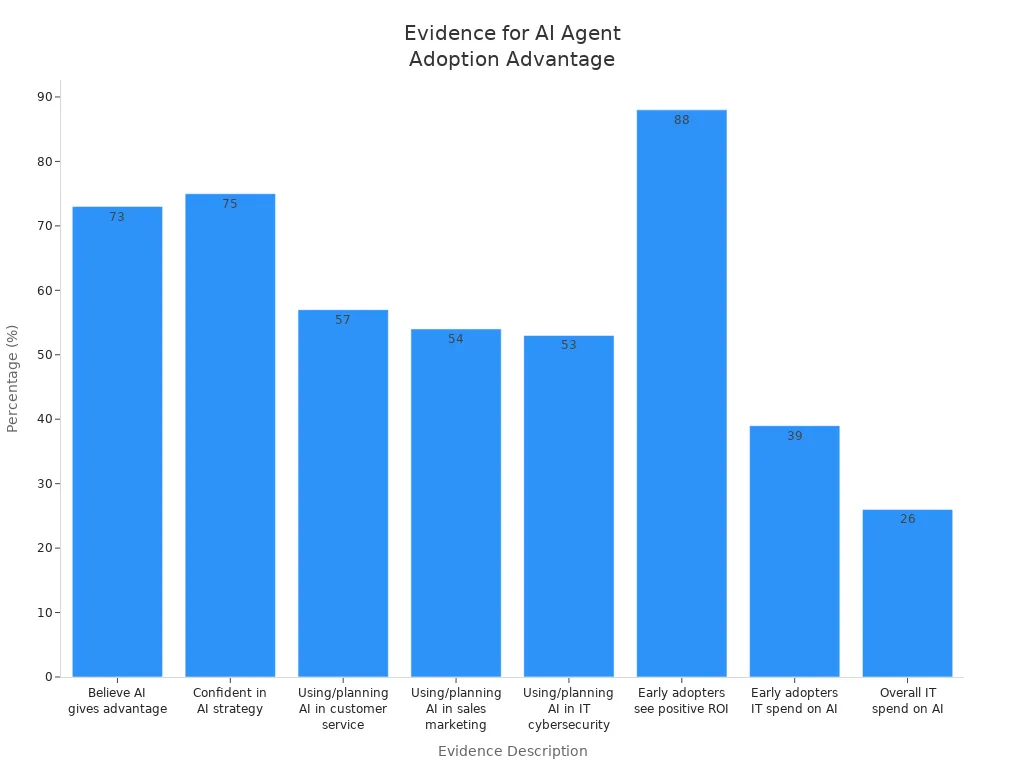
You now see the end of manual data entry as a turning point. Agentic workflows powered by AI give you a clear edge. Early adopters report faster growth and better customer experiences. The table below shows how companies gain a competitive advantage:
| Description | Percentage |
|---|---|
| Believe AI agents give an edge | 73% |
| Confident in AI agent strategy | 75% |
| Early adopters see positive ROI | 88% |
Start by identifying key workflows and build a roadmap for adoption. Embrace this change as a chance to future-proof your business and lead your industry.
FAQ
What is an AI Agent in business operations?
An AI Agent is a digital assistant that observes your data, understands your goals, and takes action. You can use it to automate tasks, make decisions, and improve efficiency across your organization.
How do agentic workflows differ from traditional automation?
Agentic workflows adapt to changes and learn from new data. Traditional automation follows fixed rules. You get more flexibility and smarter decisions with agentic workflows.
Can AI Agents work with my existing systems?
Yes. You can integrate AI Agents with your current tools and databases. Many platforms offer connectors and APIs for smooth integration.
Will AI Agents replace my team?
No. AI Agents support your team by handling repetitive tasks. You can focus on strategy, creativity, and customer relationships while agents manage routine work.
How do I measure the success of agentic automation?
You should track key metrics like cost savings, error reduction, and faster processing times. User feedback and improved customer satisfaction also show success.
Is my data safe with AI Agents?
You control your data. Leading platforms use strong security, access controls, and compliance standards. You can set permissions and monitor agent activity.
What are the first steps to adopt agentic workflows?
Start by identifying repetitive tasks and high-impact processes. Build a roadmap, involve your team, and choose a trusted platform to guide your transition.
🎧 Listen to this episode
Want a practical explanation of AI Agents and the End of Manual Data Entry? This episode breaks down the topic in clear language and shows why it matters for Microsoft 365, Azure, Power Platform, security, AI, and modern work.
Listen to this episode if you want to:
- Understand the key concepts behind AI Agents and the End of Manual Data Entry
- See how it fits into the wider Microsoft technology ecosystem
- Learn where it can create practical value for your organization
You may also enjoy these related M365 FM episodes:
- From Data to Intelligent Agents: Building Trusted Enterprise AI with Microsoft AI Foundry with Shubhangi Goyal [MVP]
- Automate Power Platform Data Entry with AI Tools
- Use AI Form Fill in Power Apps for Faster Data Entry
- Govern Microsoft Fabric Data Agents in Copilot Studio
- AI Agents - Simply Explained
Discover more practical Microsoft conversations on M365 FM.
Last reviewed: July 2026.
Who Should Listen
This episode is for Microsoft administrators, architects, developers, security professionals, and business leaders who need a practical foundation before making implementation, operations, or governance decisions.
🎧 You Should Also Listen To
- Microsoft Fabric — A strongly related next step for extending this topic.
- Microsoft Fabric OneLake — A strongly related next step for extending this topic.
- Power BI Copilot — A strongly related next step for extending this topic.

Microsoft MVP | Host of M365.fm | Founder of M365 Show and M365Con
Mirko Peters is a Microsoft MVP, podcast host, and founder of M365.fm, M365 Show, and M365Con. His work connects Microsoft practitioners through podcast interviews, livestreams, and community events.
At M365.fm, Mirko hosts conversations with Microsoft MVPs, product experts, architects, and community contributors. Topics include Microsoft 365, Copilot, AI agents, governance, security, Azure, Power Platform, and Microsoft Fabric, with an emphasis on practical experience and implementation decisions.
M365.fm is the podcast and learning platform. M365 Show brings experts together for livestreams, while M365Con provides an online conference setting for community learning.
Official website: Mirko Peters (https://www.mirkopeters.com/). Recognition: Mirko Peters — Microsoft MVP profile (https://mvp.microsoft.com/de-DE/mvp/profile/9b0ca797-db5a-493a-a845-8b9158046cf5). Connect on LinkedIn (https://www.linkedin.com/in/m365showpodcast/).