Why Private RAG Isn't Enough: Bridging Data Sovereignty and Security
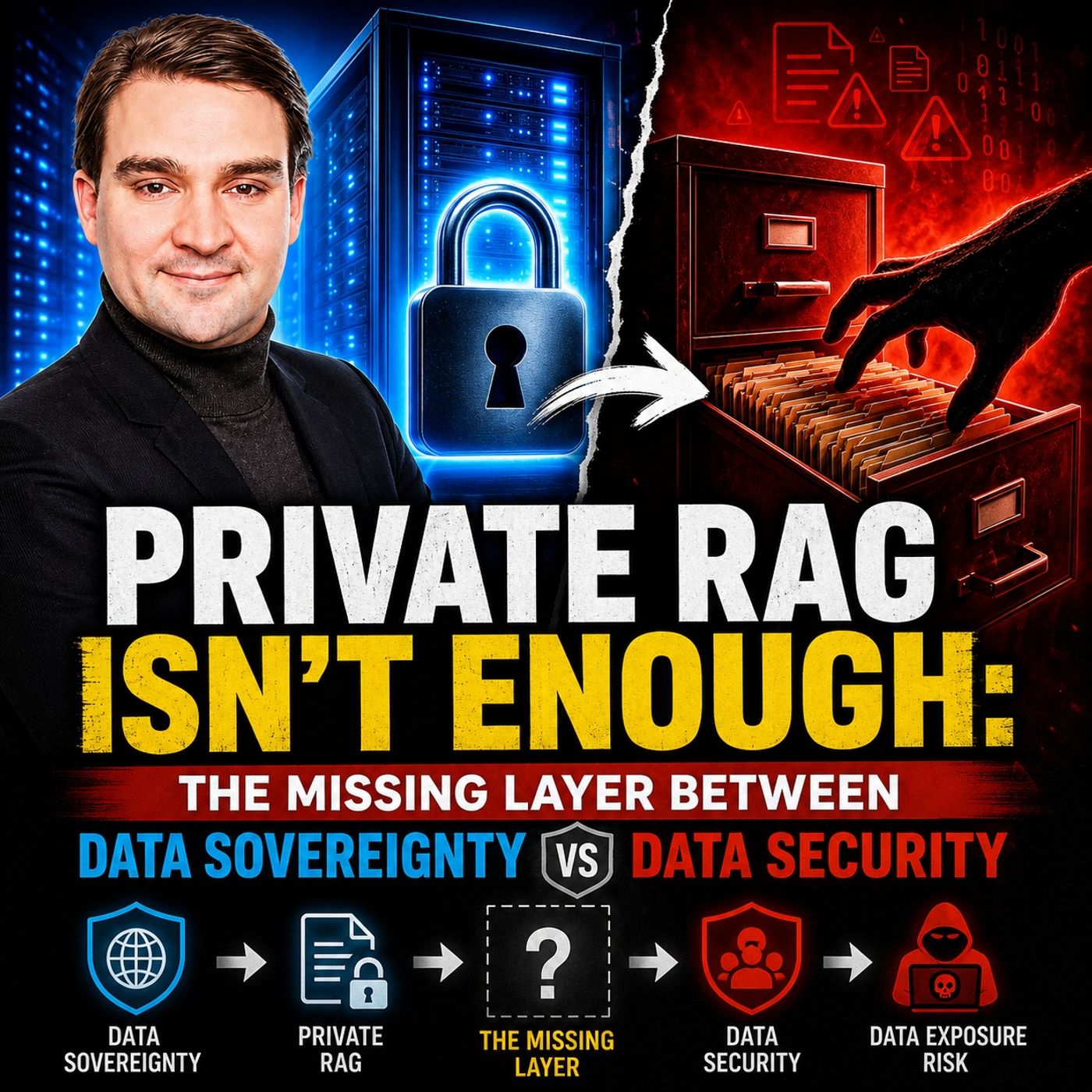
Welcome back to the blog! In today's post, we are expanding on a crucial conversation we recently tackled on the podcast. If you manage data or build AI systems within enterprise environments, you have likely heard about the push toward private Retrieval-Augmented Generation (RAG). Many organizations assume that as long as their data lives within a controlled, self-hosted environment, they are completely safe. But is data sovereignty the same as data security? Spoiler alert: it is not. To fully understand the nuances of authorization-aware retrieval and why self-hosting alone leaves massive gaps in your protection strategy, you will want to listen to the companion podcast episode, Private RAG Security: Authorization-Aware Data Retrieval. Let us dive deep into why private RAG isn't enough and how you can bridge the gap between where your data sits and who can actually access it.
Data Sovereignty vs. Security
Key Concepts
Data sovereignty refers to the idea that data is subject to the laws and regulations of the country where it is stored. This means that if you store data in a specific region, you must comply with that region's legal requirements. On the other hand, data security focuses on protecting data from unauthorized access and breaches. It involves implementing measures to ensure that only authorized individuals can access sensitive information.
Understanding these concepts is crucial for organizations. You must recognize that data sovereignty and data security are interconnected. When you store data in a specific location, you must also consider how to protect that data effectively. Failing to do so can lead to significant risks, including data breaches and legal penalties.
Importance of Data Sovereignty
Data sovereignty plays a vital role in today's digital landscape. As organizations expand globally, they face various regulatory challenges. For instance, Saudi Arabia's Personal Data Protection Law (PDPL) enforces strict data localization and security measures. This law requires businesses to understand data sovereignty laws, especially when trading overseas.
Here are some key aspects to consider regarding data sovereignty:
- Government Surveillance: Foreign governments can compel access to data under national security or law enforcement mandates, impacting data security.
- Fragmented Cloud Infrastructure: Distributing data across multiple regions complicates compliance with data sovereignty laws.
- Public Cloud Risks: Dynamic data storage locations may expose data to multiple jurisdictions without oversight.
- Private/Hybrid Cloud Control: These options offer greater control over data location, allowing for stricter sovereignty measures.
- Region-Specific Hosting: Choosing cloud providers that guarantee regional data storage helps maintain compliance.
Organizations must also address the trade-offs between data sovereignty and operational efficiency. They can establish a sovereignty baseline to build transparency on critical dependencies across business services and technology stacks. By defining sovereignty dimensions and classifying assets based on their value-at-risk, you can create a clear policy and operating posture for each tier.
Misconceptions About Private RAG
Overestimating Security
Many organizations mistakenly believe that implementing a private RAG system guarantees complete data security. This misconception often stems from a lack of understanding of the inherent vulnerabilities associated with these systems. For instance, RAG systems inherit vulnerabilities from large language models (LLMs). This means that even with a private setup, you may still face risks that could compromise your data.
Additionally, the architectural design of RAG systems introduces new privacy risks. You might not fully grasp how adversaries can exploit the external knowledge base to infer sensitive information. This lack of awareness can lead to significant security gaps. Here are some common myths regarding private RAG security:
- Self-hosting equals security: Many assume that hosting data on their own servers automatically enhances security.
- VPNs provide full protection: Some believe that using a VPN is sufficient for securing data access.
- Data is safe if it's private: The notion that private data is inherently secure can lead to complacency.
Underestimating Risks
Organizations often underestimate the risks associated with self-hosted RAG solutions. They believe that having control over their data means they are safe from breaches. However, this belief can obscure the reality that most data breaches stem from misconfigurations and inadequate security practices. These issues are often better managed by cloud providers with specialized expertise.
Here’s a table outlining some common costs and risks associated with self-hosted RAG systems:
| Cost Type | Description |
|---|---|
| Infrastructure Costs | Unplanned expenses for data storage, backup, and monitoring systems. |
| Operational Staffing | Staffing costs often exceed cloud service bills, leading to budget overruns. |
| Compute Resource Consumption | Document processing can lead to unpredictable compute costs, significantly impacting budgets. |
Moreover, several factors contribute to the risks of self-hosting:
- Misconfigurations
- Inadequate security practices
- Insufficient access controls
- Poor patch management
- Insider threats
Assuming that self-hosting guarantees data security can lead to serious vulnerabilities. For example, centralized knowledge bases can become high-value targets, exposing sensitive health information if not properly anonymized. Additionally, sensitive data can be intercepted during transmission, increasing the risk of man-in-the-middle attacks. The dynamic nature of RAG systems can also lead to unintended leakage of sensitive information through the operational pipeline.
By recognizing these misconceptions and understanding the associated risks, you can better protect your data and enhance your overall data security strategy.
Managing Permissions for Sensitive Data
Risks of Permission Loss
Managing permissions effectively is crucial for protecting sensitive data. When organizations transition data between systems or change user roles, they often face significant risks related to permission loss. Misconfigured access controls can lead to unauthorized access, exposing sensitive information to individuals who should not have it.
Here are some common permission management failures reported in sensitive data environments:
| Permission Management Failure | Description |
|---|---|
| Misconfigured access controls | Systems may have excessive permissions leading to unauthorized access. |
| Lack of visibility into data movements | Sensitive data can move without adequate protection, making it vulnerable to breaches. |
| Inadequate auditing processes | Critical activities may not be logged or monitored, allowing issues to go unnoticed. |
These failures often occur not due to malicious intent but because the systems in place do not verify user permissions adequately. For example, a misconfigured database may not send alerts when unauthorized access occurs. An unusual data export at 2 AM could go unnoticed, and vendors might access data beyond their scope without reporting their activities.
Ensuring Data Security During Transitions
To ensure data security during transitions, you must implement strong access control measures. Using Role-Based Access Control (RBAC) helps limit data access based on job roles. Applying the Principle of Least Privilege (PoLP) minimizes access rights, ensuring that users only have the permissions necessary for their tasks.
Consider these best practices for maintaining data security during organizational transitions:
- Regular Access Reviews: Conduct periodic audits to ensure users have appropriate permissions and remove outdated accounts.
- Incident Response Planning: Develop a structured plan that includes detection, response coordination, and communication protocols to manage security incidents effectively.
- Network Security and Access Control: Implement network segmentation and identity management solutions to restrict access to sensitive data.
Private RAG addresses these issues by capturing the entire permission model at the moment of document ingestion. This ensures that sensitive information remains protected even as it becomes searchable. By managing permissions at the folder or tag level, Private RAG enhances efficiency and flexibility compared to individual file management. Unique identifiers for documents enable granular access control, which is essential for both RAG and other AI systems.
By adopting these strategies, you can significantly reduce the risks associated with permission loss and enhance your overall data security posture.
Single-Agent vs. Multi-Agent Architectures
Vulnerabilities in Single-Agent Systems
Single-agent systems often present significant vulnerabilities that can compromise data security. These systems typically rely on a single point of control, which can lead to various risks. Recent security audits reveal that cross-tenant data leakage is a critical issue. Attackers can exploit this vulnerability without needing advanced technical skills. Here are some common vulnerabilities found in single-agent RAG architectures:
- Knowledge Base Poisoning: Attackers can inject documents that hijack RAG responses.
- Indirect Prompt Injection via Retrieved Context: This method uses embedded instructions to weaponize the generation step.
- Cross-Tenant Data Leakage: Missing access controls allow attackers to exfiltrate data across user boundaries.
Knowledge base poisoning is particularly effective against standard RAG stacks, succeeding 95% of the time. Additionally, cross-tenant data leakage has been shown to succeed on every query tested, indicating a severe lack of technical barriers for attackers. These vulnerabilities highlight the need for organizations to reconsider their reliance on single-agent systems.
Advantages of Multi-Agent Systems
In contrast, multi-agent systems offer several advantages that enhance data security. By distributing tasks among multiple agents, these systems reduce the risk of a single point of failure. Here are some key benefits of adopting a multi-agent approach:
- Higher Accuracy: Multi-agent systems generally achieve better accuracy in data retrieval and processing.
- Increased Transparency: These systems provide greater visibility into data movements and access controls.
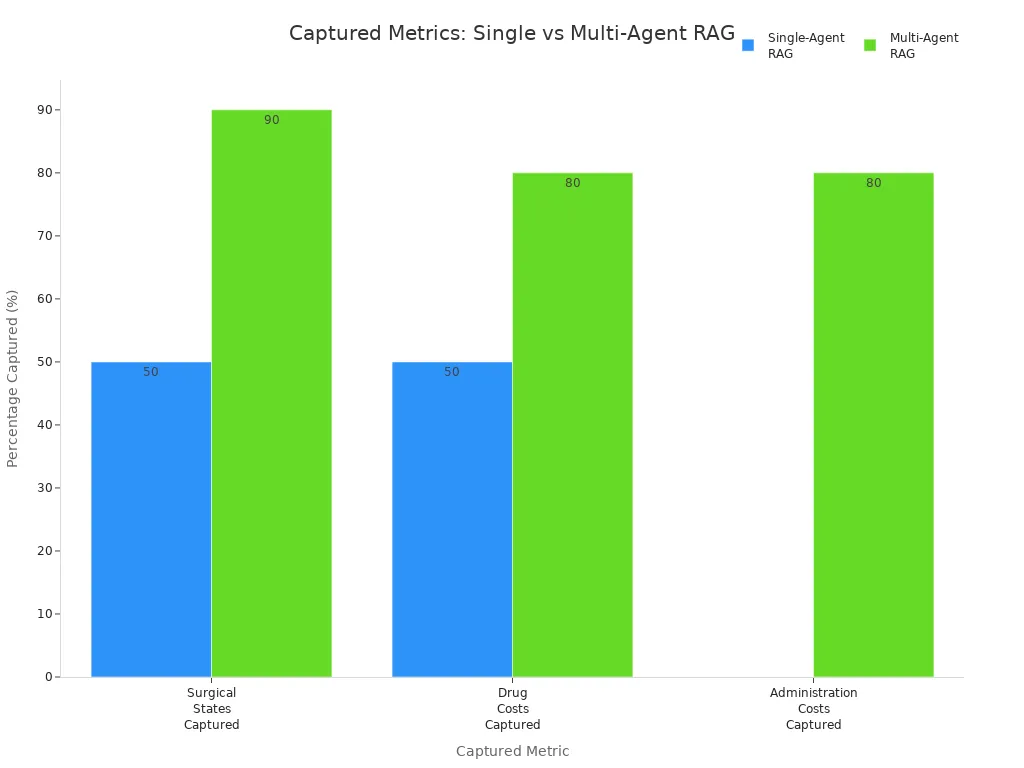
- Improved Surgical States Captured: Multi-agent systems capture 90% of surgical states compared to only 50% in single-agent systems.
- Enhanced Cost Management: They can capture up to 80% of drug costs and 80% of administration costs, making them more efficient.
| Metric | Single-Agent RAG | Multi-Agent RAG |
|---|---|---|
| Accuracy | Variable | Higher |
| Transparency | Lower | Higher |
| Processing Time | Faster | Slower |
| Surgical States Captured | 50% | 90% |
| Drug Costs Captured | 50% | 80% |
| Administration Costs Captured | 0% | 80% |
Transitioning to a multi-agent architecture may present challenges, such as increased complexity in protocol design and error handling requirements. However, the benefits of enhanced security and efficiency often outweigh these challenges. By adopting a multi-agent approach, you can significantly improve your data security posture and better protect sensitive information.
Zero Trust Principles in Data Security
Understanding Zero Trust
Zero Trust is a security model that operates on the principle of "never trust, always verify." This approach assumes that threats can exist both inside and outside your network. Therefore, every access request must undergo strict verification. The core principles of Zero Trust include:
| Principle | Description |
|---|---|
| Never Trust, Always Verify | Trust is never assumed; every access request must be verified based on multiple factors. |
| Least-Privileged Access | Access is granted only to the specific resource needed for a task, minimizing lateral movement. |
| Contextual Risk Evaluation | Continuous evaluation of risk based on contextual variables like user behavior and device health. |
| Continuous Monitoring | Real-time monitoring of all transactions to identify risks and adapt access policies dynamically. |
| Elimination of Public IP Exposure | Unauthorized users should not discover services or data without explicit permission, minimizing the attack surface. |
These principles are crucial for enhancing data security, especially in environments that handle sensitive information.
Implementing Zero Trust in Private RAG
Implementing Zero Trust in Private RAG systems involves several strategies that enhance data retrieval security. Here are some effective approaches:
- Verify Explicitly: Every user, device, and connection should require authentication and authorization before access is granted.
- Enforce Least Privilege: Limit access to what’s needed for only as long as it’s needed – nothing more.
- Assume Breach: Design your environment around the belief that compromise is inevitable and containment is key.
- Deploy Multi-Factor Authentication (MFA): Ensure every connection is verified before accessing sensitive systems and data by implementing robust MFA requirements.
- Continuously Monitor: Prioritize real-time visibility into network activity – trust is not a one-time decision.
Zero Trust architecture directly addresses the challenges of data retrieval in Private RAG systems. It mandates that every data retrieval request is authenticated and authorized, which directly addresses unauthorized access risks. Additionally, it ensures that all data in transit is encrypted, enhancing security during retrieval interactions. Dynamic access controls adjust permissions based on contextual factors, improving data retrieval security.
By adopting these Zero Trust principles, you can significantly enhance your data security posture. This approach not only protects sensitive information but also prepares your organization for future challenges in data sovereignty and security.
Conclusion
In today's digital landscape, bridging the gap between data sovereignty and security is essential. You must recognize that simply focusing on where your data is stored does not guarantee its safety. Whether you are battling knowledge base poisoning, managing fine-grained permission models, or structuring multi-agent frameworks, security requires constant verification rather than blind trust in self-hosted infrastructure. To get a comprehensive breakdown of these architectures and practical guidance on authorization-aware retrieval, make sure you listen to the full episode over at Private RAG Security: Authorization-Aware Data Retrieval. Here are some key takeaways to consider:
- Regulatory frameworks play a crucial role in ensuring data sovereignty and security in AI systems.
- Emerging technologies, especially in finance and enterprise workflows, pose unique challenges that require careful management.
- Balancing innovation with security is vital to protect sensitive information.
To enhance your data security posture, consider these lessons learned from successful organizations:
| Lesson | Description |
|---|---|
| Jurisdictional Control | Maintain control over where your data is stored and who has access to it. |
| Robust Vendor Management | Manage vendors effectively to ensure compliance with data sovereignty laws. |
| Integration into Business Strategy | Treat data sovereignty as part of your overall business strategy. |
By implementing these strategies, you can better protect your sensitive data and navigate the complexities of data sovereignty and security effectively. 🌐🔒
FAQ
What is Private RAG?
Private RAG stands for Private Retrieval-Augmented Generation. It enhances data security by managing permissions effectively during data transitions, ensuring that sensitive information remains protected.
How does Private RAG ensure data security?
Private RAG captures the entire permission model at document ingestion. This process maintains access controls, preventing unauthorized access to sensitive information.
What are the risks of self-hosting RAG systems?
Self-hosting RAG systems can lead to misconfigurations, inadequate security practices, and insider threats. These risks may expose sensitive data to breaches.
Why is permissions management important?
Effective permissions management prevents unauthorized access to sensitive data. It ensures that only authorized individuals can view or modify information, reducing the risk of data exposure.
What is Zero Trust?
Zero Trust is a security model that requires strict verification for every access request. It assumes that threats can exist both inside and outside your network.
How can I implement Zero Trust in my organization?
To implement Zero Trust, verify every user and device, enforce least privilege access, and continuously monitor network activity. This approach enhances data security significantly.
What are the benefits of multi-agent systems?
Multi-agent systems distribute tasks among multiple agents, reducing the risk of a single point of failure. They offer higher accuracy, increased transparency, and improved cost management.
How does Private RAG address data sovereignty?
Private RAG ensures compliance with data sovereignty laws by managing where data is stored and who has access. This approach helps organizations navigate regulatory challenges effectively.
🎧 Listen to this episode
Want a practical explanation of Private RAG Security? This episode breaks down the topic in clear language and shows why it matters for Microsoft 365, Azure, Power Platform, security, AI, and modern work.
Listen to this episode if you want to:
- Understand the key concepts behind Private RAG Security
- See how it fits into the wider Microsoft technology ecosystem
- Learn where it can create practical value for your organization
You may also enjoy these related M365 FM episodes:
- Private LoRA for Secure AI on Proprietary Enterprise Data
- How to Build Private RAG with SharePoint and n8n
- Dataverse Security - Simply Explained
- From Data to Intelligent Agents: Building Trusted Enterprise AI with Microsoft AI Foundry with Shubhangi Goyal [MVP]
- Microsoft Graph Data Connect - Simply Explained
Discover more practical Microsoft conversations on M365 FM.
Last reviewed: July 2026.
Who Should Listen
This episode is for Microsoft administrators, architects, developers, security professionals, and business leaders who need a practical foundation before making implementation, operations, or governance decisions.
🎧 You Should Also Listen To
- Microsoft Security Copilot — A strongly related next step for extending this topic.
- Microsoft Defender for Endpoint — A strongly related next step for extending this topic.
- Microsoft Defender for Identity — A strongly related next step for extending this topic.
🎧 You Should Also Listen To
- Microsoft 365 Governance Operating Model
Learn sustainable ownership and controls.
- AI Agents – Simply Explained
Explore responsible AI foundations.
- Microsoft Purview – Simply Explained
Understand data governance and protection.

Microsoft MVP | Host of M365.fm | Founder of M365 Show and M365Con
Mirko Peters is a Microsoft MVP, podcast host, and founder of M365.fm, M365 Show, and M365Con. His work connects Microsoft practitioners through podcast interviews, livestreams, and community events.
At M365.fm, Mirko hosts conversations with Microsoft MVPs, product experts, architects, and community contributors. Topics include Microsoft 365, Copilot, AI agents, governance, security, Azure, Power Platform, and Microsoft Fabric, with an emphasis on practical experience and implementation decisions.
M365.fm is the podcast and learning platform. M365 Show brings experts together for livestreams, while M365Con provides an online conference setting for community learning.
Official website: Mirko Peters (https://www.mirkopeters.com/). Recognition: Mirko Peters — Microsoft MVP profile (https://mvp.microsoft.com/de-DE/mvp/profile/9b0ca797-db5a-493a-a845-8b9158046cf5). Connect on LinkedIn (https://www.linkedin.com/in/m365showpodcast/).