


 Apple Podcasts
 Spotify
 Youtube Music
 Spreaker
 Podchaser
 Amazon Music
 Azure Front Door - Simply Explained
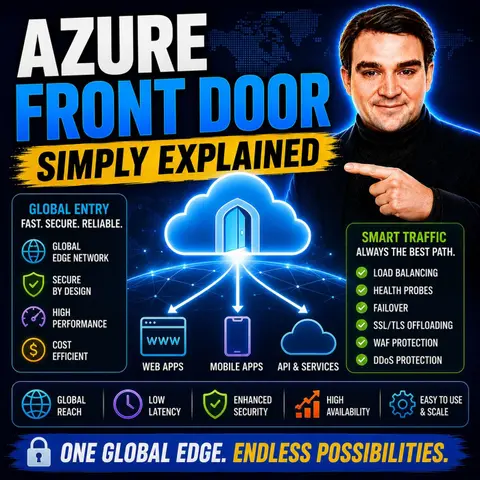

Azure Front Door is Microsoft's global application delivery network that improves the performance, availability, and security of web applications. By routing user traffic through Microsoft's worldwide edge network, Azure Front Door delivers faster response times, intelligent load balancing, SSL offloading, and built-in protection against web attacks—all from a single managed service.
In this episode, you'll learn what Azure Front Door is, how it works, and why it's an essential service for modern internet-facing applications. The discussion explains core concepts such as global load balancing, health probes, URL routing, caching, Web Application Firewall (WAF), and SSL/TLS termination. You'll also discover how Azure Front Door differs from Azure Load Balancer, Azure Traffic Manager, and Azure Application Gateway.
The episode explores practical scenarios such as hosting global websites, delivering APIs, improving application resilience, protecting against DDoS and web attacks, and optimizing user experiences across multiple Azure regions. You'll learn how Azure Front Door integrates with Azure App Service, Azure CDN, Azure Firewall, Azure Monitor, and Azure Web Application Firewall to build secure, highly available cloud applications.
By the end of this episode, you'll have a clear understanding of Azure Front Door, its core capabilities, common deployment scenarios, and best practices for delivering fast, secure, and globally resilient applications in Microsoft Azure.
Azure Front Door serves as a powerful cloud service that boosts the performance, security, and reliability of your web applications worldwide. With nearly 1,942 companies leveraging Azure Front Door, you can trust its capabilities to address significant challenges like latency and security threats. This service intelligently routes user requests to the nearest backend server, ensuring a seamless experience. It also protects your applications from various attacks, providing robust security features that enhance your online presence globally.
Key Takeaways
- Azure Front Door improves web application performance by routing user requests to the nearest server, reducing wait times.
- The service enhances security with a Web Application Firewall (WAF) that protects against common threats like SQL injection and DDoS attacks.
- Azure Front Door offers global load balancing, ensuring that traffic is distributed efficiently across multiple servers for better availability.
- Businesses can choose between Standard and Premium tiers, with Premium offering advanced features like bot protection and managed security rules.
- Using Azure Front Door as a CDN speeds up content delivery and ensures a seamless experience for users, even during high traffic.
- The service provides instant global failover, automatically redirecting traffic if a server goes down, keeping applications accessible.
- Azure Front Door simplifies web architecture by centralizing traffic management, making it easier for businesses to handle their applications.
- Implementing Azure Front Door can lead to improved user satisfaction and trust, especially for e-commerce and media platforms.
What Is Azure Front Door?

Overview of Azure Front Door
Azure Front Door is a cloud-based service that acts as a global application delivery and security solution. It functions as a reverse proxy, managing traffic distribution to enhance performance, availability, and security for your web applications. By utilizing Microsoft's extensive global network of points of presence (POPs), Azure Front Door reduces latency and improves user experience. It directs requests to the nearest backend servers, ensuring that users receive the fastest response possible.
This service offers intelligent traffic routing, SSL/TLS certificate management, and built-in security through the Azure Web Application Firewall (WAF). With Azure Front Door, you can confidently deliver your applications while maintaining high performance and security standards.
Key Features
Azure Front Door comes packed with features that enhance both performance and security. Here are some of the key features you can expect:
| Feature | Description |
|---|---|
| Global Load Balancing | Distributes incoming requests across multiple backend pools for optimal performance and availability, routing traffic to the closest and healthiest backend server. |
| Traffic Routing and URL-based Routing | Allows you to define sophisticated routing rules to direct traffic based on criteria like URL paths and client IP addresses, enabling flexible traffic management. |
| SSL/TLS Termination | Offloads SSL/TLS decryption from backend servers, enhancing security and reducing server load. |
| Web Application Firewall (WAF) | Protects your applications from common vulnerabilities and is updated with the latest threat intelligence. |
| Global Anycast DNS | Provides fast DNS resolution globally, minimizing latency and improving user experience. |
| Health Probes and Active Health Monitoring | Continuously monitors backend server health, intelligently routing traffic away from unhealthy servers. |
| Caching and CDN Integration | Integrates with Azure CDN to cache static content at the edge, reducing latency and improving performance. |
| Edge Compute | Supports running custom code at the edge for request manipulation and real-time decision-making. |
With these features, Azure Front Door ensures that your applications remain responsive and secure, even during traffic spikes or potential threats. You can leverage its capabilities to create a robust infrastructure that meets the demands of your users.
Standard vs. Premium Tiers
When choosing between the Standard and Premium tiers of Azure Front Door, you should consider your specific needs. Each tier offers unique features that cater to different business requirements.
Feature Comparison
Performance Features
Both tiers provide essential performance enhancements, but the Premium tier includes advanced capabilities. Here’s a breakdown of the key performance features:
| Features and optimizations | Front Door Standard | Front Door Premium |
|---|---|---|
| Custom web application firewall (WAF) rules | ✓ | ✓ |
| Microsoft-managed rule set | N/A | ✓ |
| Bot protection | N/A | ✓ |
| Private Link connection to origin | N/A | ✓ |
| Geo-filtering | ✓ | ✓ |
The Standard tier focuses on global load balancing and content acceleration. It optimizes both static and dynamic content delivery. The Premium tier builds on these capabilities, adding advanced security features and enhanced performance options.
Security Features
Security is a critical aspect of any web application. The Standard tier offers basic security capabilities, while the Premium tier provides more robust security features. The Premium tier includes:
- Advanced WAF rules managed by Microsoft.
- Bot protection to mitigate automated threats.
- Private Link support for secure connections to your origin.
These features ensure that your applications remain protected against various attacks, including DDoS attacks, while maintaining high availability.
Pricing Differences
Pricing is another important factor when deciding between the two tiers. Here’s a comparison of the costs associated with each tier:
| Tier | Monthly Base Fee | Key Features |
|---|---|---|
| Standard | $35 | Global load balancing, content acceleration, basic security capabilities. |
| Premium | $330 | Advanced security features, managed WAF rules, bot protection, Private Link support included at no extra charge. |
The Standard tier is ideal for businesses that require essential performance and security features without extensive costs. In contrast, the Premium tier suits organizations needing advanced security and performance optimizations, especially those handling sensitive data or facing higher traffic volumes.
Azure Front Door as a CDN
CDN Capabilities
Azure Front Door operates as a powerful CDN, enhancing your web application's performance and security. It ensures fast and seamless application delivery by leveraging Microsoft's global network. Here are some key capabilities of Azure Front Door as a CDN:
- Global HTTP(S) Load Balancing: This feature enhances traffic routing and load balancing, directing user requests to the nearest backend server.
- Advanced Security Features: Azure Front Door includes SSL termination and a built-in Web Application Firewall (WAF), providing robust protection against various threats.
- Dynamic Content Delivery: Unlike traditional CDNs that primarily cache static content, Azure Front Door optimizes both static and dynamic content delivery.
These capabilities allow Azure Front Door to exceed the performance of traditional CDN solutions, making it an ideal choice for modern web applications.
Benefits of Using Azure Front Door
Using Azure Front Door as your CDN offers numerous benefits that significantly improve content delivery speed and reliability. Here are some advantages you can expect:
- Reduced Latency: Azure Front Door minimizes latency by routing requests to the nearest point of presence (PoP). This reduction leads to faster TCP handshake times and quicker SSL setup durations.
- Improved Page Load Times: Median round-trip times have been halved, resulting in better availability and faster page load times. This improvement is particularly noticeable after adding new PoP locations, especially in regions like Africa.
- High Availability: Azure Front Door provides instant global failover, automatically redirecting traffic to the next best endpoint during backend failures. This feature ensures that your applications remain accessible even during outages.
| Feature | Description |
|---|---|
| Global HTTP Load Balancing | Routes requests to the nearest point-of-presence, reducing latency. |
| Instant Global Failover | Automatically redirects traffic to the next best endpoint during backend failures. |
| Integrated Web Application Firewall (WAF) | Protects against common web vulnerabilities like SQL injection and XSS. |
By utilizing Azure Front Door, you can enhance your web application's performance and security while ensuring a seamless experience for your users. The combination of global load balancing and advanced security features makes Azure Front Door a leading choice for businesses looking to optimize their content delivery.
Security Features of Azure Front Door

Web Application Firewall
Azure Front Door includes a robust Web Application Firewall (WAF) that plays a crucial role in protecting your web applications. The WAF monitors incoming requests and identifies potential threats, ensuring that your applications remain secure. Here are some key features of the Azure Front Door WAF:
| Feature | Description |
|---|---|
| Threat Detection | Monitors incoming requests and identifies potential threats. |
| Custom Rules | Allows you to create rules based on specific conditions to control access. |
| Managed Rules | Pre-configured rules that protect against common vulnerabilities, updated by Azure. |
| Logging | Provides real-time logs of requests and actions taken by the WAF. |
| Monitoring | Integrates with Azure Monitor for tracking alerts and trends in web application security. |
| Bot Protection | Safeguards applications from malicious bots and automated attacks. |
| Policy Settings | Enables configuration of WAF policies to adjust monitoring and blocking actions. |
You can choose between two modes for the WAF: Detection Mode and Prevention Mode. In Detection Mode, the WAF monitors and logs requests without taking action. In Prevention Mode, it actively blocks requests that match defined rules. This flexibility allows you to tailor the WAF's behavior to fit your specific security needs.
Protection Against Threats
Azure Front Door's WAF effectively protects your applications against various common web threats. It helps you maintain a secure environment by blocking attacks such as:
| Attack Type | Description |
|---|---|
| SQL Injection | Prevents malicious SQL statements from being injected into your application, which could allow attackers to manipulate your database. |
| Cross-Site Scripting (XSS) | Blocks attacks that execute malicious scripts in a user’s browser, often aimed at stealing sensitive data like cookies and session tokens. |
| File Inclusion Vulnerabilities | Protects against attackers including files on your server, which could lead to remote code execution or unauthorized access to sensitive files. |
Additionally, Azure Front Door enhances security by utilizing threat intelligence to block malicious IPs at the edge. This proactive approach prevents various threats, including credential stuffing, bot traffic, and phishing campaigns, before they reach your application servers.
With Azure Front Door, you gain advanced security features that ensure high availability and protection against DDoS attacks. The WAF provides an essential layer of defense, allowing you to focus on delivering your applications without worrying about potential vulnerabilities.
By implementing Azure Front Door, you can confidently protect your web applications while enjoying the benefits of global load balancing and enhanced performance.
Use Cases for Azure Front Door
Real-World Applications
Many businesses across various industries leverage Azure Front Door to enhance their web applications. Here are some notable examples:
-
E-Commerce Platforms: Companies like RetailCo utilize Azure Front Door to manage high traffic loads during peak shopping seasons. The service ensures secure transactions and fast page load times, which are crucial for customer satisfaction.
-
Media and Content Delivery: Streaming services such as StreamNow rely on Azure Front Door for fast and reliable content delivery. The platform optimizes video streaming and large file downloads, providing users with a seamless experience.
-
Global Enterprises: Organizations like GlobalCorp benefit from Azure Front Door's capabilities to deliver a consistent and secure experience for users across multiple geographical locations. This is essential for maintaining brand integrity and user trust.
Benefits for Businesses
Using Azure Front Door offers numerous advantages for businesses, particularly those with dynamic web applications. Here are some key benefits:
-
Scalability: Azure Front Door supports sudden spikes in traffic, making it suitable for variable traffic loads. This feature enhances user experience by ensuring high availability, even during peak times.
-
Global Load Balancing: The service routes requests to the nearest point-of-presence, reducing latency for users regardless of their location. This capability improves overall performance and user satisfaction.
-
Instant Global Failover: Azure Front Door automatically redirects traffic to the next best endpoint during backend failures. This ensures that your applications remain accessible, minimizing downtime and potential revenue loss.
-
Advanced Security Features: With built-in WAF and DDoS protection mechanisms, Azure Front Door safeguards your applications against various threats. This robust security framework allows you to focus on your core business without worrying about vulnerabilities.
| Feature | Description |
|---|---|
| Global HTTP Load Balancing | Routes requests to the nearest point-of-presence, reducing latency. |
| Instant Global Failover | Automatically redirects traffic to the next best endpoint during backend failures. |
| Scalability | Designed to handle sudden spikes in traffic, suitable for variable traffic loads. |
By implementing Azure Front Door, you can enhance your web applications' performance and security. This service not only optimizes content delivery but also provides the reliability and protection necessary for modern businesses.
Azure Front Door plays a vital role in modern web architecture. It enhances performance, security, and reliability for your applications. With features like global load balancing and advanced security measures, Azure Front Door ensures a seamless user experience.
Consider the following key benefits:
| Key Benefit | Description |
|---|---|
| Global Entry Point | Provides a centralized access point for applications, improving user experience and performance. |
| Traffic Optimization | Handles incoming traffic efficiently, allowing backend services to focus on core functionalities. |
| Security Filtering | Enhances security by filtering traffic before it reaches backend services. |
| Resilience Against Failures | Offers failover capabilities across regions, ensuring application availability. |
| Simplified Architecture | Reduces complexity by centralizing traffic management, beneficial for distributed applications. |
By adopting Azure Front Door, you can optimize your web applications for better performance and security. Don't miss the opportunity to enhance your digital presence with this powerful service.
FAQ
What is Azure Front Door used for?
Azure Front Door enhances web application performance and security. It intelligently routes user requests to the nearest backend server, reducing latency and improving user experience.
How does Azure Front Door improve security?
Azure Front Door includes a Web Application Firewall (WAF) that protects against common threats like SQL injection and DDoS attacks. It filters traffic before it reaches your applications.
Can Azure Front Door handle high traffic?
Yes, Azure Front Door efficiently manages high traffic loads. It automatically scales to accommodate sudden spikes, ensuring your applications remain available and responsive.
What are the benefits of using Azure Front Door as a CDN?
Using Azure Front Door as a CDN reduces latency, improves page load times, and provides instant global failover. It optimizes both static and dynamic content delivery.
Is Azure Front Door suitable for e-commerce sites?
Absolutely! Azure Front Door ensures fast, secure transactions for e-commerce platforms. Its global load balancing and security features enhance customer satisfaction and trust.
How do I set up Azure Front Door?
You can set up Azure Front Door through the Azure portal. Follow the guided steps to configure your backend pools, routing rules, and security settings.
What is the difference between Standard and Premium tiers?
The Standard tier offers essential features, while the Premium tier includes advanced security options like bot protection and managed WAF rules. Choose based on your business needs.
Can I customize routing rules in Azure Front Door?
Yes, Azure Front Door allows you to create custom routing rules based on URL paths, client IP addresses, and other criteria. This flexibility enhances traffic management.
🎧 Listen to this episode
Want a practical explanation of Azure Front Door? This episode breaks down the topic in clear language and shows why it matters for Microsoft 365, Azure, Power Platform, security, AI, and modern work.
Listen to this episode if you want to:
- Understand the key concepts behind Azure Front Door
- See how it fits into the wider Microsoft technology ecosystem
- Learn where it can create practical value for your organization
Discover more practical Microsoft conversations on M365 FM.
🚀 Want to be part of m365.fm?
Then stop just listening… and start showing up.
👉 Connect with me on LinkedIn and let’s make something happen:
- 🎙️ Be a podcast guest and share your story
- 🎧 Host your own episode (yes, seriously)
- 💡 Pitch topics the community actually wants to hear
- 🌍 Build your personal brand in the Microsoft 365 space
This isn’t just a podcast — it’s a platform for people who take action.
🔥 Most people wait. The best ones don’t.
👉 Connect with me on LinkedIn and send me a message:
"I want in"
Let’s build something awesome 👊
1
00:00:00,000 --> 00:00:01,340
So imagine you've got a website.
2
00:00:01,340 --> 00:00:04,140
Maybe it's an online store, a blog, or a business site.
3
00:00:04,140 --> 00:00:06,880
You host it in one place, say a data center in Virginia.
4
00:00:06,880 --> 00:00:09,360
That works fine for customers in New York or Chicago.
5
00:00:09,360 --> 00:00:12,440
But what about someone in Tokyo, or in London, or in Sydney?
6
00:00:12,440 --> 00:00:14,360
Every time that person visits your site,
7
00:00:14,360 --> 00:00:17,040
their request has to cross oceans and continents
8
00:00:17,040 --> 00:00:18,640
just to reach your server.
9
00:00:18,640 --> 00:00:20,880
Each image, each page load, each API call
10
00:00:20,880 --> 00:00:23,720
makes the same long journey, and that delay adds up quickly.
11
00:00:23,720 --> 00:00:26,720
Actually, studies show that even a one-second delay
12
00:00:26,720 --> 00:00:28,960
in page load time can cost you conversions
13
00:00:28,960 --> 00:00:30,880
and drive frustrated visitors away.
14
00:00:30,880 --> 00:00:33,520
But here's the thing, what happens when your site goes viral,
15
00:00:33,520 --> 00:00:35,280
or a botnet decides to attack?
16
00:00:35,280 --> 00:00:37,000
Your single server in Virginia gets hammered.
17
00:00:37,000 --> 00:00:38,960
It slows down and it can even crash entirely.
18
00:00:38,960 --> 00:00:40,320
You're stuck with no backup plan.
19
00:00:40,320 --> 00:00:41,840
You can fix the availability problem
20
00:00:41,840 --> 00:00:44,000
by building copies of your site in different regions,
21
00:00:44,000 --> 00:00:45,560
Tokyo, London, São Paulo.
22
00:00:45,560 --> 00:00:46,800
That helps.
23
00:00:46,800 --> 00:00:48,120
But now you have a new problem.
24
00:00:48,120 --> 00:00:50,520
How do you send each visitor to the right location?
25
00:00:50,520 --> 00:00:51,560
You don't want someone in Japan
26
00:00:51,560 --> 00:00:53,480
hitting your US server by accident.
27
00:00:53,480 --> 00:00:55,240
You need a smart way to route traffic,
28
00:00:55,240 --> 00:00:58,040
and that's exactly where Azure Front Door comes in.
29
00:00:58,040 --> 00:01:01,000
Meet the global traffic cop, what Azure Front Door is.
30
00:01:01,000 --> 00:01:03,120
Think of Azure Front Door as a global traffic cop,
31
00:01:03,120 --> 00:01:04,680
not just one at a single intersection,
32
00:01:04,680 --> 00:01:07,080
but thousands of them stationed at major intersections
33
00:01:07,080 --> 00:01:08,080
all over the world.
34
00:01:08,080 --> 00:01:09,400
Every time someone visits your website,
35
00:01:09,400 --> 00:01:11,280
the nearest cop steps in and says,
36
00:01:11,280 --> 00:01:12,240
you're in Tokyo.
37
00:01:12,240 --> 00:01:14,120
The fastest store for you is in Singapore.
38
00:01:14,120 --> 00:01:15,200
Let me take you there.
39
00:01:15,200 --> 00:01:17,800
So how is this different from a regular load balancer?
40
00:01:17,800 --> 00:01:19,680
Most load balancers work at layer four,
41
00:01:19,680 --> 00:01:22,360
looking at IP addresses and ports to route traffic.
42
00:01:22,360 --> 00:01:23,960
That's fine for basic needs.
43
00:01:23,960 --> 00:01:25,840
But Azure Front Door works at layer seven,
44
00:01:25,840 --> 00:01:29,400
meaning it understands HTTP and HTTPS traffic.
45
00:01:29,400 --> 00:01:31,160
It can look at the URL someone typed,
46
00:01:31,160 --> 00:01:32,520
check their browser headers,
47
00:01:32,520 --> 00:01:34,440
see what kind of content they're asking for,
48
00:01:34,440 --> 00:01:37,440
and make smart routing decisions based on all of that.
49
00:01:37,440 --> 00:01:40,280
Instead of just saying, this IP goes to that server,
50
00:01:40,280 --> 00:01:43,320
Front Door can say this request for API users
51
00:01:43,320 --> 00:01:45,040
goes to your US back end,
52
00:01:45,040 --> 00:01:49,080
but this request for images goes to the cashed copy in Tokyo.
53
00:01:49,080 --> 00:01:51,800
Now here's what makes this possible behind the scenes.
54
00:01:51,800 --> 00:01:54,640
Azure Front Door runs on Microsoft's global network
55
00:01:54,640 --> 00:01:56,840
with over 210 points of presence
56
00:01:56,840 --> 00:02:00,200
across more than 130 metro locations worldwide.
57
00:02:00,200 --> 00:02:02,960
Think of each point of presence as a small traffic booth,
58
00:02:02,960 --> 00:02:04,640
a local office in every major city
59
00:02:04,640 --> 00:02:06,720
that can handle the initial request quickly.
60
00:02:06,720 --> 00:02:08,240
When a user visits your site,
61
00:02:08,240 --> 00:02:09,480
they connect to the nearest booth
62
00:02:09,480 --> 00:02:12,400
instead of traveling all the way to your origin server in Virginia.
63
00:02:12,400 --> 00:02:14,080
That booth then routes their request
64
00:02:14,080 --> 00:02:16,640
over Microsoft's private backbone to your back end.
65
00:02:16,640 --> 00:02:19,680
This matters because the public internet is unpredictable.
66
00:02:19,680 --> 00:02:22,360
Your traffic might take a dozen hops through different networks,
67
00:02:22,360 --> 00:02:25,440
each one adding latency and potential packet loss.
68
00:02:25,440 --> 00:02:27,160
Microsoft's backbone, on the other hand,
69
00:02:27,160 --> 00:02:28,920
is a private high-speed network
70
00:02:28,920 --> 00:02:30,920
that connects their data centers directly.
71
00:02:30,920 --> 00:02:33,760
So once your request hits that nearest point of presence,
72
00:02:33,760 --> 00:02:36,800
the rest of the journey happens on a fast, reliable highway.
73
00:02:36,800 --> 00:02:39,280
You get faster load times, lower latency,
74
00:02:39,280 --> 00:02:41,200
and a better experience for users everywhere,
75
00:02:41,200 --> 00:02:43,960
whether they're in Tokyo, London, or Sao Paulo.
76
00:02:43,960 --> 00:02:45,560
And all of this happens automatically
77
00:02:45,560 --> 00:02:48,080
without your visitors ever knowing it's there.
78
00:02:48,080 --> 00:02:51,360
Three layers of resiliency, how AFD stays up.
79
00:02:51,360 --> 00:02:52,920
Now, you might be thinking,
80
00:02:52,920 --> 00:02:55,240
this whole global traffic cop idea sounds great,
81
00:02:55,240 --> 00:02:57,520
but what happens if the cop itself crashes?
82
00:02:57,520 --> 00:03:00,800
If Azure Front Door is the single entry point for your entire app,
83
00:03:00,800 --> 00:03:02,600
that's a pretty big single point of failure, right?
84
00:03:02,600 --> 00:03:03,720
Microsoft thought about that,
85
00:03:03,720 --> 00:03:06,360
they built three layers of resiliency into Front Door,
86
00:03:06,360 --> 00:03:07,600
so it almost never goes down.
87
00:03:07,600 --> 00:03:08,720
Let me walk you through them.
88
00:03:08,720 --> 00:03:10,440
First layer, the Front End.
89
00:03:10,440 --> 00:03:14,320
Remember those 210 plus points of presence I mentioned?
90
00:03:14,320 --> 00:03:16,560
Each one is a fully independent traffic booth.
91
00:03:16,560 --> 00:03:20,240
These pop sit in more than 130 metro locations worldwide,
92
00:03:20,240 --> 00:03:22,120
running inside Microsoft data centers
93
00:03:22,120 --> 00:03:24,000
and partner location facilities.
94
00:03:24,000 --> 00:03:26,480
Every single pop holds multiple racks of servers
95
00:03:26,480 --> 00:03:29,520
with edge controllers on top acting as a built-in load balancer.
96
00:03:29,520 --> 00:03:31,720
If one server inside a pop fails,
97
00:03:31,720 --> 00:03:33,600
the edge controller re-route traffic
98
00:03:33,600 --> 00:03:35,480
to a healthy one inside that same pop.
99
00:03:35,480 --> 00:03:37,160
And if an entire pop goes down,
100
00:03:37,160 --> 00:03:39,320
that's where any cast IP addressing kicks in,
101
00:03:39,320 --> 00:03:41,360
your visitors request automatically routes
102
00:03:41,360 --> 00:03:43,040
to the next closest pop.
103
00:03:43,040 --> 00:03:45,880
No disruption and no manual intervention, it just happens.
104
00:03:45,880 --> 00:03:47,320
Second layer, the fallback.
105
00:03:47,320 --> 00:03:49,040
But what if a pop he gets overwhelmed?
106
00:03:49,040 --> 00:03:50,520
Say there's a massive traffic spike
107
00:03:50,520 --> 00:03:52,960
or multiple pops in a region go down at once.
108
00:03:52,960 --> 00:03:55,160
The remaining pops might not be able to handle the load.
109
00:03:55,160 --> 00:03:57,320
That's when the fallback layer steps in.
110
00:03:57,320 --> 00:03:59,880
This is a separate set of pops, tens of them, not hundreds,
111
00:03:59,880 --> 00:04:02,080
running the exact same software and architecture.
112
00:04:02,080 --> 00:04:05,280
They live only in Microsoft data centers, not partner facilities.
113
00:04:05,280 --> 00:04:07,440
When a Front End pop needs to shed some traffic,
114
00:04:07,440 --> 00:04:09,600
it shifts requests to this fallback layer,
115
00:04:09,600 --> 00:04:11,920
same caching, same routing, same security.
116
00:04:11,920 --> 00:04:13,520
Your visitors never notice the difference.
117
00:04:13,520 --> 00:04:15,800
They just get their content a little slower, maybe.
118
00:04:15,800 --> 00:04:16,960
But they still get it.
119
00:04:16,960 --> 00:04:18,240
Third layer, the traffic shield.
120
00:04:18,240 --> 00:04:19,520
This is the overseer.
121
00:04:19,520 --> 00:04:21,520
Think of it as a global command center
122
00:04:21,520 --> 00:04:23,640
that watches the entire front door network.
123
00:04:23,640 --> 00:04:25,440
It monitors traffic patterns, load levels,
124
00:04:25,440 --> 00:04:27,120
and health across all pops.
125
00:04:27,120 --> 00:04:29,640
When it detects that certain pops are getting overwhelmed,
126
00:04:29,640 --> 00:04:32,040
it doesn't just wait for the fallback layer to kick in.
127
00:04:32,040 --> 00:04:34,160
It proactively shifts traffic by updating
128
00:04:34,160 --> 00:04:36,800
how DNS resolves your front door endpoint.
129
00:04:36,800 --> 00:04:38,760
It can switch from a global any cast IP
130
00:04:38,760 --> 00:04:40,600
to a regional one, moving clients
131
00:04:40,600 --> 00:04:42,280
to different sets of pops entirely.
132
00:04:42,280 --> 00:04:44,000
It can even cross continents if needed.
133
00:04:44,000 --> 00:04:47,000
The traffic shield is what makes Front Door feel almost magical.
134
00:04:47,000 --> 00:04:49,200
It's constantly optimizing behind the scenes,
135
00:04:49,200 --> 00:04:51,560
adjusting routes before problems ever happen.
136
00:04:51,560 --> 00:04:53,120
Now I should mention something here.
137
00:04:53,120 --> 00:04:56,360
In October 2025, Azure Front Door suffered a significant outage.
138
00:04:56,360 --> 00:04:58,880
A configuration change skipped the safety validations
139
00:04:58,880 --> 00:05:01,720
and caused widespread issues across Microsoft 365,
140
00:05:01,720 --> 00:05:03,880
Xbox Live and thousands of customer websites.
141
00:05:03,880 --> 00:05:05,200
Microsoft learned from it.
142
00:05:05,200 --> 00:05:07,080
They removed all asynchronous processing
143
00:05:07,080 --> 00:05:08,600
from the configuration pipeline.
144
00:05:08,600 --> 00:05:11,160
Now every code path gets tested during rollout.
145
00:05:11,160 --> 00:05:13,640
They reduced the rollback time from four hours to one
146
00:05:13,640 --> 00:05:16,760
and they're targeting 10 minutes by March, 2026.
147
00:05:16,760 --> 00:05:18,960
They're also introducing microcell segmentation
148
00:05:18,960 --> 00:05:22,040
to limit any future impact to less than 1% of tenants.
149
00:05:22,040 --> 00:05:24,040
The point is, no system is perfect,
150
00:05:24,040 --> 00:05:26,320
but Front Door's three layer architecture is designed
151
00:05:26,320 --> 00:05:28,560
to survive regional outages, traffic spikes
152
00:05:28,560 --> 00:05:30,120
and even some configuration errors.
153
00:05:30,120 --> 00:05:32,200
For most applications, that's more than enough.
154
00:05:32,200 --> 00:05:33,880
For truly mission critical systems,
155
00:05:33,880 --> 00:05:35,400
you can layer Azure Traffic Manager
156
00:05:35,400 --> 00:05:37,480
in front of Front Door as a break-class path,
157
00:05:37,480 --> 00:05:39,720
but that's an advanced topic for another day.
158
00:05:39,720 --> 00:05:42,360
How it directs traffic, rooting and origin groups.
159
00:05:42,360 --> 00:05:44,080
So we've got this global traffic cop
160
00:05:44,080 --> 00:05:46,960
with over 210 booths and three layers of backup.
161
00:05:46,960 --> 00:05:49,720
But how does it actually decide where to send each visitor?
162
00:05:49,720 --> 00:05:51,320
That's where origin groups come in.
163
00:05:51,320 --> 00:05:54,440
An origin group is basically a collection of your back-end servers.
164
00:05:54,440 --> 00:05:56,160
Think of it as your list of stores,
165
00:05:56,160 --> 00:05:59,400
the actual places where your website or app runs.
166
00:05:59,400 --> 00:06:01,160
You might have one server in North America,
167
00:06:01,160 --> 00:06:02,680
one in Europe and one in Asia.
168
00:06:02,680 --> 00:06:04,200
They all go into the same origin group.
169
00:06:04,200 --> 00:06:07,120
Now Front Door doesn't just blindly send traffic to all of them,
170
00:06:07,120 --> 00:06:08,800
it constantly checks if they're alive.
171
00:06:08,800 --> 00:06:10,200
That's called a health probe.
172
00:06:10,200 --> 00:06:12,400
Every few seconds, each Front Door pop
173
00:06:12,400 --> 00:06:14,960
pings your servers by hitting a specific path,
174
00:06:14,960 --> 00:06:16,560
usually the root of your site,
175
00:06:16,560 --> 00:06:19,320
or a dedicated health endpoint like health.
176
00:06:19,320 --> 00:06:21,800
If a server doesn't respond or responds with an error code,
177
00:06:21,800 --> 00:06:24,000
Front Door marks it as unhealthy
178
00:06:24,000 --> 00:06:25,400
and stops sending traffic there.
179
00:06:25,400 --> 00:06:28,040
It's like the traffic cop checking if a store is actually open
180
00:06:28,040 --> 00:06:29,840
before sending customers in.
181
00:06:29,840 --> 00:06:31,760
But once you have multiple healthy servers,
182
00:06:31,760 --> 00:06:35,200
the question becomes, which one should get the visitor?
183
00:06:35,200 --> 00:06:37,320
Front Door uses three factors to decide,
184
00:06:37,320 --> 00:06:39,520
priority, latency and weight,
185
00:06:39,520 --> 00:06:41,600
and they work together in a specific order.
186
00:06:41,600 --> 00:06:42,680
First is priority.
187
00:06:42,680 --> 00:06:45,920
You can designate one server as primary and another as backup.
188
00:06:45,920 --> 00:06:47,680
Set the primary to priority one,
189
00:06:47,680 --> 00:06:49,240
the backup to priority two.
190
00:06:49,240 --> 00:06:51,960
Under normal conditions, all traffic goes to the primary.
191
00:06:51,960 --> 00:06:54,360
If the primary goes down, traffic shifts to the backup.
192
00:06:54,360 --> 00:06:55,160
Simple, right?
193
00:06:55,160 --> 00:06:57,160
This is great for active passive setups
194
00:06:57,160 --> 00:07:00,120
where you want one region to handle everything unless it fails.
195
00:07:00,120 --> 00:07:01,880
But what if you want both servers active?
196
00:07:01,880 --> 00:07:03,160
That's where latency comes in.
197
00:07:03,160 --> 00:07:05,120
If multiple servers have the same priority,
198
00:07:05,120 --> 00:07:06,760
Front Door sends traffic to the one
199
00:07:06,760 --> 00:07:07,880
with the lowest latency,
200
00:07:07,880 --> 00:07:10,560
the fastest response time from the visitor's location.
201
00:07:10,560 --> 00:07:13,520
So a user in London gets rooted to your European server
202
00:07:13,520 --> 00:07:15,760
while a user in Tokyo gets the Asian one.
203
00:07:15,760 --> 00:07:19,320
There's also a sensitivity setting by default 50 milliseconds.
204
00:07:19,320 --> 00:07:21,960
If two servers are within 50 milliseconds of each other,
205
00:07:21,960 --> 00:07:24,200
Front Door considers them equally fast.
206
00:07:24,200 --> 00:07:26,360
That prevents constant switching between servers
207
00:07:26,360 --> 00:07:28,080
that are basically the same speed.
208
00:07:28,080 --> 00:07:30,440
And when latency is tied, that's where weight comes in.
209
00:07:30,440 --> 00:07:33,640
You can assign weights to split traffic between servers.
210
00:07:33,640 --> 00:07:35,720
Say you want to test a new version of your app.
211
00:07:35,720 --> 00:07:37,680
You could give your current server a weight of 90
212
00:07:37,680 --> 00:07:39,200
and the new one a weight of 10.
213
00:07:39,200 --> 00:07:41,880
That means roughly nine out of 10 visitors go to the old version
214
00:07:41,880 --> 00:07:43,720
and one out of 10 goes to the new one.
215
00:07:43,720 --> 00:07:45,640
This is perfect for gradual roll outs,
216
00:07:45,640 --> 00:07:47,560
A, B testing or just balancing load
217
00:07:47,560 --> 00:07:49,520
across servers with different capacities.
218
00:07:49,520 --> 00:07:50,720
Here's the important thing.
219
00:07:50,720 --> 00:07:52,640
All of this happens automatically.
220
00:07:52,640 --> 00:07:54,320
You configure the origin group once
221
00:07:54,320 --> 00:07:55,960
and Front Door handles the rest.
222
00:07:55,960 --> 00:07:59,240
It probes your servers, measures latency, respects priorities
223
00:07:59,240 --> 00:08:01,200
and distributes traffic based on weight.
224
00:08:01,200 --> 00:08:02,680
And it does all of this at the edge
225
00:08:02,680 --> 00:08:05,000
before the request even reaches your back end.
226
00:08:05,000 --> 00:08:06,960
That means your servers don't have to figure out
227
00:08:06,960 --> 00:08:09,160
where traffic came from or how to root it.
228
00:08:09,160 --> 00:08:10,880
They just serve content.
229
00:08:10,880 --> 00:08:12,880
Security at the edge, the WAF and beyond.
230
00:08:12,880 --> 00:08:14,160
So now let's talk about security.
231
00:08:14,160 --> 00:08:17,160
Because Front Door sits at the very edge of Microsoft's network,
232
00:08:17,160 --> 00:08:19,280
it's the perfect place to stop attacks
233
00:08:19,280 --> 00:08:20,840
before they ever reach your servers.
234
00:08:20,840 --> 00:08:22,360
Think of it as a security checkpoint
235
00:08:22,360 --> 00:08:23,920
at the entrance to a building.
236
00:08:23,920 --> 00:08:26,320
Anyone who wants in has to pass through first.
237
00:08:26,320 --> 00:08:28,920
That checkpoint is called the web application firewall
238
00:08:28,920 --> 00:08:31,760
or WAF and it's built into both Front Door standard
239
00:08:31,760 --> 00:08:32,640
and premium.
240
00:08:32,640 --> 00:08:35,080
It blocks common web attacks automatically.
241
00:08:35,080 --> 00:08:37,400
Things like SQL injection, where an attacker tries
242
00:08:37,400 --> 00:08:40,280
to sneak malicious database commands into a form field
243
00:08:40,280 --> 00:08:42,800
or cross-site scripting, where they inject scripts
244
00:08:42,800 --> 00:08:44,720
into your pages or de-doss attacks,
245
00:08:44,720 --> 00:08:47,240
where they try to overwhelm your servers with traffic.
246
00:08:47,240 --> 00:08:48,840
The WAF catches all of this at the edge
247
00:08:48,840 --> 00:08:51,560
and drops it before your origin ever sees a thing.
248
00:08:51,560 --> 00:08:54,360
Beyond automatic protections, you can also create custom rules.
249
00:08:54,360 --> 00:08:57,320
For example, if your site is only meant for customers in Europe,
250
00:08:57,320 --> 00:08:59,960
you can block traffic from other regions entirely.
251
00:08:59,960 --> 00:09:01,960
Or maybe you've noticed a specific IP range
252
00:09:01,960 --> 00:09:04,720
that keeps probing your site, you can block that too.
253
00:09:04,720 --> 00:09:06,400
You can also filter based on request headers,
254
00:09:06,400 --> 00:09:08,960
URL patterns, or even the browser someone is using,
255
00:09:08,960 --> 00:09:11,480
the WAF gives you very specific control over who gets in
256
00:09:11,480 --> 00:09:12,360
and who doesn't.
257
00:09:12,360 --> 00:09:14,160
Here's where the pricing tears matter.
258
00:09:14,160 --> 00:09:16,000
Standard gives you custom WAF rules
259
00:09:16,000 --> 00:09:18,400
where you define what to block and allow.
260
00:09:18,400 --> 00:09:20,480
Premium goes further by adding managed rule sets
261
00:09:20,480 --> 00:09:22,640
powered by Microsoft threat intelligence,
262
00:09:22,640 --> 00:09:25,200
which are constantly updated based on real-world attack
263
00:09:25,200 --> 00:09:28,560
patterns, Microsoft sees across its entire network.
264
00:09:28,560 --> 00:09:30,440
Premium also includes bot protection
265
00:09:30,440 --> 00:09:32,440
that blocks automated scrapers, credential
266
00:09:32,440 --> 00:09:34,440
stuffers, and other bots automatically.
267
00:09:34,440 --> 00:09:36,520
And it adds private link support, which lets you connect
268
00:09:36,520 --> 00:09:38,440
to your origins over a private network connection
269
00:09:38,440 --> 00:09:39,840
instead of the public internet.
270
00:09:39,840 --> 00:09:42,800
That means your backend servers can be completely hidden
271
00:09:42,800 --> 00:09:44,000
from the outside world.
272
00:09:44,000 --> 00:09:45,520
Only front door can reach them.
273
00:09:45,520 --> 00:09:47,160
This is a big deal for security.
274
00:09:47,160 --> 00:09:49,560
A lot of attacks don't target the front door.
275
00:09:49,560 --> 00:09:51,880
They try to find the back door.
276
00:09:51,880 --> 00:09:54,320
If your origin server has a public IP address,
277
00:09:54,320 --> 00:09:55,800
attackers can probe it directly
278
00:09:55,800 --> 00:09:58,080
and bypass all your front door protections.
279
00:09:58,080 --> 00:09:59,800
With private link, that's not possible
280
00:09:59,800 --> 00:10:01,600
because the origin has no public endpoint
281
00:10:01,600 --> 00:10:03,480
and is only accessible through front door.
282
00:10:03,480 --> 00:10:05,720
So even if someone discovers your server's IP,
283
00:10:05,720 --> 00:10:06,800
they can't reach it.
284
00:10:06,800 --> 00:10:08,440
The result is defense in depth.
285
00:10:08,440 --> 00:10:10,440
The Waffblocks application layer attacks,
286
00:10:10,440 --> 00:10:12,680
custom rules handle your specific requirements,
287
00:10:12,680 --> 00:10:14,640
bot protection stops automated threats,
288
00:10:14,640 --> 00:10:16,840
and private link keeps your origins invisible.
289
00:10:16,840 --> 00:10:18,240
All of this happens at the edge
290
00:10:18,240 --> 00:10:20,160
before traffic even reaches your infrastructure,
291
00:10:20,160 --> 00:10:22,440
so your servers stay focused on serving content,
292
00:10:22,440 --> 00:10:24,080
not fighting off attacks.
293
00:10:24,080 --> 00:10:26,360
Caching, making things even faster.
294
00:10:26,360 --> 00:10:28,160
So we've covered routing and security,
295
00:10:28,160 --> 00:10:29,840
but there's another feature that makes front door
296
00:10:29,840 --> 00:10:30,800
really useful.
297
00:10:30,800 --> 00:10:31,880
Caching.
298
00:10:31,880 --> 00:10:33,880
Here's the idea, a lot of your website content
299
00:10:33,880 --> 00:10:35,240
doesn't change very often.
300
00:10:35,240 --> 00:10:38,720
Images, CSS files, JavaScript libraries, product photos,
301
00:10:38,720 --> 00:10:40,320
maybe even some HTML pages.
302
00:10:40,320 --> 00:10:42,320
If every single visitor has to fetch those
303
00:10:42,320 --> 00:10:45,120
from your origin server, your wasting time and bandwidth
304
00:10:45,120 --> 00:10:47,240
because the server has to process the same request
305
00:10:47,240 --> 00:10:50,160
over and over, sending the same bytes across the internet
306
00:10:50,160 --> 00:10:51,000
each time.
307
00:10:51,000 --> 00:10:52,680
Caching fixes that by keeping a copy
308
00:10:52,680 --> 00:10:54,400
of static content at the edge pop.
309
00:10:54,400 --> 00:10:56,160
The next time someone requests that same file,
310
00:10:56,160 --> 00:10:58,520
the pop serves it instantly without ever contacting
311
00:10:58,520 --> 00:10:59,320
your origin.
312
00:10:59,320 --> 00:11:01,600
It's like having a small warehouse next to every traffic
313
00:11:01,600 --> 00:11:02,440
booth.
314
00:11:02,440 --> 00:11:04,840
Instead of sending every customer back to the main factory,
315
00:11:04,840 --> 00:11:06,720
you just hand them what's already on the shelf.
316
00:11:06,720 --> 00:11:08,280
The performance difference is dramatic.
317
00:11:08,280 --> 00:11:10,080
Instead of a round trip across the ocean,
318
00:11:10,080 --> 00:11:12,560
the response comes from a server in the same city.
319
00:11:12,560 --> 00:11:14,280
Milliseconds instead of seconds.
320
00:11:14,280 --> 00:11:16,160
And your origin server gets a break because it
321
00:11:16,160 --> 00:11:18,760
handles fewer requests and can focus on the dynamic stuff
322
00:11:18,760 --> 00:11:20,080
that actually needs processing.
323
00:11:20,080 --> 00:11:22,280
Now, caching isn't automatic for everything.
324
00:11:22,280 --> 00:11:25,280
You control what gets cached and for how long.
325
00:11:25,280 --> 00:11:27,760
Front door respects standard cache control headers
326
00:11:27,760 --> 00:11:30,480
from your origin, like max-age or smax-age.
327
00:11:30,480 --> 00:11:32,920
And you can also configure caching rules directly,
328
00:11:32,920 --> 00:11:35,040
overriding your origin's headers if needed.
329
00:11:35,040 --> 00:11:36,960
When you update content, you can purge the cache
330
00:11:36,960 --> 00:11:38,840
and tell front door to throw away the old copies
331
00:11:38,840 --> 00:11:40,000
and fetch fresh ones.
332
00:11:40,000 --> 00:11:42,040
That's important for things like product launches or price
333
00:11:42,040 --> 00:11:44,880
changes where the new version needs to be visible immediately.
334
00:11:44,880 --> 00:11:45,800
Here's the thing.
335
00:11:45,800 --> 00:11:47,760
Front door isn't just for static content.
336
00:11:47,760 --> 00:11:50,920
Even for dynamic content like APIs, personalized pages,
337
00:11:50,920 --> 00:11:52,920
or shopping carts, it still accelerates delivery
338
00:11:52,920 --> 00:11:55,280
because once that request hits the nearest pop,
339
00:11:55,280 --> 00:11:58,200
it travels to your origin over Microsoft's private backbone
340
00:11:58,200 --> 00:11:59,720
instead of the public internet.
341
00:11:59,720 --> 00:12:02,040
That private backbone is faster and more reliable
342
00:12:02,040 --> 00:12:03,120
than the open web.
343
00:12:03,120 --> 00:12:05,720
So even uncached requests get a speed boost.
344
00:12:05,720 --> 00:12:08,160
This is one of the key differences between front door
345
00:12:08,160 --> 00:12:09,520
and a traditional CDN.
346
00:12:09,520 --> 00:12:12,120
A CDN caches static content and that's about it.
347
00:12:12,120 --> 00:12:13,840
Front door caches static content
348
00:12:13,840 --> 00:12:15,520
and accelerates everything else.
349
00:12:15,520 --> 00:12:17,000
It's a two for one deal.
350
00:12:17,000 --> 00:12:18,240
Pricing tiers.
351
00:12:18,240 --> 00:12:19,440
Which one to choose?
352
00:12:19,440 --> 00:12:22,000
All right, let's talk money because that's the big question.
353
00:12:22,000 --> 00:12:23,320
How much does this cost?
354
00:12:23,320 --> 00:12:25,120
And which tier should you actually pick?
355
00:12:25,120 --> 00:12:27,320
Before we get into the numbers, here's why this matters.
356
00:12:27,320 --> 00:12:29,960
The tier you choose doesn't just affect the price tag.
357
00:12:29,960 --> 00:12:32,360
It also determines the security and features available
358
00:12:32,360 --> 00:12:33,720
to protect your application.
359
00:12:33,720 --> 00:12:35,600
As your front door comes in three versions,
360
00:12:35,600 --> 00:12:36,720
classic is the old one.
361
00:12:36,720 --> 00:12:39,440
It still works, but Microsoft recommends against using it
362
00:12:39,440 --> 00:12:40,640
for new projects.
363
00:12:40,640 --> 00:12:42,120
Classic is on its way out.
364
00:12:42,120 --> 00:12:47,120
No new resources after 2025 and full retirement by 2027.
365
00:12:47,120 --> 00:12:50,520
So if you're starting fresh, you're looking at standard or premium.
366
00:12:50,520 --> 00:12:51,960
Here's the simplest breakdown.
367
00:12:51,960 --> 00:12:55,120
Standard costs $35 per month as a base fee.
368
00:12:55,120 --> 00:12:57,560
Premium costs $330 per month.
369
00:12:57,560 --> 00:12:58,400
That's a big jump.
370
00:12:58,400 --> 00:12:59,680
But here's the interesting part.
371
00:12:59,680 --> 00:13:02,040
The per gigabyte data transfer rates
372
00:13:02,040 --> 00:13:03,880
are identical between both tiers.
373
00:13:03,880 --> 00:13:05,720
In North America and Europe, outbound traffic
374
00:13:05,720 --> 00:13:07,840
runs about 8.25 cents per gigabyte
375
00:13:07,840 --> 00:13:09,320
for the first 10 terabytes.
376
00:13:09,320 --> 00:13:11,800
Edge to origin transfer is about 2 cents per gigabyte,
377
00:13:11,800 --> 00:13:13,160
same pricing on both.
378
00:13:13,160 --> 00:13:15,920
So what does that extra $300 buy you?
379
00:13:15,920 --> 00:13:16,800
Features?
380
00:13:16,800 --> 00:13:21,000
Premium ads managed waft rules powered by Microsoft threat intelligence,
381
00:13:21,000 --> 00:13:24,360
rules that update automatically based on real attack patterns.
382
00:13:24,360 --> 00:13:26,640
You also get bot protection, private link support,
383
00:13:26,640 --> 00:13:29,000
so your origins stay hidden from the public internet
384
00:13:29,000 --> 00:13:30,800
and deeper security analytics.
385
00:13:30,800 --> 00:13:32,760
Standard gives you global load balancing,
386
00:13:32,760 --> 00:13:36,040
caching, dynamic acceleration, and custom waft rules.
387
00:13:36,040 --> 00:13:39,040
You can block IP ranges, countries, or request patterns.
388
00:13:39,040 --> 00:13:41,600
You just don't get the managed rule sets or private link.
389
00:13:41,600 --> 00:13:43,320
The request charges are different too.
390
00:13:43,320 --> 00:13:47,640
Standard costs about $9 per 10,000 requests for the first $250 million.
391
00:13:47,640 --> 00:13:50,000
Premium cost about $15 per 10,000.
392
00:13:50,000 --> 00:13:51,320
At scale, that difference adds up.
393
00:13:51,320 --> 00:13:52,320
So how do you choose?
394
00:13:52,320 --> 00:13:53,440
Here's my rule of thumb.
395
00:13:53,440 --> 00:13:55,720
If you're running a typical website or API,
396
00:13:55,720 --> 00:13:58,120
something that needs global performance and basic security,
397
00:13:58,120 --> 00:13:59,200
start with standard.
398
00:13:59,200 --> 00:14:01,400
The $35 base fee is affordable,
399
00:14:01,400 --> 00:14:04,400
and the custom waft rules handle most common threats.
400
00:14:04,400 --> 00:14:07,320
You can always upgrade later if your security needs grow.
401
00:14:07,320 --> 00:14:09,040
If you're in a regulated industry,
402
00:14:09,040 --> 00:14:10,920
healthcare, finance, government,
403
00:14:10,920 --> 00:14:13,000
or if you handle sensitive customer data,
404
00:14:13,000 --> 00:14:15,040
premium is worth the extra cost.
405
00:14:15,040 --> 00:14:18,280
The managed waft rules catch threats you might not think to block.
406
00:14:18,280 --> 00:14:20,320
Private link keeps your origins invisible
407
00:14:20,320 --> 00:14:23,520
and bot protection stops automated attacks that standard wouldn't catch.
408
00:14:23,520 --> 00:14:26,080
One last thing, if you're only serving static content
409
00:14:26,080 --> 00:14:27,920
and don't need routing or security features,
410
00:14:27,920 --> 00:14:29,680
a traditional CDN might be cheaper,
411
00:14:29,680 --> 00:14:32,000
as your CDN from Microsoft still exists,
412
00:14:32,000 --> 00:14:35,000
and for pure static delivery, it's often more cost-effective.
413
00:14:35,000 --> 00:14:36,960
But for most real-world applications,
414
00:14:36,960 --> 00:14:40,440
where you need routing, security, caching, and acceleration,
415
00:14:40,440 --> 00:14:42,560
front door standard is the sweet spot.
416
00:14:42,560 --> 00:14:45,120
Putting it all together, a real-world example.
417
00:14:45,120 --> 00:14:47,040
Let me walk you through a real-world scenario
418
00:14:47,040 --> 00:14:49,840
so you can see exactly how all these pieces work together.
419
00:14:49,840 --> 00:14:51,600
Imagine you run an e-commerce site.
420
00:14:51,600 --> 00:14:52,880
You have servers in three regions,
421
00:14:52,880 --> 00:14:54,360
North America, Europe, and Asia.
422
00:14:54,360 --> 00:14:57,840
Your customers are everywhere from Japan to Brazil to South Africa.
423
00:14:57,840 --> 00:14:58,960
Without front door,
424
00:14:58,960 --> 00:15:02,560
a customer in Tokyo connects directly to your US server.
425
00:15:02,560 --> 00:15:04,760
Every image, product page, and checkout request
426
00:15:04,760 --> 00:15:07,120
has to cross the Pacific Ocean, that's slow.
427
00:15:07,120 --> 00:15:08,440
And if your US server goes down,
428
00:15:08,440 --> 00:15:10,000
that customer just sees an error.
429
00:15:10,000 --> 00:15:11,240
Now add front door.
430
00:15:11,240 --> 00:15:13,400
The customer in Tokyo opens your site.
431
00:15:13,400 --> 00:15:15,440
Their browser hits the nearest Azure location.
432
00:15:15,440 --> 00:15:16,600
Let's call it Tokyo.
433
00:15:16,600 --> 00:15:18,760
That location checks the health of your three servers,
434
00:15:18,760 --> 00:15:20,760
all healthy, it measures latency.
435
00:15:20,760 --> 00:15:22,640
The Asian server responds fastest.
436
00:15:22,640 --> 00:15:25,640
So it routes the request there over Microsoft's private backbone.
437
00:15:25,640 --> 00:15:27,880
The page loads in under a second instead of three.
438
00:15:27,880 --> 00:15:30,920
Now imagine the Asian server gets overloaded during a flash sale.
439
00:15:30,920 --> 00:15:34,040
Front door's health probes detect the increased latency.
440
00:15:34,040 --> 00:15:36,520
It starts shifting traffic to the European server,
441
00:15:36,520 --> 00:15:38,080
the next best option.
442
00:15:38,080 --> 00:15:39,920
Customers still get a fast experience,
443
00:15:39,920 --> 00:15:41,840
maybe not quite as fast as the Asian server,
444
00:15:41,840 --> 00:15:44,320
but still faster than going all the way to the US.
445
00:15:44,320 --> 00:15:46,000
The whole failover happens automatically
446
00:15:46,000 --> 00:15:47,960
without anyone touching a configuration.
447
00:15:47,960 --> 00:15:49,640
Meanwhile, the wafer runs at the edge.
448
00:15:49,640 --> 00:15:51,160
It blocks a SQL injection attempt
449
00:15:51,160 --> 00:15:53,360
from a botnet probing your checkout form.
450
00:15:53,360 --> 00:15:56,080
It blocks traffic from known malicious IP ranges.
451
00:15:56,080 --> 00:15:57,920
And it rate limits requests from an IP
452
00:15:57,920 --> 00:15:59,640
that's scraping your product catalog.
453
00:15:59,640 --> 00:16:01,960
None of these attacks ever reach your origin servers.
454
00:16:01,960 --> 00:16:04,000
Your backend team doesn't even know they happened.
455
00:16:04,000 --> 00:16:07,200
And the static content, product images, CSS files,
456
00:16:07,200 --> 00:16:10,280
JavaScript libraries, those get cashed at the Tokyo location.
457
00:16:10,280 --> 00:16:12,720
The first visitor loads them from the Asian origin.
458
00:16:12,720 --> 00:16:15,760
The second visitor gets them from the edge cash instantly.
459
00:16:15,760 --> 00:16:18,040
Repeat visitors see near instant load times
460
00:16:18,040 --> 00:16:19,800
because everything they need is already
461
00:16:19,800 --> 00:16:21,760
sitting at the edge location near them.
462
00:16:21,760 --> 00:16:24,600
All of this, faster routing, automatic failover,
463
00:16:24,600 --> 00:16:27,880
edge security and cashed content, works together seamlessly.
464
00:16:27,880 --> 00:16:29,400
Your customers never know it's there.
465
00:16:29,400 --> 00:16:31,360
They just see a fast, reliable site.
466
00:16:31,360 --> 00:16:32,440
Here's what to remember.
467
00:16:32,440 --> 00:16:34,440
Azure Front Door acts as a global traffic cop
468
00:16:34,440 --> 00:16:35,920
rooting users to the fastest server,
469
00:16:35,920 --> 00:16:38,320
caching content at the edge and blocking attacks
470
00:16:38,320 --> 00:16:39,360
before they reach you.
471
00:16:39,360 --> 00:16:41,240
It's built on three layers of resiliency.
472
00:16:41,240 --> 00:16:44,160
So even if a region goes down, your site stays up.
473
00:16:44,160 --> 00:16:47,400
For most projects, the standard tier at just $35 a month
474
00:16:47,400 --> 00:16:50,080
is the sweet spot between performance and cost.
475
00:16:50,080 --> 00:16:52,360
Upgrade to premium when you need advanced security
476
00:16:52,360 --> 00:16:53,400
or private link.
477
00:16:53,400 --> 00:16:56,280
Start small with a single origin and grow from there.
478
00:16:56,280 --> 00:16:58,120
Front door scales with you.
479
00:16:58,120 --> 00:17:00,240
If your web app has users spread across regions,
480
00:17:00,240 --> 00:17:02,080
set up a front door profile today.
481
00:17:02,080 --> 00:17:04,280
Even a single server gets global acceleration
482
00:17:04,280 --> 00:17:05,400
and security benefits.
483
00:17:05,400 --> 00:17:07,560
Subscribe on your favorite podcast platform
484
00:17:07,560 --> 00:17:10,360
and share this with someone starting their cloud journey.

Founder of m365.fm, m365.show and m365con.net
Mirko Peters is a Microsoft 365 expert, content creator, and founder of m365.fm, a platform dedicated to sharing practical insights on modern workplace technologies. His work focuses on Microsoft 365 governance, security, collaboration, and real-world implementation strategies.
Through his podcast and written content, Mirko provides hands-on guidance for IT professionals, architects, and business leaders navigating the complexities of Microsoft 365. He is known for translating complex topics into clear, actionable advice, often highlighting common mistakes and overlooked risks in real-world environments.
With a strong emphasis on community contribution and knowledge sharing, Mirko is actively building a platform that connects experts, shares experiences, and helps organizations get the most out of their Microsoft 365 investments.




