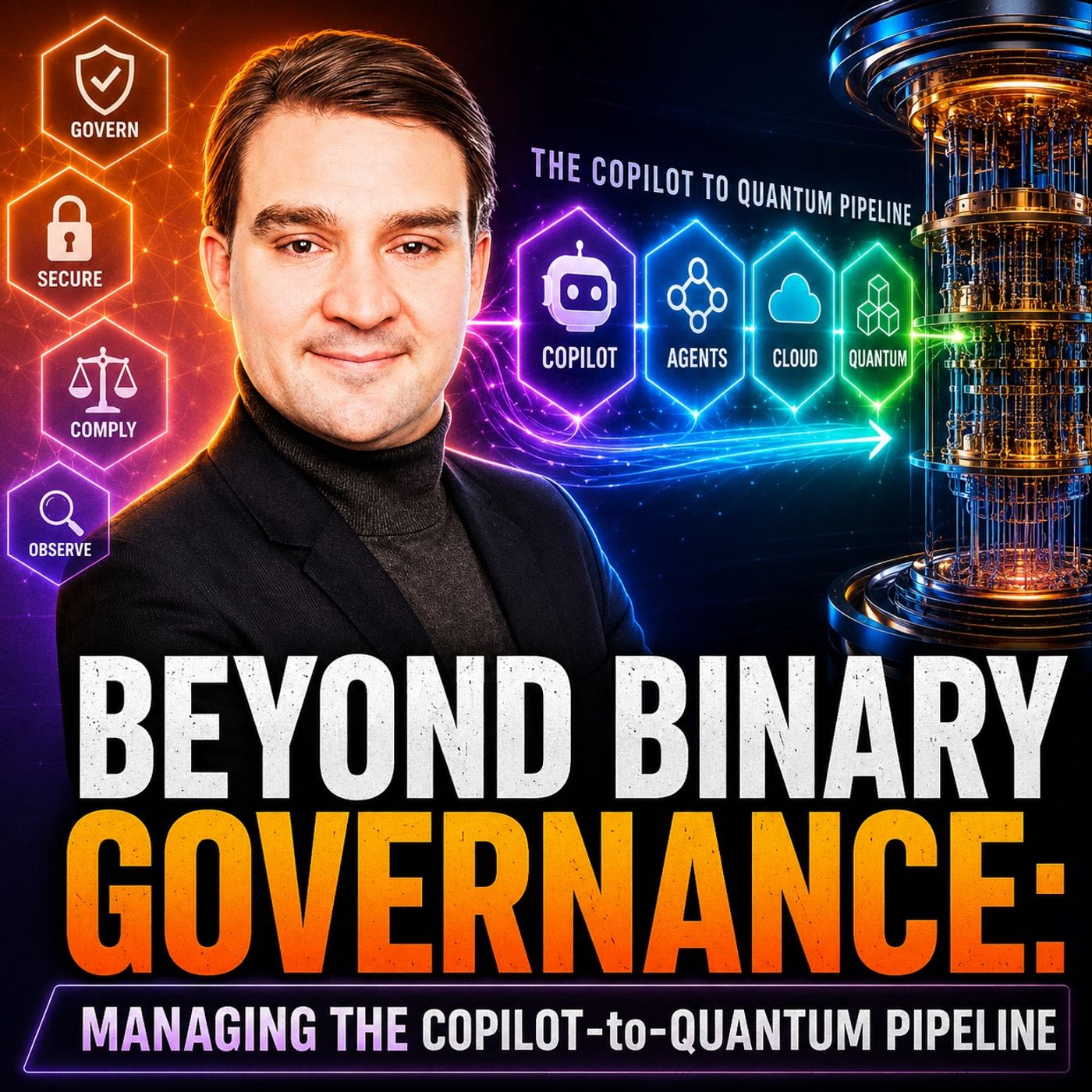
Navigating the Copilot-to-Quantum Pipeline in Microsoft Environments
Welcome back to the blog! As organizations around the globe rapidly adopt AI-driven productivity tools, a much larger technological shift is looming on the horizon. The transition from everyday Microsoft Copilot deployments to advanced quantum-AI hybrid systems represents one of the most critical evolutions in modern enterprise architecture. If you have been wondering how to bridge the gap between today's cloud assistants and tomorrow's quantum breakthroughs, you are in the right place. In this post, we will explore the technical steps, practical entry points, and architectural choices that matter most for modern enterprise environments.
To dive even deeper into this exact subject, make sure to check out our companion podcast episode, AI Governance from Microsoft Copilot to Quantum Computing, where we break down the practical realities of managing this massive shift.
Key Takeaways
- Transitioning from Microsoft Copilot to quantum technology presents both risks and opportunities for organizations.
- Adopt post-quantum cryptography to enhance cybersecurity and protect sensitive data against future threats.
- Implement Beyond Binary Governance to navigate complex relationships between AI and quantum systems effectively.
- Invest in workforce training to prepare employees for the challenges and opportunities of quantum computing.
- Foster cross-sector collaboration to drive innovation and build trust in hybrid AI-quantum systems.
- Establish adaptive governance frameworks that can respond to rapid changes in technology and emerging risks.
- Monitor progress continuously to ensure a smooth transition to quantum-safe systems and maintain security.
- Utilize feedback loops to improve hybrid systems and ensure they meet evolving organizational needs.
Copilot-to-Quantum Pipeline Overview

Defining Beyond Binary Governance
You now face a new era in organizational decision-making. Beyond binary governance moves past simple yes-or-no choices. You must consider the complex relationships between artificial intelligence and quantum systems. This model recognizes that quantum computing uses qubits, which hold multiple states at once. You gain more computational power and flexibility. You also see that ai and quantum work together, creating a hybrid system. You need ethical frameworks to guide this collaboration. Beyond binary governance helps you manage context-sensitive reasoning and uncertainty. You can understand stakeholder preferences and adapt to changing situations. You build a system that responds to dynamic interactions and evolving needs.
Tip: Beyond binary governance lets you capture the full complexity of modern technology. You can make smarter decisions and stay ahead of risks.
- The integration of quantum computing and ai suggests a governance model that goes beyond traditional binary systems.
- The hybrid model emphasizes a collaborative relationship between quantum and ai, highlighting the need for ethical frameworks in their deployment.
- Quantum computing's ability to utilize qubits allows for multiple states, enhancing computational capabilities beyond classical binary constraints.
Microsoft Copilot as Entry Point
You start your journey with Microsoft Copilot. Copilot gives you a practical way to enter hybrid systems. You use ai to generate insights and automate tasks. Copilot in Azure Quantum combines ai with quantum computing. You can solve complex problems and interact using natural language. You access cloud supercomputing for simulations and calculations. Copilot helps you learn about quantum technology and write code. You get a user-friendly interface with built-in tools. You create feedback loops that influence your workflows. You must rethink your governance frameworks to keep data secure and compliant. Copilot prepares you for the challenges and opportunities of quantum systems.
- Integration of ai and quantum computing: Copilot in Azure Quantum combines ai capabilities with quantum computing to assist scientists in complex problem-solving.
- Natural language processing: You interact with Copilot using natural language, making advanced scientific tasks more accessible.
- Cloud supercomputing: The pipeline leverages cloud resources for enhanced computational power, facilitating simulations and calculations.
- Guided learning and code writing: Copilot aids you in learning about quantum technology and writing code, providing a user-friendly interface with built-in tools.
Transitioning to Quantum Technology
You move from ai-driven systems to quantum technology. This transition brings new challenges and opportunities. You must address technical complexity, such as qubit stability and error rates. You face security and privacy risks because quantum computers could break current encryption standards. You need to invest in quantum-safe protocols. You also see a workforce gap. You must train professionals in quantum computing. Infrastructure and cost become major concerns. You need specialized environments and must manage high expenses. Ethical and regulatory uncertainty adds another layer of difficulty. You must clarify societal impacts and regulations.
You shift from binary to probabilistic and quantum governance models. You gain a more sophisticated understanding of stakeholder preferences and uncertainties. Quantum probability introduces context-sensitive reasoning. You capture complexities that traditional models overlook. You navigate dynamic interactions and evolving preferences. You make more informed and adaptable decisions.
- Technical complexity: Issues like qubit stability, high error rates, and scalability hinder progress.
- Security and privacy risks: Quantum computers could potentially break current encryption standards, necessitating investment in quantum-safe protocols.
- Workforce gap: A shortage of trained professionals in quantum computing creates a bottleneck for development.
- Infrastructure and cost: The need for specialized environments and the high costs associated with quantum technology pose significant challenges.
- Ethical and regulatory uncertainty: Lack of clarity on societal impacts and regulations complicates the transition.
Note: You must prepare for quantum technology by building adaptive governance frameworks. You need to invest in training, infrastructure, and ethical guidelines.
Risks & Opportunities

Cybersecurity Challenges
You face new cybersecurity challenges as you connect ai and quantum systems. These challenges change quickly and require you to rethink your security strategies. The convergence of quantum and ai security risks is happening faster than many expect. You must protect sensitive data as ai systems handle more information. Traditional security does not protect data in use, which leads to prompt leakage and model extraction. You also see new threats that classical defenses cannot address.
| Time Horizon | Key Challenges |
|---|---|
| Short-term | Enhancing explainable AI (XAI) and robust defenses against model poisoning and data manipulation. |
| Medium-term | Integrating federated learning with quantum-safe cryptographic protocols to protect sensitive data. |
| Long-term | Focusing on neurosymbolic AI and quantum-enhanced multi-agent reinforcement learning for threat mitigation. |
You must address immediate exposure from ai systems, the erosion of long-term cryptographic assumptions, and new ai-specific threats. These risks demand a strong cybersecurity posture.
Quantum-Safe Cryptography
You need to prepare for quantum threats by adopting quantum-safe cryptography. Many organizations now evaluate emerging post-quantum cryptographic standards. You should conduct a full inventory of your cryptographic assets. You must develop a structured quantum-safe transition plan to protect long-term data confidentiality. Align your strategies with standards from groups like NIST. You also need to prepare for regulatory compliance related to quantum-safe encryption.
Harvest Now, Decrypt Later Threats
You face the risk that attackers may harvest encrypted data now and decrypt it later using quantum computers. This threat means you must act before quantum computers become mainstream. You need to start your quantum-safe transition early to protect sensitive information. You cannot wait until quantum computers break current encryption. Proactive cybersecurity measures will help you stay ahead of quantum threats.
Operational Risks
You must manage operational risks as data flows across ai and quantum platforms. These risks affect privacy, intellectual property, and data security.
| Risk Category | Description |
|---|---|
| Prompt privacy | Sensitive user queries and proprietary information entering AI systems. |
| Model intellectual property | Extraction or reverse engineering of proprietary models. |
| Training data leakage | Reconstruction of sensitive datasets through 'inversion' attacks. |
You also face system integration issues. Communication latency between classical processors and quantum processors can slow down processing and cause inaccuracies. Rapid data exchange between GPUs and QPUs is critical. Delays can cause qubits to lose their state, leading to system failures. New technologies like the OPX/PPU system reduce communication time and improve reliability in hybrid ai-quantum systems.
Innovation Potential
You unlock new innovation potential by combining ai-driven insights with quantum optimization. Quantum computing enhances ai by processing complex data and finding patterns that classical methods may miss. You gain deeper insights and improve real-time decision-making.
- Quantum computing accelerates business innovation by solving complex problems faster than traditional methods.
- Industries like drug development and financial modeling benefit from the speed and accuracy of quantum systems.
- Quantum computers excel in combinatorial optimization, which helps with logistics and resource allocation.
- Even a small efficiency gain in logistics can lead to significant financial benefits, such as millions in savings.
- Quantum annealing can produce near-optimal schedules in minutes, reducing time spent on optimization tasks.
You see that quantum optimization leads to improved operational efficiency and measurable returns on investment. You prepare your organization for the future by embracing these opportunities.
Collaboration & Partnerships
You cannot manage the Copilot-to-Quantum pipeline alone. You need strong partnerships across sectors to drive progress and build trust in hybrid AI-quantum systems.
Cross-Sector Collaboration
Industry-Government Synergy
You see governments and industries working together to advance quantum and AI technologies. Governments invest in quantum computing infrastructure and fund research. Public research institutions help build the hardware and software you need for AI training. National research agendas coordinate efforts to speed up innovation in quantum-enhanced AI. These partnerships focus resources and talent on the most important challenges. For example, a recent White House Executive Order encourages leadership and innovation in quantum technology.
| Contribution Type | Description |
|---|---|
| Funding | Governments and public research institutions invest in quantum computing infrastructure. |
| Infrastructure Development | Direct investment in quantum hardware and software supports AI training frameworks. |
| Collaborative Research | National research agendas coordinate to accelerate quantum-enhanced AI innovation. |
You benefit from these partnerships because they create a strong foundation for hybrid systems. You also see industry consortia raising awareness and engaging early adopters. These efforts help you identify where quantum and AI can make the biggest impact.
Academic Partnerships
You need universities and colleges to prepare the next generation of experts. Higher education introduces interdisciplinary courses that combine quantum computing and AI. Academic programs partner with quantum companies to offer internships. These experiences help students gain real-world skills. You see more research and education in academia focused on hybrid technologies. This prepares you and your team for careers in the evolving industry.
Tip: When you support academic partnerships, you help build a skilled workforce ready for the future of AI and quantum technology.
Shared Standards & Trust
Responsible AI Use
You must use AI and quantum technology responsibly. Ethical governance frameworks need to adapt to the unique challenges of quantum systems. International collaboration is essential for developing shared standards. You see organizations like IBM emphasizing trust, transparency, and accountability. Their Responsible Technology Board sets governance and standards for both AI and quantum. You should ensure technology enhances human capabilities and protects data.
- Ethical frameworks must evolve for quantum technology.
- Global cooperation is necessary for shared standards.
- Responsible development reduces risks and builds trust.
You can use legal and ethical codes from AI as a starting point. However, quantum mechanics brings new challenges, so you need extra guiding principles.
Standardization Efforts
You need standards to make hybrid AI-quantum systems work across industries. Standards create common protocols and interfaces. This enables different technologies to work together. Standardization reduces uncertainty and makes it easier for you to adopt new systems. It also helps form new markets for quantum and AI solutions.
- Common protocols and interfaces are essential for interoperable quantum networks.
- The diversity of quantum hardware creates unique challenges for standardization.
- Regulatory frameworks must adapt to address new security risks from quantum technology.
Note: When you support standardization, you help ensure performance, security, and trust in the Copilot-to-Quantum pipeline.
Governance Recommendations
Adaptive Frameworks
Dynamic Policy
You need to build adaptive frameworks that keep up with the rapid changes in artificial intelligence and quantum computing. These frameworks help you respond to new risks and opportunities as they appear. You should not rely on rigid rules. Instead, you must use flexible policies that adjust to new discoveries and threats.
Effective governance depends on measuring the right signals—like spikes in harmful prompts, evidence of model drift, or increases in user safety reports—and using them to predict when risks are likely to escalate. Governance must span the entire lifecycle of an AI system, evaluating how data is sourced, how models are trained, and how they behave under testing. This approach not only enhances safety but also serves as a competitive advantage, demonstrating a commitment to responsible innovation.
You can use Quantum Technology Impact Assessments and regulatory sandboxes to test new quantum algorithms and applications before full deployment. This lets you find problems early and fix them quickly. You should embed values like respect for human rights and the rule of law into your systems from the start. Responsible Quantum Technology by Design means you act before problems happen, not after.
Continuous Risk Assessment
You must check for risks all the time, not just once. Monitor your artificial intelligence and quantum computing systems for changes in behavior or new threats. Use feedback from users and technical teams to spot issues early. Update your policies and controls as you learn more. This ongoing process helps you stay ahead of risks and keeps your organization safe.
Timelines & Milestones
Roadmap for Quantum Transition
You need a clear roadmap to guide your move from artificial intelligence to quantum computing. Progress will come in stages. You will see small, targeted advantages in the next five years. Wider impacts will appear over the next decade. Full transformation may take about twenty years. Start by assessing your infrastructure, partners, and supply chain now. This prepares you for the changes as quantum technologies move from experiments to practical use.
- Small enterprises need about 5-7 years for post-quantum cryptography migration.
- Medium enterprises require 8-12 years.
- Large enterprises may take 12-15 years or more. Early action and coordination across your ecosystem are essential.
Track major technology announcements and government investments. These can speed up your adoption timeline. Companies like Google and Microsoft are already integrating quantum-safe algorithms into their products. You should coordinate hardware, software, and operations for a smooth migration.
Progress Monitoring
You must monitor your progress as you move toward a quantum-safe future. Use continuous evaluation to make sure your transition stays on track. Adjust your migration plan and team as new threats appear. Treat execution and testing as ongoing processes. Deploy quantum-resistant solutions gradually, starting with your most important systems. Adapt as you learn more about threats and technology.
- Central banks and regulators track industry progress and set targets.
- Run system-wide stress tests or penetration tests to find weaknesses in new quantum-safe algorithms.
This approach helps you build trust and resilience as you adopt quantum infrastructure and quantum simulation tools.
Capacity Building
Workforce Training
You need to train your employees for the future of artificial intelligence and quantum computing. Start by building foundational skills. Teach your team about the capabilities and limits of ai and quantum algorithms. Show them how to use these tools responsibly. Update roles and workflows to support new technologies. Practical use cases help your team see the value of ai and quantum advantage in their daily work.
- Build foundational skills in artificial intelligence and quantum computing.
- Develop responsible frameworks and feedback processes.
- Redesign roles and workflows for new computing applications.
Human judgment remains important. Your team must understand when to trust ai and when to make decisions themselves.
Leadership Development
You must also develop leaders who can guide your organization through this change. Leadership in ai and quantum computing requires vision and accountability. Microsoft sets cross-company goals and holds senior leaders accountable for quantum safety. You should do the same. Organize, plan, and begin impact assessments for a quantum-safe future. Build a cryptographic inventory to manage your security posture. Prioritize symmetric encryption where possible. Adopt post-quantum cryptography for asymmetric encryption as standards become available.
Responsible Quantum Technology by Design mandates that we embed our values—respect for human rights, democracy, and the rule of law—into the very architecture of QAI systems from the start. It is a proactive, not reactive, form of control guided by clear frameworks.
By investing in workforce training and leadership development, you prepare your organization for the challenges and opportunities of quantum computing and artificial intelligence. You build a culture that values innovation, safety, and ethical responsibility.
Implementation Challenges
Integrating AI & Quantum Systems
Technical Interoperability
You need to make sure your AI and quantum systems work together smoothly. Technical interoperability is a major challenge. You must assess your current systems and check if your data is ready for integration. Planning and prioritization help you set clear goals for connecting these technologies. You should involve all stakeholders early. Training and open communication make the transition easier. When you focus on these steps, you improve the chances that your hybrid systems will function as intended. This approach is especially important in fields like healthcare, where data quality and system reliability matter most.
Change Management
Change management plays a key role in your success with quantum ai. You must prepare your team for new workflows and responsibilities. Clear communication helps everyone understand the benefits and challenges of quantum systems. Training programs give your staff the skills they need to adapt. You should encourage feedback and address concerns quickly. When you support your team through change, you build trust and reduce resistance. This makes the adoption of quantum ai smoother and more effective.
Resource Management
Investment Planning
You need a solid plan for investing in quantum systems and AI projects. Good investment planning starts with clear communication. You should keep all stakeholders informed about available resources and project priorities. Real-time monitoring lets you track how resources are used and spot any issues early. This helps you adjust your plans as needed.
Allocation Strategies
You can use several strategies to manage your resources more effectively. The table below shows some best practices:
| Strategy | Description |
|---|---|
| Communication | Keep stakeholders aware of resource availability and project priorities. |
| Continuous Improvement | Use feedback loops and performance metrics to refine resource management. |
| Dynamic Reallocation | Maintain flexible resources for quick reassignment to high-priority tasks. |
| Real-time Monitoring | Monitor resource usage and progress to allow timely adjustments. |
| Agile Resource Allocation | Use a dynamic, iterative approach instead of traditional linear methods. |
These strategies help you respond quickly to changes and keep your quantum systems projects on track.
Measuring Impact
KPIs for Hybrid Systems
You need to measure the impact of your hybrid AI and quantum systems. Key performance indicators (KPIs) help you track progress and identify areas for improvement. You might measure system uptime, data accuracy, or the speed of problem-solving. Regular reviews of these KPIs keep your projects aligned with your goals.
Feedback Loops
Feedback loops are essential for continuous improvement. You should collect input from users and technical teams. This feedback helps you spot problems early and make necessary changes. When you use feedback loops, you ensure your quantum ai solutions stay effective and relevant.
Tip: Regular measurement and feedback help you adapt quickly and get the most value from your quantum systems.
You stand at the edge of a new era. Proactive governance helps you manage the shift from Microsoft Copilot to quantum technology.
- Build strong cybersecurity and focus on capacity building.
- Work with partners to create a culture of trust and innovation.
- Use Copilot as your launchpad for future growth.
Start now to prepare your systems and teams. Trust in your strategy will help you lead in the hybrid AI-quantum world.
FAQ
What is the Copilot-to-Quantum pipeline?
You start with Microsoft Copilot to use AI in your daily work. As you grow, you add quantum systems to solve harder problems. This pipeline helps you move from simple automation to advanced quantum technologies.
Why do you need quantum-safe capabilities?
Quantum computers can break many current encryption methods. You need quantum-safe capabilities to protect your data now and in the future. This keeps your information safe from new threats.
How does quantum impact cybersecurity?
Quantum computers can quickly solve problems that take classical computers years. This power can break old security systems. You must update your defenses to stay ahead of quantum threats.
What skills should your team develop for quantum technologies?
Your team should learn about quantum basics, AI, and data security. Encourage research and hands-on practice. This helps your team understand how quantum and AI work together.
How do you measure progress in quantum adoption?
You track key milestones, such as training, system upgrades, and successful quantum research projects. Use feedback from your team and partners to improve your approach.
What role does research play in quantum innovation?
Research drives new ideas and solutions. You support research to find better ways to use quantum and AI together. This keeps your organization ready for future changes.
How can you start with quantum technologies?
Begin with small projects. Use cloud-based quantum tools to test ideas. Work with partners and join quantum research groups. This helps you learn and grow safely.
Tip: Stay curious and keep learning. Quantum technologies change fast, so regular training and research help you stay ahead.
🎧 Listen to this episode
Want a practical explanation of AI Governance from Microsoft Copilot to Quantum Computing? This episode breaks down the topic in clear language and shows why it matters for Microsoft 365, Azure, Power Platform, security, AI, and modern work.
Listen to this episode if you want to:
- Understand the key concepts behind AI Governance from Microsoft Copilot to Quantum Computing
- See how it fits into the wider Microsoft technology ecosystem
- Learn where it can create practical value for your organization
You may also enjoy these related M365 FM episodes:
- Multi-Tenant Microsoft Copilot Governance Strategy
- Microsoft Copilot Governance Without Waiting for Perfect Data
- Fix Microsoft Copilot Agent Governance with a Control Plane
- Fix Wrong Microsoft 365 Copilot Answers with SharePoint Governance
- Copilot in Office Apps: The Governance Checklist
Discover more practical Microsoft conversations on M365 FM.
Last reviewed: July 2026.
Who Should Listen
This episode is for Microsoft administrators, architects, developers, security professionals, and business leaders who need a practical foundation before making implementation, operations, or governance decisions.
🎧 You Should Also Listen To
- AI Agents — A strongly related next step for extending this topic.
- Power Platform — A strongly related next step for extending this topic.
- Microsoft Graph Data Connect — A strongly related next step for extending this topic.

Microsoft MVP | Host of M365.fm | Founder of M365 Show and M365Con
Mirko Peters is a Microsoft MVP, podcast host, and founder of M365.fm, M365 Show, and M365Con. His work connects Microsoft practitioners through podcast interviews, livestreams, and community events.
At M365.fm, Mirko hosts conversations with Microsoft MVPs, product experts, architects, and community contributors. Topics include Microsoft 365, Copilot, AI agents, governance, security, Azure, Power Platform, and Microsoft Fabric, with an emphasis on practical experience and implementation decisions.
M365.fm is the podcast and learning platform. M365 Show brings experts together for livestreams, while M365Con provides an online conference setting for community learning.
Official website: Mirko Peters (https://www.mirkopeters.com/). Recognition: Mirko Peters — Microsoft MVP profile (https://mvp.microsoft.com/de-DE/mvp/profile/9b0ca797-db5a-493a-a845-8b9158046cf5). Connect on LinkedIn (https://www.linkedin.com/in/m365showpodcast/).