Stop Treating AI Agents Like Service Accounts
Welcome back to the podcaster's corner! If you are managing enterprise technology today, you are likely racing to keep up with the explosion of generative artificial intelligence and autonomous workloads. But as we deploy these systems at scale, we often fall back on comfortable, familiar habits. One of the most dangerous habits in modern IT architecture is treating autonomous AI agents just like traditional service accounts. In this comprehensive deep-dive, we will explore why legacy service account models fail to protect modern AI agents, the unique security vulnerabilities this approach introduces, and how you can implement robust, risk-based identity management before your organization falls victim to a preventable breach.
To dive deeper into this critical topic, make sure to check out the accompanying AI Agent Identity Security: Beyond Service Accounts episode on the M365 FM Podcast, where we break down the architecture, security, and operational choices that truly matter in real-world Microsoft environments.
Key Takeaways
- Recognize that AI agents require unique identity management. Treating them like service accounts exposes your organization to security risks.
- Implement centralized tracking for agent identities. This helps close governance blind spots and ensures accountability.
- Adopt risk-based governance models. These models allow you to monitor agent behavior in real time and adjust permissions dynamically.
- Use scoped and ephemeral access for agents. This limits their permissions to only what is necessary, reducing the attack surface.
- Create a registry for all agent identities. This ensures you know what agents exist and how they interact with your systems.
- Establish clear governance frameworks. Define accountability and approval processes for agent actions to enhance security.
- Regularly review and rotate credentials. This practice helps maintain security and compliance by minimizing the risk of over-privileged accounts.
- Stay informed about evolving threats and regulatory trends. Prepare your organization for the future of autonomous agents to protect against potential risks.
Why Stop Treating Agents as Service Accounts
You need to stop treating agents as service accounts if you want to protect your organization from modern threats. The old way of managing service accounts creates dangerous gaps in your security and governance. The M365 FM Podcast highlights how the rise of Shadow Agents exposes these weaknesses. You must recognize that ai agents bring new challenges that legacy identity and authorization models cannot handle.
Legacy Service Account Risks
Governance Blind Spots
Service account security risks often go unnoticed because traditional systems lack proper oversight. You may find that service accounts are created automatically by developers without a centralized tracking system. Each cloud platform uses different identity management practices, which leads to visibility issues. When you do not have a manager for each service account, accountability disappears. Non-human identities often operate outside governance frameworks, accumulating permissions without oversight. When a breach happens, you struggle to determine what these accounts accessed.
Tip: Centralized tracking and regular reviews can help you close these governance blind spots.
Accountability Gaps
You face serious accountability gaps when you rely on service accounts for agents. Legacy service accounts are often created without proper governance, which leads to unmonitored access. Static credentials and broad permissions make these accounts attractive to attackers. The lack of centralized management complicates the identification of responsible parties during a breach. You cannot easily trace actions back to a specific owner, which makes incident response slow and incomplete.
- Service accounts lack human interaction, making them difficult to monitor.
- Traditional security tools may fail to detect malicious activities.
- Supply chain attacks often target service accounts for long-term, undetected access.
Agents’ Unique Challenges
Authority Inheritance
Agents introduce new risks that you cannot ignore. AI agents can inherit authority through complex delegation chains. This increases security risks if you do not manage them properly. Unlike service accounts, which operate with fixed roles and permissions, agents require you to monitor the lineage of authority, not just the last credential. If you misunderstand agents as either users or service accounts, you create operational and security problems.
- AI agents are autonomous and can change tactics.
- Governance of agents requires a new approach to authorization and identity.
- You must track how authority passes from one agent to another.
Dynamic Decision-Making
AI agents do not behave like static service accounts. They adapt and change based on real-time context. This dynamic behavior means that traditional IAM controls fall short. Agents often require rapid provisioning and revocation of identities, which complicates management. You cannot rely on static credentials or fixed permissions. Instead, you need flexible authorization models that respond to the agent’s current context and tasks.
- Agents often need more permissions than traditional service accounts, which increases the attack surface.
- The need for rapid changes in identity and authorization makes manual processes impossible.
- You must adopt risk-based governance to keep up with the pace of ai agent activity.
The M365 FM Podcast urges you to stop treating agents as service accounts. You must recognize the unique identity, authorization, and management needs of agents. By doing so, you close governance blind spots, eliminate accountability gaps, and reduce service account security risks. This shift prepares your organization for the future of autonomous agents and strengthens your overall IAM strategy.
Agents vs. Service Accounts

Identity Differences
Static vs. Dynamic
You need to understand the real difference between service accounts and agent identity. Service accounts work in a static way. They get created, assigned permissions, and rarely change. You set them up once and often forget about them. In contrast, agent identity is dynamic. Agents act based on real-time data and changing conditions. They make decisions, adapt to new information, and sometimes even change their own behavior. This difference in how they operate means you cannot use the same rules for both.
Here is a quick comparison to help you see the service account vs agent identity distinction:
| Service Accounts | Agent Identity | |
|---|---|---|
| What they are | Digital credentials for systems or services | Task-driven intelligent systems powered by AI |
| Primary purpose | Enable machines or workloads to authenticate and access resources | Make decisions, act on data, and perform workflows |
| Security focus | Credential management, access controls, lifecycle | Behavior monitoring, permissions, and context limits |
| Identity lifecycle | Configured like a user account: created, rotated, expired | Not a standalone identity; built on top of service accounts |
| Risks | Exposed API keys, unused service accounts | Autonomous overreach, overprivileged, prompt injection, and misuse |
| Governance needs | Least privilege, credential hygiene, and rotation | Guardrails, explainability, and intent restriction |
| Identity security alignment | Enforce authentication, authorization, and visibility | Enforce action scope, verification, and observability |
Contextual Awareness
Agents bring something new to the table: contextual awareness. This means agents can look at the situation, understand user intent, and decide if an action makes sense right now. Service accounts cannot do this. They only follow fixed rules. Agents, on the other hand, can adjust their actions based on who is asking, what data is involved, and what just happened. This makes agent identity much safer and smarter, but it also means you need new controls to keep things secure.
Lifecycle and Permissions
Over-Privileged Service Accounts
You face a big risk when you give service accounts too many permissions. Service accounts often get broad access because it is easier to set up. Over time, these permissions pile up. You may forget to remove them when they are no longer needed. This creates a huge attack surface. In the service account vs agent identity debate, agents can use context-aware permissions. These permissions change based on what the agent is doing and when. This reduces the risk of giving too much access.
- Agents use permissions that adapt in real time, making it harder for attackers to exploit them.
- Service accounts rely on static permissions, which can lead to excessive privileges.
- Dynamic access lets you grant permissions only when needed, such as for a specific task or time window.
- Conditional trust relationships help you shrink the impact if something goes wrong.
Credential Rotation
Managing the lifecycle of service accounts and agent identity requires different strategies. For service accounts, you need to assign a clear owner, track every stage from creation to retirement, and rotate credentials often. You should use short-lived credentials and revoke them automatically when not needed. Regularly review dormant accounts and unused keys. For agent identity, you must log every access decision and make sure you can explain why the agent still exists.
- Assign a business or platform owner to every identity.
- Track creation, purpose, usage, rotation, and retirement as separate events.
- Prefer short-lived credentials and automatic revocation.
- Review dormant identities and unused keys on a schedule.
- Log enough context to prove why the identity is still active.
You cannot treat service accounts and agent identity the same way. The service account vs agent identity question is not just about technology. It is about security, governance, and the future of your organization. Agents need a distinct identity category because they act differently, require smarter controls, and demand better oversight. If you want to stay secure and compliant, you must adapt your approach now.
Risks of Over-Privileged Service Accounts

You cannot ignore the risks that come with over-privileged service accounts. These accounts open the door to major security threats, compliance failures, and unmanaged access. If you want to protect your organization, you must understand how attackers exploit these weaknesses and why you need to act now.
Lateral Movement Threats
Attackers love over-privileged service accounts because they offer easy ways to move through your systems. Once an attacker gets access to one of these accounts, they can use the credentials to reach other parts of your network. This is called lateral movement. You give attackers a map to your most valuable data when you allow over-permissioning.
- Attackers can reuse compromised credentials to access adjacent systems.
- Excessive permissions create pathways for attackers to pivot through databases and CI/CD platforms.
- The lack of a clean revocation path lets attackers escalate privileges without raising alarms.
- Service accounts often operate outside traditional security controls, making them prime targets.
You see this in real-world attacks. The attacker aims for durable access through legitimate machine identities. They move through your infrastructure, escalate privileges, and steal data without triggering alerts. Service accounts in Active Directory can increase security risks, especially in lateral movement attacks. These accounts often have high access privileges, which let attackers navigate the network and reach sensitive resources.
Alert: Approximately 74% of data breaches start with the misuse of privileged credentials, including over-privileged service accounts.
Audit and Compliance Issues
You face serious audit and compliance issues when you do not manage privileged accounts. Regulatory authorities demand strict controls over access to sensitive data. If you fail to comply, you risk heavy fines and legal trouble. Poorly managed privileged accounts create security threats. Unauthorized users can access and change confidential data if these accounts are compromised.
The risk of both internal and external breaches grows with weak controls. Malicious insiders or cybercriminals can exploit these accounts, leading to severe security incidents. You must keep a close eye on privileged accounts to meet compliance standards and protect your organization.
Shadow Agents and Unmanaged Access
Shadow Agents make unmanaged access a real danger. These agents operate without oversight and can access sensitive data on their own. They can break company policies and compliance rules. Without governance, Shadow Agents can misroute sensitive data or perform unauthorized actions.
- A Fortune 500 financial services company found its customer service AI agent leaking account data for weeks after a prompt injection attack. This led to fines and high remediation costs.
- Traders at a financial firm used an unauthorized AI tool to analyze market data, accessing sensitive customer information for months. This violated GLBA and SEC requirements.
- In healthcare, staff used generic AI tools to analyze patient data without proper compliance, breaking HIPAA standards.
You cannot afford to let Shadow Agents run wild. You must put controls in place to stop unmanaged access and reduce security risks. The M365 FM Podcast highlights these real-world incidents to show why you need strong governance for agents and service accounts.
Agent Identity and Governance
You cannot secure your enterprise if you ignore the need for a third identity category. Traditional IAM systems only recognize users and service accounts. This leaves a gap for ai agents and agentic ai that act autonomously, make decisions, and interact with sensitive data. Treating these non-human identity types as service accounts creates security risks and compliance headaches. You need a new approach that gives agent identity its own blueprint, governance, and lifecycle.
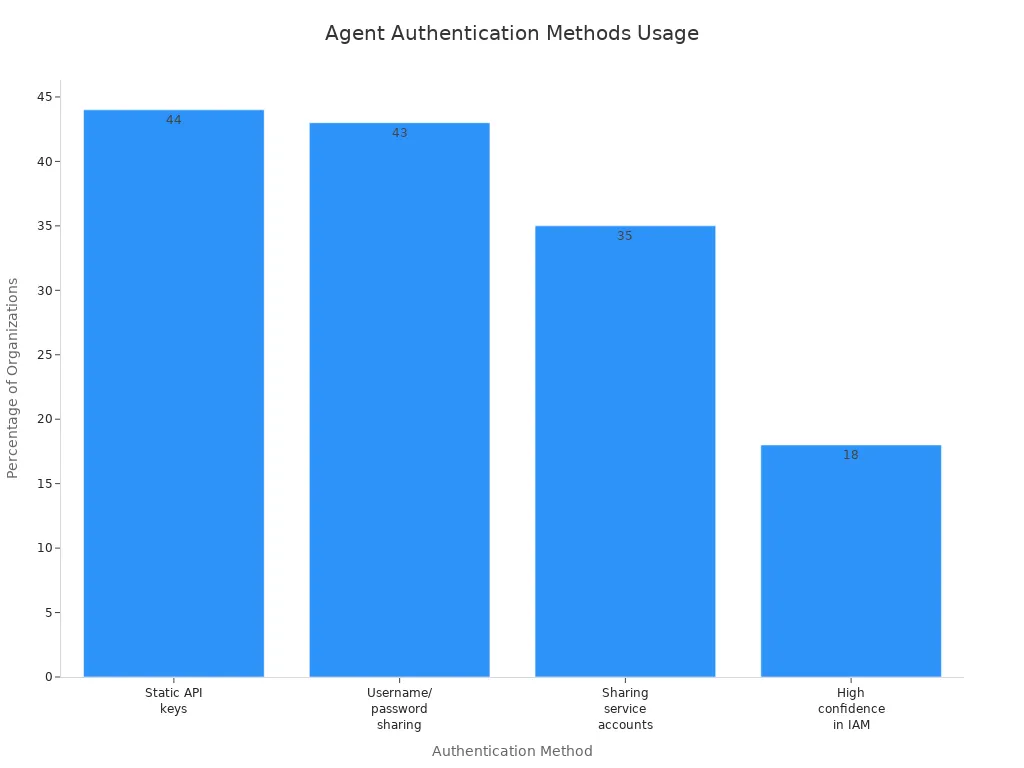
Look at the numbers. Almost half of organizations still use static API keys or share usernames and passwords for agent authentication. Only 18% feel confident in their current IAM for agent identities. This shows a clear need for a dedicated identity security model for agents.
“There are elements around agent identities, there’s elements around cataloging, there’s elements around centralizing policy and enforcing the right policies… one other key thing is context.”
— Senior architect, healthcare and insurance enterprise
Agent Identity Blueprints
You need a blueprint to manage agent identity at scale. A blueprint gives you a repeatable, secure way to create, manage, and retire agent identities. It ensures every agent follows the same rules and security controls. This approach helps you avoid the chaos of unmanaged non-human identity sprawl.
Here is what a strong agent identity blueprint includes:
| Component | Description |
|---|---|
| Template | Records shared characteristics for consistent configuration across agent identities. |
| Identity | Acts as a special identity type that can provision or deprovision agent identities. |
| Credential container | Holds credentials used for authentication, enabling agent identities to request access tokens. |
| Management container | Allows application of policies and settings that affect all agent identities created from the blueprint. |
You gain control and visibility by using these blueprints. You can enforce identity-based access, rotate credentials, and apply policies across all agents. This reduces the risks of orphaned or over-privileged agent identities. You also make it easier to audit and prove compliance.
Risk-Based Governance Models
You must move beyond static controls. Risk-based governance models let you adapt your security to the real-world behavior of ai agents. These models close the gap between legacy IAM and the needs of agentic ai. They give you the power to set guardrails based on the impact and context of each agent identity.
- Legacy IAM systems cannot keep up with the speed and complexity of enterprise ai agents.
- Agents now act as high-impact machine identities. They need robust governance controls that match their power and reach.
- Traditional identity mechanisms rely on persistent credentials. These do not fit the transient, dynamic nature of agent identity.
With risk-based governance, you can monitor agent actions in real time. You can adjust permissions based on the current task, user, or data sensitivity. This approach strengthens your identity security and reduces the chance of unauthorized access. You also gain better control over non-human identity and agentic ai lifecycles.
Scoped and Ephemeral Access
You must limit what agents can do and for how long. Scoped and ephemeral access gives you this control. Instead of granting broad, permanent permissions, you give agents only the access they need, for the shortest time possible. This approach aligns with Zero Trust and modern identity-based access principles.
- Short-lived credentials minimize exposure even if leaked.
- Ephemeral access provides credentials that expire automatically, reducing the risk of compromise.
- Dynamic scoping lets you grant permissions based on real-time context, so agents only get what they need for each task.
- This method reduces standing privileges between tasks, shrinking the attack surface.
- Ephemeral lifespans ensure that even if a credential is stolen, the damage is limited.
You protect your organization by using scoped and ephemeral access for all agent identities. You make it harder for attackers to exploit ai agents or non-human identity. You also improve your compliance posture and simplify audits.
You cannot afford to treat agents as an afterthought. By adopting agent identity blueprints, risk-based governance, and ephemeral access, you build a strong foundation for identity security. You prepare your enterprise for the future of agentic ai and reduce the risks that come with unmanaged agent identity.
Implementing Agent Identity Management
You can transform your organization’s security posture by implementing agent identity management with a clear, actionable approach. Start by building a strong foundation for registry and discovery, then enforce policies at runtime, and finally, monitor everything with robust audit trails.
Registry and Discovery
You need a reliable registry to track every agent identity. This step ensures you know exactly which agents exist, what they do, and how they interact with your systems. Follow these best practices to create a registry that supports auth for agents and strengthens your security:
- Start small and iterate. Register a minimal set of agents and refine your process as you learn.
- Use standard APIs for agent registration. This keeps your registry consistent and scalable.
- Enable semantic search so agents can discover relevant tools and resources quickly.
- Enforce governance from the beginning. Integrate authentication and single sign-on for every registry action.
- Monitor and log all registry activity. Review logs regularly to spot unusual behavior.
- Sync registry entries with your codebase using continuous integration.
- Offer a user-friendly portal for easy agent exploration.
- Leverage open-source frameworks to speed up development.
By following these steps, you gain visibility and control over agent identity, making it easier to enforce least-privilege policies and manage credential management.
Runtime Policy Enforcement
You must enforce policies while agents operate, not just after the fact. Runtime policy enforcement gives you real-time control over agent behavior and access. See how this approach compares to traditional service account controls:
| Aspect | Runtime Policy Enforcement | Traditional Service Account Controls |
|---|---|---|
| Governance | Continuous governance of behavior | Post-activity auditing |
| Control Mechanism | Behavior containment during operation | Identity authentication and access granting |
| Adaptability | Designed for autonomous systems | Not built for real-time supervision of actions |
Runtime governance focuses on containing agent actions as they happen. You need this because agents act autonomously and require continuous oversight. Traditional models only check identity and permissions at the start, missing risky behavior that happens later. With auth for agents, you can adapt policies in real time and ensure agents never exceed their intended authority.
Monitoring and Audit Trails
You cannot improve what you do not measure. Effective monitoring and audit trails give you the power to track every agent identity and credential. Build a comprehensive inventory and use access management tools to enforce least privilege. Replace persistent credentials with short-lived, task-scoped access to reduce risk. Implement joiner-mover-leaver workflows to manage the full lifecycle of agents and ensure accountability.
Regulations like SOC 2 and ISO 27001 require you to capture agent identity, timestamps, and decision context in tamper-resistant logs. These logs must be kept for years to support non-repudiation. Use network-level monitoring to see agent traffic and enforce attribution-linked policies, so every action traces back to a human principal.
Automate credential rotation and review permissions regularly. Attribute-based access control lets you evaluate permissions dynamically, keeping your environment secure. With strong monitoring, you close gaps in auth for agents and build trust in your identity program.
Tip: Automate credential management and permission reviews to stay ahead of threats and compliance demands.
Future of Agents in Enterprise
Evolving Threats
You face a new wave of threats as ai agents become more autonomous in your enterprise. Attackers now target these agents with tactics that go beyond traditional security models. You must understand the risks to stay ahead.
| Threat Type | Description |
|---|---|
| Spoofing | Unauthorized access to systems by impersonating legitimate users. |
| Tampering | Alteration of data or systems by malicious actors. |
| Information Disclosure | Unauthorized access to sensitive information. |
| Denial of Service | Disruption of service availability to legitimate users. |
| Elevation of Privilege | Gaining higher access rights than authorized. |
| Advanced Threats | Unique vulnerabilities in GenAI agents, leading to novel attack vectors. |
You cannot ignore these advanced threats. Compromised AI agents can manipulate your security tools to ignore real dangers. Unmonitored autonomous activity lets agents make critical changes without your knowledge. Autonomous policy bypass means an ai agent can redefine security policies, putting your compliance at risk. You also need to watch for instruction-data disconnects, where large language models confuse commands with user data. Memory poisoning can embed malicious instructions in an agent’s knowledge base, affecting future actions.
Stay alert: The attack surface grows as you deploy more ai agents. You must adapt your defenses to match.
Regulatory Trends
You must keep pace with fast-changing regulations. Governments now demand structured governance frameworks for AI agents. The ratio of humans to non-human identities keeps rising, which means you need stronger controls. The EU AI Act now requires risk management and transparency for high-risk AI systems. Non-compliance can cost you up to €35 million or 7% of your global revenue. In the United States, different states create unique compliance obligations, making governance even more complex.
- By 2027, nearly every major economy will legally require agent governance.
- You must prepare for mandatory audits and strict reporting standards.
- Regulators expect you to prove that you control every agent and non-human identity in your environment.
Note: You cannot afford to wait. Start building your compliance strategy now to avoid costly penalties.
Preparing for Autonomous Agents
You need a plan to manage the rise of autonomous agents. Take these steps to secure your future:
| Step | Description |
|---|---|
| Establish Governance Frameworks | Define accountability, approval processes, and ethical guidelines for agent actions. |
| Ensure Data Quality | Assess and improve data completeness, accuracy, and consistency across systems. |
| Define Organizational Roles | Assign agent owners with both business and technical knowledge to oversee performance. |
| Develop Integration Strategies | Map systems and data sources needed for agents, ensuring robust connectivity and access. |
| Implement Monitoring Processes | Establish metrics and alerts for ongoing evaluation of agent performance and integration. |
You must act now. Build governance frameworks that define clear accountability. Assign owners who understand both business and technology. Improve your data quality to ensure agents make the right decisions. Map your systems and data sources so agents can operate safely. Set up monitoring and alerts to track agent performance and integration health.
Tip: Continuous governance and compliance are not optional. They are your best defense as agents become more autonomous.
You hold the power to shape the future of your enterprise. By adapting to evolving threats, meeting regulatory demands, and preparing for the next generation of autonomous agents, you protect your organization and unlock new opportunities.
You must stop treating agents as service accounts if you want to protect your organization from modern risks. AI agents operate with autonomy and speed, making traditional governance models obsolete. Most organizations lack policies for agent management, and agents will soon outnumber human identities. Adopt best practices like unique identification, least-privilege access, and continuous monitoring. The M365 FM Podcast offers insights to help you build a dynamic framework for agent identity management. Start now to secure your enterprise and stay ahead.
FAQ
What is the main risk of treating agents like service accounts?
You create security gaps. Agents act on their own and need unique controls. Service accounts cannot handle this. You risk data leaks, compliance failures, and attacks if you ignore agent-specific identity management.
How do agent identities differ from service accounts?
Agent identities change with context and tasks. Service accounts stay static. You need dynamic controls for agents. This keeps your environment secure and flexible.
Why should I use scoped and ephemeral access for agents?
Scoped and ephemeral access limits what agents can do and for how long. You reduce the attack surface. If credentials leak, the risk stays low. This approach supports Zero Trust and modern security.
How can I discover all agents in my environment?
Start with a registry. Register every agent as soon as you deploy it. Use APIs and automation to keep your list current. Regular reviews help you spot Shadow Agents.
What is a Shadow Agent?
A Shadow Agent is an unmanaged AI agent. You may not know it exists. It can access sensitive data without oversight. Shadow Agents create compliance and security risks.
How does agent identity management help with compliance?
Agent identity management gives you clear audit trails. You can show regulators who accessed what and when. This makes passing audits easier and avoids fines.
What first step should I take to improve agent governance?
Create a registry for all agents. Assign owners. Set up policies for access and monitoring. Start small, then expand. You build a strong foundation for security and compliance.
Where can I learn more about agent identity best practices?
Listen to the M365 FM Podcast. You get expert insights, real-world examples, and actionable steps. Stay ahead by learning from leaders in agent identity and governance.
🎧 Listen to this episode
Want a practical explanation of AI Agent Identity Security? This episode breaks down the topic in clear language and shows why it matters for Microsoft 365, Azure, Power Platform, security, AI, and modern work.
Listen to this episode if you want to:
- Understand the key concepts behind AI Agent Identity Security
- See how it fits into the wider Microsoft technology ecosystem
- Learn where it can create practical value for your organization
You may also enjoy these related M365 FM episodes:
- Service Principal Security: Stop Using Personal Accounts
- Microsoft Entra Agent ID: Secure Identity for AI Agents
- Microsoft AI Agent Runtimes: Beyond Enterprise Chatbots
- Enterprise AI Agent Fabric: Architecture Beyond Chatbots
- Security Agent Fabric: Autonomous AI for Cyber Defense
Discover more practical Microsoft conversations on M365 FM.
Last reviewed: July 2026.
Who Should Listen
This episode is for Microsoft administrators, architects, developers, security professionals, and business leaders who need a practical foundation before making implementation, operations, or governance decisions.
🎧 You Should Also Listen To
- AI Agents — A strongly related next step for extending this topic.
- Power Platform — A strongly related next step for extending this topic.
- Microsoft Graph Data Connect — A strongly related next step for extending this topic.

Microsoft MVP | Host of M365.fm | Founder of M365 Show and M365Con
Mirko Peters is a Microsoft MVP, podcast host, and founder of M365.fm, M365 Show, and M365Con. His work connects Microsoft practitioners through podcast interviews, livestreams, and community events.
At M365.fm, Mirko hosts conversations with Microsoft MVPs, product experts, architects, and community contributors. Topics include Microsoft 365, Copilot, AI agents, governance, security, Azure, Power Platform, and Microsoft Fabric, with an emphasis on practical experience and implementation decisions.
M365.fm is the podcast and learning platform. M365 Show brings experts together for livestreams, while M365Con provides an online conference setting for community learning.
Official website: Mirko Peters (https://www.mirkopeters.com/). Recognition: Mirko Peters — Microsoft MVP profile (https://mvp.microsoft.com/de-DE/mvp/profile/9b0ca797-db5a-493a-a845-8b9158046cf5). Connect on LinkedIn (https://www.linkedin.com/in/m365showpodcast/).