


 Apple Podcasts
 Spotify
 Youtube Music
 Spreaker
 Podchaser
 Amazon Music
 Azure Policy - Simply Explained
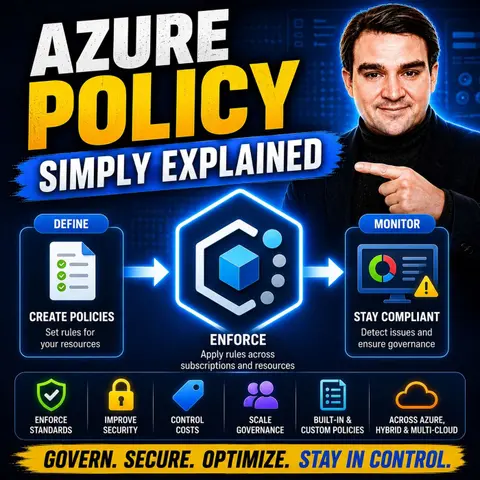
Azure Policy is Microsoft's governance and compliance service for Azure, helping organizations enforce standards, prevent misconfigurations, and keep cloud environments secure at scale. Instead of relying on administrators to manually follow best practices, Azure Policy automatically evaluates resources against defined rules and can deny, audit, modify, or automatically remediate deployments that don't meet organizational requirements.
In this episode, you'll learn what Azure Policy is, how it works, and why governance should be built into your Azure environment from day one. The discussion explains the core concepts of policy definitions, assignments, initiatives, scopes, exemptions, and compliance reporting, showing how they work together to enforce consistent standards across subscriptions, resource groups, and management groups. You'll also discover the difference between Azure Policy, Azure RBAC, and Azure Blueprints, helping you understand when each service should be used.
The episode explores practical use cases such as enforcing resource tagging, restricting deployment regions, requiring encryption, preventing public access to storage accounts, enabling diagnostic logging, and ensuring security baselines are consistently applied. You'll learn how Azure Policy integrates with Azure Monitor, Microsoft Defender for Cloud, Azure Landing Zones, and Infrastructure as Code solutions like Bicep and ARM Templates to automate governance without slowing down development.
Finally, you'll understand why Azure Policy is more than just a compliance reporting tool—it actively prevents configuration drift and helps organizations build secure, standardized, and cost-efficient Azure environments. By the end of this episode, you'll have a clear understanding of Azure Policy, policy enforcement, governance strategies, and best practices for managing enterprise-scale Azure deployments.
Quick answer: Azure Policy helps organizations define, assess, and enforce cloud governance rules across Azure resources. This episode explains initiatives, assignments, effects, remediation, and the difference between policy and permissions so teams can prevent configuration drift while keeping delivery practical.
In a world where cloud technology is booming, understanding how to manage it effectively is crucial. Azure, with its impressive market share of 24% in Q1 2024, has become a go-to platform for businesses. As organizations embrace this shift, they face challenges in governance and compliance. That's where Azure Policy comes in. This powerful tool helps you enforce rules and maintain standards across your cloud resources. By automating compliance, Azure Policy not only reduces manual errors but also keeps your organization secure and efficient.
Remember, effective governance is a continuous cycle that requires regular monitoring and adjustments to stay relevant!
Key Takeaways
- Azure Policy automates compliance checks, reducing manual errors and enhancing security across cloud resources.
- Implementing Azure Policy helps organizations adhere to regulations like ISO 27001 and PCI DSS, ensuring legal compliance.
- Using Azure Policy can lead to significant cost savings by enforcing tagging for better resource management and expense tracking.
- Establish a clear understanding of business outcomes before setting up Azure Policies to ensure they align with organizational goals.
- Regularly review and adjust Azure Policies to keep them relevant as business needs and regulations change.
- Azure Policy provides a compliance dashboard that helps identify non-compliant resources quickly, aiding in effective governance.
- Assign Azure Policies at management group levels for consistent enforcement across multiple subscriptions and resources.
- Leverage Azure Policy alongside other tools like Azure Blueprints and Azure Security Center for a comprehensive governance strategy.
Azure Policy Overview

Core Concepts of Azure Policy
Azure Policy is a powerful service within Microsoft Azure that helps you create, assign, and manage policies aimed at ensuring compliance and security across your resources, identities, and groups. Think of it as your cloud governance toolkit. With Azure Policy, you can enforce rules that dictate how resources should be configured and deployed. This ensures that your cloud environment remains secure and compliant with organizational standards.
Why is this important? Well, as you navigate the complexities of cloud governance, maintaining compliance and standardization becomes crucial. Here are some key reasons why organizations implement Azure Policy:
| Reason | Description |
|---|---|
| Compliance | Ensures adherence to regulations and standards such as ISO 27001 and PCI DSS. |
| Security | Implements security baselines, including encryption and secure transfer requirements. |
| Operational Consistency | Maintains consistent governance across different teams and workloads through layered policies. |
| Cost Management | Enforces tagging for cost control and ownership, aiding in chargeback and lifecycle management. |
| Region Restrictions | Limits resource deployment to approved Azure regions for data sovereignty and supportability. |
| Logging and Diagnostics | Mandates diagnostic settings and log forwarding for better visibility during incident response. |
By leveraging Azure Policy, you can automate compliance checks and ensure that every deployment aligns with your organization's governance standards. This not only saves time but also reduces the risk of human error. For example, if a developer tries to deploy a resource that doesn't meet your security requirements, Azure Policy can automatically deny that deployment. This proactive approach helps you maintain a secure and compliant cloud environment.
Benefits of Azure Policy

Azure Policy offers a range of benefits that can significantly enhance your cloud governance strategy. Let's explore how it helps you achieve compliance, manage resources effectively, and reduce costs.
Compliance and Security
One of the standout benefits of Azure Policy is its ability to bolster compliance and security. With built-in regulatory compliance policies, you can align your resources with standards like HIPAA, PCI-DSS, and ISO 27001. This alignment ensures that your organization meets legal requirements, which is crucial in today’s regulatory landscape.
Moreover, Azure Policy allows you to create custom compliance policies tailored to your specific industry needs. This flexibility means you can audit and enforce rules to prevent non-compliant resource creation. You’ll also benefit from compliance reporting and remediation options for any non-compliant resources, making it easier to manage compliance effectively.
Here are some key security benefits you can expect:
| Security Benefit | Description |
|---|---|
| Built-in regulatory compliance policies | Align with standards like HIPAA, PCI-DSS, and ISO 27001. |
| Custom compliance policies | Tailor policies to meet specific industry needs. |
| Audit and enforce modes | Audit non-compliance or enforce rules to prevent non-compliant resource creation. |
| Compliance reporting and remediation | Provides reports and remediation options for non-compliant resources. |
Resource Management
Managing resources in Azure can be challenging, especially with the rapid pace of change in compliance standards. Azure Policy simplifies this process by helping you keep up with regulatory changes. You can map compliance requirements to technical controls, ensuring that your resources remain compliant as regulations evolve.
Additionally, Azure Policy provides a compliance dashboard that aggregates the compliance state of your environment. This feature allows you to identify non-compliant resources easily. You can assign policies across various levels—management groups, subscriptions, and resource groups—to enforce governance rules consistently. This capability is vital for maintaining operational consistency across your organization.
Cost Reduction
Cost management is another significant advantage of using Azure Policy. By enforcing tagging for cost control and ownership, you can better allocate resources and manage expenses. Azure Policy helps you identify misconfigured resources that could lead to unnecessary costs.
For instance, organizations have reported substantial savings through various Azure cost optimization methods. Here’s a quick look at some of the average savings percentages:
| Cost Optimization Method | Average Savings Percentage | Maximum Reported Savings Percentage |
|---|---|---|
| Azure savings plan for compute | 48% | 63% |
| Azure reservations | 52% | 72% |
| Azure Hybrid Benefit | N/A | 85% |
| Microsoft Cost Management, Azure Advisor | 25% | N/A |
By leveraging Azure Policy, you can ensure that your cloud resources are not only compliant but also cost-effective. This proactive approach to governance helps you maintain a secure, efficient, and financially sound cloud environment.
How to Use Azure Policies
Setting Up Policies
Setting up Azure Policies is a straightforward process, but it requires careful planning. You want to start with a clear understanding of your business outcomes. Here’s a simple approach to get you started:
- Identify Business Outcomes: Focus on what you want to achieve, such as cost control, data residency, or security baseline requirements.
- Translate Outcomes into Technical Rules: Use Azure Policy to create policies that reflect these outcomes.
- Test for Operational Impact: Before enforcing rules that block deployments, test them to see how they affect your operations.
- Define Exception Handling: Make sure you have a plan for temporary deviations so they don’t become permanent issues.
- Review and Adjust: As your business needs or regulations change, revisit your policies to ensure they remain relevant.
When you create a policy definition, you’ll define the rules in JSON format. For example, a simple policy might look like this:
{
  "properties": {
    "displayName": "Allowed Locations",
    "policyType": "BuiltIn",
    "mode": "All",
    "parameters": {
      "allowedLocations": {
        "type": "Array",
        "metadata": {
          "description": "The list of allowed locations for resources.",
          "displayName": "Allowed Locations"
        }
      }
    },
    "policyRule": {
      "if": {
        "field": "location",
        "notIn": "[parameters('allowedLocations')]"
      },
      "then": {
        "effect": "deny"
      }
    }
  }
}
Assigning and Monitoring
Once you’ve set up your policies, it’s time to assign them. Azure Policies can be assigned at various scopes, including management groups, subscriptions, or resource groups. Here’s how to do it:
- Sign in to the Azure Portal: Start by logging into your Azure account.
- Navigate to Azure Policy: Search for 'policy' in the portal and select it.
- Select Assignments: Click on 'Assignments' in the Policy pane.
- Assign Policy: Click 'Assign Policy' and configure the options in the Assign Policy pane.
- Define Parameters: Set any parameters needed during the assignment to tailor the policy to your requirements.
- Review and Save: Confirm your settings and save the assignment.
Monitoring compliance is crucial. Azure Policy continuously evaluates your resources and provides dashboards that show compliance status. You can easily see if a problem is isolated or systemic. This visibility helps you prioritize remediation for non-compliant resources.
Evaluating Compliance
Evaluating compliance is an ongoing process. Azure Policy provides tools to help you stay on top of compliance issues. Here are some key aspects to consider:
| Aspect | Description |
|---|---|
| Continuous Evaluation | Azure Policy continuously evaluates resource compliance and surfaces results in the portal. |
| Compliance Dashboards | Provides dashboards and compliance views for operational monitoring. |
| Integration with Tools | Integrates with Azure Monitor, Log Analytics, and Event Grid for alerts and automation. |
| Trend Analysis | Exported compliance data is useful for trend analysis and audit evidence. |
| Scheduled Reports | Schedule reports for recurring reviews around audit cycles. |
| Alert Rules | Azure Monitor and Log Analytics support alert rules for compliance changes. |
| Event-driven Workflows | Routes failures to ticketing or automation systems for proactive governance. |
By leveraging these tools, you can ensure that your Azure environment remains compliant and secure. Remember, policy enforcement is only half the job. You also need to know what is out of compliance and what actions to take. Azure Policy compliance dashboards provide visibility into policy adherence across different scopes, making it easier to manage your resources effectively.
Azure Policy Scopes
When you work with Azure Policy, understanding the different scopes is essential. Scopes define where policies apply, and they can significantly impact how you manage your resources. Let's break down the three main scopes: management groups, subscriptions, and resource groups.
Management Groups
Management groups serve as a way to organize your subscriptions into a hierarchy. This structure allows you to manage multiple subscriptions collectively, simplifying governance. Here’s why applying Azure Policy at the management group level is beneficial:
- You can enforce security practices uniformly across all subscriptions.
- This method helps establish comprehensive security guardrails.
- Policies assigned at this level cascade down to all subscriptions, ensuring compliance across various environments.
| Aspect | Description |
|---|---|
| Management Group Level | Management groups enable the organization of subscriptions into a hierarchy. |
| Policy Assignment | Policies assigned at the management group level cascade down to all subscriptions and resources. |
| Consistency in Enforcement | This structure is beneficial for uniformly enforcing policies across various environments. |
By using management groups, you ensure consistent governance across your Azure environment. This approach eliminates the need for individual policy implementation at each subscription, making your life easier.
Subscriptions
Subscriptions are the next level down in the Azure hierarchy. They represent a billing unit and a way to manage resources. However, applying Azure Policy at the subscription level has its limitations. For instance, you can only assign a limited number of policies and exemptions per subscription.
| Scope | Policy or initiative assignments | Exemptions |
|---|---|---|
| Subscription | 200 | 1000 |
While subscriptions allow for some flexibility, they can complicate governance if you have many subscriptions to manage. You might find it challenging to maintain consistent policies across all your resources.
Resource Groups
Resource groups in Azure serve as a defined scope for applying Azure Policies. They enable focused management of resources according to their lifecycle and security requirements. When you apply policies at the resource group level, all resources within that group are impacted. This approach improves governance and compliance efforts.
To make the most of resource groups, consider these best practices:
- Require tags on resources: Enforcing tags helps manage large environments by ensuring specific tags are applied to all resources, aiding in cost tracking and resource ownership.
- Inherit tags: This policy ensures consistency by automatically applying tags from parent resources to their underlying resources, reducing manual tagging and simplifying resource management.
By leveraging resource groups effectively, you can enhance your governance strategy and ensure that your Azure environment remains compliant and secure.
Azure Policy vs. Other Tools
When it comes to cloud governance, you have several tools at your disposal. Two of the most notable ones are Azure Blueprints and Azure Security Center. Each tool serves a unique purpose, and understanding their differences can help you choose the right one for your needs.
Azure Blueprints
Azure Blueprints is designed to help you set up a governed environment from the start. It packages policy assignments, role definitions, templates, and resource groups into a single unit. This makes it easier for you to deploy a consistent environment across your organization. Here’s how Azure Policy and Azure Blueprints differ:
| Azure Policy | Azure Blueprints |
|---|---|
| Focuses on enforcing rules across resources. | Packages policy assignments with role definitions, templates, and resource groups. |
| Central to long-term governance and ongoing compliance. | Best for standardized initial environment setup. |
| Evaluates resources continuously and enforces rules. | Applies governed artifacts during provisioning. |
You can think of Azure Policy as the enforcement engine that checks resources continuously. In contrast, Azure Blueprints helps you establish a controlled environment right from the beginning.
Azure Security Center
Azure Security Center focuses on enhancing your security posture. It provides features like secure score, actionable recommendations, and automation capabilities. Here’s a quick comparison of features unique to Azure Security Center versus Azure Policy:
| Feature | Azure Security Center | Azure Policy |
|---|---|---|
| Secure Score | Provides a visual representation of security posture and areas for improvement. | N/A |
| Security Recommendations | Offers actionable recommendations to enhance security posture. | N/A |
| Automation Capabilities | Allows for automated remediation of security issues. | N/A |
| Policy Definitions | Defines specific security conditions to control. | Customizable policy definitions. |
| Compliance Monitoring | Audits environment against security policies. | Ensures compliance with defined policies. |
Azure Security Center integrates with Azure Policy to provide a more comprehensive governance solution. It manages security policies across all Azure resources, ensuring compliance while offering insights into security health based on defined policies.
Comparison Overview
In summary, Azure Policy, Azure Blueprints, and Azure Security Center each play a vital role in cloud governance. Azure Policy focuses on ongoing compliance and drift detection, while Azure Blueprints helps you set up standardized environments. Azure Security Center enhances your security posture with actionable insights and automation.
By understanding these differences, you can leverage each tool effectively to maintain a secure, compliant, and well-governed Azure environment.
In summary, Azure Policy is your go-to tool for effective cloud governance. It helps you enforce compliance, enhance security, and manage resources efficiently. By automating policy enforcement, you save time and reduce risks. 🌟
As you navigate your Azure journey, remember to leverage Azure Policy to maintain a secure and compliant environment. Start implementing it today, and watch your cloud management transform!
FAQ
What is Azure Policy?
Azure Policy is a service that helps you manage and enforce rules for your Azure resources. It ensures compliance with organizational standards and security requirements.
How do I create a policy in Azure?
You can create a policy in Azure by defining rules in JSON format. Use the Azure Portal to navigate to Azure Policy and select "Create Policy Definition."
Can I assign policies to multiple subscriptions?
Yes, you can assign policies to multiple subscriptions using management groups. This allows for consistent governance across all your Azure resources.
What happens if a resource is non-compliant?
If a resource is non-compliant, Azure Policy can deny its deployment or modify it automatically to meet compliance standards. You’ll receive alerts for any non-compliance issues.
How often does Azure Policy evaluate compliance?
Azure Policy continuously evaluates compliance for your resources. It provides real-time insights into the compliance state, allowing you to address issues promptly.
Can I customize compliance policies?
Absolutely! Azure Policy allows you to create custom compliance policies tailored to your organization's specific needs and regulatory requirements.
What are initiatives in Azure Policy?
Initiatives are collections of related policies that help you manage compliance at scale. They simplify reporting and enforcement of multiple policies together.
How can I monitor compliance status?
You can monitor compliance status through the Azure Portal. The compliance dashboard provides a clear view of your resources' compliance state and highlights any issues.
🎧 Listen to this episode
Want a practical explanation of Azure Policy? This episode breaks down the topic in clear language and shows why it matters for Microsoft 365, Azure, Power Platform, security, AI, and modern work.
Listen to this episode if you want to:
- Understand the key concepts behind Azure Policy
- See how it fits into the wider Microsoft technology ecosystem
- Learn where it can create practical value for your organization
You may also enjoy these related M365 FM episodes:
- Real-Time Azure Cost Control with Azure Policy
- Replace Legacy Middleware with Policy-Driven Architecture
- Fix Copilot Policy Hallucinations with Custom Engine Agents
- Connect Copilot Studio to Word Policy Files
Discover more practical Microsoft conversations on M365 FM.
Last reviewed: July 2026.
Who Should Listen
This episode is for Azure administrators, architects, developers, and IT leaders who need a practical foundation before designing, governing, or operating this service.
🎧 You Should Also Listen To
- Azure Landing Zones — A practical next step for extending this topic.
- Azure Resource Manager — A practical next step for extending this topic.
- Azure Management Groups — A practical next step for extending this topic.
🚀 Want to be part of m365.fm?
Then stop just listening… and start showing up.
👉 Connect with me on LinkedIn and let’s make something happen:
- 🎙️ Be a podcast guest and share your story
- 🎧 Host your own episode (yes, seriously)
- 💡 Pitch topics the community actually wants to hear
- 🌍 Build your personal brand in the Microsoft 365 space
This isn’t just a podcast — it’s a platform for people who take action.
🔥 Most people wait. The best ones don’t.
👉 Connect with me on LinkedIn and send me a message:
"I want in"
Let’s build something awesome 👊
1
00:00:00,000 --> 00:00:04,000
Today we're talking about an Azure feature you've probably heard about but might not fully understand.
2
00:00:04,000 --> 00:00:07,800
Azure Policy is one of the most powerful governance tools in the whole platform
3
00:00:07,800 --> 00:00:11,800
yet most people either ignore it or think it's only for IT administrators.
4
00:00:11,800 --> 00:00:15,200
By the end of this episode, you'll know what Azure Policy actually is,
5
00:00:15,200 --> 00:00:17,400
how it works like an invisible rulebook,
6
00:00:17,400 --> 00:00:21,800
and why it's essential for keeping your Azure environment safe and under control.
7
00:00:21,800 --> 00:00:25,200
We'll break it down into clear building blocks starting with the problem it solves,
8
00:00:25,200 --> 00:00:27,500
grab your coffee, and let's dive in.
9
00:00:27,500 --> 00:00:28,500
The problem.
10
00:00:28,500 --> 00:00:30,300
Why Cloud needs guardrails?
11
00:00:30,300 --> 00:00:32,400
Think about the old way of doing things.
12
00:00:32,400 --> 00:00:34,600
On premises, when you needed a server,
13
00:00:34,600 --> 00:00:37,200
you'd submit a request to the operations team.
14
00:00:37,200 --> 00:00:40,700
They check the rules, company policies, security standards,
15
00:00:40,700 --> 00:00:42,700
maybe some regulatory requirements,
16
00:00:42,700 --> 00:00:44,200
and then provision the server for you.
17
00:00:44,200 --> 00:00:46,900
A human gatekeeper stood between you and the infrastructure.
18
00:00:46,900 --> 00:00:51,000
That person knew the rules and made sure nothing slipped through the cloud flips that completely.
19
00:00:51,000 --> 00:00:54,300
Now the app owner has direct access with no human in the middle.
20
00:00:54,300 --> 00:00:57,800
Click Create in the Azure portal and it happens instantly.
21
00:00:57,800 --> 00:01:02,600
You can also use the command line, an API, or infrastructure as code tools like Terraform.
22
00:01:02,600 --> 00:01:05,700
The point is nobody checks your work before the resource gets created.
23
00:01:05,700 --> 00:01:07,000
And that's where the problem starts.
24
00:01:07,000 --> 00:01:08,800
Most app owners don't know all the rules.
25
00:01:08,800 --> 00:01:12,800
Maybe they don't realize that company policy requires all data to stay in Europe.
26
00:01:12,800 --> 00:01:15,100
All that storage accounts must block public access.
27
00:01:15,100 --> 00:01:18,600
All that certain VM sizes are expensive and should only be used in production.
28
00:01:18,600 --> 00:01:21,800
So they go ahead and create resources and sometimes mistakes happen.
29
00:01:21,800 --> 00:01:25,500
A virtual machine gets deployed with a public IP and open ports to the internet.
30
00:01:25,500 --> 00:01:29,900
A storage account gets created with public blob access, exposing sensitive data.
31
00:01:29,900 --> 00:01:34,200
Someone spins up an expensive GPU instance for a quick test and forgets to delete it.
32
00:01:34,200 --> 00:01:35,800
These things happen all the time.
33
00:01:35,800 --> 00:01:39,300
What we need is an automatic enforcement system that works every time.
34
00:01:39,300 --> 00:01:41,700
No matter who creates the resource or how they do it,
35
00:01:41,700 --> 00:01:45,600
whether it's the portal, the CLI, an API call or a Terraform deployment,
36
00:01:45,600 --> 00:01:47,800
the rules should be checked automatically.
37
00:01:47,800 --> 00:01:50,800
And that's exactly what Azure Policy was built to provide.
38
00:01:50,800 --> 00:01:53,200
What is Azure Policy, the invisible rulebook?
39
00:01:53,200 --> 00:01:55,600
So what is Azure Policy? Here's the simplest definition.
40
00:01:55,600 --> 00:01:59,400
Azure Policy is a service that lets you define rules for your Azure resources
41
00:01:59,400 --> 00:02:00,900
and automatically enforces them.
42
00:02:00,900 --> 00:02:02,800
Think of it like the rulebook for a board game.
43
00:02:02,800 --> 00:02:06,900
The game has lots of possible moves, but the rulebook says which ones are actually allowed.
44
00:02:06,900 --> 00:02:09,200
You can't just move your piece anywhere you want.
45
00:02:09,200 --> 00:02:11,500
The rules tell you what's legal and what isn't.
46
00:02:11,500 --> 00:02:12,800
Now here's a critical distinction.
47
00:02:12,800 --> 00:02:16,000
Azure Policy is not the same as a role-based access control or R-back.
48
00:02:16,000 --> 00:02:17,900
R-back controls who can do something.
49
00:02:17,900 --> 00:02:21,700
It answers the question, who is allowed to create resources in this subscription?
50
00:02:21,700 --> 00:02:23,800
Azure Policy controls what can be done?
51
00:02:23,800 --> 00:02:26,100
Or more precisely what configurations are allowed.
52
00:02:26,100 --> 00:02:28,600
It answers the question, what kind of resources can be created?
53
00:02:28,600 --> 00:02:30,300
And how should they be configured?
54
00:02:30,300 --> 00:02:32,900
So R-back says, "Mirko can create storage accounts."
55
00:02:32,900 --> 00:02:36,800
And Azure Policy says, "Storage accounts must have HTTPS enabled."
56
00:02:36,800 --> 00:02:38,300
Two different things and you need both.
57
00:02:38,300 --> 00:02:39,200
Here's the key thing.
58
00:02:39,200 --> 00:02:42,000
Azure Policy is always on and it's always enforced.
59
00:02:42,000 --> 00:02:46,400
Every single request to create, update or delete a resource passes through Azure Policy
60
00:02:46,400 --> 00:02:48,100
and there is no way to bypass it.
61
00:02:48,100 --> 00:02:50,300
It sits between you and Azure Resource Manager.
62
00:02:50,300 --> 00:02:51,800
The control plane of Azure.
63
00:02:51,800 --> 00:02:53,400
Think of it as an automatic filter.
64
00:02:53,400 --> 00:02:56,700
Every request goes through this filter and if it doesn't match the rules,
65
00:02:56,700 --> 00:03:00,100
the request gets blocked or flagged and it doesn't just work for new resources.
66
00:03:00,100 --> 00:03:03,100
Azure Policy also evaluates existing resources
67
00:03:03,100 --> 00:03:05,500
so it catches configuration drift over time.
68
00:03:05,500 --> 00:03:09,000
If someone changes a setting on a resource that you've already deployed
69
00:03:09,000 --> 00:03:12,000
and that change violates a policy, Azure Policy will flag it.
70
00:03:12,000 --> 00:03:13,700
So how do you actually write these rules?
71
00:03:13,700 --> 00:03:15,600
That's where policy definitions come in.
72
00:03:15,600 --> 00:03:18,500
Policy definitions, writing the rules.
73
00:03:18,500 --> 00:03:20,300
So how do you actually write these rules?
74
00:03:20,300 --> 00:03:21,900
That's where policy definitions come in.
75
00:03:21,900 --> 00:03:25,500
A policy definition is the rule itself and it's written as a JSON document.
76
00:03:25,500 --> 00:03:28,700
JSON might sound technical but the structure is actually quite simple.
77
00:03:28,700 --> 00:03:30,200
It follows a basic pattern.
78
00:03:30,200 --> 00:03:33,200
If this condition is true, then apply this effect.
79
00:03:33,200 --> 00:03:34,600
Let me give you a real example.
80
00:03:34,600 --> 00:03:36,200
There's a built-in policy that says,
81
00:03:36,200 --> 00:03:39,500
"If a storage account doesn't have HTTPS enabled, deny it."
82
00:03:39,500 --> 00:03:40,200
That's it.
83
00:03:40,200 --> 00:03:43,500
When the condition is true, the effect kicks in and blocks the deployment.
84
00:03:43,500 --> 00:03:45,700
Every policy definition has three key parts.
85
00:03:45,700 --> 00:03:47,000
First, the conditions.
86
00:03:47,000 --> 00:03:47,900
That's the if part.
87
00:03:47,900 --> 00:03:48,900
What are you checking for?
88
00:03:48,900 --> 00:03:51,400
The resource type, the location, a specific setting.
89
00:03:51,400 --> 00:03:52,900
Second, the effects.
90
00:03:52,900 --> 00:03:53,900
That's the then part.
91
00:03:53,900 --> 00:03:55,400
What happens when the condition is met?
92
00:03:55,400 --> 00:03:57,400
Do you block the deployment or just flag it?
93
00:03:57,400 --> 00:03:58,900
Third, parameters.
94
00:03:58,900 --> 00:04:01,900
These are the fill-in-the-blanks that make the policy reusable.
95
00:04:01,900 --> 00:04:04,200
Parameters are where the real power comes in.
96
00:04:04,200 --> 00:04:08,900
Imagine you want to write a policy that only allows resources in certain regions.
97
00:04:08,900 --> 00:04:12,200
You don't want to write a separate policy for every possible combination of regions.
98
00:04:12,200 --> 00:04:15,200
Instead, you write one definition called "allowed locations."
99
00:04:15,200 --> 00:04:17,700
And you add a parameter for which regions are allowed.
100
00:04:17,700 --> 00:04:19,900
When you assign the policy, you fill in the blank.
101
00:04:19,900 --> 00:04:23,100
Maybe you say "west, Europe, and North Europe" for one subscription.
102
00:04:23,100 --> 00:04:25,100
And "east, US, and West, US for another."
103
00:04:25,100 --> 00:04:26,600
Same definition, different parameters.
104
00:04:26,600 --> 00:04:28,100
That's how you keep things manageable.
105
00:04:28,100 --> 00:04:29,000
Here's the good news.
106
00:04:29,000 --> 00:04:30,900
You don't have to write all of these from scratch.
107
00:04:30,900 --> 00:04:35,500
Microsoft provides hundreds of built-in policy definitions that you can start using immediately.
108
00:04:35,500 --> 00:04:40,500
They cover categories like "computer storage, networking, security center, tagging, cost management, and more."
109
00:04:40,500 --> 00:04:44,700
You can find them in the Azure portal, search for what you need, and assign them right away.
110
00:04:44,700 --> 00:04:46,900
No JSON required if you don't want to write it.
111
00:04:46,900 --> 00:04:49,300
But a definition sitting in a file doesn't do anything.
112
00:04:49,300 --> 00:04:51,100
You have to assign it to make it work.
113
00:04:51,100 --> 00:04:53,600
Policy assignments, putting rules to work.
114
00:04:53,600 --> 00:04:57,400
A policy assignment is where you take your definition and point it at a specific scope.
115
00:04:57,400 --> 00:04:59,700
The scope is just the boundary where that rule applies.
116
00:04:59,700 --> 00:05:02,500
You have three choices from the widest to the tightest.
117
00:05:02,500 --> 00:05:06,200
Assign at the management group level, and it covers a whole set of subscriptions.
118
00:05:06,200 --> 00:05:09,700
Drop it at the subscription level, and it covers everything inside that subscription.
119
00:05:09,700 --> 00:05:14,200
Or assign at the resource group level, and it only covers the resources inside that group.
120
00:05:14,200 --> 00:05:15,500
Now let's talk about inheritance.
121
00:05:15,500 --> 00:05:16,500
This is a key concept.
122
00:05:16,500 --> 00:05:18,900
When you assign a policy at the management group level,
123
00:05:18,900 --> 00:05:23,100
it automatically flows down to every subscription and resource group underneath.
124
00:05:23,100 --> 00:05:24,700
You don't need to assign it again and again.
125
00:05:24,700 --> 00:05:28,700
It's like posting a rule on the main bulletin board at the entrance of an office building.
126
00:05:28,700 --> 00:05:30,600
Everyone who passes through has to follow it.
127
00:05:30,600 --> 00:05:33,100
You wouldn't post the same rule on every floor.
128
00:05:33,100 --> 00:05:34,300
That's wasted effort.
129
00:05:34,300 --> 00:05:35,600
The rule just flows down.
130
00:05:35,600 --> 00:05:37,400
But what happens when you need an exception?
131
00:05:37,400 --> 00:05:39,800
Maybe your company says all data must stay in Europe,
132
00:05:39,800 --> 00:05:43,100
but one project has a legitimate reason to use a data center in Asia.
133
00:05:43,100 --> 00:05:46,300
You don't want to remove the whole policy that would leave everything exposed.
134
00:05:46,300 --> 00:05:47,800
So you create an exemption.
135
00:05:47,800 --> 00:05:51,400
Exemptions let you make carve-outs for specific resources or resource groups
136
00:05:51,400 --> 00:05:53,500
without killing the policy everywhere else.
137
00:05:53,500 --> 00:05:55,200
It's a clean way to handle edge cases.
138
00:05:55,200 --> 00:05:56,700
Here's the practical guidance.
139
00:05:56,700 --> 00:06:01,200
Assign your broad foundational policies at the management group level.
140
00:06:01,200 --> 00:06:04,900
Things like allowed locations or required tags should apply to everything.
141
00:06:04,900 --> 00:06:08,500
Then assign more specific policies at the subscription or resource group level.
142
00:06:08,500 --> 00:06:12,000
Maybe your dev subscription has looser rules than your production subscription.
143
00:06:12,000 --> 00:06:13,000
That's perfectly fine.
144
00:06:13,000 --> 00:06:15,400
The specific policies add on top of the broad ones.
145
00:06:15,400 --> 00:06:18,200
Now let's talk about what actually happens when someone breaks a rule.
146
00:06:18,200 --> 00:06:19,900
That's where effects come in.
147
00:06:19,900 --> 00:06:20,900
Effects.
148
00:06:20,900 --> 00:06:22,600
What happens when rules are broken?
149
00:06:22,600 --> 00:06:24,500
So you've written a rule and assigned it.
150
00:06:24,500 --> 00:06:26,000
What happens when someone breaks it?
151
00:06:26,000 --> 00:06:27,200
That's where effects come in.
152
00:06:27,200 --> 00:06:30,000
Effects are the then part of the policy.
153
00:06:30,000 --> 00:06:33,200
They decide what happens when a resource doesn't match the rule.
154
00:06:33,200 --> 00:06:34,600
There are four main ones you'll see.
155
00:06:34,600 --> 00:06:36,100
First up, deny.
156
00:06:36,100 --> 00:06:38,600
This is the most common effect for critical rules.
157
00:06:38,600 --> 00:06:41,900
When a deny policy is triggered, the deployment is blocked completely.
158
00:06:41,900 --> 00:06:45,200
The user gets a clear error message that says validation failed.
159
00:06:45,200 --> 00:06:47,300
And explains which policy stopped them.
160
00:06:47,300 --> 00:06:49,500
No resources created, no harm done.
161
00:06:49,500 --> 00:06:51,900
Use this for rules that must never be broken.
162
00:06:51,900 --> 00:06:57,600
Like no public blob access on storage accounts or no deployments outside approved regions.
163
00:06:57,600 --> 00:06:58,800
Second, audit.
164
00:06:58,800 --> 00:07:00,100
This one works differently.
165
00:07:00,100 --> 00:07:04,600
The deployment goes through, but the resource is marked as non-compliant in the compliance dashboard.
166
00:07:04,600 --> 00:07:08,600
Audit is incredibly useful when you're not sure how a new rule will affect your environment.
167
00:07:08,600 --> 00:07:11,000
You can see what's happening without breaking anything.
168
00:07:11,000 --> 00:07:14,000
It's like taking a measurement before you enforce a change.
169
00:07:14,000 --> 00:07:15,800
Third, modify and append.
170
00:07:15,800 --> 00:07:19,200
These effects automatically fix the problem instead of blocking it.
171
00:07:19,200 --> 00:07:21,800
Modify changes existing settings during deployment.
172
00:07:21,800 --> 00:07:23,800
Append adds something to an existing field.
173
00:07:23,800 --> 00:07:28,200
For example, you can create a policy that automatically adds a required tag with a default value.
174
00:07:28,200 --> 00:07:31,800
If someone forgets to add a cost center tag, the policy adds it for them,
175
00:07:31,800 --> 00:07:36,000
the deployment goes through and the resource is compliant without extra work.
176
00:07:36,000 --> 00:07:38,000
Fourth, deploy if not exists.
177
00:07:38,000 --> 00:07:40,800
This one handles situations where supporting resources missing.
178
00:07:40,800 --> 00:07:43,800
Say you want diagnostic logging enabled on every storage account.
179
00:07:43,800 --> 00:07:46,600
If someone creates a storage account without diagnostic settings,
180
00:07:46,600 --> 00:07:50,600
deploy if not exists kicks in and deploys the missing configuration automatically.
181
00:07:50,600 --> 00:07:52,600
It's like having a helper that cleans up behind you.
182
00:07:52,600 --> 00:07:53,800
Here's the best practice.
183
00:07:53,800 --> 00:07:54,800
Start with audit.
184
00:07:54,800 --> 00:07:57,000
See what's actually happening in your environment first.
185
00:07:57,000 --> 00:07:59,800
Find out how many resources would be affected by a new rule.
186
00:07:59,800 --> 00:08:00,800
Then move to deny.
187
00:08:00,800 --> 00:08:04,400
Once your confident the rule is correct and won't break legitimate deployments.
188
00:08:04,400 --> 00:08:09,600
Managing one policy is simple, but what if you need 50 of them all related to security or compliance?
189
00:08:09,600 --> 00:08:11,600
That's where initiatives come in.
190
00:08:11,600 --> 00:08:13,600
Initiatives bundling rules together.
191
00:08:13,600 --> 00:08:14,600
So what is an initiative?
192
00:08:14,600 --> 00:08:18,200
Think of it as a collection of policies all grouped around one common goal.
193
00:08:18,200 --> 00:08:21,200
Instead of assigning 50 individual policies one by one,
194
00:08:21,200 --> 00:08:24,400
you assign one single initiative that contains all of them.
195
00:08:24,400 --> 00:08:27,200
It's like a prepacked toolkit for a specific job.
196
00:08:27,200 --> 00:08:29,800
You don't pick up a hammer, a screwdriver and a wrench separately.
197
00:08:29,800 --> 00:08:31,200
You just grab the whole toolkit.
198
00:08:31,200 --> 00:08:32,600
Everything you need is in one place.
199
00:08:32,600 --> 00:08:34,600
The real advantage here is compliance reporting.
200
00:08:34,600 --> 00:08:38,200
When you assign an initiative, you get a single compliance view for the whole group.
201
00:08:38,200 --> 00:08:41,800
You can see at a glance whether your environment meets the overall standard.
202
00:08:41,800 --> 00:08:46,200
And if something is non-compliant, you can drill right into the specific policy that's failing.
203
00:08:46,200 --> 00:08:49,000
It's much cleaner than tracking 50 separate policies.
204
00:08:49,000 --> 00:08:52,800
Microsoft provides built-in initiatives that cover major compliance frameworks.
205
00:08:52,800 --> 00:08:59,800
Things like the Azure Security benchmark, CIS, NIST, PCI DSS, HIPAA, ISO 27001 and more.
206
00:08:59,800 --> 00:09:02,000
These are already created and ready to assign.
207
00:09:02,000 --> 00:09:05,800
You don't have to figure out which policies map to which compliance requirement.
208
00:09:05,800 --> 00:09:07,600
Microsoft has done that work for you.
209
00:09:07,600 --> 00:09:10,400
Some of these initiatives contain hundreds of individual policies.
210
00:09:10,400 --> 00:09:12,600
Imagine trying to assign all of those one by one.
211
00:09:12,600 --> 00:09:14,200
You wouldn't. You'd use the initiative.
212
00:09:14,200 --> 00:09:17,000
You can also create custom initiatives for your own standards.
213
00:09:17,000 --> 00:09:22,400
Maybe you have a production baseline that includes policies for encryption, logging and network security.
214
00:09:22,400 --> 00:09:27,000
Or a cost-control standards initiative that limits VM sizes and requires cost-center tags.
215
00:09:27,000 --> 00:09:28,000
Same idea.
216
00:09:28,000 --> 00:09:31,600
Bundle the policies, assign the bundle and track compliance as a single unit.
217
00:09:31,600 --> 00:09:36,000
Let's make this concrete with real-world examples of how people actually use Azure Policy.
218
00:09:36,000 --> 00:09:37,600
Real-world examples.
219
00:09:37,600 --> 00:09:38,800
Policy in action.
220
00:09:38,800 --> 00:09:40,200
Let's make this real.
221
00:09:40,200 --> 00:09:44,000
Here are five common scenarios where Azure Policy solves actual problems.
222
00:09:44,000 --> 00:09:46,400
First, region restrictions for data compliance.
223
00:09:46,400 --> 00:09:50,800
Imagine your company has a policy that all customer data must stay in Europe.
224
00:09:50,800 --> 00:09:55,200
You can assign the allowed locations built in policy at the root management group level
225
00:09:55,200 --> 00:09:58,400
and only allow EU regions like West Europe and North Europe.
226
00:09:58,400 --> 00:10:02,200
Now, when someone creates a new subscription, it automatically inherits that rule.
227
00:10:02,200 --> 00:10:05,400
They can't deploy resources in the US or Asia even if they try.
228
00:10:05,400 --> 00:10:06,400
The policy blocks it.
229
00:10:06,400 --> 00:10:08,200
No manual checks, no asking for permission.
230
00:10:08,200 --> 00:10:09,600
The rule is just enforced.
231
00:10:09,600 --> 00:10:11,800
Second, tag enforcement for cost allocation.
232
00:10:11,800 --> 00:10:18,000
Your finance team needs to track spending by department, but they can't do that if resources don't have the right tags.
233
00:10:18,000 --> 00:10:23,600
So you create a policy that requires a cost-center tag and an environment tag on every resource.
234
00:10:23,600 --> 00:10:24,800
But here's the smart part.
235
00:10:24,800 --> 00:10:26,200
You use the modify effect.
236
00:10:26,200 --> 00:10:30,000
If someone forgets to add the tag, the policy automatically adds it with a default value.
237
00:10:30,000 --> 00:10:32,800
The deployment goes through and the resource is compliant.
238
00:10:32,800 --> 00:10:36,400
Finance gets accurate cost data and developers don't get blocked by a missing tag.
239
00:10:36,400 --> 00:10:38,200
Third, cost-control in development.
240
00:10:38,200 --> 00:10:41,600
Development teams love to experiment, but experiments can get expensive fast.
241
00:10:41,600 --> 00:10:45,400
Someone might spin up a GPU instance with 24 cores just to test a simple script.
242
00:10:45,400 --> 00:10:50,000
So you create a policy that restricts VM sizes in dev subscriptions to smaller skews.
243
00:10:50,000 --> 00:10:52,600
Things like B-Series or D-Series with limited cores.
244
00:10:52,600 --> 00:10:56,400
If someone tries to deploy an expensive GPU or high memory VM,
245
00:10:56,400 --> 00:10:58,400
the deny effect kicks in and blocks it.
246
00:10:58,400 --> 00:11:01,400
Developers can still experiment, but they can't blow the budget.
247
00:11:01,400 --> 00:11:03,400
Fourth, security baseline for storage.
248
00:11:03,400 --> 00:11:07,200
Storage accounts are one of the most common places where security mistakes happen.
249
00:11:07,200 --> 00:11:10,000
Someone creates a storage account with public blob access.
250
00:11:10,000 --> 00:11:13,000
And suddenly, sensitive data is exposed to the internet.
251
00:11:13,000 --> 00:11:17,600
So you create a policy that requires HTTPS only traffic and blocks public blob access.
252
00:11:17,600 --> 00:11:21,400
And you use deploy if not exists to automatically enable diagnostic logging
253
00:11:21,400 --> 00:11:23,800
on every storage account that doesn't have it.
254
00:11:23,800 --> 00:11:26,400
The policy fixes the problem before it becomes a problem.
255
00:11:26,400 --> 00:11:28,400
Fifth, naming conventions.
256
00:11:28,400 --> 00:11:31,600
Your team wants all resources to start with prod or dev
257
00:11:31,600 --> 00:11:34,600
so they can easily tell which environment something belongs to.
258
00:11:35,600 --> 00:11:38,600
You create a policy that checks the resource name against the pattern.
259
00:11:38,600 --> 00:11:41,400
But instead of blocking the deployment, you use the audit effect.
260
00:11:41,400 --> 00:11:44,200
And the resource gets created, but it's flagged as non-compliant.
261
00:11:44,200 --> 00:11:47,400
Then you run a monthly compliance report and ask the team to fix the naming.
262
00:11:47,400 --> 00:11:50,400
It's a gentle way to enforce standards without breaking workflows.
263
00:11:50,400 --> 00:11:53,000
Every one of these examples follows the same pattern.
264
00:11:53,000 --> 00:11:54,400
Identify the problem.
265
00:11:54,400 --> 00:11:56,000
Choose or create the policy.
266
00:11:56,000 --> 00:11:59,600
Decide the effect, assign at the right scope, monitor compliance.
267
00:11:59,600 --> 00:12:00,600
That's the playbook.
268
00:12:00,600 --> 00:12:03,600
Now let's zoom out and see how all these pieces fit into the bigger
269
00:12:03,600 --> 00:12:05,000
as your governance picture.
270
00:12:05,000 --> 00:12:07,800
The big picture, how it all connects.
271
00:12:07,800 --> 00:12:10,200
So where does Azure Policy fit in the bigger picture?
272
00:12:10,200 --> 00:12:11,600
Let's think about it this way.
273
00:12:11,600 --> 00:12:13,600
Azure Policy works at the control plane level,
274
00:12:13,600 --> 00:12:16,200
sitting right on top of Azure Resource Manager.
275
00:12:16,200 --> 00:12:19,200
And it evaluates every single request that comes through.
276
00:12:19,200 --> 00:12:22,200
Every time someone creates updates or deletes a resource,
277
00:12:22,200 --> 00:12:23,800
Azure Policy checks the rules.
278
00:12:23,800 --> 00:12:25,600
It's the gatekeeper at the front door.
279
00:12:25,600 --> 00:12:28,400
Now, it's not the only tool in the governance toolbox.
280
00:12:28,400 --> 00:12:30,800
Azure Policy is just one piece of a bigger system.
281
00:12:30,800 --> 00:12:34,000
Management groups provide the hierarchy to organize your subscriptions
282
00:12:34,000 --> 00:12:35,800
and apply rules at scale.
283
00:12:35,800 --> 00:12:38,800
Roll-based access control decides who has access to what,
284
00:12:38,800 --> 00:12:41,800
while Azure Policy controls what configurations are allowed.
285
00:12:41,800 --> 00:12:44,200
Together, they form the foundation of cloud governance.
286
00:12:44,200 --> 00:12:45,400
Now, here's the thing.
287
00:12:45,400 --> 00:12:48,800
Azure Policy is also the engine behind other services you might already use.
288
00:12:48,800 --> 00:12:51,600
Microsoft Defender for Cloud uses Azure Policy
289
00:12:51,600 --> 00:12:53,400
to generate its compliance recommendations.
290
00:12:53,400 --> 00:12:56,000
When Defender tells you a storage account is non-compliant,
291
00:12:56,000 --> 00:12:58,200
it's actually running a policy evaluation.
292
00:12:58,200 --> 00:13:01,800
Azure Advisor pulls many of its cost and reliability recommendations
293
00:13:01,800 --> 00:13:03,800
from the same policy evaluations.
294
00:13:03,800 --> 00:13:06,200
And the compliance dashboard in the Azure Portal
295
00:13:06,200 --> 00:13:07,600
all built on policy data.
296
00:13:07,600 --> 00:13:09,600
So even if you've never created a policy yourself,
297
00:13:09,600 --> 00:13:11,800
you've probably been using them without knowing it.
298
00:13:11,800 --> 00:13:14,000
There's another practice called policy as code.
299
00:13:14,000 --> 00:13:16,200
Instead of creating policies through the portal,
300
00:13:16,200 --> 00:13:19,000
you store them as JSON files in a Git repository
301
00:13:19,000 --> 00:13:22,600
and deploy them through CI/CD pipelines just like application code.
302
00:13:22,600 --> 00:13:24,600
That gives you version control, code reviews,
303
00:13:24,600 --> 00:13:27,000
and automated testing for your governance rules.
304
00:13:27,000 --> 00:13:30,600
It's a more scalable way to manage policies across large organizations.
305
00:13:30,600 --> 00:13:32,400
Here's the most important thing to take away.
306
00:13:32,400 --> 00:13:34,400
Once you set up Azure Policy properly,
307
00:13:34,400 --> 00:13:36,200
it runs silently in the background.
308
00:13:36,200 --> 00:13:39,600
It's the automatic guardrail that prevents problems before they happen.
309
00:13:39,600 --> 00:13:41,200
Users may never know it's there,
310
00:13:41,200 --> 00:13:44,000
but they benefit from it every time they deploy a resource.
311
00:13:44,000 --> 00:13:46,200
You get consistent enforcement every single time
312
00:13:46,200 --> 00:13:49,600
without manual checks, approval tickets, or human error.
313
00:13:49,600 --> 00:13:52,200
So that's Azure Policy in plain English.
314
00:13:52,200 --> 00:13:55,600
It's an invisible rulebook that enforces your organizations,
315
00:13:55,600 --> 00:13:57,800
standards on every resource every time.
316
00:13:57,800 --> 00:14:01,000
If you want one single action from this episode, here it is.
317
00:14:01,000 --> 00:14:03,400
Go into the Azure portal, find policy,
318
00:14:03,400 --> 00:14:07,200
and assign the built-in allowed locations policy to a test subscription.
319
00:14:07,200 --> 00:14:09,000
Start with audit and see what happens.
320
00:14:09,000 --> 00:14:11,200
That's the fastest way to understand how this works.
321
00:14:11,200 --> 00:14:13,200
Subscribe for more Microsoft knowledge nuggets
322
00:14:13,200 --> 00:14:15,800
and share this with someone starting their Azure journey.
323
00:14:15,800 --> 00:14:18,200
Drop a comment with what you'd like me to explain next.

Founder of m365.fm, m365.show and m365con.net
Mirko Peters is a Microsoft 365 expert, content creator, and founder of m365.fm, a platform dedicated to sharing practical insights on modern workplace technologies. His work focuses on Microsoft 365 governance, security, collaboration, and real-world implementation strategies.
Through his podcast and written content, Mirko provides hands-on guidance for IT professionals, architects, and business leaders navigating the complexities of Microsoft 365. He is known for translating complex topics into clear, actionable advice, often highlighting common mistakes and overlooked risks in real-world environments.
With a strong emphasis on community contribution and knowledge sharing, Mirko is actively building a platform that connects experts, shares experiences, and helps organizations get the most out of their Microsoft 365 investments.




