
Data Governance Power Platform Microsoft Security Cloud Architecture AI in Microsoft 365 Dynamics 365 Insights Developer Practices Microsoft 365 Podcast – Teams, SharePoint, Office Apps & Productivity Microsoft Strategy & Partner Marketing Guest Episodes Simply Explained Workshops on Microsoft Tech for free
![Secure MLOps in Microsoft Cloud with Martin Dimovski [MVP-MCT]](https://d3wo5wojvuv7l.cloudfront.net/t_rss_itunes_square_1400/images.spreaker.com/original/2f1a5cb84f89a1f18949df8af8032543.jpg "Secure MLOps in Microsoft Cloud with Martin Dimovski [MVP-MCT]")
May 23, 2026
Secure MLOps in Microsoft Cloud with Martin Dimovski [MVP-MCT]
In this episode of the m365.fm podcast, Mirko Peters speaks with Microsoft MVP and cloud security expert Martin Dimovski about securing AI workloads and MLOps environments in Microsoft Cloud. The conversation focuses on why AI security must be treated as a core business requirement instead of an afterthought. Martin explains the growing risks organizations face as they rapidly deploy AI agents, large language models, APIs, and cloud-native AI solutions without fully understanding the security implications. The episode highlights how AI introduces new attack surfaces while also amplifying existing cybersecurity weaknesses. A major theme is “secure-by-design” architecture. Martin stresses that security should start during the planning and design phase, not after deployment. Topics include threat modeling, identity protection, secure pipelines, infrastructure hardening, API security, and governance. He emphasizes that security teams should work alongside developers and DevOps teams…
Guests: Mirko Peters , Martin Dimovski
![AD Tiering and Privileged Access with Viktor Hedberg [MVP-MCT]](https://d3wo5wojvuv7l.cloudfront.net/t_rss_itunes_square_1400/images.spreaker.com/original/13746b817bb6d94c0b03f623efb9d37d.jpg "AD Tiering and Privileged Access with Viktor Hedberg [MVP-MCT]")
May 23, 2026
AD Tiering and Privileged Access with Viktor Hedberg [MVP-MCT]
In this episode of the m365.fm podcast, host Mirko Peters speaks with cybersecurity expert Viktor Hedberg about the importance of securing enterprise environments through Active Directory (AD) tiering and privileged access management. The discussion explores how attackers commonly target privileged accounts to move laterally through corporate networks and why traditional “flat” admin models are no longer sufficient. Viktor explains the concept of AD tiering, where administrative privileges are separated into security tiers to reduce the blast radius of compromised credentials. He also highlights the role of privileged access workstations (PAWs), just-in-time administration, and strong identity protection practices. The episode covers real-world attack scenarios, lessons learned from incident response engagements, and practical recommendations for organizations running hybrid Microsoft environments. Key themes include reducing standing privileges, enforcing multi-factor authentic…
Guests: Mirko Peters , Viktor Hedberg
![Microsoft 365 Simplicity with Evi van der Velden [MVP]](https://d3wo5wojvuv7l.cloudfront.net/t_rss_itunes_square_1400/images.spreaker.com/original/c89430ac20f79a64ad137de54f18d317.jpg "Microsoft 365 Simplicity with Evi van der Velden [MVP]")
May 22, 2026
Microsoft 365 Simplicity with Evi van der Velden [MVP]
Microsoft MVP Evi van der Velden joins the M365.fm podcast to explain why simplicity is one of the most overlooked success factors in Microsoft 365. The conversation explores how many organizations create unnecessary complexity through excessive customization, unclear governance, and overengineered solutions that ultimately reduce productivity instead of improving it. Evi shares practical insights from real-world Microsoft 365 projects, highlighting how simpler architectures, cleaner collaboration environments, and focused governance strategies often deliver better long-term results. The discussion covers Microsoft Teams, SharePoint, governance, adoption, user experience, and the growing impact of AI tools like Microsoft Copilot inside modern workplaces. A key theme throughout the episode is that technology should support people rather than force users to adapt to complicated systems. Evi explains why organizations frequently underestimate the importance of user behavior, commun…
Guests: Mirko Peters , Evi van der Velden
![Power Platform Governance Best Practices with Craig White [MVP]](https://d3wo5wojvuv7l.cloudfront.net/t_rss_itunes_square_1400/images.spreaker.com/original/e73dd0245083c6c0436fba96faa96483.jpg "Power Platform Governance Best Practices with Craig White [MVP]")
May 22, 2026
Power Platform Governance Best Practices with Craig White [MVP]
Secure, scalable, and governed Power Platform adoption requires more than just enabling low-code tools — it demands a structured governance strategy that balances innovation, security, and operational control. In this episode of the M365.fm podcast, Mirko Peters speaks with Microsoft MVP Craig White about the real-world challenges organizations face when scaling Microsoft Power Platform across the enterprise. Craig explains why governance should never block innovation. Instead, organizations should create guardrails that allow citizen developers to build solutions safely while maintaining compliance, security, and architectural consistency. The discussion covers environment strategies, Data Loss Prevention (DLP) policies, connector governance, lifecycle management, identity security, and API control. The episode highlights how many businesses still misunderstand Power Platform governance, often relying on restrictive policies that create shadow IT instead of reducing risk. Craig…
Guests: Mirko Peters , Craig White
![Maximize Microsoft Copilot Value with Ralph Rivas [MVP]](https://d3wo5wojvuv7l.cloudfront.net/t_rss_itunes_square_1400/images.spreaker.com/original/5ee0134e3b62fe4d527f29111e00d9e9.jpg "Maximize Microsoft Copilot Value with Ralph Rivas [MVP]")
May 21, 2026
Maximize Microsoft Copilot Value with Ralph Rivas [MVP]
In this episode of the M365.fm podcast, we explore how organizations can maximize the value of Microsoft Copilot across Microsoft 365, Power Platform, Security, and Azure environments. The discussion focuses on practical, real-world use cases that help businesses automate repetitive work, improve collaboration, accelerate reporting, and enhance decision-making using AI. The episode explains how Copilot integrates with tools like Word, Excel, Outlook, Teams, Power BI, and Power Automate to simplify everyday tasks such as content creation, meeting summaries, data analysis, workflow automation, and reporting. It also covers how Microsoft Graph enables Copilot to provide context-aware assistance by connecting emails, files, meetings, and business data. Beyond productivity, the episode dives into advanced scenarios including Copilot extensibility, custom plugins, AI agents, governance, security operations, and compliance automation. Special attention is given to the importance of dat…
Guests: Mirko Peters , Ralph Rivas
![AI Governance for Microsoft 365 with Christian Buckley [MVP]](https://d3wo5wojvuv7l.cloudfront.net/t_rss_itunes_square_1400/images.spreaker.com/original/cfdce6ca5ff257bb37e690ea4bd225f8.jpg "AI Governance for Microsoft 365 with Christian Buckley [MVP]")
May 21, 2026
AI Governance for Microsoft 365 with Christian Buckley [MVP]
In this episode of the m365.fm podcast, Christian Buckley joins the conversation to unpack why traditional governance models are struggling to keep up with the pace of AI adoption inside Microsoft 365. The discussion explores how tools like Copilot and autonomous AI agents are reshaping collaboration, compliance, and content management — often faster than organizations can adapt their policies and processes. Christian explains that most governance frameworks were designed for static content and predictable user behavior, not AI systems capable of generating, accessing, and acting on information across the tenant. The episode dives into the growing risks of “agent sprawl,” shadow AI, uncontrolled permissions, and poor data quality, all of which can undermine security, compliance, and trust in AI-driven workplaces. A major theme throughout the episode is that governance is no longer just an IT responsibility. Successful AI governance requires a balance between innovation and contr…
Guests: Mirko Peters , Christian Buckley
![Enterprise AI Agent Engineering with Karthikeyan VK [MVP]](https://d3wo5wojvuv7l.cloudfront.net/t_rss_itunes_square_1400/images.spreaker.com/original/2f57511552c865613a91e0c61100a12b.jpg "Enterprise AI Agent Engineering with Karthikeyan VK [MVP]")
May 20, 2026
Enterprise AI Agent Engineering with Karthikeyan VK [MVP]
In this episode of the M365 FM Podcast, host Mirko Peters speaks with Microsoft AI MVP and CTO Karthikeyan VK about the biggest problem in today’s AI landscape: organizations are relying too heavily on Large Language Models (LLMs) while ignoring the engineering foundations needed for reliable enterprise AI systems. Karthikeyan explains that many companies try to make AI agents handle everything directly through prompts and LLMs, instead of combining them with deterministic engineering practices such as orchestration, validation, governance, retries, observability, and state management. He argues that LLMs should act as reasoning engines, while structured workflows and business logic remain controlled through traditional engineering systems. The discussion highlights the difference between probabilistic AI systems and deterministic enterprise processes like finance, compliance, ERP integrations, and security workflows. According to Karthikeyan, enterprise trust breaks down when A…
Guests: Mirko Peters , Karthikeyan
![Migrate Exchange Web Services to Microsoft Graph with Glen Scales [MVP]](https://d3wo5wojvuv7l.cloudfront.net/t_rss_itunes_square_1400/images.spreaker.com/original/aa0c11947976681a8d18c70b629fa584.jpg "Migrate Exchange Web Services to Microsoft Graph with Glen Scales [MVP]")
May 20, 2026
Migrate Exchange Web Services to Microsoft Graph with Glen Scales [MVP]
Microsoft is ending support for Exchange Web Services (EWS) in Exchange Online, with full retirement starting October 2026. The article explains why this matters for Microsoft 365 administrators, developers, ISVs, backup vendors, and enterprises still relying on legacy integrations. EWS has been a core API for mailbox access, calendar synchronization, migrations, archiving, and third-party tools for years, but Microsoft is now pushing organizations toward Microsoft Graph as the modern replacement. The article highlights that this is not just a technical API change. Many existing applications, scripts, automation processes, monitoring tools, and enterprise workflows still depend heavily on EWS. Organizations that fail to identify these dependencies early may face outages, broken integrations, compliance risks, or unsupported applications once Microsoft disables the service. A major focus is the migration challenge. While Microsoft Graph offers a modern, secure, and unified API mo…
Guests: Mirko Peters , Glen Scales
![Power BI DAX and Semantic Models with Bernat Agulló Roselló [MVP]](https://d3wo5wojvuv7l.cloudfront.net/t_rss_itunes_square_1400/images.spreaker.com/original/2efb1e72ffe98f8a3cc8d3a507928870.jpg "Power BI DAX and Semantic Models with Bernat Agulló Roselló [MVP]")
May 19, 2026
Power BI DAX and Semantic Models with Bernat Agulló Roselló [MVP]
From DAX to Community: The Power BI Journey with Bernat Agulló Roselló explores the evolution of modern Business Intelligence through the personal and professional journey of Microsoft MVP Bernat Agulló Roselló. In this episode of the m365.fm podcast, Bernat shares how he moved from Excel macros and manufacturing reporting into advanced Power BI development, semantic modeling, DAX optimization, and community leadership. The conversation highlights how Business Intelligence is far more than dashboards and visuals. Bernat explains that successful Power BI solutions depend on data modeling, automation, architecture, optimization, and collaboration. A major focus is DAX (Data Analysis Expressions), where he discusses common misconceptions, especially the mistake of treating DAX like Excel formulas. He emphasizes the importance of semantic models, filter context, relationships, and understanding measures versus calculated columns. Another key topic is Tabular Editor and its role in e…
Guests: Mirko Peters , Bernat Agulló Roselló
![Microsoft Copilot Adoption with Edyta Gorzoń [MVP]](https://d3wo5wojvuv7l.cloudfront.net/t_rss_itunes_square_1400/images.spreaker.com/original/c1dd26eff19ea70d2d2ab9e951efb36c.jpg "Microsoft Copilot Adoption with Edyta Gorzoń [MVP]")
May 19, 2026
Microsoft Copilot Adoption with Edyta Gorzoń [MVP]
In this episode of the m365.fm podcast, Mirko Peters speaks with Microsoft MVP and Copilot adoption expert Edyta Gorzoń about why successful Microsoft Copilot adoption is far more than a technical deployment project. The conversation focuses on the gap many organizations face between rolling out AI tools and creating measurable business impact. Edyta explains that real adoption depends on people, communication, culture, and change management rather than only licenses, governance, or feature training. She highlights why many AI initiatives fail when companies focus purely on technology while ignoring user behavior, business processes, and employee concerns. The episode explores how organizations can build scalable adoption strategies by identifying real business use cases, supporting employees through change, and creating continuous learning instead of one-time training sessions. Edyta also discusses the importance of leadership involvement, internal champions, and measuring prod…
Guests: Mirko Peters , Edyta Gorzoń
![Microsoft Foundry AI Apps with Jannik Reinhard [MVP]](https://d3wo5wojvuv7l.cloudfront.net/t_rss_itunes_square_1400/images.spreaker.com/original/ddad938baeb7c725689943f1d2b39e87.jpg "Microsoft Foundry AI Apps with Jannik Reinhard [MVP]")
May 18, 2026
Microsoft Foundry AI Apps with Jannik Reinhard [MVP]
What does it really take to build modern AI applications at scale? In this episode, we take a deep dive into Microsoft Foundry and explore how it is shaping the next generation of AI-powered apps and services. We unpack the vision behind Foundry, the developer experience it enables, and how Microsoft is bringing together AI models, orchestration, security, and enterprise-grade infrastructure into a unified platform. From rapid prototyping to production-ready deployments, Foundry is designed to help developers and organizations move faster while maintaining governance and control. The conversation covers the evolving AI stack, practical use cases, and how developers can integrate tools like copilots, agents, retrieval-augmented generation (RAG), and model customization into real-world business applications. We also discuss the growing importance of observability, responsible AI, and hybrid architectures as enterprises adopt generative AI at scale. Whether you are a developer, …
Guests: Mirko Peters , Jannik Reinhard
![AI Security and Microsoft Purview with Danilo Nogueira [Microsoft]](https://d3wo5wojvuv7l.cloudfront.net/t_rss_itunes_square_1400/images.spreaker.com/original/7a2e65341e49f210059e2158efe3e43e.jpg "AI Security and Microsoft Purview with Danilo Nogueira [Microsoft]")
May 18, 2026
AI Security and Microsoft Purview with Danilo Nogueira [Microsoft]
“AI Meets Security” is a deep-dive conversation between Mirko Peters and Microsoft Senior Product Manager Danilo Nogueira about how AI is reshaping enterprise security, governance, and compliance. The episode explains that the biggest challenge with Microsoft Copilot and AI adoption is not the technology itself, but the hidden weaknesses already existing inside many Microsoft 365 environments. Danilo highlights that oversharing in SharePoint, weak permissions, poor governance, and missing classification policies become far more dangerous once AI can instantly surface information through natural language prompts. Organizations often believe they are “AI ready” because they purchased licenses, but true readiness requires understanding data access, governance structures, and organizational behavior. A major focus is Microsoft Purview, which Danilo compares to a “baby monitor” for enterprise data. Instead of blocking everything, modern security should focus on monitoring, visibility…
Guests: Mirko Peters , Danilo Nogueira
![Azure Governance at Scale with Vladimir Stefanovic [MVP-MCT]](https://d3wo5wojvuv7l.cloudfront.net/t_rss_itunes_square_1400/images.spreaker.com/original/955d5d107052da8ae2967c37434d355d.jpg "Azure Governance at Scale with Vladimir Stefanovic [MVP-MCT]")
May 17, 2026
Azure Governance at Scale with Vladimir Stefanovic [MVP-MCT]
This episode of M365.fm explores why traditional Microsoft 365 governance approaches fail at enterprise scale and how organizations can move from manual oversight to automated, enforceable governance models. The discussion explains the difference between governance documentation and true operational governance, highlighting why policies alone are not enough in modern cloud environments. The episode introduces the concept of control planes versus data planes and explains how scalable governance depends on automation, identity management, lifecycle controls, telemetry, and policy enforcement rather than human-driven approval processes. It also covers common governance failures such as stale policies, overprivileged automation, unmanaged AI identities, and lack of monitoring. Additional topics include governance strategies for Copilot, AI agents, and Power Platform environments, along with practical ways organizations can reduce governance friction while maintaining security, compl…
Guests: Mirko Peters , Vladimir Stefanovic
![Agentic Coding with Nick Doelman [MVP-MCT]](https://d3wo5wojvuv7l.cloudfront.net/t_rss_itunes_square_1400/images.spreaker.com/original/4ae34efbce3198b2e401c2a38659c887.jpg "Agentic Coding with Nick Doelman [MVP-MCT]")
May 17, 2026
Agentic Coding with Nick Doelman [MVP-MCT]
In this episode of the M365.fm podcast, Mirko Peters speaks with Microsoft MVP and MCT Nick Doelman about the rapid evolution of agentic coding and how AI is transforming software development. Nick shares his journey from traditional development into the world of low-code, Power Platform, and AI-assisted application building. The discussion explores how modern AI agents are changing the way developers create solutions by automating repetitive tasks, generating code, and assisting with business logic. Nick explains that agentic coding is not about replacing developers, but about enabling them to work faster, focus on architecture and problem-solving, and deliver value more efficiently. The episode also highlights the growing importance of Microsoft Copilot, Power Platform, and AI orchestration within enterprise environments. Nick discusses how developers and organizations must adapt their skills, rethink governance, and understand the balance between automation and human oversigh…
Guests: Mirko Peters , Nick Doelman
![AI and Copilot in D365FO Finance with Billur Samdancioglu [MVP-MCT]](https://d3wo5wojvuv7l.cloudfront.net/t_rss_itunes_square_1400/images.spreaker.com/original/77e0d66da09c924d97e0da0a1f0e644d.jpg "AI and Copilot in D365FO Finance with Billur Samdancioglu [MVP-MCT]")
May 16, 2026
AI and Copilot in D365FO Finance with Billur Samdancioglu [MVP-MCT]
In this episode of the m365.fm podcast, Mirko Peters speaks with Microsoft MVP and MCT Billur Samdancioglu about how AI, Copilot, and autonomous agents are transforming finance operations inside Dynamics 365 Finance & Operations (D365FO). The conversation explores how modern ERP systems are evolving far beyond traditional accounting platforms into intelligent business ecosystems that connect finance, procurement, analytics, automation, compliance, and AI-driven decision-making. Billur shares insights from more than 20 years of experience in Dynamics AX and D365FO implementations, explaining how the pace of innovation has accelerated dramatically in recent years. A major focus of the episode is Microsoft Copilot inside D365FO. Billur explains how conversational AI is changing the way finance teams interact with ERP systems by enabling natural language queries, automated reporting, invoice analysis, procurement assistance, forecasting, and workflow guidance. Rather than navigating…
Guests: Mirko Peters , Billur Samdancioglu
![Secure Azure Automation with Ahmed Uzejnovic [MVP]](https://d3wo5wojvuv7l.cloudfront.net/t_rss_itunes_square_1400/images.spreaker.com/original/c8600cadac70933af59559e365e97e11.jpg "Secure Azure Automation with Ahmed Uzejnovic [MVP]")
May 16, 2026
Secure Azure Automation with Ahmed Uzejnovic [MVP]
“Automating Azure Securely” explores how organizations can modernize Azure automation without creating hidden security risks. The core message is that automation is no longer optional in large Microsoft cloud environments, but poorly designed automation can quickly become a major attack surface. The episode explains that many companies still rely on outdated service accounts, excessive permissions, hardcoded credentials, and unmanaged scripts that silently weaken their Azure security posture. The discussion highlights how secure automation should be built around Zero Trust principles, least privilege access, identity governance, and modern authentication methods such as managed identities and Microsoft Graph integrations. Instead of giving automation tools broad tenant-wide permissions, organizations should isolate workloads, scope permissions tightly, and continuously monitor automated actions. A major focus is the transition away from legacy AzureAD and MSOnline modules toward…
Guests: Mirko Peters , Uzejnovic Ahmed
![Power Apps AI and Vibe Coding with Keith Atherton [MVP-MCT]](https://d3wo5wojvuv7l.cloudfront.net/t_rss_itunes_square_1400/images.spreaker.com/original/3a6e0d78cc83808be570f4d5f4e0c68d.jpg "Power Apps AI and Vibe Coding with Keith Atherton [MVP-MCT]")
May 15, 2026
Power Apps AI and Vibe Coding with Keith Atherton [MVP-MCT]
Keith shares his background in traditional .NET and SQL development and explains why Power Apps immediately stood out to him: speed. Instead of repeatedly building the same forms, logic, and app structures manually, Power Apps allowed him to focus more on solving business problems while drastically reducing development time. A major topic is “vibe coding,” where developers describe applications in natural language while AI generates layouts, formulas, workflows, and functionality automatically. The episode covers new Power Apps capabilities such as Generative Pages, Vibe Apps, Code Apps, AI-generated layouts, and Copilot-assisted Power Fx generation. Keith explains how screenshots, requirement documents, and prompts can now generate working applications in minutes instead of days or weeks. The discussion also highlights how AI is changing the role of developers. Future app creators will rely less on memorizing syntax and more on business analysis, architecture, governance, testi…
Guests: Mirko Peters , Keith Atherton
![Modern .NET: WPF, ASP.NET Core, and gRPC with Gábor Ruzsinszki [MVP]](https://d3wo5wojvuv7l.cloudfront.net/t_rss_itunes_square_1400/images.spreaker.com/original/2611195d4be7035bbaf0f878a20704e5.jpg "Modern .NET: WPF, ASP.NET Core, and gRPC with Gábor Ruzsinszki [MVP]")
May 15, 2026
Modern .NET: WPF, ASP.NET Core, and gRPC with Gábor Ruzsinszki [MVP]
In this episode of the m365.fm podcast, Mirko Peters talks with Microsoft MVP Gábor Ruzsinszki about the evolution of modern .NET development, from legacy WPF desktop applications to ASP.NET Core, cloud-native architectures, and gRPC services. Gábor shares his journey from teaching IT and programming to becoming a software architect specializing in C# and .NET. He explains how .NET has transformed from a Windows-only framework into a fast, cross-platform ecosystem used for cloud services, APIs, IoT, and enterprise applications. He highlights major performance improvements in recent .NET releases and discusses how upgrading frameworks alone can significantly improve application speed. A large part of the conversation focuses on WPF and why many enterprise companies still rely on it today. Gábor explains the strengths of WPF, its XAML-based architecture, and how it influenced newer technologies like .NET MAUI and WinUI. He also compares alternatives such as Avalonia and Uno Platfo…
Guests: Mirko Peters , Gabor Ruzsinszki
![Build a Power Platform Career with Nathalie Leenders [MVP-MCT]](https://d3wo5wojvuv7l.cloudfront.net/t_rss_itunes_square_1400/images.spreaker.com/original/85abd326963d3573e7f64bbee4c5ddf7.jpg "Build a Power Platform Career with Nathalie Leenders [MVP-MCT]")
May 14, 2026
Build a Power Platform Career with Nathalie Leenders [MVP-MCT]
In this episode of the m365.fm podcast, Mirko Peters speaks with Microsoft MVP and Microsoft Certified Trainer Nathalie Leenders about building a successful career in the Microsoft Power Platform ecosystem. Nathalie shares her journey from IT service management and support roles into SharePoint, InfoPath, Power BI, and eventually Power Platform consulting. Her story highlights that careers in technology are rarely linear and often grow through curiosity, experimentation, and continuous learning. A major focus of the conversation is the value of hands-on experience. Nathalie explains how she learned by solving real business problems, watching tutorials, attending workshops, and building solutions directly in customer environments. She emphasizes that certifications alone are not enough. While Microsoft exams such as PL-400 can help create structure and validate skills, true expertise comes from practical implementation, understanding business processes, and staying curious about new…
Guests: Mirko Peters , Nathalie Leenders
![PowerShell Automation with Harm Veenstra [MVP]](https://d3wo5wojvuv7l.cloudfront.net/t_rss_itunes_square_1400/images.spreaker.com/original/28785c3e8b9ba75fc74950dfe763d619.jpg "PowerShell Automation with Harm Veenstra [MVP]")
May 14, 2026
PowerShell Automation with Harm Veenstra [MVP]
PowerShell is far more than just a scripting language for administrators. It is a powerful automation platform that can simplify repetitive tasks, connect services, and save countless hours across many different environments. From Microsoft 365 and Azure automation to local system management, reporting, APIs, and DevOps workflows, PowerShell provides flexible tools for almost every scenario. This session explores practical automation examples from multiple areas, showing how PowerShell can be used to streamline daily operations, improve consistency, and reduce manual work. We will look at real-world use cases including Microsoft 365 management, file and data processing, REST API integrations, scheduled automation, and cross-platform scripting. Whether you are just getting started with PowerShell or already writing scripts regularly, this session demonstrates how small automations can create significant improvements in productivity and reliability. Expect live demos, useful tips,…
Guests: Mirko Peters , Harm Veenstra
![Protect Microsoft Copilot with Purview, DLP, and Insider Risk with Alan Cox [MVP]](https://d3wo5wojvuv7l.cloudfront.net/t_rss_itunes_square_1400/images.spreaker.com/original/2c55143063e1a6c5acf4c137f20fedde.jpg "Protect Microsoft Copilot with Purview, DLP, and Insider Risk with Alan Cox [MVP]")
May 13, 2026
Protect Microsoft Copilot with Purview, DLP, and Insider Risk with Alan Cox [MVP]
In this episode of the M365.fm podcast, Microsoft MVP Alan Cox joins us to discuss how organizations can securely adopt Microsoft 365 Copilot using Microsoft Purview, Data Loss Prevention (DLP), and Insider Risk Management. As AI becomes increasingly integrated into daily work, protecting sensitive business data while enabling productivity is becoming a major priority for IT and security teams. Alan explains how Microsoft Purview helps organizations manage data governance, reduce oversharing risks, and apply security controls that work alongside Microsoft 365 Copilot. The conversation explores how DLP policies can help prevent sensitive information from being exposed through AI-powered experiences, how Insider Risk Management can identify potentially risky user behavior, and why adaptive protection is changing the way businesses approach security and compliance in Microsoft 365. Alan also shares practical guidance around Copilot readiness, governance strategies, compliance co…
Guests: Mirko Peters , Alan Cox
![Scale Microsoft Copilot Adoption in 90 Days with Carina de Vries [MVP]](https://d3wo5wojvuv7l.cloudfront.net/t_rss_itunes_square_1400/images.spreaker.com/original/8f4c745dfd4ea776b0bb711f98477a87.jpg "Scale Microsoft Copilot Adoption in 90 Days with Carina de Vries [MVP]")
May 13, 2026
Scale Microsoft Copilot Adoption in 90 Days with Carina de Vries [MVP]
In this episode of the M365.fm podcast, Carina de Vries shares practical strategies for making AI adoption successful inside organizations and turning Microsoft Copilot into a tool employees actually use every day. Drawing from her own personal journey with AI and years of experience in user adoption, she explains why most AI rollouts fail: companies focus too much on the technology and not enough on the real problems employees are trying to solve. The conversation explores how organizations can move from experimentation to measurable productivity within 90 days by focusing on small, repeatable habits instead of overwhelming users with one-time training sessions. Carina highlights the importance of trust, confidence, and behavior change, explaining that successful AI adoption starts with understanding user needs, daily workflows, and business outcomes before introducing tools like Microsoft Copilot or ChatGPT. The episode also dives into the challenges companies face when employ…
Guests: Mirko Peters , Carina de Vries
![The Human Side of CRM with Thomas Sandsør [MVP]](https://d3wo5wojvuv7l.cloudfront.net/t_rss_itunes_square_1400/images.spreaker.com/original/392d2f759ffcf8c1e6ad7451c866b718.jpg "The Human Side of CRM with Thomas Sandsør [MVP]")
May 12, 2026
The Human Side of CRM with Thomas Sandsør [MVP]
In this episode of the m365.fm podcast, Mirko Peters talks with Microsoft MVP Thomas Sandsør about the human side of CRM, Dynamics 365, and modern business applications. Rather than focusing on technical features, the conversation explores why successful CRM projects depend more on people, culture, leadership, and trust than on software itself. Thomas shares his journey from aspiring soccer goalkeeper to becoming “The CRM Keeper,” explaining how teamwork, leadership, and understanding personalities shaped his consulting approach. Drawing from nearly 20 years of Dynamics CRM experience, he reflects on how he originally believed technology alone solved business problems, only to later realize that user adoption, change management, and organizational buy-in are the real drivers of success. The discussion dives into why so many CRM implementations fail despite powerful technology. Common issues include weak leadership engagement, poor communication, unclear goals, and resistance to …
Guests: Mirko Peters , Thomas Sandsør
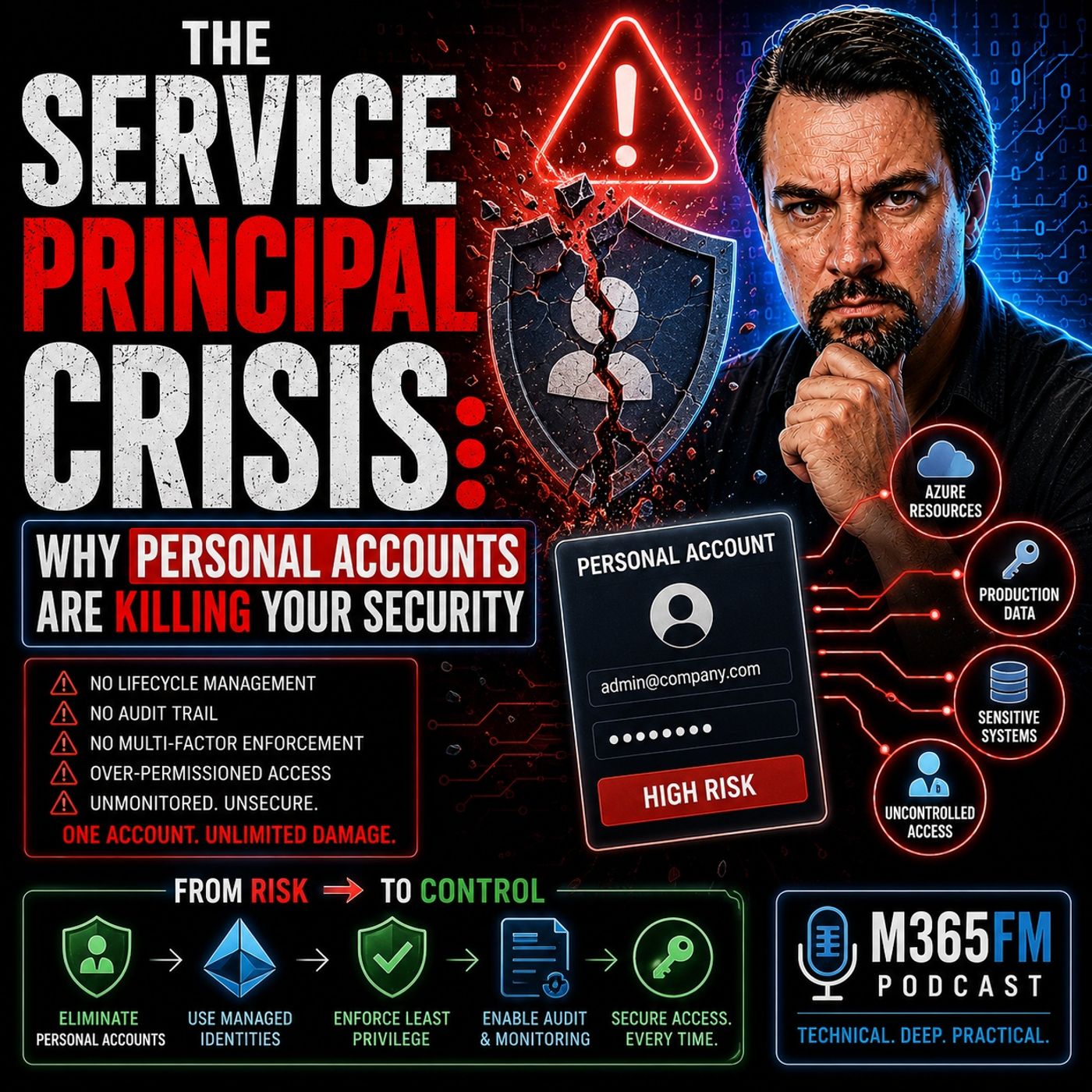
May 12, 2026
Service Principal Security: Stop Using Personal Accounts
Your Microsoft 365 automation environment is probably running on borrowed identity. In this episode of the M365FM Podcast, we expose one of the biggest hidden risks inside modern cloud architecture: enterprise workflows tethered to personal user accounts. It starts innocently enough. An engineer builds a Power Automate flow, connects a Logic App, configures a Power BI refresh, or deploys a SharePoint integration using their own credentials because it is fast and convenient. But the moment that p...